
By Steven Goddard
The quest for the Holy Grail.
I have been looking for a reliable early predictor of September area/extent based on June ice data, and have found it – almost. Previously I established that current extent is a useless predictor, prior to August. The reasons for this are :
- Extent tells you nothing about thickness
- Many areas currently covered with ice, will normally have almost none in September (Hudson Bay, Barents Sea, etc.)
I eliminated the second issue by reducing the region of interest to the area shown in white below. That area corresponds approximately to the maximum extent of September ice in the 30 year NSIDC record.

Then I tried three different metrics to compare June 6 ice parameters vs. September extent and area, for the decade 2000-2009.
The first parameter was June 6 ice area. As expected, this correlated very poorly with September extent and area. The rsq value of June 6 ice area rankings vs September extent rankings is 0.02. The rsq value of June 6 ice area rankings vs September area rankings is 0.07.
The next parameter for comparison was June 6 ice volume (calculated from PIPS) vs September extent. This correlated much better. The rsq value of June 6 ice volume rankings vs September extent rankings is 0.22. The rsq value of June 6 ice volume rankings vs September area rankings is 0.37.

The final parameter for comparison was June 6 average ice thickness (calculated from PIPS) vs September extent. This correlated the best. The rsq value of June 6 average ice thickness rankings vs September extent rankings is 0.28. The rsq value of June 6 average ice thickness rankings vs September area rankings is an excellent 0.65.
So it appears that we have found a reliable predictor of September extent based on June ice thickness, which makes sense from a physical point of view. But it isn’t perfect! The graph and table below show the problem.

Average thickness on June 6, 2010 is 2.55 metres. The table below shows the June 6 rankings for the last 11 years. 2010 is in 7th place, behind 2006 and ahead of 2007, 2003, 2009 and 2008. Average thickness is more than half a metre thicker than 2008.
Date            Average Thickness

6/6/2004        2.95

6/6/2005        2.87

6/6/2001        2.86

6/6/2000        2.84

6/6/2002        2.76

6/6/2006        2.68

6/6/2010        2.55

6/6/2007        2.54

6/6/2003        2.5

6/6/2009        2.17

6/6/2008        1.96
Everything in that table makes sense, except for 2007. Ice thickness in the central Arctic on June 6, 2007 was nearly identical to 2010 and the top year – 2003.
Conclusion : Based on current ice thickness, we should expect September extent/area to come in near the top of the JAXA rankings (near 2003 and 2006.) However, unusual weather conditions like those from the summer of 2007 could dramatically change this. There is no guarantee, because weather is very variable.


No doubt some people are wondering how this can be true, given that extent is currently lowest in the record. The reason (again) is that June extent has almost no correlation with September extent. Imagine an ice cube floating in water. It occupies a much smaller area of water than a ground up ice cube. But which one melts faster? The ground up ice cube will of course melt faster. Having a wide extent in June is not necessarily a good thing, unless the ice is also thick.
Sea surface temperatures continue to run cold in the Northern Pacific. They also are cooling down some in Atlantic.

http://weather.unisys.com/surface/sst_anom.html
Arctic temperatures have been running cold for the last week or so.
From: http://www.esrl.noaa.gov/psd/map/images/fnl/sfctmpmer_01a.fnl.anim.html

http://ocean.dmi.dk/arctic/meant80n.uk.php
There is no indication of melt in the ice off Barrow, with ongoing cold temperatures and the deepest snow of the winter.

http://seaice.alaska.edu/gi/observatories/barrow_sealevel/brw2010/BRW_MBS10_overview_complete.png
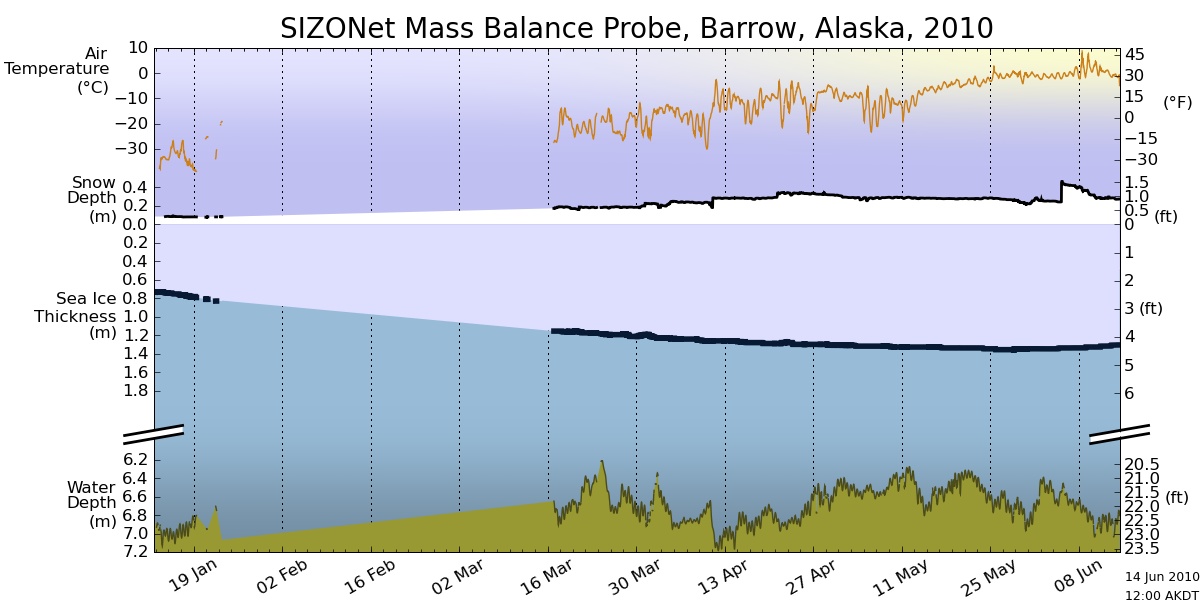
Ice continues to look very concentrated in the Arctic Basin, as seen in this enhanced satellite photo.

http://ice-map.appspot.com/?map=Arc&sat=ter&lvl=7&lat=67.940426&lon=-168.991006&yir=2010&day=149
——————————————–
The disparity between ice indices continues to widen.DMI has 2010 ahead of 2007 and 2008. Other indices have 2010 lower. Given the analysis above, these numbers are relativelymeaningless this early in the summer.

The modified NSIDC graph below shows a comparison of 2010 ice extent vs. 2007. Areas in green have more ice than 2007. Areas in red have less ice.

The modified NSIDC map below shows ice loss since April 5, in red.

The modified NSIDC map shows changes in Arctic ice over the last week, using the same colour scheme.

The modified NSIDC image below shows the current anomaly. Areas in red have less ice than the 30 year mean, and areas in green have more ice.

Arctic temperatures have been running cold for the last week or so.
There’s still more snow on the ground in the Northern Hemisphere than usual.
Comparison of June 5, 2010 to previous years on the same day:
1980 to 2010
http://igloo.atmos.uiuc.edu/cgi-bin/test/print.sh?fm=06&fd=05&fy=1980&sm=06&sd=05&sy=2010
1985 to 2010
http://igloo.atmos.uiuc.edu/cgi-bin/test/print.sh?fm=06&fd=05&fy=1985&sm=06&sd=05&sy=2010
1990 to 2010
http://igloo.atmos.uiuc.edu/cgi-bin/test/print.sh?fm=06&fd=05&fy=1990&sm=06&sd=05&sy=2010
1995 to 2010
http://igloo.atmos.uiuc.edu/cgi-bin/test/print.sh?fm=06&fd=05&fy=1995&sm=06&sd=05&sy=2010
2000 to 2010
http://igloo.atmos.uiuc.edu/cgi-bin/test/print.sh?fm=06&fd=05&fy=2000&sm=06&sd=05&sy=2010
2005 to 2010
unfortunately there is no data available at Cryosphere Today for that date in 2005
http://igloo.atmos.uiuc.edu/cgi-bin/test/print.sh?fm=06&fd=01&fy=2005&sm=06&sd=05&sy=2010
So, I’ll use 2007 instead. That’s ok because 2007 is when this focus on Arctic (North Pole) ice began. And it’s a year Steven Goddard is highlighting too :
http://igloo.atmos.uiuc.edu/cgi-bin/test/print.sh?fm=06&fd=05&fy=2007&sm=06&sd=05&sy=2010
Oddly enough there is more snow on the ground in the Northern Hemisphere in 2007 than 2010 but there is less concentration of Arctic ice in 2007 than 2010. That is the thickness pointed out by Steven Goddard? You can see a noticeable difference in ice in the Barrow, Alaska area and in the Laptev Sea.
It looks like the Atlantic Ocean temperatures are going to be a key in melt this year, as Steven Goddard has pointed out.
———————————————————————————————–
Thanks for these Arctic ice updates! What’s the best science blog in cyberworld? WUWT of course!
rbateman
June 6, 2010 at 3:33 pm
Speaking of Joe Bastardi here’s his latest video blog:
“Latest on GLOBAL Ice, Temps, and Trends”
http://www.accuweather.com/video/90250406001/latrest-on-global-ice-temps-and-trends.asp?channel=vblog_bastardi
Steve,
As I have shown in your previous thread on the arctic ice “The Undeath Spiral”, you are incorrectly calculating average ice thicknesses from the PIPS maps. You need to take into account concentrations to get the right result from PIPS. For example, currently ice is 9% thicker on average than last year, not 18% thicker as you indicate.
Calculating the trend from the annual ice-volume minima from the PIPS 2 data gives an ice loss of 2900 km^3 for the last decade, whereas PIOMAS gives 3400 km^3 for its dataset, quite reasonable agreement.
Minimum ice extent is a tricky parameter to predict, given its dependence on wind and currents. However, I think it’s very likely that this year’s minimum ice volume will be lower than the 2007 value, as calculated by either PIPS or PIOMAS.
In a warming world we should expect less ice in the Arctic. Hoping for more ice, as if this were evidence to disprove AGM, seems like a dead end argument.
Looking at the graphs of annual ice extent I am unconvinced that the summer ice minimum can be predicted with any level of confidence. Wind currents, water currents etc.
In fact this is the weakness of alarmist science – modest correlation, no error bars and a lot of friends pitching in as co-authors.
Rather than year over year predictions I would be interested in decadal predictions of ice extent variation based on some measurable force.
stevengoddard says:
June 6, 2010 at 1:32 pm
Anu,
I take it from your comment that you didn’t read the article.
Sure I read it – I’m interested in your analysis, Steven.
‘Dropping like a rock” is a description, not a prediction. Perhaps you missed the 6/5/10 speedup, after having dropped quickly through the last 7 years plots:
http://www.ijis.iarc.uaf.edu/seaice/extent/AMSRE_Sea_Ice_Extent_L.png
There were record summer minimums in 2002, 2005, 2007 – the “weather” sure is being cooperative to the AGW predictions of less and less Arctic summer sea ice. I wonder if the weather gods will be cooperative again this summer ?
Besides, I don’t make predictions about summer minimums based on data from just one Spring.
I look at this:
http://nsidc.org/images/arcticseaicenews/20091005_Figure3.png
I’m predicting a summer minimum less than that of 2009.
I also think the ice is thinner this year, which will help the summer melt:
http://psc.apl.washington.edu/ArcticSeaiceVolume/images/BPIOMASIceVolumeAnomalyCurrent.png
Concentration is looking pretty spotty along the incoming Atlantic warm currents, too:
http://nsidc.org/data/seaice_index/images/daily_images/N_daily_concentration_hires.png
Less than 2009 – the gauntlet is thrown down.
Ice extent is only a proxy for temperature for temperatures near freezing. The southern ocean gets very cold in Antarctic winter. Direct measurements show that the southern ocean has been warming faster than the global average, while ice extent has been trending up (although without much statistical significance). Thus, Antarctic ice extent is demonstrably a poor proxy for temperature. And of course, the whole point of a proxy is to use it when direct measurements are not available.
I’ve been saying for some time that Steve’s often used PIPS 2.0 data is suspect at best, and so I wanted to give one more example of why this is so . Let’s take a look at the AMSRE sea ice concentration data for June 6, 2010:
http://iup.physik.uni-bremen.de:8084/amsr/arctic_AMSRE_nic.png
For example, if you study this very accurate map, that correlates very well with high resolution satellite photos, you’ll see large areas of open water near Siberia, in the Laptev Sea. Now take a look at this PIPS 2.0 MODEL map for June 6, 2010 (caution you must be running Internet Explorer 4.0 or better to view this site!):)
http://www7320.nrlssc.navy.mil/pips2/archive/retrievepic.html?filetype=Thickness&year=2010&month=6&day=6
In this same area of the Arctic Ocean, running from the Laptev Sea toward the Central Arctic, PIPS 2.0 is showing hardly any open water and a SOLID BLOCK of sea ice with thickness ranging ranging from 2.0 to 2.75 meters. Now, on the AMSRE map, we see in addition to the larger area of open ocean, there is also a fairly good size region of lower sea ice concentration heading into the central Arctic Ocean that falls almost down to the 50% concentration range. PIPS 2.0 totally ignores this data and see it shows a total monolithic block of sea ice. PIPS 2.0 is an OUTDATED model that is totally blind to concentration even though concentration is an important part of total volume. In any model that is trying to accurately predict the September minimum based on volume, it must take into account the conentration (in addition to pressure ridges, etc), for while volume is certainly better than extent only for a predictor, the best predictor is total mass of ice, and therefore, concentration is critical. PIPS 2.0 doesn’t look at concentration very well, however, PIOMAS, using the Los Alamos CICE model data does.
You can study the two maps referenced above to find other big differences, and in doing so it doesn’t take too long to realize that PIPS 2.0 is not very accurate, as the Navy fully realized, and hence developed PIPS 3.0. Unfortunately, PIPS 3.0 versions were so good, and the Arctic so strategically important, that PIP 3.0 model data is mostly classified, but used every day for the safe navigation of the Arctic by ships and submarines. The rest of us will have to wait for CryroSat 2 to start giving out non-military sea ice thickness data later this year…
I am sadly lax for not having previously thanked you for these updates.
Thanks for these updates! 😉
Steve Goddard says:
June 6, 2010 at 2:41 pm
S.E. Hendriksen
Are you suggesting that the ice started melting at minus 8C two weeks ago?
I believe that the minus 8C is taken in the shade?. If so all the ice thats in the sun can melt at that temp because its warmer in the sun.
If the September Volume is above average the CAGW followers will revert to Area. If the Volume and Area are greater then it wil be Extent. If the Volumne and Area and Extent are greater then they will say is is a fluke of weather.
I have been reading most of the ice and temperature articles the last few months, pro and con. It seems like when actual readings are involved, ice and cold are advancing. When models are involved, we have an ice free Arctic!
My take – How do we stop advancing glaciers in the next few years?
I haven’t seen any articles on how we prepare for this inevitability. I hope the advancing ice holds up for a few decades. Even if we burn all our “fossil fuel” at once, it won’t amount to a hill of beans against the impending ice age.
R. Gates
You keep talking about a data set which is not available. I’m having a difficult time seeing the point.
Mark.R
Good luck finding shade in the Arctic!
Please clarify Anu.
Extent, Volume, or Both?
GFW, oceans globally are not warming. There might be some circulation changes that warm parts here and there while other locations cool but the overall average for global oceans has been steady to slightly cooling temperatures. The oceans are not warming.
But when people speak of AGW, they tend to speak of air temperatures as that is what data is usually produced. Sea ice doesn’t form in response to water temperature, it forms in response to air temperature.
Anyhow, it is beside the point that ice extent, particularly ‘15%’ ice extent, is more a function of wind than temperature.
And this just in:
“In parts of southern Sweden this winter’s snow cover lasted longer than in any year since the 1970s or 1980s.
More snow? Albedo? Snow turning to ice in the Arctic? Need I show those references?
I’m still with you, Steve. I see what you see. It will be an interesting summer. 🙂
R. Gates says:
June 6, 2010 at 5:17 pm
……..Unfortunately, PIPS 3.0 versions were so good, and the Arctic so strategically important, that PIP 3.0 model data is mostly classified,………
===============
If the data could have advanced the theory of the “catastrophic” decline of the arctic ice, it would have been declassified. Follow the money.
First, I would like everyone to remember what makes the world go around ”
Money” Global warming is an attempt to create a “World Tax System” . The funds would do nothing but create a ” New World Government”. Which wold be fine as long as you could find lots of HONEST politicians to run it. But we all know that will NEVER happen. I’m also interested in know just how many people out there thing the government would REALLY inform you of a serious threat from an incoming asteroid? I would be inclined to believe a scenario much like what was depicted in the movie “2012”. Seriously, knowing you couldn’t save but a few, what would you do? THEY could be selling seats on the ARK as we speak. Has it occurred to anyone else the nonchalant behavior exibited by world leaders about the economy, the oil spill or the increase of large earthquakes?
crosspatch says:
June 6, 2010 at 6:14 pm
GFW, oceans globally are not warming
________________
Incorrect. Ocean heat content has increased. See:
http://www.nodc.noaa.gov/OC5/3M_HEAT_CONTENT/
______________________
stevengoddard says:
June 6, 2010 at 6:08 pm
R. Gates
You keep talking about a data set which is not available. I’m having a difficult time seeing the point.
___________
The point is PIPS 2.0 is NO’T data, but a model, and a old and inaccurate one at that, and you keep using it to project unsupportable claims as if they are fact, such as sea ice volume increasing 25% etc. You reject more recent volume models such as PIOMAS, which has at least some sort of validation, when you’ve not shown one iota of validation for the dated PIPS 2.0 MODEL. You are projecting a September sea ice minimum on an old model, and passsing it off as the only data available, which is incorrect…
(Sorry if this is repeat post)
stevengoddard says:
June 6, 2010 at 6:08 pm
R. Gates
You keep talking about a data set which is not available. I’m having a difficult time seeing the point.
___________
The point is, you are basing your entire projection on an outdated model. You keep selling the PIPS 2.0 model as if it were actually sea ice thickness data, but it is not. (why would we need CryoSat 2 then?). You reject the model projections from other models, such as PIOMAS, even though those models at least have some validation testing but you’ve not shown how the PIPS 2.0 model has been validated or backtested. PIPS 2.0 has no such validation runs, because it is so inaccurate, yet your entire thesis that we’ll see a higher summer low in September is based on this PIPS 2.0 model, that was abandoned by the Navy for any official use back in 2005 in favor of PIPS 3.0, which is also based on the Los Alamos CICE model, as is PIOMAS. In short, your PIPS 2.0 thesis is based on the very thin ice of an outdated model…
“Amino Acids in Meteorites” mentioned snow cover. I looked for mentions of snow because it occurred to me that the ice cover is likely to melt much more after the snow cover is gone. So it would be interesting to add snow cover in as another factor.
And, looking at NH spring snow cover, I see that 2003 and 2007 snow cover was dramatically different. Unfortunately, 2007 and 2010 are alike. There is plenty of other info on the Global Snow Lab site.
http://climate.rutgers.edu/snowcover/chart_seasonal.php?ui_set=nhland&ui_season=2
R. Gates
The PIPS 2 data seems to correlate very nicely with past behaviour. Why are you so frantic to demonstrate otherwise? September will be here very soon ;^)
R. Gates
June 6, 2010 at 5:17 pm
It’s obvious Arctic ice volume has increased since 2007. Your PIOMAS graph is a model. It does not match reality. It is wrong. I know your ilk hated it to be found out to be poor work. But as is the case with all ‘global warming disaster science’ it is flawed and based on the glass being half empty. The sky is not falling—sorry.
September is coming soon. We will see the minimum then. And it will be confirmed, again, that PIOMAS is wrong.
bubbagyro says:
June 6, 2010 at 6:20 pm
Need I show those references?
Yes, you always need to show references. It might seem redundant but it’s still good to have everyone see where you get your ideas from. You don’t want to be like the global warming ilk who make it difficult to find their sources, or even hide ‘sources’.