A major hurricane could devastate the Houston/Galveston region? Whooda thunk? Thank goodness they consulted the all knowing supercomputer model to figure this fact out: “it could easily have caused $100 billion in damage“.
Or, they could have simply consulted history to arrive at the same conclusion and saved a boatload of money and electricity. Nah, history ain’t sexy, modeling is. Don’t get me wrong, I’m all for hurricane safety preparation, but this didn’t require a multi-university consortium and a supercomputer model to figure out.
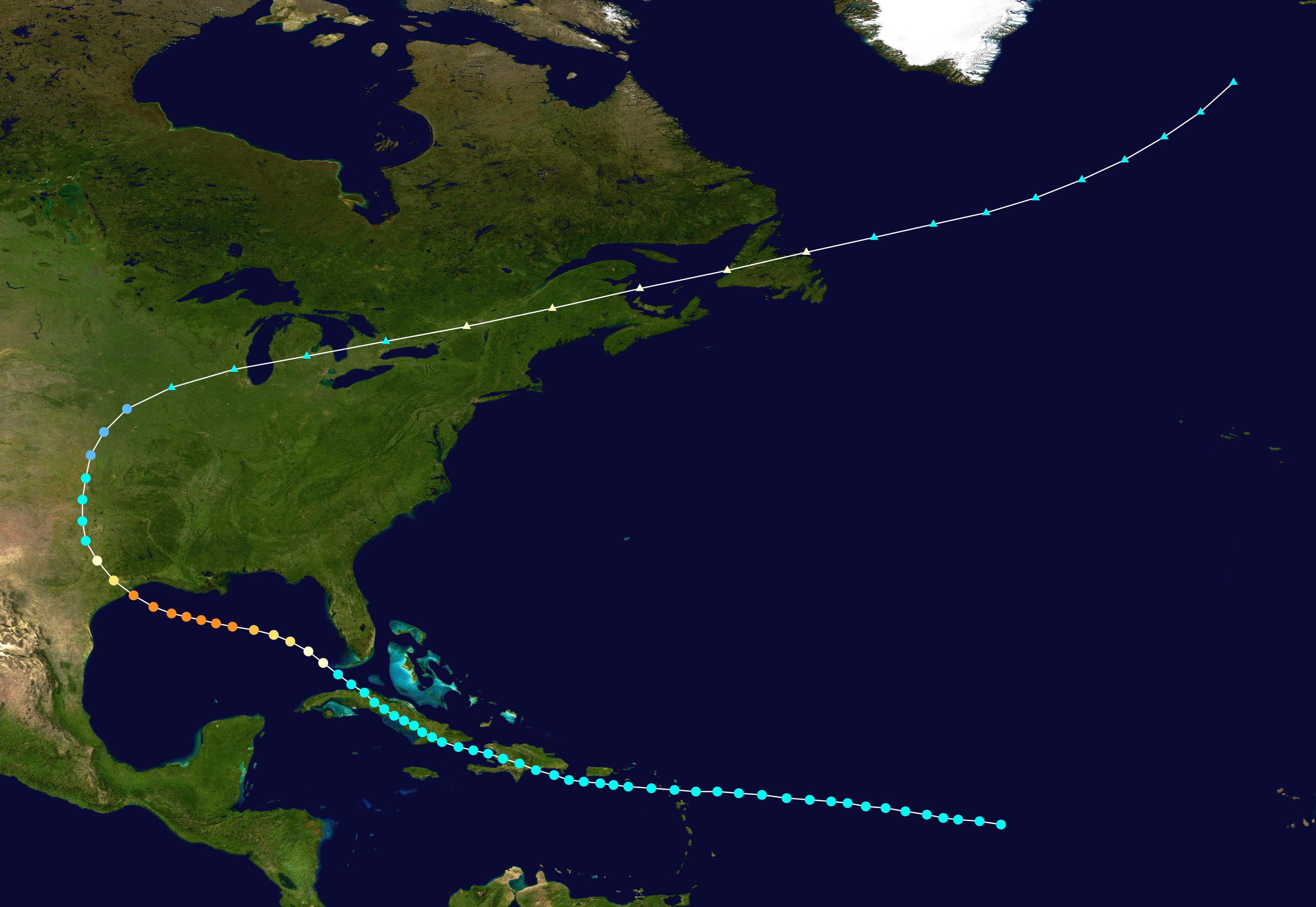


Via press release from Eurekalert. Study: Major hurricane could devastate Houston
Post-Ike study by Rice’s SSPEED Center details vulnerabilities
With the 2010 Atlantic hurricane season less than a week away, a new analysis from experts at several Texas universities is warning that a major hurricane could devastate the Houston/Galveston region. A report issued today by the Rice University-based Severe Storm Prediction, Education and Evacuation from Disasters Center (SSPEED) indicates that even a moderately powerful hurricane could endanger tens of thousands of lives and cripple the Houston Ship Channel, which is home to about one-quarter of U.S. refineries.
SSPEED’s report was unveiled today at the 2010 Coastal Resilience Symposium, a one-day workshop at Rice that brought together regional, national and international experts to discuss how the Houston region can be made more resilient to severe storm impacts.
“There are warning signs across the board,” said SSPEED Director Phil Bedient, Rice’s Herman Brown Professor of Engineering and a co-author of the new report. “Ike was a Category 2 hurricane, and it caused $30 billion in damage. Had that same storm struck 30 miles farther south, it could easily have caused $100 billion in damage. Had it struck that location as a Category 4 storm, like Carla, the results would have been catastrophic.”
The new report comes from an ongoing two-year study commissioned from SSPEED in 2009 by the nonprofit Houston Endowment. SSPEED has assembled a team of more than a dozen leading experts from Rice University, the University of Texas at Austin, Texas A&M University, the University of Houston, Texas Southern University and several other institutions to examine flood risks, evacuation readiness, industrial vulnerability and both structural and nonstructural approaches for mitigating storm impact.
SSPEED’s report indicates:
- Existing dikes and levees along the Houston Ship Channel were barely adequate during Hurricane Ike and would not protect all refineries from the storm surge of a more powerful hurricane or even an Ike-like Category 2 hurricane striking farther south.
- More than 65 percent of water-crossing bridges in the Galveston Bay area may be especially vulnerable to damage from a powerful hurricane like Katrina.
- Highway infrastructure to evacuate the 1 million residents living in evacuation zones today is inadequate, and 500,000 more are expected to move into these zones by 2035.
- There is a “major disconnect” between the level of coastal flooding that would be caused by a major hurricane and the 100-year floodplains that flood insurance is based upon.
Bedient said one need look no further than the Houston Ship Channel to get a clear sense of the region’s vulnerability. The ship channel is home to one of the nation’s busiest ports and about one-quarter of U.S. refineries. The Coast Guard estimates a one-month closure of a major port like Houston would cost the national economy $60 billion.
Despite this, government regulations require dikes and levees that can protect ship channel facilities against only the 100-year flood of 14-15 feet. Bedient said that based upon results from supercomputer models at the University of Texas, Austin, Ike could have caused a 20- to 25-foot storm surge along the ship channel if it had struck about 30 miles farther south.
“Our team is taking an in-depth, scientific look at structural proposals like the Ike Dike and other dike solutions, as well as nonstructural proposals related to land use,” said Rice’s Jim Blackburn, professor in the practice of environmental law and co-author of the new report. “Our work so far has revealed a number of different structural and nonstructural solutions. There are dozens of communities along the coast, and each is unique in some way. We are attempting to identify the most cost-effective and environmentally acceptable methods of providing a basic level of protection, including both structural barriers and nonstructural approaches that take advantage of natural features like barrier islands and storm-surge storage in wetlands.”
Blackburn said SSPEED’s goal is to propose policy options to decision makers at the state, local and federal level with an unbiased assessment of the economic and environmental costs and benefits of all approaches so that an informed decision on the future of the region can be made.
“And make no mistake about it – the solutions that are chosen to deal with this flood-surge problem will determine the landscape of the future for the upper Texas coast,” Blackburn said.
| Saffir-Simpson Hurricane Scale | ||||||
| TD | TS | 1 | 2 | 3 | 4 | 5 |
A 20 to 25 foot storm surge along the Ship Channel and western shore of Galveston Bay would not only exceed $100 billion in repairs but would probably cause a short-term US economic downturn.
The reason, which is not widely known, is that the American petrochemical world is highly interdependent. Supplier A needs supplier B and supplier B needs supplier A. If A is shut down then B cannot run. If B is shut down then A cannot run. Lose them both for a month and exhaust global inventories and it becomes extremely difficult to restart them due to lack of key raw materials.
Also, the industry uses things called cooling towers, which would be flattened in a bad storm. A 1000 cooling towers might be destroyed in the Houston area and take years to rebuild, due to the shortage of expertise. That affects the US economy. If the Big One approaches Houston, short the stock market.
Robert Kral says:
May 28, 2010 at 2:03 pm
Really? Any ten-year old could have predicted that if a Cat 2-4 storm hit New Orleans the last forty years, the devastation would be disastrous. But no one wanted to act on that information and make the Mississippi’s cesspool viable, because it lives to just party down night and day. And, if Galveston and Houston fail to take appropriate action, the devastation there will be comparable.
Major hurricane could devastate (Coastal City).
Now, where’s my grant money?!
What will happen if a hurricane hits the Gulf oil slick? The power comes, IIRC , from the condensation of water vapour which releases latent heat. Will the oil make condensation happen more quickly, releasing the energy in one huge burst? I found a paper last week — 1977 — which showed rapid coalescence of oil polluted droplets in a lab experiment.
Well, at least there’s someone to blame. Sell Amoco, BP, Haliburton….
JF
(My guess is it’ll make it swerve right through 120 degrees.)
Anthony, I strongly suspect it is you missing the point rather than me. Headlining much larger damage potential of a hurricane striking Houston directly versus that experienced by a recent near miss is far afield of climate modeling or of AGW advocacy. Beyond the headline, press release content addresses adequacy of existing infrastructure for coping with a recurring natural phenomenon, and means of mitigating future damage through attention to land-use patterns, etc.
Replace “Hurricane” with “Earthquake” in the press release headline and to me the PR body reads pretty much like what one might expect of a California study of earthquake damage potential and possible mitigation measures.
Also, “Rice University is chartered as a non-profit organization and is owned and governed by a privately-appointed board of trustees.” (http://en.wikipedia.org/wiki/Rice_University)
REPLY: We see the press release and background differently, not worth arguing about, nuff said. A
The funny thing about this prediction is that it actually happened, and very nearly cost us WW2.
I am an oldster who has been through Houston hurricanes since 1949, including several where we were without electricity for several weeks. Nothing surprizing about the flooding. Just remember that the worst we ever had for flooding was from a mere TS that dumped 44 inches in 24 hours. (Alvin – where the weather folks HQed)
But back in August of 1943 Houston was really damaged.Cat2 storm came out of the Gulf and tracked right up the shipchannel. In the process it destroyed the loading docks in Baytown and damaged the refinery, then proceeded on into Houston proper.
Now in ww2 Houston did not produce tanks or ships or planes. It just made the drilling equipment and housed the businesses that produced the oil to make them work. Little known fact, over 25% of all the oil used by the Allies (and that includes the big USSR Caucus fields) came from that small piece of land known as the East Texas Oil Field.
Oil would be produced up there, piped south to Houston (Baytown), refined or just loaded as crude and shipped to New Jersey, and thense to England to stockpile for the invasion. Thus for us ww2 was over until the docks were back.
Wipe out the loading docks and there would be no fuel to fight WW2. Lucky for us it was a small storm and not a big Cat5. We got everything running in a couple months (instead of years with a Cat5) and thus DDay could happen.
If not for the luck of only “small” damage, the Red army would have marched through Germany, and been at Gibralter before before we could get enough fuel for the invasion across the pond.
(The industry planners knew it was a weak strategic link — that was why the heroic effort was made to build the Big Inch pipleline beginning in 1940 that finally reached New Jersey in 1945.)
Why do you not know about this storm. Simple, it was a military secret. Censorship was imposed on the papers, telegraph lines and telephes to keep the rest of the country in total ignorance to the fact that we might lose ww2 (to the Russians). Thus the name for the storm locally. The Hurricane that never was.
As I had said before, this study has nothing to do with science or protecting human life. Its merely a political tool to use fear to push a Marxist agenda. How can anyone give credence to anything authored by this guy?
“Mr. Blackburn is a Houston-based environmental attorney with a practice including toxic torts litigation and community group representation. His work with grassroots organizations has included a variety of cases, ranging from wetland, flooding, dam, hazardous waste, landfill, wastewater and air emission controversies. He has also participated in land use planning and design studies, taught environmental law and planning courses at Rice University and the University of Houston, and helped establish several conservation groups, including the Galveston Bay Foundation and the Matagorda Bay Foundation. Recently, he has written a book about the wonders and protection of the Texas coast, The Book of Texas Bays.”
My look-backs would suggest Florida and the North Caribbean is most at risk this season. Gulf coast hits would be more likely towards Texas and Mexico.
John Baltusi- You said: Really? Any ten-year old could have predicted that if a Cat 2-4 storm hit New Orleans the last forty years, the devastation would be disastrous.
You’re missing my point. Obviously many people recognized the risk of devastating damage if a major hurricane hit New Orleans. However, the politicians responsible for emergency planning and other preparations did not act on this knowledge. There’s no question that the people of New Orleans were very poorly served by their alleged leaders (although they re-elected Ray Nagin, so I have less sympathy for them than I once did). If a document like this had been available at the time, and widely publicized, it might have helped to muster some political will to actually do something.
As noted by another reader, Rice is not a public university though they certainly get thier share of federal grant money.
I see that they held a “workshop” to discuss this. I always thought that a workshop is a place where industrious people make things, not a gathering of the idle and over paid discussing the bleedin’ obvious. Next they will be be telling us the Pope is a Catholic.
So when an inevitably nasty hurricane hits the area one of these days, no doubt these prophetic schmucks will take the credit for saying “we told you so” ?
Me :
“There’s going to be a violent thunderstorm in the New York region sometime this summer.”
3 months later :
I told you so.
Just send my cheque in the mail, thank you and have a nice day.
Perhaps when they have weatherproofed Galveston they could have a look at remedial action for the San Andreas Fault. Must be a university in Los Angeles that could do with some grant money.
Pascvaks says:
May 28, 2010 at 10:14 am
“…. It seems very apparent, during these days of severe economic disruption and excessive government borrowing and soon to be horrendous taxation, that we can do ourselves an awful lot of good by eliminating an awful lot of government studies and other very wasteful give-aways. Hummmmm… wonder if it would be only just that easy?….”
__________________________________________________________________________
You forgot one tiny but very important point.
100% of my US tax dollars go to pay interest on the fiat (fake) money the banks “loaned” (printed) for the US government. Those same bankers OWN the politicians. If they did not we would have thrown the Federal Reserve Banks under the bus in 1933. Instead Congressman McFadden was assassinated and the US government confiscated private citizens gold and give it to the banks . Citizens got drab looking pieces of paper and eternal serfdom in exchange.
On May 23, 1933, Congressman, Louis T. McFadden, brought formal charges against the Board of Governors of the Federal Reserve Bank system, The Comptroller of the Currency and the Secretary of United States Treasury for numerous criminal acts, including but not limited to, CONSPIRACY, FRAUD, UNLAWFUL CONVERSION, AND TREASON.
The petition for Articles of Impeachment was thereafter referred to the Judiciary Committee and has YET TO BE ACTED ON.
Congressman McFadden on the Federal Reserve Corporation Remarks in Congress, 1934 text
“…”Mr. Chairman, we have in this Country one of the most corrupt institutions the world has ever known. I refer to the Federal Reserve Board and the Federal Reserve Banks, hereinafter called the Fed. The Fed has cheated the Government of these United States and the people of the United States out of enough money to pay the Nation’s debt. The depredations and iniquities of the Fed has cost enough money to pay the National debt several times over.
Congressman McFadden’s Speech On the Federal Reserve Corporation made on the Floor of the House of Representatives
“This evil institution has impoverished and ruined the people of these United States, has bankrupted itself, and has practically bankrupted our Government. It has done this through the defects of the law under which it operates, through the maladministration of that law by the Fed and through the corrupt practices of the moneyed vultures who control it.
This evil institution has impoverished and ruined the people of these United States, has bankrupted itself, and has practically bankrupted our Government. It has done this through the defects of the law under which it operates, through the maladministration of that law by the Fed and through the corrupt practices of the moneyed vultures who control it…
“Some people who think that the Federal Reserve Banks United States Government institutions. They are private monopolies which prey upon the people of these United States for the benefit of themselves and their foreign customers; foreign and domestic speculators and swindlers; and rich and predatory money lender.
“The United States has been ransacked and pillaged. Our structures have been gutted and only the walls are left standing. While being perpetrated, everything the world would rake up to sell us was brought in here at our expense by the Fed until our markets were swamped with unneeded and unwanted imported goods priced far above their value and make to equal the dollar volume of our honest exports, and to kill or reduce our favorite balance of trade. As Agents of the foreign central banks the Fed try by every means in their power to reduce our favorable balance of trade. They act for their foreign principal and they accept fees from foreigners for acting against the best interests of these United States. Naturally there has been great competition among among foreigners for the favors of the Fed….”
Gee sounds familiar doesn’t it?
McFadden’s Speech is well worth a read. We should send it to ALL politicians were a central bank is in control (most countries) Unfortunately with the establishment of the international Financial Stability Board it may already be too late.
“The Financial Stability Board (FSB) has been established to address vulnerabilities and to develop and implement strong regulatory, supervisory and other policies in the interest of financial stability. http://www.financialstabilityboard.org/
Obama has already signed over control of the USA to this board. As well as doubling the US money supply (printing lots of money thereby halving the worth of your labor) The financial types figure there could be some major fallout from this idiotic move. See A Dollar Collapse for a fairly balanced look at the situation.
Oh, yes do not forget that Maurice Strong, father of CAGW is a senior advisor to the World Bank.
@Enneagram says:
May 28, 2010 at 9:52 am
Didn’t the three little pigs figure that out a long time ago?
I’m not sure why WUWT is against attempts to providing policymakers with accurate information. Geography makes different coastal areas more or less sensitive to flooding from storm surge and rainfall. Hurricane Ike demonstated what a Category 2 storm does when it hits modern-day Houston dead on. (Since storm surge is worst to the right of the hurricane’s path, a path slightly to the left of Houston would have been worse.) Scientists can now show policymakers that they have models capable of accurately predicting the local areas to be flooded by hurricanes striking Texas at varying locations with varying intensity (and serious computing power makes predictions more accurate). Given the long historical record of hurricanes striking Texas, it should be possible to estimate that Houston will see another Ike every X years, an Enhanced-Ike every Y years, and a Super-Ike every Z years. Everyone knows that Galveston (or Key West or Cape Hatteras) is a dangerous place to be during a hurricane, but the danger to New Orleans was mostly hypothetical before Katrina. When policymakers don’t know whether the probability of disastrous hurricane damage is once every 25 years or once every 250 years, the are unlikely to take action unless they have recently experienced a disaster. Was Katrina a once-every-25-years event that New Orleans was lucky enough to miss for more than a century or a once-every-250-years event? I’d certainly spend a lot more money trying to avoid the former.