A major hurricane could devastate the Houston/Galveston region? Whooda thunk? Thank goodness they consulted the all knowing supercomputer model to figure this fact out: “it could easily have caused $100 billion in damage“.
Or, they could have simply consulted history to arrive at the same conclusion and saved a boatload of money and electricity. Nah, history ain’t sexy, modeling is. Don’t get me wrong, I’m all for hurricane safety preparation, but this didn’t require a multi-university consortium and a supercomputer model to figure out.
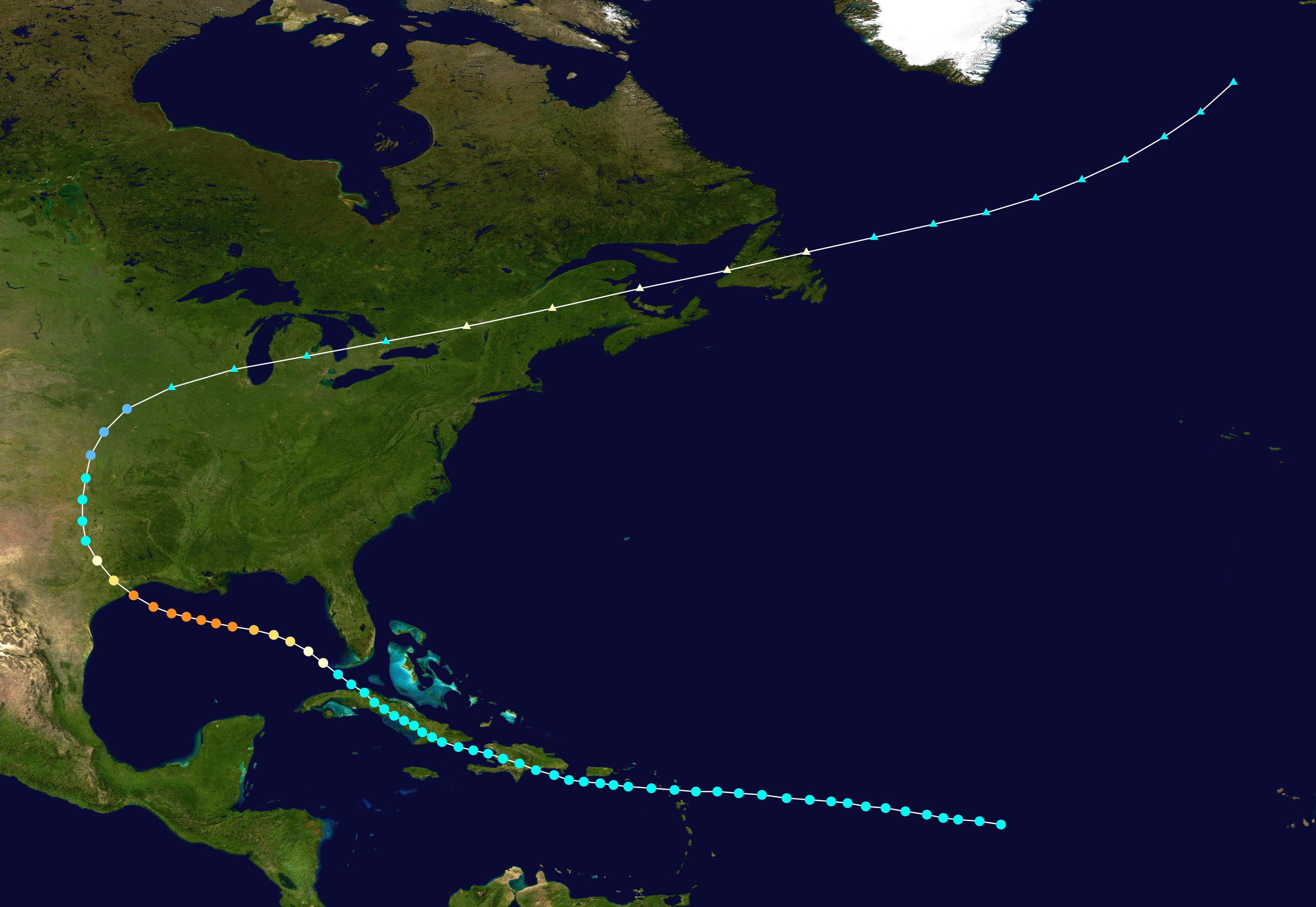


Via press release from Eurekalert. Study: Major hurricane could devastate Houston
Post-Ike study by Rice’s SSPEED Center details vulnerabilities
With the 2010 Atlantic hurricane season less than a week away, a new analysis from experts at several Texas universities is warning that a major hurricane could devastate the Houston/Galveston region. A report issued today by the Rice University-based Severe Storm Prediction, Education and Evacuation from Disasters Center (SSPEED) indicates that even a moderately powerful hurricane could endanger tens of thousands of lives and cripple the Houston Ship Channel, which is home to about one-quarter of U.S. refineries.
SSPEED’s report was unveiled today at the 2010 Coastal Resilience Symposium, a one-day workshop at Rice that brought together regional, national and international experts to discuss how the Houston region can be made more resilient to severe storm impacts.
“There are warning signs across the board,” said SSPEED Director Phil Bedient, Rice’s Herman Brown Professor of Engineering and a co-author of the new report. “Ike was a Category 2 hurricane, and it caused $30 billion in damage. Had that same storm struck 30 miles farther south, it could easily have caused $100 billion in damage. Had it struck that location as a Category 4 storm, like Carla, the results would have been catastrophic.”
The new report comes from an ongoing two-year study commissioned from SSPEED in 2009 by the nonprofit Houston Endowment. SSPEED has assembled a team of more than a dozen leading experts from Rice University, the University of Texas at Austin, Texas A&M University, the University of Houston, Texas Southern University and several other institutions to examine flood risks, evacuation readiness, industrial vulnerability and both structural and nonstructural approaches for mitigating storm impact.
SSPEED’s report indicates:
- Existing dikes and levees along the Houston Ship Channel were barely adequate during Hurricane Ike and would not protect all refineries from the storm surge of a more powerful hurricane or even an Ike-like Category 2 hurricane striking farther south.
- More than 65 percent of water-crossing bridges in the Galveston Bay area may be especially vulnerable to damage from a powerful hurricane like Katrina.
- Highway infrastructure to evacuate the 1 million residents living in evacuation zones today is inadequate, and 500,000 more are expected to move into these zones by 2035.
- There is a “major disconnect” between the level of coastal flooding that would be caused by a major hurricane and the 100-year floodplains that flood insurance is based upon.
Bedient said one need look no further than the Houston Ship Channel to get a clear sense of the region’s vulnerability. The ship channel is home to one of the nation’s busiest ports and about one-quarter of U.S. refineries. The Coast Guard estimates a one-month closure of a major port like Houston would cost the national economy $60 billion.
Despite this, government regulations require dikes and levees that can protect ship channel facilities against only the 100-year flood of 14-15 feet. Bedient said that based upon results from supercomputer models at the University of Texas, Austin, Ike could have caused a 20- to 25-foot storm surge along the ship channel if it had struck about 30 miles farther south.
“Our team is taking an in-depth, scientific look at structural proposals like the Ike Dike and other dike solutions, as well as nonstructural proposals related to land use,” said Rice’s Jim Blackburn, professor in the practice of environmental law and co-author of the new report. “Our work so far has revealed a number of different structural and nonstructural solutions. There are dozens of communities along the coast, and each is unique in some way. We are attempting to identify the most cost-effective and environmentally acceptable methods of providing a basic level of protection, including both structural barriers and nonstructural approaches that take advantage of natural features like barrier islands and storm-surge storage in wetlands.”
Blackburn said SSPEED’s goal is to propose policy options to decision makers at the state, local and federal level with an unbiased assessment of the economic and environmental costs and benefits of all approaches so that an informed decision on the future of the region can be made.
“And make no mistake about it – the solutions that are chosen to deal with this flood-surge problem will determine the landscape of the future for the upper Texas coast,” Blackburn said.
| Saffir-Simpson Hurricane Scale | ||||||
| TD | TS | 1 | 2 | 3 | 4 | 5 |
Discover more from Watts Up With That?
Subscribe to get the latest posts sent to your email.
Let’s have some “linear fit fun” with the top ten hurricane hits just the like warmists do with their trendlines:
Using a bin size of 22 years, I get the following numbers ($billions in 2005):
1900-1921 = 167.4
1922-1943 = 229.8
1944-1965 = 65.5
1966-1987 = 21.2
1988-2009 = 136.8
That gives a slope of -1.22 $bil/yr, so obviously storm damage must be going down, disproving that claim of CAGW! (Note, using a bin size of 10 yrs and starting with 1900, the slope is -0.71 $bil/yr). The 95% confidence interval crosses into positive values, but who cares, LOL!
In all seriousness though, here’s some “hard evidence” to use against those that claim Katrina was caused by CAGW.
-Scott
My response to this news is “No shet!” It takes millions to take a firm grasp of the obvious?
How to avoid problems like this in the future.
Step 1. Evacuate the faculty from all major universities NOW before its too late.
Step 2. Replace them with non-idiots.
Step 3. Act prudently, relax. You are in no more danger than you were before the study wasted so much money.
First time poster. Long time admirer…
I agree with Robert Kral. Why pick on this study?
This from the press release: “Our team is taking an in-depth, scientific look at structural proposals like the Ike Dike and other dike solutions, as well as nonstructural proposals related to land use,” …
Do we not want to inventory our vulnerabilities? Can a model not provide some engineering guidance?
REPLY: As I said in the lead in, I’m all for hurricane safety, but when you headline via press release something coming out of a computer model that is already a known i.e. “100 billion for a hit on Houston” it deserves some ribbing. -A
Issac’s Storm was a good read. Especially the part where the Cubans in Havana had a better sense of the hurricane than the Americans, after all they had been in the Hurricane business a lot longer.
Off Topic: Anthony, I couldn’t get your tips section to work so here goes:
I am in no way qualified to evaluate this article or its supporting documents but I’ve read it and find it very, VERY interesting. Particularily some of the references. So I’m passing it on so that more educated eyes than mine can check it out. Concerns NASA and their black body calculations and thermodynamic assumptios.
http://climaterealists.com/?id=5783
Did I miss something? Where does it talk about modelling and supercomputers?
REPLY: yes you did, here’s the connection -A
Ike was a Category 2 hurricane, and it caused $30 billion in damage. Had that same storm struck 30 miles farther south, it could easily have caused $100 billion in damage.
Bedient said that based upon results from supercomputer models at the University of Texas, Austin, Ike could have caused a 20- to 25-foot storm surge along the ship channel if it had struck about 30 miles farther south.
Does a hurricane generate weight?
It does push water ahead of it, so gravity must pull down on it.
There was a very good book written about it.
It was interesting to read, in these days of “tsunami” fixated weather forecasters,
that although most of the deaths were by water, there was never a tidal wave.
The book relates how, in the teeth of the high winds, the sea water just slowly rose, and rose, and rose….until it was past the first floors of houses.
The Wiki report gives a pointer to this when it says there was extended periods of Easterly winds, which of course could well cause a sea water rise.
Climate change may raise sea levels 16 inches in a hundred years. We are told we need to spend trillions to stop this danger. New York City’s mayor and Senators agree. A Category 2 hurricane that hit NYC in 1893 sent a 30 foot storm surge- at low tide- across Brooklyn and Queens. How much are we spending on infrastructure improvements to get ready for the next one? Next to nothing. When is the next one- NOAA says we are due for a Cat 3. The last Cat 3 hit western Long Island in 1938 fortunately it was sparsely populated at the time as the storm surge washed across it.
A Cat 3 storm once passing Hatteras (due to some weather/hydrodynamic factors I don’t understand) picks up tremendous forward speed that can exceed 60 miles an hour. This forward speed when added to the wind speed makes a northeast hurricane pack more punch per category. The forward speed also makes evacuation of the City practically impossible. Skyscrapers make hurricanes more problematic as wind speeds are twice ground speed at 30 stories. The concern is that as some of the older windows are “sucked out” of their frames- flying office furniture will start a chain reaction of raining glass. And the scenarios just get worse. The NYC hurricane plan is basically an admission we’re screwed.
If New York elected officials do nothing about this near term and more probable threat- why should I believe them when they want to spend us into oblivion to protect us from a threat 100 years from now?
WOW. Just what in the PR suggests AGW advocacy behind the study. I see no claim the study modeled changing likelihood of hurricane strike location or storm severity. Nor do I see any basis for inference the study was funded with tax dollars.
From the press release,
<
The new report comes from an ongoing two-year study commissioned from SSPEED in 2009 by the nonprofit Houston Endowment. SSPEED has assembled a team of more than a dozen leading experts from Rice University, the University of Texas at Austin, Texas A&M University, the University of Houston, Texas Southern University and several other institutions to examine flood risks, evacuation readiness, industrial vulnerability and both structural and nonstructural approaches for mitigating storm impact.
<
From http://en.wikipedia.org/wiki/Houston_Endowment_Inc.,
<
Houston Endowment Inc. was founded in 1937 by Jesse H. Jones and Mary Gibbs Jones as an extension of their personal philanthropy to help establish institutions and organizations that help facilitate the growth of Houston and develop its people. It was the principal beneficiary of Jesse and Mary Jones' estates after their deaths.
<
And, the study objective(s) were stated clearly in the press release.
<
Blackburn said SSPEED's goal is to propose policy options to decision makers at the state, local and federal level with an unbiased assessment of the economic and environmental costs and benefits of all approaches so that an informed decision on the future of the region can be made.
<
REPLY: Well you missed the point, if you headline a press release with “Houston could be devastated by major hurricane” doesn’t that scream of overstating the obvious to you? And, last time I checked, the listed “Rice University, the University of Texas at Austin, Texas A&M University, the University of Houston, Texas Southern University and several other institutions” are publicly funded. I’m sure the use of these facilities and staff qualify for publix use of tax dollars. Now if the PR said it was done entirely by the non profit NGO, that would be clearly not connected to publicly funded facilities in any way.
The whole point is the ridiculously obvious headline and overstating the obvious using a computer model to determine what is already known from history, but you miss that. – A
Not exactly a major prediction. If they told me that a major hurricane could devastate say for example Pittsburgh…….and it happened, I’d be all in for modeling.
“results from supercomputer models at the University of Texas, Austin, Ike could have caused a 20- to 25-foot storm surge along the ship channel”
Well, that’s just routine CFD analysis of coastal structures – probably just from a published paper. I can’t see any indication that this report is based on modelling or supercomputers. Not that there’s anything wrong with that, of course.
REPLY: There’s plenty wrong with it when it wastes taxpayer money to produce a result so obvious and with historical precedent that you can find the exact same damage number on Wikipedia for a hurricane in the past. But you can’t see that, like you couldn’t see the words modeling and supercomputer at first. -A
This is part of the media setting the American people up for a Global Warming scare. Houston/Galveston has always been set for devastation from a hurricane. Ask the people in 1900. If you read this story http://wp.me/pduTk-2G4 then you see a collection of headlines relating to hurricane forecasts. They all scream that it could be the worst ever when NONE of the forecasts actually says any such thing. They made it up. They also do not let the public know that forecasts for other tropical basins near Australia, the NW Pacific and the Eastern Pacific are for average or below average activity. Maybe the best part is the reference to the public policy think tank that used a monkey to make a forecast to illustrate just how little humans know about the climate of the earth and that any long term forecasts of any type should be held with some skepticism. Either the media is dumb, ill-informed or deliberately trying to create news that is not there.
The people living in Houston/Galveston are already fully aware of the risk of further hurricanes and I’m sure most of the sensible ones monitor the warnings and exit stage left quickly when events dictate. I’ve got a friend who lives in a town on the flank of Vesuvius, and he never lets the tank on his 4X4 get less than 1/2 empty and has a case ready packed with his personal stuff, ready for if the worst should happen.
People all over the world live in situations where life threatening situations are probable, and I don’t think they need the output of a model running on a supercomputer to tell them of the risk. Common sense is all that’s needed!
Yep, another study released in order to justify the funding.
I hope it wasn’t my money.
Stimulus money?
Never mind, that’s my money too.
Regarding 100 year floodplain vs storm surge levels for flood insurance I seem to recall people with flood insurance fighting insurance companies in Mississippi after Katrina. The insurance companies claimed the storm surge was not “rising water” and therefor denied the claims. Not sure how that fight ended.
I have two brothers in Houston, they made it through Ike, by staying put. They looked at the traffic in the evacuation and just got another blanket out of the closet just in case — And sat with the flashlights and radio. They said, near every glass window downtown, popped out onto the streets.
The big problem was evacuation, I think it was something like 60 people died in car crashes trying to run away.
Hey a major hurricane would make a hell of a mess up here in San Francisco Bay too; so who cares about Galveston.
Gee these people are dumber than a box of rocks; what do you think a cat five slamming right into New Orleans would do right now; wouldn’t that be a mess too ?
The inmates are running the asylum; I believe In Germany, they call it a “Crankenhaus.” Sounds about par for the course to me. I actually drove past a Crankenhaus on my one trip to Germany (Bavaria).
Golly; I wonder if that is supposed to be Krankenhaus. Well take your pick. I’m not much good at this.
Krankenhaus has a better ring to it. Must amend my previous post on storm surge. After taking a quick look back the debate was over wind damage vs storm surge damage. Claimants (who did not have flood insurance) were told the damage was from flooding – not wind. Homeowners argued that the wind caused the flooding (storm surge). The insurance agents told them (alledgedly) they did not need federal flood insurance because they were not in the 100 year floodplain. The houses were destroyed by the storm and the wind pushed the water so it is debatable.
Anthony,
I had been looking for some indication that “A major hurricane could devastate the Houston/Galveston region? Whooda thunk? Thank goodness they consulted the all knowing supercomputer model to figure this fact out”. There was none. I missed that they had looked up a paper which used modelling to predict the size of waves on the Houston Ship Channel.
And funding from Houston Endowment Inc is no more taxpayers money than, say, from the Heartland Institute.
REPLY: Perhaps, but the universities that did the work are publicly funded. If the Houston Endowment did all the work themselves, then there would be no use of public “anything”.
Point is, money was spent, public facilities and staff were used, and all they had to show for it was a study that overstates the already blindingly obvious. If Heartland funded something and the resulting headline was equally silly, you’d be having a cow. So chill dude, enjoy the weekend, embrace your wrongness. 😉 -A
When I lived in Houston, a three inch rain could result in flooding in some parts. If a tropical storm dropped 12 to 24 inches of water, we were in big trouble. Almost any direct hit from a significant hurricane would be catastrophic.
My question is why do Texas officials not protect the ship channel area better. We all knew what storm surges could do, but there’s not a lot they can do about flooding due to rainfall. The terrain is as flat as a pancake, and water has almost no place to go. If streams and rivers are backed up with a storm surge, you would have a wading pool of several hundred square miles.
It looks to me that the reason for so many universities to participate is because of Texas politics. With a study involving Houston you have to include the University of Houston, Rice, and Texas Southern, all headquartered in Houston.
Plus, everybody knows that you can’t have an engineering study in Texas without the aggies from A&M doing their thing. So, how did the Univ of Texas get involved being located a hundred miles away, all snug and secure in the liberal environs of the hill country?
It is kinda like the Alabama song, “If you are going to play in Texas, you gotta have a fiddle in the band”. You can’t have a respectable study without a super-computer, and UT has one.
It’s only money, and all that academic talent has to be fed.
“SSPEED has assembled a team of more than a dozen leading experts from Rice University, the University of Texas at Austin, Texas A&M University, the University of Houston, Texas Southern University and several other institutions…”
====================
It’s a “consensus”, if a Category 4 or 5 hurricane hits Houston/Galveston the best place to be is, somewhere else.
Everybody already knew, that.
Lowering CO2 will make them go away, right?
Using a little Roger Piekle data on hurricanes….the costliest hurricane to make landfall in Texas is about $99.4 billion. 95% of all Texas hurricanes caused less than $25.4 Billion and a most likely case of $424 million. So, $100 billion sounds like a pretty big number. Gotta scare up some funding some how.