A major hurricane could devastate the Houston/Galveston region? Whooda thunk? Thank goodness they consulted the all knowing supercomputer model to figure this fact out: “it could easily have caused $100 billion in damage“.
Or, they could have simply consulted history to arrive at the same conclusion and saved a boatload of money and electricity. Nah, history ain’t sexy, modeling is. Don’t get me wrong, I’m all for hurricane safety preparation, but this didn’t require a multi-university consortium and a supercomputer model to figure out.
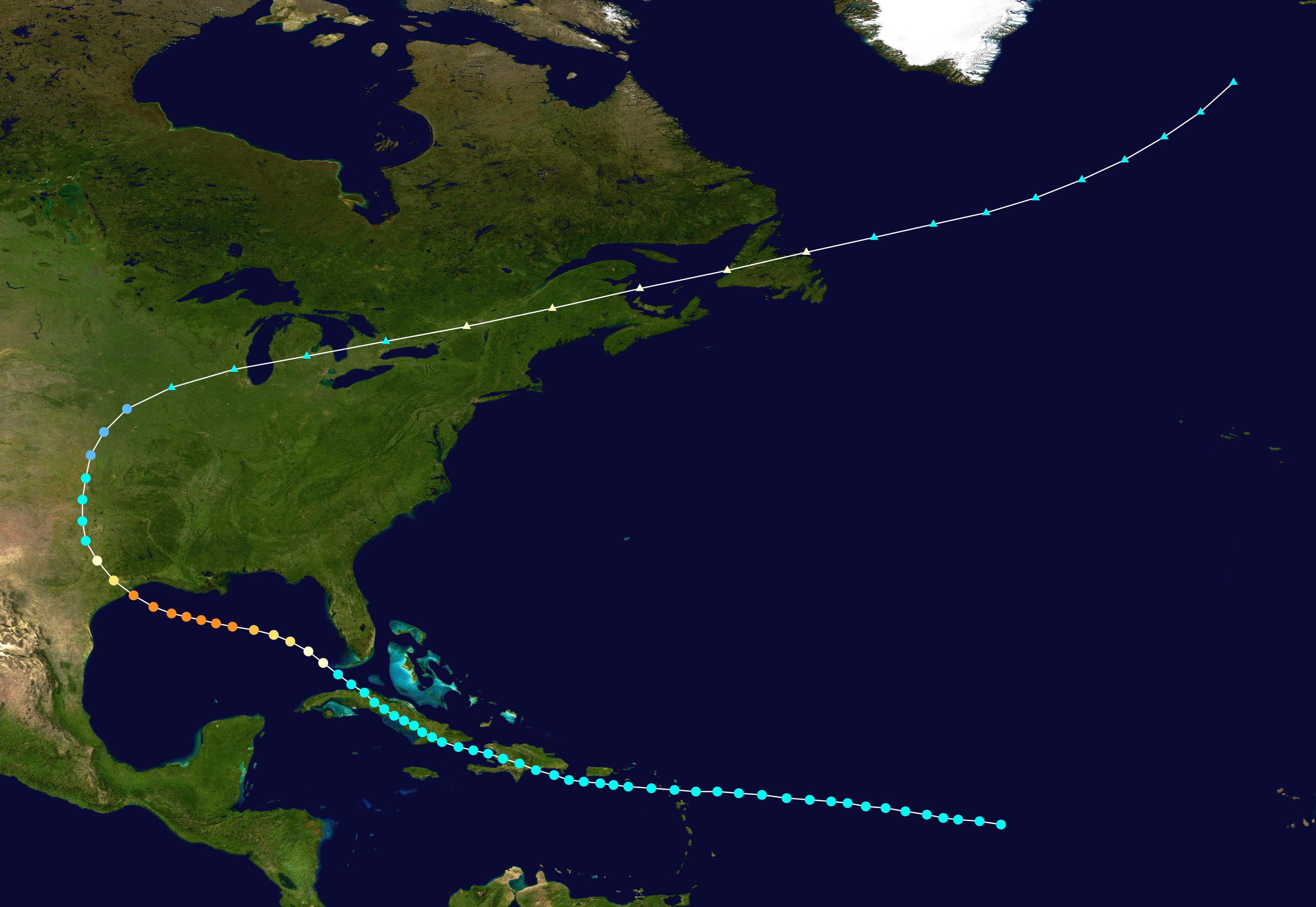


Via press release from Eurekalert. Study: Major hurricane could devastate Houston
Post-Ike study by Rice’s SSPEED Center details vulnerabilities
With the 2010 Atlantic hurricane season less than a week away, a new analysis from experts at several Texas universities is warning that a major hurricane could devastate the Houston/Galveston region. A report issued today by the Rice University-based Severe Storm Prediction, Education and Evacuation from Disasters Center (SSPEED) indicates that even a moderately powerful hurricane could endanger tens of thousands of lives and cripple the Houston Ship Channel, which is home to about one-quarter of U.S. refineries.
SSPEED’s report was unveiled today at the 2010 Coastal Resilience Symposium, a one-day workshop at Rice that brought together regional, national and international experts to discuss how the Houston region can be made more resilient to severe storm impacts.
“There are warning signs across the board,” said SSPEED Director Phil Bedient, Rice’s Herman Brown Professor of Engineering and a co-author of the new report. “Ike was a Category 2 hurricane, and it caused $30 billion in damage. Had that same storm struck 30 miles farther south, it could easily have caused $100 billion in damage. Had it struck that location as a Category 4 storm, like Carla, the results would have been catastrophic.”
The new report comes from an ongoing two-year study commissioned from SSPEED in 2009 by the nonprofit Houston Endowment. SSPEED has assembled a team of more than a dozen leading experts from Rice University, the University of Texas at Austin, Texas A&M University, the University of Houston, Texas Southern University and several other institutions to examine flood risks, evacuation readiness, industrial vulnerability and both structural and nonstructural approaches for mitigating storm impact.
SSPEED’s report indicates:
- Existing dikes and levees along the Houston Ship Channel were barely adequate during Hurricane Ike and would not protect all refineries from the storm surge of a more powerful hurricane or even an Ike-like Category 2 hurricane striking farther south.
- More than 65 percent of water-crossing bridges in the Galveston Bay area may be especially vulnerable to damage from a powerful hurricane like Katrina.
- Highway infrastructure to evacuate the 1 million residents living in evacuation zones today is inadequate, and 500,000 more are expected to move into these zones by 2035.
- There is a “major disconnect” between the level of coastal flooding that would be caused by a major hurricane and the 100-year floodplains that flood insurance is based upon.
Bedient said one need look no further than the Houston Ship Channel to get a clear sense of the region’s vulnerability. The ship channel is home to one of the nation’s busiest ports and about one-quarter of U.S. refineries. The Coast Guard estimates a one-month closure of a major port like Houston would cost the national economy $60 billion.
Despite this, government regulations require dikes and levees that can protect ship channel facilities against only the 100-year flood of 14-15 feet. Bedient said that based upon results from supercomputer models at the University of Texas, Austin, Ike could have caused a 20- to 25-foot storm surge along the ship channel if it had struck about 30 miles farther south.
“Our team is taking an in-depth, scientific look at structural proposals like the Ike Dike and other dike solutions, as well as nonstructural proposals related to land use,” said Rice’s Jim Blackburn, professor in the practice of environmental law and co-author of the new report. “Our work so far has revealed a number of different structural and nonstructural solutions. There are dozens of communities along the coast, and each is unique in some way. We are attempting to identify the most cost-effective and environmentally acceptable methods of providing a basic level of protection, including both structural barriers and nonstructural approaches that take advantage of natural features like barrier islands and storm-surge storage in wetlands.”
Blackburn said SSPEED’s goal is to propose policy options to decision makers at the state, local and federal level with an unbiased assessment of the economic and environmental costs and benefits of all approaches so that an informed decision on the future of the region can be made.
“And make no mistake about it – the solutions that are chosen to deal with this flood-surge problem will determine the landscape of the future for the upper Texas coast,” Blackburn said.
| Saffir-Simpson Hurricane Scale | ||||||
| TD | TS | 1 | 2 | 3 | 4 | 5 |
Silly.
Living here in Houston for the last 16 years, it’s pretty apparent that a hurricane can cause major damage. No power for 10 days after Ike two years ago seems to be more of an indicator than the modeling. Why does one need a model to tell you this? Just remembering the tropical storms (pretty large loss of life as well in 2001) and hurricanes on the gulf coast since I’ve been here says enough.
Really, nothing more than more scare tactics about how ‘hot’ the sea surface temperature is and how global warming will crush Houston. I’m more concerned about the oil that will be pushed up WAY on shore during a tropical storm at this point, then the storm itself.
Jerry
good to know that the study dollars are protecting ourt interests…..
These areas are extraordinarily unprepared for a major Hurricane. That is when you will see the 500 year flood zone stressed as well as the complete inadequacy of building codes and architectural design. Those glass towers will turn into death. And it is not just Houston. Honolulu will be in exactly the same fix.
Those who forget the past…
Meanwhile experts predict that there may or may not be a serious earthquake somewhere in the world soon or possibly in the distant future, probably in or very near an earthquake zone but possibly elsewhere.
Rain is also forecast for the UK.
Why are we in for a very active hurricane season? Check out Scott Sabol’s World of Weather and Science for the complete analysis:
http://sabolscience.blogspot.com
I lived in Houston when Gilbert was supposed to hit in 1988. It was the second most intense hurricane on record after Wilma, and was almost 1000km in diameter. The NHC center had Houston right in the path of the eye, but it diverted to the west. Neil Frank was very excited at the time ;^)
http://en.wikipedia.org/wiki/Hurricane_Gilbert
Just knew there had to be some Aggies involved. I hope Texas Tech didn’t have anything to do with it. My daughter starts there in the fall.
“but this didn’t require a multi-university consortium and a supercomputer model to figure out.”
Not to mention copious amounts of grant money. Appalling to see funds frittered away on this kind of nonsense that could be applied to a multitude of other areas to better scientific understanding.
Time for them to focus on Part 2 of their study: Category 3 or higher Hurricane could devastate Louisiana and Mississippi.
“Ike was a Category 2 hurricane, and it caused $30 billion in damage.”
Yes, Ike was a cat 2, but it was a strong cat 2, just barely below cat 3. But you have to look past the wind speeds. Ike was massive, and had a lot of energy. After Ike, many hurricane experts started proposing updates to the Saffir-Simpson scale because they didn’t feel it adequately reflected Ike’s true power.
My point is that it’s possible for storms to be more powerful than Ike, but not by very much. And Houston survived Ike quite well (the parts of Galveston not protected by the seawall is another story). After going through Ike, I’m not as concerned about hurricanes as I used to be. You leave, you come back, you live without electricity for awhile, you fix everything and then get on with your life. I don’t expect Houston to be “devastated” during my lifetime.
So what?…That’s life!
If you would build with concrete there would be no problem but also no business for the insurance companies and wooden house builders. So enjoy it!
Take a look at the historical hurricane tracks vs. population density on the Texas Gulf coast. Hurricanes NEVER hit unpopulated areas. A study of this phenomenon might yield some useful results. And confirm UHI.
1919 Indianola was unpopulated afterwards, but that don’t count.
Just sayin’.
“■There is a “major disconnect” between the level of coastal flooding that would be caused by a major hurricane and the 100-year floodplains that flood insurance is based upon.”
Houston, YOU have a problem. A massive increase in insurance rates may be the biggest impact of this study
I really think that there are things more devasting than hurricanes: Green Policies.
OT but at least one politician may have her head screwed on straight or, perhaps, has listened to some voters instead of the usual crowd of alarmists!
“Connecticut governor vetoes energy reform bill
HARTFORD, Conn.
Gov. M. Jodi Rell has vetoed a massive bill that would have overhauled Connecticut’ energy policy, saying the legislation would have led to higher rates for electric customers.
Rell vetoed the 129-page bill on Tuesday, as expected.
http://www.businessweek.com/ap/financialnews/D9FUHC7O1.htm
A major hurricane will devastate any area it hits . It’s almost time to start watching “Tropical Update” a couple of times a day – too bad that TWC is the only game in town ( over the top agw bias ) .
Anthony , I’m about to get a new laptop . Does Storm Predator require Pentium , or is it compatible with with whatever HP uses ? Thanks .
REPLY: It works with whatever CPU you have, any OS From Win XP on, though do yourself a favor and don’t get Vista. Windows 7 is well done and works much better. – A
OT
I noticed the small sunspot like artifact near the center of the daily view of the sun is gone. It was like an alpha sign near the center of the view. Does anybody know what happened to it?
http://solarcycle24.com/pictures/spots3.jpg
Jim Blackburn’s not a researcher, he’s a Marxist Law professor. Just look at this jargon laden sentence.
“Blackburn said SSPEED’s goal is to propose policy options to decision makers at the state, local and federal level with an unbiased assessment of the economic and environmental costs and benefits of all approaches so that an informed decision on the future of the region can be made.”
This study is not about protecting human life. Its all about using scare tactics to further Marxist goals, namely the elimination of private property rights, one parcel at a time.
Galveston is on there how many times?
Next study… “Building vulnerable cities where hurricanes hit…a mistake?”.
I have a hunch that a volcano could erupt in the Los Angeles metropolitan area and kill thousands of extras. May I have a major grant to study the problem? (Hey, it could happen; I saw it in a movie once!)
“The only thing we have to fear, is fear itself” and a few tens of thousands of irresponsible idiots who wish to profit from our fear. It seems very apparent, during these days of severe economic disruption and excessive government borrowing and soon to be horrendous taxation, that we can do ourselves an awful lot of good by eliminating an awful lot of government studies and other very wasteful give-aways. Hummmmm… wonder if it would be only just that easy? You don’t suppose that all the idiots at NOAA and NASA and the UN, and a thousand other little deadbeat outfits around the world, would have any trouble finding another job if we put them on the unemployment list, do you? After all, as smart as they claim to be, they’d probably get a job way before some truck driver or plumber, right? So, what say you? Are you game?
Cost is a bad method for assessing the impact and damage of a hurricane. If the area that the hurricane hits is already appropriately prepared for it, the cost of the damage will be less. Ike darn near devastated Galveston and did some serious damage in Houston, yet doesn’t blip on this chart b/c the cities of Houston and Galveston were much better prepared than the cities (in their day and age) on this chart.
Numerous reports have mentioned that the 2010 Atlantic hurricane season is rapidly approaching. That, however, is a date and of no real consequence. When the first hurricane forms in the Atlantic Ocean let me know.
http://www.nhc.noaa.gov/ No tropical cyclones at this time