By Steven Goddard
I found a computer simulation of Arctic ice produced by The University Of Washington, which struck me as being particularly disconnected from reality.
This group is forecasting that September extent will be lower than last year.

Below is their simulation map.

http://psc.apl.washington.edu/zhang/IDAO/seasonal_outlook.html
After watching their map animate, I noticed something which bothered me. They are showing that by August 18, all ice will be gone north of Barrow, AK.

The problem is that NSIDC shows 3+ year old ice in that region:


Cropped from : http://nsidc.org/images/arcticseaicenews/20100406_Figure6.png
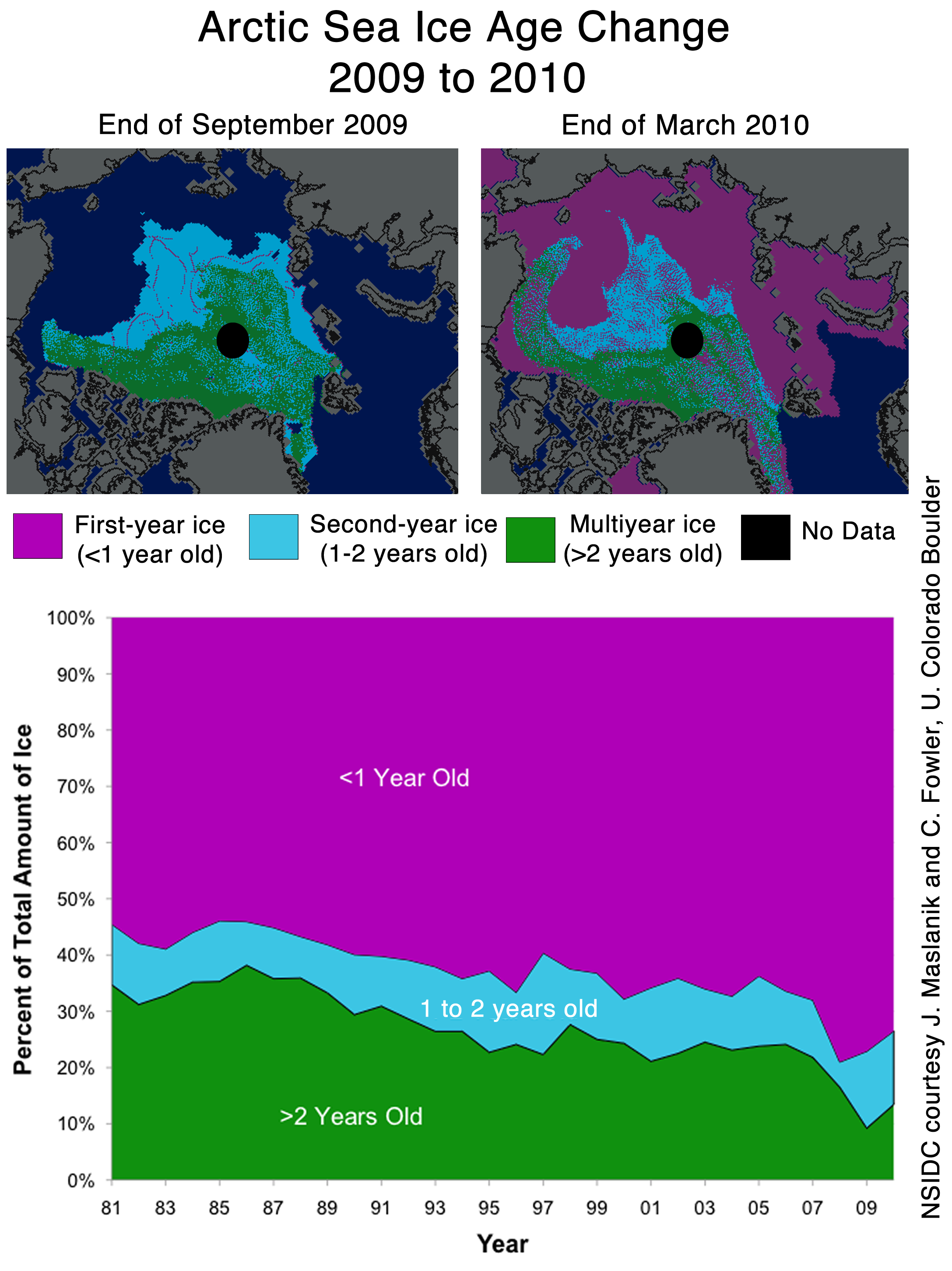
The computer model is predicting that 3+ year old ice (which is probably in excess of 10 feet thick) is going to melt by early August. That seems rather far fetched. Below is an overlay of the NSIDC map and the U of W simulation for August 18. Note all the multi-year ice that needs to melt.

Last June, temperatures in Barrow averaged 35F. In July they averaged 44F. It is a tall order to melt 10 feet of ice at those temperatures. This is how Barrow looks today:

http://www.gi.alaska.edu/snowice/sea-lake-ice/barrow_webcam.html
I am a big fan of computer models – when they produce useful information. Garbage in, garbage out.
stevengoddard says:
April 29, 2010 at 2:32 pm
John from CA
2008 and 2009 did not have any multi-year ice near Barrow. That is what makes 2010 different.
Check out area ‘V’
http://ice-glaces.ec.gc.ca/www_archive//AOI_10/Charts/sc_a10_20080526_WIS56SD.gif
R. Gates says:
April 29, 2010 at 4:53 pm
See figure 1 for an example of ice thickness in that area:
http://www.cpom.org/research/swl-nature.pdf
I also ran across this study which is very curious – implies air temperature has little impact on sea ice in that area.
http://imb.crrel.usace.army.mil/pdfs/Change_in_Beaufort_SeaIce_1990s.pdf
Before you jump to the conclusion that the thick multi-year sea-ice currently north of Alaska makes the predictions of this models unreasonable, you may want to consider whether winds and currents are likely to move that robust ice to a new location by September 2010.
This is a weird “forecast”. They don’t forecast the weather AND what it will do to the current ice. Instead they start with ice conditions at the recent maximum and then apply the observed weather from seven previous years (including 2007, the year of minimum coverage) to produce seven scenarios.. Then they average the seven scenarios to produce one “forecast” for 2010.
Some of their papers are interesting. Maximum melting in August amounts to about 0.5 meters/month.
R. Gates
Multi-year ice is typically 3-5 metres thick.
http://www.jpl.nasa.gov/news/news.cfm?release=2009-107
I think anyone who tries to predict this stuff is just plain nuts.
stevengoddard says:
April 29, 2010 at 6:21 pm
R. Gates
Multi-year ice is typically 3-5 metres thick.
http://www.jpl.nasa.gov/news/news.cfm?release=2009-107
And from the link you’ll find this statement:
“The Arctic ice cap grows each winter as the sun sets for several months and intense cold ensues. In the summer, wind and ocean currents cause some of the ice naturally to flow out of the Arctic, while much of it melts in place. But not all of the Arctic ice melts each summer; the thicker, older ice is more likely to survive. Seasonal sea ice usually reaches about 2 meters (6 feet) in thickness, while multi-year ice averages 3 meters (9 feet).”
======
One of the best realizations, thus far in the readings for me, is the Arctic is not an ice cube tray in my freezer that sits there until I take it out to melt.
The Arctic is a dynamic system that’s constantly changing. It’s not a static thing that sits there “while much of it melts in place“.
Nearly every NSF buoy (arctic surface weather station) they plant at the North Pole moves to Greenland in less than a year. Yet, the Arctic Ocean dynamics are far more interesting and poorly understood?
So the statement, “Garbage in, garbage out” pretty much defines the state of the game at all levels thus far?
John from CA says:
April 29, 2010 at 2:00 pm
Hey Steven,
By August 18th 2008 and 2009, there wasn’t any sea [just] north of Barrow, AK; http://igloo.atmos.uiuc.edu/cgi-bin/test/print.sh?fm=08&fd=18&fy=2008&sm=08&sd=18&sy=2009
NSIDC is probably imaging flocks of migrating birds or Arctic slush under 30% concentration (which can hardly be considered multi-year ice)?
Actually it’s about 50% multi-year ice interspersed with 50% first year ice, the MY ice originated off the Canadian Archipelago coast (the oldest ice). It’s drifting around the Beaufort gyre.
Phil..yes and since there is some MYI in the Beaufort Gyre and as anyone who watches animations of ice over the last few years will notice the ice in the Gyre doesn’t survive like it used to, this is bad news for that MYI. BTW…ice flux out of Fram Strait this winter was not unusually low, it was in fact normal. So old ice was still exported out of Fram Strait. And if you look at March…it was quite strong (lots of export).
If you guys keep talking, maybe you can make the ice melt?
PhD students make computer models to predict various outcomes of physical systems. In our modern era, many of the models can’t be verified; but the students earn PhD degrees. It doesn’t surprise me that these techniques have now become “scientific results”.
stevengoddard says:
April 30, 2010 at 4:36 am
If you guys keep talking, maybe you can make the ice melt?
The ice will melt just fine on it’s own. would be great though if you would spend some time with accurate portrayal of the ice conditions rather than flippant statements.
jeff brown
http://wattsupwiththat.com/2010/04/27/wuwt-sea-ice-news-2/
I also ran across this study which is very curious implies air temperature has little impact on sea ice in that area.