By Steven Goddard
I found a computer simulation of Arctic ice produced by The University Of Washington, which struck me as being particularly disconnected from reality.
This group is forecasting that September extent will be lower than last year.

Below is their simulation map.

http://psc.apl.washington.edu/zhang/IDAO/seasonal_outlook.html
After watching their map animate, I noticed something which bothered me. They are showing that by August 18, all ice will be gone north of Barrow, AK.

The problem is that NSIDC shows 3+ year old ice in that region:


Cropped from : http://nsidc.org/images/arcticseaicenews/20100406_Figure6.png
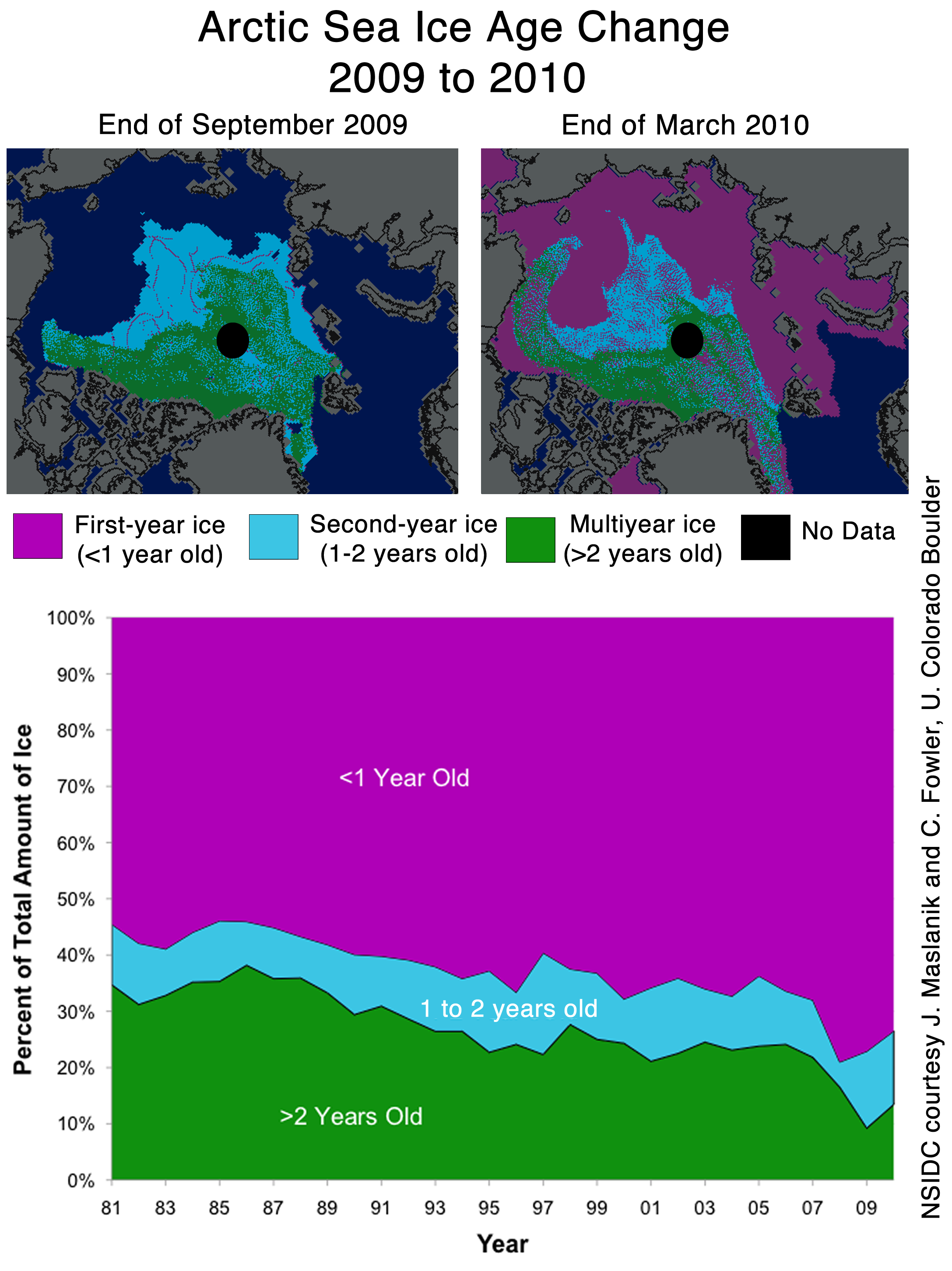
The computer model is predicting that 3+ year old ice (which is probably in excess of 10 feet thick) is going to melt by early August. That seems rather far fetched. Below is an overlay of the NSIDC map and the U of W simulation for August 18. Note all the multi-year ice that needs to melt.

Last June, temperatures in Barrow averaged 35F. In July they averaged 44F. It is a tall order to melt 10 feet of ice at those temperatures. This is how Barrow looks today:

http://www.gi.alaska.edu/snowice/sea-lake-ice/barrow_webcam.html
I am a big fan of computer models – when they produce useful information. Garbage in, garbage out.
Mike Haseler,
“OT News: 21% would give up sex to stop climate change
21% of total respondents would be willing to give up sex for “one year or more” if they could stop climate change (10% of women would be willing to do so forever vs. 3% of men).”
Reminds me of the comic book guy in an episode of the Simpsons, who, when dictating that procreation would take place once every seven years, mused “for me, this will mean a lot more sex.”
Capn Jack says: If you can’t hindcast with a model, it’s a fantasy game.
Hindcasts are little more than curve-fitting. I’d say that if you can’t predict going forward with a model, it is a fantasy game.
I say so what if there does happen to be more open water up there. It’s good for the polar bears — more sunlight on the water means more phytoplankton primary production, which eventually means MORE POLAR BEARS (along with every other living thing in that food web). Capn Jack’s brothers will be fightin ’em off with longboat oars. I want a white bearskin rug. The Gore-ist Gullibles should be glad that more CO2 might be at least temporarily sequestered in the increased biomass.
Chances are next years you would have to worry about the extension of ice ON continental areas, that will be much more interesting. For sure, Catlin´s expedition members will set up a new expedition, perhaps to travel from NY to Washington state along the new glaciers….
It is as though they know nothing about the actual thing they are simulating. I would not be surprised to discover that they have never been there. But if you asked them, they would probably come back with a defensive arguement such as, “well, do you expect modellers of the Sun to have been to the Sun”. Seriously, this is the level of these “researchers”.
Do not try to model the Northern Ice unless you have been there, touched it, tasted it, for a whole annual cycle, and understood the power of the cold, and the wind, that you are nullifying in your silly little model. in fact, you should relocate there and conduct your research in situ – then you would not make such a silly mistake.
diablobanquisa says:
April 29, 2010 at 5:39 am
Arctic sea ice age, april 2009 vs. february 2010. More multiyear sea ice than a year ago: http://img408.imageshack.us/img408/6951/image001hw.png
Not really since the two images are not for the same time, the one for 2010 is 9 weeks earlier and so misses a consistent outflow through the Fram of about 60km/week.
stevengoddard says:
April 28, 2010 at 10:49 pm
jeff brown,
Steve, that changes in summer. Look at http://www.arctic.noaa.gov/report08/ocean.html
meemoe_uk says:
April 29, 2010 at 12:26 am
NSIDC has Arctic sea ice data back to 1972 from satellite. The Had1SST data set gives it back to 1900.
stevengoddard says:
April 29, 2010 at 5:16 am
Leif, Finally, I understand Hamlet.
You understand Hamlet? Wow! Your even better than I thought!
et. al.,
It’s not the humidity %.
It’s not the air temperature.
It’s not the water temperature.
It’s not the wind direction or speed.
It’s not the ocean currents/circulation.
It’s not the average cloud cover in July.
It’s not how much it snows on the ice in June.
It’s not the degree of change in barometric pressure.
It’s ALL of the above, and each has a maximum degree of effect, air temp. being one of the least. AND ALL (to a significant degree) unpredictable between 3 days from now and August. UW’s prediction is a seat-of-the-pants guess, probably “designed” to get attention and more funding OR to JUSTFY the expenditure of some already awarded grant funds. Could it happen? Sure. Do current conditions lean in that direction? No, but that could change in a day or two.
BTW, the “Ice Thickness Chart” R.Gates has linked to a number of times is also from UW, but I can not find any real world confirmation data (raw or other wise) supporting it’s creation. It appears to be 100% computer model generated based entirely on assumptions.
http://psc.apl.washington.edu/zhang/Global_seaice/model.html
Satellite sea ice concentration data are assimilated in GIOMAS using the Lindsay and Zhang (2005) assimilation procedure. The procedure is based on “nudging” the model estimate of ice concentration toward the observed concentration in a manner that emphasizes the ice extent and minimizes the effect of observational errors in the interior of the ice pack.
I wonder if they told the data – Resistance is futile. You will be assimilated.??
Slightly OT, but are there any comparison runs of how far off the models have been in the last 20 years to what was physically observed, and would somebody point me to where those might be?
Just unplug it and save the planet!
The fallacies of the imprudent if left unchecked, uncontested and uncorrected will damage the credibility of the whole modeling gamut. Myself, being an ordinary person trying to make a decision, am hovering in limbo until ‘scientific’ theories become confirmed and certified factual indicators. There are clearly ulterior motives at work in some of the persons allowed to influence the public and to the untrained eye it is impossible to know who is misrepresenting the data. Should I flip a coin or will someone in your area of expertise stand up and call a spade a spade?
Dr. Svalgaard raises a valid point. Using the NSIDC info to call into question the U of W model, seems to require taking a stand on the validity of the NSIDC chart, not a surly tap dance about traversing the Arctic. That sort of rhetorical device is something warmists often employ to deflect.
Milwaukee Bob says:
April 29, 2010 at 7:44 am
Bob, you are right that it is all of those things, and that is why even though a thin ice cover may imply more ice loss in summer, the summer weather patterns still play a crucial role in shaping the end-of-summer ice cover. But what the PIOMAS model is doing in Lindsay and Zhang’s 2005 study is very appropriate for simulation of the ice cover. That is how climate forecasting can be improved, by using actual data to force the models, and not climatologies. It’s what your weather predictions do. But of course, we don’t know what the summer weather is going to be, so there’s a limit on predictability.
But if you evaluate climate model output (which you can do by downloading data from CMIP3), you will find that as the ice cover thins, you reach a point where the summer weather patterns are no longer as important and predictability of summer ice cover based on knowledge of the winter ice cover improves. Obviously the Arctic ice cover is still strongly influenced by the summer weather patterns which is why predictions for 2009 were so far off.
Don’t forget that the Russians have a fleet of nuclear powered ice breakers that will make 10 knots through 8-9 feet of ice, use them for clearing the shipping lanes above Siberia (where the ice melts first in the summer, and even for holidays to the north pole.
What is the effect on sea ice in the summer and the deposition of precipitation build-up? How about reduction in albedo of open ocean? Ice formation in the winter (max area-min area) is about at normal 30-year levels. I think I saw annual mileage of 30,000, but can’t find the reference. Other countries have ice breakers and many have ice breaking ships.
Thanks for your good work, all!
http://www.victory-cruises.com/arctic.html
http://www.youtube.com/watch?v=g4RQXkI3B8w&feature=related
What a pity to get petty..
Craig Moore
I have never seen any evidence that NSIDC data is significantly incorrect. I once wrote about an apparent discrepancy between NSIDC and UIUC, and it turned out the problem was mainly on the UIUC side.
Capn Jack, you used to do what to the Vikings? I hope that has nothing to do with your mizzin mast, …… 8^D
stevengoddard says:
April 29, 2010 at 8:30 am
NSIDC’s sea ice extent data can be incorrect near the coasts (land contamination) and near the ice edge from weather effects. They can also underestimate new, thin ice because the algorithm used assumes snow on the ice. That is why ice chart data is the most accurate since they also incorporate radar and visible imagery as well as in situ observations into their charts. Perhaps you should use data from NIC or the Canadian ice service instead?
Leif Svalgaard says:
April 29, 2010 at 6:57 am
There are small differences and then there are gnat’s *ss differences. That smudge of white you’re pointing at. . . is it even as much as .001% of the total?
All-
Microsunspot 1063 just appeared, and we now have a sunspot count of 12. Since suspots play a role in the global warming debate, does anyone have any data on whether these microsupots are being “over-read” essentially increasing the sunspot number? 1063 is barely there!
Fred Chopin
Excellent point about icebreakers. That may well be contributing to recent low summer minimums, by exposing more ice surface area to the sun and the water.
At the end of August we will have the empirical data that will either support or refute their computer generated forecast. I wonder if they will admit error if their model proves to be wrong? Or, I wonder what lame excuse they will come up with if they are unwilling to admit error? If they turn out to be right, they’ll deserve congrats!
kadaka, it was interesting that 10% of women and 4% of men said they would “give up sex forever” to save the planet.
I wonder what the response would have been if the question would have been: “would you give up having children”?
And why wasn’t that obvious question raised? Reducing fossil fuel use per person AND reducing the number of people would be equally viable ways to “tackle global warming” (as they put it). So why is it that the former and not the latter is always top of the warmer’s agenda?
Have you noticed that “tackling global warming” always involves giving up “boys toys” like cars, planes etc. But it never involves giving up “girls toys” (i.e. babies)? If the debate were rational (which it clearly isn’t) then anyone could see that if you wanted to reduce overall fossil fuel use, then you could achieve this without any impact on (mankind’s) standard of living if you cut population by the required percentage. And whilst there is obviously a natural limit to the rate of reduction – any such reduction would have minimal impact of anyone who is alive today.
So, it seems to me that there is clearly a very anti-male sexual bias amongst the global warming brigade. What after all is trying to save “mother earth” other than part of a much wider female conspiracy to feminise even the planet we live on!
Put it this way, given a straight choice between:
A) No car and no sex with all the babies (and nappies/diapers?) you could ever want,
B) A car and as much sex as you like without the hassle of babies.
… as for the “precautionary approach” …. I could go on but I’ve got to cook dinner!
As pointed out earlier, Zhang way underpredicted the sea ice extent last year. In fact, if we take this into account, the sea ice extent minimum should actually come in around 6.4 M sq. km. (rather than 5.3).