By Steven Goddard
I found a computer simulation of Arctic ice produced by The University Of Washington, which struck me as being particularly disconnected from reality.
This group is forecasting that September extent will be lower than last year.

Below is their simulation map.

http://psc.apl.washington.edu/zhang/IDAO/seasonal_outlook.html
After watching their map animate, I noticed something which bothered me. They are showing that by August 18, all ice will be gone north of Barrow, AK.

The problem is that NSIDC shows 3+ year old ice in that region:


Cropped from : http://nsidc.org/images/arcticseaicenews/20100406_Figure6.png
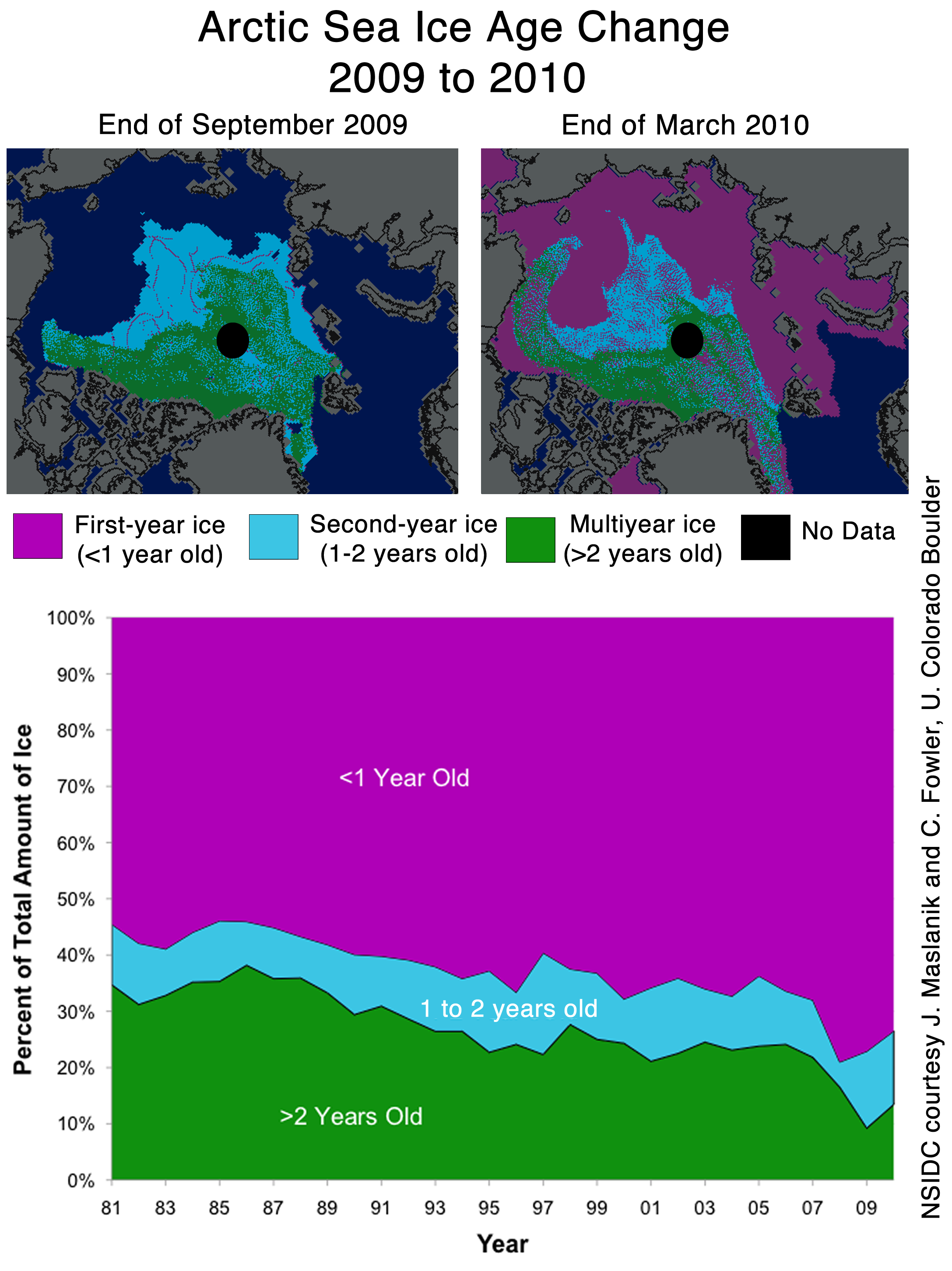
The computer model is predicting that 3+ year old ice (which is probably in excess of 10 feet thick) is going to melt by early August. That seems rather far fetched. Below is an overlay of the NSIDC map and the U of W simulation for August 18. Note all the multi-year ice that needs to melt.

Last June, temperatures in Barrow averaged 35F. In July they averaged 44F. It is a tall order to melt 10 feet of ice at those temperatures. This is how Barrow looks today:

http://www.gi.alaska.edu/snowice/sea-lake-ice/barrow_webcam.html
I am a big fan of computer models – when they produce useful information. Garbage in, garbage out.
Hopefully not too OT.
Very interesting. As I write the ABC (Australia) is showing a science based show (Catalyst), this week dedicated to the Antarctic. The main interviewees are scientists from the Antarctic Division of the CSIRO and James Hansen of NASA. Melting,thinning,acidification and tipping points all get a run. AGW is to blame without doubt. Warm currents and thin shelled pteropods prove a disaster is imminent.
Now maybe they are right but the CSIRO and James Hansen have been so compromised in the past on the AGW/CC issue one wonders where the truth lies. Please help me out.
My model predicts that by the end of the 2010 melt season the number of worthless layabouts investigating the effects of AGW on – almost anything! – will have fallen to it’s lowest level this century. The possible slow motion meltdown of the Euro and the likely decline in world trade that might then occur could result in national governments facing a projected reluctance on the part of investors (to one std of course) to bail out nations that could be identified by a secret algorithm as multi-year debtors , whilst those debtors of barely one years standing may feel the heat much sooner, and may have a statistical chance of becoming toast.
Let’s see whose prediction is more correct in September.
I think my model (5’6″, 36-24-36, and blonde with a gsoh) has more chance than than Washington Uni.
Mike Haseler says:
April 29, 2010 at 1:46 am
BE GREEN, boycott solar panels! Not only is nitrogen trifluoride (NF3) 17,200 times more potent GHG than CO2 but also plants don’t live on it and convert it to O2. Another great GREEN industrial product to save the world, just ignore the manufacturer’s footprint and where it goes when it’s broken! (Mike, thanks for the info)
In fact, I wonder what it’s half-life time in the atmosphere is?
@Juraj V.
Thats no good, and is typical of the data given by all the ice authoritys. Discontinuous, and in map form. Time series is what everyones after.
Wonder if Goddard has got any, he seems to be one of the top ice men round here.
Let me guess, they get their grant money from the government …
It is getting to be an old joke, Anthony, but the warmaholics have redefined GIGO. For warmaholics GIGO means Garbage In, Gospel Out. I hope SEARCH is going to run it’s survey of model outputs for September 2010.
Ray says:
April 28, 2010 at 10:35 pm
As I understand it, and only from those more learned than me here, so don’t call me on it, icebergs are from glaciers, not sea ice. They will, therefore, be a great deal larger than sea ice may be (generally).
Graigo: Wonder what Phil and De Witt pain have to say about that
http://www.nenanaakiceclassic.com/Ice%20Measurement.htm
Looks like its all over the place confirming that its got absolutely nothing to do with ice status at minima or maxima extent or more or less ice melting etc.
Wonder if its real data though….
Phil,
You linked to a video which started in October, 2007 and claimed it showed 2007 melt.
http://wattsupwiththat.files.wordpress.com/2009/04/arctic_amsr-e_flow_animation-40.gif
Nice try.
This post concerns PIOMAS, which is used to generate the terrifying anomaly graph the CAGW Crowd have been waving around to PROVE there is a horrendous ongoing loss of Arctic sea ice VOLUME with a definitive downward trend.
http://psc.apl.washington.edu/ArcticSeaiceVolume/images/BPIOMASIceVolumeAnomalyCurrent.png
And now we can see the problems of the PIOMAS model, besides all the other assumptions made in estimating (read: guessing with computers) the ice thickness and thus the ice volume.
Nice work, Steven.
I think that there is a considerable tendency to falsely equate ‘Atmospheric Temperature’ with ‘Atmospheric Heat Content’ this is because it is an easier metric. However, a negative NAO leads to a large drop in moisture flux North of 70-degrees and this will result in a drop of atmospheric heat content (due to reduced enthalpy) in the Arctic for a particular temperature. It is the available heat energy that melts the ice not the air temperature. From the Unisys SST anomaly maps there does not appear to be as much heat content in the oceans just outside the arctic as normal either.
Perhaps the models are using the wrong proxies for available heat energy?
Leif,
Finally, I understand Hamlet.
“Something (ice) is rotten in the state of Denmark.”
Before posting next week’s edition, I promise to personally traverse the entire Arctic on foot, and make sure that NSIDC doesn’t show any stray ice pixels.
Mauibrad: probably best video ever on the issue. A must definitely
http://www.blip.tv/file/3539174
Clear law violations or intent to violate law with proof
DMI ice wild swing up again!
http://ocean.dmi.dk/arctic/icecover.uk.php
Arctic sea ice age, april 2009 vs. february 2010. More multiyear sea ice than a year ago: http://img408.imageshack.us/img408/6951/image001hw.png
http://soa.arcus.org/sites/soa.arcus.org/files/sessions/2-1-observations-arctic-change/pdf/2-1-3-tschudi-mark.pdf
Lawrie Ayres says:
April 29, 2010 at 3:36 am
. . . . . .
Please help me out.
It’s really quite simple Lawrie, unless you’re comfortable with that sort of entertainment and with making the correct utterances, you see that ‘off’ button there . . .
OT News: 21% would give up sex to stop climate change
21% of total respondents would be willing to give up sex for “one year or more” if they could stop climate change (10% of women would be willing to do so forever vs. 3% of men)
15% of respondents would be willing to give up their spouse for “one year or more” and 11% would be willing to do so forever
http://www.thegreenworkplace.com/
http://www.earthtimes.org/articles/show/would-activists-give-up-sex,1272743.shtml
How wonderful it is that so many global warmers would give up sex to save the planet, surely an inspiration to others! A pity their parents didn’t share the same noble ideas!
Nick says: (April 29, 2010 at 1:57 am)
“Perhaps you should discuss the model inputs are before passing judgement.”
This model can only predict what may happen IF the conditions programmed into it actually do come about. What are those conditions and what is the probability that those conditions will prevail?
Mike Haseler says: (April 29, 2010 at 5:51 am)
“15% of respondents would be willing to give up their spouse for “one year or more” and 11% would be willing to do so forever”
Probably true without any conditions attached!
The NOAA has this link of the predicted ice extent minimum for 2009 by 16 individual scientists/models (and they were all too low even though the predictions were made in July, 2009) (3 of the scientists are from the Polar Science Centre and they got the prize for 1st, 2nd and 4th worst predictions. )
http://www.arcus.org/search/seaiceoutlook/2009_outlook/minimum/downloads/pdf/minimum-july-comparison-2009.pdf
[The ones done in June were even farther off].
From Mike Haseler on April 29, 2010 at 5:51 am:
How wonderful it is that so many global warmers would give up sex to save the planet, surely an inspiration to others! A pity their parents didn’t share the same noble ideas!
Considering what I’ve heard that the teenagers and young adults consider to be “not really sex,” I wonder if it was clearly specified they’d be giving up all of that. Perhaps they should bring in Dr. Ruth to explain that should also include the self-service option. And going by “that Seinfeld episode,” could people give up to fight “global warming” what they couldn’t even give up for money?
It goes back to the old saying: To err is human. “To really foul things up requires a computer.”
Or more precisely, to really foul things up requires a computer mindlessly cranking out results based on only understanding half of the picture. This was recognized decades ago, before we applied the term “modeling” to it.
Then if the program was written by volunteers, there is often no good way to add new factors without re-writing a bunch of it. So the owner, not having the budget to fix the problem, is forced to defend the indefensible.
@MartinGAtkins
Thks, I found that one too, and was going to puzzle over it, but then thought – this is absurd! We shouldn’t have to put up with these artifically poor data sets. All the graphs for dmi, nansen, cyro , nsidc are based on daily data points.
Gotta look for better data sets.
The presumption appears to be that the intention is to project the extent of ice rather than to provide support for the military planners of several nations who propose to demonstrate sovereignty in the area by establishing regular patrols in an ice-free arctic. Patrols requiring new ships, fuel, provisions, emergency planning etc. A strategy that would no doubt add to the wealth of companies who provide such things to the military and elevate the status of the officers in charge of such operations. Forgive me, I’m just an old cynic.
Peter Plail says:
April 29, 2010 at 3:21 am
You seen to have a perpetual problem with Steven using NSDIC maps.
Don’t know of any better [haven’t looked hard, though], but it would seem that NSDIC are the ones with the problem. Perhaps the lesson is to realize that there are uncertainties that may at times be greater than the apparent changes, so not to read too much into small differences.