By Steven Goddard
I found a computer simulation of Arctic ice produced by The University Of Washington, which struck me as being particularly disconnected from reality.
This group is forecasting that September extent will be lower than last year.

Below is their simulation map.

http://psc.apl.washington.edu/zhang/IDAO/seasonal_outlook.html
After watching their map animate, I noticed something which bothered me. They are showing that by August 18, all ice will be gone north of Barrow, AK.

The problem is that NSIDC shows 3+ year old ice in that region:


Cropped from : http://nsidc.org/images/arcticseaicenews/20100406_Figure6.png
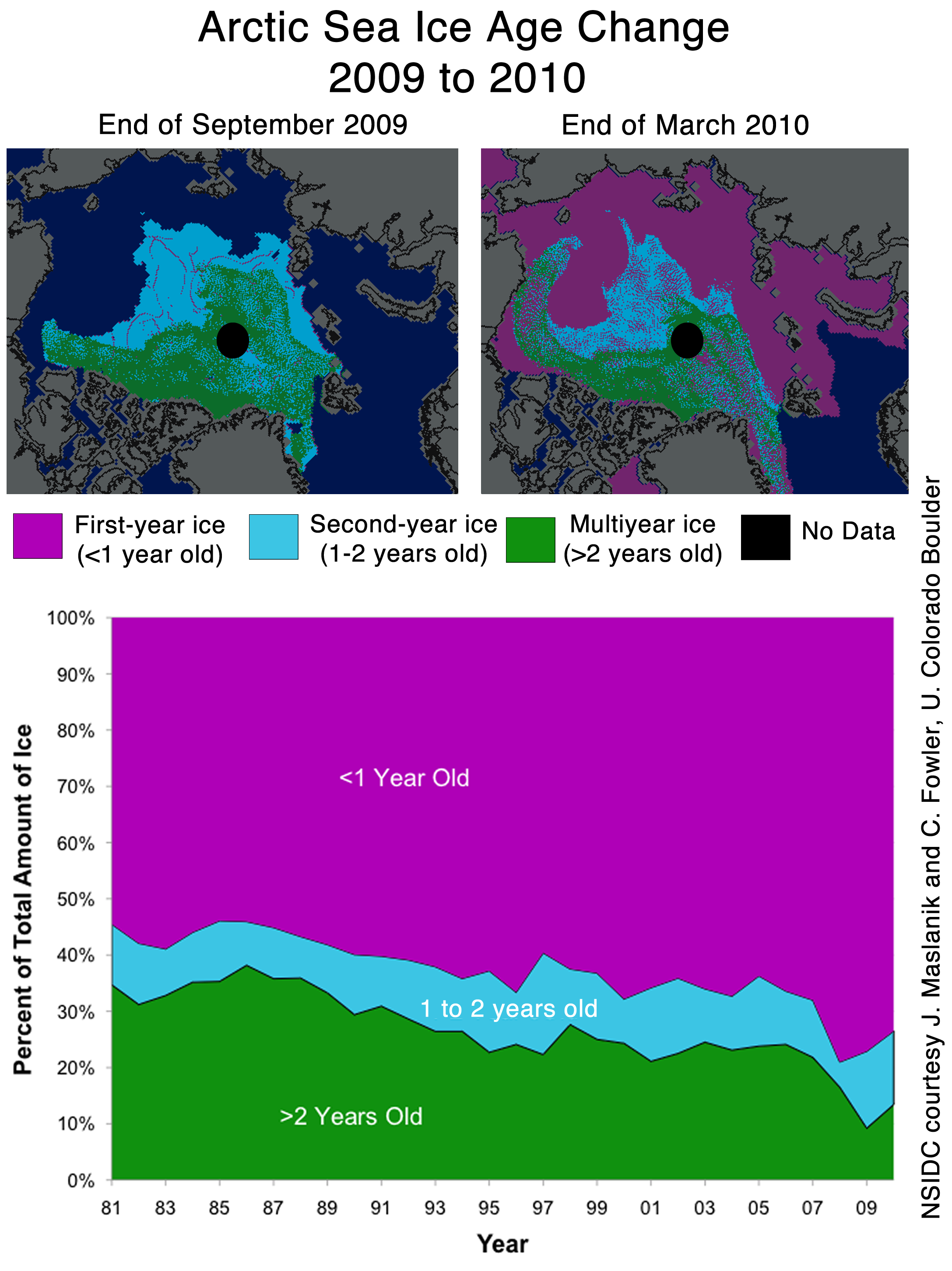
The computer model is predicting that 3+ year old ice (which is probably in excess of 10 feet thick) is going to melt by early August. That seems rather far fetched. Below is an overlay of the NSIDC map and the U of W simulation for August 18. Note all the multi-year ice that needs to melt.

Last June, temperatures in Barrow averaged 35F. In July they averaged 44F. It is a tall order to melt 10 feet of ice at those temperatures. This is how Barrow looks today:

http://www.gi.alaska.edu/snowice/sea-lake-ice/barrow_webcam.html
I am a big fan of computer models – when they produce useful information. Garbage in, garbage out.
Has anyone noticed that the same computer modeling techniques and “quant-types” predicted that sub-prime mortgages were safe?
The irony is delicious. Wall Street models = Enviro models.
The computer model is predicting that 3+ year old ice (which is probably in excess of 10 feet thick) is going to melt by early August. That seems rather far fetched.
Not really, it’s fragmented ice so has high surface area exposure and will likely melt like it did in 2007.
http://wattsupwiththat.files.wordpress.com/2009/04/arctic_amsr-e_flow_animation-40.gif
Also that ice is drifting away at ~10km/day.
Ray says:
April 28, 2010 at 10:35 pm
How high above sea level does one year ice stand? How come there are so many huge and tall iceberg going south during the melting season? Are those big ones multi-year glaciers?
Calving from glaciers not sea ice.
Whoa. That is removed from reality. There is NOTHING in the present weather or solar patterns that would indicate a sustained above 32degree atmospheric/oceanic temperature. And I do nor believe you could melt that much ice without a cataclysmic cause. This would be unprecedented.
The European research (?) project DAMOCLES (!) for two years now has a competiton, which model gives the best prediction of the September arctic sea ice minimum (kind of Europe’s next Top Climate Model). And guess what, in 2009they all were wrong (you can guess as well, in which direction they failed). I think in 2010 they will have this competition as well. It will be interesting to see, if teir guesses are any better this year…
Anyone got a link for sea ice data series that go back to 1979?
I’ve been looking for such a series, but so far, all the sources, such as cryo, dmi, nansen, nersc, hide their series data. Only jaxa openly provide data but that only goes back to 2002.
Looking like we’ll need another round of FOI requests.
@meemoe_uk:
ftp://sidads.colorado.edu/DATASETS/NOAA/G02135/
Here’s what we get fed here in Australia about Arctic ice;
http://www.smh.com.au/environment/climate-change/melting-ice-makes-the-arctic-a-vicious-circle-20100429-tssb.html
“The amount of Arctic sea ice was at a record low in the summer of 2007, down about 40 per cent.
Although it has recovered slightly since, the long-term trend is down, he said. “We’re heading towards a situation where the Arctic Sea will be ice-free in summer.”
Bastardi also predicting a Arctic ice low this year. He also says it will rebound in the next few years to unseen levels, so while the Warmists may cheer that their theories are correct by Xmas, they will be silent in the coming years.
More fun with ice!. The tipping point is getting nearer at the Nenana Ice Classic. http://www.nenanaakiceclassic.com/
Ummm… I have written my fair share of simulations. Look even when you have ALL the variables accounted for predicting something like ice loss or other complex systems is rough. What these researchers are really relying on is linear regression and then extending it out to the future. Because in the end that is all you can do in a case like this.
A simple example of a simulation is a coin flip. Now after 10,000 flips the model will be about 50/50 though in reality it is usually weighted 51.5 to 48.5
Even then it does not tell me what the next coin flip will be. Now you can say that modeling the behavior of something is different. And it is to a limited extent. But in the end because you do not have all the variables ultimately you rely on trends to truly model from. This is where danger lies in any model. A trend is just that, a trend. If I break down the controlled experiment of a coin toss and I have just had 6 heads in a row would I then expect the next flip to be a head or a tail? Even in accounting for all the variables in a coin flip ( there are two ) you cannot predict with accuracy the next toss. Now you can predict that the next toss will be either a head or a tail with a fairly large degree of certainty. I.e. I predict that there will be arctic ice loss in August. But to model this and claim anything until it has happened is a little silly. In other words after 2 decades of them internally making a prediction and then their being correct 95% of the time I would lend credence to a prediction. Short of that it is hypothesis and while interesting if repeated 20 – 100 times ( again with the 95% accuracy ) then I will pay attention. This prediction via modeling is not really worth mentioning as until it is proven to be accurate.
hi,
in fig. 1 i cannt see the extent in 09 2010 lower than 2009!
Well, if anything this is a forecast that can be “validated” within a few months. Garbage out.
gg
How come there are so many huge and tall iceberg going south during the melting season?
Icebergs come from glaciers. And the more snow there is, the more icebergs there will be, because there is more bulk of snow and ice pushing the bits to break off. Icebergs are not directly related to melting due to heating of the earth. (Warming without extra snow to compensate will cause the glaciers to retreat, not calve more.)
But I suspect you know that already. Either that or [snip]
One way of testing the validity of the models is to look at past performance. The SEARCH predictions, from some of the most expert Arctic scientists, which were based on July 2009 data failed miserably to get it right. The lowest estimate out of the 14 predictions was 4.2 million square kilometres and the highest was 5.0 with an actual of 5.36 million square kilometres.
http://www.arcus.org/search/seaiceoutlook/2009_outlook/august_report/downloads/graphs/augustreport_julydata_chart_preview.png
Clearly we have much to learn before long-term estimates give meaningful results.
OT: News – Gas breakthrough promises to slash solar industry’s climate impact
It may have a reputation as one of the greenest industries around, but the solar sector is also directly responsible for emissions of one the world’s most potent greenhouse gases.
Manufacturers of photovoltaic solar panels, computer chips and flat-screen TVs typically use production processes that make use of a gas called nitrogen trifluoride (NF3) to clean the machines used for chemical deposition processes. However, while NF3 is only used in relatively small quantities, it has a global warming impact that is 17,200 times greater than carbon dioxide.
http://www.businessgreen.com/business-green/news/2262226/gas-breakthrough-promises-slash
Odd! But that’s what “businessGreen” says! What next? Will someone tell us that grass isn’t green?
Perhaps you should discuss the model inputs are before passing judgement.
Calving is ice buildup not melting.
Shit even Pirates know that, means top of the world is too cold for safe passage.
Shit we used to ferry Vikings and tow Longboats.
And the odd Roman on the other side the odd Kahn and pony.
Seems no one learns Pirate history, anymore.
I dont know what your point bringing up Barrow ice melt in relation to the models. If you look at the yearly series of images on the Barrow webcam site you’ll see that there is consistently open ocean north of Barrow by mid-July, so open ocean by August isnt a big feat. Hell, even when I was in Barrow in April 2008, large portions of open water had already begun to open up north of Barrow.
It’s possible for predictors to bet on whether this year’s minimum arctic ice extent will be greater than last year’s. The rules are given here, and contain a link to the bet-page:
https://bb.intrade.com/intradeForum/posts/list/4474.page
The last bet was at 50% odds.
meemoe_uk says:
April 29, 2010 at 12:26 am
Anyone got a link for sea ice data series that go back to 1979?
This is a seasonal sea ice extent timeseries. It starts at 1870 and the last full year is 2007 How accurate it is I will leave you to judge. There is no explanation of what the column values indicate but I have looked at it and calculated that column 1 is the year average. I’m assuming that the other columns follow seasonal conventions.
Winter DJF col 2, Sping MAM col 3. Summer JJA col 4, Autumn SON col 5
http://arctic.atmos.uiuc.edu/SEAICE/timeseries.1870-2008
Source page.
http://arctic.atmos.uiuc.edu/SEAICE/
Craigo says:
April 29, 2010 at 1:23 am
More fun with ice!. The tipping point is getting nearer at the Nenana Ice Classic. http://www.nenanaakiceclassic.com/
—
Now there is some real data!
http://www.nenanaakiceclassic.com/Ice%20Measurement.htm
Never heard of Nenana Ice, guess the pot goes to those who get closest to the date and time, right?
Just scanning, seems 2010 is really one of the coldest years for the last 20 years, over 50 inches of ice and so far days still clicking. Thanks for something new!
I told you before has any body told the polar bears about this thay have been relying on Al Gore for there travel plans
Anthony, check this video out http://www.blip.tv/file/3539174
Leif Svalgaard
You seen to have a perpetual problem with Steven using NSDIC maps. Perhaps you can refer us to what you consider an authoritative source of information on ice extent/coverage.