Guest post by Steven Goddard
In his recent article, NSIDC’s Dr. Meier answered Question #9 “Are the models capable of projecting climate changes for 100 years?” with a coin flipping example.
1. You are given the opportunity to bet on a coin flip. Heads you win a million dollars. Tails you die. You are assured that it is a completely fair and unbiased coin. Would you take the bet? I certainly wouldn’t, as much as it’d be nice to have a million dollars.2. You are given the opportunity to bet on 10000 coin flips. If heads comes up between 4000 and 6000 times, you win a million dollars. If heads comes up less than 4000 or more than 6000 times, you die. Again, you are assured that the coin is completely fair and unbiased. Would you take this bet? I think I would.
Dr. Meier is correct that his coin flip bet is safe. I ran 100,000 iterations of 10,000 simulated random coin flips, which created the frequency distribution seen below.

The chances of getting less than 4,000 or greater than 6,000 heads are essentially zero. However, this is not an appropriate analogy for GCMs. The coin flip analogy assumes that each iteration is independent of all others, which is not the case with climate.
[Note: Originally I used Microsoft’s random number generator, which isn’t the best, as you can see below. The above plot which I added within an hour after the first post was made uses the gnu rand() function which generates a much better looking Gaussian.]

Climate feedback is at the core of Hansen’s catastrophic global warming argument. Climate feedback is based on the idea that today’s weather is affected by yesterday’s weather, and this year’s climate is dependent on last year. For example, climate models (incorrectly) forecast that Arctic ice would decrease between 2007 and 2010. This would have caused a loss of albedo and led to more absorption of incoming short wave radiation – a critical calculation. Thus climate model runs in 2007 also incorrectly forecast the radiative energy balance in 2010. And that error cascaded into future year calculations. Same argument can be made for cloud cover, snow cover, ocean temperatures, etc. Each year and each day affects the next. If 2010 calculations are wrong, then 2011 and 2100 calculations will also be incorrect.
Because of feedback, climate models are necessarily iterative. NCAR needs a $500 million supercomputer to do very long iterative runs decades into the future. It isn’t reasonable to claim both independence (randomness) and dependence (feedback.) Climate model errors compound through successive iterations, rather than correct. How could they correct?
Speaking of Arctic ice cover and albedo, the sun is starting to get high in the sky in the Arctic, and ice extent is essentially unchanged from 30 years ago. How does this affect climate calculations?

GCMs are similar to weather models, with added parameters for factors which may change over time – like atmospheric composition, changes in sea surface temperatures, changes in ice cover, etc. We know that weather models are very accurate for about three days, and then quickly break down due to chaos. There is little reason to believe that climate models will do any better through successive iterations. The claim is that the errors average out over time and produce a regionally correct forecast, even if incorrect for a specific location.
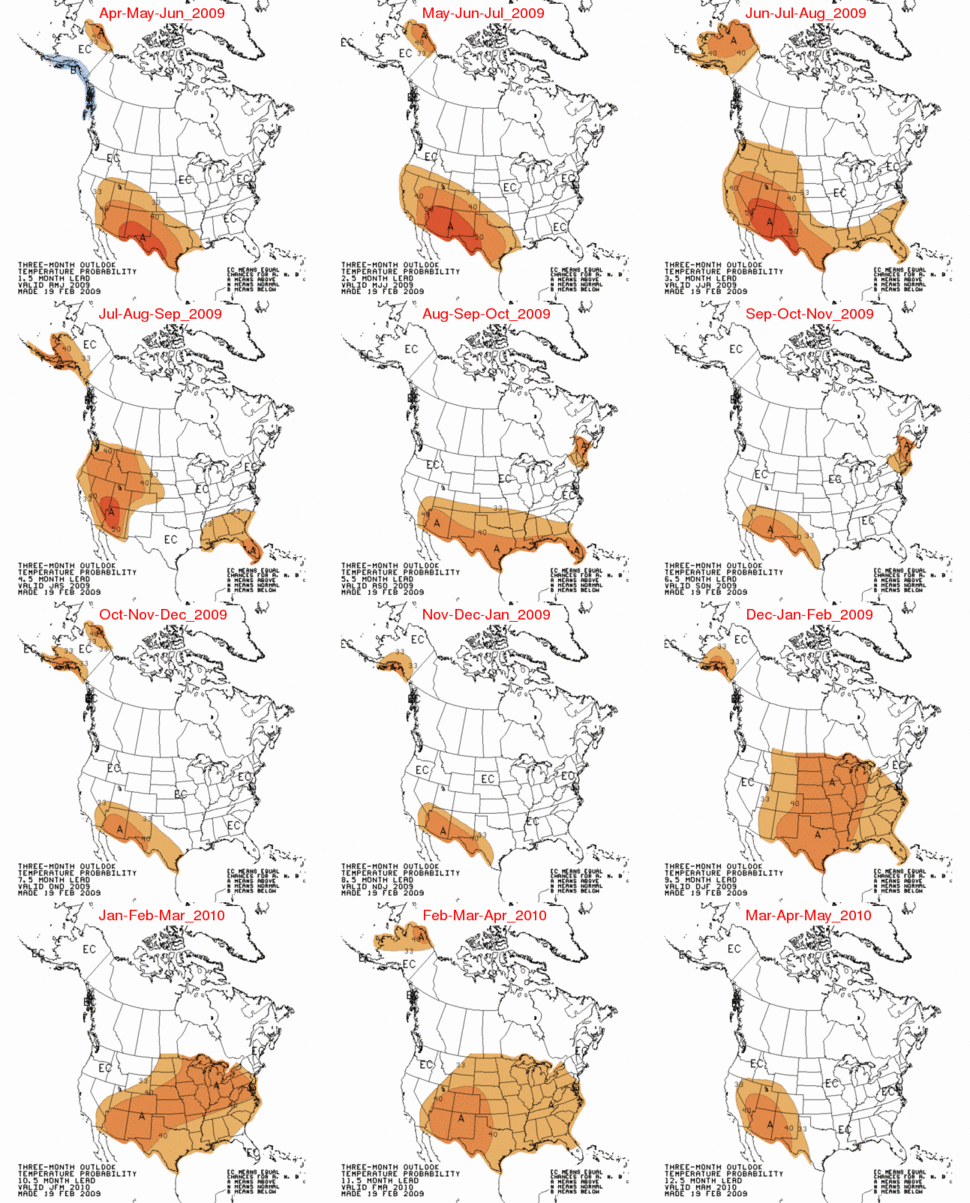
A good example of how inaccurate climate forecasts are, is shown in the two images below. NOAA’s Climate Prediction Center issued a long range forecast for the past winter in February, 2009. Brown and orange represents above normal temperatures, and as you can see they got most of the US backwards.

NOAA CPC’s long range forecast for winter 2009-2010

NOAA’s reported results for winter 2009-2010
The UK Met Office seasonal forecasts have also been notoriously poor, culminating in their forecast of a warm winter in 2009-2010.
The Met Office climate models forecast declining Antarctic sea ice, which is the opposite of what has been observed.


NSIDC’s observed increase in Antarctic sea ice
Conclusion : I don’t see much theoretical or empirical evidence that climate models produce meaningful information about the climate in 100 years.
However, Willis claims that such a projection is not possible because climate must be more complex than weather. How can a more complex situation be modeled more easily and accurately than a simpler situation? Let me answer that with a couple more questions:1. You are given the opportunity to bet on a coin flip. Heads you win a million dollars. Tails you die. You are assured that it is a completely fair and unbiased coin. Would you take the bet? I certainly wouldn’t, as much as it’d be nice to have a million dollars.2. You are given the opportunity to bet on 10000 coin flips. If heads comes up between 4000 and 6000 times, you win a million dollars. If heads comes up less than 4000 or more than 6000 times, you die. Again, you are assured that the coin is completely fair and unbiased. Would you take this bet? I think I would.
Discover more from Watts Up With That?
Subscribe to get the latest posts sent to your email.
DirkH said:
“You wanted to know what skeptics say to this “2010 hottest year on instrumental record.” Well.
My all-time favorite quote: It’s a minor short-term issue. [R. Gates]”
_______________
Except 2010 follows on the heals of the warmest decade on instrument record, and so is part of an ongoing trend. You see, I have no problem with the leveling of the growth in temperatures in 2003-2008 timeframe as I can accept that the solar minimum would do this, just as is seen in past solar minimums, but now that the solar minimum is passed us, we would expect the signal of GHG forcing to once more be the dominant signal. In other words, if the 2010 warmth had occurred in the middle of 20 years of a downward trend in temperatures I would consider it a minor short-term “blip”, but coming after the warmest decade ever on instrument record, it is a continuation of a trend.
So far, except for saying “it’s all El Nino”, (which it is not), I’ve not heard a reasonable explanation for why 2010 is so warm from AGW skeptics, but AGW models say the odds are better than 50/50 we’ll see each successive decade warmer than the next, so with the flattening during the 2003-2008 time frame, it makes sense that to average out over the next 10 years, we’re now in for some warming…especially with the solar minimum behind us.
The rand function, in most implementations, is a pseudo-random number generator based on a seed. From the same seed the same sequence of random numbers is generated. I found this confusing at first, but if you’re trying to debug a program or reproduce a result, truly random data is not useful.
To achieve randomness for multiple runs use some other variable for a seed, I don’t know what current practice is for this. We used to use time when computers were slower.
If climate models are better predictors for a 100 year span than a 1 year span, does that mean they can get it exactly right for 3010?
And as several have previously posted, do any of the models predict the start of the next glacial? If not, it seems to me that they are omitting THE major climate driver.
RhudsonL – It’s not Jesus it’s Madame Pompadour. You can see that from her bra.
Ibrahim said (13:43:09) :
“Explain to me wich forcing caused the warming between 1910 and 1945?
And you get this picture wirh it:
http://i39.tinypic.com/261p2tu.png”
____________
Could be multiple inputs (including GHG’s) and/or something that works on a multidecadal scale. Would have to look at all the available charts from the period, including whatever PDO, AMO, volcanism, etc. data that is available. I’ve not studied this in detail, but certainly know it has been a focus of much study and debate. If we take the stance the at least some of the warming during this period was caused by GHG’s then you could ask the reverse question, what caused the cooling from during the 1950-1977 period? Perhaps something else caused this period to be cooler than it would have been if whatever caused the forcing of the earlier period had continued.
One of the major issues with this little experiment, is that it is a Frequency distribution; as opposed to a Probability distribution. I should not have to explain the difference, but simply put they are not equivalent. Frequency distributions are historical, whereas Probability distributions are a statement regarding a future state and our knowledge ( inference ) thereof. A frequency distribution may inform a Probability calculation as prior information. But it should be recognized that a Probability is a statement concerning the future.
Probabilities do not exist, else they would be called Reality. A Reality is the point at which P=1 (an Event ).
Steve Goddard;
So… you built a model… and expect THIS audience to accept the results? Of a MODEL?
Now enough with coin flipping. I went out on the bubble on a bad beat in my last 11 poker tournaments in a row. WUWT? I would have thought that global warming caused an even distribution of bad beats, but apparently not so. Is the CO2 changing the ratio of flushes to straights and no one has been studying this? Can I get a grant? Yes… a grant to study the effects of global warming on poker… finaly an aspect of climate science that I am qualified for. Whose in? I figure 10 people, one grant apiece, we can each come up with our own theory, apply the theory at the poker table, and who ever has the most grant money at the end gets to present their paper as proof of their theory with the other 9 being cited as “peer review”. Having established the relationship between global warming and poker (with no less than TEN scientists attesting to the results) we can then take the next step and challenge the warmists to put their grant money up against ours. I can see some potential problems though. The dealer might be heard to make certain statements:
No Mr Jones, you CANNOT erase the cards and draw your own numbers on them.
Mr Mann, I’m sorry, but you cannot bring your own cards to the table and just substitute some of them when it suits you.
Mr Briffa I can see you have the ace of spades, that’s very nice. But the rules don’t allow you to decide that the other 51 cards no longer count.
Back to you Mr Jones, where did you put those cards you were trying to erase? What do you mean you LOST them? No! We can’t just go on playing without them!
Mr Hansen, I’m sorry, you lost this hand. No Mr Hansen, a straight does not beat a flush. No Mr Hansen, you did not have four of a kind. Look Mr Hansen, you are not an officer of the law, so you can’t put me in jail because you lost the hand. And PREDICTING that you would have four of a kind is not the SAME as having four of a kind.
Put those chips back Mr Ravetz! Poker is about uncertainty, that doesn’t mean you can take half the chips “just in case”. What? Its “urgent”? Look, if you gotta go pee, then go, but you can’t take half the chips with you just because you MIGHT win the hand!
Who the heck are you now? Mugabe? Am I pronouncing that right? Yes you can enter a team late… no… you have to pay for your own chips you can’t make everyone else give you a few of theirs.
Oh for gosh sakes will the interruptions never end? Who are you now? Really? From the UN? I’m impressed…. what… NO! You can’t just decide who the winner is in advance, that’s not how poker works! Well I don’t CARE how many people studied it or how thick your report is… huh? Look, it doesn’t matter if 13,000 professional poker players reviewed your predictions, it doesn’t change how many chips Mr Jones has left!
JONES! Stop that right now! You can’t erase the numbers on the cards and you can’t change the numbers on the chips EITHER. What? You aren’t changing them you’re adjusting them? NO! You can’t adjust them, and you can’t compare your adjustments to Hansen’s adjustments… wait, you’re saying Hansen made adjustments too… Stop that, BOTH of you!
Sigh. Another late entry, sit down young lady. What was the name? Curry? Here are your chips Ms Curry. Now what team are you on, warmist or skeptic? Uh, no, you can’t play for both, you have to pick one. No you can’t wait until one team wins and then decide. OK warmist it is. Ok, skeptic. Ok, warmist…. Ok warmist it is.
Welcome back Mr Ravetz, you are looking much better now, not so uncertain anymore. Uh, yes, I see you brought your own rule book. Well yes, I can see where rule number 24 says it is urgent for you to win. I can see the white out you wrote on top of too… and that’s your rule book not the house rule book, it doesn’t count.
Mr Jones, you have to show me your cards, you can’t just declare yourself the winner of the hand. No, I am sorry, you have to show ME the cards. What? No, it doesn’t matter if you showed them to Briffa and Mann, I can’t just take their word for it, you have to show them to ME. What do you mean why? Because I am the dealer, THAT’s why. It’s my job to look at the cards to verify them. HEY! stop cutting up those cards! Mr Mann I SAW you slide your own cards onto the table while I was grabbing the scissors from Jones, you can’t DO that…. Briffa! Briffa! why are you throwing all the cards in the garbage? NO! keeping the ace of spades does NOT make it the most powerfull card in the world, I already TOLD you that. And origami is very nice but you shouldn’t fold the cards up like that. Yes I know what you made, you made it look like a hockey stick… NO! that doesn’t mean you won!
I QUIT! This is INSANE! I am taking my dog sled team and going back across the ice to Florida where I came from, you bozos can settle this global warming thing on your own!
MikeA (14:54:19) :
rand() implementations are deterministic and will always produce the same number with the same seed. Iterating inside a program does not have that problem, though random number generators also have a repeat cycle length where they produce the same numbers.
People who need extremely good random number generators (like thermonuclear weapons designers) require huge supercomputers to generate the needed randomness.
Thanks Steve. The Hansen and MET GCM’s seem to rely on feedbacks acting as endless mirrors. They probably failed because the cause of conditions they attribute to feedback are transitory. Other phenomena are able to displace conditions that cause warming. Such models are sucking all the fun out of learning how the natural cycles work.
I understand that The Farmer’s Almanac has an ultra secret method of weather forecasting; that it’s a very ‘hands on kinda get-your-butt-out-of-the-office” thing. Perhaps NOAA&Friends would do well to buy the rights to use it for a few years before spending $500million on an unproven supercomputer (and another $5 to purchase the latest share-ware ‘super dupper’ program to run the data on it).
To say that Climatology is in its infancy is wrong. It hasn’t even been properly conceived yet.
I am only a simpleminded engineering type but I will say that the models can’t make predictions and never will unless the mechanism which they are trying to describe is understood. Not only is it not understood now, but the mechanism currently in vogue is wrong.
George Steiner (16:17:28) :
The bottom line may turn out to be that climate is impossible to forecast on scales shorter than ice age cycles.
Steve,
Since your Visual Studios chart has no tails and only a spread of +-100 from what would be expected. I suggest there is the possibility an error occurred between keyboard and chair. 🙂
I just ran the same simulation in VB6 which is part of the Visual Studio 6.0 package and came up with a similar distribution as your gnu implementation. Spread +-200. 4999 heads occurred most often and happened 869 times.
RockyRoad (11:52:08) :
“Love your map of the US for weather projections by the NOAA. What’s their projection for next year, and is there any way I can get a color negative of it so it will be more accurate?”
Simply save the image. In the case of this post’s image:
Install the Imagemagick suite of graphic utilities. From the command line, do
gt@koko:~$ convert cpcwinter2010forecast1.jpg -negate cpc-negative.jpg
all on one line. That will produce your negative of the original.
cheers
“Coin Flips using the Microsoft random number function”
It looks more like a Rorschach Test than anything ‘random’.
GCMs did not / do not predict the future, they do not correspond with real observations, they are scientifically invalid.
We are thus beyond science and in to the art of climastrology. Cross their palms with silver and they will tell you your doom. Quiver before the new climastrologer priests, who can say no wrong. Give up your worldly possessions, turn your back on civilisation, and recreate your ancestors life in the honest toil of serfdom.
[The rich are not affected by these predictions and must make their own arrangements]
If you like plots, try this random number series. (rand()-0.5) + (rand()-0.5)……(rand()-0.5)n.
This gives pseudo-random walk, you can get some very nice hockey sticks. This is actually much closer to a real random process that has ‘memory’; each time you flip a coin there is a loss of memory as you return to the same state each time. In my series, there is a memory of the previous state. Take a series or 100 random steps and the value should have a mean of 0; but what sort of distribution do you get? It’s rather funkey actually.
Bob Koss (17:07:43) :
Both plots came from compilations of the same source code. I’m using Visual C++ 2008 professional. VS6 which you are using is a much older version. Perhaps MS has diminished the quality of their rand() function recently.
Also, there is no reason to believe that the VB libraries are written by the same people who write their C++ libraries.
God does not play dice with the Universe.
There is only one future, not an infinite number of runs. The Law of Large Numbers does not apply.
GC models are GIGO. Running them a zillion times does not change that.
The “You Bet Your Life” alarmist scenario is preposterous, irrational, and hysterical. I reject the proposition utterly.
WARMER IS BETTER!!!!!!!!!!!!!
Steve Goodard: (16:31:16)
You might be right as this Ice Age
the Pliocene-Quaternary glaciation, started about 2.58 million years ago and the interglacials do not follow a set pattern that can be predicted.
http://en.wikipedia.org/wiki/Ice_age
Pardon the Wiki link (It was a “quiki” look up
Bob Koss (17:07:43) :
Tried it on on MS.Net 2003 pro and get the same numbers as VS8 pro. Probably a VB/VC++ difference.
The classic climate period is 30 years. Meier’s comments on GCMs refer to global climate models projecting out through the coming century. This post refers to seasonal climate models for a fraction of the globe (US), which is about weather, temporally and spatially. There aren’t enough coin flips to smooth out the distribution here. The people who run models say that weather can be predicted with reasonable accuracy over a couple of weeks at the most, and that long-term GCMs are reasonable over several decades. For anything in between they say there is not much skill, so they agree with Steve Goddard on that point.
But there is a good analogy here regarding the seasons. We can’t tell what the temperature will be on a given day in winter. We might be surprised to find that one warm winter’s day has a higher temperature than a cool summer’s day (in a specific location). But we can tell with a great deal of confidence that winter will be cooler than summer.
As for climate sensitivity – a 23 degree tilt in the Earth’s axis resulting in an annual redistribution of insolation is sufficient to demonstrate that small energy changes are enough to cause significant changes in the biosphere.
Speaking of Arctic ice cover and albedo, the sun is starting to get high in the sky in the Arctic, and ice extent is essentially unchanged from 30 years ago.
Monthly anomalies are, of course, weather. Using the classic 30-year period, we see that there has been a significant trend in Arctic sea ice extent – not to mention volume, which was nowhere near normal last month. If by July the sea ice extent dropped well below normal, it would likewise be invalid to rely on that month’s anomaly to say anything about sea ice climatic trends. We’re talking about 2 or 3 coin flips here. We could easily get all heads or all tails. Weather is not climate.
I don’t see much theoretical or empirical evidence that climate models produce meaningful information about the climate in 100 years.
If you take the A1B model runs used for the IPCC AR4, don’t smooth them but leave in the interannual variability, and then overlay the instrumental record, you’ll see that obs lie within the range of projections to data – even for such a short time span (from 1990). No one model replicates the year-to-year temperature of course, but taken together they capture the distribution – even for the relatively cool 2008. So far, they’re doing ok. We’ll see what happens down the road.
Climate feedback is based on the idea that today’s weather is affected by yesterday’s weather, and this year’s climate is dependent on last year.
Climate feedback in the context Meier is working with is a long-term process. There’s no such thing as ‘this years’ climate’. It’s an oxymoron. Just as with forcings, feedbacks are not expected to dominate interannual variability. The signal emerges over decades. Truncate the data, spatially or temporally, and you’re talking about weather. Compare two subsequent days or years and you’re only working with two coin flips.
Steve Goddard (13:44:30) :
Wren (13:13:23) :
Sneak preview of something I am writing up. Here is GISS vs. CO2 concentration.
http://docs.google.com/View?id=ddw82wws_5998xrxhzhc
Steve, you might be interested in this if you haven’t already seen it:
http://moregrumbinescience.blogspot.com/2009/03/does-co2-correlate-with-temperature.html
Regarding your first chart, notice how the line through the GISS temperature historical series usually doesn’t touch the actual values. It does a poor job of describing short-term changes in temperature, but a good job of describing changes over 100+ years.
R. Gates (15:15:00) :
Ibrahim said (13:43:09) :
“Explain to me wich forcing caused the warming between 1910 and 1945?
And you get this picture wirh it:
http://i39.tinypic.com/261p2tu.png”
____________
….. “I’ve not studied this in detail, but certainly know it has been a focus of much study and debate …..
—————–
I wouldn’t have asked the question if it was allready answered.
davidmhoffer (15:43:40),
Very good, I enjoyed that.