The problem with existing climate models:
Guest post by Stephen Wilde

Even those who aver that man’s activity affects climate on a global scale rather than just locally or regionally appear to accept that the existing climate models are incomplete. It is a given that the existing models do not fully incorporate data or mechanisms involving cloudiness or global albedo (reflectivity) variations or variations in the speed of the hydrological cycle and that the variability in the temperatures of the ocean surfaces and the overall ocean energy content are barely understood and wholly inadequately quantified in the infant attempts at coupled ocean/atmosphere models. Furthermore the effect of variability in solar activity on climate is barely understood and similarly unquantified.
As they stand at present the models assume a generally static global energy budget with relatively little internal system variability so that measurable changes in the various input and output components can only occur from external forcing agents such as changes in the CO2 content of the air caused by human emissions or perhaps temporary after effects from volcanic eruptions, meteorite strikes or significant changes in solar power output.
If such simple models are to have any practical utility it is necessary to demonstrate that some predictive skill is a demonstrable outcome of the models. Unfortunately it is apparent that there is no predictive skill whatever despite huge advances in processing power and the application of millions or even billions of man hours from reputable and experienced scientists over many decades.
As I will show later on virtually all climate variability is a result of internal system variability and additionally the system not only sets up a large amount of variability internally but also provides mechanisms to limit and then reduce that internal variability. It must be so or we would not still have liquid oceans. The current models neither recognise the presence of that internal system variability nor the processes that ultimately stabilise it.
The general approach is currently to describe the climate system from ‘the bottom up’ by accumulating vast amounts of data, observing how the data has changed over time, attributing a weighting to each piece or class of data and extrapolating forward. When the real world outturn then differs from what was expected then adjustments are made to bring the models back into line with reality. This method is known as ‘hindcasting’.
Although that approach has been used for decades no predictive skill has ever emerged. Every time the models have been adjusted using guesswork (or informed judgment as some would say) to bring them back into line with ongoing real world observations a new divergence between model expectations and real world events has begun to develop.
It is now some years since the weighting attached to the influence of CO2 was adjusted to remove a developing discrepancy between the real world warming that was occurring at the time and which had not been fully accounted for in the then climate models. Since that time a new divergence began and is now becoming embarrassingly large for those who made that adjustment. At the very least the weighting given to the effect of more CO2 in the air was excessive.
The problem is directly analogous to a financial accounting system that balances but only because it contains multiple compensating errors. The fact that it balances is a mere mirage. The accounts are still incorrect and woe betide anyone who relies upon them for the purpose of making useful commercial decisions.
Correcting multiple compensating errors either in a climate model or in a financial accounting system cannot be done by guesswork because there is no way of knowing whether the guess is reducing or compounding the underlying errors that remain despite the apparent balancing of the financial (or in the case of the climate the global energy) budget.
The system being used by the entire climatological establishment is fundamentally flawed and must not be relied upon as a basis for policy decisions of any kind.
A better approach:
We know a lot about the basic laws of physics as they affect our day to day existence and we have increasingly detailed data about past and present climate behaviour.
We need a New Climate Model (from now on referred to as NCM) that is created from ‘the top down’ by looking at the climate phenomena that actually occur and using deductive reasoning to decide what mechanisms would be required for those phenomena to occur without offending the basic laws of physics.
We have to start with the broad concepts first and use the detailed data as a guide only. If a broad concept matches the reality then the detailed data will fall into place even if the broad concept needs to be refined in the process. If the broad concept does not match the reality then it must be abandoned but by adopting this process we always start with a broad concept that obviously does match the reality so by adopting a step by step process of observation, logic, elimination and refinement a serviceable NCM with some predictive skill should emerge and the more detailed the model that is built up the more predictive skill will be acquired.
That is exactly what I have been doing step by step in my articles here:
for some two years now and I believe that I have met with a degree of success because many climate phenomena that I had not initially considered in detail seem to be falling into line with the NCM that I have been constructing.
In the process I have found it necessary to propound various novel propositions that have confused and irritated warming proponents and sceptics alike but that is inevitable if one just follows the logic without a preconceived agenda which I hope is what I have done.
I will now go on to describe the NCM as simply as I can in verbal terms, then I will elaborate on some of the novel propositions (my apologies if any of them have already been propounded elsewhere by others but I think I would still be the first to pull them all together into a plausible NCM) and I will include a discussion of some aspects of the NCM which I find encouraging.
Preliminary points:
- Firstly we must abandon the idea that variations in total solar output have a significant effect over periods of time relevant to human existence. At this point I should mention the ‘faint sun paradox’:
http://en.wikipedia.org/wiki/Faint_young_Sun_paradox
Despite a substantial increase in the power of the sun over billions of years the temperature of the Earth has remained remarkably stable. My proposition is that the reason for that is the existence of water in liquid form in the oceans combined with a relatively stable total atmospheric density. If the power input from the sun changes then the effect is simply to speed up or slow down the hydrological cycle.
An appropriate analogy is a pan of boiling water. However much the power input increases the boiling point remains at 100C. The speed of boiling however does change in response to the level of power input. The boiling point only changes if the density of the air above and thus the pressure on the water surface changes. In the case of the Earth’s atmosphere a change in solar input is met with a change in evaporation rates and thus the speed of the whole hydrological cycle keeping the overall temperature stable despite a change in solar power input.
A change in the speed of the entire hydrological cycle does have a climate effect but as we shall see on timescales relevant to human existence it is too small to measure in the face of internal system variability from other causes.
Unless more CO2 could increase total atmospheric density it could not have a significant effect on global tropospheric temperature. Instead the speed of the hydrological cycle changes to a minuscule and unmeasurable extent in order to maintain sea surface and surface air temperature equilibrium. As I have explained previously a change limited to the air alone short of an increase in total atmospheric density and pressure is incapable of altering that underlying equilibrium.
2. Secondly we must realise that the absolute temperature of the Earth as a whole is largely irrelevant to what we perceive as climate. In any event those changes in the temperature of the Earth as a whole are tiny as a result of the rapid modulating effect of changes in the speed of the hydrological cycle and the speed of the flow of radiated energy to space that always seeks to match the energy value of the whole spectrum of energy coming in from the sun.
The climate in the troposphere is a reflection of the current distribution of energy within the Earth system as a whole and internally the system is far more complex than any current models acknowledge.
That distribution of energy can be uneven horizontally and vertically throughout the ocean depths, the troposphere and the upper atmosphere and furthermore the distribution changes over time.
We see ocean energy content increase or decrease as tropospheric energy content decreases or increases. We see the stratosphere warm as the troposphere cools and cool as the troposphere warms. We see the upper levels of the atmosphere warm as the stratosphere cools and vice versa. We see the polar surface regions warm as the mid latitudes cool or the tropics warm as the poles cool and so on and so forth in infinite permutations of timing and scale.
As I have said elsewhere:
“It is becoming increasingly obvious that the rate of energy transfer varies all the time between ocean and air, air and space and between different layers in the oceans and air. The troposphere can best be regarded as a sandwich filling between the oceans below and the stratosphere above. The temperature of the troposphere is constantly being affected by variations in the rate of energy flow from the oceans driven by internal ocean variability, possibly caused by temperature fluctuations along the horizontal route of the thermohaline circulation and by variations in energy flow from the sun that affect the size of the atmosphere and the rate of energy loss to space.
The observed climate is just the equilibrium response to such variations with the positions of the air circulation systems and the speed of the hydrological cycle always adjusting to bring energy differentials above and below the troposphere back towards equilibrium (Wilde’s Law ?).
Additionally my propositions provide the physical mechanisms accounting for the mathematics of Dr. F. Miskolczi..”
He appears to have demonstrated mathematically that if greenhouse gases in the air other than water vapour increase then the amount of water vapour declines so as to maintain an optimum optical depth for the atmosphere which modulates the energy flow to maintain sea surface and surface air temperature equilibrium. In other words the hydrological cycle speeds up or slows down just as I have always proposed.
3. In my articles to date I have been unwilling to claim anything as grand as the creation of a new model of climate because until now I was unable to propose any solar mechanism that could result directly in global albedo changes without some other forcing agent or that could account for a direct solar cause of discontinuities in the temperature profile along the horizontal line of the oceanic thermohaline circulation.
I have now realised that the global albedo changes necessary and the changes in solar energy input to the oceans can be explained by the latitudinal shifts (beyond normal seasonal variation) of all the air circulation systems and in particular the net latitudinal positions of the three main cloud bands namely the two generated by the mid latitude jet streams plus the Inter Tropical Convergence Zone (ITCZ).
The secret lies in the declining angle of incidence of solar energy input from equator to poles.
It is apparent that the same size and density of cloud mass moved, say, 1000 miles nearer to the equator will have the following effects:
-
It will receive more intense irradiation from the sun and so will reflect more energy to space.
-
It will reduce the amount of energy reaching the surface compared to what it would have let in if situated more poleward.
-
In the northern hemisphere due to the current land/sea distribution the more equatorward the cloud moves the more ocean surface it will cover thus reducing total solar input to the oceans and reducing the rate of accretion to ocean energy content
-
It will produce cooling rains over a larger area of ocean surface.
As a rule the ITCZ is usually situated north of the equator because most ocean is in the southern hemisphere and it is ocean temperatures that dictate it’s position by governing the rate of energy transfer from oceans to air. Thus if the two mid latitude jets move equatorward at the same time as the ITCZ moves closer to the equator the combined effect on global albedo and the amount of solar energy able to penetrate the oceans will be substantial and would dwarf the other proposed effects on albedo from changes in cosmic ray intensity generating changes in cloud totals as per Svensmark and from suggested changes caused in upper cloud quantities by changes in atmospheric chemistry involving ozone which various other climate sceptics propose.
Thus the following NCM will incorporate my above described positional cause of changes in albedo and rates of energy input to the oceans rather than any of the other proposals. That then leads to a rather neat solution to the other theories’ problems with the timing of the various cycles as becomes clear below.
4. I have previously described why the solar effect on climate is not as generally thought but for convenience I will summarise the issue here because it will help readers to follow the logic of the NCM.Variations in total solar power output on timescales relevant to human existence are tiny and are generally countered by a miniscule change in the speed of the hydrological cycle as described above.
However according to our satellites variations in the turbulence of the solar energy output from sunspots and solar flares appear to have significant effects.
During periods of an active solar surface our atmosphere expands and during periods of inactive sun it contracts.
When the atmosphere expands it does so in three dimensions around the entire circumference of the planet but the number of molecules in the atmosphere remains the same with the result that there is an average reduced density per unit of volume with more space between the molecules. Consequently the atmosphere presents a reduced resistance to outgoing longwave energy photons that experience a reduced frequency of being obstructed by molecules in the atmosphere.
Additionally a turbulent solar energy flow disturbs the boundaries of the layers in the upper atmosphere thus increasing their surface areas allowing more energy to be transferred from layer to layer just as wind on water causes waves, an increased sea surface area and faster evaporation.
The changes in the rate of outgoing energy flow caused by changes in solar surface turbulence may be small but they appear to be enough to affect the air circulation systems and thereby influence the overall global energy budget disproportionately to the tiny variations in solar power intensity.
Thus when the sun is more active far from warming the planet the sun is facilitating an increased rate of cooling of the planet. That is why the stratosphere cooled during the late 20th Century period of a highly active sun although the higher levels of the atmosphere warmed. The higher levels were warmed by direct solar impacts but the stratosphere cooled because energy was going up faster than it was being received from the troposphere below.
The opposite occurs for a period of inactive sun.
Some do say that the expansion and contraction of the atmosphere makes no difference to the speed of the outward flow of longwave energy because that outgoing energy still has to negotiate the same mass but that makes no sense to me if that mass is more widely distributed over a three dimensional rather than two dimensional space. If one has a fine fabric container holding a body of liquid the speed at which the liquid escapes will increase if the fabric is stretched to a larger size because the space between the fibres will increase.
Furthermore all that the NCM requires is for the stratosphere alone to lose or gain energy faster or slower so as to influence the tropospheric polar air pressure cells. The energy does not need to actually escape to space to have the required effect. It could just as well simply take a little longer or a little less long to traverse the expanded or contracted upper atmospheric layers.
The New Climate Model (NCM)
- Solar surface turbulence increases causing an expansion of the Earth’s atmosphere.
- Resistance to outgoing longwave radiation reduces, energy is lost to space faster.
- The stratosphere cools. Possibly also the number of chemical reactions in the upper atmosphere increases due to the increased solar effects with faster destruction of ozone.
- The tropopause rises.
- There is less resistance to energy flowing up from the troposphere so the polar high pressure systems shrink and weaken accompanied by increasingly positive Arctic and Antarctic Oscillations.
- The air circulation systems in both hemispheres move poleward and the ITCZ moves further north of the equator as the speed of the hydrological cycle increases due to the cooler stratosphere increasing the temperature differential between stratosphere and surface.
- The main cloud bands move more poleward to regions where solar insolation is less intense so total global albedo decreases.
- More solar energy reaches the surface and in particular the oceans as more ocean surfaces north of the equator are exposed to the sun by the movement of the clouds to cover more continental regions.
- Less rain falls on ocean surfaces allowing them to warm more.
- Ocean energy input increases but not all is returned to the air. A portion enters the thermohaline circulation to embark on a journey of 1000 to 1500 years. A pulse of slightly warmer water has entered the ocean circulation.
- Solar surface turbulence passes its peak and the Earth’s atmosphere starts to contract.
- Resistance to outgoing longwave radiation increases, energy is lost to space more slowly.
- The stratosphere warms. Ozone levels start to recover.
- The tropopause falls
- There is increased resistance to energy flowing up from the troposphere so the polar high pressure systems expand and intensify producing increasingly negative Arctic and Antarctic Oscillations.
- The air circulation systems in both hemispheres move back equatorward and the ITCZ moves nearer the equator as the speed of the hydrological cycle decreases due to the warming stratosphere reducing the temperature differential between stratosphere and surface.
- The main cloud bands move more equatorward to regions where solar insolation is more intense so total global albedo increases once more.
- Less solar energy reaches the surface and in particular the oceans as less ocean surfaces north of the equator are exposed to the sun by the movement of the clouds to cover more oceanic regions.
- More rain falls on ocean surfaces further cooling them.
- Ocean energy input decreases and the amount of energy entering the thermohaline circulation declines sending a pulse of slightly cooler water on that 1000 to 1500 year journey.
- After 1000 to 1500 years those variations in energy flowing through the thermohaline circulation return to the surface by influencing the size and intensity of the ocean surface temperature oscillations that have now been noted around the world in all the main ocean basins and in particular the Pacific and the Atlantic. It is likely that the current powerful run of positive Pacific Decadal Oscillations is the pulse of warmth from the Mediaeval Warm Period returning to the surface with the consequent inevitable increase in atmospheric CO2 as that warmer water fails to take up as much CO2 by absorption. Cooler water absorbs more CO2, warmer water absorbs less CO2. We have the arrival of the cool pulse from the Little Ice Age to look forward to and the scale of its effect will depend upon the level of solar surface activity at the time. A quiet sun would be helpful otherwise the rate of tropospheric cooling as an active sun throws energy into space at the same time as the oceans deny energy to the air will be fearful indeed. Fortunately the level of solar activity does seem to have begun a decline from recent peaks.
- The length of the thermohaline circulation is not synchronous with the length of the variations in solar surface turbulence so it is very much a lottery as to whether a returning warm or cool pulse will encounter an active or inactive sun.
- A returning warm pulse will try to expand the tropical air masses as more energy is released and will try to push the air circulation systems poleward against whatever resistance is being supplied at the time by the then level of solar surface turbulence. A returning cool pulse will present less opposition to solar effects.
- Climate is simply a product of the current balance in the troposphere between the solar and oceanic effects on the positions and intensities of all the global air circulation systems
- The timing of the solar cycles and ocean cycles will drift relative to one another due to their asynchronicity so there will be periods when solar and ocean cycles supplement one another in transferring energy out to space and other periods when they will offset one another.
26) During the current interglacial the solar and oceanic cycles are broadly offsetting one another to reduce overall climate variability but during glacial epochs they broadly supplement one another to produce much larger climate swings. The active sun during the Mediaeval Warm Period and the Modern Warm Period and the quiet sun during the Little Ice Age reduced the size of the climate swings that would otherwise have occurred. During the former two periods the extra energy from a warm ocean pulse was ejected quickly to space by an active sun to reduce tropospheric heating. During the latter period the effect on tropospheric temperatures of reduced energy from a cool ocean pulse was mitigated by slower ejection of energy to space from a less active sun.
Discussion points:
Falsification:
Every serious hypothesis must be capable of being proved false. In the case of this NCM my narrative is replete with opportunities for falsification if the future real world observations diverge from the pattern of cause and effect that I have set out.
However that narrative is based on what we have actually observed over a period of 1000 years with the gaps filled in by deduction informed by known laws of physics.
At the moment I am not aware of any observed climate phenomena that would effect falsification. If there be any that suggest such a thing then I suspect that they will call for refinement of the NCM rather than abandonment.
For true falsification we would need to observe events such as the mid latitude jets moving poleward during a cooling oceanic phase and a period of quiet sun or the ITCZ moving northward whilst the two jets moved equatorward or the stratosphere, troposphere and upper atmosphere all warming or cooling in tandem or perhaps an unusually powerful Arctic Oscillation throughout a period of high solar turbulence and a warming ocean phase.
They say nothing is impossible so we will have to wait and see.
Predictive skill:
To be taken seriously the NCM must be seen to show more predictive skill than the current computer based models.
In theory that shouldn’t be difficult because their level of success is currently zero.
From a reading of my narrative it is readily apparent that if the NCM matches reality then lots of predictions can be made. They may not be precise in terms of scale or timing but they are nevertheless useful in identifying where we are in the overall scheme of things and the most likely direction of future trend.
For example if the mid latitude jets stay where they now are then a developing cooling trend can be expected.
If the jets move poleward for any length of time then a warming trend may be returning.
If the solar surface becomes more active then we should see a reduction in the intensity of the Arctic Oscillation.
If the current El Nino fades to a La Nina then the northern winter snows should not be as intense next winter but it will nevertheless be another cold though drier northern hemisphere winter as the La Nina denies energy to the air.
The past winter is a prime example of what the NCM suggests for a northern winter with an El Nino during a period of quiet sun. The warmth from the oceans pumps energy upwards but the quiet sun prevents the poleward movement of the jets. The result is warming of the tropics and of the highest latitudes (but the latter stay below the freezing point of water) and a flow of cold into the mid latitudes and more precipitation in the form of snow at lower latitudes than normal.
So I suggest that a degree of predictive skill is already apparent for my NCM.
Likely 21st Century climate trend:
There are 3 issues to be resolved for a judgement on this question.
i) We need to know whether the Modern Warm Period has peaked or not. It seems that the recent peak late 20th Century has passed but at a level of temperature lower than seen during the Mediaeval Warm Period. Greenland is not yet as habitable as when the Vikings first colonised it. Furthermore it is not yet 1000 years since the peak of the Mediaeval Warm Period which lasted from about 950 to 1250 AD
http://www.theresilientearth.com/?q=content/medieval-warm-period-rediscovered
so I suspect that the Mediaeval warmth now emanating from the oceans may well warm the troposphere a little more during future years of warm oceanic oscillations. I would also expect the CO2 levels to continue drifting up until a while after the Mediaeval Warm Period water surface warming peak has begun it’s decline. That may still be some time away, perhaps a century or two.
ii) We need to know where we are in the solar cycles. The highest peak of solar activity in recorded history occurred during the late 20th Century but we don’t really know how active the sun became during the Mediaeval Warm Period. There are calculations from isotope proxies but the accuracy of proxies is in the doghouse since Climategate and the hockey stick farrago. However the current solar quiescence suggests that the peak of recent solar activity is now over.
http://solarscience.msfc.nasa.gov/images/ssn_predict_l.gif
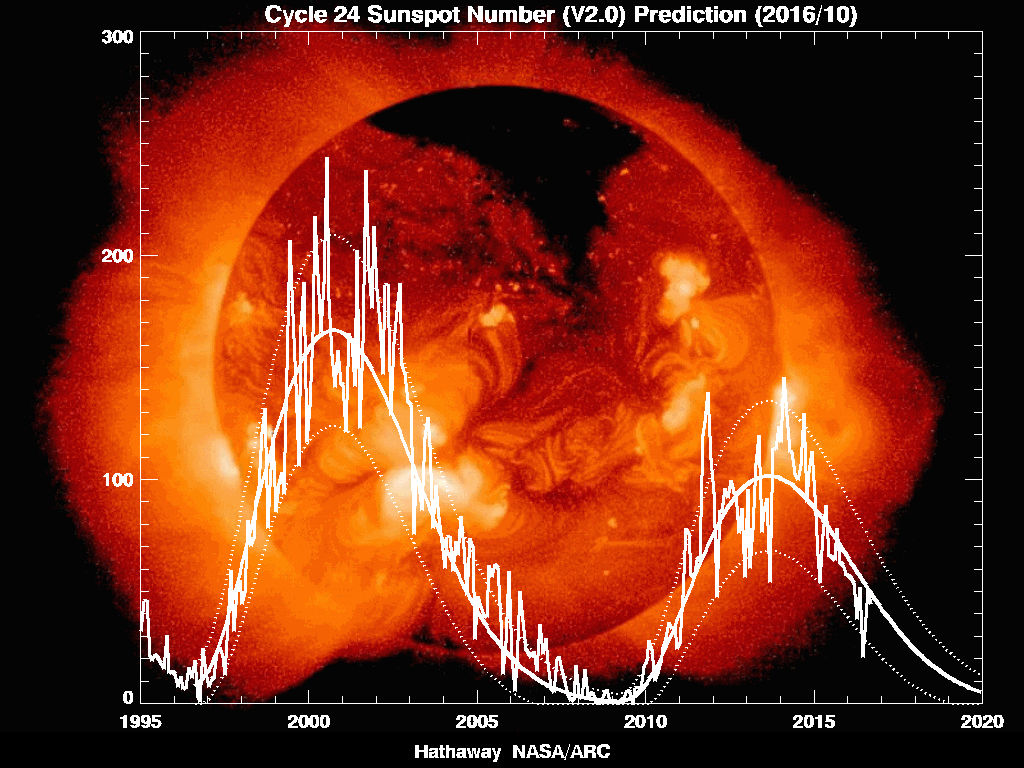
iii) Then we need to know where we stand in relation to the other shorter term cycles of sun and oceans.
Each varies on at least two other timescales. The level of solar activity varies during each cycle and over a run of cycles. The rate of energy release from the oceans varies from each El Nino to the following La Nina and back again over several years and the entire Pacific Decadal Oscillation alters the rate of energy release to the air every 25 to 30 years or so.
All those cycles vary in timing and intensity and interact with each other and are then superimposed on the longer term cycling that forms the basis of this article.
Then we have the chaotic variability of weather superimposed on the whole caboodle.
We simply do not have the data to resolve all those issues so all I can do is hazard a guess based on my personal judgement. On that basis I think we will see cooling for a couple of decades due to the negative phase of the Pacific Decadal Oscillation which has just begun then at least one more 20 to 30 year phase of natural warming before we start the true decline as the cooler thermohaline waters from the Little Ice Age come back to the surface.
If we get a peak of active sun at the same time as the worst of the cooling from the Little Ice Age comes through the oceanic system then that may be the start of a more rapid ending of the current interglacial but that is 500 years hence by which time we will have solved our energy problems or will have destroyed our civilisation.
Other climate theories:
Following the implosion of the CO2 based theory there are lots of other good ideas going around and much effort being expended by many individuals on different aspects of the climate system.
All I would suggest at the moment is that there is room in my NCM for any of those theories that demonstrate a specific climate response from sources other than sun and oceans.
All I contend is that sun and oceans together with the variable speed of the hydrological cycle assisted by the latitudinal movements of the air circulation systems and the vertical movement of the tropopause overwhelmingly provide the background trend and combine to prevent changes in the air alone changing the Earth’s equilibrium temperature.
For example:
Orbital changes feed into the insolation and albedo effects caused by moveable cloud masses.
Asteroid strikes and volcanoes feed into the atmospheric density issue.
Changing length of day and external gravitational forces feed into the speed of the thermohaline circulation.
Geothermal energy feeds into temperatures along the horizontal path of the thermohaline circulation.
Cosmic ray variations and ozone chemistry feed into the albedo changes.
The NCM can account for all past climate variability, can give general guidance as to future trends and can accommodate all manner of supplementary climate theories provided their real world influence can be demonstrated.
I humbly submit that all this is an improvement on existing modelling techniques and deserves fuller and more detailed consideration and investigation.
Novel propositions:
I think it helpful to set out here some of the novel propositions that I have had to formulate in order to obtain a climate description that complies both with observations and with basic laws of physics. This list is not intended to be exhaustive. Other new propositions may be apparent from the content and/or context of my various articles
i) Earth’s temperature is determined primarily by the oceans and not by the air (The Hot Water Bottle Effect). The contribution of the Greenhouse effect is miniscule.
ii) Changes in the air alone cannot affect the global equilibrium temperature because of oceanic dominance that always seeks to maintain sea surface and surface air equilibrium whatever the air tries to do. Warm air cannot significantly affect the oceans due to the huge difference in thermal capacities and by the effect of evaporation which removes unwanted energy to latent form as necessary to maintain the said equilibrium.
iii) Counterintuitively an active sun means cooling not warming and vice versa.
iv) The net global oceanic rate of energy release to the air is what matters with regard to the oceanic effect on the latitudinal positions of the air circulation systems and the associated cloud bands. All the oceanic oscillations affecting the rates of energy release to the air operate on different timescales and different magnitudes as energy progresses through the system via surface currents (not the thermohaline circulation which is entirely separate).
v) More CO2 ought theoretically induce faster cooling of the oceans by increasing evaporation rates. Extra CO2 molecules simply send more infra red radiation back down to the surface but infra red cannot penetrate deeper than the region of ocean surface involved in evaporation and since evaporation has a net cooling effect due to the removal of energy as latent heat the net effect should be increased cooling and not warming of the oceans.
vi) The latitudinal position of the air circulation systems at any given moment indicates the current tropospheric temperature trend whether warming or cooling and their movement reveals any change in trend
vii) All the various climate phenomena in the troposphere serve to balance energy budget changes caused by atmospheric effects from solar turbulence changes on the air above which affect the rate of energy loss to space or from variable rates of energy release from the oceans below.
viii) The speed of the hydrological cycle globally is the main thermostat in the troposphere. Changes in its speed are achieved by latitudinal shifts in the air circulation systems and by changes in the height of the tropopause.
ix) The difference between ice ages and interglacials is a matter of the timing of solar and oceanic cycles. Interglacials only occur when the solar and oceanic cycles are offsetting one another to a sufficient degree to minimise the scale of climate variability thereby preventing winter snowfall on the northern continents from being sufficient to last through the following summer.
x) Landmass distribution dictates the relative lengths of glacials and interglacials. The predominance of landmasses in the northern hemisphere causes glaciations to predominate over interglacials by about 9 to 1 with a full cycle every 100, 000 years helped along by the orbital changes of the Milankovitch cycles that affect the pattern of insolation on those shifting cloud masses.
xi) Distribution of energy within the entire system is more significant for climate (which is limited to the troposphere) than the actual temperature of the entire Earth. The latter varies hardly at all.
xii) All regional climate changes are a result of movement in relation to the locally dominant air circulation systems which move cyclically poleward and equatorward.
xiii) Albedo changes are primarily a consequence of latitudinal movement of the clouds beyond normal seasonal variability.
ix) The faint sun paradox is explained by the effectiveness of changes in the speed of the hydrological cycle. Only if the oceans freeze across their entire surfaces thereby causing the hydrological cycle to cease or if the sun puts in energy faster than it can be pumped upward by the hydrological cycle will the basic temperature equilibrium derived from the properties of water and the density and pressure of the atmosphere fail to be maintained.
A New And Effective Climate Model
The problem with existing climate models:
Even those who aver that man’s activity affects climate on a global scale rather than just locally or regionally appear to accept that the existing climate models are incomplete. It is a given that the existing models do not fully incorporate data or mechanisms involving cloudiness or global albedo (reflectivity) variations or variations in the speed of the hydrological cycle and that the variability in the temperatures of the ocean surfaces and the overall ocean energy content are barely understood and wholly inadequately quantified in the infant attempts at coupled ocean/atmosphere models. Furthermore the effect of variability in solar activity on climate is barely understood and similarly unquantified.
As they stand at present the models assume a generally static global energy budget with relatively little internal system variability so that measurable changes in the various input and output components can only occur from external forcing agents such as changes in the CO2 content of the air caused by human emissions or perhaps temporary after effects from volcanic eruptions, meteorite strikes or significant changes in solar power output.
If such simple models are to have any practical utility it is necessary to demonstrate that some predictive skill is a demonstrable outcome of the models. Unfortunately it is apparent that there is no predictive skill whatever despite huge advances in processing power and the application of millions or even billions of man hours from reputable and experienced scientists over many decades.
As I will show later on virtually all climate variability is a result of internal system variability and additionally the system not only sets up a large amount of variability internally but also provides mechanisms to limit and then reduce that internal variability. It must be so or we would not still have liquid oceans. The current models neither recognise the presence of that internal system variability nor the processes that ultimately stabilise it.
The general approach is currently to describe the climate system from ‘the bottom up’ by accumulating vast amounts of data, observing how the data has changed over time, attributing a weighting to each piece or class of data and extrapolating forward. When the real world outturn then differs from what was expected then adjustments are made to bring the models back into line with reality. This method is known as ‘hindcasting’.
Although that approach has been used for decades no predictive skill has ever emerged. Every time the models have been adjusted using guesswork (or informed judgement as some would say) to bring them back into line with ongoing real world observations a new divergence between model expectations and real world events has begun to develop.
It is now some years since the weighting attached to the influence of CO2 was adjusted to remove a developing discrepancy between the real world warming that was occurring at the time and which had not been fully accounted for in the then climate models. Since that time a new divergence began and is now becoming embarrassingly large for those who made that adjustment. At the very least the weighting given to the effect of more CO2 in the air was excessive.
The problem is directly analogous to a financial accounting system that balances but only because it contains multiple compensating errors. The fact that it balances is a mere mirage. The accounts are still incorrect and woe betide anyone who relies upon them for the purpose of making useful commercial decisions.
Correcting multiple compensating errors either in a climate model or in a financial accounting system cannot be done by guesswork because there is no way of knowing whether the guess is reducing or compounding the underlying errors that remain despite the apparent balancing of the financial (or in the case of the climate the global energy) budget.
The system being used by the entire climatological establishment is fundamentally flawed and must not be relied upon as a basis for policy decisions of any kind.
A better approach:
We know a lot about the basic laws of physics as they affect our day to day existence and we have increasingly detailed data about past and present climate behaviour.
We need a New Climate Model (from now on referred to as NCM) that is created from ‘the top down’ by looking at the climate phenomena that actually occur and using deductive reasoning to decide what mechanisms would be required for those phenomena to occur without offending the basic laws of physics.
We have to start with the broad concepts first and use the detailed data as a guide only. If a broad concept matches the reality then the detailed data will fall into place even if the broad concept needs to be refined in the process. If the broad concept does not match the reality then it must be abandoned but by adopting this process we always start with a broad concept that obviously does match the reality so by adopting a step by step process of observation, logic, elimination and refinement a serviceable NCM with some predictive skill should emerge and the more detailed the model that is built up the more predictive skill will be acquired.
That is exactly what I have been doing step by step in my articles here:
for some two years now and I believe that I have met with a degree of success because many climate phenomena that I had not initially considered in detail seem to be falling into line with the NCM that I have been constructing.
In the process I have found it necessary to propound various novel propositions that have confused and irritated warming proponents and sceptics alike but that is inevitable if one just follows the logic without a preconceived agenda which I hope is what I have done.
I will now go on to describe the NCM as simply as I can in verbal terms, then I will elaborate on some of the novel propositions (my apologies if any of them have already been propounded elsewhere by others but I think I would still be the first to pull them all together into a plausible NCM) and I will include a discussion of some aspects of the NCM which I find encouraging.
Preliminary points:
-
Firstly we must abandon the idea that variations in total solar output have a significant effect over periods of time relevant to human existence. At this point I should mention the ‘faint sun paradox’:
http://en.wikipedia.org/wiki/Faint_young_Sun_paradox
Despite a substantial increase in the power of the sun over billions of years the temperature of the Earth has remained remarkably stable. My proposition is that the reason for that is the existence of water in liquid form in the oceans combined with a relatively stable total atmospheric density. If the power input from the sun changes then the effect is simply to speed up or slow down the hydrological cycle.
An appropriate analogy is a pan of boiling water. However much the power input increases the boiling point remains at 100C. The speed of boiling however does change in response to the level of power input. The boiling point only changes if the density of the air above and thus the pressure on the water surface changes. In the case of the Earth’s atmosphere a change in solar input is met with a change in evaporation rates and thus the speed of the whole hydrological cycle keeping the overall temperature stable despite a change in solar power input.
A change in the speed of the entire hydrological cycle does have a climate effect but as we shall see on timescales relevant to human existence it is too small to measure in the face of internal system variability from other causes.
Unless more CO2 could increase total atmospheric density it could not have a significant effect on global tropospheric temperature. Instead the speed of the hydrological cycle changes to a miniscule and unmeasurable extent in order to maintain sea surface and surface air temperature equilibrium. As I have explained previously a change limited to the air alone short of an increase in total atmospheric density and pressure is incapable of altering that underlying equilibrium.
-
Secondly we must realise that the absolute temperature of the Earth as a whole is largely irrelevant to what we perceive as climate. In any event those changes in the temperature of the Earth as a whole are tiny as a result of the rapid modulating effect of changes in the speed of the hydrological cycle and the speed of the flow of radiated energy to space that always seeks to match the energy value of the whole spectrum of energy coming in from the sun.
The climate in the troposphere is a reflection of the current distribution of energy within the Earth system as a whole and internally the system is far more complex than any current models acknowledge.
That distribution of energy can be uneven horizontally and vertically throughout the ocean depths, the troposphere and the upper atmosphere and furthermore the distribution changes over time.
We see ocean energy content increase or decrease as tropospheric energy content decreases or increases. We see the stratosphere warm as the troposphere cools and cool as the troposphere warms. We see the upper levels of the atmosphere warm as the stratosphere cools and vice versa. We see the polar surface regions warm as the mid latitudes cool or the tropics warm as the poles cool and so on and so forth in infinite permutations of timing and scale.
As I have said elsewhere:
“It is becoming increasingly obvious that the rate of energy transfer varies all the time between ocean and air, air and space and between different layers in the oceans and air. The troposphere can best be regarded as a sandwich filling between the oceans below and the stratosphere above. The temperature of the troposphere is constantly being affected by variations in the rate of energy flow from the oceans driven by internal ocean variability, possibly caused by temperature fluctuations along the horizontal route of the thermohaline circulation and by variations in energy flow from the sun that affect the size of the atmosphere and the rate of energy loss to space.
The observed climate is just the equilibrium response to such variations with the positions of the air circulation systems and the speed of the hydrological cycle always adjusting to bring energy differentials above and below the troposphere back towards equilibrium (Wilde’s Law ?).
Additionally my propositions provide the physical mechanisms accounting for the mathematics of Dr. F. Miskolczi..”
He appears to have demonstrated mathematically that if greenhouse gases in the air other than water vapour increase then the amount of water vapour declines so as to maintain an optimum optical depth for the atmosphere which modulates the energy flow to maintain sea surface and surface air temperature equilibrium. In other words the hydrological cycle speeds up or slows down just as I have always proposed.
-
In my articles to date I have been unwilling to claim anything as grand as the creation of a new model of climate because until now I was unable to propose any solar mechanism that could result directly in global albedo changes without some other forcing agent or that could account for a direct solar cause of discontinuities in the temperature profile along the horizontal line of the oceanic thermohaline circulation.
I have now realised that the global albedo changes necessary and the changes in solar energy input to the oceans can be explained by the latitudinal shifts (beyond normal seasonal variation) of all the air circulation systems and in particular the net latitudinal positions of the three main cloud bands namely the two generated by the mid latitude jet streams plus the Inter Tropical Convergence Zone (ITCZ).
The secret lies in the declining angle of incidence of solar energy input from equator to poles.
It is apparent that the same size and density of cloud mass moved, say, 1000 miles nearer to the equator will have the following effects:
-
It will receive more intense irradiation from the sun and so will reflect more energy to space.
-
It will reduce the amount of energy reaching the surface compared to what it would have let in if situated more poleward.
-
In the northern hemisphere due to the current land/sea distribution the more equatorward the cloud moves the more ocean surface it will cover thus reducing total solar input to the oceans and reducing the rate of accretion to ocean energy content
-
It will produce cooling rains over a larger area of ocean surface.
As a rule the ITCZ is usually situated north of the equator because most ocean is in the southern hemisphere and it is ocean temperatures that dictate it’s position by governing the rate of energy transfer from oceans to air. Thus if the two mid latitude jets move equatorward at the same time as the ITCZ moves closer to the equator the combined effect on global albedo and the amount of solar energy able to penetrate the oceans will be substantial and would dwarf the other proposed effects on albedo from changes in cosmic ray intensity generating changes in cloud totals as per Svensmark and from suggested changes caused in upper cloud quantities by changes in atmospheric chemistry involving ozone which various other climate sceptics propose.
Thus the following NCM will incorporate my above described positional cause of changes in albedo and rates of energy input to the oceans rather than any of the other proposals. That then leads to a rather neat solution to the other theories’ problems with the timing of the various cycles as becomes clear below.
-
I have previously described why the solar effect on climate is not as generally thought but for convenience I will summarise the issue here because it will help readers to follow the logic of the NCM.Variations in total solar power output on timescales relevant to human existence are tiny and are generally countered by a miniscule change in the speed of the hydrological cycle as described above.
However according to our satellites variations in the turbulence of the solar energy output from sunspots and solar flares appear to have significant effects.
During periods of an active solar surface our atmosphere expands and during periods of inactive sun it contracts.
When the atmosphere expands it does so in three dimensions around the entire circumference of the planet but the number of molecules in the atmosphere remains the same with the result that there is an average reduced density per unit of volume with more space between the molecules. Consequently the atmosphere presents a reduced resistance to outgoing longwave energy photons that experience a reduced frequency of being obstructed by molecules in the atmosphere.
Additionally a turbulent solar energy flow disturbs the boundaries of the layers in the upper atmosphere thus increasing their surface areas allowing more energy to be transferred from layer to layer just as wind on water causes waves, an increased sea surface area and faster evaporation.
The changes in the rate of outgoing energy flow caused by changes in solar surface turbulence may be small but they appear to be enough to affect the air circulation systems and thereby influence the overall global energy budget disproportionately to the tiny variations in solar power intensity.
Thus when the sun is more active far from warming the planet the sun is facilitating an increased rate of cooling of the planet. That is why the stratosphere cooled during the late 20th Century period of a highly active sun although the higher levels of the atmosphere warmed. The higher levels were warmed by direct solar impacts but the stratosphere cooled because energy was going up faster than it was being received from the troposphere below.
The opposite occurs for a period of inactive sun.
Some do say that the expansion and contraction of the atmosphere makes no difference to the speed of the outward flow of longwave energy because that outgoing energy still has to negotiate the same mass but that makes no sense to me if that mass is more widely distributed over a three dimensional rather than two dimensional space. If one has a fine fabric container holding a body of liquid the speed at which the liquid escapes will increase if the fabric is stretched to a larger size because the space between the fibres will increase.
Furthermore all that the NCM requires is for the stratosphere alone to lose or gain energy faster or slower so as to influence the tropospheric polar air pressure cells. The energy does not need to actually escape to space to have the required effect. It could just as well simply take a little longer or a little less long to traverse the expanded or contracted upper atmospheric layers.
The New Climate Model (NCM)
-
Solar surface turbulence increases causing an expansion of the Earth’s atmosphere.
-
Resistance to outgoing longwave radiation reduces, energy is lost to space faster.
-
The stratosphere cools. Possibly also the number of chemical reactions in the upper atmosphere increases due to the increased solar effects with faster destruction of ozone.
-
The tropopause rises.
-
There is less resistance to energy flowing up from the troposphere so the polar high pressure systems shrink and weaken accompanied by increasingly positive Arctic and Antarctic Oscillations.
-
The air circulation systems in both hemispheres move poleward and the ITCZ moves further north of the equator as the speed of the hydrological cycle increases due to the cooler stratosphere increasing the temperature differential between stratosphere and surface.
-
The main cloud bands move more poleward to regions where solar insolation is less intense so total global albedo decreases.
-
More solar energy reaches the surface and in particular the oceans as more ocean surfaces north of the equator are exposed to the sun by the movement of the clouds to cover more continental regions.
-
Less rain falls on ocean surfaces allowing them to warm more.
-
Ocean energy input increases but not all is returned to the air. A portion enters the thermohaline circulation to embark on a journey of 1000 to 1500 years. A pulse of slightly warmer water has entered the ocean circulation.
-
Solar surface turbulence passes its peak and the Earth’s atmosphere starts to contract.
-
Resistance to outgoing longwave radiation increases, energy is lost to space more slowly.
-
The stratosphere warms. Ozone levels start to recover.
-
The tropopause falls
-
There is increased resistance to energy flowing up from the troposphere so the polar high pressure systems expand and intensify producing increasingly negative Arctic and Antarctic Oscillations.
-
The air circulation systems in both hemispheres move back equatorward and the ITCZ moves nearer the equator as the speed of the hydrological cycle decreases due to the warming stratosphere reducing the temperature differential between stratosphere and surface.
-
The main cloud bands move more equatorward to regions where solar insolation is more intense so total global albedo increases once more.
-
Less solar energy reaches the surface and in particular the oceans as less ocean surfaces north of the equator are exposed to the sun by the movement of the clouds to cover more oceanic regions.
-
More rain falls on ocean surfaces further cooling them.
-
Ocean energy input decreases and the amount of energy entering the thermohaline circulation declines sending a pulse of slightly cooler water on that 1000 to 1500 year journey.
-
After 1000 to 1500 years those variations in energy flowing through the thermohaline circulation return to the surface by influencing the size and intensity of the ocean surface temperature oscillations that have now been noted around the world in all the main ocean basins and in particular the Pacific and the Atlantic. It is likely that the current powerful run of positive Pacific Decadal Oscillations is the pulse of warmth from the Mediaeval Warm Period returning to the surface with the consequent inevitable increase in atmospheric CO2 as that warmer water fails to take up as much CO2 by absorption. Cooler water absorbs more CO2, warmer water absorbs less CO2. We have the arrival of the cool pulse from the Little Ice Age to look forward to and the scale of its effect will depend upon the level of solar surface activity at the time. A quiet sun would be helpful otherwise the rate of tropospheric cooling as an active sun throws energy into space at the same time as the oceans deny energy to the air will be fearful indeed. Fortunately the level of solar activity does seem to have begun a decline from recent peaks.
-
The length of the thermohaline circulation is not synchronous with the length of the variations in solar surface turbulence so it is very much a lottery as to whether a returning warm or cool pulse will encounter an active or inactive sun.
-
A returning warm pulse will try to expand the tropical air masses as more energy is released and will try to push the air circulation systems poleward against whatever resistance is being supplied at the time by the then level of solar surface turbulence. A returning cool pulse will present less opposition to solar effects.
-
Climate is simply a product of the current balance in the troposphere between the solar and oceanic effects on the positions and intensities of all the global air circulation systems
-
The timing of the solar cycles and ocean cycles will drift relative to one another due to their asynchronicity so there will be periods when solar and ocean cycles supplement one another in transferring energy out to space and other periods when they will offset one another.
26) During the current interglacial the solar and oceanic cycles are broadly offsetting one another to reduce overall climate variability but during glacial epochs they broadly supplement one another to produce much larger climate swings. The active sun during the Mediaeval Warm Period and the Modern Warm Period and the quiet sun during the Little Ice Age reduced the size of the climate swings that would otherwise have occurred. During the former two periods the extra energy from a warm ocean pulse was ejected quickly to space by an active sun to reduce tropospheric heating. During the latter period the effect on tropospheric temperatures of reduced energy from a cool ocean pulse was mitigated by slower ejection of energy to space from a less active sun.
Discussion points:
Falsification:
Every serious hypothesis must be capable of being proved false. In the case of this NCM my narrative is replete with opportunities for falsification if the future real world observations diverge from the pattern of cause and effect that I have set out.
However that narrative is based on what we have actually observed over a period of 1000 years with the gaps filled in by deduction informed by known laws of physics.
At the moment I am not aware of any observed climate phenomena that would effect falsification. If there be any that suggest such a thing then I suspect that they will call for refinement of the NCM rather than abandonment.
For true falsification we would need to observe events such as the mid latitude jets moving poleward during a cooling oceanic phase and a period of quiet sun or the ITCZ moving northward whilst the two jets moved equatorward or the stratosphere, troposphere and upper atmosphere all warming or cooling in tandem or perhaps an unusually powerful Arctic Oscillation throughout a period of high solar turbulence and a warming ocean phase.
They say nothing is impossible so we will have to wait and see.
Predictive skill:
To be taken seriously the NCM must be seen to show more predictive skill than the current computer based models.
In theory that shouldn’t be difficult because their level of success is currently zero.
From a reading of my narrative it is readily apparent that if the NCM matches reality then lots of predictions can be made. They may not be precise in terms of scale or timing but they are nevertheless useful in identifying where we are in the overall scheme of things and the most likely direction of future trend.
For example if the mid latitude jets stay where they now are then a developing cooling trend can be expected.
If the jets move poleward for any length of time then a warming trend may be returning.
If the solar surface becomes more active then we should see a reduction in the intensity of the Arctic Oscillation.
If the current El Nino fades to a La Nina then the northern winter snows should not be as intense next winter but it will nevertheless be another cold though drier northern hemisphere winter as the La Nina denies energy to the air.
The past winter is a prime example of what the NCM suggests for a northern winter with an El Nino during a period of quiet sun. The warmth from the oceans pumps energy upwards but the quiet sun prevents the poleward movement of the jets. The result is warming of the tropics and of the highest latitudes (but the latter stay below the freezing point of water) and a flow of cold into the mid latitudes and more precipitation in the form of snow at lower latitudes than normal.
So I suggest that a degree of predictive skill is already apparent for my NCM.
Likely 21st Century climate trend:
There are 3 issues to be resolved for a judgement on this question.
i) We need to know whether the Modern Warm Period has peaked or not. It seems that the recent peak late 20th Century has passed but at a level of temperature lower than seen during the Mediaeval Warm Period. Greenland is not yet as habitable as when the Vikings first colonised it. Furthermore it is not yet 1000 years since the peak of the Mediaeval Warm Period which lasted from about 950 to 1250 AD
http://www.theresilientearth.com/?q=content/medieval-warm-period-rediscovered
so I suspect that the Mediaeval warmth now emanating from the oceans may well warm the troposphere a little more during future years of warm oceanic oscillations. I would also expect the CO2 levels to continue drifting up until a while after the Mediaeval Warm Period water surface warming peak has begun it’s decline. That may still be some time away, perhaps a century or two.
ii) We need to know where we are in the solar cycles. The highest peak of solar activity in recorded history occurred during the late 20th Century but we don’t really know how active the sun became during the Mediaeval Warm Period. There are calculations from isotope proxies but the accuracy of proxies is in the doghouse since Climategate and the hockey stick farrago. However the current solar quiescence suggests that the peak of recent solar activity is now over.
http://solarscience.msfc.nasa.gov/images/ssn_predict_l.gif
iii) Then we need to know where we stand in relation to the other shorter term cycles of sun and oceans.
Each varies on at least two other timescales. The level of solar activity varies during each cycle and over a run of cycles. The rate of energy release from the oceans varies from each El Nino to the following La Nina and back again over several years and the entire Pacific Decadal Oscillation alters the rate of energy release to the air every 25 to 30 years or so.
All those cycles vary in timing and intensity and interact with each other and are then superimposed on the longer term cycling that forms the basis of this article.
Then we have the chaotic variability of weather superimposed on the whole caboodle.
We simply do not have the data to resolve all those issues so all I can do is hazard a guess based on my personal judgement. On that basis I think we will see cooling for a couple of decades due to the negative phase of the Pacific Decadal Oscillation which has just begun then at least one more 20 to 30 year phase of natural warming before we start the true decline as the cooler thermohaline waters from the Little Ice Age come back to the surface.
If we get a peak of active sun at the same time as the worst of the cooling from the Little Ice Age comes through the oceanic system then that may be the start of a more rapid ending of the current interglacial but that is 500 years hence by which time we will have solved our energy problems or will have destroyed our civilisation.
Other climate theories:
Following the implosion of the CO2 based theory there are lots of other good ideas going around and much effort being expended by many individuals on different aspects of the climate system.
All I would suggest at the moment is that there is room in my NCM for any of those theories that demonstrate a specific climate response from sources other than sun and oceans.
All I contend is that sun and oceans together with the variable speed of the hydrological cycle assisted by the latitudinal movements of the air circulation systems and the vertical movement of the tropopause overwhelmingly provide the background trend and combine to prevent changes in the air alone changing the Earth’s equilibrium temperature.
For example:
Orbital changes feed into the insolation and albedo effects caused by moveable cloud masses.
Asteroid strikes and volcanoes feed into the atmospheric density issue.
Changing length of day and external gravitational forces feed into the speed of the thermohaline circulation.
Geothermal energy feeds into temperatures along the horizontal path of the thermohaline circulation.
Cosmic ray variations and ozone chemistry feed into the albedo changes.
The NCM can account for all past climate variability, can give general guidance as to future trends and can accommodate all manner of supplementary climate theories provided their real world influence can be demonstrated.
I humbly submit that all this is an improvement on existing modelling techniques and deserves fuller and more detailed consideration and investigation.
Novel propositions:
I think it helpful to set out here some of the novel propositions that I have had to formulate in order to obtain a climate description that complies both with observations and with basic laws of physics. This list is not intended to be exhaustive. Other new propositions may be apparent from the content and/or context of my various articles
i) Earth’s temperature is determined primarily by the oceans and not by the air (The Hot Water Bottle Effect). The contribution of the Greenhouse effect is miniscule.
ii) Changes in the air alone cannot affect the global equilibrium temperature because of oceanic dominance that always seeks to maintain sea surface and surface air equilibrium whatever the air tries to do. Warm air cannot significantly affect the oceans due to the huge difference in thermal capacities and by the effect of evaporation which removes unwanted energy to latent form as necessary to maintain the said equilibrium.
iii) Counterintuitively an active sun means cooling not warming and vice versa.
iv) The net global oceanic rate of energy release to the air is what matters with regard to the oceanic effect on the latitudinal positions of the air circulation systems and the associated cloud bands. All the oceanic oscillations affecting the rates of energy release to the air operate on different timescales and different magnitudes as energy progresses through the system via surface currents (not the thermohaline circulation which is entirely separate).
v) More CO2 ought theoretically induce faster cooling of the oceans by increasing evaporation rates. Extra CO2 molecules simply send more infra red radiation back down to the surface but infra red cannot penetrate deeper than the region of ocean surface involved in evaporation and since evaporation has a net cooling effect due to the removal of energy as latent heat the net effect should be increased cooling and not warming of the oceans.
vi) The latitudinal position of the air circulation systems at any given moment indicates the current tropospheric temperature trend whether warming or cooling and their movement reveals any change in trend
vii) All the various climate phenomena in the troposphere serve to balance energy budget changes caused by atmospheric effects from solar turbulence changes on the air above which affect the rate of energy loss to space or from variable rates of energy release from the oceans below.
viii) The speed of the hydrological cycle globally is the main thermostat in the troposphere. Changes in its speed are achieved by latitudinal shifts in the air circulation systems and by changes in the height of the tropopause.
ix) The difference between ice ages and interglacials is a matter of the timing of solar and oceanic cycles. Interglacials only occur when the solar and oceanic cycles are offsetting one another to a sufficient degree to minimise the scale of climate variability thereby preventing winter snowfall on the northern continents from being sufficient to last through the following summer.
x) Landmass distribution dictates the relative lengths of glacials and interglacials. The predominance of landmasses in the northern hemisphere causes glaciations to predominate over interglacials by about 9 to 1 with a full cycle every 100, 000 years helped along by the orbital changes of the Milankovitch cycles that affect the pattern of insolation on those shifting cloud masses.
xi) Distribution of energy within the entire system is more significant for climate (which is limited to the troposphere) than the actual temperature of the entire Earth. The latter varies hardly at all.
xii) All regional climate changes are a result of movement in relation to the locally dominant air circulation systems which move cyclically poleward and equatorward.
xiii) Albedo changes are primarily a consequence of latitudinal movement of the clouds beyond normal seasonal variability.
ix) The faint sun paradox is explained by the effectiveness of changes in the speed of the hydrological cycle. Only if the oceans freeze across their entire surfaces thereby causing the hydrological cycle to cease or if the sun puts in energy faster than it can be pumped upward by the hydrological cycle will the basic temperature equilibrium derived from the properties of water and the density and pressure of the atmosphere fail to be maintained.
“Dan C. (13:29:29) :
[…]
around you shoulder-to-shoulder. Hold an AK47 horizontally, close your eyes, spin in a circle and empty the clip.”
You got a funny approach to physics, kid…
Don’t worry – it’ll go away once you stop watching “Saw” and “Hostel”.
A problem:
“Despite a substantial increase in the power of the sun over billions of years the temperature of the Earth has remained remarkably stable. My proposition is that the reason for that is the existence of water in liquid form in the oceans combined with a relatively stable total atmospheric density. If the power input from the sun changes then the effect is simply to speed up or slow down the hydrological cycle.”
The problem, the atmospheric density has almost certainly gone down on average over time. The time I speak of is the time when the surface of the planet cooled enough that the planet itself was not contributing noticably to its atmospheric temperature, and when the atmosphere was substanially like it is now in composition (after all the volcanic crud had settled out and early plant life had created free oxegen). In short, there is considerable evidence that the atmospheric density used to be substantially higher on avarage than it is today.
Data:
There has been recent findings that show that earths magnetic field provides less protection against solor wind stripping away the atmosphere than was thought, scientists were suprised at how much was stripped away regularly. This, plus some stripping away from the gravitational effects of the moon, strongly suggests that the atmosphere formerly used to be denser than it is now.
Micro bubbles found in deep polar ice cores of the ancient atmosphere (1-200,000 years ago) showed a higher atmospheric density than now, perhaps 2 atmospheres, also higher water vapor and CO2. Note that this is a reletivly short time period and I am not sure how accurate it is, however, scientists seemed to think that it was a relativly accurate representation of this ancient atmoshere.
A relativly ingored evidence is the giant flying dinosaurs and dragonflies with 3 foot wingspans that existed in ancient times. The conventional explaination from non multidisciplinary scientists (those who never look beyond their own branch) is that the dinosaurs flew off cliffs, a ridiculous essertion since they would quickly die off when forced down at any non cliff, it would restrict them to such a small zone where they could fly and hence live that they would be non viable, it also does not explain the giant dragonflies. However, if we add the solar wind and moon slow stipping of the atmosphere, which show that atmosphere must have been denser in the past than now, a simpler and more logical explaination, that the giant flying critters could fly due to the denser atmosphere then extant, is warrented.
In short, there is evidence that, going back in time, the atmosphere was more dense. This would to some extant conteract the smaller dimmer sun. Also, there is evidence that CO2 levels, on avarage, were much higher in ancient times than today, although how much effect that had on temperature is hard to tell, since these high CO2 levels did not stop any ice ages. All that CO2 did allow abuntanct plant and hence animal and other life on land and in the sea which must also have had some effect on climate if only by changing albedo. However, the two together, especially the higher atmospheric density, must have had some effect on heat retention of the earth system.
Also, do we really know what a smaller dimmer sun was like? Was it’s solar wind stronger or weaker, what about magnetism, sunspots and solar activity, the effect of that different magnetism and sunspot activity on cosmic rays, etc? What about spectrum, did the sun put out the same or different types of energy than today, more or less infra-red, visible, ultraviolet, xrays, and what effect wuld that have on climate?
In short, your idea that the temperature of the earth has been remarkably stable over times is correct, and the idea that water seems to dominate also looks correct, but the idea of a stable atmospheric density appears incorrect, and the ancient sun is a complete unknown that needs looking into.
Stephen your new look at climate modelling is commendable. I just hope that you can get the necessary finding to continue with this work given the current frenzied CO2 world. From the above comments some work still needs to be done.
One of the issues that puzzle me with the current climate models is that they do not follow the protocols of numerical models used in other earth sciences such as hydrogeology for example. These models (I have more than 35 years experience running these) ideally require a historical record of long duration that is used for calibrating (fitting the data) for part of the record and then validating (checking the sim results with measured data) for the remaining part of the record. It seems to me that unless a climate model can both calibrate the Medieval Warm Period and the Little Ice Age and then validate the 20th and 21st Century true (un-manipulated) temperatures using all of the known influencing factors, it cannot be claimed that such a model is a representative simulation of earth’s climate.
Currently climate models use ALL of the data (without validation) from the late 19th Century onwards and fudge fit the data using a number of “tuning” parameters. The results of course can look quite good but of course bear no relation to the causes of the actual changing climatic conditions.
The whole human induced climate change belief and its doomsayers remind me very much about Copernicus (the skeptics) and Ptolomy (the IPCC et. al.). Ptolemy’s geocentric version of the solar system was supported by religious fervour and dogma together with a few high priests spelling out the “End is nigh” for the human race to believe otherwise. Any naysayers of course were at the time ceremoniously burnt at the stake. In the 21st Century they’re simply labelled as environmental criminals and “flat earthers”.
When Ptolemy’s model of the planets didn’t quite fit with observations, he manipulated/ fudged his model to fit the observations. His model was totally wrong of course. The Sun turned out to be at the centre of the solar system not the earth and ironically it is also one of the main drivers of global warming (and cooling) in the geological history of the earth, including the 20th and 21st Century.
Leif Svalgaard (12:44:47) :
Sigh. Those changes are caused by upwards traveling Rossby waves that break in the stratosphere and then influence stuff below.
Forgot a reference: http://www.ccpo.odu.edu/SEES/ozone/class/Chap_6/
See section 4.
___________________________
The article quoted does a very good job of describing of how Lunar declinational tidal action progresses, for the 27.32 day cycle of movement, they just never label it as “Lunar tides”. There is a similar patterns in over all global circulation as an over all 18.6 year and 18.03 year Saros cycle that shows up in the data. This feature alone can be used as a daily forecast, for the next 18 years, from the repeatability of the global circulation patterns driven by the moon’s tidal effects and modulated by the passing of the outer planets heliocentricly. Pattern recognition is a good thing, repeating patterns on repeating periods, are not hard to find. There are additional effects not yet considered, that when understood from their meaning in satellite data, will prove to be useful in both weather and climate forecasting.
RE: Sphaerica (14:32:04) :
“Hindcasting is a way of validating a model, not changing or improving it. You start from some point back in time, so that you have a period of actual data (from then to the present) against which to compare the results of the model. If the two match well, then you know your model is accurate. If not, your model is inaccurate and needs improvement, but you do not improve it by simply applying actual measurements to force the model in line.”
In your first sentence you state “Hindcasting is a way of validating a model, not changing or improving it” and in your last sentence you state “If not, your model is inaccurate and needs improvement”. So then hindcasting is a method of improving the model.
The process you have described is exactly using actual measurements to force the model into line. You continually re-iterate your model until it fits the past data. Therefore it is your data that is forcing your model into line. Hindcasting cannot then confirm how accurately your model approximates the real world. For the stock market you could easily construct a model through a few iterations that hindcasts very well. I can remember doing that exercise in undergrad. What do you expect the forecasting power of our models were? They were very poor, but how could that be? After all they fitted the past data perfectly.
The important test of any scientific theory/model is that it predicts something new. Otherwise you are engaging in inductivism instead of deductivism. Hindcasting is just inductivism. For a model to be scientific it mast prove itself as being able to be correct in a deductive way. In other words for a completely new situation you should be able to deduce the outcomes correctly from your model. Look at the projections of the IPCC models. They continually have to be updated as the deductions they make are wrong and the new data produces a different induced model.
—————————————————————
DeNihilist (09:32:16) :
DavidB (01:33:58) :
A differing view on the state of physics:
http://discovermagazine.com/2009/may/01-the-biocentric-universe-life-creates-time-space-cosmos
————————————————————-
DeNihilist:
I nautighly suggested to Lief in a thread that the affect of the sun on the
earth was perhaps from entanglement. That is, entangled particles, some
how seperated (at birth) but now aggregated into balls the size of the earth and the sun, with entangled kindred particles aggregated into their opposite bodies, but remain entangled with each other. This is of course is ridiculous. But never the less, entanglement is a reality. So, it’s force is neglible…but if two particles are entangled at a distance of 7 miles, the distance is irrelevant and as affecting one affects the other virtually concurrently, and while the force between two particles can barely be measured; an aggregation the size of a planet……
I didn’t arrive at my idea by the article in Discover Mag. or anyone’s idea but from the indication that the ‘sun did not shine for 3 hours’ in the gospels (14th of Nisan, AD 26 (?)) a suggestion to me that everything is connected. No room for religion here and sorry to bring it up.
But……….entanglement would provide that connection. FYI. Not proposing anything. This can’t be true. But what the hell is entanglement? and how is it that one affects the other by way of a communication faster than light. Both notions are as rediculous as the other, but the latter appears to have been accepted as a reality. I know Discover is a ‘pop’ magazine. Anyway, for the sake of discussion I say this but also accept that it’s probably not worth discussing!
Heres the blip from the Discover article:
‘………………In 1997 University of Geneva physicist Nicolas Gisin sent two entangled photons zooming along optical fibers until they were seven miles apart. One photon then hit a two-way mirror where it had a choice: either bounce off or go through. Detectors recorded what it randomly did. But whatever action it took, its entangled twin always performed the complementary action. The communication between the two happened at least 10,000 times faster than the speed of light. It seems that quantum news travels instantaneously, limited by no external constraints—not even the speed of light. Since then, other researchers have duplicated and refined Gisin’s work. Today no one questions the immediate nature of this connectedness between bits of light or matter, or even entire clusters of atoms………….’
————– ———————————————
Anthony: I’m in favor of the removal of Dan C (13:29:29) comments. Totally out of place here. Doesn’t represent the spirit of things here at all.
=================
DirkH (15:40:06) :
“Dan C. (13:29:29) :
[…]
around you shoulder-to-shoulder. Hold an AK47 horizontally, close your eyes, spin in a circle and empty the clip.”
You got a funny approach to physics, kid…
Don’t worry – it’ll go away once you stop watching “Saw” and “Hostel”.
This is precisely the type of climate “model” that the science of climatology needs, in its current infancy. Such thought models can be turned into testable hypotheses — and can be falsified since they lack the quasi-reverence that is accorded to the “CO2 is ALL” theory of climate change.
Orthodox climate modelers have failed miserably because they attempted to model a theory which had not been well thought out. Hence plenty of equations, but no content of any significance. GIGO GIGO GIGO
Richard Holle (16:33:09) :
driven by the moon’s tidal effects and modulated by the passing of the outer planets heliocentricly.
Lunar [and solar tides] are measurable. The outer planets’ absolutely not, much too small. The tides are proportional to the mass divided by the cube of the distance. Jupiter is 25,000 heavier than the Moon, but is 2000 times further away, so the tides are 25,000/2000^3 = 0.000,003 times that of the Moon [that is 300,000 times smaller], completely negligible.
Stephen Wilde is quite correct in pointing to evaporation from the oceans and the rate of the hydrological cycle as the pre-eminent regulator of surface temperatures on Earth in his conceptual “model.” The physics of that regulation, however, is misunderstood by many, whose concept of thermodynamics is confined to Stefan-Boltzman graybody approximations. What is essentially different about the oceans from a graybody is that energy absorption is entirely radiative, whereas emission is only partly radiative. On a NET climatic basis, more energy leaves the global ocean surface in the form of latent heat than in LW radiation and conduction/convection combined. Most models do not get this right and forget that IR is totally absorbed within the top fraction of a millimeter of the ocean, going largely into evaporating the surface skin. Unlike the situation on land, which can be well approximated as a graybody, it does NOT go into raising the temperature of the underlying layers. Moreover, the LW backradiation of from the atmosphere is largely a net null exchange, wherein the insolation thermalized near the surface brings the nearby air to close the same temperature. It no more “heats the surface” than exchanging checks with your wife increases household spending power.
Doesn’t everyone love watching the “big cats” in this global climate scientific cage spitting and hissing back and forth? At their technical conferences, I’m guessing they practice professional decorum to a flaw. On the pages of this blog, they slash and burn with wild abandon. This is a great site!
Outstanding ……………
One thing seems inconsistent.
One aspect of the theory revolves about solar activity heating and expanding the atmosphere – thus making it easier to long wave radiation to escape because of the less dense molecule phenomenon. Seems wrong.
Say the atmosphere is heated and expands. Look at a single cylinder originating from the surface of the earth and ending at the top of the atmosphere. The volume of this cylinder increases as the contents are heated and thereby expand. Note the diameter remains unchanged since there are neighboring cylinders doing the same expansion, thus constraining any expansion of the walls of the cylinder. Only the top moves – upward in our ‘heating’ example.
The theory is that since the molecules are now further apart there are less collisions for escaping radiation to survive before reaching space, thus more outbound radiation happens. Not so, I suggest.
There exist the same number of molecules in the cylinder, regardless of the volume. Regardless of their proximity to each other, there still exist the same opportunity for collisions by outbound radiation. think of it this way: the molecules are less densely packed, but the DISTANCE the radiation must survive to escape the cylinder has increased since the top surface of the cylinder has moved outward as the contents expanded.
At least, that’s how i see it.
Leif Svalgaard (19:03:11) :
Richard Holle (16:33:09) :
driven by the moon’s tidal effects and modulated by the passing of the outer planets heliocentricly.
Lunar [and solar tides] are measurable. The outer planets’ absolutely not, much too small. The tides are proportional to the mass divided by the cube of the distance. Jupiter is 25,000 heavier than the Moon, but is 2000 times further away, so the tides are 25,000/2000^3 = 0.000,003 times that of the Moon [that is 300,000 times smaller], completely negligible.
___________________
(brevity in loo of detail, where is the line?)Sorry the more words I leave out the less sense it makes, maybe putting them back will help?
There is a discernible repeating pattern in the weather data, due to the Lunar declinational atmospheric tides that, also shows recognizable patterns of interference, that leaves the Earth homopolar effects mechanism, modulated electromagnetically from the effects of Earth passing through the concentrated magnetic field flux, extending from the sun out to that outer planet, that defines the pattern of magnetic field coupling of the solar wind into and through the magnetically permeable content of each planet. Resulting in Angular momentum and LOD changes, and driving an increase in the equator to pole voltage gradient, shifting poleward more positive ions than before, then just past peak EM coupling the system discharges back to close to average, by generating greater than normal precipitations, connected interactively and striving for total energy balance between them.
In the research pages of text on my web site more detail can be found.
Richard Holle (21:56:31) :
magnetic field coupling of the solar wind into and through the magnetically permeable content of each planet. Resulting in Angular momentum and LOD changes,
Well, putting them back in did not help. The solar wind does not couple to the Earth through magnetism. It would be rather O/T to discuss this here and now [it has been discussed many times before]. There are no changes in Angular Momentum or LOD related to the solar wind.
Leif Svalgaard (12:44:47) :
Stephen Wilde (12:23:46) :
“They say the trend toward a stronger, tighter circulation around the North Pole could be triggered just as well by processes in the stratosphere as by those in the ocean.”
Sigh. Those changes are caused by upwards traveling Rossby waves that break in the stratosphere and then influence stuff below.
SEPPÄALÄA ET AL 2009 suggests
Ozone changes could affect stratospheric winds so that breaking of vertically propagating planetary-scale Rossby waves from the troposphere would be affected, this breaking could drive the downward propagation of NAM-like patterns which would ultimately be seen in the SAT. The resemblance of the NH ¢SAT patterns to the typical cell-like NAM pattern effects in the meteorological data used here and the similarity of model predictions of Rozanov et al. to the positive NAM SAT pattern perhaps indicates a common mechanism between the NAM and changes induced by geomagnetic variations. The origin of the annular mode patterns is not yet fully understood, although it is possibly linked to polar
vortex strength [Baldwin et al., 2003
The enhanced polar vortex restricts the annular or seasonal expansion or contraction of the high latitude stormtracks it tends to retain the ST in the higher latitudes in the SH in winter where there is interference in the competing periodicites and systems eg Trebneth 1986 2010.
Ramanathan provides some interesting conjectures
Cloud radiative forcing (CRF) is defined as the difference between the radiation budget (net incoming solar radiation minus the outgoing long wave) over a cloudy (mix of clearand clouds) sky and that over a clear sky. If this difference is negative clouds exert a cooling effect, while if it is positive, it denotes a heating effect. Five-year average of the cloud radiative forcing [1] is shown in Fig. 2. The global average forcing is about –15 to–20 W m-2 and thus clouds have a major cooling effect on the planet.
The enormous cooling effect of extratropical storm track cloud systems
Extra-tropical storm track cloud systems provide about 60% of the total cooling effect of clouds [2]. The annual mean forcing from these cloud systems is in the range of –45 to –55 W m–2 and effectively these cloud systems are shielding both the northern and the southern polar regions from intense radiative heating. Their spatial extent towards the tropics moves with the jet stream, extending farthest towards the tropics (about 35 deg latitude) during winter and retreating polewards (polewards of 50 deg latitude) during summer. This phenomenon raises an important question related to past climate dynamics. During the ice age, due to the large polar cooling, the northern hemisphere jet stream extended more southwards. But have the extra tropical cloud systems also moved southward? The increase in the negative forcing would have exerted a major positive feedback on the ice age cooling. There is a curious puzzle about the existence of these cooling clouds. The basic function of the extra tropical dynamics is to export heat polewards.
While the baroclinic systems are efficient in transporting heat, the enormous negative
radiative forcing (Fig. 2) associated with these cloud systems seems to undo the
poleward transport of heat by the dynamics. The radiative effect of these systems is working against the dynamical effect. Evidently,we need better understanding of the dynamic-thermodynamic coupling between these enormous cooling clouds and the
equator-pole temperature gradient, and greenhouse forcing.
Let’s take a step back because most of the negative contributors here are missing the point.
Contrary to what Leif suggests I do not ‘want’ any particular feature of the so called ‘model’.
My description is based (as per Occam’s Razor) on the the simplest solution wherever real world observed phenomena appear to be offending the basic laws of physics. Two examples:
i) It is clear that there is differential warming and cooling of the layers in the system. Troposphere, stratosphere and the upper layers of the air never warm or cool in tandem.The stratosphere seems to go in the opposite direction to the other two. Thus the simplest explanation is internal system variability in the rate of upward transmission of energy between the layers. Below the tropopause the behaviour of the oceans and the speed of the hydrological cycle will suffice but that won’t have much effect above the tropopause. Above the tropopause the only feasible cause of differential warming and cooling in seperate layers has to be differential responses to solar changes. It’s all very well asserting that that is impossible as per Leif and Frank but that gets us nowhere. If the simplest explanation is impossible then kindly come up with a plausible alternative.
ii) Likewise with the latitudinal positions of the air circulation systems. It is clear that the positioning varies over time and cyclically as a balance of influence shifts between oceanic effects from below and atmospheric effects from above. In accordance with that proposition the ocean surface temperatures change cyclically and the polar atmospheric oscillations change cyclically. As before, the ocean effects are not going to do much above the tropopause and indeed the polar oscillations appear to vary independently of the oceans. Occams’ Razor suggests a solar influence from above which, logically, can be linked to the differential warming and cooling of the layers above the tropopause.That is merely the starting point.If the simplest explanation is impossible then kindly come up with a plausible alternative.
All I have done is fire a starting pistol. The finish line may or may not be where I have proposed it should be. However the further away from my proposals that it is necessary to go then the less likely it is to be right as per Occam’s Razor.
Now, can anyone else cut it ?
Here is my problem:
The problem is that your predictions for the NCM are not falsifiable in time or space. There’s far too much wiggle room in the “degree of predictive skill” that you claim (and too much ambiguity in the term).
If I read those claims correctly, then there’s not a single climate modeler out there (including the wretched Schmidt) who can’t make the same predictions as yours do.
There’s no “If the current El Nino fades to a La Nina then…” language required if your model has any predictive skill. It should tell us when and by how much these phenomena will occur. The predictions should also be unique to your model and unambiguous.
Otherwise all I can see are another set of vague claims that this or that climate phenomenon “are consistent with the model”
If this reminds me of anything, it would be the late theoretical physicist David Bohm’s Wholeness and the Implicate Order, in which he critiques science for its bottom up approach to understanding the universe. Bohm was thought of by some as the closest thing to Einstein his time produced.
From his book:
And:
Wikipedia sums up the concept with 9 points, the first 2 of which are:
1.) That phenomena are reducible to fundamental particles and laws describing the behaviour of particles, or more generally to any static (i.e. unchanging) entities, whether separate events in space-time, quantum states, or static entities of some other nature.
2.) Related to (1), that human knowledge is most fundamentally concerned with mathematical prediction of statistical aggregates of particles.
These, taken with the last sentence in the previous quote sum up the approach of climatology, as I see it – that they approach it from the bottom up, certain that they can re-create and understand the entirety by predicting the aggregate of the particles in the atmosphere, and that in the end, they will be able to construct and atmospheric theory of everything.
That seems – especially from his hubristic attitude – Mann’s attempt to bring all proxies and instrument data together, and that it would be the end-all and be-all of climate studies.
The climate models certainly are built on the concept of “from the gazillion particles the entire atmosphere can be re-created inside a computer.”
Bohm argued that primacy be
and that
Hardly anything we can have studied could be more aptly called a “Flowing Movement” as our climate. Applying Bohm’s approach would come up with something very close to this approach of Stephen Wilde, irregardless of whether every part of Wilde’s New Climate Model is perfectly true or not. As Wilde says, (if I understand him correctly) since it starts out from the top, from a vision of its whole, correcting parts of it does not destroy the entirety – only the way we approach that portion of it.
There IS an inherent weakness in constructs whose whole is built from the pieces. And that is mainly that there soon becomes no whole of which those pieces really are a part – the whole gets lost in the territorial claims made by each part. And the parts fail to – in Bohm’s experience in physics especially – become a whole that makes the sense it is intended to. In other words, the parts contradict each other and researchers spin their collective wheels forever trying to get the parts to fit – which Bohm strongly implies will never happen, not until the whole becomes the construct into which the parts are then fitted.
The whole gives a guide to what the parts will be and where they fit in.
Climatologists will almost certainly argue that the “whole” in their studies IS climate. Yet none study it all; all break it into parts and then believe that they are re-constructing it via analysis of its parts. Such was (and is) the approach of theoretical physics, too – and the “schizoid” approach (my term not his) makes for a lot of little pieces of something that he basically asserts isn’t the right “something”, the right “whole.”
So, whether Wilde here has pegged it – nailed what the whole is – or not, Bohm would approve of this approach. And Bohm would predict it will have greater understanding come out of it – and, like Wilde asserts – will be able to predict more consistently correct results.
Nothing in climatology (that I see) is as embarrassing for the field than the strident assertions that such and such is going to happen to temps in the near future and then it not happen. The silliness with which such failures are defended is probably the only thing sillier than the strident nature of the predictions in the first place.
Extrapolating a whole from parts – the CO2 in the stratosphere as Earth incubator being one of them – means that the parts REALLY have to be nailed AND COMPLETELY AND CORRECTLY UNDERSTOOD in order for the whole to eventually be apprehended.
Without the whole as an overall guide, as Wilde and Bohm suggest, extrapolated wholes seem nigh on impossible to achieve. Bohm decried the state of physics, that its lack of a wholeness framework led to its piecemeal understandings and fragmented and disjointed concepts which did not (and still do not) fit together. Climatologists might not think that is the case in their filed, too, but nearly every part of it is contended by some major part of its adherents – regardless of the claim to “consensus” on anthropogenic global warming. (Even there, they are looking at only temperature as if that is the entirety of climate, so their own work indicts them.)
I side with Wilde, even though I am certain that parts of what he has attempted will be shown to be in need of revision.
.
“Leif Svalgaard (11:23:51) :
Michael Ozanne (09:49:47) :
Well I architect Enteprise Business Intelligence solutions for a living. If I were tasked with doing this the overall solution would have the following bits :-
You are describing a multi-tiered application or solution. The database itself has no tiers. Now, from an Oracle salesman’s point of view EVERYTHING is the database and that is why HIS database is so important and why you MUST buy it.
”
Not going to argue a point about whether Oracle salesmen have been known to verbally jack off, thats a Bear-Catholic, Pope-craps-in-woods scenario…:-)
You are essentially correct a relational database is essentially simple, records in tables that have constraints upon them and relations between them. A good database management system lets you use these artefacts to construct a solution to your requirement, a bad one gets in the way until you beat it into submission. So as far as I’m concerned a “multi-tier database” would be a particular achitectural design built to answer a requirement rather than a type of RDBMS. This applies no matter how shiny you’ve built it so federation, clustering, server partitioning, SAN’s, Data devices such as netezza, meta-linking to SOA’s or message brokers, etc etc are all solution techniques rather than definitions of a different type of database manager.
OTOH the AS/400 integrated database did allow the use of physical file members below the file main member and logical files above it so it could be considered multi-tier to that extent……:-)
Stephen Wilde (09:28:51)
Then I think you need to account for the faint sun paradox.
Sorry? Where in your “model” do you discuss the “faint sun paradox”? You are just citing the last article you read in an effort to confuse the reader.
At the time this was relevant the Earth’s entire system was totally different. Bigger oceans, different land-mass distribution, different atmospheric chemistry, different sea-water chemistry hotter core / mantle and so on. This was hundreds of millions of years ago, its relevance to the Earth’s current climate is zero.
And why CO2 changes never preceded temperature changes throughout the ice core history.
Why is this relevant? The ice ages were caused by variations in the Earth’s orbit, not by CO2. The latter may have had some impact in reinforcing the warming (positive feedback) but CO2 was not the primary cause.
Your “model” seems to be a random collection of various studies you have read on this site. Take a step back and have a look at the bigger picture. it really is a lot simpler than even your model tries to describe.
The problem for the climate models is not that they cannot predict the future, just that they cannot predict the near future, i.e. the next 5 to 10 years. What they can do, however, is predict a trend. I think a problem for the modellers is that they are probably trying to claim too much for their models.
They are almost certainly predicting the correct “trend”, i.e. a gradually warming climate. What they cannot do is account for all the internal variability – and to be honest I think it is beyond any climate model to do that.
Internal variability is by definition “weather”. Predicting chaotic variations in weather gets more difficult as the period of time increases. However, predicting a long term trend in the climate becomes easier as the period of time increases because the chaotic internal variations cancel each other out and the trend becomes clearer above the noise. If you do not understand that then you misunderstand the whole point of climate modelling!
Ryan (09:58:28) :
Even wacking it with an asteroid the size of France and setting off multiple huge volcanic eruptions didn’t cause much long-term upset.
Er what?
I presume you mean the Chicxulub impact. I suppose it depends on what you mean by “long term” and “upset”.
About 17% of all families, 50% of all genera and 75% of species went extinct. It ended the reign of dinosaurs and opened the way for mammals and birds to become the dominant land vertebrates. In the seas it reduced the percentage of sessile animals by about 67%.
Now I call that quite some “upset”. And the long term impact is, of course, a total and utter change in the dominant flora and fauna inhabiting the Earth, a probable major shift in plate tectonics, and a change in atmospheric chemistry that lasted at least several hundreds of years.
Up to the point of this statement I had some sympathy with your comments – but I think you over-state your case!
The thing that the climate modellers are trying to achieve is a prediction of the effect of adding billions of tons of CO2 to our atmosphere over the next hundred years – that is a human timescale of two or three generations. It is worth stating what they are not trying to achieve:
1. Prediction of the weather and temperature over the next one, two or even ten years.
2. Prediction of the climate over the next thousand years.
3. Prediction of the climate over the next million years.
Their major problem is that it is going to take another 10 or 20 years of empirical data for the trend to become apparent enough to “prove” that their models are correct – by which time it will probably be too late for us to do very much about it.
George E. Smith (11:38:13) : Most of the time at WUWT, I tend to briefly scan the “essay” or…
Beautiful piece, George! Thank you.
Feet2theFire (01:53:43)
“since it starts out from the top, from a vision of its whole, correcting parts of it does not destroy the entirety – only the way we approach that portion of it.”
Exactly. Thank you.
I want to provoke a new approach and provide the starting position. I do not claim a uniquely comprehensive degree of completeness, accuracy or correctness as regards every portion.
We must start with what we observe the Earth system to actually be doing as a coherent whole and then fill in the blanks. Working up from data alone and having everyone concentrating on individual components and then defending their positions and pet theories tooth and nail has caused enough chaos and confusion.
@DickH: It doesn’t really matter if the climate is sufficiently complex that it has parts which are open loop or positive feedback. In control loop theory if you have a negative feedback loop with enough gain it will override all the other influences.
This is my point – we don’t need a complicated model of the earth’s climate because it is clear from historical data that the earth’s climate is in a powerful negative feedback loop which keeps the clmiate very stable, and we can find out all sorts of things about how this negative feedback loop responds to changes at its inputs by looking at past data.
For instance, we can see that when the meteorite that wiped out the dinosaurs hit the earth it caused a lot of volcanic eruptions at the same time such as the one that created the Deccan. These events together would have released huge amounts of CO2 and particulates into the atmosphere, changing the climate. Nevertheless, we know that the climate before this event and the climate after this event were not so very different. So we can see that despite this huge step change in the climate system inputs the output settled back to the same equilibrium point. Thus there is a strong negative feedback loop and although the climate may have been influenced in many ways , open loop or positive feedback or whatver, this negative feedback loop is sufficiently powerful to override all of them bringing the climate back to its normal equilibrium – there were no tipping points that permanently damaged the climate. If we investigated this further we could get an idea of the response time of the negative feedback loop and its gain.
Step changes to climate like El Nino or volcanic eruptions will impact climate for short periods because negative feedback loops take some time to recover to their equilibrium. furthermore, permanent changes to the climate system (such as the Sun’s output power changing) will have a permanent impact on the Earth’s climate (but negative feedback would suggest this impact not as great as it might at first appear).
It follows from this we don’t really need to model the entire complexity of the Earth’s climate. All we are interested in doing is modelling the climate as a simple input/output control block, and these can be modelled by looking at their response to step changes in their input. Volcanic eruptions and meteorite strikes are perfect examples of step changes at the input. What we need to do now is simly investigate how big those step changes were and how the Earth’s climate responded to them.
A modern hi-fi amplifier can be a complex system of feedback loops, but in the end what matters is how the output responds to a change at the input. You can get an idea of how an amplfier might respond to a change in its inputs by computer modelling every individual component in its design, but it is far easier and more reliable to simply measure the response on the real system.
This 2-port approach is of course simple, but it is simple only if you realise that massive climate change has not been caused by massive impact to the Earth’s climate in the past – that there must be a negative feedback loop. Team-AGW is unwilling to admit that, so building a simple model from investigations of those step changes in climate is not something on their agenda. There is of course more grant money in modelling the complex rather than investigating the simple.
Thanks Stephen, for a very thought provoking piece. I don’t have the time at the moment to digest it, but here are my first thoughts.
It is too early in it’s development for what you have posited to be called a NCM. I think a better term would be a new climate paradigm or premise.
I think your broad ‘top down’ approach to the development of a new climate oscillation premise is more likely to bear fruit than trying to build it bottom up. The climate system is is driven by deterministic chaos and involves many non-linear over-lapping interdependent mechanisms. Scrutinising each separate bits in detail and hoping to understand the whole is not the way forward.
More detail to follow when I have digested your ideas and read the comments.
Thanks again for an insightful post.
No, AlexB, you are dead wrong. Hindcasting is a test that helps to tell you whether or not your model is behaving accurately, but it is not also the source of the corrections. Those corrections must come from evaluating your understanding of the actual physical scenario that you are trying to replicate (not just the numbers and the results), and determining where you made mistakes.
Simple example:
Model for a toy car rolling down a hill is v=at, where v is velocity, a is acceleration per unit time, and t is time.
You measure an actual toy car, and find out that the velocity evens out after a certain point. You look at the hill and realize that the slope is not constant, that the hill begins to level off near the bottom. You made a mistake in assuming that acceleration was constant. You measure the slope of the hill at various points, create an equation to describe that slope, modify your velocity equation to vary acceleration with position, and you get closer.
But you’re still wrong. Then you realize that the car is going fast enough for air friction to affect the velocity, and friction also increases with velocity. You look that equation up in a manual on aerodynamics, run some easy “wind tunnel” tests with a little house fan, factor that in and find you are very close (close enough for your purposes).
You used hindcasting to compare your model to the real world. You used that as an indicator that you needed to do more work. But you didn’t simply take the difference between the real world and your model and add a fudge factor.
At no time did you simply take the effect that you wanted to achieve and retrofit it into your model. The comparison to the real world simply told you whether or not your model was accurate. The adjustments came from observing the real world, relating that to your knowledge of physics, and separately coming up something that made sense, not simply something that fit.
Now let me ask you… where did you get this fabulous, unequivocal “knowledge” of modeling that you have? Did you take courses in college? Do you work professionally on models? Did you even bother to download the GISS GCM ModelE code and read it?
Or did you just make assumptions that were convenient, and read what bloggers say about it, and then not only take their word for it, but spew it yourself as if it was gospel?