The problem with existing climate models:
Guest post by Stephen Wilde

Even those who aver that man’s activity affects climate on a global scale rather than just locally or regionally appear to accept that the existing climate models are incomplete. It is a given that the existing models do not fully incorporate data or mechanisms involving cloudiness or global albedo (reflectivity) variations or variations in the speed of the hydrological cycle and that the variability in the temperatures of the ocean surfaces and the overall ocean energy content are barely understood and wholly inadequately quantified in the infant attempts at coupled ocean/atmosphere models. Furthermore the effect of variability in solar activity on climate is barely understood and similarly unquantified.
As they stand at present the models assume a generally static global energy budget with relatively little internal system variability so that measurable changes in the various input and output components can only occur from external forcing agents such as changes in the CO2 content of the air caused by human emissions or perhaps temporary after effects from volcanic eruptions, meteorite strikes or significant changes in solar power output.
If such simple models are to have any practical utility it is necessary to demonstrate that some predictive skill is a demonstrable outcome of the models. Unfortunately it is apparent that there is no predictive skill whatever despite huge advances in processing power and the application of millions or even billions of man hours from reputable and experienced scientists over many decades.
As I will show later on virtually all climate variability is a result of internal system variability and additionally the system not only sets up a large amount of variability internally but also provides mechanisms to limit and then reduce that internal variability. It must be so or we would not still have liquid oceans. The current models neither recognise the presence of that internal system variability nor the processes that ultimately stabilise it.
The general approach is currently to describe the climate system from ‘the bottom up’ by accumulating vast amounts of data, observing how the data has changed over time, attributing a weighting to each piece or class of data and extrapolating forward. When the real world outturn then differs from what was expected then adjustments are made to bring the models back into line with reality. This method is known as ‘hindcasting’.
Although that approach has been used for decades no predictive skill has ever emerged. Every time the models have been adjusted using guesswork (or informed judgment as some would say) to bring them back into line with ongoing real world observations a new divergence between model expectations and real world events has begun to develop.
It is now some years since the weighting attached to the influence of CO2 was adjusted to remove a developing discrepancy between the real world warming that was occurring at the time and which had not been fully accounted for in the then climate models. Since that time a new divergence began and is now becoming embarrassingly large for those who made that adjustment. At the very least the weighting given to the effect of more CO2 in the air was excessive.
The problem is directly analogous to a financial accounting system that balances but only because it contains multiple compensating errors. The fact that it balances is a mere mirage. The accounts are still incorrect and woe betide anyone who relies upon them for the purpose of making useful commercial decisions.
Correcting multiple compensating errors either in a climate model or in a financial accounting system cannot be done by guesswork because there is no way of knowing whether the guess is reducing or compounding the underlying errors that remain despite the apparent balancing of the financial (or in the case of the climate the global energy) budget.
The system being used by the entire climatological establishment is fundamentally flawed and must not be relied upon as a basis for policy decisions of any kind.
A better approach:
We know a lot about the basic laws of physics as they affect our day to day existence and we have increasingly detailed data about past and present climate behaviour.
We need a New Climate Model (from now on referred to as NCM) that is created from ‘the top down’ by looking at the climate phenomena that actually occur and using deductive reasoning to decide what mechanisms would be required for those phenomena to occur without offending the basic laws of physics.
We have to start with the broad concepts first and use the detailed data as a guide only. If a broad concept matches the reality then the detailed data will fall into place even if the broad concept needs to be refined in the process. If the broad concept does not match the reality then it must be abandoned but by adopting this process we always start with a broad concept that obviously does match the reality so by adopting a step by step process of observation, logic, elimination and refinement a serviceable NCM with some predictive skill should emerge and the more detailed the model that is built up the more predictive skill will be acquired.
That is exactly what I have been doing step by step in my articles here:
for some two years now and I believe that I have met with a degree of success because many climate phenomena that I had not initially considered in detail seem to be falling into line with the NCM that I have been constructing.
In the process I have found it necessary to propound various novel propositions that have confused and irritated warming proponents and sceptics alike but that is inevitable if one just follows the logic without a preconceived agenda which I hope is what I have done.
I will now go on to describe the NCM as simply as I can in verbal terms, then I will elaborate on some of the novel propositions (my apologies if any of them have already been propounded elsewhere by others but I think I would still be the first to pull them all together into a plausible NCM) and I will include a discussion of some aspects of the NCM which I find encouraging.
Preliminary points:
- Firstly we must abandon the idea that variations in total solar output have a significant effect over periods of time relevant to human existence. At this point I should mention the ‘faint sun paradox’:
http://en.wikipedia.org/wiki/Faint_young_Sun_paradox
Despite a substantial increase in the power of the sun over billions of years the temperature of the Earth has remained remarkably stable. My proposition is that the reason for that is the existence of water in liquid form in the oceans combined with a relatively stable total atmospheric density. If the power input from the sun changes then the effect is simply to speed up or slow down the hydrological cycle.
An appropriate analogy is a pan of boiling water. However much the power input increases the boiling point remains at 100C. The speed of boiling however does change in response to the level of power input. The boiling point only changes if the density of the air above and thus the pressure on the water surface changes. In the case of the Earth’s atmosphere a change in solar input is met with a change in evaporation rates and thus the speed of the whole hydrological cycle keeping the overall temperature stable despite a change in solar power input.
A change in the speed of the entire hydrological cycle does have a climate effect but as we shall see on timescales relevant to human existence it is too small to measure in the face of internal system variability from other causes.
Unless more CO2 could increase total atmospheric density it could not have a significant effect on global tropospheric temperature. Instead the speed of the hydrological cycle changes to a minuscule and unmeasurable extent in order to maintain sea surface and surface air temperature equilibrium. As I have explained previously a change limited to the air alone short of an increase in total atmospheric density and pressure is incapable of altering that underlying equilibrium.
2. Secondly we must realise that the absolute temperature of the Earth as a whole is largely irrelevant to what we perceive as climate. In any event those changes in the temperature of the Earth as a whole are tiny as a result of the rapid modulating effect of changes in the speed of the hydrological cycle and the speed of the flow of radiated energy to space that always seeks to match the energy value of the whole spectrum of energy coming in from the sun.
The climate in the troposphere is a reflection of the current distribution of energy within the Earth system as a whole and internally the system is far more complex than any current models acknowledge.
That distribution of energy can be uneven horizontally and vertically throughout the ocean depths, the troposphere and the upper atmosphere and furthermore the distribution changes over time.
We see ocean energy content increase or decrease as tropospheric energy content decreases or increases. We see the stratosphere warm as the troposphere cools and cool as the troposphere warms. We see the upper levels of the atmosphere warm as the stratosphere cools and vice versa. We see the polar surface regions warm as the mid latitudes cool or the tropics warm as the poles cool and so on and so forth in infinite permutations of timing and scale.
As I have said elsewhere:
“It is becoming increasingly obvious that the rate of energy transfer varies all the time between ocean and air, air and space and between different layers in the oceans and air. The troposphere can best be regarded as a sandwich filling between the oceans below and the stratosphere above. The temperature of the troposphere is constantly being affected by variations in the rate of energy flow from the oceans driven by internal ocean variability, possibly caused by temperature fluctuations along the horizontal route of the thermohaline circulation and by variations in energy flow from the sun that affect the size of the atmosphere and the rate of energy loss to space.
The observed climate is just the equilibrium response to such variations with the positions of the air circulation systems and the speed of the hydrological cycle always adjusting to bring energy differentials above and below the troposphere back towards equilibrium (Wilde’s Law ?).
Additionally my propositions provide the physical mechanisms accounting for the mathematics of Dr. F. Miskolczi..”
He appears to have demonstrated mathematically that if greenhouse gases in the air other than water vapour increase then the amount of water vapour declines so as to maintain an optimum optical depth for the atmosphere which modulates the energy flow to maintain sea surface and surface air temperature equilibrium. In other words the hydrological cycle speeds up or slows down just as I have always proposed.
3. In my articles to date I have been unwilling to claim anything as grand as the creation of a new model of climate because until now I was unable to propose any solar mechanism that could result directly in global albedo changes without some other forcing agent or that could account for a direct solar cause of discontinuities in the temperature profile along the horizontal line of the oceanic thermohaline circulation.
I have now realised that the global albedo changes necessary and the changes in solar energy input to the oceans can be explained by the latitudinal shifts (beyond normal seasonal variation) of all the air circulation systems and in particular the net latitudinal positions of the three main cloud bands namely the two generated by the mid latitude jet streams plus the Inter Tropical Convergence Zone (ITCZ).
The secret lies in the declining angle of incidence of solar energy input from equator to poles.
It is apparent that the same size and density of cloud mass moved, say, 1000 miles nearer to the equator will have the following effects:
-
It will receive more intense irradiation from the sun and so will reflect more energy to space.
-
It will reduce the amount of energy reaching the surface compared to what it would have let in if situated more poleward.
-
In the northern hemisphere due to the current land/sea distribution the more equatorward the cloud moves the more ocean surface it will cover thus reducing total solar input to the oceans and reducing the rate of accretion to ocean energy content
-
It will produce cooling rains over a larger area of ocean surface.
As a rule the ITCZ is usually situated north of the equator because most ocean is in the southern hemisphere and it is ocean temperatures that dictate it’s position by governing the rate of energy transfer from oceans to air. Thus if the two mid latitude jets move equatorward at the same time as the ITCZ moves closer to the equator the combined effect on global albedo and the amount of solar energy able to penetrate the oceans will be substantial and would dwarf the other proposed effects on albedo from changes in cosmic ray intensity generating changes in cloud totals as per Svensmark and from suggested changes caused in upper cloud quantities by changes in atmospheric chemistry involving ozone which various other climate sceptics propose.
Thus the following NCM will incorporate my above described positional cause of changes in albedo and rates of energy input to the oceans rather than any of the other proposals. That then leads to a rather neat solution to the other theories’ problems with the timing of the various cycles as becomes clear below.
4. I have previously described why the solar effect on climate is not as generally thought but for convenience I will summarise the issue here because it will help readers to follow the logic of the NCM.Variations in total solar power output on timescales relevant to human existence are tiny and are generally countered by a miniscule change in the speed of the hydrological cycle as described above.
However according to our satellites variations in the turbulence of the solar energy output from sunspots and solar flares appear to have significant effects.
During periods of an active solar surface our atmosphere expands and during periods of inactive sun it contracts.
When the atmosphere expands it does so in three dimensions around the entire circumference of the planet but the number of molecules in the atmosphere remains the same with the result that there is an average reduced density per unit of volume with more space between the molecules. Consequently the atmosphere presents a reduced resistance to outgoing longwave energy photons that experience a reduced frequency of being obstructed by molecules in the atmosphere.
Additionally a turbulent solar energy flow disturbs the boundaries of the layers in the upper atmosphere thus increasing their surface areas allowing more energy to be transferred from layer to layer just as wind on water causes waves, an increased sea surface area and faster evaporation.
The changes in the rate of outgoing energy flow caused by changes in solar surface turbulence may be small but they appear to be enough to affect the air circulation systems and thereby influence the overall global energy budget disproportionately to the tiny variations in solar power intensity.
Thus when the sun is more active far from warming the planet the sun is facilitating an increased rate of cooling of the planet. That is why the stratosphere cooled during the late 20th Century period of a highly active sun although the higher levels of the atmosphere warmed. The higher levels were warmed by direct solar impacts but the stratosphere cooled because energy was going up faster than it was being received from the troposphere below.
The opposite occurs for a period of inactive sun.
Some do say that the expansion and contraction of the atmosphere makes no difference to the speed of the outward flow of longwave energy because that outgoing energy still has to negotiate the same mass but that makes no sense to me if that mass is more widely distributed over a three dimensional rather than two dimensional space. If one has a fine fabric container holding a body of liquid the speed at which the liquid escapes will increase if the fabric is stretched to a larger size because the space between the fibres will increase.
Furthermore all that the NCM requires is for the stratosphere alone to lose or gain energy faster or slower so as to influence the tropospheric polar air pressure cells. The energy does not need to actually escape to space to have the required effect. It could just as well simply take a little longer or a little less long to traverse the expanded or contracted upper atmospheric layers.
The New Climate Model (NCM)
- Solar surface turbulence increases causing an expansion of the Earth’s atmosphere.
- Resistance to outgoing longwave radiation reduces, energy is lost to space faster.
- The stratosphere cools. Possibly also the number of chemical reactions in the upper atmosphere increases due to the increased solar effects with faster destruction of ozone.
- The tropopause rises.
- There is less resistance to energy flowing up from the troposphere so the polar high pressure systems shrink and weaken accompanied by increasingly positive Arctic and Antarctic Oscillations.
- The air circulation systems in both hemispheres move poleward and the ITCZ moves further north of the equator as the speed of the hydrological cycle increases due to the cooler stratosphere increasing the temperature differential between stratosphere and surface.
- The main cloud bands move more poleward to regions where solar insolation is less intense so total global albedo decreases.
- More solar energy reaches the surface and in particular the oceans as more ocean surfaces north of the equator are exposed to the sun by the movement of the clouds to cover more continental regions.
- Less rain falls on ocean surfaces allowing them to warm more.
- Ocean energy input increases but not all is returned to the air. A portion enters the thermohaline circulation to embark on a journey of 1000 to 1500 years. A pulse of slightly warmer water has entered the ocean circulation.
- Solar surface turbulence passes its peak and the Earth’s atmosphere starts to contract.
- Resistance to outgoing longwave radiation increases, energy is lost to space more slowly.
- The stratosphere warms. Ozone levels start to recover.
- The tropopause falls
- There is increased resistance to energy flowing up from the troposphere so the polar high pressure systems expand and intensify producing increasingly negative Arctic and Antarctic Oscillations.
- The air circulation systems in both hemispheres move back equatorward and the ITCZ moves nearer the equator as the speed of the hydrological cycle decreases due to the warming stratosphere reducing the temperature differential between stratosphere and surface.
- The main cloud bands move more equatorward to regions where solar insolation is more intense so total global albedo increases once more.
- Less solar energy reaches the surface and in particular the oceans as less ocean surfaces north of the equator are exposed to the sun by the movement of the clouds to cover more oceanic regions.
- More rain falls on ocean surfaces further cooling them.
- Ocean energy input decreases and the amount of energy entering the thermohaline circulation declines sending a pulse of slightly cooler water on that 1000 to 1500 year journey.
- After 1000 to 1500 years those variations in energy flowing through the thermohaline circulation return to the surface by influencing the size and intensity of the ocean surface temperature oscillations that have now been noted around the world in all the main ocean basins and in particular the Pacific and the Atlantic. It is likely that the current powerful run of positive Pacific Decadal Oscillations is the pulse of warmth from the Mediaeval Warm Period returning to the surface with the consequent inevitable increase in atmospheric CO2 as that warmer water fails to take up as much CO2 by absorption. Cooler water absorbs more CO2, warmer water absorbs less CO2. We have the arrival of the cool pulse from the Little Ice Age to look forward to and the scale of its effect will depend upon the level of solar surface activity at the time. A quiet sun would be helpful otherwise the rate of tropospheric cooling as an active sun throws energy into space at the same time as the oceans deny energy to the air will be fearful indeed. Fortunately the level of solar activity does seem to have begun a decline from recent peaks.
- The length of the thermohaline circulation is not synchronous with the length of the variations in solar surface turbulence so it is very much a lottery as to whether a returning warm or cool pulse will encounter an active or inactive sun.
- A returning warm pulse will try to expand the tropical air masses as more energy is released and will try to push the air circulation systems poleward against whatever resistance is being supplied at the time by the then level of solar surface turbulence. A returning cool pulse will present less opposition to solar effects.
- Climate is simply a product of the current balance in the troposphere between the solar and oceanic effects on the positions and intensities of all the global air circulation systems
- The timing of the solar cycles and ocean cycles will drift relative to one another due to their asynchronicity so there will be periods when solar and ocean cycles supplement one another in transferring energy out to space and other periods when they will offset one another.
26) During the current interglacial the solar and oceanic cycles are broadly offsetting one another to reduce overall climate variability but during glacial epochs they broadly supplement one another to produce much larger climate swings. The active sun during the Mediaeval Warm Period and the Modern Warm Period and the quiet sun during the Little Ice Age reduced the size of the climate swings that would otherwise have occurred. During the former two periods the extra energy from a warm ocean pulse was ejected quickly to space by an active sun to reduce tropospheric heating. During the latter period the effect on tropospheric temperatures of reduced energy from a cool ocean pulse was mitigated by slower ejection of energy to space from a less active sun.
Discussion points:
Falsification:
Every serious hypothesis must be capable of being proved false. In the case of this NCM my narrative is replete with opportunities for falsification if the future real world observations diverge from the pattern of cause and effect that I have set out.
However that narrative is based on what we have actually observed over a period of 1000 years with the gaps filled in by deduction informed by known laws of physics.
At the moment I am not aware of any observed climate phenomena that would effect falsification. If there be any that suggest such a thing then I suspect that they will call for refinement of the NCM rather than abandonment.
For true falsification we would need to observe events such as the mid latitude jets moving poleward during a cooling oceanic phase and a period of quiet sun or the ITCZ moving northward whilst the two jets moved equatorward or the stratosphere, troposphere and upper atmosphere all warming or cooling in tandem or perhaps an unusually powerful Arctic Oscillation throughout a period of high solar turbulence and a warming ocean phase.
They say nothing is impossible so we will have to wait and see.
Predictive skill:
To be taken seriously the NCM must be seen to show more predictive skill than the current computer based models.
In theory that shouldn’t be difficult because their level of success is currently zero.
From a reading of my narrative it is readily apparent that if the NCM matches reality then lots of predictions can be made. They may not be precise in terms of scale or timing but they are nevertheless useful in identifying where we are in the overall scheme of things and the most likely direction of future trend.
For example if the mid latitude jets stay where they now are then a developing cooling trend can be expected.
If the jets move poleward for any length of time then a warming trend may be returning.
If the solar surface becomes more active then we should see a reduction in the intensity of the Arctic Oscillation.
If the current El Nino fades to a La Nina then the northern winter snows should not be as intense next winter but it will nevertheless be another cold though drier northern hemisphere winter as the La Nina denies energy to the air.
The past winter is a prime example of what the NCM suggests for a northern winter with an El Nino during a period of quiet sun. The warmth from the oceans pumps energy upwards but the quiet sun prevents the poleward movement of the jets. The result is warming of the tropics and of the highest latitudes (but the latter stay below the freezing point of water) and a flow of cold into the mid latitudes and more precipitation in the form of snow at lower latitudes than normal.
So I suggest that a degree of predictive skill is already apparent for my NCM.
Likely 21st Century climate trend:
There are 3 issues to be resolved for a judgement on this question.
i) We need to know whether the Modern Warm Period has peaked or not. It seems that the recent peak late 20th Century has passed but at a level of temperature lower than seen during the Mediaeval Warm Period. Greenland is not yet as habitable as when the Vikings first colonised it. Furthermore it is not yet 1000 years since the peak of the Mediaeval Warm Period which lasted from about 950 to 1250 AD
http://www.theresilientearth.com/?q=content/medieval-warm-period-rediscovered
so I suspect that the Mediaeval warmth now emanating from the oceans may well warm the troposphere a little more during future years of warm oceanic oscillations. I would also expect the CO2 levels to continue drifting up until a while after the Mediaeval Warm Period water surface warming peak has begun it’s decline. That may still be some time away, perhaps a century or two.
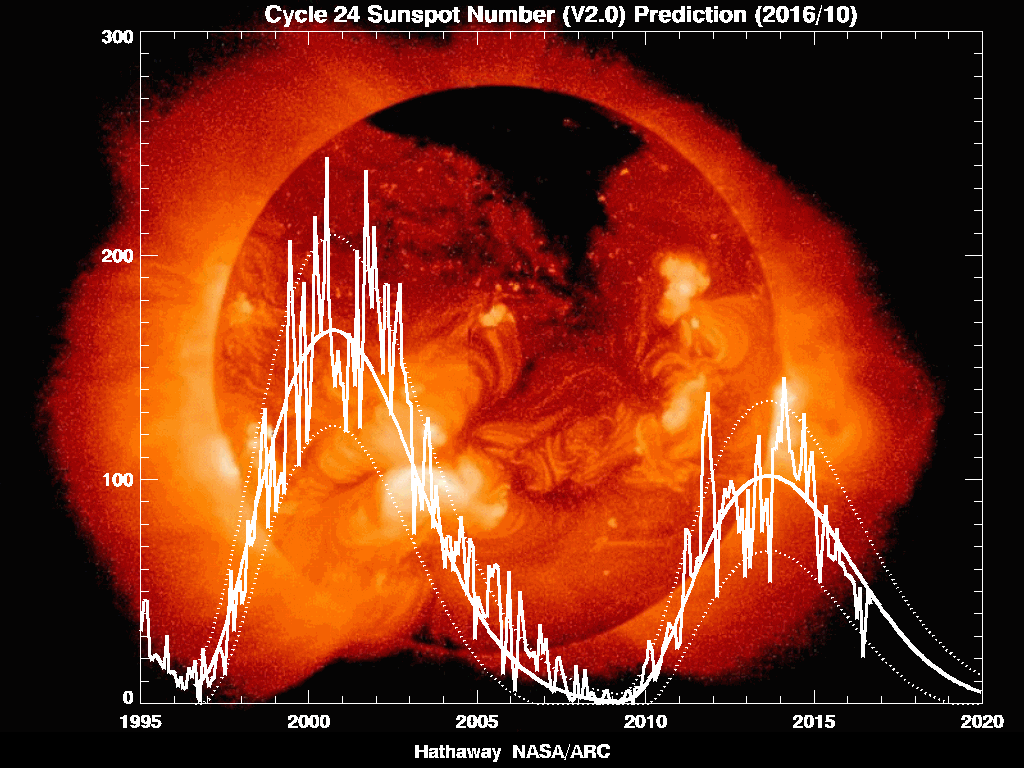
ii) We need to know where we are in the solar cycles. The highest peak of solar activity in recorded history occurred during the late 20th Century but we don’t really know how active the sun became during the Mediaeval Warm Period. There are calculations from isotope proxies but the accuracy of proxies is in the doghouse since Climategate and the hockey stick farrago. However the current solar quiescence suggests that the peak of recent solar activity is now over.
http://solarscience.msfc.nasa.gov/images/ssn_predict_l.gif
iii) Then we need to know where we stand in relation to the other shorter term cycles of sun and oceans.
Each varies on at least two other timescales. The level of solar activity varies during each cycle and over a run of cycles. The rate of energy release from the oceans varies from each El Nino to the following La Nina and back again over several years and the entire Pacific Decadal Oscillation alters the rate of energy release to the air every 25 to 30 years or so.
All those cycles vary in timing and intensity and interact with each other and are then superimposed on the longer term cycling that forms the basis of this article.
Then we have the chaotic variability of weather superimposed on the whole caboodle.
We simply do not have the data to resolve all those issues so all I can do is hazard a guess based on my personal judgement. On that basis I think we will see cooling for a couple of decades due to the negative phase of the Pacific Decadal Oscillation which has just begun then at least one more 20 to 30 year phase of natural warming before we start the true decline as the cooler thermohaline waters from the Little Ice Age come back to the surface.
If we get a peak of active sun at the same time as the worst of the cooling from the Little Ice Age comes through the oceanic system then that may be the start of a more rapid ending of the current interglacial but that is 500 years hence by which time we will have solved our energy problems or will have destroyed our civilisation.
Other climate theories:
Following the implosion of the CO2 based theory there are lots of other good ideas going around and much effort being expended by many individuals on different aspects of the climate system.
All I would suggest at the moment is that there is room in my NCM for any of those theories that demonstrate a specific climate response from sources other than sun and oceans.
All I contend is that sun and oceans together with the variable speed of the hydrological cycle assisted by the latitudinal movements of the air circulation systems and the vertical movement of the tropopause overwhelmingly provide the background trend and combine to prevent changes in the air alone changing the Earth’s equilibrium temperature.
For example:
Orbital changes feed into the insolation and albedo effects caused by moveable cloud masses.
Asteroid strikes and volcanoes feed into the atmospheric density issue.
Changing length of day and external gravitational forces feed into the speed of the thermohaline circulation.
Geothermal energy feeds into temperatures along the horizontal path of the thermohaline circulation.
Cosmic ray variations and ozone chemistry feed into the albedo changes.
The NCM can account for all past climate variability, can give general guidance as to future trends and can accommodate all manner of supplementary climate theories provided their real world influence can be demonstrated.
I humbly submit that all this is an improvement on existing modelling techniques and deserves fuller and more detailed consideration and investigation.
Novel propositions:
I think it helpful to set out here some of the novel propositions that I have had to formulate in order to obtain a climate description that complies both with observations and with basic laws of physics. This list is not intended to be exhaustive. Other new propositions may be apparent from the content and/or context of my various articles
i) Earth’s temperature is determined primarily by the oceans and not by the air (The Hot Water Bottle Effect). The contribution of the Greenhouse effect is miniscule.
ii) Changes in the air alone cannot affect the global equilibrium temperature because of oceanic dominance that always seeks to maintain sea surface and surface air equilibrium whatever the air tries to do. Warm air cannot significantly affect the oceans due to the huge difference in thermal capacities and by the effect of evaporation which removes unwanted energy to latent form as necessary to maintain the said equilibrium.
iii) Counterintuitively an active sun means cooling not warming and vice versa.
iv) The net global oceanic rate of energy release to the air is what matters with regard to the oceanic effect on the latitudinal positions of the air circulation systems and the associated cloud bands. All the oceanic oscillations affecting the rates of energy release to the air operate on different timescales and different magnitudes as energy progresses through the system via surface currents (not the thermohaline circulation which is entirely separate).
v) More CO2 ought theoretically induce faster cooling of the oceans by increasing evaporation rates. Extra CO2 molecules simply send more infra red radiation back down to the surface but infra red cannot penetrate deeper than the region of ocean surface involved in evaporation and since evaporation has a net cooling effect due to the removal of energy as latent heat the net effect should be increased cooling and not warming of the oceans.
vi) The latitudinal position of the air circulation systems at any given moment indicates the current tropospheric temperature trend whether warming or cooling and their movement reveals any change in trend
vii) All the various climate phenomena in the troposphere serve to balance energy budget changes caused by atmospheric effects from solar turbulence changes on the air above which affect the rate of energy loss to space or from variable rates of energy release from the oceans below.
viii) The speed of the hydrological cycle globally is the main thermostat in the troposphere. Changes in its speed are achieved by latitudinal shifts in the air circulation systems and by changes in the height of the tropopause.
ix) The difference between ice ages and interglacials is a matter of the timing of solar and oceanic cycles. Interglacials only occur when the solar and oceanic cycles are offsetting one another to a sufficient degree to minimise the scale of climate variability thereby preventing winter snowfall on the northern continents from being sufficient to last through the following summer.
x) Landmass distribution dictates the relative lengths of glacials and interglacials. The predominance of landmasses in the northern hemisphere causes glaciations to predominate over interglacials by about 9 to 1 with a full cycle every 100, 000 years helped along by the orbital changes of the Milankovitch cycles that affect the pattern of insolation on those shifting cloud masses.
xi) Distribution of energy within the entire system is more significant for climate (which is limited to the troposphere) than the actual temperature of the entire Earth. The latter varies hardly at all.
xii) All regional climate changes are a result of movement in relation to the locally dominant air circulation systems which move cyclically poleward and equatorward.
xiii) Albedo changes are primarily a consequence of latitudinal movement of the clouds beyond normal seasonal variability.
ix) The faint sun paradox is explained by the effectiveness of changes in the speed of the hydrological cycle. Only if the oceans freeze across their entire surfaces thereby causing the hydrological cycle to cease or if the sun puts in energy faster than it can be pumped upward by the hydrological cycle will the basic temperature equilibrium derived from the properties of water and the density and pressure of the atmosphere fail to be maintained.
A New And Effective Climate Model
The problem with existing climate models:
Even those who aver that man’s activity affects climate on a global scale rather than just locally or regionally appear to accept that the existing climate models are incomplete. It is a given that the existing models do not fully incorporate data or mechanisms involving cloudiness or global albedo (reflectivity) variations or variations in the speed of the hydrological cycle and that the variability in the temperatures of the ocean surfaces and the overall ocean energy content are barely understood and wholly inadequately quantified in the infant attempts at coupled ocean/atmosphere models. Furthermore the effect of variability in solar activity on climate is barely understood and similarly unquantified.
As they stand at present the models assume a generally static global energy budget with relatively little internal system variability so that measurable changes in the various input and output components can only occur from external forcing agents such as changes in the CO2 content of the air caused by human emissions or perhaps temporary after effects from volcanic eruptions, meteorite strikes or significant changes in solar power output.
If such simple models are to have any practical utility it is necessary to demonstrate that some predictive skill is a demonstrable outcome of the models. Unfortunately it is apparent that there is no predictive skill whatever despite huge advances in processing power and the application of millions or even billions of man hours from reputable and experienced scientists over many decades.
As I will show later on virtually all climate variability is a result of internal system variability and additionally the system not only sets up a large amount of variability internally but also provides mechanisms to limit and then reduce that internal variability. It must be so or we would not still have liquid oceans. The current models neither recognise the presence of that internal system variability nor the processes that ultimately stabilise it.
The general approach is currently to describe the climate system from ‘the bottom up’ by accumulating vast amounts of data, observing how the data has changed over time, attributing a weighting to each piece or class of data and extrapolating forward. When the real world outturn then differs from what was expected then adjustments are made to bring the models back into line with reality. This method is known as ‘hindcasting’.
Although that approach has been used for decades no predictive skill has ever emerged. Every time the models have been adjusted using guesswork (or informed judgement as some would say) to bring them back into line with ongoing real world observations a new divergence between model expectations and real world events has begun to develop.
It is now some years since the weighting attached to the influence of CO2 was adjusted to remove a developing discrepancy between the real world warming that was occurring at the time and which had not been fully accounted for in the then climate models. Since that time a new divergence began and is now becoming embarrassingly large for those who made that adjustment. At the very least the weighting given to the effect of more CO2 in the air was excessive.
The problem is directly analogous to a financial accounting system that balances but only because it contains multiple compensating errors. The fact that it balances is a mere mirage. The accounts are still incorrect and woe betide anyone who relies upon them for the purpose of making useful commercial decisions.
Correcting multiple compensating errors either in a climate model or in a financial accounting system cannot be done by guesswork because there is no way of knowing whether the guess is reducing or compounding the underlying errors that remain despite the apparent balancing of the financial (or in the case of the climate the global energy) budget.
The system being used by the entire climatological establishment is fundamentally flawed and must not be relied upon as a basis for policy decisions of any kind.
A better approach:
We know a lot about the basic laws of physics as they affect our day to day existence and we have increasingly detailed data about past and present climate behaviour.
We need a New Climate Model (from now on referred to as NCM) that is created from ‘the top down’ by looking at the climate phenomena that actually occur and using deductive reasoning to decide what mechanisms would be required for those phenomena to occur without offending the basic laws of physics.
We have to start with the broad concepts first and use the detailed data as a guide only. If a broad concept matches the reality then the detailed data will fall into place even if the broad concept needs to be refined in the process. If the broad concept does not match the reality then it must be abandoned but by adopting this process we always start with a broad concept that obviously does match the reality so by adopting a step by step process of observation, logic, elimination and refinement a serviceable NCM with some predictive skill should emerge and the more detailed the model that is built up the more predictive skill will be acquired.
That is exactly what I have been doing step by step in my articles here:
for some two years now and I believe that I have met with a degree of success because many climate phenomena that I had not initially considered in detail seem to be falling into line with the NCM that I have been constructing.
In the process I have found it necessary to propound various novel propositions that have confused and irritated warming proponents and sceptics alike but that is inevitable if one just follows the logic without a preconceived agenda which I hope is what I have done.
I will now go on to describe the NCM as simply as I can in verbal terms, then I will elaborate on some of the novel propositions (my apologies if any of them have already been propounded elsewhere by others but I think I would still be the first to pull them all together into a plausible NCM) and I will include a discussion of some aspects of the NCM which I find encouraging.
Preliminary points:
-
Firstly we must abandon the idea that variations in total solar output have a significant effect over periods of time relevant to human existence. At this point I should mention the ‘faint sun paradox’:
http://en.wikipedia.org/wiki/Faint_young_Sun_paradox
Despite a substantial increase in the power of the sun over billions of years the temperature of the Earth has remained remarkably stable. My proposition is that the reason for that is the existence of water in liquid form in the oceans combined with a relatively stable total atmospheric density. If the power input from the sun changes then the effect is simply to speed up or slow down the hydrological cycle.
An appropriate analogy is a pan of boiling water. However much the power input increases the boiling point remains at 100C. The speed of boiling however does change in response to the level of power input. The boiling point only changes if the density of the air above and thus the pressure on the water surface changes. In the case of the Earth’s atmosphere a change in solar input is met with a change in evaporation rates and thus the speed of the whole hydrological cycle keeping the overall temperature stable despite a change in solar power input.
A change in the speed of the entire hydrological cycle does have a climate effect but as we shall see on timescales relevant to human existence it is too small to measure in the face of internal system variability from other causes.
Unless more CO2 could increase total atmospheric density it could not have a significant effect on global tropospheric temperature. Instead the speed of the hydrological cycle changes to a miniscule and unmeasurable extent in order to maintain sea surface and surface air temperature equilibrium. As I have explained previously a change limited to the air alone short of an increase in total atmospheric density and pressure is incapable of altering that underlying equilibrium.
-
Secondly we must realise that the absolute temperature of the Earth as a whole is largely irrelevant to what we perceive as climate. In any event those changes in the temperature of the Earth as a whole are tiny as a result of the rapid modulating effect of changes in the speed of the hydrological cycle and the speed of the flow of radiated energy to space that always seeks to match the energy value of the whole spectrum of energy coming in from the sun.
The climate in the troposphere is a reflection of the current distribution of energy within the Earth system as a whole and internally the system is far more complex than any current models acknowledge.
That distribution of energy can be uneven horizontally and vertically throughout the ocean depths, the troposphere and the upper atmosphere and furthermore the distribution changes over time.
We see ocean energy content increase or decrease as tropospheric energy content decreases or increases. We see the stratosphere warm as the troposphere cools and cool as the troposphere warms. We see the upper levels of the atmosphere warm as the stratosphere cools and vice versa. We see the polar surface regions warm as the mid latitudes cool or the tropics warm as the poles cool and so on and so forth in infinite permutations of timing and scale.
As I have said elsewhere:
“It is becoming increasingly obvious that the rate of energy transfer varies all the time between ocean and air, air and space and between different layers in the oceans and air. The troposphere can best be regarded as a sandwich filling between the oceans below and the stratosphere above. The temperature of the troposphere is constantly being affected by variations in the rate of energy flow from the oceans driven by internal ocean variability, possibly caused by temperature fluctuations along the horizontal route of the thermohaline circulation and by variations in energy flow from the sun that affect the size of the atmosphere and the rate of energy loss to space.
The observed climate is just the equilibrium response to such variations with the positions of the air circulation systems and the speed of the hydrological cycle always adjusting to bring energy differentials above and below the troposphere back towards equilibrium (Wilde’s Law ?).
Additionally my propositions provide the physical mechanisms accounting for the mathematics of Dr. F. Miskolczi..”
He appears to have demonstrated mathematically that if greenhouse gases in the air other than water vapour increase then the amount of water vapour declines so as to maintain an optimum optical depth for the atmosphere which modulates the energy flow to maintain sea surface and surface air temperature equilibrium. In other words the hydrological cycle speeds up or slows down just as I have always proposed.
-
In my articles to date I have been unwilling to claim anything as grand as the creation of a new model of climate because until now I was unable to propose any solar mechanism that could result directly in global albedo changes without some other forcing agent or that could account for a direct solar cause of discontinuities in the temperature profile along the horizontal line of the oceanic thermohaline circulation.
I have now realised that the global albedo changes necessary and the changes in solar energy input to the oceans can be explained by the latitudinal shifts (beyond normal seasonal variation) of all the air circulation systems and in particular the net latitudinal positions of the three main cloud bands namely the two generated by the mid latitude jet streams plus the Inter Tropical Convergence Zone (ITCZ).
The secret lies in the declining angle of incidence of solar energy input from equator to poles.
It is apparent that the same size and density of cloud mass moved, say, 1000 miles nearer to the equator will have the following effects:
-
It will receive more intense irradiation from the sun and so will reflect more energy to space.
-
It will reduce the amount of energy reaching the surface compared to what it would have let in if situated more poleward.
-
In the northern hemisphere due to the current land/sea distribution the more equatorward the cloud moves the more ocean surface it will cover thus reducing total solar input to the oceans and reducing the rate of accretion to ocean energy content
-
It will produce cooling rains over a larger area of ocean surface.
As a rule the ITCZ is usually situated north of the equator because most ocean is in the southern hemisphere and it is ocean temperatures that dictate it’s position by governing the rate of energy transfer from oceans to air. Thus if the two mid latitude jets move equatorward at the same time as the ITCZ moves closer to the equator the combined effect on global albedo and the amount of solar energy able to penetrate the oceans will be substantial and would dwarf the other proposed effects on albedo from changes in cosmic ray intensity generating changes in cloud totals as per Svensmark and from suggested changes caused in upper cloud quantities by changes in atmospheric chemistry involving ozone which various other climate sceptics propose.
Thus the following NCM will incorporate my above described positional cause of changes in albedo and rates of energy input to the oceans rather than any of the other proposals. That then leads to a rather neat solution to the other theories’ problems with the timing of the various cycles as becomes clear below.
-
I have previously described why the solar effect on climate is not as generally thought but for convenience I will summarise the issue here because it will help readers to follow the logic of the NCM.Variations in total solar power output on timescales relevant to human existence are tiny and are generally countered by a miniscule change in the speed of the hydrological cycle as described above.
However according to our satellites variations in the turbulence of the solar energy output from sunspots and solar flares appear to have significant effects.
During periods of an active solar surface our atmosphere expands and during periods of inactive sun it contracts.
When the atmosphere expands it does so in three dimensions around the entire circumference of the planet but the number of molecules in the atmosphere remains the same with the result that there is an average reduced density per unit of volume with more space between the molecules. Consequently the atmosphere presents a reduced resistance to outgoing longwave energy photons that experience a reduced frequency of being obstructed by molecules in the atmosphere.
Additionally a turbulent solar energy flow disturbs the boundaries of the layers in the upper atmosphere thus increasing their surface areas allowing more energy to be transferred from layer to layer just as wind on water causes waves, an increased sea surface area and faster evaporation.
The changes in the rate of outgoing energy flow caused by changes in solar surface turbulence may be small but they appear to be enough to affect the air circulation systems and thereby influence the overall global energy budget disproportionately to the tiny variations in solar power intensity.
Thus when the sun is more active far from warming the planet the sun is facilitating an increased rate of cooling of the planet. That is why the stratosphere cooled during the late 20th Century period of a highly active sun although the higher levels of the atmosphere warmed. The higher levels were warmed by direct solar impacts but the stratosphere cooled because energy was going up faster than it was being received from the troposphere below.
The opposite occurs for a period of inactive sun.
Some do say that the expansion and contraction of the atmosphere makes no difference to the speed of the outward flow of longwave energy because that outgoing energy still has to negotiate the same mass but that makes no sense to me if that mass is more widely distributed over a three dimensional rather than two dimensional space. If one has a fine fabric container holding a body of liquid the speed at which the liquid escapes will increase if the fabric is stretched to a larger size because the space between the fibres will increase.
Furthermore all that the NCM requires is for the stratosphere alone to lose or gain energy faster or slower so as to influence the tropospheric polar air pressure cells. The energy does not need to actually escape to space to have the required effect. It could just as well simply take a little longer or a little less long to traverse the expanded or contracted upper atmospheric layers.
The New Climate Model (NCM)
-
Solar surface turbulence increases causing an expansion of the Earth’s atmosphere.
-
Resistance to outgoing longwave radiation reduces, energy is lost to space faster.
-
The stratosphere cools. Possibly also the number of chemical reactions in the upper atmosphere increases due to the increased solar effects with faster destruction of ozone.
-
The tropopause rises.
-
There is less resistance to energy flowing up from the troposphere so the polar high pressure systems shrink and weaken accompanied by increasingly positive Arctic and Antarctic Oscillations.
-
The air circulation systems in both hemispheres move poleward and the ITCZ moves further north of the equator as the speed of the hydrological cycle increases due to the cooler stratosphere increasing the temperature differential between stratosphere and surface.
-
The main cloud bands move more poleward to regions where solar insolation is less intense so total global albedo decreases.
-
More solar energy reaches the surface and in particular the oceans as more ocean surfaces north of the equator are exposed to the sun by the movement of the clouds to cover more continental regions.
-
Less rain falls on ocean surfaces allowing them to warm more.
-
Ocean energy input increases but not all is returned to the air. A portion enters the thermohaline circulation to embark on a journey of 1000 to 1500 years. A pulse of slightly warmer water has entered the ocean circulation.
-
Solar surface turbulence passes its peak and the Earth’s atmosphere starts to contract.
-
Resistance to outgoing longwave radiation increases, energy is lost to space more slowly.
-
The stratosphere warms. Ozone levels start to recover.
-
The tropopause falls
-
There is increased resistance to energy flowing up from the troposphere so the polar high pressure systems expand and intensify producing increasingly negative Arctic and Antarctic Oscillations.
-
The air circulation systems in both hemispheres move back equatorward and the ITCZ moves nearer the equator as the speed of the hydrological cycle decreases due to the warming stratosphere reducing the temperature differential between stratosphere and surface.
-
The main cloud bands move more equatorward to regions where solar insolation is more intense so total global albedo increases once more.
-
Less solar energy reaches the surface and in particular the oceans as less ocean surfaces north of the equator are exposed to the sun by the movement of the clouds to cover more oceanic regions.
-
More rain falls on ocean surfaces further cooling them.
-
Ocean energy input decreases and the amount of energy entering the thermohaline circulation declines sending a pulse of slightly cooler water on that 1000 to 1500 year journey.
-
After 1000 to 1500 years those variations in energy flowing through the thermohaline circulation return to the surface by influencing the size and intensity of the ocean surface temperature oscillations that have now been noted around the world in all the main ocean basins and in particular the Pacific and the Atlantic. It is likely that the current powerful run of positive Pacific Decadal Oscillations is the pulse of warmth from the Mediaeval Warm Period returning to the surface with the consequent inevitable increase in atmospheric CO2 as that warmer water fails to take up as much CO2 by absorption. Cooler water absorbs more CO2, warmer water absorbs less CO2. We have the arrival of the cool pulse from the Little Ice Age to look forward to and the scale of its effect will depend upon the level of solar surface activity at the time. A quiet sun would be helpful otherwise the rate of tropospheric cooling as an active sun throws energy into space at the same time as the oceans deny energy to the air will be fearful indeed. Fortunately the level of solar activity does seem to have begun a decline from recent peaks.
-
The length of the thermohaline circulation is not synchronous with the length of the variations in solar surface turbulence so it is very much a lottery as to whether a returning warm or cool pulse will encounter an active or inactive sun.
-
A returning warm pulse will try to expand the tropical air masses as more energy is released and will try to push the air circulation systems poleward against whatever resistance is being supplied at the time by the then level of solar surface turbulence. A returning cool pulse will present less opposition to solar effects.
-
Climate is simply a product of the current balance in the troposphere between the solar and oceanic effects on the positions and intensities of all the global air circulation systems
-
The timing of the solar cycles and ocean cycles will drift relative to one another due to their asynchronicity so there will be periods when solar and ocean cycles supplement one another in transferring energy out to space and other periods when they will offset one another.
26) During the current interglacial the solar and oceanic cycles are broadly offsetting one another to reduce overall climate variability but during glacial epochs they broadly supplement one another to produce much larger climate swings. The active sun during the Mediaeval Warm Period and the Modern Warm Period and the quiet sun during the Little Ice Age reduced the size of the climate swings that would otherwise have occurred. During the former two periods the extra energy from a warm ocean pulse was ejected quickly to space by an active sun to reduce tropospheric heating. During the latter period the effect on tropospheric temperatures of reduced energy from a cool ocean pulse was mitigated by slower ejection of energy to space from a less active sun.
Discussion points:
Falsification:
Every serious hypothesis must be capable of being proved false. In the case of this NCM my narrative is replete with opportunities for falsification if the future real world observations diverge from the pattern of cause and effect that I have set out.
However that narrative is based on what we have actually observed over a period of 1000 years with the gaps filled in by deduction informed by known laws of physics.
At the moment I am not aware of any observed climate phenomena that would effect falsification. If there be any that suggest such a thing then I suspect that they will call for refinement of the NCM rather than abandonment.
For true falsification we would need to observe events such as the mid latitude jets moving poleward during a cooling oceanic phase and a period of quiet sun or the ITCZ moving northward whilst the two jets moved equatorward or the stratosphere, troposphere and upper atmosphere all warming or cooling in tandem or perhaps an unusually powerful Arctic Oscillation throughout a period of high solar turbulence and a warming ocean phase.
They say nothing is impossible so we will have to wait and see.
Predictive skill:
To be taken seriously the NCM must be seen to show more predictive skill than the current computer based models.
In theory that shouldn’t be difficult because their level of success is currently zero.
From a reading of my narrative it is readily apparent that if the NCM matches reality then lots of predictions can be made. They may not be precise in terms of scale or timing but they are nevertheless useful in identifying where we are in the overall scheme of things and the most likely direction of future trend.
For example if the mid latitude jets stay where they now are then a developing cooling trend can be expected.
If the jets move poleward for any length of time then a warming trend may be returning.
If the solar surface becomes more active then we should see a reduction in the intensity of the Arctic Oscillation.
If the current El Nino fades to a La Nina then the northern winter snows should not be as intense next winter but it will nevertheless be another cold though drier northern hemisphere winter as the La Nina denies energy to the air.
The past winter is a prime example of what the NCM suggests for a northern winter with an El Nino during a period of quiet sun. The warmth from the oceans pumps energy upwards but the quiet sun prevents the poleward movement of the jets. The result is warming of the tropics and of the highest latitudes (but the latter stay below the freezing point of water) and a flow of cold into the mid latitudes and more precipitation in the form of snow at lower latitudes than normal.
So I suggest that a degree of predictive skill is already apparent for my NCM.
Likely 21st Century climate trend:
There are 3 issues to be resolved for a judgement on this question.
i) We need to know whether the Modern Warm Period has peaked or not. It seems that the recent peak late 20th Century has passed but at a level of temperature lower than seen during the Mediaeval Warm Period. Greenland is not yet as habitable as when the Vikings first colonised it. Furthermore it is not yet 1000 years since the peak of the Mediaeval Warm Period which lasted from about 950 to 1250 AD
http://www.theresilientearth.com/?q=content/medieval-warm-period-rediscovered
so I suspect that the Mediaeval warmth now emanating from the oceans may well warm the troposphere a little more during future years of warm oceanic oscillations. I would also expect the CO2 levels to continue drifting up until a while after the Mediaeval Warm Period water surface warming peak has begun it’s decline. That may still be some time away, perhaps a century or two.
ii) We need to know where we are in the solar cycles. The highest peak of solar activity in recorded history occurred during the late 20th Century but we don’t really know how active the sun became during the Mediaeval Warm Period. There are calculations from isotope proxies but the accuracy of proxies is in the doghouse since Climategate and the hockey stick farrago. However the current solar quiescence suggests that the peak of recent solar activity is now over.
http://solarscience.msfc.nasa.gov/images/ssn_predict_l.gif
iii) Then we need to know where we stand in relation to the other shorter term cycles of sun and oceans.
Each varies on at least two other timescales. The level of solar activity varies during each cycle and over a run of cycles. The rate of energy release from the oceans varies from each El Nino to the following La Nina and back again over several years and the entire Pacific Decadal Oscillation alters the rate of energy release to the air every 25 to 30 years or so.
All those cycles vary in timing and intensity and interact with each other and are then superimposed on the longer term cycling that forms the basis of this article.
Then we have the chaotic variability of weather superimposed on the whole caboodle.
We simply do not have the data to resolve all those issues so all I can do is hazard a guess based on my personal judgement. On that basis I think we will see cooling for a couple of decades due to the negative phase of the Pacific Decadal Oscillation which has just begun then at least one more 20 to 30 year phase of natural warming before we start the true decline as the cooler thermohaline waters from the Little Ice Age come back to the surface.
If we get a peak of active sun at the same time as the worst of the cooling from the Little Ice Age comes through the oceanic system then that may be the start of a more rapid ending of the current interglacial but that is 500 years hence by which time we will have solved our energy problems or will have destroyed our civilisation.
Other climate theories:
Following the implosion of the CO2 based theory there are lots of other good ideas going around and much effort being expended by many individuals on different aspects of the climate system.
All I would suggest at the moment is that there is room in my NCM for any of those theories that demonstrate a specific climate response from sources other than sun and oceans.
All I contend is that sun and oceans together with the variable speed of the hydrological cycle assisted by the latitudinal movements of the air circulation systems and the vertical movement of the tropopause overwhelmingly provide the background trend and combine to prevent changes in the air alone changing the Earth’s equilibrium temperature.
For example:
Orbital changes feed into the insolation and albedo effects caused by moveable cloud masses.
Asteroid strikes and volcanoes feed into the atmospheric density issue.
Changing length of day and external gravitational forces feed into the speed of the thermohaline circulation.
Geothermal energy feeds into temperatures along the horizontal path of the thermohaline circulation.
Cosmic ray variations and ozone chemistry feed into the albedo changes.
The NCM can account for all past climate variability, can give general guidance as to future trends and can accommodate all manner of supplementary climate theories provided their real world influence can be demonstrated.
I humbly submit that all this is an improvement on existing modelling techniques and deserves fuller and more detailed consideration and investigation.
Novel propositions:
I think it helpful to set out here some of the novel propositions that I have had to formulate in order to obtain a climate description that complies both with observations and with basic laws of physics. This list is not intended to be exhaustive. Other new propositions may be apparent from the content and/or context of my various articles
i) Earth’s temperature is determined primarily by the oceans and not by the air (The Hot Water Bottle Effect). The contribution of the Greenhouse effect is miniscule.
ii) Changes in the air alone cannot affect the global equilibrium temperature because of oceanic dominance that always seeks to maintain sea surface and surface air equilibrium whatever the air tries to do. Warm air cannot significantly affect the oceans due to the huge difference in thermal capacities and by the effect of evaporation which removes unwanted energy to latent form as necessary to maintain the said equilibrium.
iii) Counterintuitively an active sun means cooling not warming and vice versa.
iv) The net global oceanic rate of energy release to the air is what matters with regard to the oceanic effect on the latitudinal positions of the air circulation systems and the associated cloud bands. All the oceanic oscillations affecting the rates of energy release to the air operate on different timescales and different magnitudes as energy progresses through the system via surface currents (not the thermohaline circulation which is entirely separate).
v) More CO2 ought theoretically induce faster cooling of the oceans by increasing evaporation rates. Extra CO2 molecules simply send more infra red radiation back down to the surface but infra red cannot penetrate deeper than the region of ocean surface involved in evaporation and since evaporation has a net cooling effect due to the removal of energy as latent heat the net effect should be increased cooling and not warming of the oceans.
vi) The latitudinal position of the air circulation systems at any given moment indicates the current tropospheric temperature trend whether warming or cooling and their movement reveals any change in trend
vii) All the various climate phenomena in the troposphere serve to balance energy budget changes caused by atmospheric effects from solar turbulence changes on the air above which affect the rate of energy loss to space or from variable rates of energy release from the oceans below.
viii) The speed of the hydrological cycle globally is the main thermostat in the troposphere. Changes in its speed are achieved by latitudinal shifts in the air circulation systems and by changes in the height of the tropopause.
ix) The difference between ice ages and interglacials is a matter of the timing of solar and oceanic cycles. Interglacials only occur when the solar and oceanic cycles are offsetting one another to a sufficient degree to minimise the scale of climate variability thereby preventing winter snowfall on the northern continents from being sufficient to last through the following summer.
x) Landmass distribution dictates the relative lengths of glacials and interglacials. The predominance of landmasses in the northern hemisphere causes glaciations to predominate over interglacials by about 9 to 1 with a full cycle every 100, 000 years helped along by the orbital changes of the Milankovitch cycles that affect the pattern of insolation on those shifting cloud masses.
xi) Distribution of energy within the entire system is more significant for climate (which is limited to the troposphere) than the actual temperature of the entire Earth. The latter varies hardly at all.
xii) All regional climate changes are a result of movement in relation to the locally dominant air circulation systems which move cyclically poleward and equatorward.
xiii) Albedo changes are primarily a consequence of latitudinal movement of the clouds beyond normal seasonal variability.
ix) The faint sun paradox is explained by the effectiveness of changes in the speed of the hydrological cycle. Only if the oceans freeze across their entire surfaces thereby causing the hydrological cycle to cease or if the sun puts in energy faster than it can be pumped upward by the hydrological cycle will the basic temperature equilibrium derived from the properties of water and the density and pressure of the atmosphere fail to be maintained.
[quote stephen richards (02:37:55) :]
magicjava (22:54:43) :
I’ll have a go at this one, Leif. The problem for most scientific lay people is that “physics is not about common sense”, as Einstein once said. Expansion of materiels requires kinetic energy ( the energy of movement) to create the molecular collisons which in turn force the expansion. In metal, for instance, the molecular structure is agitated by the increased flow of electrons which in turn cause the structure to vibrate and therefor expand. Its what makes an electric fire work. The energy creates collisions and therefore heat as well as movement. The total energy remains the same, of course. Conservation of energy law.
In the upper atmosphere the molecules have so much space to move (low density environment) that collisions are much less probable and therefore expansion much less likely.
[/quote]
Understood. My response was (and still is) that it’s not clear to me that Wilde is talking about anything more than expansion taking place in the stratosphere and lower. At those levels of the atmosphere, expansion happens all the time as warm air rises.
So I’d request that Mr. Wilde specifically say whether or not his model requires expansion of the entire atmosphere, including the thermosphere and exosphere, or if all that’s required is just expansion in the troposphere, tropopause, and stratosphere.
I’d also like to know if his model requires a global expansion, like a ballon being blown up, or if multiple local expansions will do the trick. I’m not sure if the atmosphere at any layer expands and contracts like a balloon. But I’m 100% certain that local expansions happen all the time all over the world.
I think we should throw no variable out of this “NCM”. Thus, include the stratosphere, lunar effects and cosmic ray cloud seeding; their effect may be small but they may surprise us.
TLM (08:24:20)
Then I think you need to account for the faint sun paradox.
And why CO2 changes never preceded temperature changes throughout the ice core history.
Something prevented the Earth’s temperature from changing much at all despite a substantial increase in solar input.
Your objections are wrong in so many fundamental ways that I would hardly know where to start even if I had the energy.
DavidB (01:33:58) :
A differing view on the state of physics:
http://discovermagazine.com/2009/may/01-the-biocentric-universe-life-creates-time-space-cosmos
TLM: You wrote, “Seasonal, annual and even decadal variations would cancel each other out if measured over a long enough period. La Nina would counteract El Nino…”
First, the amplitude and frequency of El Nino events are not counteracted by the frequency and amplitude of La Nina events.
Second, La Nina events are not the opposite of El Nino events. A La Nina event is an exaggeration of an ENSO-neutral state. That is, trade winds increase during a La Nina, decreasing cloud cover over the tropical Pacific, increasing Downward Shortwave Radiation, increasing Pacific Equatorial Current flow. This is how the Pacific Warm Pool is recharged after an El Nino event. It is also one of the reasons why ~25% of the global oceans warm during a La Nina event, (in addition to warming from the El Nino).
http://i48.tinypic.com/2qamu88.png
I just read this over for the first time. Great! I will need to study it more completely of course. My first reaction is more then positive because it makes sense and meet the criteria of falsification. Is this a true revolutionary Kuhnian shift? I can’t answer that yet but I can say it is going to be a great ride in the doing. Thank you Stephen Wild.
P.S.
Just to be clear about what I’m asking: Do thermals rising into the troposphere and stratosphere and expanding there due to lower air pressure qualify as the “expansion mechanism” in this model?
“Leif Svalgaard (22:49:30) :
Dennis Wingo (22:36:20) :
ultimate climate model is a huge multi-tiered database
What is a ‘multi-tiered’ database?”
Well I architect Enteprise Business Intelligence solutions for a living. If I were tasked with doing this the overall solution would have the following bits :-
Databases
1 Stageing – A place to store the raw data
2 Exceptions A place to store items in 1 that can’t be cleansed validated and forwarded to 3
3 Climate Datawarehouse A place to store cleansed validated entries gleaned from 1. These entries will have been re-keyed with surrogate primary keys and rationally determined business keys, all missing values and keys discarded or marked as null. Logic embedded to allow management od slowly changing references and late arriving data
4 Models Derivatives from 3 based on different assumptions, theories, modelling methods, and purposes. All null/missing values and keys fostered to unambiguous missing data missing key references
5 Presentation Views over the models optimised for reporting/analytical performance
SQL entities
6 Set of procedures and functions to populate 1 from sources
7 Set of procedures and functions to populate 3 from 1 and park exceptions in 2
8 Sets of procedures functions and objects to populate 4 from 3
9 Sets of procedures functions and objects to build 5 from 4
In an industrial setting you would also expect
10 Metadata Management tools to broker access to 5
11 Reporting/Analytical tools that pull data from 5 via 9
In our trade jargon 1 to 5 are the database layers or tiers 6 to 9 are the ETL layers or tiers, 10 is the metadata layer/tier 11 is the reporting layer/tier
Possible in practice that additional layers/tiers might be added in the interest of getting the F**king thing to work right…
In hardware terms there would be seperate server resources ( that might be clusters) to database management, ETL processing, Application management and user access. Sometimes these are helpfully referred to as tiers or layers too…
In practical terms I ballpark estimated the land record raw data at about 4Tb, same again for the warehouse, the models should be aggregated so maybe 2Tb for them, can’t promise on the presentation layer as can’t tell how much of it could be kept virtual. Obviously as you started adding in sea records, Argo, Satellite and other sources these would add to the overall size. If you wanted image/blob storage as well then shares in disk manufacturers would be on the up….:-)
This all seems overly complicated to me. The climate is one of three possibilities:
“open loop” – it has no feedback mechanism and any change in energy levels will result directly in a change in temperature – this is more or less the position of Team AGW.
“positive feedback loop” – inherently unstable with the smallest change leading to catastrohpic irreversible climate change. This is the “tipping point” theory, and we can throw this one out because in billions of years the Earth’s climate has been remarkably stable.
“negative feedback loop” – this is the position held by most in Team skeptic and the most plausible since we know that the Earth’s clmiaet has been pretty stable since its first beginnings. The questions then becomes “how do we prove it?” and “just how stable is the negative feedback loop?”. The idea that the climate was not much different 3.5bn years ago when the sun had an output of 70% of what it is today suggests that it is pretty darn stable. Even wacking it with an asteroid the size of France and setting off multiple huge volcanic eruptions didn’t cause much long-term upset. What we need is a climate forcing event of known magnitude and a measurement of the clmiate change caused to be able to get a feeling for the gain in the negative feedback loop and hence a feeling for the sensitivity to other changes that might influence the climate.
How to write a scientific paper:
You start by putting the paper in context. Cite several papers [pro & con]. this shows that you are not working in a vacuum, but have knowledge of the field. Then you set out your analysis of the data/evidence or, if it is a new theory, your salient points and what data/evidence backs up your points. Which points are crucial and which are peripheral. What new experiments/data would further support/refute your theory. In other words, where the strong/weak points are. You end by highlighting where your theory differs from other work. Always stress the fundamental points and don’t overwhelm the reader with details that may or may not be relevant. Then write a 250-word abstract that summarizes your paper. Many readers won’t get past the abstract, so it has to be good and understandable.
This method has been honed over centuries and has proven its value. The first ‘modern’ scientific paper along those lines was De Magnete by Gilbert published in 1600 AD. I’m holding a copy in my hand right now and it is amazing how modern it reads.
magicjava (09:23:59) :
At those levels of the atmosphere, expansion happens all the time as warm air rises.
The crucial point is that the expansion/contraction you are talking about is a consequence of changing temperature. Stephen wants it the other way: the expansion/contraction is the cause of change of temperature. It is perhaps telling that Stephen has not clarified which part of the atmosphere he is talking about, although the statement that ‘the turbulent Sun causes the expansion/contraction points to the thermosphere’ where this is true.
magicjava (09:40:26)
For the purpose of my NCM I’m only referring to expansion caused by changes in solar activity.
As Leif says that is most higher up where density is lowest and reduces as one goes down to lower altitudes. However an increase in the rate of energy loss to space has been observed as described here:
http://www.nasa.gov/topics/earth/features/AGU-SABER.html
The expansion and contraction locally within the troposphere relates to the speed of the hydrological cycle which is a seperate issue.
Leif Svalgaard (10:29:18)
Not so. Temperature changes first then the expansion occurs but that seems to increase the porosity of the entire atmosphere. The outgoing longwave emissions face reduced resistance from the molecules in the atmosphere above them.
A porous material becomes more porous as it expands to surround a larger volume.
Stephen, it will be interesting to follow the development of your project, I hope you will keep us up to date on it.
I don’t want to come across as a wet blanket, but just as a general comment on prediction (weather, climate, or otherwise ): If a prediction is made and believed then people will act on that prediction in order to change the predicted future in some manner if it is in their interest and power to do so. Thus invalidating the original prediction, and setting up some other possible future with a different ( and likely unknown ) set of probabilities and outcomes. I have some professional experience of this behavior in industrial settings, and it is not a trivial issue.
This is one of the things that drives any number of “climate modification” proposals currently being considered, and why I tend to be very, very cautious and skeptical of anything that is justified by pleading the so-called “precautionary principle”.
Let us not forget Niels Bohr’s admonition that prediction is very difficult, especially if it concerns the future. 🙂
I think most of this theory boils down to the conclusion that global warming as such is not possible. I also came to that conclusion some time ago (with some help from Stephen! Thx.) but I still believe that some variation in warming and cooling is possible due to the variation in cloud formation caused by GCR. I note that Stephen makes no mention of this. Did I miss something? Do we still believe GCR is a factor in cloud formation or not? What is the consensus about that, here on WUWT?
“The Oracle guy’s idea of a multi-tier climate application is actually not that bad at all”
Oracle made a complete mess of the California DMV database. If they couldn’t handle that I wouldn’t let them near climate science data.
” Ryan (09:58:28) :
This all seems overly complicated to me. The climate is one of three possibilities:
“open loop” […]
“positive feedback loop” […]
“negative feedback loop”[…]
”
It’s definitely a combination of all three, with different feedback strengths and time lags. That’s why you get the wild and as yet unpredictable local and temporal swings, like the El Nino spike in 1998.
Skeptics and catastrophists differ in their estimation of the potential minima of the system. Catastrophists postulate a local potential minimum in the high temperature range and our CO2 emissions pushing the system over the potential wall towards this hypothetic local minimum, hence the “tipping point”. Skeptics posit that this scenario is unlikely and unproven and assume that the negative feedbacks are stronger than positive feedbacks.
Are positive feedbacks possible at all? Yes; a heating up for whatever reason might drive the humidity up when there’s water available and that might improve the water vapour GH effect locally (it wouldn’t work in the Sahara). I as a skeptic would doubt that this effect lasts long as i think that Miskolczi’s theory indicates a subsequent balancing out of this effect.
This would correspond to a fast positive feedback followed by a negative feedback with a longer lag time. Getting the feedback strengths and the time lags right would result in better prediction.
The major problem of the conventional GCM’s is that they fiddle with the aerosols every time they get it wrong.
Stephen writes: “In the case of the Earth’s atmosphere a change in solar input is met with a change in evaporation rates and thus the speed of the whole hydrological cycle keeping the overall temperature stable despite a change in solar power input.” If this statement were always true, then the non-tropics would not warm every summer and cool every winter.
Stephen writes: “During periods of an active solar surface our atmosphere expands and during periods of inactive sun it contracts.” Only the sections of the atmosphere that are warmed by an active solar surface expand when the sun is active. The troposphere can be warmed when visible and near-visible solar radiation increase, but the increase in visible and near visible radiation is only about 0.1% during a typical solar maximum. High energy particles increase dramatically during the sun’s active periods, but they only warm/expand the thermosphere where very little GHG can be found.
Stephen writes: “When the atmosphere expands it does so in three dimensions around the entire circumference of the planet but the number of molecules in the atmosphere remains the same with the result that there is an average reduced density per unit of volume with more space between the molecules. Consequently the atmosphere presents a reduced resistance to outgoing longwave energy photons that experience a reduced frequency of being obstructed by molecules in the atmosphere.” According to quantum mechanics, each molecule has a given probability of absorbing a photon of a given wavelength passing nearby. Absorption doesn’t change when the concentration of absorbers drop by a factor of 2X and the path length during which absorption increases by a factor of 2X. For a sphere, a 2X increase in path length produces an 8X increase in volume. But the earth’s atmosphere is not a sphere, it is a thin spherical shell surrounding a much larger earth. If R is the radius of the earth and h is the “height” of the atmosphere above the earth, the volume of the atmosphere (V) is given by:
V = (4/3)*Pi*(R+h)^3 – (4/3)*Pi*R^3
V = 4*Pi*R^2*h + 4*Pi*R*h^2 + 4/3)*Pi*h^3
Since R>>h for the vast majority of the earth’s atmosphere, V can be approximated by 4*Pi*R^2*h. So when the volume of the atmosphere doubles from warming thus decreasing the concentration of absorbers by 2X, the path length of absorption will double. Total absorption of outgoing long wavelength radiation will remain constant.
Stephen writes: “iii) Counterintuitively an active sun means cooling not warming and vice versa.” However, the coldest periods of the LIA took place during the Dalton and Maunder minimums.
Stephen Wilde (10:33:56) :
However an increase in the rate of energy loss to space has been observed as described here:
http://www.nasa.gov/topics/earth/features/AGU-SABER.html
You have completely misunderstood this. All the observations say is that when you heat something it increases the radiation from what is being heated. In any event the energy involved is extremely minute because the thermosphere is so thin.
Stephen Wilde (10:38:11) :
Not so. Temperature changes first then the expansion occurs</i<
They go together without delay
but that seems to increase the porosity of the entire atmosphere.
Nobody [except you] claims such a thing. ‘Porosity’ is meaningless in this connection anyway. Perhaps a link to a paper claiming porosity of the entire atmosphere changes when the thermosphere expands might be useful.
Thank you Stephen and Leif for your answers.
Unfortunately for me, the behavior of the thermosphere as it interacts with the sun is a bit outside my area of understanding. So I’ll read the paper Stephen provided, sit back, and munch popcorn. 😉
Michael Ozanne (09:49:47) :
Well I architect Enteprise Business Intelligence solutions for a living. If I were tasked with doing this the overall solution would have the following bits :-
You are describing a multi-tiered application or solution. The database itself has no tiers. Now, from an Oracle salesman’s point of view EVERYTHING is the database and that is why HIS database is so important and why you MUST buy it.
Fascinating post and comments. I have not made up my mind if I have “Wilde” birds or just wild birds on my birdfeeder.
Most of the time at WUWT, I tend to briefly scan the “essay” or article; whatever you want to call what Anthony has posted for us to see; and if that immediately triggers any thoughts I think might be relevant, I tend to start writing. Once I get something down, It may force me to go back and reread the essay to clear up details. Quite often after I post, I find that others have already made all the observations I just spent time on.
I also find that if I excerpt from somebody else’s post, either to try and explain (if possible) or maybe add on, or to dispute, that often doesn’t post till way beyond the original , so there is a lot of disconnect as one reads through the various posts.
This time, I decided to not say anything, until I had read everything, including all the posts (so-far).
The first thought that came to mind, is that when I was an early teener, and doing my first explorations of Elec& Mag, and Electronic circuits (Valves; or maybe to you, Vaccuum Tubes), I had learned enough mathematics to do all the usual elementary circuit calculations for AC circuits containing RLC components and Vacuum Tubes. Well I read a lot of interesting books.
When I ran into some early discrepancies, between the simple theory, and some of the more arcane concepts; maybe transit time in valves, or cathode lead inductance; I decided to get serious.
It should be possible I reasoned to mathematically describe the whole process, without any of the simplifying assumptions, and really find out what made things tick.
Well needless to say, even with my quite restricted math skills at that age, I very quickly became embroiled in a hodge-podge of mathematical minutiae, that might even have been accurate; but gave absolutely no seat of the pants feel for what the hell was really going on.
In retrospect, I realize that my attempt at a complete theory ov vacuum tube electronics, was like trying to hand draw a fractal object, like Mandelbrot Set or somesuch. I realized that my very simply described task of a complete theory, was quite impossible to achieve, and if it could be done; it wouldn’t be understandable as a whole. Small corners could probably be understood, and rendered quite useful. I decided that no matter how much my math repertoire might grow in the future, I would never be able to construct a complete theory of vacuum tube behavior, and it was of little use to the practical circuit designer even if possible.
Well I feel the same way about climate. I wouldn’t ever be so bold as to propose that a completely chaotic, and also quite fractal system that is earth’s climate, could ever be accurately described; well in any way that was useful; which would imply some ability to predict future behavior.
We can describe a lot about some systems that are in equilibrium; we can even describe how they might transition from one “state” to some other state; but one thing we know for sure about earth’s climate, is that nothing in it is in equilibrium. Neither static nor dynamic equilibrium exists in earth climate; and we know for sure that must be true, since weather represents a significant change of the system from one state to another; and does so, at all time, and space scales.
The very rotation of the earth, which scans the solar blowtorch across earth’s surface, ensures that nothing ever reaches equilibrium.
Today, I know pretty much what happens to a vacuum tube circuit as a result of cathode lead inductance; even wrote an IEEE paper on the subject (not published; but presented at a “meeting”). But that is really a small scrap of a totally intransigent problem.
I find such niches in the climate puzzle that I feel comfortable talking about, with some degree of understanding; but I am not going to drive myself insane trying to understand the whole kit and caboodle.
I am however quite confident; that Gaia knows exactly how it all works; and we will never match her laboratory measurement skills, no matter how big a computer we may set to work on the problem.
Frank (11:16:34)
i) I’m discussing changes beyond normal seasonal variation.
ii) You are referring to raw energy output which I concede seems to have little effect. I am referring to solar surface turbulence.
iii) I have difficulty with that proposition because like Leif you are suggesting a simple doubling which would be a response to a two dimensional situation such as elongating a tube with parallel sides where I concede you would be right. The Earth’s atmosphere does not expand in only two dimensions but in three so the distance between molecules increases disproportionately as one moves outward during the expansion process. The path length of aborption will not quite double and I see that you use approximations on the basis that Radius is so much greater than height
“V can be approximated by 4*Pi*R^2*h.”
The main valid point I see from you and Leif is that the approximation is good enough and the effect is too small to consider.
Against that we have observational evidence that the polar high pressure cells do vary from influences above and until there is another explanation I’ll go with the solar/expansion idea but any idea that demonstrably works is good enough for me.
iv) “However, the coldest periods of the LIA took place during the Dalton and Maunder minimums.”
Quite so but only because, during the current interglacial low solar activity generally occurs around the same time as low rates of energy release from the oceans so that during the LIA the quiet sun was mitigating the effect of the cooler ocean surfaces. You need to re read parts of my article.
So, if someone could provide a convincing non solar cause of changes in the polar atmospheric oscillations I’ll see if I can slot it in instead of solar but for the time being solar fits well enough on the basis of historical data even if we haven’t yet pinned it down adequately.
Henry Pool (10:48:59)
Thanks Henry. I did refer to the Svensmark cosmic ray idea in passing and have always been prepared to accept some truth in it. However my current view is that the albedo changes from shifting the cloud masses latitudinally beyond normal seasonal variation would be far greater.