The problem with existing climate models:
Guest post by Stephen Wilde

Even those who aver that man’s activity affects climate on a global scale rather than just locally or regionally appear to accept that the existing climate models are incomplete. It is a given that the existing models do not fully incorporate data or mechanisms involving cloudiness or global albedo (reflectivity) variations or variations in the speed of the hydrological cycle and that the variability in the temperatures of the ocean surfaces and the overall ocean energy content are barely understood and wholly inadequately quantified in the infant attempts at coupled ocean/atmosphere models. Furthermore the effect of variability in solar activity on climate is barely understood and similarly unquantified.
As they stand at present the models assume a generally static global energy budget with relatively little internal system variability so that measurable changes in the various input and output components can only occur from external forcing agents such as changes in the CO2 content of the air caused by human emissions or perhaps temporary after effects from volcanic eruptions, meteorite strikes or significant changes in solar power output.
If such simple models are to have any practical utility it is necessary to demonstrate that some predictive skill is a demonstrable outcome of the models. Unfortunately it is apparent that there is no predictive skill whatever despite huge advances in processing power and the application of millions or even billions of man hours from reputable and experienced scientists over many decades.
As I will show later on virtually all climate variability is a result of internal system variability and additionally the system not only sets up a large amount of variability internally but also provides mechanisms to limit and then reduce that internal variability. It must be so or we would not still have liquid oceans. The current models neither recognise the presence of that internal system variability nor the processes that ultimately stabilise it.
The general approach is currently to describe the climate system from ‘the bottom up’ by accumulating vast amounts of data, observing how the data has changed over time, attributing a weighting to each piece or class of data and extrapolating forward. When the real world outturn then differs from what was expected then adjustments are made to bring the models back into line with reality. This method is known as ‘hindcasting’.
Although that approach has been used for decades no predictive skill has ever emerged. Every time the models have been adjusted using guesswork (or informed judgment as some would say) to bring them back into line with ongoing real world observations a new divergence between model expectations and real world events has begun to develop.
It is now some years since the weighting attached to the influence of CO2 was adjusted to remove a developing discrepancy between the real world warming that was occurring at the time and which had not been fully accounted for in the then climate models. Since that time a new divergence began and is now becoming embarrassingly large for those who made that adjustment. At the very least the weighting given to the effect of more CO2 in the air was excessive.
The problem is directly analogous to a financial accounting system that balances but only because it contains multiple compensating errors. The fact that it balances is a mere mirage. The accounts are still incorrect and woe betide anyone who relies upon them for the purpose of making useful commercial decisions.
Correcting multiple compensating errors either in a climate model or in a financial accounting system cannot be done by guesswork because there is no way of knowing whether the guess is reducing or compounding the underlying errors that remain despite the apparent balancing of the financial (or in the case of the climate the global energy) budget.
The system being used by the entire climatological establishment is fundamentally flawed and must not be relied upon as a basis for policy decisions of any kind.
A better approach:
We know a lot about the basic laws of physics as they affect our day to day existence and we have increasingly detailed data about past and present climate behaviour.
We need a New Climate Model (from now on referred to as NCM) that is created from ‘the top down’ by looking at the climate phenomena that actually occur and using deductive reasoning to decide what mechanisms would be required for those phenomena to occur without offending the basic laws of physics.
We have to start with the broad concepts first and use the detailed data as a guide only. If a broad concept matches the reality then the detailed data will fall into place even if the broad concept needs to be refined in the process. If the broad concept does not match the reality then it must be abandoned but by adopting this process we always start with a broad concept that obviously does match the reality so by adopting a step by step process of observation, logic, elimination and refinement a serviceable NCM with some predictive skill should emerge and the more detailed the model that is built up the more predictive skill will be acquired.
That is exactly what I have been doing step by step in my articles here:
for some two years now and I believe that I have met with a degree of success because many climate phenomena that I had not initially considered in detail seem to be falling into line with the NCM that I have been constructing.
In the process I have found it necessary to propound various novel propositions that have confused and irritated warming proponents and sceptics alike but that is inevitable if one just follows the logic without a preconceived agenda which I hope is what I have done.
I will now go on to describe the NCM as simply as I can in verbal terms, then I will elaborate on some of the novel propositions (my apologies if any of them have already been propounded elsewhere by others but I think I would still be the first to pull them all together into a plausible NCM) and I will include a discussion of some aspects of the NCM which I find encouraging.
Preliminary points:
- Firstly we must abandon the idea that variations in total solar output have a significant effect over periods of time relevant to human existence. At this point I should mention the ‘faint sun paradox’:
http://en.wikipedia.org/wiki/Faint_young_Sun_paradox
Despite a substantial increase in the power of the sun over billions of years the temperature of the Earth has remained remarkably stable. My proposition is that the reason for that is the existence of water in liquid form in the oceans combined with a relatively stable total atmospheric density. If the power input from the sun changes then the effect is simply to speed up or slow down the hydrological cycle.
An appropriate analogy is a pan of boiling water. However much the power input increases the boiling point remains at 100C. The speed of boiling however does change in response to the level of power input. The boiling point only changes if the density of the air above and thus the pressure on the water surface changes. In the case of the Earth’s atmosphere a change in solar input is met with a change in evaporation rates and thus the speed of the whole hydrological cycle keeping the overall temperature stable despite a change in solar power input.
A change in the speed of the entire hydrological cycle does have a climate effect but as we shall see on timescales relevant to human existence it is too small to measure in the face of internal system variability from other causes.
Unless more CO2 could increase total atmospheric density it could not have a significant effect on global tropospheric temperature. Instead the speed of the hydrological cycle changes to a minuscule and unmeasurable extent in order to maintain sea surface and surface air temperature equilibrium. As I have explained previously a change limited to the air alone short of an increase in total atmospheric density and pressure is incapable of altering that underlying equilibrium.
2. Secondly we must realise that the absolute temperature of the Earth as a whole is largely irrelevant to what we perceive as climate. In any event those changes in the temperature of the Earth as a whole are tiny as a result of the rapid modulating effect of changes in the speed of the hydrological cycle and the speed of the flow of radiated energy to space that always seeks to match the energy value of the whole spectrum of energy coming in from the sun.
The climate in the troposphere is a reflection of the current distribution of energy within the Earth system as a whole and internally the system is far more complex than any current models acknowledge.
That distribution of energy can be uneven horizontally and vertically throughout the ocean depths, the troposphere and the upper atmosphere and furthermore the distribution changes over time.
We see ocean energy content increase or decrease as tropospheric energy content decreases or increases. We see the stratosphere warm as the troposphere cools and cool as the troposphere warms. We see the upper levels of the atmosphere warm as the stratosphere cools and vice versa. We see the polar surface regions warm as the mid latitudes cool or the tropics warm as the poles cool and so on and so forth in infinite permutations of timing and scale.
As I have said elsewhere:
“It is becoming increasingly obvious that the rate of energy transfer varies all the time between ocean and air, air and space and between different layers in the oceans and air. The troposphere can best be regarded as a sandwich filling between the oceans below and the stratosphere above. The temperature of the troposphere is constantly being affected by variations in the rate of energy flow from the oceans driven by internal ocean variability, possibly caused by temperature fluctuations along the horizontal route of the thermohaline circulation and by variations in energy flow from the sun that affect the size of the atmosphere and the rate of energy loss to space.
The observed climate is just the equilibrium response to such variations with the positions of the air circulation systems and the speed of the hydrological cycle always adjusting to bring energy differentials above and below the troposphere back towards equilibrium (Wilde’s Law ?).
Additionally my propositions provide the physical mechanisms accounting for the mathematics of Dr. F. Miskolczi..”
He appears to have demonstrated mathematically that if greenhouse gases in the air other than water vapour increase then the amount of water vapour declines so as to maintain an optimum optical depth for the atmosphere which modulates the energy flow to maintain sea surface and surface air temperature equilibrium. In other words the hydrological cycle speeds up or slows down just as I have always proposed.
3. In my articles to date I have been unwilling to claim anything as grand as the creation of a new model of climate because until now I was unable to propose any solar mechanism that could result directly in global albedo changes without some other forcing agent or that could account for a direct solar cause of discontinuities in the temperature profile along the horizontal line of the oceanic thermohaline circulation.
I have now realised that the global albedo changes necessary and the changes in solar energy input to the oceans can be explained by the latitudinal shifts (beyond normal seasonal variation) of all the air circulation systems and in particular the net latitudinal positions of the three main cloud bands namely the two generated by the mid latitude jet streams plus the Inter Tropical Convergence Zone (ITCZ).
The secret lies in the declining angle of incidence of solar energy input from equator to poles.
It is apparent that the same size and density of cloud mass moved, say, 1000 miles nearer to the equator will have the following effects:
-
It will receive more intense irradiation from the sun and so will reflect more energy to space.
-
It will reduce the amount of energy reaching the surface compared to what it would have let in if situated more poleward.
-
In the northern hemisphere due to the current land/sea distribution the more equatorward the cloud moves the more ocean surface it will cover thus reducing total solar input to the oceans and reducing the rate of accretion to ocean energy content
-
It will produce cooling rains over a larger area of ocean surface.
As a rule the ITCZ is usually situated north of the equator because most ocean is in the southern hemisphere and it is ocean temperatures that dictate it’s position by governing the rate of energy transfer from oceans to air. Thus if the two mid latitude jets move equatorward at the same time as the ITCZ moves closer to the equator the combined effect on global albedo and the amount of solar energy able to penetrate the oceans will be substantial and would dwarf the other proposed effects on albedo from changes in cosmic ray intensity generating changes in cloud totals as per Svensmark and from suggested changes caused in upper cloud quantities by changes in atmospheric chemistry involving ozone which various other climate sceptics propose.
Thus the following NCM will incorporate my above described positional cause of changes in albedo and rates of energy input to the oceans rather than any of the other proposals. That then leads to a rather neat solution to the other theories’ problems with the timing of the various cycles as becomes clear below.
4. I have previously described why the solar effect on climate is not as generally thought but for convenience I will summarise the issue here because it will help readers to follow the logic of the NCM.Variations in total solar power output on timescales relevant to human existence are tiny and are generally countered by a miniscule change in the speed of the hydrological cycle as described above.
However according to our satellites variations in the turbulence of the solar energy output from sunspots and solar flares appear to have significant effects.
During periods of an active solar surface our atmosphere expands and during periods of inactive sun it contracts.
When the atmosphere expands it does so in three dimensions around the entire circumference of the planet but the number of molecules in the atmosphere remains the same with the result that there is an average reduced density per unit of volume with more space between the molecules. Consequently the atmosphere presents a reduced resistance to outgoing longwave energy photons that experience a reduced frequency of being obstructed by molecules in the atmosphere.
Additionally a turbulent solar energy flow disturbs the boundaries of the layers in the upper atmosphere thus increasing their surface areas allowing more energy to be transferred from layer to layer just as wind on water causes waves, an increased sea surface area and faster evaporation.
The changes in the rate of outgoing energy flow caused by changes in solar surface turbulence may be small but they appear to be enough to affect the air circulation systems and thereby influence the overall global energy budget disproportionately to the tiny variations in solar power intensity.
Thus when the sun is more active far from warming the planet the sun is facilitating an increased rate of cooling of the planet. That is why the stratosphere cooled during the late 20th Century period of a highly active sun although the higher levels of the atmosphere warmed. The higher levels were warmed by direct solar impacts but the stratosphere cooled because energy was going up faster than it was being received from the troposphere below.
The opposite occurs for a period of inactive sun.
Some do say that the expansion and contraction of the atmosphere makes no difference to the speed of the outward flow of longwave energy because that outgoing energy still has to negotiate the same mass but that makes no sense to me if that mass is more widely distributed over a three dimensional rather than two dimensional space. If one has a fine fabric container holding a body of liquid the speed at which the liquid escapes will increase if the fabric is stretched to a larger size because the space between the fibres will increase.
Furthermore all that the NCM requires is for the stratosphere alone to lose or gain energy faster or slower so as to influence the tropospheric polar air pressure cells. The energy does not need to actually escape to space to have the required effect. It could just as well simply take a little longer or a little less long to traverse the expanded or contracted upper atmospheric layers.
The New Climate Model (NCM)
- Solar surface turbulence increases causing an expansion of the Earth’s atmosphere.
- Resistance to outgoing longwave radiation reduces, energy is lost to space faster.
- The stratosphere cools. Possibly also the number of chemical reactions in the upper atmosphere increases due to the increased solar effects with faster destruction of ozone.
- The tropopause rises.
- There is less resistance to energy flowing up from the troposphere so the polar high pressure systems shrink and weaken accompanied by increasingly positive Arctic and Antarctic Oscillations.
- The air circulation systems in both hemispheres move poleward and the ITCZ moves further north of the equator as the speed of the hydrological cycle increases due to the cooler stratosphere increasing the temperature differential between stratosphere and surface.
- The main cloud bands move more poleward to regions where solar insolation is less intense so total global albedo decreases.
- More solar energy reaches the surface and in particular the oceans as more ocean surfaces north of the equator are exposed to the sun by the movement of the clouds to cover more continental regions.
- Less rain falls on ocean surfaces allowing them to warm more.
- Ocean energy input increases but not all is returned to the air. A portion enters the thermohaline circulation to embark on a journey of 1000 to 1500 years. A pulse of slightly warmer water has entered the ocean circulation.
- Solar surface turbulence passes its peak and the Earth’s atmosphere starts to contract.
- Resistance to outgoing longwave radiation increases, energy is lost to space more slowly.
- The stratosphere warms. Ozone levels start to recover.
- The tropopause falls
- There is increased resistance to energy flowing up from the troposphere so the polar high pressure systems expand and intensify producing increasingly negative Arctic and Antarctic Oscillations.
- The air circulation systems in both hemispheres move back equatorward and the ITCZ moves nearer the equator as the speed of the hydrological cycle decreases due to the warming stratosphere reducing the temperature differential between stratosphere and surface.
- The main cloud bands move more equatorward to regions where solar insolation is more intense so total global albedo increases once more.
- Less solar energy reaches the surface and in particular the oceans as less ocean surfaces north of the equator are exposed to the sun by the movement of the clouds to cover more oceanic regions.
- More rain falls on ocean surfaces further cooling them.
- Ocean energy input decreases and the amount of energy entering the thermohaline circulation declines sending a pulse of slightly cooler water on that 1000 to 1500 year journey.
- After 1000 to 1500 years those variations in energy flowing through the thermohaline circulation return to the surface by influencing the size and intensity of the ocean surface temperature oscillations that have now been noted around the world in all the main ocean basins and in particular the Pacific and the Atlantic. It is likely that the current powerful run of positive Pacific Decadal Oscillations is the pulse of warmth from the Mediaeval Warm Period returning to the surface with the consequent inevitable increase in atmospheric CO2 as that warmer water fails to take up as much CO2 by absorption. Cooler water absorbs more CO2, warmer water absorbs less CO2. We have the arrival of the cool pulse from the Little Ice Age to look forward to and the scale of its effect will depend upon the level of solar surface activity at the time. A quiet sun would be helpful otherwise the rate of tropospheric cooling as an active sun throws energy into space at the same time as the oceans deny energy to the air will be fearful indeed. Fortunately the level of solar activity does seem to have begun a decline from recent peaks.
- The length of the thermohaline circulation is not synchronous with the length of the variations in solar surface turbulence so it is very much a lottery as to whether a returning warm or cool pulse will encounter an active or inactive sun.
- A returning warm pulse will try to expand the tropical air masses as more energy is released and will try to push the air circulation systems poleward against whatever resistance is being supplied at the time by the then level of solar surface turbulence. A returning cool pulse will present less opposition to solar effects.
- Climate is simply a product of the current balance in the troposphere between the solar and oceanic effects on the positions and intensities of all the global air circulation systems
- The timing of the solar cycles and ocean cycles will drift relative to one another due to their asynchronicity so there will be periods when solar and ocean cycles supplement one another in transferring energy out to space and other periods when they will offset one another.
26) During the current interglacial the solar and oceanic cycles are broadly offsetting one another to reduce overall climate variability but during glacial epochs they broadly supplement one another to produce much larger climate swings. The active sun during the Mediaeval Warm Period and the Modern Warm Period and the quiet sun during the Little Ice Age reduced the size of the climate swings that would otherwise have occurred. During the former two periods the extra energy from a warm ocean pulse was ejected quickly to space by an active sun to reduce tropospheric heating. During the latter period the effect on tropospheric temperatures of reduced energy from a cool ocean pulse was mitigated by slower ejection of energy to space from a less active sun.
Discussion points:
Falsification:
Every serious hypothesis must be capable of being proved false. In the case of this NCM my narrative is replete with opportunities for falsification if the future real world observations diverge from the pattern of cause and effect that I have set out.
However that narrative is based on what we have actually observed over a period of 1000 years with the gaps filled in by deduction informed by known laws of physics.
At the moment I am not aware of any observed climate phenomena that would effect falsification. If there be any that suggest such a thing then I suspect that they will call for refinement of the NCM rather than abandonment.
For true falsification we would need to observe events such as the mid latitude jets moving poleward during a cooling oceanic phase and a period of quiet sun or the ITCZ moving northward whilst the two jets moved equatorward or the stratosphere, troposphere and upper atmosphere all warming or cooling in tandem or perhaps an unusually powerful Arctic Oscillation throughout a period of high solar turbulence and a warming ocean phase.
They say nothing is impossible so we will have to wait and see.
Predictive skill:
To be taken seriously the NCM must be seen to show more predictive skill than the current computer based models.
In theory that shouldn’t be difficult because their level of success is currently zero.
From a reading of my narrative it is readily apparent that if the NCM matches reality then lots of predictions can be made. They may not be precise in terms of scale or timing but they are nevertheless useful in identifying where we are in the overall scheme of things and the most likely direction of future trend.
For example if the mid latitude jets stay where they now are then a developing cooling trend can be expected.
If the jets move poleward for any length of time then a warming trend may be returning.
If the solar surface becomes more active then we should see a reduction in the intensity of the Arctic Oscillation.
If the current El Nino fades to a La Nina then the northern winter snows should not be as intense next winter but it will nevertheless be another cold though drier northern hemisphere winter as the La Nina denies energy to the air.
The past winter is a prime example of what the NCM suggests for a northern winter with an El Nino during a period of quiet sun. The warmth from the oceans pumps energy upwards but the quiet sun prevents the poleward movement of the jets. The result is warming of the tropics and of the highest latitudes (but the latter stay below the freezing point of water) and a flow of cold into the mid latitudes and more precipitation in the form of snow at lower latitudes than normal.
So I suggest that a degree of predictive skill is already apparent for my NCM.
Likely 21st Century climate trend:
There are 3 issues to be resolved for a judgement on this question.
i) We need to know whether the Modern Warm Period has peaked or not. It seems that the recent peak late 20th Century has passed but at a level of temperature lower than seen during the Mediaeval Warm Period. Greenland is not yet as habitable as when the Vikings first colonised it. Furthermore it is not yet 1000 years since the peak of the Mediaeval Warm Period which lasted from about 950 to 1250 AD
http://www.theresilientearth.com/?q=content/medieval-warm-period-rediscovered
so I suspect that the Mediaeval warmth now emanating from the oceans may well warm the troposphere a little more during future years of warm oceanic oscillations. I would also expect the CO2 levels to continue drifting up until a while after the Mediaeval Warm Period water surface warming peak has begun it’s decline. That may still be some time away, perhaps a century or two.
ii) We need to know where we are in the solar cycles. The highest peak of solar activity in recorded history occurred during the late 20th Century but we don’t really know how active the sun became during the Mediaeval Warm Period. There are calculations from isotope proxies but the accuracy of proxies is in the doghouse since Climategate and the hockey stick farrago. However the current solar quiescence suggests that the peak of recent solar activity is now over.
http://solarscience.msfc.nasa.gov/images/ssn_predict_l.gif
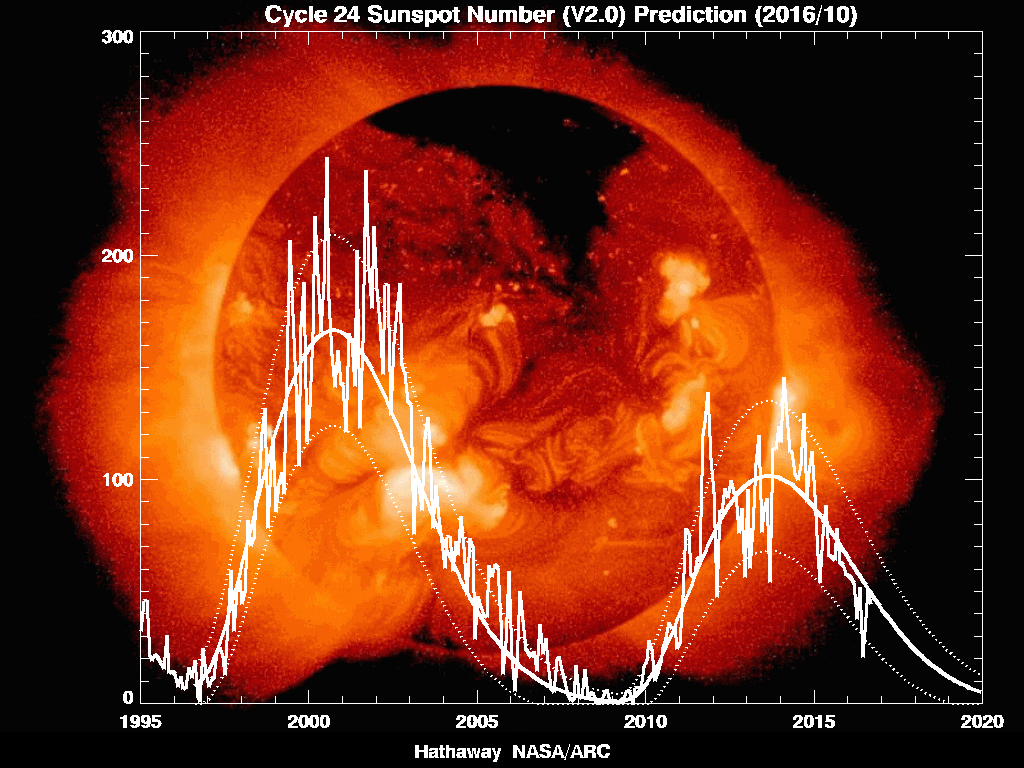
iii) Then we need to know where we stand in relation to the other shorter term cycles of sun and oceans.
Each varies on at least two other timescales. The level of solar activity varies during each cycle and over a run of cycles. The rate of energy release from the oceans varies from each El Nino to the following La Nina and back again over several years and the entire Pacific Decadal Oscillation alters the rate of energy release to the air every 25 to 30 years or so.
All those cycles vary in timing and intensity and interact with each other and are then superimposed on the longer term cycling that forms the basis of this article.
Then we have the chaotic variability of weather superimposed on the whole caboodle.
We simply do not have the data to resolve all those issues so all I can do is hazard a guess based on my personal judgement. On that basis I think we will see cooling for a couple of decades due to the negative phase of the Pacific Decadal Oscillation which has just begun then at least one more 20 to 30 year phase of natural warming before we start the true decline as the cooler thermohaline waters from the Little Ice Age come back to the surface.
If we get a peak of active sun at the same time as the worst of the cooling from the Little Ice Age comes through the oceanic system then that may be the start of a more rapid ending of the current interglacial but that is 500 years hence by which time we will have solved our energy problems or will have destroyed our civilisation.
Other climate theories:
Following the implosion of the CO2 based theory there are lots of other good ideas going around and much effort being expended by many individuals on different aspects of the climate system.
All I would suggest at the moment is that there is room in my NCM for any of those theories that demonstrate a specific climate response from sources other than sun and oceans.
All I contend is that sun and oceans together with the variable speed of the hydrological cycle assisted by the latitudinal movements of the air circulation systems and the vertical movement of the tropopause overwhelmingly provide the background trend and combine to prevent changes in the air alone changing the Earth’s equilibrium temperature.
For example:
Orbital changes feed into the insolation and albedo effects caused by moveable cloud masses.
Asteroid strikes and volcanoes feed into the atmospheric density issue.
Changing length of day and external gravitational forces feed into the speed of the thermohaline circulation.
Geothermal energy feeds into temperatures along the horizontal path of the thermohaline circulation.
Cosmic ray variations and ozone chemistry feed into the albedo changes.
The NCM can account for all past climate variability, can give general guidance as to future trends and can accommodate all manner of supplementary climate theories provided their real world influence can be demonstrated.
I humbly submit that all this is an improvement on existing modelling techniques and deserves fuller and more detailed consideration and investigation.
Novel propositions:
I think it helpful to set out here some of the novel propositions that I have had to formulate in order to obtain a climate description that complies both with observations and with basic laws of physics. This list is not intended to be exhaustive. Other new propositions may be apparent from the content and/or context of my various articles
i) Earth’s temperature is determined primarily by the oceans and not by the air (The Hot Water Bottle Effect). The contribution of the Greenhouse effect is miniscule.
ii) Changes in the air alone cannot affect the global equilibrium temperature because of oceanic dominance that always seeks to maintain sea surface and surface air equilibrium whatever the air tries to do. Warm air cannot significantly affect the oceans due to the huge difference in thermal capacities and by the effect of evaporation which removes unwanted energy to latent form as necessary to maintain the said equilibrium.
iii) Counterintuitively an active sun means cooling not warming and vice versa.
iv) The net global oceanic rate of energy release to the air is what matters with regard to the oceanic effect on the latitudinal positions of the air circulation systems and the associated cloud bands. All the oceanic oscillations affecting the rates of energy release to the air operate on different timescales and different magnitudes as energy progresses through the system via surface currents (not the thermohaline circulation which is entirely separate).
v) More CO2 ought theoretically induce faster cooling of the oceans by increasing evaporation rates. Extra CO2 molecules simply send more infra red radiation back down to the surface but infra red cannot penetrate deeper than the region of ocean surface involved in evaporation and since evaporation has a net cooling effect due to the removal of energy as latent heat the net effect should be increased cooling and not warming of the oceans.
vi) The latitudinal position of the air circulation systems at any given moment indicates the current tropospheric temperature trend whether warming or cooling and their movement reveals any change in trend
vii) All the various climate phenomena in the troposphere serve to balance energy budget changes caused by atmospheric effects from solar turbulence changes on the air above which affect the rate of energy loss to space or from variable rates of energy release from the oceans below.
viii) The speed of the hydrological cycle globally is the main thermostat in the troposphere. Changes in its speed are achieved by latitudinal shifts in the air circulation systems and by changes in the height of the tropopause.
ix) The difference between ice ages and interglacials is a matter of the timing of solar and oceanic cycles. Interglacials only occur when the solar and oceanic cycles are offsetting one another to a sufficient degree to minimise the scale of climate variability thereby preventing winter snowfall on the northern continents from being sufficient to last through the following summer.
x) Landmass distribution dictates the relative lengths of glacials and interglacials. The predominance of landmasses in the northern hemisphere causes glaciations to predominate over interglacials by about 9 to 1 with a full cycle every 100, 000 years helped along by the orbital changes of the Milankovitch cycles that affect the pattern of insolation on those shifting cloud masses.
xi) Distribution of energy within the entire system is more significant for climate (which is limited to the troposphere) than the actual temperature of the entire Earth. The latter varies hardly at all.
xii) All regional climate changes are a result of movement in relation to the locally dominant air circulation systems which move cyclically poleward and equatorward.
xiii) Albedo changes are primarily a consequence of latitudinal movement of the clouds beyond normal seasonal variability.
ix) The faint sun paradox is explained by the effectiveness of changes in the speed of the hydrological cycle. Only if the oceans freeze across their entire surfaces thereby causing the hydrological cycle to cease or if the sun puts in energy faster than it can be pumped upward by the hydrological cycle will the basic temperature equilibrium derived from the properties of water and the density and pressure of the atmosphere fail to be maintained.
A New And Effective Climate Model
The problem with existing climate models:
Even those who aver that man’s activity affects climate on a global scale rather than just locally or regionally appear to accept that the existing climate models are incomplete. It is a given that the existing models do not fully incorporate data or mechanisms involving cloudiness or global albedo (reflectivity) variations or variations in the speed of the hydrological cycle and that the variability in the temperatures of the ocean surfaces and the overall ocean energy content are barely understood and wholly inadequately quantified in the infant attempts at coupled ocean/atmosphere models. Furthermore the effect of variability in solar activity on climate is barely understood and similarly unquantified.
As they stand at present the models assume a generally static global energy budget with relatively little internal system variability so that measurable changes in the various input and output components can only occur from external forcing agents such as changes in the CO2 content of the air caused by human emissions or perhaps temporary after effects from volcanic eruptions, meteorite strikes or significant changes in solar power output.
If such simple models are to have any practical utility it is necessary to demonstrate that some predictive skill is a demonstrable outcome of the models. Unfortunately it is apparent that there is no predictive skill whatever despite huge advances in processing power and the application of millions or even billions of man hours from reputable and experienced scientists over many decades.
As I will show later on virtually all climate variability is a result of internal system variability and additionally the system not only sets up a large amount of variability internally but also provides mechanisms to limit and then reduce that internal variability. It must be so or we would not still have liquid oceans. The current models neither recognise the presence of that internal system variability nor the processes that ultimately stabilise it.
The general approach is currently to describe the climate system from ‘the bottom up’ by accumulating vast amounts of data, observing how the data has changed over time, attributing a weighting to each piece or class of data and extrapolating forward. When the real world outturn then differs from what was expected then adjustments are made to bring the models back into line with reality. This method is known as ‘hindcasting’.
Although that approach has been used for decades no predictive skill has ever emerged. Every time the models have been adjusted using guesswork (or informed judgement as some would say) to bring them back into line with ongoing real world observations a new divergence between model expectations and real world events has begun to develop.
It is now some years since the weighting attached to the influence of CO2 was adjusted to remove a developing discrepancy between the real world warming that was occurring at the time and which had not been fully accounted for in the then climate models. Since that time a new divergence began and is now becoming embarrassingly large for those who made that adjustment. At the very least the weighting given to the effect of more CO2 in the air was excessive.
The problem is directly analogous to a financial accounting system that balances but only because it contains multiple compensating errors. The fact that it balances is a mere mirage. The accounts are still incorrect and woe betide anyone who relies upon them for the purpose of making useful commercial decisions.
Correcting multiple compensating errors either in a climate model or in a financial accounting system cannot be done by guesswork because there is no way of knowing whether the guess is reducing or compounding the underlying errors that remain despite the apparent balancing of the financial (or in the case of the climate the global energy) budget.
The system being used by the entire climatological establishment is fundamentally flawed and must not be relied upon as a basis for policy decisions of any kind.
A better approach:
We know a lot about the basic laws of physics as they affect our day to day existence and we have increasingly detailed data about past and present climate behaviour.
We need a New Climate Model (from now on referred to as NCM) that is created from ‘the top down’ by looking at the climate phenomena that actually occur and using deductive reasoning to decide what mechanisms would be required for those phenomena to occur without offending the basic laws of physics.
We have to start with the broad concepts first and use the detailed data as a guide only. If a broad concept matches the reality then the detailed data will fall into place even if the broad concept needs to be refined in the process. If the broad concept does not match the reality then it must be abandoned but by adopting this process we always start with a broad concept that obviously does match the reality so by adopting a step by step process of observation, logic, elimination and refinement a serviceable NCM with some predictive skill should emerge and the more detailed the model that is built up the more predictive skill will be acquired.
That is exactly what I have been doing step by step in my articles here:
for some two years now and I believe that I have met with a degree of success because many climate phenomena that I had not initially considered in detail seem to be falling into line with the NCM that I have been constructing.
In the process I have found it necessary to propound various novel propositions that have confused and irritated warming proponents and sceptics alike but that is inevitable if one just follows the logic without a preconceived agenda which I hope is what I have done.
I will now go on to describe the NCM as simply as I can in verbal terms, then I will elaborate on some of the novel propositions (my apologies if any of them have already been propounded elsewhere by others but I think I would still be the first to pull them all together into a plausible NCM) and I will include a discussion of some aspects of the NCM which I find encouraging.
Preliminary points:
-
Firstly we must abandon the idea that variations in total solar output have a significant effect over periods of time relevant to human existence. At this point I should mention the ‘faint sun paradox’:
http://en.wikipedia.org/wiki/Faint_young_Sun_paradox
Despite a substantial increase in the power of the sun over billions of years the temperature of the Earth has remained remarkably stable. My proposition is that the reason for that is the existence of water in liquid form in the oceans combined with a relatively stable total atmospheric density. If the power input from the sun changes then the effect is simply to speed up or slow down the hydrological cycle.
An appropriate analogy is a pan of boiling water. However much the power input increases the boiling point remains at 100C. The speed of boiling however does change in response to the level of power input. The boiling point only changes if the density of the air above and thus the pressure on the water surface changes. In the case of the Earth’s atmosphere a change in solar input is met with a change in evaporation rates and thus the speed of the whole hydrological cycle keeping the overall temperature stable despite a change in solar power input.
A change in the speed of the entire hydrological cycle does have a climate effect but as we shall see on timescales relevant to human existence it is too small to measure in the face of internal system variability from other causes.
Unless more CO2 could increase total atmospheric density it could not have a significant effect on global tropospheric temperature. Instead the speed of the hydrological cycle changes to a miniscule and unmeasurable extent in order to maintain sea surface and surface air temperature equilibrium. As I have explained previously a change limited to the air alone short of an increase in total atmospheric density and pressure is incapable of altering that underlying equilibrium.
-
Secondly we must realise that the absolute temperature of the Earth as a whole is largely irrelevant to what we perceive as climate. In any event those changes in the temperature of the Earth as a whole are tiny as a result of the rapid modulating effect of changes in the speed of the hydrological cycle and the speed of the flow of radiated energy to space that always seeks to match the energy value of the whole spectrum of energy coming in from the sun.
The climate in the troposphere is a reflection of the current distribution of energy within the Earth system as a whole and internally the system is far more complex than any current models acknowledge.
That distribution of energy can be uneven horizontally and vertically throughout the ocean depths, the troposphere and the upper atmosphere and furthermore the distribution changes over time.
We see ocean energy content increase or decrease as tropospheric energy content decreases or increases. We see the stratosphere warm as the troposphere cools and cool as the troposphere warms. We see the upper levels of the atmosphere warm as the stratosphere cools and vice versa. We see the polar surface regions warm as the mid latitudes cool or the tropics warm as the poles cool and so on and so forth in infinite permutations of timing and scale.
As I have said elsewhere:
“It is becoming increasingly obvious that the rate of energy transfer varies all the time between ocean and air, air and space and between different layers in the oceans and air. The troposphere can best be regarded as a sandwich filling between the oceans below and the stratosphere above. The temperature of the troposphere is constantly being affected by variations in the rate of energy flow from the oceans driven by internal ocean variability, possibly caused by temperature fluctuations along the horizontal route of the thermohaline circulation and by variations in energy flow from the sun that affect the size of the atmosphere and the rate of energy loss to space.
The observed climate is just the equilibrium response to such variations with the positions of the air circulation systems and the speed of the hydrological cycle always adjusting to bring energy differentials above and below the troposphere back towards equilibrium (Wilde’s Law ?).
Additionally my propositions provide the physical mechanisms accounting for the mathematics of Dr. F. Miskolczi..”
He appears to have demonstrated mathematically that if greenhouse gases in the air other than water vapour increase then the amount of water vapour declines so as to maintain an optimum optical depth for the atmosphere which modulates the energy flow to maintain sea surface and surface air temperature equilibrium. In other words the hydrological cycle speeds up or slows down just as I have always proposed.
-
In my articles to date I have been unwilling to claim anything as grand as the creation of a new model of climate because until now I was unable to propose any solar mechanism that could result directly in global albedo changes without some other forcing agent or that could account for a direct solar cause of discontinuities in the temperature profile along the horizontal line of the oceanic thermohaline circulation.
I have now realised that the global albedo changes necessary and the changes in solar energy input to the oceans can be explained by the latitudinal shifts (beyond normal seasonal variation) of all the air circulation systems and in particular the net latitudinal positions of the three main cloud bands namely the two generated by the mid latitude jet streams plus the Inter Tropical Convergence Zone (ITCZ).
The secret lies in the declining angle of incidence of solar energy input from equator to poles.
It is apparent that the same size and density of cloud mass moved, say, 1000 miles nearer to the equator will have the following effects:
-
It will receive more intense irradiation from the sun and so will reflect more energy to space.
-
It will reduce the amount of energy reaching the surface compared to what it would have let in if situated more poleward.
-
In the northern hemisphere due to the current land/sea distribution the more equatorward the cloud moves the more ocean surface it will cover thus reducing total solar input to the oceans and reducing the rate of accretion to ocean energy content
-
It will produce cooling rains over a larger area of ocean surface.
As a rule the ITCZ is usually situated north of the equator because most ocean is in the southern hemisphere and it is ocean temperatures that dictate it’s position by governing the rate of energy transfer from oceans to air. Thus if the two mid latitude jets move equatorward at the same time as the ITCZ moves closer to the equator the combined effect on global albedo and the amount of solar energy able to penetrate the oceans will be substantial and would dwarf the other proposed effects on albedo from changes in cosmic ray intensity generating changes in cloud totals as per Svensmark and from suggested changes caused in upper cloud quantities by changes in atmospheric chemistry involving ozone which various other climate sceptics propose.
Thus the following NCM will incorporate my above described positional cause of changes in albedo and rates of energy input to the oceans rather than any of the other proposals. That then leads to a rather neat solution to the other theories’ problems with the timing of the various cycles as becomes clear below.
-
I have previously described why the solar effect on climate is not as generally thought but for convenience I will summarise the issue here because it will help readers to follow the logic of the NCM.Variations in total solar power output on timescales relevant to human existence are tiny and are generally countered by a miniscule change in the speed of the hydrological cycle as described above.
However according to our satellites variations in the turbulence of the solar energy output from sunspots and solar flares appear to have significant effects.
During periods of an active solar surface our atmosphere expands and during periods of inactive sun it contracts.
When the atmosphere expands it does so in three dimensions around the entire circumference of the planet but the number of molecules in the atmosphere remains the same with the result that there is an average reduced density per unit of volume with more space between the molecules. Consequently the atmosphere presents a reduced resistance to outgoing longwave energy photons that experience a reduced frequency of being obstructed by molecules in the atmosphere.
Additionally a turbulent solar energy flow disturbs the boundaries of the layers in the upper atmosphere thus increasing their surface areas allowing more energy to be transferred from layer to layer just as wind on water causes waves, an increased sea surface area and faster evaporation.
The changes in the rate of outgoing energy flow caused by changes in solar surface turbulence may be small but they appear to be enough to affect the air circulation systems and thereby influence the overall global energy budget disproportionately to the tiny variations in solar power intensity.
Thus when the sun is more active far from warming the planet the sun is facilitating an increased rate of cooling of the planet. That is why the stratosphere cooled during the late 20th Century period of a highly active sun although the higher levels of the atmosphere warmed. The higher levels were warmed by direct solar impacts but the stratosphere cooled because energy was going up faster than it was being received from the troposphere below.
The opposite occurs for a period of inactive sun.
Some do say that the expansion and contraction of the atmosphere makes no difference to the speed of the outward flow of longwave energy because that outgoing energy still has to negotiate the same mass but that makes no sense to me if that mass is more widely distributed over a three dimensional rather than two dimensional space. If one has a fine fabric container holding a body of liquid the speed at which the liquid escapes will increase if the fabric is stretched to a larger size because the space between the fibres will increase.
Furthermore all that the NCM requires is for the stratosphere alone to lose or gain energy faster or slower so as to influence the tropospheric polar air pressure cells. The energy does not need to actually escape to space to have the required effect. It could just as well simply take a little longer or a little less long to traverse the expanded or contracted upper atmospheric layers.
The New Climate Model (NCM)
-
Solar surface turbulence increases causing an expansion of the Earth’s atmosphere.
-
Resistance to outgoing longwave radiation reduces, energy is lost to space faster.
-
The stratosphere cools. Possibly also the number of chemical reactions in the upper atmosphere increases due to the increased solar effects with faster destruction of ozone.
-
The tropopause rises.
-
There is less resistance to energy flowing up from the troposphere so the polar high pressure systems shrink and weaken accompanied by increasingly positive Arctic and Antarctic Oscillations.
-
The air circulation systems in both hemispheres move poleward and the ITCZ moves further north of the equator as the speed of the hydrological cycle increases due to the cooler stratosphere increasing the temperature differential between stratosphere and surface.
-
The main cloud bands move more poleward to regions where solar insolation is less intense so total global albedo decreases.
-
More solar energy reaches the surface and in particular the oceans as more ocean surfaces north of the equator are exposed to the sun by the movement of the clouds to cover more continental regions.
-
Less rain falls on ocean surfaces allowing them to warm more.
-
Ocean energy input increases but not all is returned to the air. A portion enters the thermohaline circulation to embark on a journey of 1000 to 1500 years. A pulse of slightly warmer water has entered the ocean circulation.
-
Solar surface turbulence passes its peak and the Earth’s atmosphere starts to contract.
-
Resistance to outgoing longwave radiation increases, energy is lost to space more slowly.
-
The stratosphere warms. Ozone levels start to recover.
-
The tropopause falls
-
There is increased resistance to energy flowing up from the troposphere so the polar high pressure systems expand and intensify producing increasingly negative Arctic and Antarctic Oscillations.
-
The air circulation systems in both hemispheres move back equatorward and the ITCZ moves nearer the equator as the speed of the hydrological cycle decreases due to the warming stratosphere reducing the temperature differential between stratosphere and surface.
-
The main cloud bands move more equatorward to regions where solar insolation is more intense so total global albedo increases once more.
-
Less solar energy reaches the surface and in particular the oceans as less ocean surfaces north of the equator are exposed to the sun by the movement of the clouds to cover more oceanic regions.
-
More rain falls on ocean surfaces further cooling them.
-
Ocean energy input decreases and the amount of energy entering the thermohaline circulation declines sending a pulse of slightly cooler water on that 1000 to 1500 year journey.
-
After 1000 to 1500 years those variations in energy flowing through the thermohaline circulation return to the surface by influencing the size and intensity of the ocean surface temperature oscillations that have now been noted around the world in all the main ocean basins and in particular the Pacific and the Atlantic. It is likely that the current powerful run of positive Pacific Decadal Oscillations is the pulse of warmth from the Mediaeval Warm Period returning to the surface with the consequent inevitable increase in atmospheric CO2 as that warmer water fails to take up as much CO2 by absorption. Cooler water absorbs more CO2, warmer water absorbs less CO2. We have the arrival of the cool pulse from the Little Ice Age to look forward to and the scale of its effect will depend upon the level of solar surface activity at the time. A quiet sun would be helpful otherwise the rate of tropospheric cooling as an active sun throws energy into space at the same time as the oceans deny energy to the air will be fearful indeed. Fortunately the level of solar activity does seem to have begun a decline from recent peaks.
-
The length of the thermohaline circulation is not synchronous with the length of the variations in solar surface turbulence so it is very much a lottery as to whether a returning warm or cool pulse will encounter an active or inactive sun.
-
A returning warm pulse will try to expand the tropical air masses as more energy is released and will try to push the air circulation systems poleward against whatever resistance is being supplied at the time by the then level of solar surface turbulence. A returning cool pulse will present less opposition to solar effects.
-
Climate is simply a product of the current balance in the troposphere between the solar and oceanic effects on the positions and intensities of all the global air circulation systems
-
The timing of the solar cycles and ocean cycles will drift relative to one another due to their asynchronicity so there will be periods when solar and ocean cycles supplement one another in transferring energy out to space and other periods when they will offset one another.
26) During the current interglacial the solar and oceanic cycles are broadly offsetting one another to reduce overall climate variability but during glacial epochs they broadly supplement one another to produce much larger climate swings. The active sun during the Mediaeval Warm Period and the Modern Warm Period and the quiet sun during the Little Ice Age reduced the size of the climate swings that would otherwise have occurred. During the former two periods the extra energy from a warm ocean pulse was ejected quickly to space by an active sun to reduce tropospheric heating. During the latter period the effect on tropospheric temperatures of reduced energy from a cool ocean pulse was mitigated by slower ejection of energy to space from a less active sun.
Discussion points:
Falsification:
Every serious hypothesis must be capable of being proved false. In the case of this NCM my narrative is replete with opportunities for falsification if the future real world observations diverge from the pattern of cause and effect that I have set out.
However that narrative is based on what we have actually observed over a period of 1000 years with the gaps filled in by deduction informed by known laws of physics.
At the moment I am not aware of any observed climate phenomena that would effect falsification. If there be any that suggest such a thing then I suspect that they will call for refinement of the NCM rather than abandonment.
For true falsification we would need to observe events such as the mid latitude jets moving poleward during a cooling oceanic phase and a period of quiet sun or the ITCZ moving northward whilst the two jets moved equatorward or the stratosphere, troposphere and upper atmosphere all warming or cooling in tandem or perhaps an unusually powerful Arctic Oscillation throughout a period of high solar turbulence and a warming ocean phase.
They say nothing is impossible so we will have to wait and see.
Predictive skill:
To be taken seriously the NCM must be seen to show more predictive skill than the current computer based models.
In theory that shouldn’t be difficult because their level of success is currently zero.
From a reading of my narrative it is readily apparent that if the NCM matches reality then lots of predictions can be made. They may not be precise in terms of scale or timing but they are nevertheless useful in identifying where we are in the overall scheme of things and the most likely direction of future trend.
For example if the mid latitude jets stay where they now are then a developing cooling trend can be expected.
If the jets move poleward for any length of time then a warming trend may be returning.
If the solar surface becomes more active then we should see a reduction in the intensity of the Arctic Oscillation.
If the current El Nino fades to a La Nina then the northern winter snows should not be as intense next winter but it will nevertheless be another cold though drier northern hemisphere winter as the La Nina denies energy to the air.
The past winter is a prime example of what the NCM suggests for a northern winter with an El Nino during a period of quiet sun. The warmth from the oceans pumps energy upwards but the quiet sun prevents the poleward movement of the jets. The result is warming of the tropics and of the highest latitudes (but the latter stay below the freezing point of water) and a flow of cold into the mid latitudes and more precipitation in the form of snow at lower latitudes than normal.
So I suggest that a degree of predictive skill is already apparent for my NCM.
Likely 21st Century climate trend:
There are 3 issues to be resolved for a judgement on this question.
i) We need to know whether the Modern Warm Period has peaked or not. It seems that the recent peak late 20th Century has passed but at a level of temperature lower than seen during the Mediaeval Warm Period. Greenland is not yet as habitable as when the Vikings first colonised it. Furthermore it is not yet 1000 years since the peak of the Mediaeval Warm Period which lasted from about 950 to 1250 AD
http://www.theresilientearth.com/?q=content/medieval-warm-period-rediscovered
so I suspect that the Mediaeval warmth now emanating from the oceans may well warm the troposphere a little more during future years of warm oceanic oscillations. I would also expect the CO2 levels to continue drifting up until a while after the Mediaeval Warm Period water surface warming peak has begun it’s decline. That may still be some time away, perhaps a century or two.
ii) We need to know where we are in the solar cycles. The highest peak of solar activity in recorded history occurred during the late 20th Century but we don’t really know how active the sun became during the Mediaeval Warm Period. There are calculations from isotope proxies but the accuracy of proxies is in the doghouse since Climategate and the hockey stick farrago. However the current solar quiescence suggests that the peak of recent solar activity is now over.
http://solarscience.msfc.nasa.gov/images/ssn_predict_l.gif
iii) Then we need to know where we stand in relation to the other shorter term cycles of sun and oceans.
Each varies on at least two other timescales. The level of solar activity varies during each cycle and over a run of cycles. The rate of energy release from the oceans varies from each El Nino to the following La Nina and back again over several years and the entire Pacific Decadal Oscillation alters the rate of energy release to the air every 25 to 30 years or so.
All those cycles vary in timing and intensity and interact with each other and are then superimposed on the longer term cycling that forms the basis of this article.
Then we have the chaotic variability of weather superimposed on the whole caboodle.
We simply do not have the data to resolve all those issues so all I can do is hazard a guess based on my personal judgement. On that basis I think we will see cooling for a couple of decades due to the negative phase of the Pacific Decadal Oscillation which has just begun then at least one more 20 to 30 year phase of natural warming before we start the true decline as the cooler thermohaline waters from the Little Ice Age come back to the surface.
If we get a peak of active sun at the same time as the worst of the cooling from the Little Ice Age comes through the oceanic system then that may be the start of a more rapid ending of the current interglacial but that is 500 years hence by which time we will have solved our energy problems or will have destroyed our civilisation.
Other climate theories:
Following the implosion of the CO2 based theory there are lots of other good ideas going around and much effort being expended by many individuals on different aspects of the climate system.
All I would suggest at the moment is that there is room in my NCM for any of those theories that demonstrate a specific climate response from sources other than sun and oceans.
All I contend is that sun and oceans together with the variable speed of the hydrological cycle assisted by the latitudinal movements of the air circulation systems and the vertical movement of the tropopause overwhelmingly provide the background trend and combine to prevent changes in the air alone changing the Earth’s equilibrium temperature.
For example:
Orbital changes feed into the insolation and albedo effects caused by moveable cloud masses.
Asteroid strikes and volcanoes feed into the atmospheric density issue.
Changing length of day and external gravitational forces feed into the speed of the thermohaline circulation.
Geothermal energy feeds into temperatures along the horizontal path of the thermohaline circulation.
Cosmic ray variations and ozone chemistry feed into the albedo changes.
The NCM can account for all past climate variability, can give general guidance as to future trends and can accommodate all manner of supplementary climate theories provided their real world influence can be demonstrated.
I humbly submit that all this is an improvement on existing modelling techniques and deserves fuller and more detailed consideration and investigation.
Novel propositions:
I think it helpful to set out here some of the novel propositions that I have had to formulate in order to obtain a climate description that complies both with observations and with basic laws of physics. This list is not intended to be exhaustive. Other new propositions may be apparent from the content and/or context of my various articles
i) Earth’s temperature is determined primarily by the oceans and not by the air (The Hot Water Bottle Effect). The contribution of the Greenhouse effect is miniscule.
ii) Changes in the air alone cannot affect the global equilibrium temperature because of oceanic dominance that always seeks to maintain sea surface and surface air equilibrium whatever the air tries to do. Warm air cannot significantly affect the oceans due to the huge difference in thermal capacities and by the effect of evaporation which removes unwanted energy to latent form as necessary to maintain the said equilibrium.
iii) Counterintuitively an active sun means cooling not warming and vice versa.
iv) The net global oceanic rate of energy release to the air is what matters with regard to the oceanic effect on the latitudinal positions of the air circulation systems and the associated cloud bands. All the oceanic oscillations affecting the rates of energy release to the air operate on different timescales and different magnitudes as energy progresses through the system via surface currents (not the thermohaline circulation which is entirely separate).
v) More CO2 ought theoretically induce faster cooling of the oceans by increasing evaporation rates. Extra CO2 molecules simply send more infra red radiation back down to the surface but infra red cannot penetrate deeper than the region of ocean surface involved in evaporation and since evaporation has a net cooling effect due to the removal of energy as latent heat the net effect should be increased cooling and not warming of the oceans.
vi) The latitudinal position of the air circulation systems at any given moment indicates the current tropospheric temperature trend whether warming or cooling and their movement reveals any change in trend
vii) All the various climate phenomena in the troposphere serve to balance energy budget changes caused by atmospheric effects from solar turbulence changes on the air above which affect the rate of energy loss to space or from variable rates of energy release from the oceans below.
viii) The speed of the hydrological cycle globally is the main thermostat in the troposphere. Changes in its speed are achieved by latitudinal shifts in the air circulation systems and by changes in the height of the tropopause.
ix) The difference between ice ages and interglacials is a matter of the timing of solar and oceanic cycles. Interglacials only occur when the solar and oceanic cycles are offsetting one another to a sufficient degree to minimise the scale of climate variability thereby preventing winter snowfall on the northern continents from being sufficient to last through the following summer.
x) Landmass distribution dictates the relative lengths of glacials and interglacials. The predominance of landmasses in the northern hemisphere causes glaciations to predominate over interglacials by about 9 to 1 with a full cycle every 100, 000 years helped along by the orbital changes of the Milankovitch cycles that affect the pattern of insolation on those shifting cloud masses.
xi) Distribution of energy within the entire system is more significant for climate (which is limited to the troposphere) than the actual temperature of the entire Earth. The latter varies hardly at all.
xii) All regional climate changes are a result of movement in relation to the locally dominant air circulation systems which move cyclically poleward and equatorward.
xiii) Albedo changes are primarily a consequence of latitudinal movement of the clouds beyond normal seasonal variability.
ix) The faint sun paradox is explained by the effectiveness of changes in the speed of the hydrological cycle. Only if the oceans freeze across their entire surfaces thereby causing the hydrological cycle to cease or if the sun puts in energy faster than it can be pumped upward by the hydrological cycle will the basic temperature equilibrium derived from the properties of water and the density and pressure of the atmosphere fail to be maintained.
Stephen
The atmospheric part of your model – expansion / contraction and boundary turbulence in response to solar activity – presumably would be amenable to Monte Carlo computer simulation or something similar? Perhaps you could get a University to fund a PhD studentship on the topic.
phlogiston (21:40:00)
That would be nice. I’m open to offers 🙂
In the meantime just watching real world events should be sufficient.
Perhaps I’m getting the wrong end of the stick, please correct me if I am.
However, in this 2008 article it seemed to me that Mr. Wilde was saying high solar activity leads to warming:
Solar Energy, Ocean Cycles And Global Temperature (Stephen Wilde, May 2008)
http://www.rightsidenews.com/20080521994/energy-and-environment/solar-energy-ocean-cycles-and-global-temperature.html
“On the basis of the information in the public domain about solar cycles and the positive PDO it should have been blatantly obvious that the world would warm up without the need to speculate on a contribution from CO2 or anything else…I find Mr. [Alec] Rawls very helpful in illustrating the effect of time lags between solar input and oceanic oscillations…As Mr. Rawls points out…
Active sun during cycles 21, 22 and the double peak of 23 plus positive PDO = significant warming. (1975 to 1998)”
This implies high solar activity = warming. However, in
A New And Effective Climate Model
http://wattsupwiththat.com/2010/04/06/a-new-and-effective-climate-model/
“iii) Counterintuitively an active sun means cooling not warming and vice versa.”
Thus is he now saying the opposite to previously; namely, solar activity leads to cooling? If so, how does the current statement of “solar activity leading to cooling” reconcile with the previous description of the last century’s temperature changes as described in the original, 2008 article?
ClimateReview (20:19:05)
Quite right. Well spotted.
When new information becomes available I change my opinion. What do you do ?
I anticipate further changes as more real world data accumulates.
Many thanks, Stephen, for replying promptly to my question.
Science, of course, is an evolution of thought and, if better evidence presents itself, then one must adapt to the situation.
I believe you have created a new line of climate modeling here and am very intrigued about the possibilities of thought it presents. It is pretty “neat” and comprehensive in its explanation of the observed, physical evidence. The concepts are very believable and plausible indeed.
However, if you have the time, could you explain how you would explain the last century’s of “warming” via your new solar-oceanic hypothesis? I based a lot of my climate change, revue movie on your, and others, previous hypothesis. I might have to go back to the drawing board…
Cheers,
ClimateReview
Movie: http://www.climatereview.net
ClimateReview (16:40:11)
Thanks CR.
I think the warming and cooling of previous centuries, indeed aeons, is down to that ever changing balance between oceanic influences from below and solar influences from above with the latitudinal position of the air circulation systems and the speed of the hydrological cycle altering as necessary to bring the system back towards equilibrium if either influence gets out of line.
The longer the time scale the clearer the reality becomes because the very short term chaotic variability and the medium term cycle conflicts become less significant as the timescale increases.
The weakest portion of my scenario at present is deciding on the relative scales of the solar and oceanic effects. Indeed it is that very issue that led to my change of opinion. It seems from the observational evidence that the potentially cooling effect of a more disturbed solar surface is greater then the warming effect of the very small TSI increase at such times and the oceanic effect is far greater than either.
It is Leif Svalgaard’s contribution that has led me away from the idea that TSI changes have a major effect except on very long timescales of maybe 100,000 years or so and even then the internal system checks and balances seem to adjust enough to prevent a direct climate impact from TSI changes alone. I’ve already explained why I can’t yet go as far as Leif in excluding all solar influence. If someone can come up with another plausible (non solar) reason for differential warming and cooling of the layers from tropopause upwards then I could review that aspect.
I like Bob Tisdale’s work too but I can’t seem to get him to extend his work to longer timescales so as to see the wider overview and in the meantime he picks away at my work with inconclusive short term and regionally limited data.
I hope a small adjustment to your work will be sufficient rather than a return to the drawing board 🙂
Stephen Wilde (04:11:24) :
I can’t yet go as far as Leif in excluding all solar influence.>/i>
But I don’t. I expect a 0.1K solar cycle effect, and some people even claim that they have found it.
Stephen Wilde (04:11:24) :
I can’t yet go as far as Leif in excluding all solar influence.
But I don’t. I expect a 0.1K solar cycle effect, and some people even claim that they have found it.
Leif Svalgaard (04:36:41)
Thanks for that clarification.
I appreciate that you think that apart from that 0.1K solar cycle effect, (and presumably larger effects over longer time periods) all observed climate variability can be accounted for by internal system variability.
I’m almost persuaded by that point of view although you make no attempt to decribe how that could be achieved which is the approach I have adopted in my proposed NCM.
Can you make any positive suggestions that would explain observations fully without any additional solar influence ?
In particular the observed differential warming and cooling of the layers above the tropopause which doesn’t seem to be adequately accounted for by system variability from below. That is important because it would have some bearing on the size and intensities of the polar high pressure cells by altering the strength of the temperature inversion at the tropopause.
I know that you have proposed some undefined and unquantified changes in chemical composition but such changes would themselves be solar induced would they not ?
Stephen Wilde (04:11:24)
Dr. Leif Svalgaard is looking at the total. However there is a larger variation in the UV
”
Of the many trends that appear to cause fluctuations in the Sun’s energy, those that last decades to centuries are the most likely to have a measurable impact on the Earth’s climate in the foreseeable future. Many researchers believe the steady rise in sunspots and faculae since the late seventeenth century may be responsible for as much as half of the 0.6 degrees of global warming over the last 110 years (IPCC, 2001).
….The Sun’s affect on global warming can mostly be attributed to variations in the near-infrared and visible wavelengths of solar radiation. As previously stated, these types of radiation are absorbed by the lower atmosphere, the oceans, and the land. UV radiation, on the other hand, interacts strongly with the ozone layer and the upper atmosphere. Though UV solar radiation makes up a much smaller portion of the TSI than infrared or visible radiation, UV solar radiation tends to change much more dramatically over the course of solar cycles.
The impacts of undulating UV solar radiation may be substantial. Since UV radiation creates ozone in the stratosphere, the oscillation in UV levels can affect the size of the ozone hole….” http://earthobservatory.nasa.gov/Features/SORCE/sorce_04.php
“…A 12-year low in solar “irradiance”: Careful measurements by several NASA spacecraft show that the sun’s brightness has dropped by 0.02% at visible wavelengths and a whopping 6% at extreme UV wavelengths since the solar minimum of 1996….
http://wattsupwiththat.com/2009/04/01/nasa-headline-deep-solar-minimum/
“…The solar X-ray radiation varies more than other wavelengths during flares; thus solar X-ray irradiance measurements are relied upon for detecting flare events as well as used to study flare parameters. There is new information about the spectral and temporal variations of flares using solar irradiance measurements from NASA’s Solar Radiation and Climate Experiment (SORCE) and the Thermosphere, Ionosphere, Mesosphere, Energetics, and Dynamics (TIMED) missions. For one, the improved measurement precision for the total solar irradiance (TSI) measurements by the SORCE Total Irradiance Monitor (TIM) has enabled the first detection of flares in the TSI. These flare observations indicate a total flare energy that is about 105 times more than the X-ray measurements in the 0.1–0.8 nm range. In addition, solar spectral irradiance instruments aboard TIMED and SORCE have observed hundreds of flare events in the 0.1 nm to 190 nm range. These solar ultraviolet measurements show that the ultraviolet irradiance changes during flares account for 50% or more of the flare variations seen in the TSI, with most of the ultraviolet contribution coming from the ultraviolet shortward of 14 nm….” http://www.agu.org/pubs/crossref/2006/2005JA011507.shtml
Here is a long but very good look at ocean heat content. Remember the shorter the wavelength the further the energy penetrates the ocean… http://www.21stcenturysciencetech.com/articles/ocean.html
“How the Oceans Get Warm
Warming the ocean is not a simple matter, not like heating a small glass of water. The first thing to remember is that the ocean is not warmed by the overlying air.
Let’s begin with radiant energy from two sources: sunlight, and infrared radiation, the latter emitted from the “greenhouse” gases (water vapor, carbon dioxide, methane, and various others) in the lower atmosphere. Sunlight penetrates the water surface readily, and directly heats the ocean up to a certain depth. Around 3 percent of the radiation from the Sun reaches a depth of about 100 meters….
The infrared radiation penetrates but a few millimeters into the ocean. This means that the greenhouse radiation from the atmosphere affects only the top few millimeters of the ocean….”
How much high energy solar radiation makes it to the oceans past the oxygen and water, and how it varies over time I do not know, but it is a line of though that has probably been investigated and worth looking at.
H2O in the form of clouds, ice and water with a healthy helping hand from the sun get my vote for the most probable major contributors to climate variation. Mankind’s 2 to 3% contribution to a minor gas measured at under 400 ppm just doesn’t pass the smell test.
Stephen Wilde (05:40:40) :
Can you make any positive suggestions that would explain observations fully without any additional solar influence ?
Any complex system has internal variations. One could take it one step up and ask why the sun varies without additional external influence.
In particular the observed differential warming and cooling of the layers above the tropopause which doesn’t seem to be adequately accounted for by system variability from below.
Current models describe this well.
I know that you have proposed some undefined and unquantified changes in chemical composition but such changes would themselves be solar induced would they not ?
No, take CO2 for instance.
Leif Svalgaard (05:55:06)
I’ll take it that you have no positive suggestions then. Your suggestion of taking the question one step up is invalid. A very large complex system is likely to have an effect on a nearby small complex system especially if constantly bombarding it with variable flows of energy. The sun has no larger dynamic system nearby.
Current models describe it by attributing a forcing effect to CO2 which is supposed to slow down the rate of energy transfer from tropospere to stratosphere thus cooling the latter. I thought you considered that to be wrong so why do you use the term ‘describe this well’ ? What has changed in the troposphere since the mid 90s to stop the stratospheric cooling and cause it now to start warming ? That is completely inconsistent with the models.
Even CO2 is partially solar dependent. More solar energy increases the speed of processes in the biosphere and thus the carbon cycle and by warming the ocean surface reduces it’s ability to absorb CO2. And you were not referring to CO2 when you last mentioned the issue. As I understood you at the time you were referring to ozone reactions that are solar related.
Gail Combs (05:49:52)
Thanks, Gail.
I’ve seen those before but drawing attention to them here is timely.
Leif doesn’t have it all his own way and the major part of my attention is taken up sorting out the relative scales of influence and likely levels of probability of the numerous alternative propositions put forward by professional scientists of which he is just one.
Stephen Wilde (07:47:41) :
I’ll take it that you have no positive suggestions then.
Can’t have positive suggestion for something not happening.
Your suggestion of taking the question one step up is invalid. A very large complex system is likely to have an effect on a nearby small complex system especially if constantly bombarding it with variable flows of energy.
What makes the flow variable? A variable sun. What makes the Sun vary? Internal fluctuations… since no larger system nearby…
So you postulate internal causes for the Sun, but deny them on Earth….
Current models describe it by attributing a forcing effect to CO2 which is supposed to slow down the rate of energy transfer from troposphere to stratosphere thus cooling the latter. I thought you considered that to be wrong so why do you use the term ‘describe this well’
http://acd.ucar.edu/~randel/Garcia_Randel.pdf
Leif Svalgaard (08:42:20)
Looks like you are a hard wired warmist after all.
That Garcia_Randel pdf deals with acceleration of the Brewer Dobson circulation under a forcing influence from more greenhouse gases. If you accept it then your protestations about not supporting AGW come to nought which explains your apparent obsession with the removal of the sun as a potential climate forcing agent.
In fact that pdf makes my point perfectly. It proposes only an acceleration That might have been meaningful until the mid 90’s or even 2000 but no longer.
It says nothing about real world events since then which, despite increasing ghgs, have gone into reverse with a cessation of stratospheric cooling and a return back equatorward of the air circulation systems.
Thus there is indeed something happening and the models do not account for it at all let alone ‘well’.
Oh, and yet another falsehood from you concerning that which I have said earlier. You have been making a habit of that strategy.
I make it perfectly clear that I do propose considerable internal causes for the Earth.
Where we differ is that I think the sun’s internal variability somehow manages to affect the Earth’s internal variability one way or another and we need to find out how it does so and then ascertain the scale of the effect as against the oceanic effect.
Even if it is only 0.1C over a solar cycle and a little more over a 500 year period from LIA to date then that’s a good enough starting point for my NCM because all such solar variability needs to do is alter the size, position and intensity of the polar high pressure cells against an opposing force from oceanic variability. The sun doesn’t need to change the Earth’s temperature, merely force a redistribution vertically and horizontally within the system. We can leave oceanic variability to do the heavy lifting implied by an actual temperature change for the entire system.
Remember that the temperature near the surface need not be a true reflection of total system energy content if there is variability at multiple levels from ocean depths to top of atmosphere. That surface temperature need only be a snapshot at a moment in time as the energy is redistributed within the system.
That could be well within the power of even the small solar variations that you do accept.
Furthermore all the phnomena investigated by Garcia_Randel would be better explained by changes in the speed of the hydrological cycle because that would accommodate both acceleration and deceleration of the Brewer Dobson circulation which the GHG forcing idea cannot.
Stephen Wilde (14:30:43) :
Where we differ is that I think the sun’s internal variability somehow manages to affect the Earth’s internal variability one way or another and we need to find out how it does so and then ascertain the scale of the effect as against the oceanic effect.
You think so, but we should go with evidence and you have not provided any, other than your thoughts. And against mere thoughts no argument is effective. Your comments are also too loaded with unsubstantiated accusations to be taken seriously in a reasonable debate: “hard-wired”, “falsehoods”, etc.
Stephen Wilde (14:51:37) :
better explained by changes in the speed of the hydrological cycle because that would accommodate both acceleration and deceleration of the Brewer Dobson circulation
It doesn’t really matter what regulates the B-D circulation. It is enough it is there. The ‘speed’ of a cycle is a non-physical use. Speeds are measured in meters/second, so what is in m/s the speed of your cycle? Sorry to be so hard-nosed on this, but unless these things are well-defined and quantified, there is nothing.
Stephen Wilde and Dr Svalgaard,
I saw this over on tips and notes, hopefully it will soon get its own post but thought you two would like a heads up. It looks like it might explain extra variation in the sun’s contribution to the climate via clouds.
_____________________________________________________________________________
enneagram (08:34:32) :
Scientists discover surprise in Earth’s upper atmosphere
The rate at which the solar wind transfers energy to the magnetosphere can vary widely, but what determines the rate of energy transfer is unclear.
“We thought it was known, but we came up with a major surprise,” said Lyons, who conducted the research with Heejeong Kim, an assistant researcher in the UCLA Department of Atmospheric and Oceanic Sciences, and other colleagues
http://newsroom.ucla.edu/portal/ucla/scientists-discover-surprise-in-101025.aspx
_____________________________________________________________________________
I also found this but the source is not great.
“The second channel is corpuscular radiation, consisting of solar wind and space rays. Although transferring much less energy, it plays a key role in forming “space weather” – changeable conditions in space which depend on solar activity. Until recently, it was believed that “space weather” had nothing to do with ours, but that idea has been proved wrong.
“Solar wind becomes more intense when the Sun is active. It sweeps space rays out of the solar system like a broom,” Zeleny points out. “This affects cloud formation, …Yury Zaitsev (author) is an expert from the Institute of Space Studies. ” http://www.globalresearch.ca/index.php?context=va&aid=6934
Gail Combs (18:01:45) :
Scientists discover surprise in Earth’s upper atmosphere
The rate at which the solar wind transfers energy to the magnetosphere can vary widely, but what determines the rate of energy transfer is unclear.
The amount of energy involved is of the order of a million times smaller than what we get from the ordinary light and heat, so is really irrelevant. And the ‘unclear’ bit is simply not the case. We know very well how this all works [have known it 30+ years]. In fact given the solar wind properties, we can calculate in exquisite detail what the magnetosphere’s response is. Here are some pointers:
http://www.leif.org/research/suipr699.pdf see e.g. Figure 19 on page 38 [or 40]. A recent analysis shows the same:
http://www.leif.org/research/IAGA2008LS-final.pdf Figure 6,
Leif, we all know your viewpoint but some of us respectfully disagree.
Whether or not you think we are right to disagree is not relevant. You don’t have enough observational (as opposed to theoretical) evidence to resolve that issue.
Having registered your beliefs ‘ad nauseam’ perhaps you could refrain from hijacking this thread into a discussion of the validity or not of your apparent certainty that solar variability is of no significant importance.
If however you could make a positive suggestion as to alternative mechanism to account for observations then that would be welcome but I hold out no hope of that because you don’t even accept that the observations do differ from what we would expect from internal system variability on it’s own.
If internal system variability on it’s own were sufficient as you seem to believe then the mechanisms and quantities involved would already have been substantially resolved with sound predictive abilities already arising from our models.
That is obviously not happening so internal system variability is not enough on it’s own whether you acknowledge that or not.
The ‘speed’ of the hydrological cycle would not be measured in terms of metres per second.
Instead it is a composite of the rates of evaporation and condensation, melting and freezing and thus the average time that a water molecule remains in the air in vapour form, or in the ocean as a liquid or in ice and snow as a solid.
No one has a clue so don’t expect me to come up with the ‘right’ numbers.
The concept of the ‘speed’ of a natural cycle is nonetheless legitimate and in this case, in my opinion, it should be at the heart of climatology and it is essential to any calculation of the Earth’s energy budget but it remains woefully neglected.
Stephen Wilde (01:17:40) :
thus the average time that a water molecule remains in the air in vapour form, or in the ocean as a liquid or in ice and snow as a solid.
A million years for ice in the Antarctic…
Stephen Wilde (01:07:00) :
the observations do differ from what we would expect from internal system variability on it’s own.
Describe what you would expect.
Leif Svalgaard (04:55:21)
“A million years for ice in the Antarctic…”
I suppose that’s a starting point :). And your next step would be ?
“Describe what you would expect”.
An obvious sequence of cause and effect from the depths of the oceans to the top of the atmosphere. The power of the oceans is so huge that nothing else internal to the system could confuse the signals to the extent we observe.
A direct and clear relationship between the polar oscillations, the latitudinal positions of the air circulation systems and the energy released by the oceans.
A far less jumbled and confusing climate record. The difficulty obtaining clear correlations over all timescales suggests a substantial secondary force acting against the primary oceanic driver and there is no adequate internal force available.
If you look again at my NCM you will see that by attributing an influence to the sun a large number of real world observations fit into a coherent overall picture going back into the last ice age and potentially back to the first formation of the oceans.
If you think you can do better then be my guest.
Stephen Wilde (07:08:20) :
I suppose that’s a starting point :). And your next step would be ?
You tell me as it is your ‘theory’. I think it is all hogwash. The hydrological ‘cycle’ is not a driver of the climate, rather it is the other way around.
“Describe what you would expect”.
An obvious sequence of cause and effect from the depths of the oceans to the top of the atmosphere. The power of the oceans is so huge that nothing else internal to the system could confuse the signals to the extent we observe.
Vague had waving. Describe the ‘obvious’ cause.
The difficulty obtaining clear correlations over all timescales
Comes from you assuming there are relationships where there are not, so no wonder it is hard to find clear correlations.
As I have said ‘ad nauseam’, you have no coherent theory, no clue [as you say], no cause and effect chain, no quantification, no nothing.