The problem with existing climate models:
Guest post by Stephen Wilde

Even those who aver that man’s activity affects climate on a global scale rather than just locally or regionally appear to accept that the existing climate models are incomplete. It is a given that the existing models do not fully incorporate data or mechanisms involving cloudiness or global albedo (reflectivity) variations or variations in the speed of the hydrological cycle and that the variability in the temperatures of the ocean surfaces and the overall ocean energy content are barely understood and wholly inadequately quantified in the infant attempts at coupled ocean/atmosphere models. Furthermore the effect of variability in solar activity on climate is barely understood and similarly unquantified.
As they stand at present the models assume a generally static global energy budget with relatively little internal system variability so that measurable changes in the various input and output components can only occur from external forcing agents such as changes in the CO2 content of the air caused by human emissions or perhaps temporary after effects from volcanic eruptions, meteorite strikes or significant changes in solar power output.
If such simple models are to have any practical utility it is necessary to demonstrate that some predictive skill is a demonstrable outcome of the models. Unfortunately it is apparent that there is no predictive skill whatever despite huge advances in processing power and the application of millions or even billions of man hours from reputable and experienced scientists over many decades.
As I will show later on virtually all climate variability is a result of internal system variability and additionally the system not only sets up a large amount of variability internally but also provides mechanisms to limit and then reduce that internal variability. It must be so or we would not still have liquid oceans. The current models neither recognise the presence of that internal system variability nor the processes that ultimately stabilise it.
The general approach is currently to describe the climate system from ‘the bottom up’ by accumulating vast amounts of data, observing how the data has changed over time, attributing a weighting to each piece or class of data and extrapolating forward. When the real world outturn then differs from what was expected then adjustments are made to bring the models back into line with reality. This method is known as ‘hindcasting’.
Although that approach has been used for decades no predictive skill has ever emerged. Every time the models have been adjusted using guesswork (or informed judgment as some would say) to bring them back into line with ongoing real world observations a new divergence between model expectations and real world events has begun to develop.
It is now some years since the weighting attached to the influence of CO2 was adjusted to remove a developing discrepancy between the real world warming that was occurring at the time and which had not been fully accounted for in the then climate models. Since that time a new divergence began and is now becoming embarrassingly large for those who made that adjustment. At the very least the weighting given to the effect of more CO2 in the air was excessive.
The problem is directly analogous to a financial accounting system that balances but only because it contains multiple compensating errors. The fact that it balances is a mere mirage. The accounts are still incorrect and woe betide anyone who relies upon them for the purpose of making useful commercial decisions.
Correcting multiple compensating errors either in a climate model or in a financial accounting system cannot be done by guesswork because there is no way of knowing whether the guess is reducing or compounding the underlying errors that remain despite the apparent balancing of the financial (or in the case of the climate the global energy) budget.
The system being used by the entire climatological establishment is fundamentally flawed and must not be relied upon as a basis for policy decisions of any kind.
A better approach:
We know a lot about the basic laws of physics as they affect our day to day existence and we have increasingly detailed data about past and present climate behaviour.
We need a New Climate Model (from now on referred to as NCM) that is created from ‘the top down’ by looking at the climate phenomena that actually occur and using deductive reasoning to decide what mechanisms would be required for those phenomena to occur without offending the basic laws of physics.
We have to start with the broad concepts first and use the detailed data as a guide only. If a broad concept matches the reality then the detailed data will fall into place even if the broad concept needs to be refined in the process. If the broad concept does not match the reality then it must be abandoned but by adopting this process we always start with a broad concept that obviously does match the reality so by adopting a step by step process of observation, logic, elimination and refinement a serviceable NCM with some predictive skill should emerge and the more detailed the model that is built up the more predictive skill will be acquired.
That is exactly what I have been doing step by step in my articles here:
for some two years now and I believe that I have met with a degree of success because many climate phenomena that I had not initially considered in detail seem to be falling into line with the NCM that I have been constructing.
In the process I have found it necessary to propound various novel propositions that have confused and irritated warming proponents and sceptics alike but that is inevitable if one just follows the logic without a preconceived agenda which I hope is what I have done.
I will now go on to describe the NCM as simply as I can in verbal terms, then I will elaborate on some of the novel propositions (my apologies if any of them have already been propounded elsewhere by others but I think I would still be the first to pull them all together into a plausible NCM) and I will include a discussion of some aspects of the NCM which I find encouraging.
Preliminary points:
- Firstly we must abandon the idea that variations in total solar output have a significant effect over periods of time relevant to human existence. At this point I should mention the ‘faint sun paradox’:
http://en.wikipedia.org/wiki/Faint_young_Sun_paradox
Despite a substantial increase in the power of the sun over billions of years the temperature of the Earth has remained remarkably stable. My proposition is that the reason for that is the existence of water in liquid form in the oceans combined with a relatively stable total atmospheric density. If the power input from the sun changes then the effect is simply to speed up or slow down the hydrological cycle.
An appropriate analogy is a pan of boiling water. However much the power input increases the boiling point remains at 100C. The speed of boiling however does change in response to the level of power input. The boiling point only changes if the density of the air above and thus the pressure on the water surface changes. In the case of the Earth’s atmosphere a change in solar input is met with a change in evaporation rates and thus the speed of the whole hydrological cycle keeping the overall temperature stable despite a change in solar power input.
A change in the speed of the entire hydrological cycle does have a climate effect but as we shall see on timescales relevant to human existence it is too small to measure in the face of internal system variability from other causes.
Unless more CO2 could increase total atmospheric density it could not have a significant effect on global tropospheric temperature. Instead the speed of the hydrological cycle changes to a minuscule and unmeasurable extent in order to maintain sea surface and surface air temperature equilibrium. As I have explained previously a change limited to the air alone short of an increase in total atmospheric density and pressure is incapable of altering that underlying equilibrium.
2. Secondly we must realise that the absolute temperature of the Earth as a whole is largely irrelevant to what we perceive as climate. In any event those changes in the temperature of the Earth as a whole are tiny as a result of the rapid modulating effect of changes in the speed of the hydrological cycle and the speed of the flow of radiated energy to space that always seeks to match the energy value of the whole spectrum of energy coming in from the sun.
The climate in the troposphere is a reflection of the current distribution of energy within the Earth system as a whole and internally the system is far more complex than any current models acknowledge.
That distribution of energy can be uneven horizontally and vertically throughout the ocean depths, the troposphere and the upper atmosphere and furthermore the distribution changes over time.
We see ocean energy content increase or decrease as tropospheric energy content decreases or increases. We see the stratosphere warm as the troposphere cools and cool as the troposphere warms. We see the upper levels of the atmosphere warm as the stratosphere cools and vice versa. We see the polar surface regions warm as the mid latitudes cool or the tropics warm as the poles cool and so on and so forth in infinite permutations of timing and scale.
As I have said elsewhere:
“It is becoming increasingly obvious that the rate of energy transfer varies all the time between ocean and air, air and space and between different layers in the oceans and air. The troposphere can best be regarded as a sandwich filling between the oceans below and the stratosphere above. The temperature of the troposphere is constantly being affected by variations in the rate of energy flow from the oceans driven by internal ocean variability, possibly caused by temperature fluctuations along the horizontal route of the thermohaline circulation and by variations in energy flow from the sun that affect the size of the atmosphere and the rate of energy loss to space.
The observed climate is just the equilibrium response to such variations with the positions of the air circulation systems and the speed of the hydrological cycle always adjusting to bring energy differentials above and below the troposphere back towards equilibrium (Wilde’s Law ?).
Additionally my propositions provide the physical mechanisms accounting for the mathematics of Dr. F. Miskolczi..”
He appears to have demonstrated mathematically that if greenhouse gases in the air other than water vapour increase then the amount of water vapour declines so as to maintain an optimum optical depth for the atmosphere which modulates the energy flow to maintain sea surface and surface air temperature equilibrium. In other words the hydrological cycle speeds up or slows down just as I have always proposed.
3. In my articles to date I have been unwilling to claim anything as grand as the creation of a new model of climate because until now I was unable to propose any solar mechanism that could result directly in global albedo changes without some other forcing agent or that could account for a direct solar cause of discontinuities in the temperature profile along the horizontal line of the oceanic thermohaline circulation.
I have now realised that the global albedo changes necessary and the changes in solar energy input to the oceans can be explained by the latitudinal shifts (beyond normal seasonal variation) of all the air circulation systems and in particular the net latitudinal positions of the three main cloud bands namely the two generated by the mid latitude jet streams plus the Inter Tropical Convergence Zone (ITCZ).
The secret lies in the declining angle of incidence of solar energy input from equator to poles.
It is apparent that the same size and density of cloud mass moved, say, 1000 miles nearer to the equator will have the following effects:
-
It will receive more intense irradiation from the sun and so will reflect more energy to space.
-
It will reduce the amount of energy reaching the surface compared to what it would have let in if situated more poleward.
-
In the northern hemisphere due to the current land/sea distribution the more equatorward the cloud moves the more ocean surface it will cover thus reducing total solar input to the oceans and reducing the rate of accretion to ocean energy content
-
It will produce cooling rains over a larger area of ocean surface.
As a rule the ITCZ is usually situated north of the equator because most ocean is in the southern hemisphere and it is ocean temperatures that dictate it’s position by governing the rate of energy transfer from oceans to air. Thus if the two mid latitude jets move equatorward at the same time as the ITCZ moves closer to the equator the combined effect on global albedo and the amount of solar energy able to penetrate the oceans will be substantial and would dwarf the other proposed effects on albedo from changes in cosmic ray intensity generating changes in cloud totals as per Svensmark and from suggested changes caused in upper cloud quantities by changes in atmospheric chemistry involving ozone which various other climate sceptics propose.
Thus the following NCM will incorporate my above described positional cause of changes in albedo and rates of energy input to the oceans rather than any of the other proposals. That then leads to a rather neat solution to the other theories’ problems with the timing of the various cycles as becomes clear below.
4. I have previously described why the solar effect on climate is not as generally thought but for convenience I will summarise the issue here because it will help readers to follow the logic of the NCM.Variations in total solar power output on timescales relevant to human existence are tiny and are generally countered by a miniscule change in the speed of the hydrological cycle as described above.
However according to our satellites variations in the turbulence of the solar energy output from sunspots and solar flares appear to have significant effects.
During periods of an active solar surface our atmosphere expands and during periods of inactive sun it contracts.
When the atmosphere expands it does so in three dimensions around the entire circumference of the planet but the number of molecules in the atmosphere remains the same with the result that there is an average reduced density per unit of volume with more space between the molecules. Consequently the atmosphere presents a reduced resistance to outgoing longwave energy photons that experience a reduced frequency of being obstructed by molecules in the atmosphere.
Additionally a turbulent solar energy flow disturbs the boundaries of the layers in the upper atmosphere thus increasing their surface areas allowing more energy to be transferred from layer to layer just as wind on water causes waves, an increased sea surface area and faster evaporation.
The changes in the rate of outgoing energy flow caused by changes in solar surface turbulence may be small but they appear to be enough to affect the air circulation systems and thereby influence the overall global energy budget disproportionately to the tiny variations in solar power intensity.
Thus when the sun is more active far from warming the planet the sun is facilitating an increased rate of cooling of the planet. That is why the stratosphere cooled during the late 20th Century period of a highly active sun although the higher levels of the atmosphere warmed. The higher levels were warmed by direct solar impacts but the stratosphere cooled because energy was going up faster than it was being received from the troposphere below.
The opposite occurs for a period of inactive sun.
Some do say that the expansion and contraction of the atmosphere makes no difference to the speed of the outward flow of longwave energy because that outgoing energy still has to negotiate the same mass but that makes no sense to me if that mass is more widely distributed over a three dimensional rather than two dimensional space. If one has a fine fabric container holding a body of liquid the speed at which the liquid escapes will increase if the fabric is stretched to a larger size because the space between the fibres will increase.
Furthermore all that the NCM requires is for the stratosphere alone to lose or gain energy faster or slower so as to influence the tropospheric polar air pressure cells. The energy does not need to actually escape to space to have the required effect. It could just as well simply take a little longer or a little less long to traverse the expanded or contracted upper atmospheric layers.
The New Climate Model (NCM)
- Solar surface turbulence increases causing an expansion of the Earth’s atmosphere.
- Resistance to outgoing longwave radiation reduces, energy is lost to space faster.
- The stratosphere cools. Possibly also the number of chemical reactions in the upper atmosphere increases due to the increased solar effects with faster destruction of ozone.
- The tropopause rises.
- There is less resistance to energy flowing up from the troposphere so the polar high pressure systems shrink and weaken accompanied by increasingly positive Arctic and Antarctic Oscillations.
- The air circulation systems in both hemispheres move poleward and the ITCZ moves further north of the equator as the speed of the hydrological cycle increases due to the cooler stratosphere increasing the temperature differential between stratosphere and surface.
- The main cloud bands move more poleward to regions where solar insolation is less intense so total global albedo decreases.
- More solar energy reaches the surface and in particular the oceans as more ocean surfaces north of the equator are exposed to the sun by the movement of the clouds to cover more continental regions.
- Less rain falls on ocean surfaces allowing them to warm more.
- Ocean energy input increases but not all is returned to the air. A portion enters the thermohaline circulation to embark on a journey of 1000 to 1500 years. A pulse of slightly warmer water has entered the ocean circulation.
- Solar surface turbulence passes its peak and the Earth’s atmosphere starts to contract.
- Resistance to outgoing longwave radiation increases, energy is lost to space more slowly.
- The stratosphere warms. Ozone levels start to recover.
- The tropopause falls
- There is increased resistance to energy flowing up from the troposphere so the polar high pressure systems expand and intensify producing increasingly negative Arctic and Antarctic Oscillations.
- The air circulation systems in both hemispheres move back equatorward and the ITCZ moves nearer the equator as the speed of the hydrological cycle decreases due to the warming stratosphere reducing the temperature differential between stratosphere and surface.
- The main cloud bands move more equatorward to regions where solar insolation is more intense so total global albedo increases once more.
- Less solar energy reaches the surface and in particular the oceans as less ocean surfaces north of the equator are exposed to the sun by the movement of the clouds to cover more oceanic regions.
- More rain falls on ocean surfaces further cooling them.
- Ocean energy input decreases and the amount of energy entering the thermohaline circulation declines sending a pulse of slightly cooler water on that 1000 to 1500 year journey.
- After 1000 to 1500 years those variations in energy flowing through the thermohaline circulation return to the surface by influencing the size and intensity of the ocean surface temperature oscillations that have now been noted around the world in all the main ocean basins and in particular the Pacific and the Atlantic. It is likely that the current powerful run of positive Pacific Decadal Oscillations is the pulse of warmth from the Mediaeval Warm Period returning to the surface with the consequent inevitable increase in atmospheric CO2 as that warmer water fails to take up as much CO2 by absorption. Cooler water absorbs more CO2, warmer water absorbs less CO2. We have the arrival of the cool pulse from the Little Ice Age to look forward to and the scale of its effect will depend upon the level of solar surface activity at the time. A quiet sun would be helpful otherwise the rate of tropospheric cooling as an active sun throws energy into space at the same time as the oceans deny energy to the air will be fearful indeed. Fortunately the level of solar activity does seem to have begun a decline from recent peaks.
- The length of the thermohaline circulation is not synchronous with the length of the variations in solar surface turbulence so it is very much a lottery as to whether a returning warm or cool pulse will encounter an active or inactive sun.
- A returning warm pulse will try to expand the tropical air masses as more energy is released and will try to push the air circulation systems poleward against whatever resistance is being supplied at the time by the then level of solar surface turbulence. A returning cool pulse will present less opposition to solar effects.
- Climate is simply a product of the current balance in the troposphere between the solar and oceanic effects on the positions and intensities of all the global air circulation systems
- The timing of the solar cycles and ocean cycles will drift relative to one another due to their asynchronicity so there will be periods when solar and ocean cycles supplement one another in transferring energy out to space and other periods when they will offset one another.
26) During the current interglacial the solar and oceanic cycles are broadly offsetting one another to reduce overall climate variability but during glacial epochs they broadly supplement one another to produce much larger climate swings. The active sun during the Mediaeval Warm Period and the Modern Warm Period and the quiet sun during the Little Ice Age reduced the size of the climate swings that would otherwise have occurred. During the former two periods the extra energy from a warm ocean pulse was ejected quickly to space by an active sun to reduce tropospheric heating. During the latter period the effect on tropospheric temperatures of reduced energy from a cool ocean pulse was mitigated by slower ejection of energy to space from a less active sun.
Discussion points:
Falsification:
Every serious hypothesis must be capable of being proved false. In the case of this NCM my narrative is replete with opportunities for falsification if the future real world observations diverge from the pattern of cause and effect that I have set out.
However that narrative is based on what we have actually observed over a period of 1000 years with the gaps filled in by deduction informed by known laws of physics.
At the moment I am not aware of any observed climate phenomena that would effect falsification. If there be any that suggest such a thing then I suspect that they will call for refinement of the NCM rather than abandonment.
For true falsification we would need to observe events such as the mid latitude jets moving poleward during a cooling oceanic phase and a period of quiet sun or the ITCZ moving northward whilst the two jets moved equatorward or the stratosphere, troposphere and upper atmosphere all warming or cooling in tandem or perhaps an unusually powerful Arctic Oscillation throughout a period of high solar turbulence and a warming ocean phase.
They say nothing is impossible so we will have to wait and see.
Predictive skill:
To be taken seriously the NCM must be seen to show more predictive skill than the current computer based models.
In theory that shouldn’t be difficult because their level of success is currently zero.
From a reading of my narrative it is readily apparent that if the NCM matches reality then lots of predictions can be made. They may not be precise in terms of scale or timing but they are nevertheless useful in identifying where we are in the overall scheme of things and the most likely direction of future trend.
For example if the mid latitude jets stay where they now are then a developing cooling trend can be expected.
If the jets move poleward for any length of time then a warming trend may be returning.
If the solar surface becomes more active then we should see a reduction in the intensity of the Arctic Oscillation.
If the current El Nino fades to a La Nina then the northern winter snows should not be as intense next winter but it will nevertheless be another cold though drier northern hemisphere winter as the La Nina denies energy to the air.
The past winter is a prime example of what the NCM suggests for a northern winter with an El Nino during a period of quiet sun. The warmth from the oceans pumps energy upwards but the quiet sun prevents the poleward movement of the jets. The result is warming of the tropics and of the highest latitudes (but the latter stay below the freezing point of water) and a flow of cold into the mid latitudes and more precipitation in the form of snow at lower latitudes than normal.
So I suggest that a degree of predictive skill is already apparent for my NCM.
Likely 21st Century climate trend:
There are 3 issues to be resolved for a judgement on this question.
i) We need to know whether the Modern Warm Period has peaked or not. It seems that the recent peak late 20th Century has passed but at a level of temperature lower than seen during the Mediaeval Warm Period. Greenland is not yet as habitable as when the Vikings first colonised it. Furthermore it is not yet 1000 years since the peak of the Mediaeval Warm Period which lasted from about 950 to 1250 AD
http://www.theresilientearth.com/?q=content/medieval-warm-period-rediscovered
so I suspect that the Mediaeval warmth now emanating from the oceans may well warm the troposphere a little more during future years of warm oceanic oscillations. I would also expect the CO2 levels to continue drifting up until a while after the Mediaeval Warm Period water surface warming peak has begun it’s decline. That may still be some time away, perhaps a century or two.
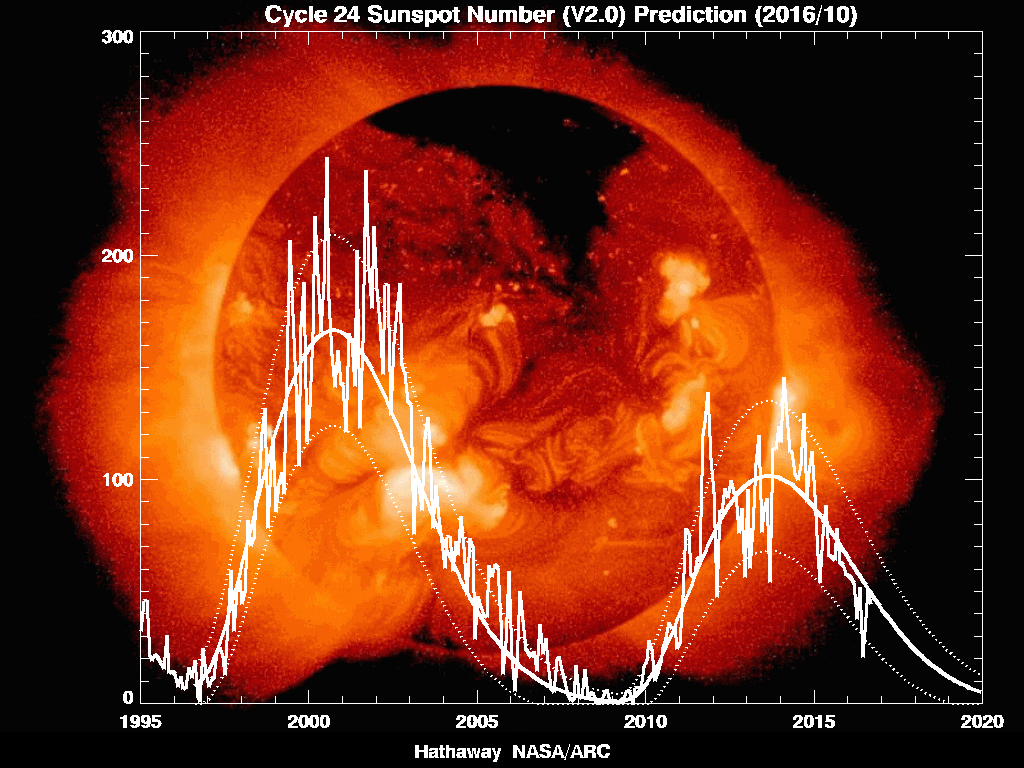
ii) We need to know where we are in the solar cycles. The highest peak of solar activity in recorded history occurred during the late 20th Century but we don’t really know how active the sun became during the Mediaeval Warm Period. There are calculations from isotope proxies but the accuracy of proxies is in the doghouse since Climategate and the hockey stick farrago. However the current solar quiescence suggests that the peak of recent solar activity is now over.
http://solarscience.msfc.nasa.gov/images/ssn_predict_l.gif
iii) Then we need to know where we stand in relation to the other shorter term cycles of sun and oceans.
Each varies on at least two other timescales. The level of solar activity varies during each cycle and over a run of cycles. The rate of energy release from the oceans varies from each El Nino to the following La Nina and back again over several years and the entire Pacific Decadal Oscillation alters the rate of energy release to the air every 25 to 30 years or so.
All those cycles vary in timing and intensity and interact with each other and are then superimposed on the longer term cycling that forms the basis of this article.
Then we have the chaotic variability of weather superimposed on the whole caboodle.
We simply do not have the data to resolve all those issues so all I can do is hazard a guess based on my personal judgement. On that basis I think we will see cooling for a couple of decades due to the negative phase of the Pacific Decadal Oscillation which has just begun then at least one more 20 to 30 year phase of natural warming before we start the true decline as the cooler thermohaline waters from the Little Ice Age come back to the surface.
If we get a peak of active sun at the same time as the worst of the cooling from the Little Ice Age comes through the oceanic system then that may be the start of a more rapid ending of the current interglacial but that is 500 years hence by which time we will have solved our energy problems or will have destroyed our civilisation.
Other climate theories:
Following the implosion of the CO2 based theory there are lots of other good ideas going around and much effort being expended by many individuals on different aspects of the climate system.
All I would suggest at the moment is that there is room in my NCM for any of those theories that demonstrate a specific climate response from sources other than sun and oceans.
All I contend is that sun and oceans together with the variable speed of the hydrological cycle assisted by the latitudinal movements of the air circulation systems and the vertical movement of the tropopause overwhelmingly provide the background trend and combine to prevent changes in the air alone changing the Earth’s equilibrium temperature.
For example:
Orbital changes feed into the insolation and albedo effects caused by moveable cloud masses.
Asteroid strikes and volcanoes feed into the atmospheric density issue.
Changing length of day and external gravitational forces feed into the speed of the thermohaline circulation.
Geothermal energy feeds into temperatures along the horizontal path of the thermohaline circulation.
Cosmic ray variations and ozone chemistry feed into the albedo changes.
The NCM can account for all past climate variability, can give general guidance as to future trends and can accommodate all manner of supplementary climate theories provided their real world influence can be demonstrated.
I humbly submit that all this is an improvement on existing modelling techniques and deserves fuller and more detailed consideration and investigation.
Novel propositions:
I think it helpful to set out here some of the novel propositions that I have had to formulate in order to obtain a climate description that complies both with observations and with basic laws of physics. This list is not intended to be exhaustive. Other new propositions may be apparent from the content and/or context of my various articles
i) Earth’s temperature is determined primarily by the oceans and not by the air (The Hot Water Bottle Effect). The contribution of the Greenhouse effect is miniscule.
ii) Changes in the air alone cannot affect the global equilibrium temperature because of oceanic dominance that always seeks to maintain sea surface and surface air equilibrium whatever the air tries to do. Warm air cannot significantly affect the oceans due to the huge difference in thermal capacities and by the effect of evaporation which removes unwanted energy to latent form as necessary to maintain the said equilibrium.
iii) Counterintuitively an active sun means cooling not warming and vice versa.
iv) The net global oceanic rate of energy release to the air is what matters with regard to the oceanic effect on the latitudinal positions of the air circulation systems and the associated cloud bands. All the oceanic oscillations affecting the rates of energy release to the air operate on different timescales and different magnitudes as energy progresses through the system via surface currents (not the thermohaline circulation which is entirely separate).
v) More CO2 ought theoretically induce faster cooling of the oceans by increasing evaporation rates. Extra CO2 molecules simply send more infra red radiation back down to the surface but infra red cannot penetrate deeper than the region of ocean surface involved in evaporation and since evaporation has a net cooling effect due to the removal of energy as latent heat the net effect should be increased cooling and not warming of the oceans.
vi) The latitudinal position of the air circulation systems at any given moment indicates the current tropospheric temperature trend whether warming or cooling and their movement reveals any change in trend
vii) All the various climate phenomena in the troposphere serve to balance energy budget changes caused by atmospheric effects from solar turbulence changes on the air above which affect the rate of energy loss to space or from variable rates of energy release from the oceans below.
viii) The speed of the hydrological cycle globally is the main thermostat in the troposphere. Changes in its speed are achieved by latitudinal shifts in the air circulation systems and by changes in the height of the tropopause.
ix) The difference between ice ages and interglacials is a matter of the timing of solar and oceanic cycles. Interglacials only occur when the solar and oceanic cycles are offsetting one another to a sufficient degree to minimise the scale of climate variability thereby preventing winter snowfall on the northern continents from being sufficient to last through the following summer.
x) Landmass distribution dictates the relative lengths of glacials and interglacials. The predominance of landmasses in the northern hemisphere causes glaciations to predominate over interglacials by about 9 to 1 with a full cycle every 100, 000 years helped along by the orbital changes of the Milankovitch cycles that affect the pattern of insolation on those shifting cloud masses.
xi) Distribution of energy within the entire system is more significant for climate (which is limited to the troposphere) than the actual temperature of the entire Earth. The latter varies hardly at all.
xii) All regional climate changes are a result of movement in relation to the locally dominant air circulation systems which move cyclically poleward and equatorward.
xiii) Albedo changes are primarily a consequence of latitudinal movement of the clouds beyond normal seasonal variability.
ix) The faint sun paradox is explained by the effectiveness of changes in the speed of the hydrological cycle. Only if the oceans freeze across their entire surfaces thereby causing the hydrological cycle to cease or if the sun puts in energy faster than it can be pumped upward by the hydrological cycle will the basic temperature equilibrium derived from the properties of water and the density and pressure of the atmosphere fail to be maintained.
A New And Effective Climate Model
The problem with existing climate models:
Even those who aver that man’s activity affects climate on a global scale rather than just locally or regionally appear to accept that the existing climate models are incomplete. It is a given that the existing models do not fully incorporate data or mechanisms involving cloudiness or global albedo (reflectivity) variations or variations in the speed of the hydrological cycle and that the variability in the temperatures of the ocean surfaces and the overall ocean energy content are barely understood and wholly inadequately quantified in the infant attempts at coupled ocean/atmosphere models. Furthermore the effect of variability in solar activity on climate is barely understood and similarly unquantified.
As they stand at present the models assume a generally static global energy budget with relatively little internal system variability so that measurable changes in the various input and output components can only occur from external forcing agents such as changes in the CO2 content of the air caused by human emissions or perhaps temporary after effects from volcanic eruptions, meteorite strikes or significant changes in solar power output.
If such simple models are to have any practical utility it is necessary to demonstrate that some predictive skill is a demonstrable outcome of the models. Unfortunately it is apparent that there is no predictive skill whatever despite huge advances in processing power and the application of millions or even billions of man hours from reputable and experienced scientists over many decades.
As I will show later on virtually all climate variability is a result of internal system variability and additionally the system not only sets up a large amount of variability internally but also provides mechanisms to limit and then reduce that internal variability. It must be so or we would not still have liquid oceans. The current models neither recognise the presence of that internal system variability nor the processes that ultimately stabilise it.
The general approach is currently to describe the climate system from ‘the bottom up’ by accumulating vast amounts of data, observing how the data has changed over time, attributing a weighting to each piece or class of data and extrapolating forward. When the real world outturn then differs from what was expected then adjustments are made to bring the models back into line with reality. This method is known as ‘hindcasting’.
Although that approach has been used for decades no predictive skill has ever emerged. Every time the models have been adjusted using guesswork (or informed judgement as some would say) to bring them back into line with ongoing real world observations a new divergence between model expectations and real world events has begun to develop.
It is now some years since the weighting attached to the influence of CO2 was adjusted to remove a developing discrepancy between the real world warming that was occurring at the time and which had not been fully accounted for in the then climate models. Since that time a new divergence began and is now becoming embarrassingly large for those who made that adjustment. At the very least the weighting given to the effect of more CO2 in the air was excessive.
The problem is directly analogous to a financial accounting system that balances but only because it contains multiple compensating errors. The fact that it balances is a mere mirage. The accounts are still incorrect and woe betide anyone who relies upon them for the purpose of making useful commercial decisions.
Correcting multiple compensating errors either in a climate model or in a financial accounting system cannot be done by guesswork because there is no way of knowing whether the guess is reducing or compounding the underlying errors that remain despite the apparent balancing of the financial (or in the case of the climate the global energy) budget.
The system being used by the entire climatological establishment is fundamentally flawed and must not be relied upon as a basis for policy decisions of any kind.
A better approach:
We know a lot about the basic laws of physics as they affect our day to day existence and we have increasingly detailed data about past and present climate behaviour.
We need a New Climate Model (from now on referred to as NCM) that is created from ‘the top down’ by looking at the climate phenomena that actually occur and using deductive reasoning to decide what mechanisms would be required for those phenomena to occur without offending the basic laws of physics.
We have to start with the broad concepts first and use the detailed data as a guide only. If a broad concept matches the reality then the detailed data will fall into place even if the broad concept needs to be refined in the process. If the broad concept does not match the reality then it must be abandoned but by adopting this process we always start with a broad concept that obviously does match the reality so by adopting a step by step process of observation, logic, elimination and refinement a serviceable NCM with some predictive skill should emerge and the more detailed the model that is built up the more predictive skill will be acquired.
That is exactly what I have been doing step by step in my articles here:
for some two years now and I believe that I have met with a degree of success because many climate phenomena that I had not initially considered in detail seem to be falling into line with the NCM that I have been constructing.
In the process I have found it necessary to propound various novel propositions that have confused and irritated warming proponents and sceptics alike but that is inevitable if one just follows the logic without a preconceived agenda which I hope is what I have done.
I will now go on to describe the NCM as simply as I can in verbal terms, then I will elaborate on some of the novel propositions (my apologies if any of them have already been propounded elsewhere by others but I think I would still be the first to pull them all together into a plausible NCM) and I will include a discussion of some aspects of the NCM which I find encouraging.
Preliminary points:
-
Firstly we must abandon the idea that variations in total solar output have a significant effect over periods of time relevant to human existence. At this point I should mention the ‘faint sun paradox’:
http://en.wikipedia.org/wiki/Faint_young_Sun_paradox
Despite a substantial increase in the power of the sun over billions of years the temperature of the Earth has remained remarkably stable. My proposition is that the reason for that is the existence of water in liquid form in the oceans combined with a relatively stable total atmospheric density. If the power input from the sun changes then the effect is simply to speed up or slow down the hydrological cycle.
An appropriate analogy is a pan of boiling water. However much the power input increases the boiling point remains at 100C. The speed of boiling however does change in response to the level of power input. The boiling point only changes if the density of the air above and thus the pressure on the water surface changes. In the case of the Earth’s atmosphere a change in solar input is met with a change in evaporation rates and thus the speed of the whole hydrological cycle keeping the overall temperature stable despite a change in solar power input.
A change in the speed of the entire hydrological cycle does have a climate effect but as we shall see on timescales relevant to human existence it is too small to measure in the face of internal system variability from other causes.
Unless more CO2 could increase total atmospheric density it could not have a significant effect on global tropospheric temperature. Instead the speed of the hydrological cycle changes to a miniscule and unmeasurable extent in order to maintain sea surface and surface air temperature equilibrium. As I have explained previously a change limited to the air alone short of an increase in total atmospheric density and pressure is incapable of altering that underlying equilibrium.
-
Secondly we must realise that the absolute temperature of the Earth as a whole is largely irrelevant to what we perceive as climate. In any event those changes in the temperature of the Earth as a whole are tiny as a result of the rapid modulating effect of changes in the speed of the hydrological cycle and the speed of the flow of radiated energy to space that always seeks to match the energy value of the whole spectrum of energy coming in from the sun.
The climate in the troposphere is a reflection of the current distribution of energy within the Earth system as a whole and internally the system is far more complex than any current models acknowledge.
That distribution of energy can be uneven horizontally and vertically throughout the ocean depths, the troposphere and the upper atmosphere and furthermore the distribution changes over time.
We see ocean energy content increase or decrease as tropospheric energy content decreases or increases. We see the stratosphere warm as the troposphere cools and cool as the troposphere warms. We see the upper levels of the atmosphere warm as the stratosphere cools and vice versa. We see the polar surface regions warm as the mid latitudes cool or the tropics warm as the poles cool and so on and so forth in infinite permutations of timing and scale.
As I have said elsewhere:
“It is becoming increasingly obvious that the rate of energy transfer varies all the time between ocean and air, air and space and between different layers in the oceans and air. The troposphere can best be regarded as a sandwich filling between the oceans below and the stratosphere above. The temperature of the troposphere is constantly being affected by variations in the rate of energy flow from the oceans driven by internal ocean variability, possibly caused by temperature fluctuations along the horizontal route of the thermohaline circulation and by variations in energy flow from the sun that affect the size of the atmosphere and the rate of energy loss to space.
The observed climate is just the equilibrium response to such variations with the positions of the air circulation systems and the speed of the hydrological cycle always adjusting to bring energy differentials above and below the troposphere back towards equilibrium (Wilde’s Law ?).
Additionally my propositions provide the physical mechanisms accounting for the mathematics of Dr. F. Miskolczi..”
He appears to have demonstrated mathematically that if greenhouse gases in the air other than water vapour increase then the amount of water vapour declines so as to maintain an optimum optical depth for the atmosphere which modulates the energy flow to maintain sea surface and surface air temperature equilibrium. In other words the hydrological cycle speeds up or slows down just as I have always proposed.
-
In my articles to date I have been unwilling to claim anything as grand as the creation of a new model of climate because until now I was unable to propose any solar mechanism that could result directly in global albedo changes without some other forcing agent or that could account for a direct solar cause of discontinuities in the temperature profile along the horizontal line of the oceanic thermohaline circulation.
I have now realised that the global albedo changes necessary and the changes in solar energy input to the oceans can be explained by the latitudinal shifts (beyond normal seasonal variation) of all the air circulation systems and in particular the net latitudinal positions of the three main cloud bands namely the two generated by the mid latitude jet streams plus the Inter Tropical Convergence Zone (ITCZ).
The secret lies in the declining angle of incidence of solar energy input from equator to poles.
It is apparent that the same size and density of cloud mass moved, say, 1000 miles nearer to the equator will have the following effects:
-
It will receive more intense irradiation from the sun and so will reflect more energy to space.
-
It will reduce the amount of energy reaching the surface compared to what it would have let in if situated more poleward.
-
In the northern hemisphere due to the current land/sea distribution the more equatorward the cloud moves the more ocean surface it will cover thus reducing total solar input to the oceans and reducing the rate of accretion to ocean energy content
-
It will produce cooling rains over a larger area of ocean surface.
As a rule the ITCZ is usually situated north of the equator because most ocean is in the southern hemisphere and it is ocean temperatures that dictate it’s position by governing the rate of energy transfer from oceans to air. Thus if the two mid latitude jets move equatorward at the same time as the ITCZ moves closer to the equator the combined effect on global albedo and the amount of solar energy able to penetrate the oceans will be substantial and would dwarf the other proposed effects on albedo from changes in cosmic ray intensity generating changes in cloud totals as per Svensmark and from suggested changes caused in upper cloud quantities by changes in atmospheric chemistry involving ozone which various other climate sceptics propose.
Thus the following NCM will incorporate my above described positional cause of changes in albedo and rates of energy input to the oceans rather than any of the other proposals. That then leads to a rather neat solution to the other theories’ problems with the timing of the various cycles as becomes clear below.
-
I have previously described why the solar effect on climate is not as generally thought but for convenience I will summarise the issue here because it will help readers to follow the logic of the NCM.Variations in total solar power output on timescales relevant to human existence are tiny and are generally countered by a miniscule change in the speed of the hydrological cycle as described above.
However according to our satellites variations in the turbulence of the solar energy output from sunspots and solar flares appear to have significant effects.
During periods of an active solar surface our atmosphere expands and during periods of inactive sun it contracts.
When the atmosphere expands it does so in three dimensions around the entire circumference of the planet but the number of molecules in the atmosphere remains the same with the result that there is an average reduced density per unit of volume with more space between the molecules. Consequently the atmosphere presents a reduced resistance to outgoing longwave energy photons that experience a reduced frequency of being obstructed by molecules in the atmosphere.
Additionally a turbulent solar energy flow disturbs the boundaries of the layers in the upper atmosphere thus increasing their surface areas allowing more energy to be transferred from layer to layer just as wind on water causes waves, an increased sea surface area and faster evaporation.
The changes in the rate of outgoing energy flow caused by changes in solar surface turbulence may be small but they appear to be enough to affect the air circulation systems and thereby influence the overall global energy budget disproportionately to the tiny variations in solar power intensity.
Thus when the sun is more active far from warming the planet the sun is facilitating an increased rate of cooling of the planet. That is why the stratosphere cooled during the late 20th Century period of a highly active sun although the higher levels of the atmosphere warmed. The higher levels were warmed by direct solar impacts but the stratosphere cooled because energy was going up faster than it was being received from the troposphere below.
The opposite occurs for a period of inactive sun.
Some do say that the expansion and contraction of the atmosphere makes no difference to the speed of the outward flow of longwave energy because that outgoing energy still has to negotiate the same mass but that makes no sense to me if that mass is more widely distributed over a three dimensional rather than two dimensional space. If one has a fine fabric container holding a body of liquid the speed at which the liquid escapes will increase if the fabric is stretched to a larger size because the space between the fibres will increase.
Furthermore all that the NCM requires is for the stratosphere alone to lose or gain energy faster or slower so as to influence the tropospheric polar air pressure cells. The energy does not need to actually escape to space to have the required effect. It could just as well simply take a little longer or a little less long to traverse the expanded or contracted upper atmospheric layers.
The New Climate Model (NCM)
-
Solar surface turbulence increases causing an expansion of the Earth’s atmosphere.
-
Resistance to outgoing longwave radiation reduces, energy is lost to space faster.
-
The stratosphere cools. Possibly also the number of chemical reactions in the upper atmosphere increases due to the increased solar effects with faster destruction of ozone.
-
The tropopause rises.
-
There is less resistance to energy flowing up from the troposphere so the polar high pressure systems shrink and weaken accompanied by increasingly positive Arctic and Antarctic Oscillations.
-
The air circulation systems in both hemispheres move poleward and the ITCZ moves further north of the equator as the speed of the hydrological cycle increases due to the cooler stratosphere increasing the temperature differential between stratosphere and surface.
-
The main cloud bands move more poleward to regions where solar insolation is less intense so total global albedo decreases.
-
More solar energy reaches the surface and in particular the oceans as more ocean surfaces north of the equator are exposed to the sun by the movement of the clouds to cover more continental regions.
-
Less rain falls on ocean surfaces allowing them to warm more.
-
Ocean energy input increases but not all is returned to the air. A portion enters the thermohaline circulation to embark on a journey of 1000 to 1500 years. A pulse of slightly warmer water has entered the ocean circulation.
-
Solar surface turbulence passes its peak and the Earth’s atmosphere starts to contract.
-
Resistance to outgoing longwave radiation increases, energy is lost to space more slowly.
-
The stratosphere warms. Ozone levels start to recover.
-
The tropopause falls
-
There is increased resistance to energy flowing up from the troposphere so the polar high pressure systems expand and intensify producing increasingly negative Arctic and Antarctic Oscillations.
-
The air circulation systems in both hemispheres move back equatorward and the ITCZ moves nearer the equator as the speed of the hydrological cycle decreases due to the warming stratosphere reducing the temperature differential between stratosphere and surface.
-
The main cloud bands move more equatorward to regions where solar insolation is more intense so total global albedo increases once more.
-
Less solar energy reaches the surface and in particular the oceans as less ocean surfaces north of the equator are exposed to the sun by the movement of the clouds to cover more oceanic regions.
-
More rain falls on ocean surfaces further cooling them.
-
Ocean energy input decreases and the amount of energy entering the thermohaline circulation declines sending a pulse of slightly cooler water on that 1000 to 1500 year journey.
-
After 1000 to 1500 years those variations in energy flowing through the thermohaline circulation return to the surface by influencing the size and intensity of the ocean surface temperature oscillations that have now been noted around the world in all the main ocean basins and in particular the Pacific and the Atlantic. It is likely that the current powerful run of positive Pacific Decadal Oscillations is the pulse of warmth from the Mediaeval Warm Period returning to the surface with the consequent inevitable increase in atmospheric CO2 as that warmer water fails to take up as much CO2 by absorption. Cooler water absorbs more CO2, warmer water absorbs less CO2. We have the arrival of the cool pulse from the Little Ice Age to look forward to and the scale of its effect will depend upon the level of solar surface activity at the time. A quiet sun would be helpful otherwise the rate of tropospheric cooling as an active sun throws energy into space at the same time as the oceans deny energy to the air will be fearful indeed. Fortunately the level of solar activity does seem to have begun a decline from recent peaks.
-
The length of the thermohaline circulation is not synchronous with the length of the variations in solar surface turbulence so it is very much a lottery as to whether a returning warm or cool pulse will encounter an active or inactive sun.
-
A returning warm pulse will try to expand the tropical air masses as more energy is released and will try to push the air circulation systems poleward against whatever resistance is being supplied at the time by the then level of solar surface turbulence. A returning cool pulse will present less opposition to solar effects.
-
Climate is simply a product of the current balance in the troposphere between the solar and oceanic effects on the positions and intensities of all the global air circulation systems
-
The timing of the solar cycles and ocean cycles will drift relative to one another due to their asynchronicity so there will be periods when solar and ocean cycles supplement one another in transferring energy out to space and other periods when they will offset one another.
26) During the current interglacial the solar and oceanic cycles are broadly offsetting one another to reduce overall climate variability but during glacial epochs they broadly supplement one another to produce much larger climate swings. The active sun during the Mediaeval Warm Period and the Modern Warm Period and the quiet sun during the Little Ice Age reduced the size of the climate swings that would otherwise have occurred. During the former two periods the extra energy from a warm ocean pulse was ejected quickly to space by an active sun to reduce tropospheric heating. During the latter period the effect on tropospheric temperatures of reduced energy from a cool ocean pulse was mitigated by slower ejection of energy to space from a less active sun.
Discussion points:
Falsification:
Every serious hypothesis must be capable of being proved false. In the case of this NCM my narrative is replete with opportunities for falsification if the future real world observations diverge from the pattern of cause and effect that I have set out.
However that narrative is based on what we have actually observed over a period of 1000 years with the gaps filled in by deduction informed by known laws of physics.
At the moment I am not aware of any observed climate phenomena that would effect falsification. If there be any that suggest such a thing then I suspect that they will call for refinement of the NCM rather than abandonment.
For true falsification we would need to observe events such as the mid latitude jets moving poleward during a cooling oceanic phase and a period of quiet sun or the ITCZ moving northward whilst the two jets moved equatorward or the stratosphere, troposphere and upper atmosphere all warming or cooling in tandem or perhaps an unusually powerful Arctic Oscillation throughout a period of high solar turbulence and a warming ocean phase.
They say nothing is impossible so we will have to wait and see.
Predictive skill:
To be taken seriously the NCM must be seen to show more predictive skill than the current computer based models.
In theory that shouldn’t be difficult because their level of success is currently zero.
From a reading of my narrative it is readily apparent that if the NCM matches reality then lots of predictions can be made. They may not be precise in terms of scale or timing but they are nevertheless useful in identifying where we are in the overall scheme of things and the most likely direction of future trend.
For example if the mid latitude jets stay where they now are then a developing cooling trend can be expected.
If the jets move poleward for any length of time then a warming trend may be returning.
If the solar surface becomes more active then we should see a reduction in the intensity of the Arctic Oscillation.
If the current El Nino fades to a La Nina then the northern winter snows should not be as intense next winter but it will nevertheless be another cold though drier northern hemisphere winter as the La Nina denies energy to the air.
The past winter is a prime example of what the NCM suggests for a northern winter with an El Nino during a period of quiet sun. The warmth from the oceans pumps energy upwards but the quiet sun prevents the poleward movement of the jets. The result is warming of the tropics and of the highest latitudes (but the latter stay below the freezing point of water) and a flow of cold into the mid latitudes and more precipitation in the form of snow at lower latitudes than normal.
So I suggest that a degree of predictive skill is already apparent for my NCM.
Likely 21st Century climate trend:
There are 3 issues to be resolved for a judgement on this question.
i) We need to know whether the Modern Warm Period has peaked or not. It seems that the recent peak late 20th Century has passed but at a level of temperature lower than seen during the Mediaeval Warm Period. Greenland is not yet as habitable as when the Vikings first colonised it. Furthermore it is not yet 1000 years since the peak of the Mediaeval Warm Period which lasted from about 950 to 1250 AD
http://www.theresilientearth.com/?q=content/medieval-warm-period-rediscovered
so I suspect that the Mediaeval warmth now emanating from the oceans may well warm the troposphere a little more during future years of warm oceanic oscillations. I would also expect the CO2 levels to continue drifting up until a while after the Mediaeval Warm Period water surface warming peak has begun it’s decline. That may still be some time away, perhaps a century or two.
ii) We need to know where we are in the solar cycles. The highest peak of solar activity in recorded history occurred during the late 20th Century but we don’t really know how active the sun became during the Mediaeval Warm Period. There are calculations from isotope proxies but the accuracy of proxies is in the doghouse since Climategate and the hockey stick farrago. However the current solar quiescence suggests that the peak of recent solar activity is now over.
http://solarscience.msfc.nasa.gov/images/ssn_predict_l.gif
iii) Then we need to know where we stand in relation to the other shorter term cycles of sun and oceans.
Each varies on at least two other timescales. The level of solar activity varies during each cycle and over a run of cycles. The rate of energy release from the oceans varies from each El Nino to the following La Nina and back again over several years and the entire Pacific Decadal Oscillation alters the rate of energy release to the air every 25 to 30 years or so.
All those cycles vary in timing and intensity and interact with each other and are then superimposed on the longer term cycling that forms the basis of this article.
Then we have the chaotic variability of weather superimposed on the whole caboodle.
We simply do not have the data to resolve all those issues so all I can do is hazard a guess based on my personal judgement. On that basis I think we will see cooling for a couple of decades due to the negative phase of the Pacific Decadal Oscillation which has just begun then at least one more 20 to 30 year phase of natural warming before we start the true decline as the cooler thermohaline waters from the Little Ice Age come back to the surface.
If we get a peak of active sun at the same time as the worst of the cooling from the Little Ice Age comes through the oceanic system then that may be the start of a more rapid ending of the current interglacial but that is 500 years hence by which time we will have solved our energy problems or will have destroyed our civilisation.
Other climate theories:
Following the implosion of the CO2 based theory there are lots of other good ideas going around and much effort being expended by many individuals on different aspects of the climate system.
All I would suggest at the moment is that there is room in my NCM for any of those theories that demonstrate a specific climate response from sources other than sun and oceans.
All I contend is that sun and oceans together with the variable speed of the hydrological cycle assisted by the latitudinal movements of the air circulation systems and the vertical movement of the tropopause overwhelmingly provide the background trend and combine to prevent changes in the air alone changing the Earth’s equilibrium temperature.
For example:
Orbital changes feed into the insolation and albedo effects caused by moveable cloud masses.
Asteroid strikes and volcanoes feed into the atmospheric density issue.
Changing length of day and external gravitational forces feed into the speed of the thermohaline circulation.
Geothermal energy feeds into temperatures along the horizontal path of the thermohaline circulation.
Cosmic ray variations and ozone chemistry feed into the albedo changes.
The NCM can account for all past climate variability, can give general guidance as to future trends and can accommodate all manner of supplementary climate theories provided their real world influence can be demonstrated.
I humbly submit that all this is an improvement on existing modelling techniques and deserves fuller and more detailed consideration and investigation.
Novel propositions:
I think it helpful to set out here some of the novel propositions that I have had to formulate in order to obtain a climate description that complies both with observations and with basic laws of physics. This list is not intended to be exhaustive. Other new propositions may be apparent from the content and/or context of my various articles
i) Earth’s temperature is determined primarily by the oceans and not by the air (The Hot Water Bottle Effect). The contribution of the Greenhouse effect is miniscule.
ii) Changes in the air alone cannot affect the global equilibrium temperature because of oceanic dominance that always seeks to maintain sea surface and surface air equilibrium whatever the air tries to do. Warm air cannot significantly affect the oceans due to the huge difference in thermal capacities and by the effect of evaporation which removes unwanted energy to latent form as necessary to maintain the said equilibrium.
iii) Counterintuitively an active sun means cooling not warming and vice versa.
iv) The net global oceanic rate of energy release to the air is what matters with regard to the oceanic effect on the latitudinal positions of the air circulation systems and the associated cloud bands. All the oceanic oscillations affecting the rates of energy release to the air operate on different timescales and different magnitudes as energy progresses through the system via surface currents (not the thermohaline circulation which is entirely separate).
v) More CO2 ought theoretically induce faster cooling of the oceans by increasing evaporation rates. Extra CO2 molecules simply send more infra red radiation back down to the surface but infra red cannot penetrate deeper than the region of ocean surface involved in evaporation and since evaporation has a net cooling effect due to the removal of energy as latent heat the net effect should be increased cooling and not warming of the oceans.
vi) The latitudinal position of the air circulation systems at any given moment indicates the current tropospheric temperature trend whether warming or cooling and their movement reveals any change in trend
vii) All the various climate phenomena in the troposphere serve to balance energy budget changes caused by atmospheric effects from solar turbulence changes on the air above which affect the rate of energy loss to space or from variable rates of energy release from the oceans below.
viii) The speed of the hydrological cycle globally is the main thermostat in the troposphere. Changes in its speed are achieved by latitudinal shifts in the air circulation systems and by changes in the height of the tropopause.
ix) The difference between ice ages and interglacials is a matter of the timing of solar and oceanic cycles. Interglacials only occur when the solar and oceanic cycles are offsetting one another to a sufficient degree to minimise the scale of climate variability thereby preventing winter snowfall on the northern continents from being sufficient to last through the following summer.
x) Landmass distribution dictates the relative lengths of glacials and interglacials. The predominance of landmasses in the northern hemisphere causes glaciations to predominate over interglacials by about 9 to 1 with a full cycle every 100, 000 years helped along by the orbital changes of the Milankovitch cycles that affect the pattern of insolation on those shifting cloud masses.
xi) Distribution of energy within the entire system is more significant for climate (which is limited to the troposphere) than the actual temperature of the entire Earth. The latter varies hardly at all.
xii) All regional climate changes are a result of movement in relation to the locally dominant air circulation systems which move cyclically poleward and equatorward.
xiii) Albedo changes are primarily a consequence of latitudinal movement of the clouds beyond normal seasonal variability.
ix) The faint sun paradox is explained by the effectiveness of changes in the speed of the hydrological cycle. Only if the oceans freeze across their entire surfaces thereby causing the hydrological cycle to cease or if the sun puts in energy faster than it can be pumped upward by the hydrological cycle will the basic temperature equilibrium derived from the properties of water and the density and pressure of the atmosphere fail to be maintained.
Leif Svalgaard ( 12:51:44)
There you go again. Overegging your case and diverting attention by giving advice.
Even if you are right it’s only a small part of the whole so you are not in a position to say that the whole scheme does not hang together.
You clearly cannot seperate the solar effects from the other (supposed) effects so your own position is weaker than you admit. You don’t even know what those other supposed effects might be.
Stephan-
Have you tried running one of the available atmospheric radiation transfer codes (like MODTRAN) to see if (and by how much) an expanding atmosphere will effect outgoing radiation? There are others besides MODTRAN- and a few that can be downloaded for free.
It seems to me that that should be your first priority.
DirkH (08:27:31) :
No special mechanism is needed, just the inability of the Earth’s ecosystem to absorb the magnitude of the change in CO2.
The carbon cycle absorbs a fairly constant amount of CO2 from the atmosphere. The main mechanisms are the conversion of CO2 and water into carbohydrates and oxygen via photosynthesis, and the solution of CO2 in bodies of water – oceans, lakes, reservoirs, rivers etc.
The oceans and biosphere have shown themselves capable of absorbing more CO2 than is naturally produced, but unable to absorb quite as much CO2 as we are currently emitting. Hence the inexorable rise in CO2 measured at Mauna Loa.
http://www.climate4you.com/GreenhouseGasses.htm#Atmospheric carbon dioxide (CO2)
The rate of absorption may increase slightly over time due to CO2 fertilisation effects – but it is very unlikely that this will rise sufficiently, or quickly enough to counteract our increasing outputs – particularly if we carry on cutting down the rainforests at the rate we are.
RE: Sphaerica (04:28:43)
Firstly if you re-read my post you will see that I have taken undergraduate courses in modelling and in my professional capacity I work on thermal modelling of laser welding and have worked on thermal modelling of aluminium reduction cells in the past.
I never stated that there was a fudge factor involved. With my work on thermal modelling of laser welding I have gone through the exact hindcasting process that you described. Based on measured data that I had on a number of trials I first developed a simple conduction model, this wasn’t approximating my results well so I added convection, this still fell short of the mark so I took into account complex absorption of the weld plasma and then my model was a good approximation of the past data.
That entire process was inductive. At no point have I used the model to deduce what would happen in a new situation and test it. That model is therefore not scientific. When a model becomes sufficiently complex it is not sufficient just to assume that because it was built using tested scientific theory and because it fits past data that it is correct. Complex models have complex interactions whose summations can be greater than the effects of the underlying theory and this has to be understood by people modelling complex systems.
The model you describe is invalid as an example because in that particular case the physics has been well tested through deductive means and interactions are not significant and all major factors can be easily considered. That model has also been tested deductively by any number of laboratories around the world.
It is not acceptable from an epistemological standpoint however to assume that because you can construct some macro models by using past data to induce what micro laws might control their behaviour that you can do this for all models. You certainly cannot do it for complex models. The practice of hindcasting remains unscientific because it circumvents deduction and, as has been widely discussed by the great philosophers of our time (e.g. Popper), just because induction works in some cases does not prove that it works in all cases and does not make it an acceptable scientific method.
When I tested my welding model in a new scenario, it was wrong, despite being only based on deductively tested theories and fitting the past data very well.
Stephen Wilde (13:24:30) :
You clearly cannot seperate the solar effects from the other (supposed) effects so your own position is weaker than you admit. You don’t even know what those other supposed effects might be.
By the same token neither can you, and that’s why they cannot be part of a serious model, that is all.
A very nice synthesis, thank-you Stephen – now I have no more excuse for not understanding any part of your climate model!
A couple of questions from a quick look through the article. First to jump on the thermosphere thickness bandwagon. Leif’s point is understandable – thermosphere equivalent to 1 cm of sea level atmosphere. However this statement as it stands is not complete as an objection to your hypothesised “expansion and contraction” of the atmosphere and concomitant effect of this on rate of heat escape from the planet. However thin and evanescent the thermosphere is, it is the “gatekeeper” of planetary heat in the sense that 100% of radiated heat from the earth must pass through the thermosphere. So to argue for the insignificance of the thermosphere to radiative balance it is not sufficient to point to its small mass and number of molecules – one must accompany this with physics showing for instance the mean free path of photons between interactions with air molecules to be sufficiently long that the thermosphere will not significantly affect outgoing flux. What is the mean free path?
This argument BTW is used to rescue C-AGW from the saturation hypothesis – that the narrow IR absorption band of CO2 is completely absorbed by a few tens of meters of air only, and that something like 50 ppm CO2 “saturates” the IR absorption – more CO2 has no effect. The counter to this is that CO2 repeatedly absorbs and re-radiates IR, so that heat energy as IR moves up the atmosphere by a kind of radiative diffusion. That CO2 absorption-re-radiation can occur is confirmed by the modus operandi of an industrial CO2 laser – the type that cuts 2-inch steel for instance. The “ser” in laser is stimulated emission of radiation – so CO2 clearly can absorb and re-radiate.
So if heat is escaping by radiative diffusion (diffusive radiation?) then there is a mean free path. How long is this in the thermosphere? cm? m? km? This is the important parameter, not equivalent sea-level thickness per se. (It looks like Frank (11:16:34) addressed this issue).
Perhaps the effect of an active sun creating turbulent boundaries between atmosphere layers (with greater surface area) might be equally or more important.
Secondly, your treatment of thermohaline circulation (THC) and the picture of alternating pulses of warmer and colder water entering THC. I have a problem with this – water enters THC by downwelling at certain key locations – the Norwegian Sea is one of them. The reason and mechanism for downwelling is cooling combined with increased salinity associated with ice formation – linked to cooling. Only cold water can downwell – you cant push warm water down into cold. OK there might be small variations. But at ocean depths of one or more km – where most water and most climate heat resides – the huge gravitational pressure starts to dictate temperature – water converges near a temperature of minimum density. So I dont feel it is plausible to envisage parcels of significantly warmer water lurking at kilometer depths writing to re-emerge centuries later and exert an influence on climate cycles, global warming politics and blog debates.
However I still strongly believe that the whole ocean including the deep ocean with the THC is a major climate driver. However I doubt that the mechanism is an alternating pipeline of warm-cold deep water. Bob Tisdale for instance probably has data that shows absence of evidence for such thermal structure in the deep ocean and would present it to refute your hypothesis. But I dont think your argument for a time-delayed role of THC requires thermal structure in the deep ocean – there are plenty of other ways that variability in THC could exist in response to solar-atmospheric dynamics. The rate of downwelling could oscillate. Thus the strength (and pattern) of deep currents could oscillate accordingly. As I have posted before, I have a hunch that the AMO is characterised by oscillations in the strength of the north Atlantic drift current caused originally by oscillations in the strength and volume of Norwegian Sea downwelling (and resultant Southstream deep current, the flip-side of the North Atlantic Drift). The Arctic ice melt -recovery cycle, currently a focus of attention, could be linked to this (recall the ~4deg C fluctuation of 100-150m deep Barents Sea water over a century cycle closely correlated with AMO).
Now I’ll read the whole article in detail, an important “breath of fresh air” in the field.
Matthew says:
“The oceans and biosphere have shown themselves capable of absorbing more CO2 than is naturally produced, but unable to absorb quite as much CO2 as we are currently emitting. Hence the inexorable rise in CO2 measured at Mauna Loa.”
Sorry to have to pore cold water on this belief but a rise in CO2 at Mauna Loa is not evidence that the oceans can’t accommodate CO2. CO2 concentrations are now much lower than earlier in earth’s history. Up to 4000 ppm or more and the oceans were able to accommodate these levels. The evidence? – Huge thicknesses of oceanic limestone (calcium carbonate CaCO3) deposits formed from the conversion of CO2 to bicarbonate and then CaCO3 assisted by the biosphere.
Remember also that Mauna Loa sits on a hot spot in the oceanic plate and the site is subject to surface and sub-surface volcanic activity (high CO2 emissions) in the region. Also a rise in temperature in these tropical waters causes CO2 expulsion from the oceans. Colder waters elsewhere on the other hand take up CO2.
Upon fuller reading of the article, my earlier praise of Wilde’s recognition of the essential role of the oceans in regulating climate has to be tempered by his basic miscomprehension of thermohaline circulation. It does NOT, as he supposes, bring any replica of the globe’s past thermal history back to the surface ~1000yrs later. On the contrary, whatever warm, hypersaline water sinks below the surface because of its great density is mixed relatively quickly by winds into the upper layer of the ocean, where it transfers its heat to colder parcels by conduction. Despite its suggestive name, THC is NOT a consequential means of redistribution of thermal energy by advection/convection. That role belongs to the wind-driven global circulation.
George E. Smith (11:38:13) :…” but one thing we know for sure about earth’s climate, is that nothing in it is in equilibrium. Neither static nor dynamic equilibrium exists in earth climate; and we know for sure that must be true, since weather represents a significant change of the system from one state to another; and does so, at all time, and space scales”…
__________
Well put. I think that a lot of climate science that fixates on metrics and instrumentation suffers from the logical fallacy of ‘misplaced precision’.
To talk of temperature in terms of +/- .01 deg. when my local temperature, measured on an instrument calibrated in 2 degree increments, might experience a temperature swing of 40-60 Deg. f during a 24 hour cycle is silly.
There are far too many independent variables at play for us to be able to assign cause and effect. I see discussion of ocean temperature and evaporation rates without mention of relative humidity effecting evaporation and heat content. The climate system is far too complex and chaotic to be modeled or predicted. I don’t need instruments to tell me that in the desert, clear nights are colder than cloudy nights. When the sun goes down a dry atmosphere ‘traps’ very little heat. It is so obvious that water in all it’s phases dominates climate, driven by old Sol.
@ur momisugly Sphaerica (04:28:43) :
Hindcasting can be used in a helpful way, to lead to a correct solution to the problem, as in your toy car example, where the right model is obtained eventually. It’s also possible to use modeling in a self-deluding, curve-fitting way, as in AlexB’s stock market example.
Climate modelers haven’t reached the toy-car-solution stage, judging by their failure to anticipate the flat trend of recent years. They’re still engaged in what I call “hack ‘n hope heuristics.”
phlogiston (16:06:41) and all other contributors.
Thanks for many useful points.
As stated before I see my description as merely a starting point for a different top down method for construction of a new type of model with, hopefully, some predictive power. Perhaps the thread title was a tad premature but it got the attention required to enable me to make progress.
The real world appears to operate along the lines proposed but the precise mechanics need lots more investigation and I would be very surprised to have nailed the detailed subtleties of each process involved.
I think the usefulness of my NCM lies in drawing together so many seperate but interlinked components to form a plausible coherent story from arrival to departure of solar energy.
How that story will need to be amended from now on is not within my control and I propose to continue to observe, learn and amend as necessary.
The various critical comments are most useful and I will consider them over time and compare those comments with real world events as they occur.
Perhaps in a year’s time I will be able to present a revised version accommodating some of the objections raised here if evidence becomes available.
In the meantime I will continue to test my ideas in blogs such as this with those who know much more than me about the individual components of the system.
In that process some may find my persistence (perhaps obstinacy) irritating but it is all in a good cause.
My special thanks to Leif, Bob Tisdale and others who have occasionally expressed frustration but who have continued to let me use their time, experience and intellectual firepower.
Stephen
Interesting explorations. Look forward to how the climate compares with your predictions.
Re:
Suggest checking on the mean free path of radiation vis “reduced resistance to outgoing longwave energy”.
Compare warming atmosphere, lowers density, which increases atmospheric height, which increases radiative surface area of the earth.
See Don Easterbrook’s sawtooth global temperature predictions. e.g.
Where are we headed during the coming century?
See Bejan’s predictions of global circulation based on equator-pole temperature difference. e.g. “Thermodynamic optimization of global circulation and climate”
David L. Hagan (08:01:09)
Thanks for the pointers and I’ll look into those matters.
I agree that not only does the atmospheric height increase when the sun is active but also the tropopause rises during a warming spell and falls during a cooling spell. As Leif has said previously if it were down to an increase in TSI then the height at which radiative balance occurred would fall not rise hence my observation that what is effecting the changes in height is solar activity levels combined with the rate of energy release by the oceans and not raw solar power output.
The same applies to all the other layer boundaries so the surface area at every boundary is variable and that must affect rates of energy transfer upwards as per my model. Leif is fixated on the thermosphere which rather misses the point in my opinion.
The contentious issue is whether a portion of the rises and falls can be attributed to solar activity changes as well as changes in the rate of energy release by the oceans. That is where I disagree with Leif at present.
The oceanic effect is always dominant but the fact is that on 500 year timescales (not necessarily on shorter time scales due to interference from lesser cycles and chaotic variability) the sun is less active as per the Maunder Minimum and at the same the oceans were independently releasing energy at a low rate. During the Maunder Minimum the jets were well equatorward compared to now as was the ITCZ and I have difficulty accepting that there was not a strongly negative AO at the same time. If there were a strong AO in the depths of the LIA then the weak solar activity causing the atmosphere to contract and intensify the polar high pressure cells would be a more likely explanation than saying the cooler ocean surfaces alone had that effect.
After all if the ocean surfaces were cool then less energy was going up into the air to feed those high pressure cells. The solar quietude must be a candidate for intensifying those high pressure cells and pushing the jets equatorward at the time of weak oceanic opposition.
Anyway that is my rationale for questioning Leif’s assertions despite his undoubted superiority in the field of solar studies.
If solar input has ” no measurable” impact then why do you suggest that Milankovitch cycles cause glacials/ interglacials
Colin Aldridge (16:10:47)
It’s a matter of scale. Over 100,000 years there are significant changes but for periods relevant to our perception of climate the solar variations in raw power output seem to be negligible.
I was obliged to take that view as a result of the researches of Leif Svalgaard and others whose most recent work has been steadily reducing the estimates of solar power output variability so if one needs to reflect solar variability at all it needs to be some element of solar influence other than raw power output.
However if a suitable amplifying factor can be brought into play then that aspect can be reviewed. Depending on measurements the variations in insolation and thus albedo caused by latitudinally shifting cloud bands could be sufficient to enable one to re introduce solar power variability as a relevant factor but the measurements do not exist at present. Indeed that is a novel idea and no one else has so far has given much attention to the movement of the air circulation systems latitudinally beyond normal seasonal variability and the effects that might have on the overall energy budget.
I think Leif looks more favourably on solely oceanic influences on climate over human timescales but I don’t feel able to go with that as yet because of the size of changes between ice ages and interglacials. I think there must be at least two factors interacting to achieve the necessary switches so that they offset one another to minimise climate variability during interglacials but supplement one another to increase climate variability during glacial periods. The climate records such as they are show huge differences in climate variability between glaciations and interglacials.
I don’t see anything other than a solar and oceanic combination as remotely plausible on the scales required for such effects.
Still, I’m open to sensible suggestions.
Note also that the switch between ice ages and interglacials can just be a reflection of the distribution of energy within the system and not a reflection of the actual amoubt of solar power coursing through the system.
The distribution of continental land masses would be the most substantial influence on that over geological time scales.
We currently have a landmass distribution that favours ice ages 90% of the time.
Stephen Wilde (13:33:19) : After all if the ocean surfaces were cool then less energy was going up into the air to feed those high pressure cells.
_________
Stephen, keep in mind that weather wise, High pressure is associated with dry clear weather, low pressure is associated with wet stormy weather. The heat content of wet air is higher than dry air even as the temps may vary inversely. Weather systems in my view are driven by low pressure pulling inward not by high pressure pushing outward. The extreme examples are hurricanes and tornadoes.
Good thought provoking article.
Richard G. (11:07:08)
Yes Richard, quite right.
What happens globally is that warm ‘wet’ air in the tropics is pumped upward by convection and after a few flirtations with the mid latitudes one gets cold ‘dry’ air pumped downward at the poles.
However the state of the stratosphere dictates how much is pumped back downward in the polar high pressure cells and how much is released to space and the state of the stratosphere (calm down Leif) appears to depend on how active is the solar surface at the time.
Don’t shoot the messenger but that is how the real world seems to work on the basis of observations.
As for the precise mechanisms I’ve made suggestions but am open minded as to alternatives. What one cannot do is deny the obvious.
this is a quote from Wikipedia:
“The amount of energy trapped by photosynthesis is immense, approximately 100 terawatts:[3] which is about six times larger than the power consumption of human civilization.[4] ”
I looked this up after doing a lot of walking in forests lately, where I noticed that coolness surrounds you as soon as you step in, i.e. is is not only the shadow that brings this coolness. You can feel the trees and plants sucking away at the warmth from the atmosphere..
A city like Johannesburg has no rivers, all water was brought from far away/.The landscape used to be semi desert or savannah but look at it now. It is green all over. I think there maybe similar places in USA (Las Vegas?) that used to have no vegetation, but humans brough a lot of vegetation. So now I have an explanation as to why humans are not really contributing much to global warming: as long as we surround ourselves with trees and plants where we live then we will “neutralize” our own existence to planet earth’s climate system.
I don’t know what Stephen thinks of this?
Hi Henry,
I don’t know the quantities involved but it is true that successful human societies with enough wealth and space do often create a more diverse local environment than existed before.
A wholly negative view of human activity is not really justified in my view.
Here’s a few thoughts, Stephen, regarding your excellent post.
I’m not sure that the extra path length you posit during periods of solar maximum would be enough to change the rate of cooling. It could be that atmospheric turbulence in the boundary layers increases the surface area of the radiation zone, so energy released quicker.
Another possible albedo changing effect is the presence of microscopic ice in the ignorosphere (mesosphere), which are very reflective as evidenced by noctilucent clouds. Worth a look at Earl Haap’s site and the paper here:-
http://www.terrapub.co.jp/journals/EPS/pdf/5107_08/51070799.pdf
Perhaps also worth looking at how the AO and the polar vortex interact and their relationship to solar cycle changes. Couple of bits here which may help?
http://www.cpc.noaa.gov/products/precip/CWlink/daily_ao_index/hgt.shtml
http://air.geo.tsukuba.ac.jp/~tanaka/papers/paper112.pdf
Good luck with your model, it seems to be developing nicely.
FRom this BBC2 documentary discusses a river that says there is a connection between the sun and something about sun spots. Rather unequivically. Start @ur momisugly Minute 2:30….
Wonders Of The Solar System, Episode 1 (Part 3/6)
http://www.youtube.com/redirect?username=AnonH5N1&q=http%3A%2F%2Fwww.youtube.com%2Fwatch%3Fv%3DNi7dKceWbHc&video_id=eQSy4NFKZko&event=url_redirect&url_redirect=True&usg=RnZDlizVFYbZV57v-uuBRTdnOcE=
Yes johny, I saw that too.
There are a number of reports that link fresh water flows around the world to levels of solar activity.
In turn I would link that to latitudinal shifts in the air circulation systems as combined solar and oceanic influences compete as described by me in my model and elsewhere.
That latitudinal shifting and the potential for large consequent albedo changes represents the most fundamental omission from current climatology. The regular seasonal shifts are acknowledged but nothing further.
Stephen: We’ll pick the trail over at the squiggly line thread. I’ve introduced
Dr. Pablo Mauas’s work on several rivers in South America, over there. Oddly, in the paper Pablo is presenting on several rivers, he doesn’t mention this one in the documentary. Glad someone watched it though! The graphics are fantastic. but his talking is a little too simplistic though.
johny
Ok, if I want to participate substantively I’ll do it there.
Here I will just point out that the effect based on my suggestion would be pretty variable being dependent largely on the way the individual river catchment areas are affected by those latitudinal air circulation shifts.
I would expect some very good matches and some very poor matches which is exactly what we do see.
Cheers.