Guest post by Steven Goddard

The climate panic headline this week has been that the warming Arctic is burping out dangerous quantities of greenhouse gas Methane.
Published on Friday, March 5, 2010 by Agence France Presse
Huge Methane Leak in Arctic Ocean: Study
WASHINGTON – Methane is leaking into the atmosphere from unstable permafrost in the Arctic Ocean faster than scientists had thought and could worsen global warming, a study said Thursday. From 2003 to 2008, an international research team led by University of Alaska-Fairbanks scientists Natalia Shakhova and Igor Semiletov surveyed the waters of the East Siberian Arctic Shelf, which covers more than 772,200 square miles (two million square kilometers) of seafloor in the Arctic Ocean. “This discovery reveals a large but overlooked source of methane gas escaping from permafrost underwater, rather than on land,” the study said. “More widespread emissions could have dramatic effects on global warming in the future.”
Methane is 30X more potent a greenhouse than CO2, so this sounds very alarming. Or does it? From the New York Times:
Dr. Shakhova said that undersea methane ordinarily undergoes oxidation as it rises to the surface, where it is released as carbon dioxide. But because water over the shelf is at most about 50 meters deep, she said, the gas bubbles to the surface there as methane. As a result, she said, atmospheric levels of methane over the Arctic are 1.85 parts per million, almost three times as high as the global average of 0.6 or 0.7 parts per million.
The first problem with the statement is that it is incorrect. The average global methane concentration is ~1.8 ppm, (1786 ppb) not 0.6 ppm as seen below in this graph from NOAA:

http://www.noaanews.noaa.gov/stories2008/images/methanetrend.jpg

The author also says that the Arctic is belching out nearly eight million tons of methane per annum.
She estimated that annual methane emissions from the East Siberian Arctic Shelf total about seven teragrams. (A teragram is 1.1 million tons.)
Sounds like a big number – except that burping/flatulating cattle produce ten times more methane than the Arctic. According to the EPA:
Globally, ruminant livestock produce about 80 million metric tons of methane annually
Is 1.85 ppm a large number? Let’s look at an analogy of what a population concentration of 1.85 parts per million really represents. If the population of Wyoming (544,270) represented all the molecules in the atmosphere, there would be only one methane molecule in the entire state. At 1.85 ppm, there would be fifteen methane molecules in New York City, out of population eight million. There would be on average zero in Nunavut, Canada.
I wonder how much methane Taco Bell indirectly generates per annum? I also wonder why so many Arctic/Greenland studies include only the years 2003-2008. Perhaps they are only interested in reporting data from unusually warm years in the Arctic?
Speaking of the Arctic. What is up with this?

http://nsidc.org/data/seaice_index/images/daily_images/N_timeseries.png
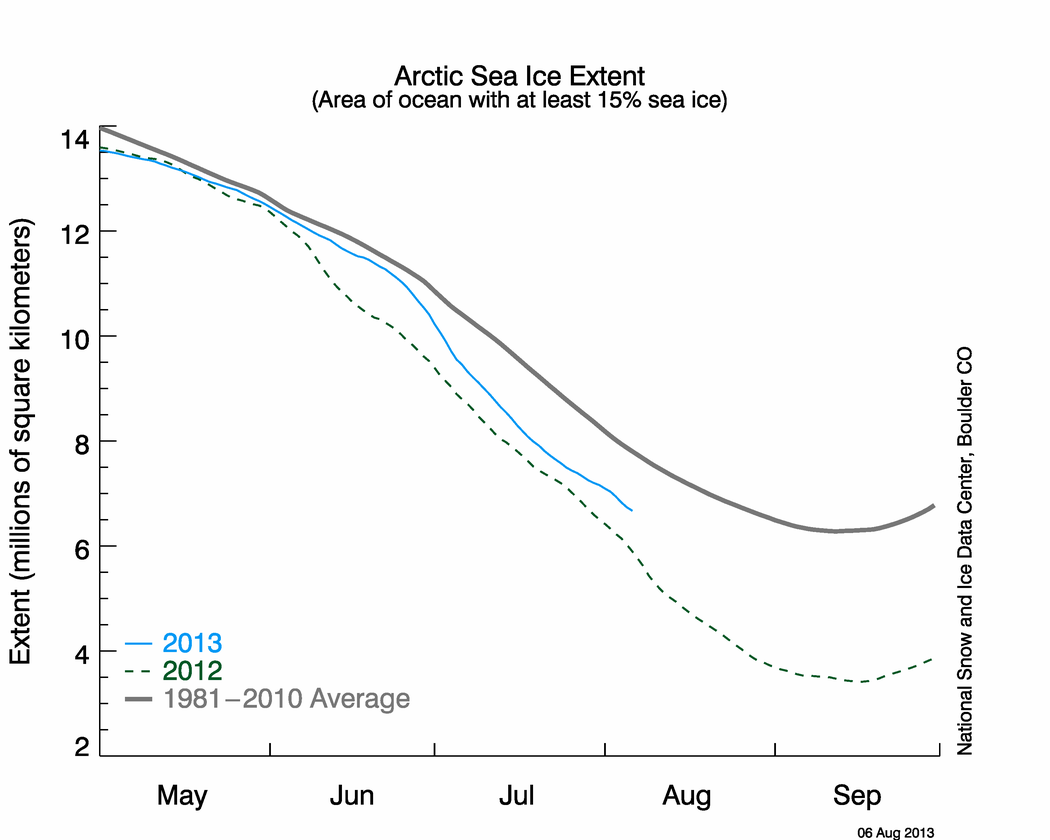
Methane, The Panic Du Jour
The climate panic headline this week has been that the warming Arctic is burping out dangerous quantities of greenhouse gas Methane.
Published on Friday, March 5, 2010 by Agence France Presse
Huge Methane Leak in Arctic Ocean: Study
WASHINGTON – Methane is leaking into the atmosphere from unstable permafrost in the Arctic Ocean faster than scientists had thought and could worsen global warming, a study said Thursday. From 2003 to 2008, an international research team led by University of Alaska-Fairbanks scientists Natalia Shakhova and Igor Semiletov surveyed the waters of the East Siberian Arctic Shelf, which covers more than 772,200 square miles (two million square kilometers) of seafloor in the Arctic Ocean. “This discovery reveals a large but overlooked source of methane gas escaping from permafrost underwater, rather than on land,” the study said. “More widespread emissions could have dramatic effects on global warming in the future.”
Methane is 30X more potent a greenhouse than CO2, so this sounds very alarming. Or does it? From the New York Times:
Dr. Shakhova said that undersea methane ordinarily undergoes oxidation as it rises to the surface, where it is released as carbon dioxide. But because water over the shelf is at most about 50 meters deep, she said, the gas bubbles to the surface there as methane. As a result, she said, atmospheric levels of methane over the Arctic are 1.85 parts per million, almost three times as high as the global average of 0.6 or 0.7 parts per million.
The first problem with the statement is that it is incorrect. The average global methane concentration is 1.8 ppm, not 0.6 ppm.
http://www.noaanews.noaa.gov/stories2008/images/methanetrend.jpg
The author also says that the Arctic is belching out nearly eight million tons of methane per annum.
She estimated that annual methane emissions from the East Siberian Arctic Shelf total about seven teragrams. (A teragram is 1.1 million tons.)
Sounds like a big number – except that burping/flatulating cattle produce ten times more methane than the Arctic. According to the EPA:
Globally, ruminant livestock produce about 80 million metric tons of methane annually
Is 1.85 ppm a large number? Let’s look at an analogy of what a population concentration of 1.85 parts per million really represents. If the population of Wyoming (544,270) represented all the molecules in the atmosphere, there would be only one methane molecule in the entire state. At 1.85 ppm, there would be fifteen methane molecules in New York City, out of population eight million. There would be on average zero in Nunavut, Canada.
I wonder how much methane Taco Bell indirectly generates per annum? I also wonder why so many Arctic/Greenland studies include only the years 2003-2008. Perhaps they are only interested in reporting data from unusually warm years in the Arctic?
Speaking of the Arctic. What is up with this?
http://nsidc.org/data/seaice_index/images/daily_images/N_timeseries.png
Willis Eschenbach (12:52:11) :
The average residence time of methane in the atmosphere is 12 years (Prather and Ehhalt 2001).
That’s far too short to explain the ice core CO2 lag, which is on the order of 600-800 years>>
Hmmm. didn’t know the lag was that big. My thought was that as temps go up, plant growth goes up, likely taking more CO2 out of the atmosphere than the methane is putting in at first. At some point plant growth starts to peak, not to mention start contributing to methane production. Then animal life starts increase as they have a more abundant food source, and the critters fart. So I figured the CO2 peak would be way after methane because it has to fight off some negative (for co2) feedback loops. I could figure a delay in my mind of decades, but centuries might be a stretch.
UK John (11:49:16) :
Even stranger fact! and something to be really worried about!
Realclimate agree with Steve Goddard, that this is not going to happen.
************************************************************
If this is true, then it can only mean one thing. . .
Hell must be freezing over! Could we send Al Gore to check on that, please?
The first one to smell it…is the culprit!
That is the smell of the decomposition of science turning into sh***through a reverse alchemical process, intended not for the obtention of gold but rather to the debasement of anything achieved in the past by hateful “capitalism”. You should turn, asap. a fourth world banana country.
Would burning the methane, to turn it into CO2 be less harmful than letting it escape into the atmosphere as methane ?
Phil.
Actually that is not what is done and you’ve made a complete dog’s breakfast of reading the paper, have another go>>
title of the paper is
The indirect global warming potential and global temperature change potential due to methane oxidation
and the quote frome the conclusion section is
our upper bound for the indirect CO2 correction is larger than the direct CH4 effect.
So please help me out and explain what I didnt understand.
David Middleton (12:59:31) : edit
Actually, there is. It is permafrost from the last ice age under the ocean. As the ice melted, the sea level rose and covered up the permafrost. From here, we have:
Since the layer of permafrost has warmer earth below and warmer water above, it has been slowly melting since it was inundated. Hard to blame that on CO2 …
The promoters are just annoyed how the ocean acidification scare fizzed out, thanks to the problem of no acidification.
Now they are back to methane.
Note how AGW alarmists cycle around a few panic butons- temps, storms, sea levels, ocean acidification, ice, and now methane.
Instead of accepting, when it is shown that the level of risk is far smaller than hype would represent, they just move back to one of the others.
The media, for the most part, is happy to enable this fear mongering shuffle.
>> CH4 + 2 O3 -> 2 H2O + CO2 + O2
Writing a balanced chemical equation doesn’t really tell you anything. First of all, is it a fundamental equation (i.e., if a CH4 molecule and two ozone molecules all meet in the same place at the same time do you really get an oxygen molecule, a carbon dioxide molecule, and 2 water molecules)? In this case, certainly not. Second – even if it is what are the forward and reverse reaction rates (or, put another way, what are the activation barriers to reaction and the energies of the reactants and products)? Third, this as written is a trimolecular reaction – which is also second order in ozone. So the overall rate (related to the product of the reaction rates and the concentrations) is quadratic in ozone (i.e., small ozone cnocentration, small overall reaction rate squared). Finally, the actual pathway for conversion of atmospheric methane to carbon dioxide is a multistep process that is dominated by an initial step in which methane reacts with free radical OH in the atmosphere.
In fact, the buzz several years back was that, a la Le Chatlier, increased methane in the atmosphere was going to scrub out all of the free radical OH in the atmosphere and when that was all gone all sorts of unknown scary stuff (including the accumulation of excess CH4) was going to ensue. Sadly, the concentrations of OH have done exactly the opposite and increased slightly. Too bad for the alarmist (the atmosphere HAS to work the way I modeled on paper!) folks.
@Willis Eschenbach (13:52:31) :
Well… I guess you can “teach an old dog new tricks”!
I had never heard of submarine permafrost… Particularly buried beneath unfrozen marine sediments.
I guess I need to get out of the Gulf of Mexico one-in-a-while.
It’s mind boggling that it could have remained frozen for 12,000 years.
Anyone know how much methane there was in the atmosphere when life started 4 billion years ago? I thought it was estimated at about 30%. I think the rest of the atmosphere was ammonia, CO2 and, I presume, a lot of water vapour.
Model that!
RE: Willis Eschenbach (12:32:00) : “..The hyping is being done, not by the media, but by Dr. Natalia Shakhova,…”
I did not get that impression initially as I thought you were comparing a news article with the actual scientific work to which it referred. Thanks the clarification. The press gets a free pass if the ‘trusted’ scientists themselves are responsible for overselling the significance of their perhaps dubious work.
Has anyone looked for hydrothermal vents? Methane oxidation occurs in and around those vents. They just found a bunch off of Antarctica…I was wondering if anyone is looking for them in the Arctic as well.
Methane has been detected on Mars, and unless there is biologic and/or geologic activity going on there, it’s apparent that it can be produced inorganically. (It can be done synthetically, too, from iron oxide, calcium carbonate, and water. But you have to get the temps up over 500 C and the pressure up to 11GPA.) So instead of blaming the cows, maybe they should apply Occam’s razor and look for a simpler explanation.
hunter (13:52:33) :
Homer and Lisa read US of A TODAY over breakfast.
Homer: Here’s good news! According to this eye-catching article,
SAT scores are declining at a slower rate!
Lisa: Dad, I think this paper is a flimsy hodgepodge of pie graphs,
factoids and Larry King.
Homer: Hey, this is the only paper in America that’s not afraid to tell
the truth, that everything is just fine.
UK John (11:49:16) :
Even stranger fact! and something to be really worried about!
Realclimate agree with Steve Goddard, that this is not going to happen.
http://www.realclimate.org/index.php/archives/2010/03/arctic-methane-on-the-move/
——–
from the RealClimate article:
Is now the time to get frightened?
No. CO2 is plenty to be frightened of, while methane is frosting on the cake. Imagine you are in a Toyota on the highway at 60 miles per hour approaching stopped traffic, and you find that the brake pedal is broken. This is CO2.
Then you figure out that the accelerator has also jammed, so that by the time you hit the truck in front of you, you will be going 90 miles per hour instead of 60. This is methane.
Is now the time to get worried? No, you should already have been worried by the broken brake pedal.
tty
“Have you considered how the sea-bottom sediment could ever be colder than the freezing-point of sea-water? In that case the sea would freeze to the bottom, no?”
By this theory Sea ice cannot exist either.
Cow methane problem solved:
http://www.ecogeek.org/preventing-pollution/1864
4 billion (00:46:34)
Interesting article and appreciate the civil discourse. I’m assuming you lean AGW but nothing wrong with that, it’s actually the part about this site that I love – there are all types here, and the comments (and light touch from the mods) make for really great back and forth.
I’m not ready to pull my hair out yelling global extinction just yet, but it is a fascinating subject and IMO definitely worthy of research dollars – as opposed to a lot of other “stuff” getting money thrown at it.
Cheers!
The NYT article is incorrect, Shakhova states Methane levels over the last 400000 years have globally averaged 0.6-0.7 ppm during warm periods, not that the current Global levels are 0.6-0.7 ppm.
=====
Yes, but the NYTimes error provides material for a straw man:
Methane, The Panic Du Jour?
Apparently, Dr. Shakhova’s isn’t panicking over her methane study. The NYTimes concludes the article on the study with the following statements from her:
But, “I am not the person to judge” whether the Arctic findings suggest that estimates of climate change in coming decades should be rewritten, she added.
“I would not go so far as to suggest any implications,” she said. “We are at the very beginning of research.”
And from Realclimate, we have this:
“For methane to be a game-changer in the future of Earth’s climate, it would have to degas to the atmosphere catastrophically, on a time scale that is faster than the decadal lifetime of methane in the air. So far no one has seen or proposed a mechanism to make that happen”
Perhaps The Panic Du Jour is the panic that never was.
Anu:
No. CO2 is plenty to be frightened of….
Ok, Anu, then here’s an easy one for you: what do you personally do in terms of your own lifestyle to forstall what you fear will result from fossil fuel CO2?
I noticed that after I and others pointed out the error in the NYT article about methane concentrations (“atmospheric levels of methane over the Arctic are 1.85 parts per million, almost three times as high as the global average of 0.6 or 0.7 parts per million”—Study Says Undersea Release of Methane Is Under Way) Revkin replied that the article was corrected. It seems that the NYT’s idea of correcting an erroneous article on climate is to pull the story altogether. Shameless. And not surprising.
Sean Peake (21:01:43) :
I noticed that after I and others pointed out the error in the NYT article about methane concentrations (“atmospheric levels of methane over the Arctic are 1.85 parts per million, almost three times as high as the global average of 0.6 or 0.7 parts per million”—Study Says Undersea Release of Methane Is Under Way) Revkin replied that the article was corrected. It seems that the NYT’s idea of correcting an erroneous article on climate is to pull the story altogether. Shameless. And not surprising.
—————–
Sometimes the NYTimes blocks unregistered users from what is a direct link to a single article.
You’re probably not signed up as a free, registered user.
Close your browser and try the link again –
http://www.nytimes.com/2010/03/05/science/earth/05methane.html?emc=tnt&tntemail1=y
It works fine for me.
I think they have a software problem with cookies.
The article is still there.
The Siberian Coastline has been in a great state of flux since the last ice age. The sea level has risen something like 100 meters, to a point in the Holocene Optimum where it was slightly higher than it is today.
Add to that the factor of isostatic uplift, (land rising after the burden of ice was removed.) This uplift was great in Finland, and a result is that the uplift may have been negative in Western Siberia, while uplift varies as you move east, and is, to be honest, not known in many eastern areas because geologists haven’t yet studied it.
Then add the warm temperatures of the Holocene Climatic Optimum, which may have been up to six degrees warmer, (or not warmer, if you read to Wikipedia or Real Climate.)
What you wind up with is a picture of a coastline which, to say the least, varies in a wondrous way. The delta of every river differs, and shows signs of reaching the sea at different points as the shorelines rose and fell. In many ways it is a paradise for geologists, especially as there are large oil reserves, and a geologist might actually get paid for wandering about up there.
Therefore to suggest the situation was somehow stable, and the deposits of methane are only now being disturbed and released, seems a bit naive. They likely have been disturbed over and over, and also are constantly created.
I think it is a very real pity geologists are reduced to these pathetic attempts to get funding by tapping into alarmism. They ought be funded simply because the subject of geology is wonderful, and has many benefits (besides the benefit of discovering vast fields of oil.)
Wren (20:03:00) :
Apparently, Dr. Shakhova’s isn’t panicking over her methane study. The NYTimes concludes the article on the study with the following statements from her:
But, “I am not the person to judge” whether the Arctic findings suggest that estimates of climate change in coming decades should be rewritten, she added.
“I would not go so far as to suggest any implications,” she said. “We are at the very beginning of research.”
Of course, she certainly knows, and expects the NYT, the MSM in general, and the alarmosphere to run with this, with the usual alarmist angle full of if…..thens, woulds, and coulds. After all, she knows on which side of her bread is buttered. It is a very convenient, symbiotic relationship.
Meanwhile, over on Romm’s site we have the usual spittle and drool alarmism:
“The new Science study, led by University of Alaska’s International Arctic Research Centre and the Russian Academy of Sciences, is “Extensive Methane Venting to the Atmosphere from Sediments of the East Siberian Arctic Shelf” (subs. req’d). The must-read National Science Foundation press release (click here), warns “Release of even a fraction of the methane stored in the shelf could trigger abrupt climate warming.” The NSF is normally a very staid organization. If they are worried, everybody should be.”
http://climateprogress.org/2010/03/04/science-nsf-tundra-permafrost-methane-east-siberian-arctic-shelf-venting/
J.Peden (21:00:57) :
Anu:
No. CO2 is plenty to be frightened of….
Ok, Anu, then here’s an easy one for you: what do you personally do in terms of your own lifestyle to forstall what you fear will result from fossil fuel CO2?
——-
Perhaps my post wasn’t clear. ( Anu (16:48:53) )
The entire text after “from the RealClimate article:”
is from the RealClimate article.
Maybe I should make quotations all in italic.
I meant to show that the RealClimate article does not agree with Steve Goddard, that this is not going to happen. It is suggesting that if the planet warms to a point where the methane gas is released from the clathrates, we are already screwed.
I think Steve Goddard would appreciate this distinction, that he does not agree with RealClimate.
Oh, good grief! Scientists, like pipers, have to eat. She’s playing the tune the man paid to hear, that’s all:
http://www.herkinderkin.com/2010/03/methane-alarm-please-fund-my-research-2/