Guest post by Steven Goddard

The climate panic headline this week has been that the warming Arctic is burping out dangerous quantities of greenhouse gas Methane.
Published on Friday, March 5, 2010 by Agence France Presse
Huge Methane Leak in Arctic Ocean: Study
WASHINGTON – Methane is leaking into the atmosphere from unstable permafrost in the Arctic Ocean faster than scientists had thought and could worsen global warming, a study said Thursday. From 2003 to 2008, an international research team led by University of Alaska-Fairbanks scientists Natalia Shakhova and Igor Semiletov surveyed the waters of the East Siberian Arctic Shelf, which covers more than 772,200 square miles (two million square kilometers) of seafloor in the Arctic Ocean. “This discovery reveals a large but overlooked source of methane gas escaping from permafrost underwater, rather than on land,” the study said. “More widespread emissions could have dramatic effects on global warming in the future.”
Methane is 30X more potent a greenhouse than CO2, so this sounds very alarming. Or does it? From the New York Times:
Dr. Shakhova said that undersea methane ordinarily undergoes oxidation as it rises to the surface, where it is released as carbon dioxide. But because water over the shelf is at most about 50 meters deep, she said, the gas bubbles to the surface there as methane. As a result, she said, atmospheric levels of methane over the Arctic are 1.85 parts per million, almost three times as high as the global average of 0.6 or 0.7 parts per million.
The first problem with the statement is that it is incorrect. The average global methane concentration is ~1.8 ppm, (1786 ppb) not 0.6 ppm as seen below in this graph from NOAA:

http://www.noaanews.noaa.gov/stories2008/images/methanetrend.jpg

The author also says that the Arctic is belching out nearly eight million tons of methane per annum.
She estimated that annual methane emissions from the East Siberian Arctic Shelf total about seven teragrams. (A teragram is 1.1 million tons.)
Sounds like a big number – except that burping/flatulating cattle produce ten times more methane than the Arctic. According to the EPA:
Globally, ruminant livestock produce about 80 million metric tons of methane annually
Is 1.85 ppm a large number? Let’s look at an analogy of what a population concentration of 1.85 parts per million really represents. If the population of Wyoming (544,270) represented all the molecules in the atmosphere, there would be only one methane molecule in the entire state. At 1.85 ppm, there would be fifteen methane molecules in New York City, out of population eight million. There would be on average zero in Nunavut, Canada.
I wonder how much methane Taco Bell indirectly generates per annum? I also wonder why so many Arctic/Greenland studies include only the years 2003-2008. Perhaps they are only interested in reporting data from unusually warm years in the Arctic?
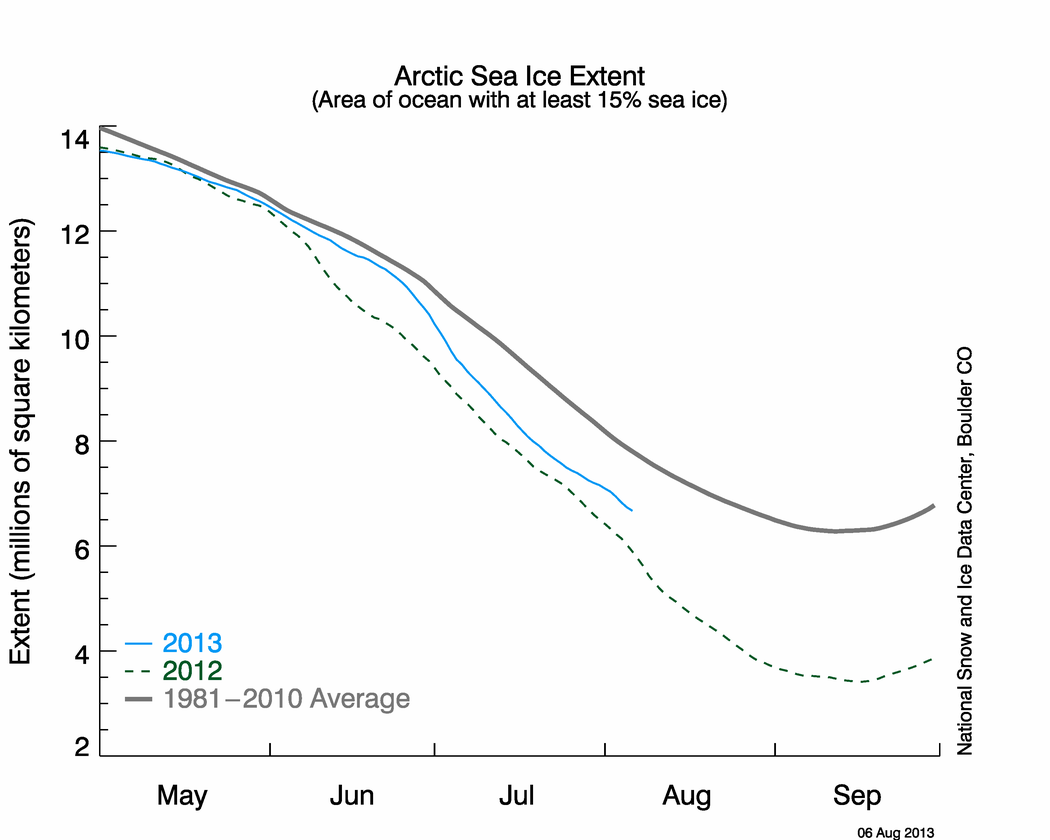
Speaking of the Arctic. What is up with this?

http://nsidc.org/data/seaice_index/images/daily_images/N_timeseries.png
Methane, The Panic Du Jour
The climate panic headline this week has been that the warming Arctic is burping out dangerous quantities of greenhouse gas Methane.
Published on Friday, March 5, 2010 by Agence France Presse
Huge Methane Leak in Arctic Ocean: Study
WASHINGTON – Methane is leaking into the atmosphere from unstable permafrost in the Arctic Ocean faster than scientists had thought and could worsen global warming, a study said Thursday. From 2003 to 2008, an international research team led by University of Alaska-Fairbanks scientists Natalia Shakhova and Igor Semiletov surveyed the waters of the East Siberian Arctic Shelf, which covers more than 772,200 square miles (two million square kilometers) of seafloor in the Arctic Ocean. “This discovery reveals a large but overlooked source of methane gas escaping from permafrost underwater, rather than on land,” the study said. “More widespread emissions could have dramatic effects on global warming in the future.”
Methane is 30X more potent a greenhouse than CO2, so this sounds very alarming. Or does it? From the New York Times:
Dr. Shakhova said that undersea methane ordinarily undergoes oxidation as it rises to the surface, where it is released as carbon dioxide. But because water over the shelf is at most about 50 meters deep, she said, the gas bubbles to the surface there as methane. As a result, she said, atmospheric levels of methane over the Arctic are 1.85 parts per million, almost three times as high as the global average of 0.6 or 0.7 parts per million.
The first problem with the statement is that it is incorrect. The average global methane concentration is 1.8 ppm, not 0.6 ppm.
http://www.noaanews.noaa.gov/stories2008/images/methanetrend.jpg
The author also says that the Arctic is belching out nearly eight million tons of methane per annum.
She estimated that annual methane emissions from the East Siberian Arctic Shelf total about seven teragrams. (A teragram is 1.1 million tons.)
Sounds like a big number – except that burping/flatulating cattle produce ten times more methane than the Arctic. According to the EPA:
Globally, ruminant livestock produce about 80 million metric tons of methane annually
Is 1.85 ppm a large number? Let’s look at an analogy of what a population concentration of 1.85 parts per million really represents. If the population of Wyoming (544,270) represented all the molecules in the atmosphere, there would be only one methane molecule in the entire state. At 1.85 ppm, there would be fifteen methane molecules in New York City, out of population eight million. There would be on average zero in Nunavut, Canada.
I wonder how much methane Taco Bell indirectly generates per annum? I also wonder why so many Arctic/Greenland studies include only the years 2003-2008. Perhaps they are only interested in reporting data from unusually warm years in the Arctic?
Speaking of the Arctic. What is up with this?
http://nsidc.org/data/seaice_index/images/daily_images/N_timeseries.png
George Comanos (18:58:11) : I don’t understand: under what conditions does one have permafrost under the sea?
Someone else may have linked this already, we’re talking clathrate hydrate, a water/methane crystal some think may be the new organic fuel reserve.
http://en.wikipedia.org/wiki/Methane_hydrate
From the NYT article cited above:
So far, Dr. Heimann wrote, methane contributions from Arctic permafrost have been “negligible.” He added: “But will this persist into the future under sustained warming trends? We do not know.”
Nobody is saying the observed methane release is a problem yet.
But given that methane clathrates are unstable at a certain temperature and pressure, many scientists are worried about what happens after the Arctic warms 6 or 7 degrees C:
http://earthobservatory.nasa.gov/Features/GlobalWarming/global_warming_update5.php
The Arctic will warm much more than the global average, and if the methane clathrates are the “tipping point” some worry about:
http://www.energybulletin.net/node/3647
then game over.
Keep in mind the Sun is brightening by about 1% every 100 million years – things that might have triggered massive clathrate destabilizations 251 million years ago (Permian extinction event) might be accomplished with smaller perturbations to the climate system today. As many here have pointed out, the Sun is a huge influence on Earth’s climate.
Basic methane clathrate info.
And then there is the recent report by the American Astronomical Society of the discovery of a rare form of carbon dioxide in the atmosphere of Venus with a special signature absorption band at 3.3 microns.
This is a special isotope of carbon dioxide, where one oxygen atom is “normal”, with eight protons and eight neutrons, while the other has eight protons and ten neutrons. On Earth, they report, about 1 percent of the carbon dioxide is of this abnormal form.
They speculate that this special gas plays an important role in the greenhouse effect on that planet (Venus).
Steve Goddard (08:06:19) :
looks like CH4 absorption is minimal and does not occupy any unique spectral bands.
http://www.globalwarmingart.com/wiki/File:Atmospheric_Transmission_
And yet the Global Warming Potential (GWP) of CH4 is 72 at 20 years:
http://en.wikipedia.org/wiki/Global_warming_potential
Good thing there are not gigatons of sulfur hexaflouride captured in precarious ice crystals in the Arctic: (GWP of 16,300)
Carbon dioxide is defined to have a GWP of 1.
Speaking of panics, in about two billion years our galaxy is expected to collide with the Andromeda galaxy. http://www.scientificamerican.com/article.cfm?id=when-milky-way-and-andromeda-collide-earth-could-find-itself-far-from-home
I just thought you should know.
Jryan
If a cow patty falls, and an tree grows from it, is their global warming?>>
To answer this question we only need to know if it can be taxed…
Steve Goddard (08:06:19) :
looks like CH4 absorption is minimal and does not occupy any unique spectral bands>>
Steve, per my previous comment, they are counting the additional CO2, O3 and H2O from the CH4 breaking down. Then they “discount” natural CH4 because it is produced by plants that remove CO2. See links in comment.
That said, if you think about how they are presenting this, they are in effect double counting the methane. Their math works like this:
CO2 + H2O + O3 = X forcing
+1 CO2 = X+1 forcing
+1 CH4 = X+25 forcing
so CH4 is 25 times as powerful.
But since our measurements of CO2, H2O and O3 ALREADY include the components generated by CH4, we are already measuring the CH4 too. so if you want to “add the methane” to the current number, you first have to start by subtracting that part of what we are measuring which is already due to CH4. Which is not what they appear to have done.
davidmhoffer;
But since our measurements of CO2, H2O and O3 ALREADY include the components generated by CH4, we are already measuring the CH4 too. so if you want to “add the methane” to the current number, you first have to start by subtracting that part of what we are measuring which is already due to CH4. Which is not what they appear to have done.>>
Not to mention that they also present it as if the number they derive for CH4 can simply be added to CO2 + H2O + O3 and get a linear increase. Of course that isn’t true. Any increases in CO2 etc are subject to the same laws of diminishing returns regardless of where they come from. This is one of the slickest misrepresentations I have ever come across.
Annnnnnd we’re on to the next scare: depleting ocean oxygen levels.
http://news.yahoo.com/s/mcclatchy/20100307/sc_mcclatchy/3444187
I used this example four days ago in my discussion with Judith Curry.
ABC news paints this as:
They quote a co-leader of the study as saying:
So I went to read the study in Science (subscription required). It says nothing of the sort. In fact, it specifically says:
In other words, we just started studying this, so we don’t know whether permafrost is gaining or losing its ability to cap the methane.
I gave this to Judy as an example of the kind of scientific alarmism I detest … and I hadn’t even noticed the question of the exaggerated claims of the amount detailed in the head post. Good job, Stephen.
davidmhoffer (09:32:02) :
Not to mention that they also present it as if the number they derive for CH4 can simply be added to CO2 + H2O + O3 and get a linear increase. Of course that isn’t true. Any increases in CO2 etc are subject to the same laws of diminishing returns regardless of where they come from. This is one of the slickest misrepresentations I have ever come across.
Not the same law, being a strong absorber CH4 follows a square root dependence (with a correction for N2O). The effect of the respective gases is combined by adding their respective forcings.
For Steve G, here’s a proper spectrum which shows where CH4 has its effect (the peak left after CH4 is removed is due to N2O):
http://i302.photobucket.com/albums/nn107/Sprintstar400/Atmos.gif
Phil. (10:40:22) :
davidmhoffer (09:32:02) :
Not to mention that they also present it as if the number they derive for CH4 can simply be added to CO2 + H2O + O3 and get a linear increase. Of course that isn’t true. Any increases in CO2 etc are subject to the same laws of diminishing returns regardless of where they come from. This is one of the slickest misrepresentations I have ever come across.
Not the same law, being a strong absorber CH4 follows a square root dependence (with a correction for N2O). The effect of the respective gases is combined by adding their respective forcings>>
Yes of course, but that is NOT how they are claiming CH4 is 20 or 30 times CO2. The 30X factor quoted from Wikipedia relies on AR4 which relies on Ramaswamy et al 2001 and Forster et al 2007 and is expanded upon here:
http://www.iop.org/EJ/article/1748-9326/4/4/044007/erl9_4_044007.html#erl324255s2
It is clear from this article and the cited literature that the forcing being attributed to CH4 is derived by calculating the increased CO2, O3 and water vapour in the atmosphere as a consequence of the intermediate and final oxidation steps of CH4. They then propose to add the forcing from the CO2, O3 and water vapour to that already in the atmosphere.
Willis Eschenbach (10:22:12)
That is a very good example. From what you have said, it looks like this is primarily a case of elite media(1) journalists hyping up the story to get more attention and sell AGW (‘Green’ Journalism?) rather than scientists exaggerating a problem to get funding.
[1. For some reason I prefer this British term for MSM]
Even stranger fact! and something to be really worried about!
Realclimate agree with Steve Goddard, that this is not going to happen.
http://www.realclimate.org/index.php/archives/2010/03/arctic-methane-on-the-move/
It is clear from this article and the cited literature that the forcing being attributed to CH4 is derived by calculating the increased CO2, O3 and water vapour in the atmosphere as a consequence of the intermediate and final oxidation steps of CH4>>
Which if you think about what they are saying about the process (never mind the forcing calculation just consider the process) a rise in temperature releases methane which drives up CO2 levels as the CH4 oxidizes. The lag would be big because plants would start taking the CO2 out of the atmosphere and slow down the rise in CO2. But this would explain nicely why CO2 levels in the geological record lag temperature increase. They are a consequence of methane released by warming temperatures and then the methane decays into CO2.
According to the EPA: Globally, ruminant livestock produce about 80 million metric tons of methane annually.
How much methane do nonruminant herbivores produce? Any person that has ever attempted or succeeded in adopting a vegitarian diet knows their personal gas emissions more than double on beans, greens, and sprouts. Should we be urging Vegans to eat meat to save The Planet…. or just put a cork in their emitters?
Bumper Sticker: Global Warming Gas: Vegans Are Full Of It!
Konrad (19:27:22) — If methane from melting permafrost was going to cause dangerous runaway global warming it would have already done so in the Medieval Warm Period.
Correct, and congrats for having the only relevant comment herein.
The only way the scare works is to have no MWP, hence Mann’s and other efforts to expunge it. Probably 90% of the present-day scares are utterly irrelevant unless there was no MWP.
“To discern whether this extensive CH4 venting over the ESAS is a steadily ongoing phenomenon or signals the start of a more massive CH4 release period, there is an urgent need for expanded multifaceted investigations into these inaccessible but climate-sensitive shelf seas north of Siberia.”
Of course. If it looks dangerous poke it with a stick. That ought to get it going.
Better yet, drag some up and have a look at it. Boom.
Spector (11:45:10)
I disagree. The hyping is being done, not by the media, but by Dr. Natalia Shakhova, for example her quote that:
I hate this kind of “science by soundbite” practiced by so many climate scientists. If the good doctor believes that, it should be in her study. And since it isn’t in her study, she’s just blowing smoke.
@ur momisugly Willis Eschenbach (12:32:00) :
OT: But I would like to let you know that I wrote this:
http://blog.stoic-epicurean.com/index.php?blog=6&p=64&more=1&c=1&tb=1&pb=1
It’s basically my thoughts on why PNS has no defined place or use, and how we’ve done without it for a long time.
This is the biggest load of crap I have ever seen.
As a geophysicist that has to deal with the effects of permafrost or lack there of on seismic data on a regular basis, I know a thing or two about the subject. For starters, as you go offshore, you loose permafrost. Why ? Because the water is WARM compared to the annual ambient temp. I dont care if the annual temp goes up 10 deg or down 10 deg, the water will still be above freezing and any remnant permafrost (it would be a remnant from the last glacial stage, when the ocean would have been frozen to bottom – it is melting now because the water is above freezing).
Short of us entering a new ice age & re-freezing the ocean to the bottom, nothing will stop this offshore permafrost melting. So, is that what we want – a new ice age?? These people are either complete morons or pathological liars. No wonder science has no credibility – people like this are destroying it.
Antonio San (21:07:50)
“….So perhaps all the MSM that propped up this study as the new scare should, for once, have read realclimate…
Thanks climategate!”
I think you meant “Thanks RealClimate”
I think we ought to keep the MSM going to WUWT – there’s no change in thinking at RealClimate, – they are at window #1 of the cartoon posted with this story and there’s just no way they want the attention to be shifted away from CO2 – at least not yet!.
davidmhoffer (11:36:56) :
Yes of course, but that is NOT how they are claiming CH4 is 20 or 30 times CO2. The 30X factor quoted from Wikipedia relies on AR4 which relies on Ramaswamy et al 2001 and Forster et al 2007 and is expanded upon here:
http://www.iop.org/EJ/article/1748-9326/4/4/044007/erl9_4_044007.html#erl324255s2
It is clear from this article and the cited literature that the forcing being attributed to CH4 is derived by calculating the increased CO2, O3 and water vapour in the atmosphere as a consequence of the intermediate and final oxidation steps of CH4. They then propose to add the forcing from the CO2, O3 and water vapour to that already in the atmosphere.
Actually that is not what is done and you’ve made a complete dog’s breakfast of reading the paper, have another go!
davidmhoffer (11:49:23) : edit
I find:
That’s far too short to explain the ice core CO2 lag, which is on the order of 600-800 years.
w.
There is no such thing as “permafrost under the East Siberian Arctic Shelf.” Permafrost is found on land… Where the ground remains frozen for years at a time. The sea floor doesn’t freeze. If it did, Snowball Earth would have been permanent.
While there is a fair amount of methane locked up in permafrost, it’s a drop in the bucket compared to sea floor methane hydrates (clathrates). A clathrate occurs when one molecule forms a lattice or cage around another compound. Methane hydrates are clathrates of CH4 molecules trapped in a lattice of H2O (ice).
Atmospheric methane (CH4) levels have been essentially flat for more than a decade; varying from 1770-1800 ppb (parts per billion).
The only mechanisms that can trigger a sudden release of sea floor methane hydrates are:
No amount of “anthropogenic global warming” can release Arctic sea floor methane hydrates. The oceans do not warm from the bottom-up… Unless the source of the warming is volcanic. The oceanic thermocline is very steep…
Thermocline
Once you get below the surface layer, solar (and atmospheric) heating don’t affect the water temperature in any significant way. The Arctic thermocline is very shallow (when it even exists).
The paper itself is behind the [I]Science[/I] paywall; but [I]Science News[/I] has a pretty good article about it… Arctic seafloor a big source of methane.
“We don’t know how long it’s been bubbling like this”… It’s most likely “been bubbling like this” since the end of the Pleistocene. There wasn’t someone monitoring the East Siberian Arctic Shelf who one day found gas seeps where none had previously existed. This is like the Antarctic ozone hole, they went looking for something and found it… But there’s no evidence that it wasn’t there before anyone looked for it.
They are most likely observing natural gas seeps. The Gulf of Mexico, for example, is loaded with natural oil and gas seeps…
<a href =http://ocean.tamu.edu/Quarterdeck/QD5.3/sassen.html"][B]Gas Hydrates
The oil and gas potential of the East Siberian Arctic Shelf is nothing new…
The USGS reports that the “undiscovered conventional oil and gas resources of the Arctic are estimated to be approximately 90 billion barrels of oil, 1,669 trillion cubic feet of natural gas, and 44 billion barrels of natural gas liquids.” Natural seafloor oil and gas seeps are among the reasons that the area is thought to have huge potential for oil and gas exploration.