Guest post by Steven Goddard

The climate panic headline this week has been that the warming Arctic is burping out dangerous quantities of greenhouse gas Methane.
Published on Friday, March 5, 2010 by Agence France Presse
Huge Methane Leak in Arctic Ocean: Study
WASHINGTON – Methane is leaking into the atmosphere from unstable permafrost in the Arctic Ocean faster than scientists had thought and could worsen global warming, a study said Thursday. From 2003 to 2008, an international research team led by University of Alaska-Fairbanks scientists Natalia Shakhova and Igor Semiletov surveyed the waters of the East Siberian Arctic Shelf, which covers more than 772,200 square miles (two million square kilometers) of seafloor in the Arctic Ocean. “This discovery reveals a large but overlooked source of methane gas escaping from permafrost underwater, rather than on land,” the study said. “More widespread emissions could have dramatic effects on global warming in the future.”
Methane is 30X more potent a greenhouse than CO2, so this sounds very alarming. Or does it? From the New York Times:
Dr. Shakhova said that undersea methane ordinarily undergoes oxidation as it rises to the surface, where it is released as carbon dioxide. But because water over the shelf is at most about 50 meters deep, she said, the gas bubbles to the surface there as methane. As a result, she said, atmospheric levels of methane over the Arctic are 1.85 parts per million, almost three times as high as the global average of 0.6 or 0.7 parts per million.
The first problem with the statement is that it is incorrect. The average global methane concentration is ~1.8 ppm, (1786 ppb) not 0.6 ppm as seen below in this graph from NOAA:

http://www.noaanews.noaa.gov/stories2008/images/methanetrend.jpg

The author also says that the Arctic is belching out nearly eight million tons of methane per annum.
She estimated that annual methane emissions from the East Siberian Arctic Shelf total about seven teragrams. (A teragram is 1.1 million tons.)
Sounds like a big number – except that burping/flatulating cattle produce ten times more methane than the Arctic. According to the EPA:
Globally, ruminant livestock produce about 80 million metric tons of methane annually
Is 1.85 ppm a large number? Let’s look at an analogy of what a population concentration of 1.85 parts per million really represents. If the population of Wyoming (544,270) represented all the molecules in the atmosphere, there would be only one methane molecule in the entire state. At 1.85 ppm, there would be fifteen methane molecules in New York City, out of population eight million. There would be on average zero in Nunavut, Canada.
I wonder how much methane Taco Bell indirectly generates per annum? I also wonder why so many Arctic/Greenland studies include only the years 2003-2008. Perhaps they are only interested in reporting data from unusually warm years in the Arctic?
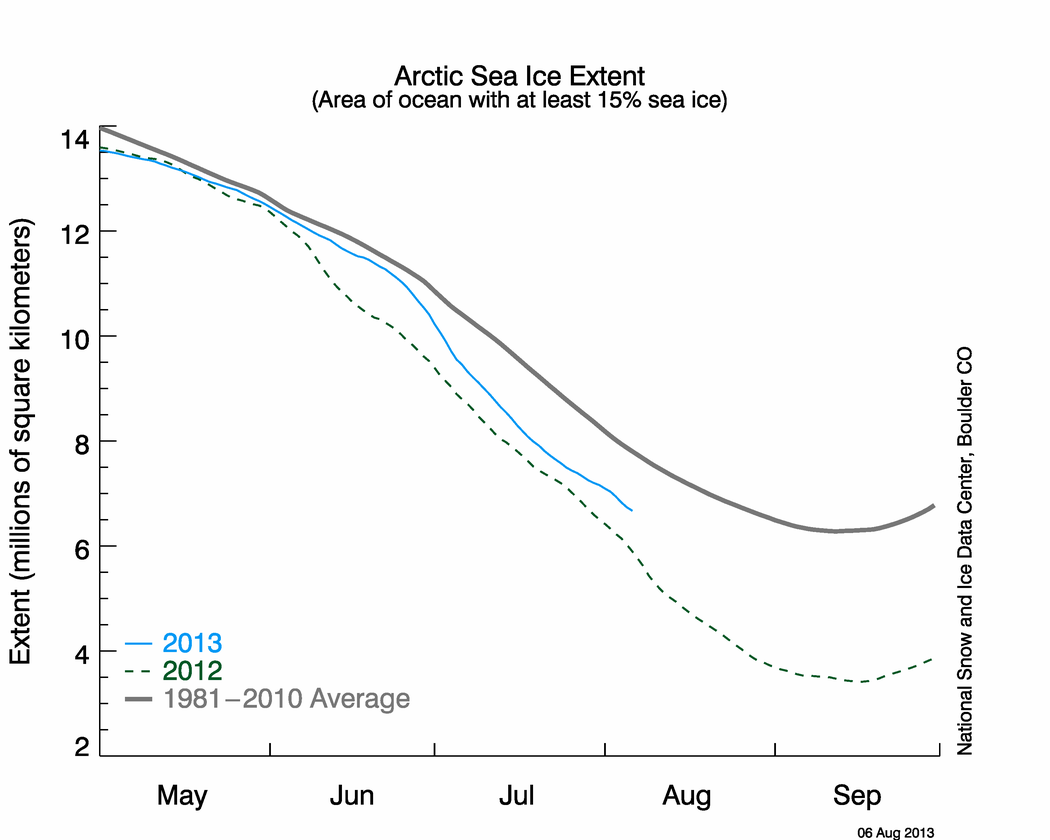
Speaking of the Arctic. What is up with this?

http://nsidc.org/data/seaice_index/images/daily_images/N_timeseries.png
Methane, The Panic Du Jour
The climate panic headline this week has been that the warming Arctic is burping out dangerous quantities of greenhouse gas Methane.
Published on Friday, March 5, 2010 by Agence France Presse
Huge Methane Leak in Arctic Ocean: Study
WASHINGTON – Methane is leaking into the atmosphere from unstable permafrost in the Arctic Ocean faster than scientists had thought and could worsen global warming, a study said Thursday. From 2003 to 2008, an international research team led by University of Alaska-Fairbanks scientists Natalia Shakhova and Igor Semiletov surveyed the waters of the East Siberian Arctic Shelf, which covers more than 772,200 square miles (two million square kilometers) of seafloor in the Arctic Ocean. “This discovery reveals a large but overlooked source of methane gas escaping from permafrost underwater, rather than on land,” the study said. “More widespread emissions could have dramatic effects on global warming in the future.”
Methane is 30X more potent a greenhouse than CO2, so this sounds very alarming. Or does it? From the New York Times:
Dr. Shakhova said that undersea methane ordinarily undergoes oxidation as it rises to the surface, where it is released as carbon dioxide. But because water over the shelf is at most about 50 meters deep, she said, the gas bubbles to the surface there as methane. As a result, she said, atmospheric levels of methane over the Arctic are 1.85 parts per million, almost three times as high as the global average of 0.6 or 0.7 parts per million.
The first problem with the statement is that it is incorrect. The average global methane concentration is 1.8 ppm, not 0.6 ppm.
http://www.noaanews.noaa.gov/stories2008/images/methanetrend.jpg
The author also says that the Arctic is belching out nearly eight million tons of methane per annum.
She estimated that annual methane emissions from the East Siberian Arctic Shelf total about seven teragrams. (A teragram is 1.1 million tons.)
Sounds like a big number – except that burping/flatulating cattle produce ten times more methane than the Arctic. According to the EPA:
Globally, ruminant livestock produce about 80 million metric tons of methane annually
Is 1.85 ppm a large number? Let’s look at an analogy of what a population concentration of 1.85 parts per million really represents. If the population of Wyoming (544,270) represented all the molecules in the atmosphere, there would be only one methane molecule in the entire state. At 1.85 ppm, there would be fifteen methane molecules in New York City, out of population eight million. There would be on average zero in Nunavut, Canada.
I wonder how much methane Taco Bell indirectly generates per annum? I also wonder why so many Arctic/Greenland studies include only the years 2003-2008. Perhaps they are only interested in reporting data from unusually warm years in the Arctic?
Speaking of the Arctic. What is up with this?
http://nsidc.org/data/seaice_index/images/daily_images/N_timeseries.png
Better than looking for hydrothermal vents… Looking for oil and gas…
The BGR97 Arctic cruise to the Laptev Sea took place in 1997. These natural hydrocarbon seeps were observed 13 years before the Shakhova publication.
The gas has been seeping from the Laptev seafloor since at least the Pleistocene. It seeps to the north of the buried Pleistocene permafrost and it seeps through the buried Pleistocene permafrost in some places.
There is no submarine permafrost to the north, in deeper water because permafrost does not form underwater. That part of the Laptev Sea was underwater during the last Pleistocene glaciation. Much of the Laptev Sea continental shelf was subaerially exposed during the last glaciation (it was above sea level) and permafrost formed there. This permafrost was buried under Holocene marine sediments when sea level rose as the last glaciation receded. Since we know that essentially the same cycle of sea level rise fall occurred in every Pleistocene glacial cycle, there’s a high probability that other, older layers of permafrost were buried in a similar fashion. Since there aren’t any extant Eemian (Sangamonian) or older layers of permafrost, it’s a pretty safe bet that they melted as the ambient temperature warmed as their depth of burial increased (geothermal gradient).
It’s physically impossible for this buried layer of submarine permafrost to be melting because of anything that’s going on in the atmosphere. The Laptev Sea was as warm as or warmer than it is now during the Medieval Warm Period and even warmer during the Holocene Climate Optimum…
Late Holocene Climatic History: Southeastern Shelf of the Laptev Sea
If the Pleistocene-aged permafrost is currently melting, it’s doing so for the same reason that earlier Pleistocene-aged permafrost layers melted… It’s being buried by younger layers sediment.
Perhaps this is a stupid question from someone who admittedly doesn’t know a whole lot about geology in general, or Siberian permafrost and methane stores in particular, but…
Is the protective sedimentary layer on top of the permafrost geologically distinct from the permafrost layer? What I’m getting at here is, is the protective layer melted permafrost or something different? If something different, was it deposited before or after the ocean rose after the last glaciation, etc.
Just curious
Global warming triggers everything evil, from glaciers melting (which never happened in history before we came along) to farting permafrost.
The next thing we will be blamed of will be getting Michael Mann’s granddaughter pregnant:
“Girl gets hot! Melts in the arms of her lover! Humans are evil! See report at 11!”
Don’t forget ozone holes, ocean conveyors and acid rain. They still bring those up all the time – to prove that this alarm is true, because weren’t those all true?
Ozone hole: What a dipshit idea. Ozone hole at the South Pole, when basically all the fluorocarbons were being released in the northern hemisphere cities – exactly where we also had ozone alerts. Funny how the fluorocarbon molecules ignored the ozone right there and traveled all the way to the upper atmosphere at the south pole before becoming ozone whores.
Ocean conveyor: Try to find the circulation in the Gulf of Mexico in ANY oceanic conveyor diagram. You can’t. They leave the Gulf of Mexico out of the Gulf Stream. (!) Then they claim it is suction that is pulling warm water north, when it is the rotation and shape of the Earth that creates the currents and the Coriolis Effect that are PUSHING the water north, and it only happens to be WARM because it was pushed into the Gulf of Mexicom, where it looled around for weeks, absorbing heat energy, before circulating out, south of Miami, into the Atlantic again. Now, you can’t suck something from 4,000 miles away, not when there are trillions of cubic meters of water nearby that will fill that little hole created by the sinking cold water. Anyone who knows anything about pressure drops knows that – but not climate scientists: Suction draws from the nearest sources first. As an engineer, I’ve had to deal with this from time to time. Gravity sinking cold water is NOT strong enough to draw water from thousands of miles away. Hell, half the water filling that “hole” east of Iceland will have come from the NORTH.
Acid Rain: Hahahahahaha – In the 1980s, the U.S. government paid people to go out in the US Northeast to find the proof of acid rain screwing up the lakes there. When the data was all in, there was ONE POND affected – an all but inaccessible small pond in upstate NY that had high acid levels. That was it. Boy, it got quiet in the Warmosphere/Acidosphere really quickly. But still, some warmers bring it up to this day, as if it was real. In their minds it still is.
Back to methane: Humans are evil. We all know that. Humans all need to die out, so that Bambi’s mother won’t ever get shot again. It’s all Walt Disney’s fault we are in this mess. We have screwed up the balance of nature, just by being alive and staying alive. Animals are more worthy occupants of this planet than we are. [Cue chanting Tibetan monks… Cue sunrise over the ocean… Cue smiling dolphins… Cue polar bears – on land – frolicking… Cue idle factories with blue skies and geese flying overhead…]
Despite the many posts here, I could not find (with a fast peruse) the following observations:
Methane release from permaforst is only with the initial melting. The thawed and alive material then becomes a good carbon sink as all of that life kicks into gear. Bubbles for a short time, carbon metabolism for the season.
1780 ppb = 1.780 ppm methane
Multiply by 20 (they claim methane is 20X better heat-trapping gas)
= 35.6 equivalent ppm CO2 as the 2004 baseline.
Of this, the 5 ppb increase in the last 5 years (0.28%) means that the increased methane is equivalent to adding . . . wait for it! 0.10 ppm CO2 !!!!!
Thus, with all due respect, this whole discussion is essentially meaningless.
Reference should also be made to Miskolczi and Zagoni’s work on the thermodynamic interaction of CO2 and water vapor which has shown that they interact to create a relatively constant heat-trapping effect such that CO2 is irrelevant to the climate.
Jack Simmons (18:06:37) :
Cow methane problem solved:
http://www.ecogeek.org/preventing-pollution/1864
REPLY:
Then you use the tanks of methane to fuel your pickup truck! There was a guy in Leominster Ma who ran his pickup on methane generated from chicken manure, perhaps he can sell conversion plans.
Sounds like a great “green energy” plan. Convert grass into fuel for the car and steaks for the freezer at the same time. Run the freeze on methane too. Just think it will give farmers every where a new product to sell!
@NickB
The permafrost is essentially a Pleistocene paleosol. It is ground that froze during the last glaciation. As the glaciers retreated during the Holocene, sea level rose very rapidly and submerged the permafrost. Over the last 12,OOO yrs, the permafrost has been buried progressively under layers of Holocene marine sediments. The burial process is gradually warming the permafrost due to the geothermal gradient.
I’ve been a working geoscientist for 3O yrs and up until a couple of days ago I had never known that submarine permafrost could exist.
[img]http://homepage.mac.com/williseschenbach/.Pictures/city_temps_and_spencer_corr.jpg[/img]