Note this a mirrored posting of Steve McIntyre’s Climate Audit post. The Climate Audit Server is getting heavy traffic and is slow to load – here is the article exactly as he wrote it yesterday. -Anthony
Yamal: A “Divergence” Problem
The second image below is, in my opinion, one of the most disquieting images ever presented at Climate Audit.
Two posts ago, I observed that the number of cores used in the most recent portion of the Yamal archive at CRU was implausibly low. There were only 10 cores in 1990 versus 65 cores in 1990 in the Polar Urals archive and 110 cores in the Avam-Taymir archive. These cores were picked from a larger population – measurements from the larger population remain unavailable.
One post ago, I observed that Briffa had supplemented the Taymir data set (which had a pronounced 20th century divergence problem) not just with the Sidorova et al 2007 data from Avam referenced in Briffa et al 2008, but with a Schweingruber data set from Balschaya Kamenka (russ124w), also located over 400 km from Taymir.
Given this precedent, I examined the ITRDB data set for potential measurement data from Yamal that could be used to supplement the obviously deficient recent portion of the CRU archive (along the lines of Brifffa’s supplementing the Taymir data set.) Hantemirov and Shiyatov 2002 describe the Yamal location as follows:
The systematic collection of subfossil wood samples was begun, in 1982, in the basins of the Khadytayakha, Yadayakhodyyakha and Tanlovayakha rivers in southern Yamal in the region located between 67°00 and 67°50 N and 68°30 and 71°00 E (Figure 1). These rivers flow from the north to the south; hence, no driftwood can be brought from the adjacent southern territories At the present time, the upper reaches of these rivers are devoid of trees; larch and spruce-birch-larch thin forests are located mainly in valley bottoms in the middle and lower reaches.
Sure enough, there was a Schweingruber series that fell squarely within the Yamal area – indeed on the first named Khadyta River – russ035w located at 67 12N 69 50Eurl . This data set had 34 cores, nearly 3 times more than the 12 cores selected into the CRU archive. Regardless of the principles for the selection of the 12 CRU cores, one would certainly hope to obtain a similar-looking RCS chronology using the Schweingruber population for living trees in lieu of the selection by CRU (or whoever).
As a sensitivity test, I constructed a variation on the CRU data set, removing the 12 selected cores and replacing them with the 34 cores from the Schweingruber Yamal sample. As shown below, this resulted in a substantial expansion of the data set in the 19th and 20th centuries and a modest decline in the 18th century. (Hantemirov and Shiyatov 2002 had reported a selection of long cores of 200-400 years; while the CRU archive does not appear to be the precisely the same as the unavailable Hantemirov and Shiyatov 2002 archive, it does appear to be related. This pattern of change indicates that the age of the CRU cores is systematically higher than the age of the Schweingruber cores.)

Figure 1. Comparison of core count. Black – variation with Schweingruber instead of CRU; red- archived version with 12 picked cores.
The next graphic compares the RCS chronologies from the two slightly different data sets: red – the RCS chronology calculated from the CRU archive (with the 12 picked cores); black – the RCS chronology calculated using the Schweingruber Yamal sample of living trees instead of the 12 picked trees used in the CRU archive. The difference is breathtaking.

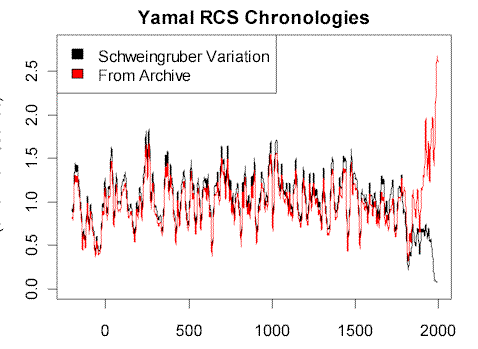
Figure 2. A comparison of Yamal RCS chronologies. red – as archived with 12 picked cores; black – including Schweingruber’s Khadyta River, Yamal (russ035w) archive and excluding 12 picked cores. Both smoothed with 21-year gaussian smooth. y-axis is in dimensionless chronology units centered on 1 (as are subsequent graphs (but represent age-adjusted ring width).
Finally, here is another graphic showing the same two RCS chronologies, but adding in an RCS chronology on the merged data set obtained by appending the Schweingruber population to the CRU archive – this time retaining the 12 cores. Unsurprisingly this is in between the other two versions, but most importantly it has no HS.

Figure 3. Also showing merged version up to 1990. (After 1990, there is only the few CRU cores and it tracks the CRU version.)
I hardly know where to begin in terms of commentary on this difference.
The Yamal chronology has always been an exception to the large-scale “Divergence Problem” that characterizes northern forests. However, using the Schweingruber population instead of the 12 picked cores, this chronology also has a “divergence problem” – not just between ring widths and temperature, but between the two versions.
Perhaps there’s some reason why Schweingruber’s Khadyta River, Yamal larch sample should not be included with the Yamal subfossil data. But given the use of a similar Schweingruber data set in combination with the Taymir data (in a case where it’s much further away), it’s very hard to think up a valid reason for excluding Khadyta River, while including the Taymir supplement.
Perhaps the difference between the two versions is related to different aging patterns in the Schweingruber population as compared to the CRU population. The CRU population consists, on average, of older trees than the Schweingruber population. It is highly possible and even probable that the CRU selection is derived from a prior selection of old trees described in Hantemirov and Shiyatov 2002 as follows:
In one approach to constructing a mean chronology, 224 individual series of subfossil larches were selected. These were the longest and most sensitive series, where sensitivity is measured by the magnitude of interannual variability. These data were supplemented by the addition of 17 ring-width series, from 200–400 year old living larches.
The subfossil collection does not have the same bias towards older trees. Perhaps the biased selection of older trees an unintentional bias, when combined with the RCS method. This bias would not have similarly affected the “corridor method” used by Hantemirov and Shiyatov themselves, since this method which did not preserve centennial-scale variability and Hantemirov and Shiyatov would not have been concerned about potential bias introduced by how their cores were selected on a RCS chronology method that they themselves were not using.
Briffa’s own caveats on RCS methodology warn against inhomogeneities, but, notwithstanding these warnings, his initial use of this subset in Briffa 2000 may well have been done without fully thinking through the very limited size and potential unrepresentativeness of the 12 cores. Briffa 2000 presented this chronology in passing and it was never properly published in any journal article. However, as CA readers know, the resulting Yamal chronology with its enormous HS blade was like crack cocaine for paleoclimatologists and got used in virtually every subsequent study, including, most recently, Kaufman et al 2009.
As CA readers also know, until recently, CRU staunchly refused to provide the measurement data used in Briffa’s Yamal reconstruction. Science(mag) acquiesced in this refusal in connection with Osborn and Briffa 2006. While the Yamal chronology was used in a Science article, it originated with Briffa 2000 and Science(mag) took the position that the previous journal (which had a different data policy) had jurisdiction. Briffa used the chronology Briffa et al (Phil Trans B, 2008) and the Phil Trans editors finally seized the nettle, requiring Briffa to archive the data. As noted before, Briffa asked for an extension and, when I checked earlier this year, the Yamal measurement data remained unarchived. A few days ago, I noticed that the Yamal data was finally placed online. With the information finally available, this analysis has only taken a few days.
If the non-robustness observed here prove out (and I’ve provided a generating script), this will have an important impact on many multiproxy studies that have relied on this study.
Bill Illis (19:33:45) :
“We can just look at the actual temperature measurements in the Yamal Pennisula to see what the actual temperatures have done recently – hint there is no substantive change in thermometre-based measurements in the Yamal Pennisula.”
The temperature plots are in Briffa’s Royal Society paper. Most of the warming has been in the summer growing season, especially over the last 25 years. It was the disagreement between McIntyre’s first, faulty, reconstruction and this temperature record which first gave me doubts about its validity.
ralph (19:35:06) :
oh my word. Yes. They do seem angry and perturbed.
TomP,
You keep re-describing the Texas Sharpshooter Fallacy over and over again. You obviously don’t get it. So I’m going to boil it down for you (and anyone else who doesn’t get it). Take several thousand (or hundred, or dozen, or whatever) random number generators, have them generate a string of numbers. Now take those random sequences and compare them to a selected short sequence of numbers from a larger, non-random sequence of numbers. INVARIABLY you will be able to find some of those random sequences that mach the non random sample to one degree or another. The larger the degree of match to the non-random sequence, the smaller the number of random sequences that will fit the criteria, the looser the match criteria, the more random sequences. If you then take your matching random number generators and try and reproduce your non-random sequence it WON’T WORK.
If a group of trees is going to act as a thermometer, any of those trees, selected at random, MUST correlate to your known temperature records (within the bounds provided by the Central Limit Theorem). You can’t go back after making measurements and then select which ones match best – that is, by definition, the Texas Sharpshooter Fallacy.
Tom P:
Please provide the raw data which supports your side of the debate. Curious minds do want to learn…
“Most of the warming has been in the summer growing season…” Why is that?
Second, why are you acting like a defence lawer, instead of being a curious scientist in the quest for knowledge?
Military-Industrial Complex Speech, Dwight D. Eisenhower, 1961
History fulfilled
Quite brave of you, Tom P, but quite foolish, too. They are eating you alive here and at Climate Audit. Where did you learn to do science, and where do you do it now? And I’ll repeat someone’s comment over there; you are blind if you can’t see that the difference between the two plots is still dramatic and damning.
===========================
Say goodbye to the latest sunspots. You may not be seeing them again for a while.
http://www.solarcycle24.com/
No sunspots for Tom P, He’s a very bad boy.
Steve Huntwork (20:13:18) :
Briffa’s Royal Society paper is here:
http://rstb.royalsocietypublishing.org/content/363/1501/2269
And it was indeed a quest for knowledge that made me read it and see the discrepancy between McIntyre’s reconstruction and the measured temperatures. Apparently no-one else on WUWT or CA was particularly interested in what the paper under criticism actually said, just that it needed its hockey stick broken.
REPLY: Quest for knowledge is a good thing, go for it. But you know Tom, you really shouldn’t paint with broad brushes when you have no specific facts in evidence, only guesses. I can tell you with certainty that one person at CA read it, Steve McIntyre. Can you be certain that others who frequent CA and WUWT did not simply becuase they didn’t post about their noble “quest for knowledge” as you did?
And I’ll point out that the full text is behind a paywall here (the PDF link from the Royal Society page)
http://www.sciencemag.org/cgi/reprint/325/5945/1236
Thus keeping a lot of people from reading it. You with your University Association get automatic access, so its normal for you. Many people who don’t get such perks may not feel inclined to pay twice for publicly funded research, so I don’t automatically blame people for not tossing money just to read a paper. Provide a free public link to the paper and then in a couple of days you can complain all you want about people not reading it. – Anthony
“how can you trust government-funded scientists in the future?”
Afraid you can’t. It’s science with an agenda.
Tom P:
Can you provide me (us) with the full paper?
Once again, can you provide us with the raw data, so that we can evaluate how reliable this Royal Society paper is?
This is what I was able to obtain:
This paper describes variability in trends of annual tree growth at several locations in the high latitudes of Eurasia, providing a wide regional comparison over a 2000-year period. The study focuses on the nature of local and widespread tree-growth responses to recent warming seen in instrumental observations, available in northern regions for periods ranging from decades to a century. Instrumental temperature data demonstrate differences in seasonal scale of Eurasian warming and the complexity and spatial diversity of tree-growing-season trends in recent decades. A set of long tree-ring chronologies provides empirical evidence of association between inter-annual tree growth and local, primarily summer, temperature variability at each location. These data show no evidence of a recent breakdown in this association as has been found at other high-latitude Northern Hemisphere locations. Using Kendall’s concordance, we quantify the time-dependent relationship between growth trends of the long chronologies as a group. This provides strong evidence that the extent of recent widespread warming across northwest Eurasia, with respect to 100- to 200-year trends, is unprecedented in the last 2000 years. An equivalent analysis of simulated temperatures using the HadCM3 model fails to show a similar increase in concordance expected as a consequence of anthropogenic forcing.
Tom P.:
“An equivalent analysis of simulated temperatures using the HadCM3 model fails to show a similar increase in concordance expected as a consequence of anthropogenic forcing.”
So, once again, your side of the debate is only based upon virtual reality computer models?
I quit being interested in climate science beyond the political circus. Like Anthony’s and Dr. Gray’s bias to the Ocean’s storage of heat and influence, I can’t get past barycentric solar tides created by the planets. I think everyone on the skeptics side is just waiting for the garbage to fly by in the next storm so we can get on with understanding what the ‘h’ ‘e’ double hockey sticks (pun intended) is going on.
Regardless, I’m personally preparing for cold and many industrial facilities I see are quietly doing the same while politically playing heed to the warmist CO2 rhetoric.
Tom P.:
Please understand that I honestly want to learn from you. I am not trying to argue and make you feel bad, but simply desire to obtain the raw data that you have based your analysis upon.
I am most likely wrong, but simply desire to evaluate the raw data myself. Why is that so difficult?
As a software engineer since 1972, I sometimes wish these darn computers had never been introduced into the scientific community.
In Astronomy, I see this confusion between reality and computer models all the time.
Please help me out, because I am honestly curious to understand the raw data that you have based your side of the debate upon.
Anthony,
“Can you be certain that others who frequent CA and WUWT did not simply becuase they didn’t post about their noble “quest for knowledge” as you did?”
That the evidence from the temperature record was not mentioned by anyone else does make me fairly certain that the paper had not been studied particularly closely.
REPLY: But you have only a guess, the link you provided does in fact put up a paywall:
http://rstb.royalsocietypublishing.org/content/363/1501/2269
Thus I submit that since you are at a London college, what is automatic and normal for you is not so easy for everybody else. Try not to maintain an academic air of elitism because you have access and the general public does not. – Anthony
Anthony,
“Provide a free public link to the paper and then in a couple of days you can complain all you want about people not reading it.”
Are you sure you’re looking at the right paper? I can access it directly at home for free at the link I gave above, though maybe there’s an international gateway: http://rstb.royalsocietypublishing.org/content/363/1501/2269.full
REPLY: That link works, the one you originally gave is this one below and links to the AAS paywall:
http://rstb.royalsocietypublishing.org/content/363/1501/2269
This one may also be behind a login, and you may simply be putting out an unauthorized link, I don’t know. But there is no link to the URL above from the public page here: http://rstb.royalsocietypublishing.org/content/363/1501/2269
I may have to delete the link you provided (due to copyright issues) unless you can demonstrate that it is a free and open access link. All these links at the bottom:
* Abstract
* Full Text
* Full Text (PDF)
Go to AAAS paywall – Anthony
Anthony = windshield, TomP = bug, ………….. 8^]
Tom P:
Outstanding!
That second link worked and I can now read the full paper that you were talking about.
Again, I simply want to learn…
Well, a downturn in something. No real evidence that it’s temperatures these proxies are responding to.
Tom P:
That is a rather interesting paper and will require much more study.
“However, a simple analysis of one such experiment, under natural and GHG forcing for the last 250 years, while showing consistently increasing concordance between simulated temperatures in the regions of our chronologies, failed to produce results that could be distinguished from the results of a similar experiment driven only with natural (i.e. non-anthropogenic) forcings. ”
Thankfully, the authors were honest and achieved some of my respect.
Anthony,
There’s no necessity to snipe at ivory towers – this paper is readily accessible as Steve Huntwork (appositely named!) demonstrated. As it says, it’s free for anyone to read.
REPLY: I’m not so sure. Prove that you can find this link from the public portal, don’t have to login or pay a fee to get it. The Royal Society may simply have bad security, allowing the access even though they haven’t gone through a pay/login portal. I’ve seen such things before. My question is, how did you come about that link? Show that it is publicly findable from http://rstb.royalsocietypublishing.org/content/363/1501/2269 or from a Google search. – Anthony
Even though the Cliff Notes version (the one with the paywall) settles on the words “anthropogenic forcing”, there are these two very telling provisos in the actual article itself, the first being in the introduction and second of the these being the final conclusion…the COMMON great adversative word being “however” in both.
“However, the strong multi-decadal component of temperature variability in the observational temperature records and the relative scarcity of data coverage severely hamper the identification of a clear amplified Arctic warming (Polyakov et al. 2002).”
“However, a simple analysis of one such experiment, under natural and GHG forcing for the last 250 years, while showing consistently increasing concordance between simulated temperatures in the regions of our chronologies, failed to produce results that could be distinguished from the results of a similar experiment driven only with natural (i.e. non-anthropogenic) forcings.”
Thank you for your honesty. That’s all we ask.
Chris
Norfolk, VA, USA
I agree Anthony, that paper is not open to the public.
I could not even copy it, but I am able to print it at this time.
Tom P:
This is all we ever asked, and I want to personally thank you for providing the information that I requested.
In my profession, my software is used to identify military targets. If it works, then the enemy is no longer around to harm another human again. If my software has failed, then other people will die as a result.
There are no “virtual reality computer models” in my world!
Anthony,
“Prove that you can find this link from the public portal, don’t have to login or pay a fee to get it.”
This is a little much! The link I give you takes you to a page that says:
Abstract Free
Full Text Free
Full Text (PDF) Free
What’s not to understand…
REPLY: Well, no, Tom it doesn’t. That’s what I’m saying. Maybe it works for you in jolly old England, but not here in America. As I’ve stated each of those links (except the abstract) goes to the AAAS paywall. – Anthony
UPDATE: It’s a function of browser width. I run a narrow width to coincide with my blog style so that my preview looks correct while writing, and when running that width your free links are not displayed. The large inks at the bottom appear to link to the current abstract displayed, but they are only to the new paper referencing the abstract. So my bad for not running a wide browser window. – Anthony
Anthony:
This link did work for me:
http://rstb.royalsocietypublishing.org/content/363/1501/2269
And I was able to print the full 18 pages of the article.
REPLY: Yes, my bad due to browser width settings. See my update to TomP.
Fair is fair!
If Tom P. is being helpfull and providing the requested information, then he should be thanked.
Actually, that was a rather interesting paper to read, even if I do have some technical questions.