Note this a mirrored posting of Steve McIntyre’s Climate Audit post. The Climate Audit Server is getting heavy traffic and is slow to load – here is the article exactly as he wrote it yesterday. -Anthony
Yamal: A “Divergence” Problem
The second image below is, in my opinion, one of the most disquieting images ever presented at Climate Audit.
Two posts ago, I observed that the number of cores used in the most recent portion of the Yamal archive at CRU was implausibly low. There were only 10 cores in 1990 versus 65 cores in 1990 in the Polar Urals archive and 110 cores in the Avam-Taymir archive. These cores were picked from a larger population – measurements from the larger population remain unavailable.
One post ago, I observed that Briffa had supplemented the Taymir data set (which had a pronounced 20th century divergence problem) not just with the Sidorova et al 2007 data from Avam referenced in Briffa et al 2008, but with a Schweingruber data set from Balschaya Kamenka (russ124w), also located over 400 km from Taymir.
Given this precedent, I examined the ITRDB data set for potential measurement data from Yamal that could be used to supplement the obviously deficient recent portion of the CRU archive (along the lines of Brifffa’s supplementing the Taymir data set.) Hantemirov and Shiyatov 2002 describe the Yamal location as follows:
The systematic collection of subfossil wood samples was begun, in 1982, in the basins of the Khadytayakha, Yadayakhodyyakha and Tanlovayakha rivers in southern Yamal in the region located between 67°00 and 67°50 N and 68°30 and 71°00 E (Figure 1). These rivers flow from the north to the south; hence, no driftwood can be brought from the adjacent southern territories At the present time, the upper reaches of these rivers are devoid of trees; larch and spruce-birch-larch thin forests are located mainly in valley bottoms in the middle and lower reaches.
Sure enough, there was a Schweingruber series that fell squarely within the Yamal area – indeed on the first named Khadyta River – russ035w located at 67 12N 69 50Eurl . This data set had 34 cores, nearly 3 times more than the 12 cores selected into the CRU archive. Regardless of the principles for the selection of the 12 CRU cores, one would certainly hope to obtain a similar-looking RCS chronology using the Schweingruber population for living trees in lieu of the selection by CRU (or whoever).
As a sensitivity test, I constructed a variation on the CRU data set, removing the 12 selected cores and replacing them with the 34 cores from the Schweingruber Yamal sample. As shown below, this resulted in a substantial expansion of the data set in the 19th and 20th centuries and a modest decline in the 18th century. (Hantemirov and Shiyatov 2002 had reported a selection of long cores of 200-400 years; while the CRU archive does not appear to be the precisely the same as the unavailable Hantemirov and Shiyatov 2002 archive, it does appear to be related. This pattern of change indicates that the age of the CRU cores is systematically higher than the age of the Schweingruber cores.)

Figure 1. Comparison of core count. Black – variation with Schweingruber instead of CRU; red- archived version with 12 picked cores.
The next graphic compares the RCS chronologies from the two slightly different data sets: red – the RCS chronology calculated from the CRU archive (with the 12 picked cores); black – the RCS chronology calculated using the Schweingruber Yamal sample of living trees instead of the 12 picked trees used in the CRU archive. The difference is breathtaking.

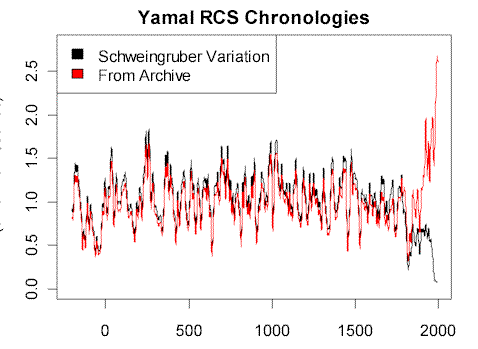
Figure 2. A comparison of Yamal RCS chronologies. red – as archived with 12 picked cores; black – including Schweingruber’s Khadyta River, Yamal (russ035w) archive and excluding 12 picked cores. Both smoothed with 21-year gaussian smooth. y-axis is in dimensionless chronology units centered on 1 (as are subsequent graphs (but represent age-adjusted ring width).
Finally, here is another graphic showing the same two RCS chronologies, but adding in an RCS chronology on the merged data set obtained by appending the Schweingruber population to the CRU archive – this time retaining the 12 cores. Unsurprisingly this is in between the other two versions, but most importantly it has no HS.

Figure 3. Also showing merged version up to 1990. (After 1990, there is only the few CRU cores and it tracks the CRU version.)
I hardly know where to begin in terms of commentary on this difference.
The Yamal chronology has always been an exception to the large-scale “Divergence Problem” that characterizes northern forests. However, using the Schweingruber population instead of the 12 picked cores, this chronology also has a “divergence problem” – not just between ring widths and temperature, but between the two versions.
Perhaps there’s some reason why Schweingruber’s Khadyta River, Yamal larch sample should not be included with the Yamal subfossil data. But given the use of a similar Schweingruber data set in combination with the Taymir data (in a case where it’s much further away), it’s very hard to think up a valid reason for excluding Khadyta River, while including the Taymir supplement.
Perhaps the difference between the two versions is related to different aging patterns in the Schweingruber population as compared to the CRU population. The CRU population consists, on average, of older trees than the Schweingruber population. It is highly possible and even probable that the CRU selection is derived from a prior selection of old trees described in Hantemirov and Shiyatov 2002 as follows:
In one approach to constructing a mean chronology, 224 individual series of subfossil larches were selected. These were the longest and most sensitive series, where sensitivity is measured by the magnitude of interannual variability. These data were supplemented by the addition of 17 ring-width series, from 200–400 year old living larches.
The subfossil collection does not have the same bias towards older trees. Perhaps the biased selection of older trees an unintentional bias, when combined with the RCS method. This bias would not have similarly affected the “corridor method” used by Hantemirov and Shiyatov themselves, since this method which did not preserve centennial-scale variability and Hantemirov and Shiyatov would not have been concerned about potential bias introduced by how their cores were selected on a RCS chronology method that they themselves were not using.
Briffa’s own caveats on RCS methodology warn against inhomogeneities, but, notwithstanding these warnings, his initial use of this subset in Briffa 2000 may well have been done without fully thinking through the very limited size and potential unrepresentativeness of the 12 cores. Briffa 2000 presented this chronology in passing and it was never properly published in any journal article. However, as CA readers know, the resulting Yamal chronology with its enormous HS blade was like crack cocaine for paleoclimatologists and got used in virtually every subsequent study, including, most recently, Kaufman et al 2009.
As CA readers also know, until recently, CRU staunchly refused to provide the measurement data used in Briffa’s Yamal reconstruction. Science(mag) acquiesced in this refusal in connection with Osborn and Briffa 2006. While the Yamal chronology was used in a Science article, it originated with Briffa 2000 and Science(mag) took the position that the previous journal (which had a different data policy) had jurisdiction. Briffa used the chronology Briffa et al (Phil Trans B, 2008) and the Phil Trans editors finally seized the nettle, requiring Briffa to archive the data. As noted before, Briffa asked for an extension and, when I checked earlier this year, the Yamal measurement data remained unarchived. A few days ago, I noticed that the Yamal data was finally placed online. With the information finally available, this analysis has only taken a few days.
If the non-robustness observed here prove out (and I’ve provided a generating script), this will have an important impact on many multiproxy studies that have relied on this study.
Thing just get worse and worse until appears a Wyatt Earp with a Peacemaker in a corral in a Tombstone. The people are truly grateful.
Tom P.
“I am rather at a loss to see what all of the fuss is about. A tree-ring series that demonstrably does not reflect recorded temperatures has not been included in one of Briffa’s temperature reconstructions of Siberia.”
As Anthony mentioned, Tom P made this same comment at CA and I answered it. So, since he choose not to see it there, I will give it to him again.
Your point of contention is that trees have been selected based upon their agreement with 20th century surface temperature records. And you seem to believe that this is a good selection criteria. But the idea that some trees can work as thermometers while others can not is absurd. First of all, all of the trees are almost genetically identical. They respond to stimulus the same way. They all need food, water, heat, CO2, sunlight, etc. To suggest that some respond to temperature while others do not is irrational. Some may be limited by other growth factors, but as a whole, the data set should show a warming trend if it exists. So you could have some subset of trees show better growth because they have more water and other nutrients for some time period. But the trees that received more of those nutrients for the last 100 years are not necessarily the same trees that received them before then. So choosing trees that match the surface temp trend of the last 100 years tells you nothing about the accuracy of those trees further back in time. 200 years ago a different set of trees may have matched surface temp better.
Now if some of the trees responded better to the temperature increase than others, the average for all of the trees should still show a twentieth century warming trend. And they clearly do not. In other words, if temperature can be reflected in tree ring data at all, then the average of all of the trees should show a temperature increase. Even in circumstances where inadequate nutrients kept some of the trees from reflecting the extra warmth, their contribution to the average would only be to lessen the magnitude of the warming, not to erase it. In any case, in the absense of information about what trees had what nutrients, all of them should be used.
Of course using the surface temperature record as the gold standard for selecting tree ring series is also questionable. The surface temperature record is made up of samples from badly maintained sites residing in areas of increasing urbanization. And all of the records have been heavily manipulated. The tree ring reconstructions are suppose to be independent sources of verification for warming. How can they be independent if trees are selected on the assumption of warming.
Please, sir, please please – hand up – can we use the word [snip] now?
If a tree ring study falls in the blogsphere and there is no MSM to hear, does it make a sound? Apparently yes, if the overload at CA is anything to go by.
This looks suspicious yet again or would it be more representative keeps your eyes on it
“Re: tty (#676),
There’s an adjustment coming at Cryosphere Today, but it’s to the baseline. They are planning on using 1979-2008 instead of 1979-2000. That will change the value of the anomaly, but shouldn’t change the area. I have been collecting data from CT since July, 2008 so if they do change, I’ll know.”
Tom P,
The AGW definition of ‘in calibration’ seems to be time and time again ‘that which yields the desired results’.
This technique so popular with AGW is the equivalent of saying that since a sculptor can yield the statue of a horse from a stone, then stones are horses.
Here is what I posted on RC on their ‘Decadal Predictions’ thread:
Corey says:
Your comment is awaiting moderation.
28 September 2009 at 5:50 PM
It seems that that Steve McIntyre has found a problem with some tree ring data. What do you make of this? Any comments?
Yamal: A “Divergence” Problem
http://www.climateaudit.org/?p=7168
Also, JeffId has some words of his own about the whole thing:
http://noconsensus.wordpress.com/2009/09/28/trash-bin/
I have a screenshot of it as well. We’ll see if it makes it through the rabbit hole.
Is this a “Tree Too Far” for The Team? Is this the “Bark That Dogged”? Is this the moment of the “Jumping of the Bark”?
AGW is a Tree Ring Circus!
These people should have their fundings cut off. Also, they should get no more money!
Look at how dramatic the downturn is in the Schweingruber Variation. Quite a number of paleo reconstructions show a similar late 20th century downturn in temperatures.
The divergence problem was always a puzzle. Either paleo climate reconstructions for some inexplicable reason stopped working 30 or so years ago, or the post-1970 warming in the surface record was spurious.
I happen to think the latter due to UHI, clean air acts and several other effects, and the paleo reconstructions are in fact correctly reflecting the climate of the last 40 years.
Wavering warmers within the scientific community could and should see this as a tipping point away from AGW.
Even Dr Strangelove had a conscience…
“Of course using the surface temperature record as the gold standard for selecting tree ring series is also questionable. The surface temperature record is made up of samples from badly maintained sites residing in areas of increasing urbanization.”
Wouldn’t it make more sense to use a temperature series from the closest weather station to the trees?
Re: Tom P (14:41:34) :
Trees aren’t thermometers. The growth rings may have a temperature signal in there but it is corrupted by other influences. By your logic there is little point in going through the effort of using more than one tree, they should just pick the “best” one and use that.
Your logic also assumes that there are only 2 types of treenometers, those that correlate with temperature throughout their entire lifetime and those that don’t. It is far more likely that throughout a trees lifetime there will be periods of time that the limiting factor on growth is the temperature and other periods that its nutrients and/or precipitation or other factors.
I just checked, and my post didn’t make it through the gauntlet of “peer review” at RC. I didn’t know I was so confrontational.
Adam from Kansas (14:43:37) :
For the effects on the growth rates, water use efficiency and yields of various species of plants under different levels of CO2 go to;
CO2 Science> http://www.co2science.org/index.php > Subject Index > W > Water Stress x CO2 Effects on Plants.
And “Data” > Plant growth. ie; Plant Dry Weight (Biomass) Responses to Atmospheric CO2 Enrichment .
Note that the above CO2 numbers in the table are additional to the atmospheric CO2 levels.
CO2 research on Wheat yields here in Australia show that the highest yields occur around 700 ppm of CO2.
Some very interesting data in the CO2 Science site and some excellent backing in the CO2 / growth / yield figures to justify trying to increase global CO2 levels to help alleviate the possibility of global food shortages in the not very distant future.
Global food shortages have the capacity to kill millions through famine and can do so in months as history has so often shown.
Rising CO2 levels can only help in increasing food production due to greater productivity from all plants.
Cooling global temperatures will drastically reduce global food production but the oh so comfortable western warmist activists don’t give a damn about the lives of the other 5 billion peoples on this planet, just their own self centred and fixated ideology is all that counts.
Or perhaps much worse, they are just plain ignorant of the way most of mankind has to live and are incapable of learning or even interested in learning the real facts, particularly as those facts will clash with their own cherished beliefs in the disaster that will accompany any Global Warming or Climate Change
For more information on the potential effects of falling global temperatures on crop production in North America; http://www.davidarchibald.info/papers/QuantifyingAgProductivityResponseSolarCycle%2024.pdf
Innocentiousxii (12:10:52) :
Scientists are not closing ranks. Climate scientists who are behind the AGW [snip] ARE closing ranks.
Steve is not a rare exception; many others have his suspicions. He is, however, fortunate in being able to have the time and skills to hunt down the devils
I think these four quotes below say it all. These climate scientists are mearly doing exactly that they are asked to do, by the people that hold their purse strings!
“Nobody is interested in solutions if they don’t think there’s a problem. Given that starting point, I believe it is appropriate to have an over-representation of factual presentations on how dangerous (global warming) is, as a predicate for opening up the audience to listen to what the solutions are, and how hopeful it is that we are going to solve this crisis.” — Al Gore
“What we’ve got to do in energy conservation is try to ride the global warming issue. Even if the theory of global warming is wrong, to have approached global warming as if it is real means energy conservation, so we will be doing the right thing anyway in terms of economic policy and environmental policy.”
— Timothy Wirth, former U.S. Senator (D-Colorado)
“Climate change (provides) the greatest chance to bring about justice and equality in the world”
“No matter if the science is all phony, there are still collateral environmental benefits” (to global warming policies)
–Christine Stewart (former canadian environmental minister)
“To capture the public imagination, we have to offer up some scary scenarios, make simplified dramatic statements and little mention of any doubts one might have. Each of us has to decide the right balance between being effictive and being honest”
— Stephan Schneider 1989 (lead the 2007 UN IPCC report)
try this reference instead, if tree rings aren’t good enough
A Holocene History of Changes in Northern Russian Treelines
MacDonald, G.M., Kremenetski, K.V. and Beilman, D.W. 2008. Climate change and the northern Russian treeline zone. Philosophical Transactions of the Royal Society B 363: 2285-2299.
Noting that the location of the northern Russian treeline “is largely controlled by summer temperatures and growing season length,” the authors conducted an analysis of past changes in the treeline of this region — as reconstructed from tree-ring data and radiocarbon-dated subfossil wood — in an attempt to answer the question: “Has the pattern of recent warming over the late nineteenth and the twentieth centuries caused significant changes in the density of trees at the treeline and/or an extension of the geographical location of the treeline?”
MacDonald et al. report that “temperature increases over the past century are already producing demonstrable changes in the population density of trees, but these changes have not yet generated an extension of conifer species’ limits to or beyond the former positions occupied during the Medieval Warm Period (MWP: ca AD 800-1300) or the Holocene Thermal Maximum treeline extension (HTM: broadly taken here to be ca 10,000-3,000 years ago).”
Of the Khibiny uplands of the central Kola Peninsula, for example, they write that “the treeline was located 100-140 m higher in elevation than today during the MWP,” and that “forest has yet to recolonize these elevations (Kremenetski et al., 2004).” Likewise, of the northern Polar Urals they say “the treeline was at its highest elevation during the MWP between ca AD 900 and 1300 when it reached 340 m,” after which it “descended to approximately 270 m during the Little Ice Age and then ascended to its present elevation of approximately 310 m during the recent warming of the late nineteenth and twentieth centuries.”
The three researchers conclude that “at the Russian sites studied, the impact of twentieth century warming has not yet compensated fully for the mortality and range constriction caused by the cold temperatures of the Little Ice Age,” and they note that “these results are similar to observations in some other northern treeline regions such as uplands in eastern Quebec and interior Labrador where Picea mariana (P. Mill.) B.S.P. and Picea glauca (Moench) Voss trees remain below their pre-Little Ice Age limits despite recent warming (Gamache and Payette,2005; Payette, 2007),” which warming has likely not yet equaled that of the MWP in either magnitude or duration … or possibly even both.
Hey, can I suggest we start a campaign for Steve’s Nobel Prize?
This is generally a long term deal; we should be looking at getting him the Nobel in 2020, because he had 2020 vision.
Reasons:
1. An example of amateur scientist making meaningful progress in science.
2. He stood against fascism.
3. He advanced the understanding of the use and abuse of time series statistics (this is the major claim).
Tom P (14:41:34) :
No sharpshooter fallacy at all. To summarise what I posted on CA for the benefit of your readers:
It is certainly valid to select the series that act as the “best” thermometers over the known record using your justified reconstruction of choice, and then see what profile is reconstructed for prior times. This might give a warmer medieval period than today, or it might be cooler.
The sharpshooter fallacy is in the definition of “best.” The 12 were cherry picked according to what they viewed that as “best.” The result is a circular proof of their thesis.
Way to help out, Anthony–you da man.
TerryS,
“Your logic also assumes that there are only 2 types of treenometers, those that correlate with temperature throughout their entire lifetime and those that don’t.”
Not at all. The RCS chronology takes into account the variation in the growth of all the trees in the series over their lifetime.
Anyway, this original point of this argument is moot. McIntyre made an error in the original plot and has now recalculated his RCS series. There now seems very little divergence with the corrected time series except for the last couple of decades. For that period we know the instrumental temperature in Siberia.
If Briffa were to include the Schweingruber series in his construction of the full Siberian chronology it would make very little difference to the shape of the plot. In this case at least, the reports of the death of the hockey stick have been greatly exaggerated.
@ur momisugly Philip_B (16:16:57)
The other possibility is that tree rings are not temperature proxies at all. The chimera is the belief that temperature rings capture mean temperatures.
Robert E. Phelan (12:03:09) :
Nothing seems to be working quite right today. The DMI COI arctic temperature graph is back up and seems to be displaying the temperature fromn several days ago but has it labeled as “Sunday, October 14, 2007″. Steve’s bombshell seems to have the world of climate science rattled.
—————-
and over at UAH they show a 40F temp increase between 26 Sept 08 and 26 Sept 09
motd1=The temperature on 09/26/2009
motd2=is 40.23 deg F warmer than
motd3=this day last year.
http://discover.itsc.uah.edu/amsutemps/data/amsu_daily_85N85S_chLT.r001.txt
Tom P, I’ll tell you what I told you over at CA: what you just described is called “cherry picking”. You do not get to sift through data and select the data that best fits your hypothesis while ignoring valid data that contradicts it. There is absolutely NOTHING scientific about that. If you can’t see that, then you are beyond help in this matter….