Note this a mirrored posting of Steve McIntyre’s Climate Audit post. The Climate Audit Server is getting heavy traffic and is slow to load – here is the article exactly as he wrote it yesterday. -Anthony
Yamal: A “Divergence” Problem
The second image below is, in my opinion, one of the most disquieting images ever presented at Climate Audit.
Two posts ago, I observed that the number of cores used in the most recent portion of the Yamal archive at CRU was implausibly low. There were only 10 cores in 1990 versus 65 cores in 1990 in the Polar Urals archive and 110 cores in the Avam-Taymir archive. These cores were picked from a larger population – measurements from the larger population remain unavailable.
One post ago, I observed that Briffa had supplemented the Taymir data set (which had a pronounced 20th century divergence problem) not just with the Sidorova et al 2007 data from Avam referenced in Briffa et al 2008, but with a Schweingruber data set from Balschaya Kamenka (russ124w), also located over 400 km from Taymir.
Given this precedent, I examined the ITRDB data set for potential measurement data from Yamal that could be used to supplement the obviously deficient recent portion of the CRU archive (along the lines of Brifffa’s supplementing the Taymir data set.) Hantemirov and Shiyatov 2002 describe the Yamal location as follows:
The systematic collection of subfossil wood samples was begun, in 1982, in the basins of the Khadytayakha, Yadayakhodyyakha and Tanlovayakha rivers in southern Yamal in the region located between 67°00 and 67°50 N and 68°30 and 71°00 E (Figure 1). These rivers flow from the north to the south; hence, no driftwood can be brought from the adjacent southern territories At the present time, the upper reaches of these rivers are devoid of trees; larch and spruce-birch-larch thin forests are located mainly in valley bottoms in the middle and lower reaches.
Sure enough, there was a Schweingruber series that fell squarely within the Yamal area – indeed on the first named Khadyta River – russ035w located at 67 12N 69 50Eurl . This data set had 34 cores, nearly 3 times more than the 12 cores selected into the CRU archive. Regardless of the principles for the selection of the 12 CRU cores, one would certainly hope to obtain a similar-looking RCS chronology using the Schweingruber population for living trees in lieu of the selection by CRU (or whoever).
As a sensitivity test, I constructed a variation on the CRU data set, removing the 12 selected cores and replacing them with the 34 cores from the Schweingruber Yamal sample. As shown below, this resulted in a substantial expansion of the data set in the 19th and 20th centuries and a modest decline in the 18th century. (Hantemirov and Shiyatov 2002 had reported a selection of long cores of 200-400 years; while the CRU archive does not appear to be the precisely the same as the unavailable Hantemirov and Shiyatov 2002 archive, it does appear to be related. This pattern of change indicates that the age of the CRU cores is systematically higher than the age of the Schweingruber cores.)

Figure 1. Comparison of core count. Black – variation with Schweingruber instead of CRU; red- archived version with 12 picked cores.
The next graphic compares the RCS chronologies from the two slightly different data sets: red – the RCS chronology calculated from the CRU archive (with the 12 picked cores); black – the RCS chronology calculated using the Schweingruber Yamal sample of living trees instead of the 12 picked trees used in the CRU archive. The difference is breathtaking.

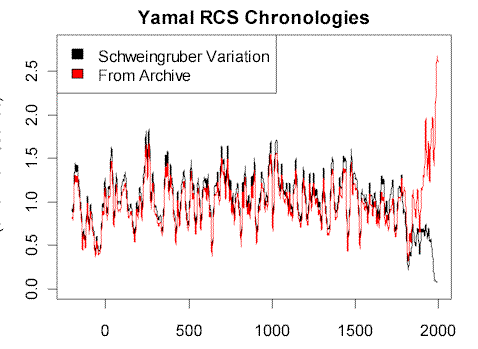
Figure 2. A comparison of Yamal RCS chronologies. red – as archived with 12 picked cores; black – including Schweingruber’s Khadyta River, Yamal (russ035w) archive and excluding 12 picked cores. Both smoothed with 21-year gaussian smooth. y-axis is in dimensionless chronology units centered on 1 (as are subsequent graphs (but represent age-adjusted ring width).
Finally, here is another graphic showing the same two RCS chronologies, but adding in an RCS chronology on the merged data set obtained by appending the Schweingruber population to the CRU archive – this time retaining the 12 cores. Unsurprisingly this is in between the other two versions, but most importantly it has no HS.

Figure 3. Also showing merged version up to 1990. (After 1990, there is only the few CRU cores and it tracks the CRU version.)
I hardly know where to begin in terms of commentary on this difference.
The Yamal chronology has always been an exception to the large-scale “Divergence Problem” that characterizes northern forests. However, using the Schweingruber population instead of the 12 picked cores, this chronology also has a “divergence problem” – not just between ring widths and temperature, but between the two versions.
Perhaps there’s some reason why Schweingruber’s Khadyta River, Yamal larch sample should not be included with the Yamal subfossil data. But given the use of a similar Schweingruber data set in combination with the Taymir data (in a case where it’s much further away), it’s very hard to think up a valid reason for excluding Khadyta River, while including the Taymir supplement.
Perhaps the difference between the two versions is related to different aging patterns in the Schweingruber population as compared to the CRU population. The CRU population consists, on average, of older trees than the Schweingruber population. It is highly possible and even probable that the CRU selection is derived from a prior selection of old trees described in Hantemirov and Shiyatov 2002 as follows:
In one approach to constructing a mean chronology, 224 individual series of subfossil larches were selected. These were the longest and most sensitive series, where sensitivity is measured by the magnitude of interannual variability. These data were supplemented by the addition of 17 ring-width series, from 200–400 year old living larches.
The subfossil collection does not have the same bias towards older trees. Perhaps the biased selection of older trees an unintentional bias, when combined with the RCS method. This bias would not have similarly affected the “corridor method” used by Hantemirov and Shiyatov themselves, since this method which did not preserve centennial-scale variability and Hantemirov and Shiyatov would not have been concerned about potential bias introduced by how their cores were selected on a RCS chronology method that they themselves were not using.
Briffa’s own caveats on RCS methodology warn against inhomogeneities, but, notwithstanding these warnings, his initial use of this subset in Briffa 2000 may well have been done without fully thinking through the very limited size and potential unrepresentativeness of the 12 cores. Briffa 2000 presented this chronology in passing and it was never properly published in any journal article. However, as CA readers know, the resulting Yamal chronology with its enormous HS blade was like crack cocaine for paleoclimatologists and got used in virtually every subsequent study, including, most recently, Kaufman et al 2009.
As CA readers also know, until recently, CRU staunchly refused to provide the measurement data used in Briffa’s Yamal reconstruction. Science(mag) acquiesced in this refusal in connection with Osborn and Briffa 2006. While the Yamal chronology was used in a Science article, it originated with Briffa 2000 and Science(mag) took the position that the previous journal (which had a different data policy) had jurisdiction. Briffa used the chronology Briffa et al (Phil Trans B, 2008) and the Phil Trans editors finally seized the nettle, requiring Briffa to archive the data. As noted before, Briffa asked for an extension and, when I checked earlier this year, the Yamal measurement data remained unarchived. A few days ago, I noticed that the Yamal data was finally placed online. With the information finally available, this analysis has only taken a few days.
If the non-robustness observed here prove out (and I’ve provided a generating script), this will have an important impact on many multiproxy studies that have relied on this study.
I tried posting another reponse on another one of the RC threads, to no avail. This time it went away right when I refreshed the page. If you’re interested in a screenshot, I have a couple.
REPLY: Try posting with a URL using http://www.tinyurl.com they may have anything with climateaudit.org in it auto flagged for spam. -A
Well, this torpedo is in the water, i will watch with much anticipation too see how she runs. Good work Steve, i take my hat off to you.
John A (17:29:49) :
@ur momisugly Philip_B (16:16:57)
The other possibility is that tree rings are not temperature proxies at all. The chimera is the belief that temperature rings capture mean temperatures.
Amen. I’ve always thought that tree rings were better suited as precipitation proxies rather than temperature proxies. I never understood how it could be otherwise. I guess I was right.
Science Fraud! If I were more astute in my knowledge of science, I would have a blog by this name to expose it all. Feel free to claim the URL, Watts or McIntyre, if it’s not already claimed.
I think some people and organizations need to be arrested and prosecuted for Science Fraud! Perpetrating such a horrific atrocity of this magnitude on mankind is disgraceful, especially since that fraud has such huge implications for all mankind.
MattN,
Do you believe my selection criteria that proxies should reflect instrumental temperatures for the last 150 years is biasing those proxies from indicating a warmer medieval period a thousand years ago?
If so, why?
Tom P. This might help.
In medicine, one of the main criteria to prove a treatment is effective, that the data in a study is meaningful, is to gauge the successful number of patients cured of their ailments or relieved of the symptoms as a ratio of those that failed to show improvements. If the ratio for cured patients is high, say 85 to 15, compared to those that didn’t respond to the treatment, then the treatment can be considered effective. If the ratio of positive responses is low, then the study of this treatment is determined to be a failure. When you have only five of forty responding positively, I hope you do not think that would be an acceptable amount for the FDA to approve the drug.
Why does this remind me of the “miracle” cancer treatment centers in Mexico. Yes four or five do come out of the “alternative” treatment centers and live normal lives (for a few years anyway, but, these same clinics don’t keep track of those whose treatment at the center was ineffective, and died a premature death because fell for the junk science. Yes, five tree ring proxies did follow the upward trend into this decade, but how many did not?
Exodus, the group that claims to cure homosexuals, say they have cured many homosexuals of their deviant behavior. They have testimonials of those who claim to be cured. But that group has seen its day, as even they now admit to a low conversion rate of 25 for every 100. That is a higher ratio of success than the 5 to 40 ratio of this Briffa study.
Totally off target. I read on the WSJ that the US government (DOE?) gave more than $500 million to a Gore company to build an electric car. No big deal except that the car would not be built in the US. What’s up with that???
On topic: I found Steve’s essay fascinating. If they wanted to cherry-pick data, they should have given reasons up-front why huge hunks of data were not used (assuming they had good reasons for excluding the data). I’m glad Steve and the others have the dedication to keep these idiots honest. I hope our biased press have the guts to print this story.
P Wilson (16:46:28) …No wonder the Kola peninsula treeline is not changed
much, Murmansk [source 1=”NASA-GISS” language=”:”][/source] was as warm or even warmer in the
1930’s…[“raw”]…”Homogenised” of course some 0,3C warmer than 1930’s…
I think science is like Groucho Marx said: “These are my principles, if you
don’t like them, I have others” We are after all, sentimental critters, aren’t we??
Let me see if I have this right:
“This tree right here is a ‘temperature tree’ because it says what I wish to hear. This other tree is not a ‘temperature tree’ because it screws up my entire story.”
Does the so-called “academic community” not appreciate how utterly loopy the entire concept of temperature from tree rings becomes when some Byzantine analysis is required to decide which tree is and is not “a temperature tree”? Regardless of what selection criteria is appointed, does the scientific community not appreciate the potential for, or more directly, the probability of “self-deception”?
“Do you believe my selection criteria that proxies should reflect instrumental temperatures for the last 150 years is biasing those proxies from indicating a warmer medieval period a thousand years ago?
If so, why?”
Yes.
Because the proxies that DO NOT reflect instrumental temperatures for the last 150 years are JUST AS VALID as the ones that do. What you describe wouldn’t pass 8th Grade Science Fair….
This book provides a fascinating insight into the Global Climate over the centuries….
http://books.google.co.uk/books?id=m5IOAAAAQAAJ&printsec=frontcover
(HInt: It was written in the late-70s….)
At Climate Audit, Geoff Sherrington says he’d be trying to crack the CRU temperature problem as well as the dendro problem, because in combination they might tell a stronger story than each alone. The Team can still try to refer to the (unavailable) CRU Arctic thermometer records as being compatible with Briffa etc.
I hope my post at the Air Vent can help crack open the CRU records issue too – the thermometer records. For all my evidence there shows that Daly’s trustworthy Arctic thermometer records near to Yamal (and other records like Irkutsk) simply do not bear out the Yamal treering measurements of temperature, whereas they all show kinships to each other.
“REPLY: Try posting with a URL using http://www.tinyurl.com they may have anything with climateaudit.org in it auto flagged for spam. -A”
I just tried it with your suggestion, also denied. Unbelievable! This was my second time commenting at RC, aside from the first one with the climateaudit.com link. Here is my second comment:
Corey says:
Your comment is awaiting moderation.
28 September 2009 at 8:16 PM
Speaking of ‘communicating science’, it seems that that Steve McIntyre has found a problem with some tree ring data. What do you make of this? Any comments?
Yamal: A “Divergence” Problem
http://tinyurl.com/ya856cm
Also, Jeff Id has some words of his own about the whole thing:
http://tinyurl.com/yemnfmv
It seems like Yamal isn’t the only thing with a “divergence” problem. Any links to criticism is diverged to the trash.
“Jeff Id” is almost certainly flagged at RC. 🙂
Corey (18:38:17) :
Ive had a comment there that has literally taken over a full day to appear(nothing controversial, just a Q on resolution o models on oceans, and regards apparent stability o hot house periods vrs tipping points)… thus the reason i dont post there, its really really slow. And i dont really do confrontational:-)
[REPLY – If it is not yet posted, it may have been inadvertently deleted. There’s nothing in the queue or spam filter at this time. If not, please repost and we’re sorry. ~ Evan]
[REPLY – If it is not yet posted, it may have been inadvertently deleted. There’s nothing in the queue or spam filter at this time. If not, please repost and we’re sorry. ~ Evan]
Sorry i should have been clearer, this was in regards to coreys post about RC, and i was just pointing out they can just be slow to moderate. (although i am well aware stuff does disapear or get edited)
I have no complaints in regards too WUWT;-)
Mike Ewing (18:52:31) :
“Ive had a comment there that has literally taken over a full day to appear”
I will check back tomorrow and see if they are there. I will not hold my breath, though. If that is the case, I do not know how they could have a free flow of ideas, and any semblance of a conversation, if that is the status quo.
I do not think it is typical of their site, since there have been numerous posts since I tried to post my initial one. I could be wrong, so we will see.
Molon Labe (18:44:31) :
That may be, but anyone posting a link to his site should not be as well. If they choose to “ban” him for whatever reason, fine. But doing that to a person for just citing his webpage, while they allow links to Tamino, just shows they are afraid of any kind of scrutiny, while they say they do not censor posts.
Just checked GoDaddy, climatesciencefraud.com is still available.
MattN (18:21:45) :
“Because the proxies that DO NOT reflect instrumental temperatures for the last 150 years are JUST AS VALID as the ones that do. What you describe wouldn’t pass 8th Grade Science Fair….”
You have a very short memory. McIntyres’ original reconstruction contradicted the temperature record and I said therefore that it should rejected. In fact this reconstruction had indeed been miscalculated.
The correctly calculated reconstruction is in much better agreement with the temperature record and in fact has excellent correlation with Briffa’s results throughout the entire pre-instrument period.
Briffa’s results are confirmed, not contradicted, by McIntyre’s corrected analysis.
Quote of the year: “AGW is a tree ring circus.” Robert Wood
“AGW is a tree ring circus.”
Timber!
We can just look at the actual temperature measurements in the Yamal Pennisula to see what the actual temperatures have done recently – hint there is no substantive change in thermometre-based measurements in the Yamal Pennisula.
The tree rings are useful for one purpose. The northern half of Yamal is currently tundra – it is too cold for trees to grow there now.
But the sub-fossil buried trees tell us it was at least warmer in the Holocene Optimum period (6000 years ago) so that healthy forests grew there. It is has been generally cooling off since then, more-or-less on schedule with the changing Earth axis tilt of the Milankovitch cycles.
If you go back about 11,000 years ago, Yamal was under a mile of Glacier.
Very little CO2 changes are required to explain the changing temperature history of Yamal.
Tom P (19:16:05) :
You have a very short memory. McIntyres’ original reconstruction contradicted the temperature record and I said therefore that it should rejected. In fact this reconstruction had indeed been miscalculated.
Youre missing the point…. by youre reasoning, thus the past reconstruction cannot be considered accurate when its been shown that that there is such a divergence in the data with temp correlated tree’s, so how do you know which trees from the past are accurate? how do you decide which tree’s are accurately showing the historic temperature when you have no way to verify with thermometers from 1000ybp?
>>> I stayed up to Midnight reading the comments at both
>>>WUWT and CA – good comments both places.
You should see the comments on New Scientist – hilarious ranting and raving. The Greens don’t like it up ’em, Mr Mannering (with apologies to Dad’s Army).
http://www.newscientist.com/commenting/browse?id=dn11646&page=1
.
John A (17:29:49
tree rings do not accurately captyure temperature proxies. During a very warm period they do the opposite. During hot eras if there is little precipitaion. ie hot and dry, then tree rings will be narrow in most trees, apart from Larix which “is a species which is not affected by rainfall” and demands high intensity light. Yet its inferred that smaller tree rings mean lower temperatures. and so an inaccurate proxy occurs.
tree ring data from the last several decades do not at all concur with tree ring data of the last 30 years at all, which is why other more valuable proxies into past climate count, such as sediments which give a better record. It is more impoertant to study the chemistry of tree rings as that could give vital indications of ecologicla conditions in any particular place.