Count the number of ifs, mays, and coulds in this story, then look the rebuttal and other supporting information. The Telegraph is repeating alarmism.
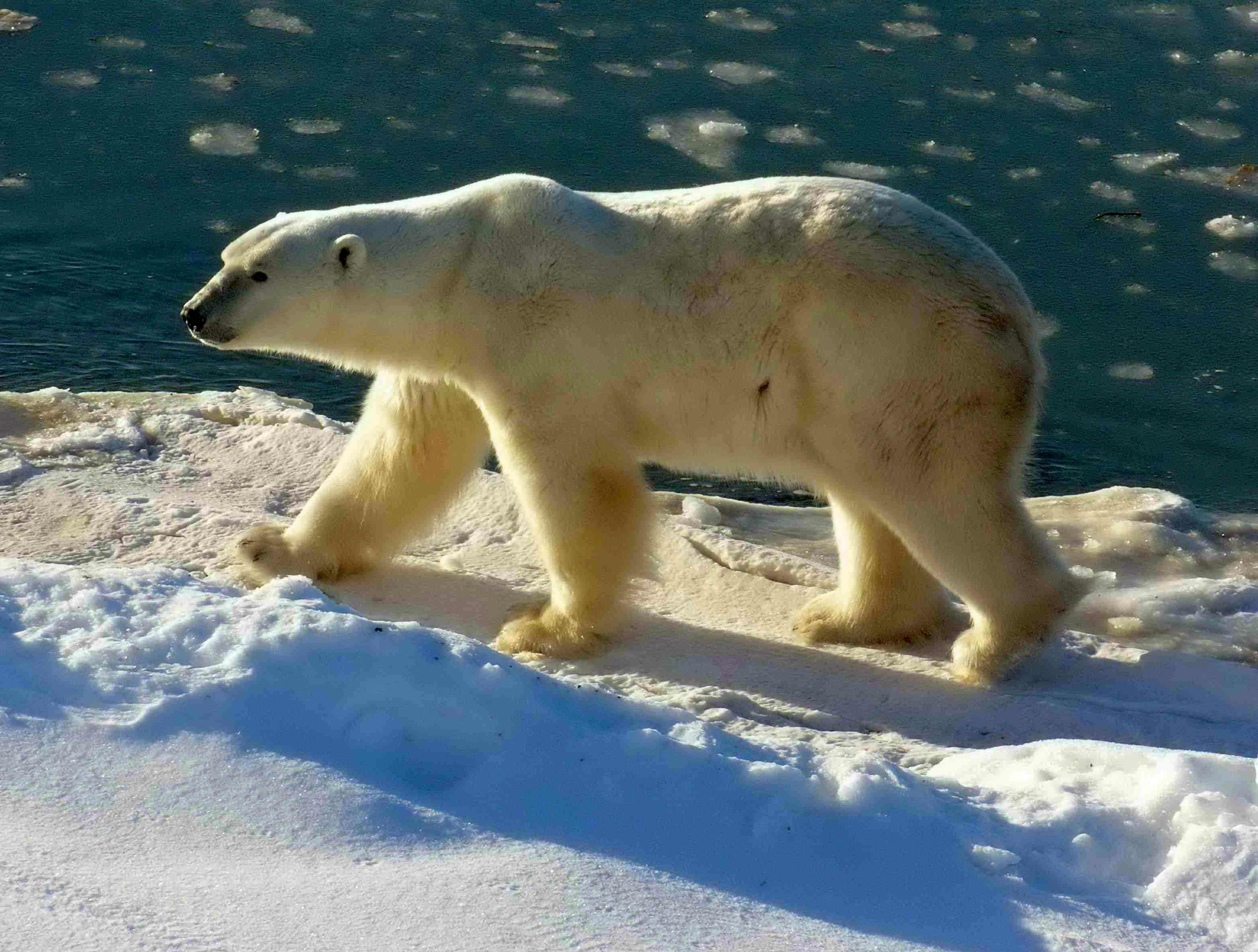
From the Telegraph By Kate Devlin, Medical Correspondent
Polar bears face extinction in less than 70 years because of global warming, scientists have warned.
Melting ice is causing their numbers to drop dramatically, they warn. Others also at risk include ivory gulls, Pacific walruses, ringed and hooded seals and narwhals, small whales with long, spiral tusks.
One of the problems is that other animals are moving north, encroaching on their territory, spurred by increasing temperatures, pushing out native species.
The animals are also struggling with the loss of sea ice.
“The Arctic as we know it may soon be a thing of the past,” said Eric Post, associate professor of biology at Penn State University, who led the latest study, published in the journal Science.
“Recent projections suggest polar bears could be extinct within 70 years.
“But we think this could be a very conservative estimate. The outlook is very bleak for them and other creatures such as ringed seals.”
He added: “The rate at which sea ice is disappearing is accelerating and these creatures rely on it for shelter, hunting and breeding. If this goes, so do they.”
Read the complete story in the Telegraph here
OK now for the other side of the story:
A few countering reports:
Christian Science Monitor, May 3rd, 2007 – Despite global warming, an ongoing study says polar bear populations are rising in the country’s eastern Arctic region.
Science Daily May 10th, 2008 – Federal Polar Bear Research Critically Flawed, Forecasting Expert Asserts
National Post March 6th, 2007 – Polar bear numbers up, but rescue continues
WUWT May 9th 2009 – The “precarious state of the U.S. polar bear population”
Dr. Mitchell Taylor, a biologist with Nunavut Territorial government in Canada wrote this letter (PDF) on April 6th, 2006 to the U.S. Fish and Wildlife Service:
Some excerpts:
At present, the polar bear is one of the best managed of the large arctic mammals. If all the arctic nations continue to abide by the terms and intent of the Polar Bear Agreement, the future of polar bears is secure.
…
Polar bears are believed to have evolved from grizzly bears during the Pleistocene era some 200-250,000 years ago (Amstrup 2003). Polar bears were well developed as a separate species by the Eemian interglacial approximately 125,000 years ago. This period was characterized by temperature fluctuations caused by entirely natural events on the same order as those predicted by contemporary climate change models. Polar bears obviously adapted to the changing environment, as evidenced by their presence today. That simple fact is well known and part of the information contained in the reference material cited throughout the petition, yet it is never mentioned. This fact alone is sufficient grounds to reject the petition. Clearly polar bears can adapt to climate change. They have evolved and persisted for thousands of years in a period characterized by fluctuating climate. No rational person could review this information and conclude that climate change pre-destined polar bears to extinction.
…
The petition admits that there is only evidence for deleterious effects from climate change for one polar bear population (Western Hudson Bay [WH]) at the southernmost extreme of polar bear range (Fig. 1). The petition argues that the likelihood of change in other areas is reason enough to find that polar bears should be regarded as a species at risk of imminent extinction. I hope the review considers the precedent set by accepting this argument. Climate change will affect all species to some extent, including humans. If the likelihood of change is regarded as sufficient cause to designate a species or population as “threatened,” then all species around the world are “threatened.”
Some data. With hunting no longer allowed, bear populations have increased 4-5 times:


I made this in response to anthropogenic polar bear catastrophe
http://img2.imageshack.us/img2/7421/wired500px.jpg
Not only that, jorgekafkazar (14:31:27), but with those polar bears reproducing all over the place their combined albedo indexes could cause a complete white out. I’m of course assuming that polar bears have an albedo index of 1 or close to it (they do have black noses after all). Maybe that is why scientists, a tasty polar bear treat although not as tasty as kittens but still ok, are so easy to sneak up on – they (the bears) have a natural invisibility cloak.
“The albedo of an object is the extent to which it diffusely reflects light from light sources such as the Sun. It is therefore a more specific form of the term reflectivity. Albedo is defined as the ratio of diffusely reflected to incident electromagnetic radiation. It is a unitless measure indicative of a surface’s or body’s diffuse reflectivity. The word is derived from Latin albedo “whiteness”, in turn from albus “white”, and was introduced into optics in by Johann Heinrich Lambert in his 1760 work Photometria. The range of possible values is from 0 (dark) to 1 (bright).”
http://en.wikipedia.org/wiki/Albedo
[:)]
And who needs Polar Bears anyway…if the Author of this paper happend to be around polar bears, he’d get eaten alive.
The paper by Post’s research team shows that the effects of Arctic warming have been dramatic so far, especially since the warming amounts to only about 1-degree Celsius over the last 150 years. Post said it is difficult to predict what will happen with the anticipated 6-degree warming over the next century.
it’s the “the anticipated 6-degree warming ” that gets my attention – utter BS. How can you include statements like that in a reputable science paper?
“Denis Hopkins (13:41:25) :
I take the DT every day as well and it has become much more in line twith the “science is decided” type of reporting.”
I cancelled my DT subscription in July for that very reason. The “dead tree press” is going the way of the dodo and it only has itself to blame.
Do yourself a favour and quit spending money on propaganda. Get the real news from blogs (like WUWT).
Simples!
I fear commas may be extinct in 20 years.
GK (07:21:22) : ‘You can fool most of the people some of the time. And you can fool some of the people most of the time. But you cannot fool all of the people all of the time. ~Abraham Lincoln”
Right, not if 2 million people who haven’t been fooled will show up at a rally in DC.
Pardon me if someone else in the 100+ comments noticed the same thing, but I thought the “rubbish” was left behind by the Caitlin expedition.
L (12:46:44) : Armadillos , perhaps .
Is there any data from the Arctic on how much ice loss is actual melting of the top snow/ice surface, ie thawing (above zero air temp), compared to sublimation (ablation) by summer solar radiation in dry subzero air, particularly during strong prevailing winds? I understand sublimation can account for 40, even up to 80-90% in some terrains studied elsewhere, but am no expert.
try this Britannic
http://users.tpg.com.au/johnsay1/Stuff/Arctic_warming.pdf
Heck with polat bears… Considering things like birth rates this article should have been written about Europeans.
tokyoboy
a, b, c, and d
is grammatically correct.
Commas separate items in a list. The ‘and’ merely indicates that is the last item in the list. The ‘and’ without the comma indicates that ‘c’ and ‘d’ are somehow related in some other way.
As an example of what I mean –
Some gun makers are Remington, Ruger, Smith and Wesson, and Winchester.
‘Smith and Wesson’ is the name of one company. Leaving out the comma before the ‘and’ would make ‘. . .Ruger, Smith and Wesson and Winchester.’ which is obviously incorrect.
You cannot rely on the mainstream media to use correct grammar, any more than you can rely on their ‘facts’ about global warming.
(I had to learn English myself when my parents moved from Tokyo to the U.S.) 🙂
“Melting ice is causing their (polar bear) numbers to drop dramatically, they warn.”
It is a large study, “At the close of the Fourth International Polar Year….” It covers a wide area, judging by the affiliations of the 25 authors. However, nobody is from Russia.
;So this study presumably includes new information, since the previous studies,, from previous years. When increasing populations were in post-hunting regions. And, many of the remote populations had not been studied.
It takes great skeptical confidence and bravery to be trashing the most recent paper before anyone has read it.
“The researchers found Polar bears and ringed seals, both of which give birth in lairs or caves under the snow, lose many newborn pups when the lairs collapse in unusually early spring rains. These species may be headed for extinction.” Science Daily Notice how this short newspaper article has widened the plight-of-the-polar-bear issue, beyond the obvious no-ice-to-hunt-from issue.
This is one more adaptation hurdle. How many generations would it take before they learn to look for a den in the forest?
“The rate at which sea ice is disappearing is accelerating and those creatures (seals, bears) rely on it for shelter, hunting, and breeding. If this goes, so do they.”
2007 was the summer of the least sea ice extent.
But 2008 was the summer of the least sea ice volume. The thick stuff was disappearing around Greenland.
2009 has shown an increase in extent. But what about the volume?
This is my question: Are there any lifestyle consequences resulting from the increasing areas of first year ice? (Photographs usually show polar bears on thick ice floes.)
ADAPTATION TO LIFE ON LAND
This is a story that has already been televised. Public television cameras followed a mother polar bear and her cub when a lack of sea ice forced them inland. They found the berries, but missed the salmon run. She was gaunt and dirty when she curled up for the winter. I don’t remember how it ended.
“No rational person could review this information and conclude that climate change pre-destined polar bears to extinction.” Mitchell Taylor
Extinction is a high bar…although the word does appear in reference to pups dying in early spring rains. I think the public sentiment (and mine) would be sufficiently aroused by the possibility of the dying off of all of the polar bears in most of the regions.
Remember the non-Mann hockey stick graphs. And the recent Arctic temperature hockey stick graph. The most significant aspect is the steepness of the blade. The current warming is happening quicker than past warmings. So there’s less time for adaptation.
So, it seems inappropriate to bring up “evolution” when the time span will be measured in decades.
“Adaptation” ignores the presence of the brown bears on land in some regions. There’ll be competition, and interbreeeding. Whatever the genetic outcome, the polar bear as a sub-species will be lost.
Crossbreed polar/brown bears wouldn’t be new. But I don’t think they’ve been named yet. ‘Prizzly” and “Grolar” have been suggested.
Male polar/male brown encounters would be more interesting. I think the plight of the polar bear sentiment might have to compete with the plight of the brown bear stories. Besides size, the polar bears could have an (easy to learn) head-butt knockout blow.
AGW believers decry the global CO2 experiment that is continuing. Personally I think that we should not permit this resulting biological experiment to also take place. Presumably the brown bears have already expanded to the maximum carrying capacity of their region. So interloping polar bears will ultimately just displace an equal number of brown bears. Resumed hunting may be the sad, ugly, selfish, ruthless… …solution, that is still preferable to all the others.
P.S. Eric Post’s research interests seem to be herbivores (musk ox, caribou) in Greenland. More research is needed to find who to blame for the polar bear conclusions.
I worry more that a lot of people will become extinct within 70 years if the AGW crowd has its’ way. From famine (or poverty, about the same). The warmers seem to want to dig our graves.
The PB population is limited by food supply. They will increase until there isn’t enough to eat (and I doubt if enough researchers will venture north to compensate). Their numbers may well decline if their primary food supplies (anything that walks or swims) do not get busy and reproduce. (also limited by food supply)
Supply and demand applies at all levels.
Meanwhile in sunny Northern Australia, July was quite a warm month and the drop bears retreated further into the bush. This caused relief to local people, who live in never-ending fear of that thump on the back followed by those razor sharp teeth lacerating critical veins and arteries of the neck.
Drop Bears have adapted well to the presence of man. Telegraph and power poles have become particularly useful as drop points. On the other hand, the more modern indoor toilet has largely replaced the outhouse, where the long drop was but a short drop for the drop bear, unless the target stood up at the precise time of the strike. This was a significant mechanism (locally called ‘being in the poo’) for the moderation of Drop Bear numbers, though Climate change effects need much more research by large dedicated regional teams.
Australia hosts many of the world’s most dangerous creatures, from the Tiapan Snake Oxyuranus scutellatus to the Blue-ringed Octopus Hapalochlaena fasciata to the nocturnal Drop Bear Bruno mercilus. All 3 are on the protected species list and harming them is illegal. Current population estimates are in excess of 100,000 in Queensland alone, this number being derived from the number of volunteers lost as a % of the combined size of the research groups counting them each night.
It is not yet established if the Drop Bear is completely vegetarian, for the victim is never eaten in hot weather. Funded research into this vital question could answer the question of whether the Drop Bear is allergic to human perspiration, giving future hope that a remedy can be found. With the inexorable advance of Global warming, can we expect attacks to diminish? We locals certainly wish for Global Warming.
Drop Bears?? Seems to me that they need to chill out like the Bundy Rum Bear.
I guess I get to do this again with a few embellishments. If the ice were to disappear in the arctic, the seals would have to come ashore and the polar bear would then have only two dimensional hunting ground. This may have happened in the past, driving seals down to southern waters (eg. California). Also the polar bear range from Moosonee in Northern Ontario (and Newfoundland on the east coast) to the top of the arctic Islands. Mean weather in Moosonee is 20C warmer in winter and 12-14C warmer in the summer. This means that arctic bears could certainly survive many more than a few degrees warming. Also to get an idea of the southern reach of the range, from, say, Portland Maine to Gander, Newfoundland is closer than from New York to Chicago, an hour’s flight or so.
http://www.polarbearsinternational.org/arctic-map/
Paul Maynard (04:15:43) :
There are two things going on here, one local to the Telegraph the other to do with Copenhagen.
…
In my business – the London Insurance Market – the AGW religion is ever more pernicious and intolerant of rationalist views. Still, the refusal of global temps to cooperate and the deluge of real science contradicting AGW hysteria give one hope.
Regards
Paul
Hi Paul, agree with your post.
I suspect that the insurance industry would thrive on AGW and any scare story without foundation as the most profitiable insurance surely lives in the gap between “perceived” risk and “real” risk.
Insurance companies could sell more “storm” insurance predicated on the perceived risk of AGW Alarmist scaremongering, while raking in the profits as actual real risk of destructive storms via storm energy has decreased.
REF: http://www.coaps.fsu.edu/~maue/tropical/
Geoff Sherington (18:58:06) :
Meanwhile in sunny Northern Australia, July was quite a warm month and the drop bears retreated further into the bush. This caused relief to local people, who live in never-ending fear of that thump on the back followed by those razor sharp teeth lacerating critical veins and arteries of the neck.
Drop Bears have adapted well to the presence of man. Telegraph and power poles have become particularly useful as drop points. On the other hand, the more modern indoor toilet has largely replaced the outhouse, where the long drop was but a short drop for the drop bear, unless the target stood up at the precise time of the strike. This was a significant mechanism (locally called ‘being in the poo’) for the moderation of Drop Bear numbers, though Climate change effects need much more research by large dedicated regional teams.
Australia hosts many of the world’s most dangerous creatures, from the Tiapan Snake Oxyuranus scutellatus to the Blue-ringed Octopus Hapalochlaena fasciata to the nocturnal Drop Bear Bruno mercilus. All 3 are on the protected species list and harming them is illegal. Current population estimates are in excess of 100,000 in Queensland alone, this number being derived from the number of volunteers lost as a % of the combined size of the research groups counting them each night.
It is not yet established if the Drop Bear is completely vegetarian, for the victim is never eaten in hot weather. Funded research into this vital question could answer the question of whether the Drop Bear is allergic to human perspiration, giving future hope that a remedy can be found. With the inexorable advance of Global warming, can we expect attacks to diminish? We locals certainly wish for Global Warming.
Geoff – are you insane??? Any increase in warming will only increase the range and duration of the deadly “Hoop Snake” Oxyuranus Hulaii; that vicious and ferocious outback predator that lurks on high ground, only to grasp it’s tail in its mouth and roll down hill – hoop like – before launching itself onto the throats of unwary and unsuspecting humans.
We had the NZ Actor Lucy Lawless going on about she didn’t want to see Polar Bears drowning. That was one of the main reasons she was one of the NZ actors along with Keisha Castle-Hughes fronting the Greenpeace NZ Sign on for 40% emission reductions by 2020 Propaganda Crap campaign.
Yep she could adopt a drowning Polar Bear. If she can find one. She’ll become extinct before the bear does though!
Jack Simmons (08:56:21) :
tallbloke (04:58:37) :
Aron (23:40:17) :
us who are always credited with destroying life but because of us many species have a chance of survival that they never had before.
Could you expand on this a little please.
Here’s at least three species doing much better with mankind:
Blattella germanica
Canis latrans
Rattus rattus…… and some more species doing well because of humans.
Equus ferus caballus
Felis catus
Ovis aries
Bos primigenius
Columba livia……
The DMI keeps dropping like a rock, hugging the norm line.
The sun goes down up there in 1 week.
Last year, it stayed well above the current temps, so it’s at least 2 degees colder this year.
This keeps up and the AMSR-E is going to take off like a Saturn V.
My Polar Cap runneth over.
Francis,
“The current warming is happening quicker than past warmings. So there’s less time for adaptation.
So, it seems inappropriate to bring up “evolution” when the time span will be measured in decades.”
Utter nonsense! Why do alarmists only think of adaptation in evolutionary terms? Any zoologist knows that adaptation has a behavioural dimension, especially when you are talking about higher organisms, viz birds and mammals. This simple fact constantly confounds the doomsayers as they wave their arms despariingly at the millions of years needed for evolutionary change. Yet all the while, behind their backs, these cunning critters are proving more than a match, amazing us all with their abilities to adapt their behaviour.
And this is just common sense really, because for your information, prehistoric climate shifts have occured with lightning speeds, with temperature shifts of a few degrees occuring in less than a century.
The ignorance of so-called learned people never ceases to amaze me.
In the photo in the opening thread header, it looks like someone has photoshopped some rough floating ice in the background. If this was the real article, then it was created for effect, obviously.