California’s Fires Result of a Cooling Pacific, Two Years of La Niña and Environmental Mismanagement
Guest Post By Joseph D’Aleo, CCM, ICECAP
While environmentalists and clueless politicans like CA Representative Linda Sanchez and not surprisingly Climate Progress’ Joe Romm sought to place the blame for the California wildfires on ‘global warming’. the massive California wildfires can be attributed to a cooling Pacific, two years of La Nina and environmental mismanagement.

La Ninas and/or a cold PDO Usually Means Drier California
You can see clearly from the following correlation chart of La Ninas (using the Southern Oscillation Index) with precipitation from CDC, that La Ninas favor dryness in the southwest.

The basin wide Pacific multidecadal warming and cooling affects the frequency and strength of La Ninas and El Ninos. The cold PDO favoring more, stronger and longer lasting La Ninas and the warm PDO more, stronger and longer lasting El Ninos and fewer briefer, mostly weak La Ninas. The PDO turned cold in 1998 bounced some until 2006 when it began a significant decline. See the blue La Nina frequency increasing like it did when the PDO was last cold from 1947 to 1977.
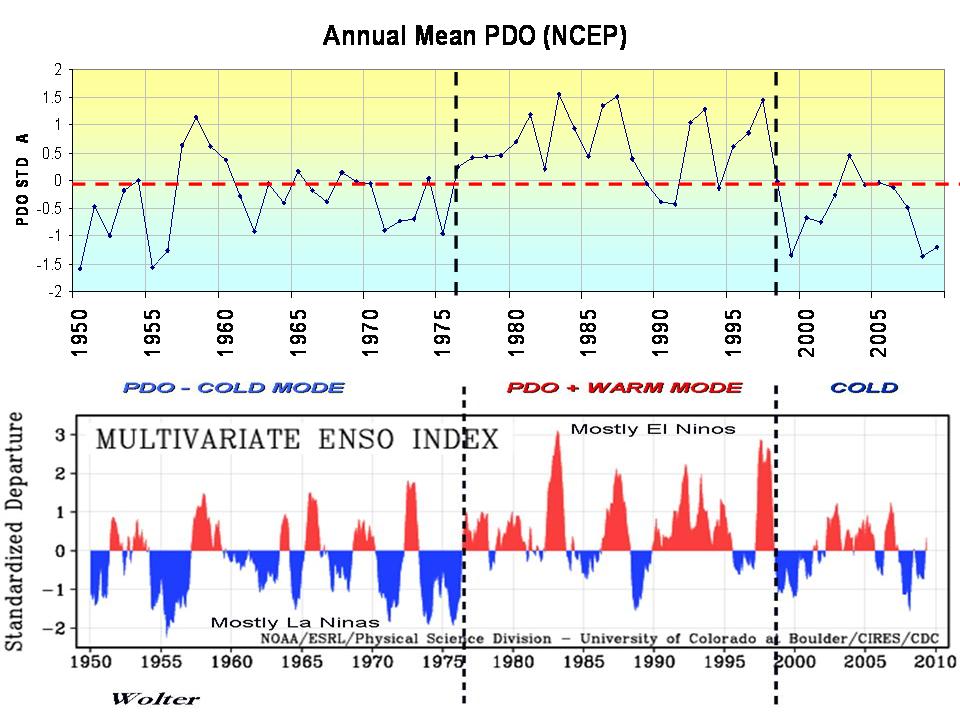

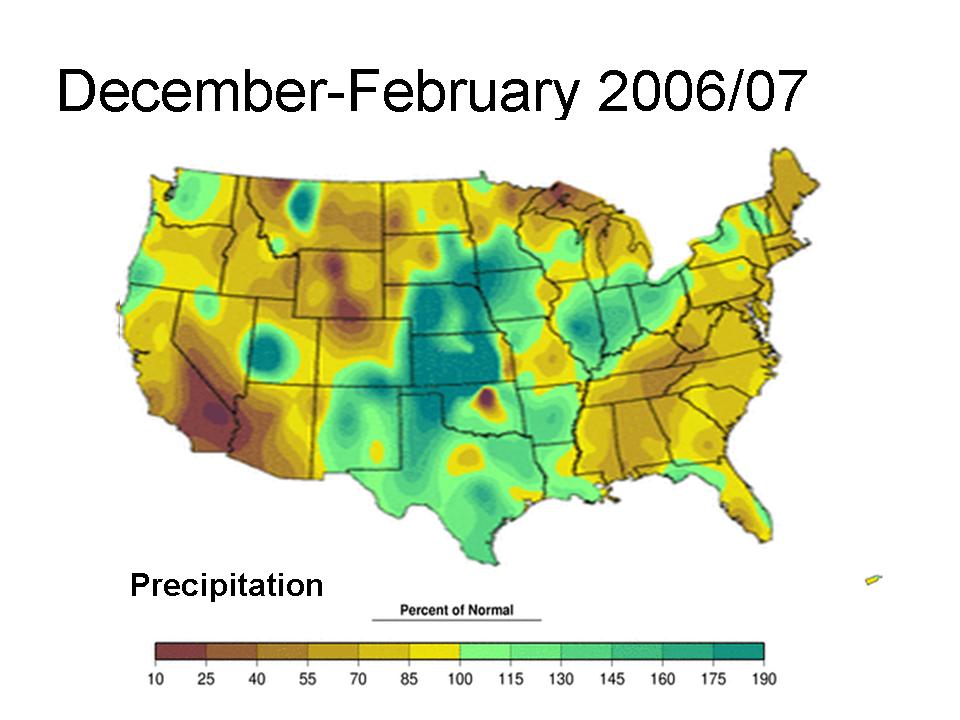
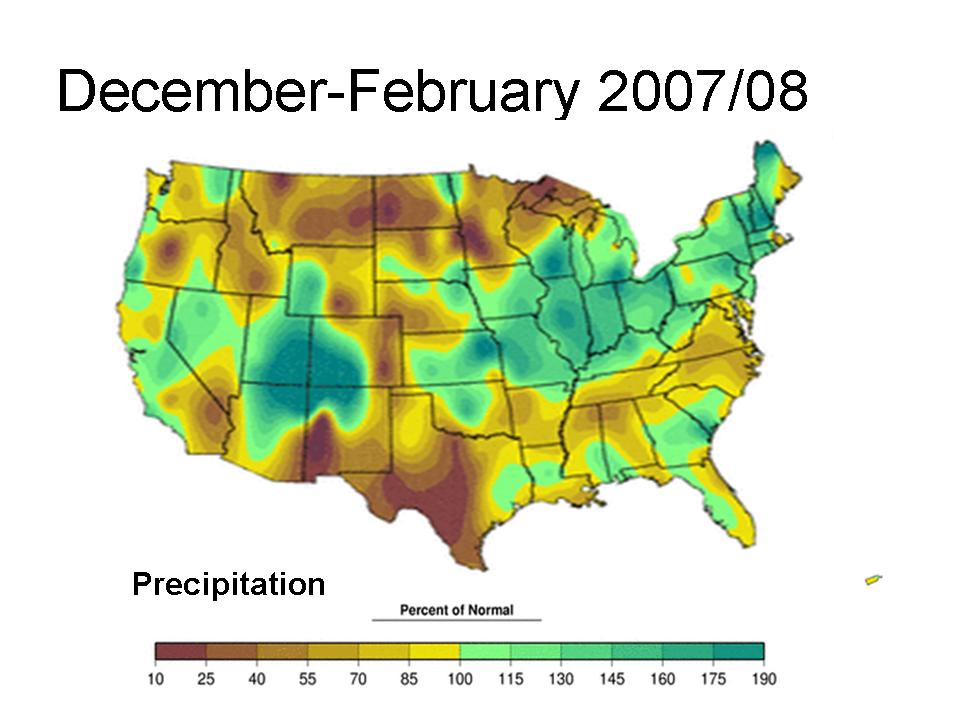
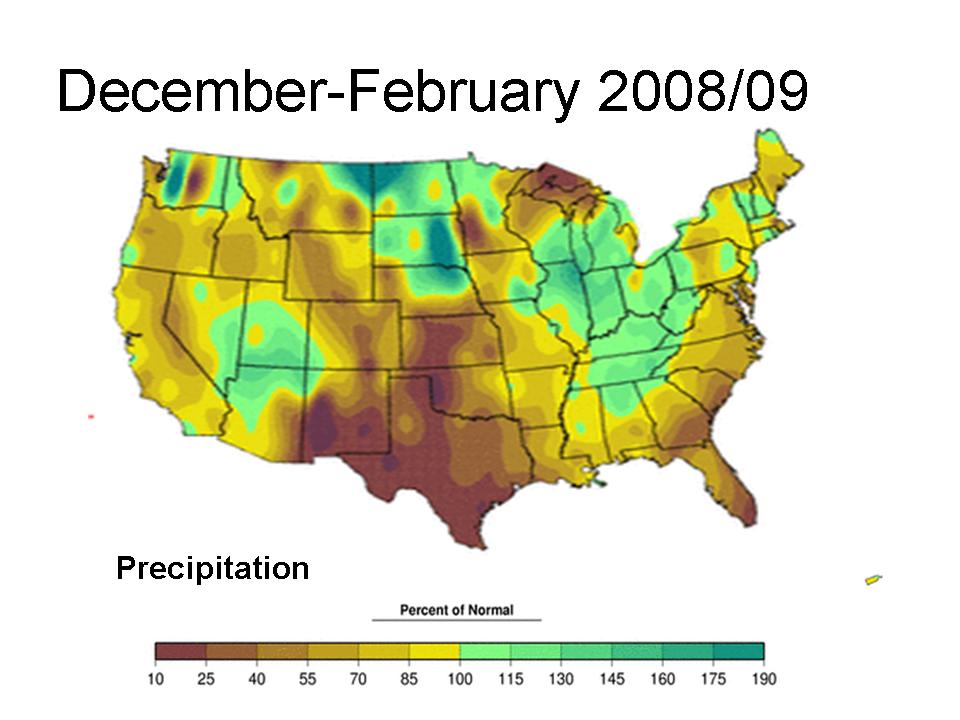
The rapid cooling in the Pacific in 2006 caused the El Nino winter of 2006/07 rains to fail in California. The La Nina that ensued became strong in the late winter and early spring of 2007/08 and came back again for a reprise in 2008/09 winter continued to produce sub normal rainfall.


A few years back McCabe, Palecki and Betancourt published a paper that looked at drought frequency across the United States related to both the Pacific Decadal Oscillation and the Atlantic Mulitdecadal Oscillation. Droughts in the United States were more frequent when the Atlantic was in its warm mode. When the Atlantic was warm, and the Pacific was also in its warm mode, the dryness was more across the northwest and southeast and when the Pacific was cold more across the southwest. Red areas have enhanced drought probabilities.


We are currently still have a warm Atlantic mode and cold Pacific mode (D) and thus should expect the increased risk of dryness in the southwest. See these maps and read more here.
Environmental Mismanagement
This natural cyclical lack of rainfall combined with unwise policy that Dr. Scott Campbell reported concerning the prohibition against clearing up accumulated brush from the areas surrounding housing developments that were instituted at the insistence of the Sierra Club and other environmental groups has left more fuel for the fires fanned by the Santa Ana winds. The JPL’s Dr Patzert indicated, in a release, were also more common in La Ninas. The risk is also greater because more people built homes in the cooler hills among the trees, putting more than trees at risk.
In addition, environmentalists have reduced the amount of water that can be used for agriculture. Farmers in the Central Valley are asking for a new canal to get water from the Sacramento River, as well as a relaxation of environmental restrictions resulting from a 2007 court ruling limiting the amount of water pumped south from the delta – a giant sponge that absorbs runoff from the wetter north. The ruling was in response to a suit by environmental groups that held that the water pumping through the delta endangered several species of fish, including smelt, green sturgeon, and winter and spring salmon. More here.
What Lies Ahead
Given the current El Nino is in the cold PDO mode, it should be weak and tend to be brief. It may peak this fall and weaken this winter. The increased tropical activity in the eastern Pacific is favored in El Nino years (in some El Ninos they reach California in the early fall in a weakened state – e.g. Kathleen in 1976). The similar El Ninos in the cold PDO tended to produce normal to below normal wet season precipitation and another active fire season next year.
It is likely a La Nina will return next year. Expect another fire season. See more here.
janama (14:17:34) :
unfortuntely the introduction of the aussie Eucalyptus gum tree to California in the 1850s as left you with the fire relationship that goes with gum trees.
This story is just deja vu of last february in Australia
Re; the Oakland fire-an old CDF S-2 driver who had gotten in on that little clambake,
-I was off my fed contract by one week so I missed it,-calls Eucalyptus:”Australian
Gasoline Weeds.”-though Chaparral isn’t very far off that remark either…
Let’s see, who filed the suit and won a restraining order for the 4.6 million bf salvage sale in the Shasta-Trinity National Forest, Trough Fire south of Ruth, Ca.?
Here it is: Klamath-Siskyou Wildlands Center, Environmental Protection Information Center, Klamath Forest Alliance and John Muir Project.
John Muir, isn’t he the naturalist who warned that California is HOT way back in the 1880’s, and if you took off the forest cover the place would overheat? Rather odd name for anti-forest recovery agenda.
The Judge was U.S. District Court John Mendez.
A further hearing scheduled for Sept. 16.
Just about right to destroy the value of the standing dead trees in this burned hulk, assuming the USFS wants to go down the tortuos appeals road.
I have seen plenty of places where USFS restoration was and was not done.
Where it was done, there’s now a forest 30 years later.
Where it was not done, a rabbit is the only creature able to penetrate the tangled growth.
We’re going Green, right?
Philip Mulholland (15:46:25) :
So, how many fires is enough fires? Until there isn’t twig #1 left standing in a sea of ashes and rock?
You see, Phil, when the fires get that HOT, the seeds do not survive. Everything is consumed.
The trick is, after a fire in these conditions, you need restoration, remove the fuel in the half-burned areas, because next time around, there won’t be anything left of the half-burned area you just condemned to total destruction. No seeds.
DaveE (15:31:58) :
“What’s so damned wonderful about natural typhoid, malaria, tuberculosis, (insert disease), or natural cyanide, arsenic, (insert poison)?”
Answer: Prevents over-population of the planet, if it weren’t for the introduction of unnatural medication.
Janama:
> This story is just deja vu of last february in Australia.
I’m in northern Australia and hard up against a state forest (not a national park). It is early Spring and for the past week or so there has been nothing but smoke as the local fire authorities have been burning off the undergrowth to prevent the possibility of wildfires during the coming Summer. They do this every 2 or 3 years and while it is a annoyance now, it is the only way to prevent a wildfire.
Now if this was national park, or land controlled by a local authority where the city eco-concerned were in control this would never have happened and the recipe for another disaster like last February would be in the making. It would also be different in different states as some have not learned this basic lesson. I’m just glad for common sense where I live, because in the height of summer when temperatures are in the 40C+ range a fire can get out of control very quickly if there is fuel to burn.
Chris Schoneveld (16:41:19) :
Except that development does the job so much better by reduced birthrates!
The developed world has barely managed to maintain replacement.
DaveE.
Goats. We need more goats. The Europeans replaced the native browsers and grazers with cattle, sheep and goats. Now, most of the cattle, sheep and goats are heavily restricted and the native browsers and grazers will never recover to their pre-colonial populations (except, perhaps, rodents).
Another fire freindly invasive species is Cheat Grass (Downy Brome). It crowds out the native perennials by quickly robbing soil moisture in late Spring, then it dies and turns to tinder. The flame front of a fire in dry Cheat Grass can move as fast as the wind.
I agree with the comment about shake roofs. It never ceases to amaze me that anyone would spend hundreds of thousands or millions of dollars on a beautiful house in the hills and have it built out of flammable material (I understand it from an aesthetic standpoint, but there are flame resistant/proof materials that do a good job of mimicking the look of real wood. Someone here in Utah even found a flame resistant substitute for a thatched roof.). If the only way to preserve your home is to clear all vegetation for 50 or 100 or 200 yards, what is the point of moving to the hills? And how do they get insurance? Its like giving flood insurance to someone building on the wrong side of a levee, or on the beach. If zoning and CC&Rs can’t be changed, maybe the insurance industry can get things moving?
Same thing is happening around me in Northern NSW Greg. The local fire chief lives opposite me and he says he’s been told to burn whatever he deems necessary. A complete turn around from previous instruction where forms in triplicate were needed to get permission to control burn.
For the record, here is what Sierra Club’s Executive Director Carl Pope had said in regards to prescribed burns and other thinning projects:
(More here: http://www.sierraclub.org/sierra/200211/ways.asp )
“”” DaveE (15:31:58) :
George E. Smith (14:34:34) :
natural and therefore good.
That’s one I’ve never understood.
What’s so damned wonderful about natural typhoid, malaria, tuberculosis, (insert disease), or natural cyanide, arsenic, (insert poison)?
Too illogical for me!
DaveE. “””
Well Dave, we could probably eliminate some of those wonders of nature (smallpox too) if it wasn’t for the endangered species act; we need those pestilences for bio-diversity; simply wunnerful !
George
“”” Joel Shore (18:17:15) :
For the record, here is what Sierra Club’s Executive Director Carl Pope had said in regards to prescribed burns and other thinning projects:
Let’s set the record straight: The Sierra Club and other environmental groups have for years advocated protecting old growth and other large, fire-resistant trees while allowing low-intensity fires to burn, “””
Well yes we’ve all heard that; so this was a low intensity fire right, with no old growth forests; how can they be old growth when they burn every year ?
Joel, I wish this were the case in the Wallowas. But it ain’t so. There has been no management worth a tinker’s damn. South Fork and the general Eagle Cap Wilderness is so overgrown with spindly closely packed trees and floor fuel that it will explode the next dry spell we get. Why? Because the guvment no longer allows the private citizen access into the forest to gather fire wood. The govment also puts out every fire that starts there. So because of the last 30 years of this nonsense, we now have a tinderbox that will burn so hot, the soil will be sanitized from the river bottom to the mountain peaks. Then soil erosion will turn the river into chocolate and destroy fish habitat for decades. If I were the Sierra Club I would be backing out of that endorsement plan.
George and Pamela: The point that I was addressing was the claim that the Sierra Club is somehow responsible for the policies (or the implementation of policies) that resulted. I am not saying that the policies or policy implementation on the part of the government was good.
So what is it, a cool Pacific or a warm Pacific (According to the Australian BoM)?
Sierra club plus an arsonist we have fire and fuel. what a team.
Some studies indicate that fires put carbon into the soil, so perhaps the landowners could be selling carbon credits.
Pamela Gray (18:30:55) : guvment management ?
Very strange. The USFS has been watching a fire burn in the Alpine Lakes Wilderness (east of Seattle) for about six weeks now. A few days ago hot sun and wind caused a major expansion and the burning resulted in the closure of the Pacific Crest Trail. As for gathering fire wood where that fire is, is not really possible. Some other more accessible places are, as you say, off limits to private and/or commercial gathering.
This is the exact same argument we’ve been having – the Green groups say they approve of regular burns etc then load the local councils and stop any burns – i.e. say one thing but implement another.
For those who wish to know more about the Sheahans in Australia (ref. bush clearing around their home); this is from the Earth Garden Magazine website:
http://www.earthgarden.com.au/portal/news.php?readmore=421
It’s very interesting reading, especially as EG tends to follow the AGW line.
As anybody who has lived in SoCal for any length of time can tell you, the average rainfall is just that – average – over many years. It is bipolar, going dry for years at a time, with the occasional storm that will drop 2 or 3 years of rain in a couple days. This results in episodic flourishing of greenery, followed by gradual drying until ot become tinder. “Fire season” in CA occurs with the convergence of drought conditions and a jet stream shift that parks high pressure systems over the Great Basin, so that the Santa Ana winds (adiabatically heated and dried by descending the Sierras from Nevada) pick up speed. Santa Ana winds of 70 mph of 90+° F with single-digit humidity are not uncommon. The Lodgepole Pine of California has actually evolved to require periodic fires as part of its reproductive cycle, so this has been the pattern for a VERY long time.
Well,
I just made it away from the house. New fire, called “Station Fire”, was pretty close. But they knocked it down before it got out of control. Although cop cars were staged in the community to start evacuation in case it did, they were thankfully not needed. But I layed a fire hose from the nearest hydrant to my house just in case.
Sorry, not “Station Fire” of course, but “Ortega Fire”.
“”” Joel Shore (19:10:04) :
George and Pamela: The point that I was addressing was the claim that the Sierra Club is somehow responsible for the policies (or the implementation of policies) that resulted. I am not saying that the policies or policy implementation on the part of the government was good. “””
Joel, nor would I assert that the Sierra Club actually drives Government forestry policy. They like to follow a basic leave it alone approach; and they are sufficiently vocal to get heard. I quit the Sierra Club many years ago, when I attended a party at a Sierra Club Honcho’s house, and saw the biggest pile of redwood lumber I have ever seen in any house (it’s in Woodside Ca). They went too radical for my tastes; I just wanted to get out and enjoy the outdoors; they seemed to want to rid the planet of humans; or at least keep us away from “their” wilderness.
But the forest service has enough kooks to set the policy themselves; the 60s sure created enough to go around.
That is a difficult question, and varies with terrain and vegetation. The key is to remove what are referred to as “ladder fuels” these are the brush and small trees that are small enough to burn hot and fast, but tall enough and large enough in plant mass to carry a fire into the crown of near by mature trees. If those are removed or only exist in small areas, the fire will burn quickly across the ground burning off the small dry grasses and low bushes without killing the mature trees.
Here in the Colorado Rockies we have fire species trees like the lodgepole pine tree that also needs hot fires to reproduce, as the pine cones are very tight but open after being exposed to fire, allowing the seeds to be spread.
Aspen is a pioneer tree species that takes over burned off areas and stabilizes them, and are gradually crowded out by the large tall pines due to shading.
All those colorful meadows flanked by Aspen trees everyone loves in the fall for their colors are probably old burn scars.
When doing a research on wild fire risk here in the front range near Denver back around 1990 when I still worked with Emergency Management, I happened to talk to a state forester on the issue, and mentioned the lodge pole pines and beetle killed pines we had due to the pine beetle. The area just west of Denver has large areas of standing dead pine as a result.
He mentioned that it just happened that he was involved with a study on the fire history of that area and its average time between burns is about 70-80 years.
I asked him when it last burned and he said in the early 1900’s, about 75 years before our conversation.
One of these days the Evergreen and Genesee communities near Denver will have one of those fires and a lot of very expensive homes will burn here too!
http://www.wildfirelessons.net/uploads/pinebeetle_factsheet.doc
http://earthobservatory.nasa.gov/Features/BOREASFire/
Larry
Joel, what the Sierra Club says and what they do are two different things. Take for instance this news report from yesterday:
http://www.courthousenews.com/2009/09/03/Groups_Fight_Forest_Thinning_Project.htm
I am familiar with this project. The assertions by the Sierra Club are counter-factual. No old-growth is to be cut. Instead the treatments are designed to save old-growth from catastrophic fire. This is the umpteenth time, not the first time, the Sierra Club has sued to stop a beneficial forest restoration project.
So you see, the Sierra Club does not give a hang about saving forests; they care only about engendering megafire holocausts. That is their desire and where their actions lead, regardless of the lip service they may pay to responsible stewardship.