California’s Fires Result of a Cooling Pacific, Two Years of La Niña and Environmental Mismanagement
Guest Post By Joseph D’Aleo, CCM, ICECAP
While environmentalists and clueless politicans like CA Representative Linda Sanchez and not surprisingly Climate Progress’ Joe Romm sought to place the blame for the California wildfires on ‘global warming’. the massive California wildfires can be attributed to a cooling Pacific, two years of La Nina and environmental mismanagement.

La Ninas and/or a cold PDO Usually Means Drier California
You can see clearly from the following correlation chart of La Ninas (using the Southern Oscillation Index) with precipitation from CDC, that La Ninas favor dryness in the southwest.

The basin wide Pacific multidecadal warming and cooling affects the frequency and strength of La Ninas and El Ninos. The cold PDO favoring more, stronger and longer lasting La Ninas and the warm PDO more, stronger and longer lasting El Ninos and fewer briefer, mostly weak La Ninas. The PDO turned cold in 1998 bounced some until 2006 when it began a significant decline. See the blue La Nina frequency increasing like it did when the PDO was last cold from 1947 to 1977.
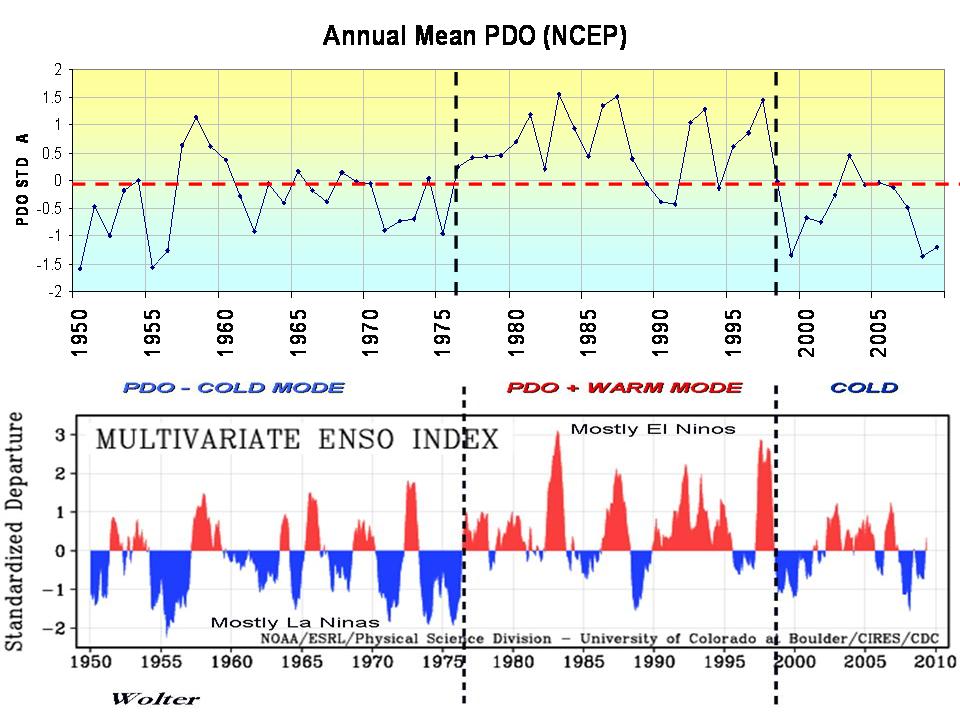

The rapid cooling in the Pacific in 2006 caused the El Nino winter of 2006/07 rains to fail in California. The La Nina that ensued became strong in the late winter and early spring of 2007/08 and came back again for a reprise in 2008/09 winter continued to produce sub normal rainfall.
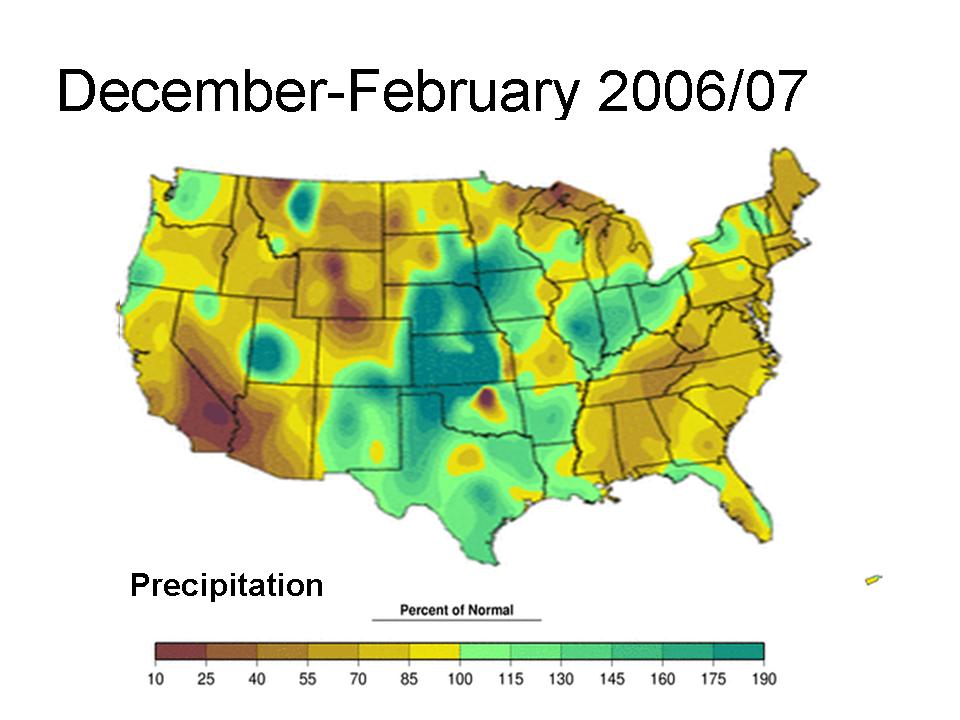
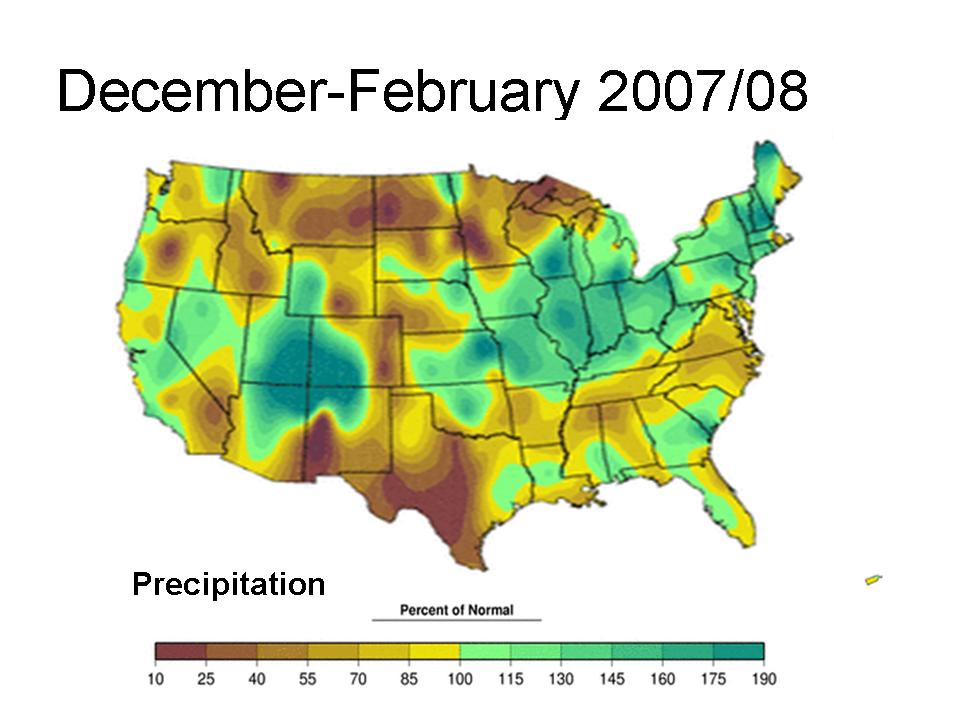
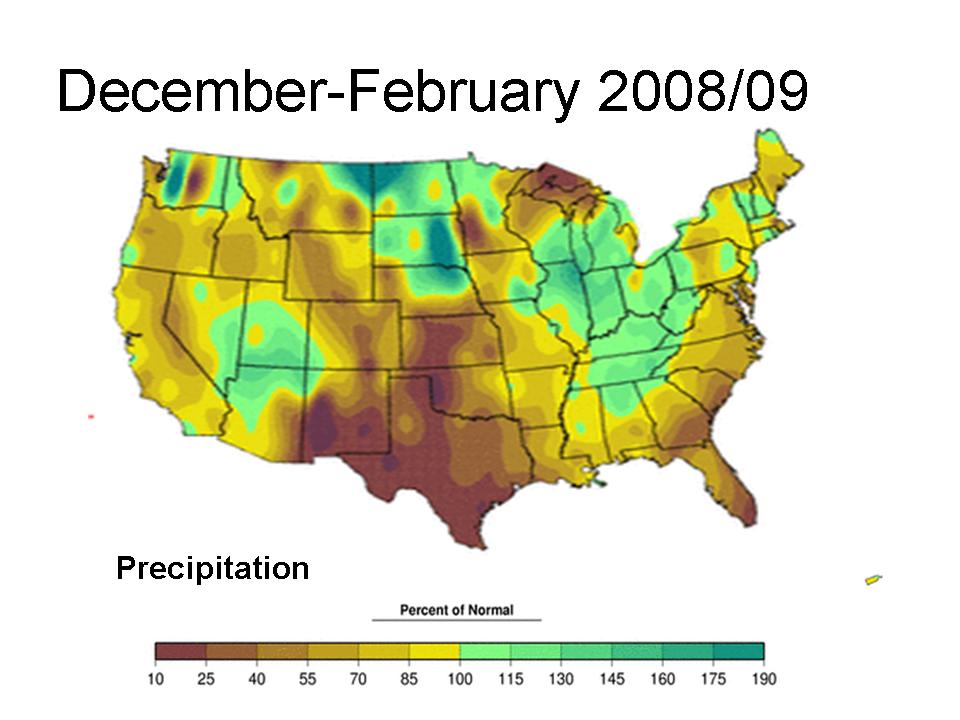


A few years back McCabe, Palecki and Betancourt published a paper that looked at drought frequency across the United States related to both the Pacific Decadal Oscillation and the Atlantic Mulitdecadal Oscillation. Droughts in the United States were more frequent when the Atlantic was in its warm mode. When the Atlantic was warm, and the Pacific was also in its warm mode, the dryness was more across the northwest and southeast and when the Pacific was cold more across the southwest. Red areas have enhanced drought probabilities.


We are currently still have a warm Atlantic mode and cold Pacific mode (D) and thus should expect the increased risk of dryness in the southwest. See these maps and read more here.
Environmental Mismanagement
This natural cyclical lack of rainfall combined with unwise policy that Dr. Scott Campbell reported concerning the prohibition against clearing up accumulated brush from the areas surrounding housing developments that were instituted at the insistence of the Sierra Club and other environmental groups has left more fuel for the fires fanned by the Santa Ana winds. The JPL’s Dr Patzert indicated, in a release, were also more common in La Ninas. The risk is also greater because more people built homes in the cooler hills among the trees, putting more than trees at risk.
In addition, environmentalists have reduced the amount of water that can be used for agriculture. Farmers in the Central Valley are asking for a new canal to get water from the Sacramento River, as well as a relaxation of environmental restrictions resulting from a 2007 court ruling limiting the amount of water pumped south from the delta – a giant sponge that absorbs runoff from the wetter north. The ruling was in response to a suit by environmental groups that held that the water pumping through the delta endangered several species of fish, including smelt, green sturgeon, and winter and spring salmon. More here.
What Lies Ahead
Given the current El Nino is in the cold PDO mode, it should be weak and tend to be brief. It may peak this fall and weaken this winter. The increased tropical activity in the eastern Pacific is favored in El Nino years (in some El Ninos they reach California in the early fall in a weakened state – e.g. Kathleen in 1976). The similar El Ninos in the cold PDO tended to produce normal to below normal wet season precipitation and another active fire season next year.
It is likely a La Nina will return next year. Expect another fire season. See more here.
“Wildland fire in ecosystems: effects of fire on flora.”
http://www.fs.fed.us/rm/pubs/rmrs_gtr042_2.pdf (9MB PDF)
* Map on page 7 (PDF page 15) shows how often the plants tend to be burned. 60 years between burns is a long time.
* Chaparral is on page 158 (PDF page 166). That’s in the “Stand-replacement fire regime” section, because the entire tree tends to burn in a fire through a chaparral stand. Most of the trees are only a few meters tall.
“By the end of the 19th century, newspaper accounts of fires burning through this type for days and weeks in southern California became common.”
Jeremy (11:28:14) – Actually you can blame the Army. When Yellowstone Park was created, the Army was sent there. They decided that they should put out fires. That created the policy which was eventually adopted by the Forest Service. But you have to give the forester academics credit, as they have been studying the subject quite well.
You’d have to be awfully cynical to say environmentalists wouldn’t want accumulated brush cleared up so that when a fire did start it would be big and they could use that as political leverage to advance their cause.
Miles:
It’s simpler than that, environmentalists decry all activities by humans including prevention activities and blame whatever happens on humans. They don’t need a logical pathway to the cynicism you describe.
And Duncan ripped off my 20 year old fire danger rant. Duncan and I go way back.
Joe D’Aleo: I’m not disagreeing with your post, just the relationship between the PDO and ENSO.
You wrote, “The basin wide Pacific multidecadal warming and cooling affects the frequency and strength of La Ninas and El Ninos. The cold PDO favoring more, stronger and longer lasting La Ninas and the warm PDO more, stronger and longer lasting El Ninos and fewer briefer, mostly weak La Ninas. “
It only appears that way due to the smoothing you’ve used. The PDO lags ENSO.
Zhang et al (1997), who were the first to calculate the PDO, and Newman et al (2003) determined that the PDO was a lagged effect of ENSO.
Link to Zhang et al:
http://www.atmos.washington.edu/~david/zwb1997.pdf
Link to Newman et al:
http://www.cdc.noaa.gov/people/gilbert.p.compo/Newmanetal2003.pdf
Newman et al state in the conclusions, “The PDO is dependent upon ENSO on all timescales. To first order, the PDO can be considered the reddened response to both atmospheric noise and ENSO, resulting in more decadal variability than either. This null hypothesis needs to be considered when diagnosing and modeling ‘internal’ decadal variability in the North Pacific. For example, the observed spatial pattern of Pacific SST decadal variability, with relatively higher amplitude in the extratropics than in the Tropics, should be at least partly a consequence of a reddened ENSO response.”
Newman et al wrote under the heading of DATA AND RESULTS, “ENSO also leads the PDO index by a few months throughout the year (Fig. 1d), most notably in winter and summer. Simultaneous correlation is lowest in November–March, consistent with Mantua et al. (1997). The lag of maximum correlation ranges from two months in summer (r ; 0.7) to as much as five months by late winter (r ; 0.6). During winter and spring, ENSO leads the PDO for well over a year, consistent with reemergence of prior ENSO-forced PDO anomalies. Summer PDO appears to lead ENSO the following winter, but this could be an artifact of the strong persistence of ENSO from summer to winter (r 5 0.8), combined with ENSO forcing of the PDO in both summer and winter.”
http://i32.tinypic.com/143hx6p.png
Newman et al Figure 1, Cell d
Zhang et al refer to the PDO as “NP”, and, for an ENSO index, they use the Cold Tongue Index (CT). The Cold Tongue Index represents SST Anomalies of 6S-6N, 180-90W. In Figure 7 of Zhang et al, they illustrate the cross-correlation functions between the Cold Tongue and the other time series they examined. Note how in the bottom cell NP (PDO) lags (CT) ENSO by approximately 3 months.
http://i39.tinypic.com/14o3beb.jpg
Zhang et al Figure 7
They wrote on page 1011 (pdf page 8), “Figure 7 shows the cross-correlation function between CT and each of the other time series in Fig. 5. The lag is barely perceptible for TP and G and it increases to about a season for G – TP and NP, confirming that on the interannual timescale the remote features in THE PATTERNS SHOWN IN Fig. 6 ARE OCCURRING IN RESPONSE TO THE ENSO CYCLE RATHER THAN AS AN INTEGRAL PART OF IT, consistent with the conclusions of Alexander (1992a,b) and Yulaeva and Wallace (1994).” [Emphasis added]
This was also discussed in these two posts:
http://bobtisdale.blogspot.com/2009/04/misunderstandings-about-pdo-revised.html
http://bobtisdale.blogspot.com/2009/05/revisiting-misunderstandings-about-pdo.html
Glug (09:41:11) :
My comments were a little inside joke, a reference to a discussion I had with Charles the moderator a few years ago. The comments were designed to provoke a response from him, not as a manifesto of any kind.
Reply: You got a nice discussion out of it. ~ charles the ripped off moderator
There was a story in the WSJ a few years ago about a man in CA who ran afoul of the Endangered Species Act when he plowed the fields around his house to keep a brush fire from destroying his home. Seems there was a report of a “endangered” field mouse in the area, which overruled the endangered home owner.
I recall that I read that this particular fire was caused by a person; the ignition source.
The fuel source is another issue.
The headline of this post is not quite correct.
The oxidizer source is not an issue.
Ancient Native-American name for the Los Angeles Basin: (translated) Valley of Smoke.
Way before National Forest Service, and all the other interfering “experts” in land/water/forest/fire management.
It would make too much sense to allow private enterprise access to the national forests, clear selected trees or brush, and produce wood pellets for burning in wood-pellet stoves.
The La Canada / Flintridge arson team is currently investigating the origin of the Station fire, and indications are that it was arson. One should note that prior to this fire, this community was discussing laying off unneeded firemen….. fancy the coinkidink.
Thus, assigning blame to weather/climate is an unsupported argument.
P Walker (09:19:47) : Yes, the Sierra Club can be sued.
Werner Weber (08:59:00) :
My Giant Sequoia’s love this Solar Minimum, one of the few species that do.
Great article as always. Small thing. The top graphic of La Nina Annual Precipitation Correlation has the colours round the wrong way? I associate blue with wet and red with dry.
The same Environmental Groups have now filed injunctive suit and won to stop restoration/recovery efforts for last year’s massive fires in the Northstate.
The value of the timber left dead standing goes to pay for the replanting/erosion control in the fire areas.
These people stop all remediation until the standing dead timber is commerically useless. What remains is fuel for the next rounds of fire that finds these same places and runs through the area like a blowtorch, taking ever wider areas of forest out.
Instead of the cool, forested, moisture-holding, vegetative filtered clean water streams to support the fish these groups claim to want to save, we are left with arid wasteland fit only for fire brush, increased silt in streams and totally wasted renewable resource.
One thing that bothers me even more than the loss of renewable resources:
Who are these people who stop recovery? I live in the areas affected, and I have never met a single on of them, nor seen a single article from member X whom I could identify as a real person.
I have also yet to meet someone who knows one of them.
Journalists: Do your duty.
Who are these people?
Let’s see if I have this right.
You have vast tracts of forest with NO fire-breaks?
Isn’t this asking for trouble?
DaveE.
unfortuntely the introduction of the aussie Eucalyptus gum tree to California in the 1850s as left you with the fire relationship that goes with gum trees.
This story is just deja vu of last february in Australia.
A large phalanx of environmental groups sued to stop the U.S. Forest Service from grading firebreaks and performing prescribed burns in the Angeles National Forest (and several others). I’m unable to find the whole story, and the media isn’t interested, but there’s this case from 2006 where the Forest Service was enjoined by the District Court for the Northern District of California from making firebreaks (e.g. ‘roads’) Wilderness Society et.al. vs. U.S. Dept. of Forestry. Without roads, you can’t do controlled burns.
Then there’s this blog article: Figures. Feds Didn’t Clear Brush In LA Wildfire Areas Because Of Liberal Pressure.
The ‘controlled burn’ season in California starts in November, and the seven ‘environmental groups’ discussed in the above article filed suit and asked for an injunction against implementing the USFS “Forest Plan” in the Angeles and Los Padres National Forests in October, 2008. I suspect, but can’t prove, that the good judge from San Francisco granted their request for an injunction and thus the planned burns and firebreak cuts were never performed.
“”” DaveE (14:06:04) :
Let’s see if I have this right.
You have vast tracts of forest with NO fire-breaks?
Isn’t this asking for trouble?
DaveE. “””
Yes we do; “fire break” roads that allow fire equipment access are not allowed in the National Forests because the greenies don’t want people using them to go into the forests. Also removing dead trees (by helicopter) is not allowed because they need to stay on the ground and rot naturally, and fuel forest fires; becasue some forest fires are natural and therefore good.
And speaking of Aussie gum trees, we don’t have them in the National Forests but we do have them in a lot of California residential areas; and they worked very well in the great Oakland fire of a few years back; we like the Wattle trees for the same reason; they burn good.
George
“”” Miles (11:57:26) :
You’d have to be awfully cynical to say environmentalists wouldn’t want accumulated brush cleared up so that when a fire did start it would be big and they could use that as political leverage to advance their cause. “””
No you just have to be a realist; becasue it is their attitude that forest fires are a natural part of forests, and they think when you have a forest fire, you just let it burn itself out.
So in fact that is just what they did a few years ago, and they let a truly humungous fire just go; instead of trying to stop it.
If you go driving in forest fire country; you can be pressed into service fighting a fire; even if you don’t want to.
George
Weather doesn’t burn; fuels do. Fuels are biomass, the product of biology, something that has been going on in Cal and elsewhere on this planet for a very long time.
Human beings encountered SoCal at least 13,000 years ago. They soon discovered that massive conflagrations denuded the landscape and made survival (by humans) a tough go.
So humans (the regular kind, like you and me) figured out that if they burned off the landscape every year, the fires were less severe, the grass grew back quickly, game animals benefited, root crops benefited, an oak savanna developed, and humanity prospered.
About 12,500 years later, the resident land managers and stewards were eliminated by disease and conquest, and Euros took over. The Euros proclaimed manifest destiny and that God gave them this “wilderness,” even though everybody was aware that human beings already inhabited the place and done so for millennia.
Intoxicated by the creation myth they promulgated, the Euros failed to understand the traditional land management, learned the hard way over thousands of years. The Euros rejected stewardship by anthropogenic fire, and allowed creosote-laden fuels to build up to catastrophic levels.
As a predictable and preventable consequence, kaboom! holocausts break out every few years. Yet even after some 300 years of Euro myth-managed blindness, the current residents are STILL unaware and in denial of the time-tested lessons learned by the previous residents.
No, taking all the homes off the hills will NOT prevent catastrophic fires. No, cooling the planet with carbon restrictions will NOT prevent the fires. No (I love you Joe but) El Ninos and La Ninas are not the cause; fuels are.
Catastrophic fires are plaguing North America from SoCal to Alaska and everywhere in between. It ain’t the climate, because the phenomena of megafires occurs in all climates. It’s the fuels, Einsteins. No fuel management, no fire prevention.
Take a lesson from posterity, from thousands of years of experience: be good stewards of the landscape or Mother Nature will bite your backside. Manage the fuels or suffer the fires. There are no other choices.
Yeah, right, just like the 2005 wildfires… in the middle of an El Nino event.
Apologies Duncan.
Bill in LA makes some very good and accurate points.
Regarding the main post, I’m not sure why Joseph is claiming that Joe Romm attributes this particular fire to AGW. Sure it makes a nice sounding argument, but he does nothing of the sort. The article by Keith Kloor that is linked to on this point is totally misleading and the author has paid no real attention to what Romm’s article stated. Romm specifically indicates that this fire is exceptional for our current climate. He only makes the point that in a warmer future such exceptional fires may become more normal. I don’t necessarily agree with that statement as more frequent fires may lead to less severe fires, but the post, as it stands now, is misrepresenting Romm.
George E. Smith (14:34:34) :
That’s one I’ve never understood.
What’s so damned wonderful about natural typhoid, malaria, tuberculosis, (insert disease), or natural cyanide, arsenic, (insert poison)?
Too illogical for me!
DaveE.
I have seen many fires roar through the Southern California landscape — as regular as clockwork, especially after growth (El Nino) plus drought (La Nina). As someone who used to support many environmental organization. I have stopped for a number of years because their agenda changed. It turned into anti-agriculture, anti-capitalism, anti-energy development, anti-intelligent water resource enhancement, anti-intelligent management of forests, and many other forms of looney marxist-leftist-progressive — NOT LIBERAL –purposes.
I oppose rampant, thoughtless development, much of it into fragile or marginal ecological areas, making all of us pay higher insurance rates and higher taxes. Furthermore “they” put undue burdens on firefighters — who die and get severely injured protecting us — and other public services. (This is the opposite of looney M-L-P; it is greedy selfish capitalist.)
I am all for suing the so-called environmental organization for their current destructiveness and would be delighted to begin with the Sierra Club. Any other takers? Can we get a group movement?
All Southern Californians can fall down on their knees and thank the great gods of high pressure systems that we were not in the clutches of Santa Ana conditions.
Meet the Knobcone Pine, a species so well adapted that its survival strategy depends on fire. Special adaptation features include seed bearing from the sapling stage and more significantly, embedded cones encased within the trunk containing viable seed lasting as long as the tree lives. These encased seeds are protected from harmful fires, but can only be released to germinate after a massive fire totally destroys the encasing timber of the parent tree.
Re: Bob Tisdale (12:09:35)
Bob, thanks for pointing me to a bunch more useful stuff – like the EOF mapping software at KNMI & Ninderthana’s comment about PDO & ENSO. One very important thing we need to keep in mind is that .74^2 is only 55% of the variance, so while Newman et al. have given us something very interesting to chew on, they have certainly not closed the case (45% unexplained), as Ninderthana points out.
http://wattsupwiththat.com/2009/04/28/misunderstandings-about-the-pacific-decadal-oscillation/
Before today, some of the earlier (somewhat controversial) discussions about PDO & ENSO were not sitting well with me, but your comments of today have pointed to the clues I needed to pull a number of threads together. As often: Thank you for your reliably-valuable contributions.
Supplementary – for anyone trying to make sense of the indices mentioned upthread:
Zhang, Y.; Wallace, J.M.; & Battisti, D.S. (1997). ENSO-like interdecadal variability: 1900-93. Journal of Climate 10, 1004-1020.
http://www.atmos.washington.edu/~david/zwb1997.pdf
“TP: the tropical Pacific, defined as the region 208N-208S, 1608E-808W;
G: the entire global ocean as represented by all available gridpoints as in Parker and Folland (1991);
G – TP: the entire global ocean exclusive of the tropical Pacific region TP”