
Source: http://www.osdpd.noaa.gov/PSB/EPS/SST/data/anomnight.5.11.2009.gif

Bill Illis writes in comments:
The newest Ocean SST map shows the La Nina conditions have gone away and we are in slightly positive ENSO conditions.
Also interesting is that the negative PDO seems to be moving back to neutral right now. The cool SST conditions off of Alaska (which has been there for 3 years now) looks to be moderating as well.
From my perspective, the other interesting feature is how the recent La Ninas have loaded up cool SSTs in the Pacific off south-east Asia which will soon move into the Kuroshio currrent which will then flow across the north Pacific.
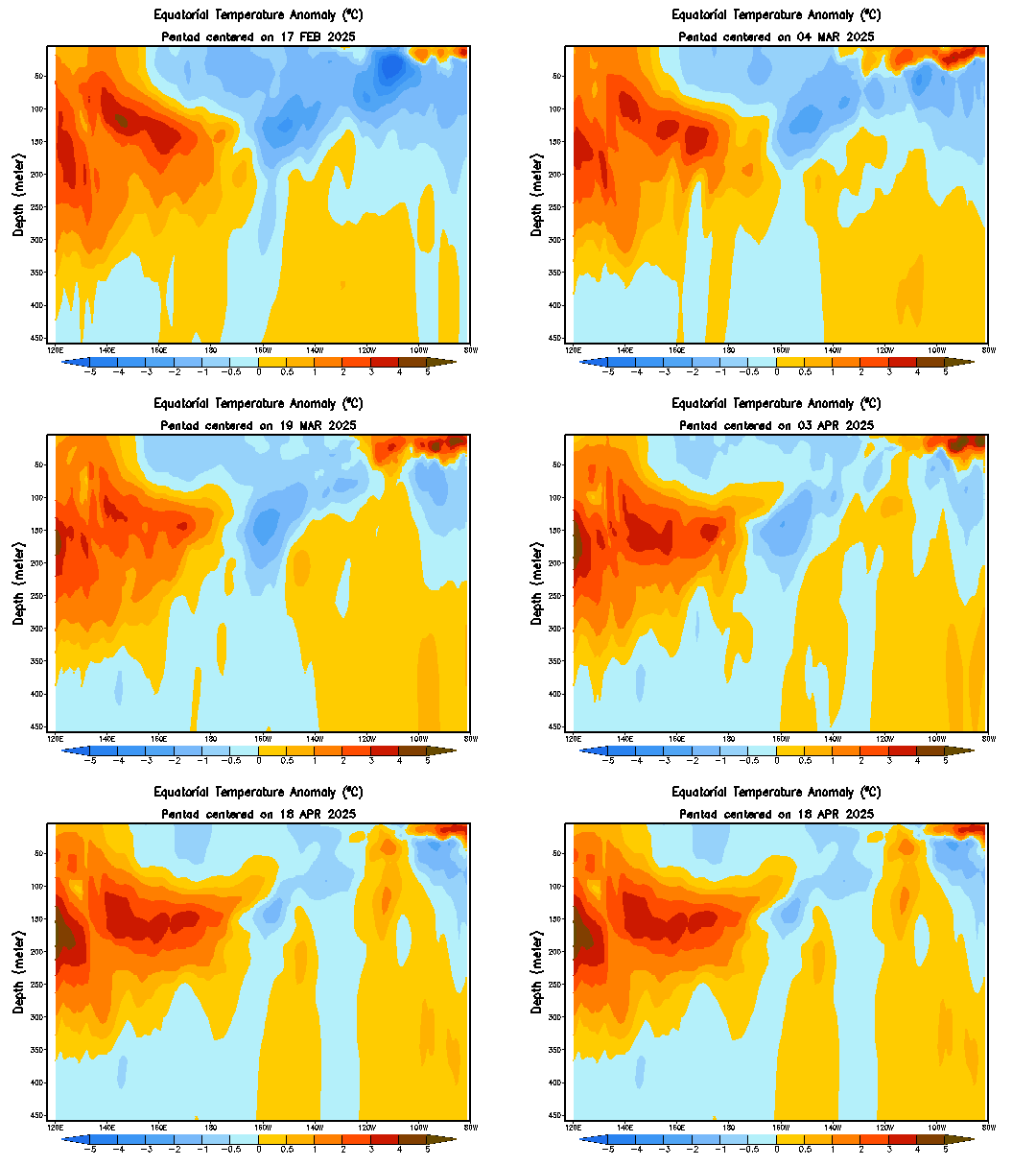
The upper ocean heat content is signaling we are going to move rapidly into El Nino conditions although most forecasts are calling for neutral conditions.
Source:
http://www.cpc.ncep.noaa.gov/products/analysis_monitoring/ocean/anim/wkxzteq_anm.gif
Atmospheric Angular Momentum has really turned negative recently (signaling La Nina), the Trade Winds have fallen off to nothing (signaling El Nino).
So overall, the north Pacific is offically schizophrenic right now.
Discover more from Watts Up With That?
Subscribe to get the latest posts sent to your email.
so what prediction does this observation lead to?
Not really surprising that this can happen. No matter what phase the PDO is in, if I remember from some previous figures displayed, it’s not some monolithic event. The real world isn’t as clear-cut and pretty as we’d like to portray on some graph. The PDO may be entering a weakened period now, only to come roaring back later. It should be interesting to see how this one plays out.
Flanagan over at the discussion board at globalwarminghoax.com has sternly reminded us that Hansen predicted a major El Nino in 2009…
Maybe, just maybe, he will get one prediction right… *rolls eyes*
Nothing unexpected. By looking at the record, the last times that an already finished La Niña event has managed to return, it has only got half way and quickly changed into a rather strong El Niño event: check years 96-97 or 85-86.
So I wouldn’t be surprised either if a strong El Niño starts to develop during the following months. However we will not experience the temperatures we had in 1998, due to the sun’s quiet status and the more benign PDO.
Personally I will be glad to have a milder winter. And Argentinians will love to have a wet year after the last dry one.
I was also going to add that the Southern Oscillation Index has also alternated between very positive and very negative recently.
http://www.longpaddock.qld.gov.au/SeasonalClimateOutlook/SouthernOscillationIndex/30DaySOIValues/
I think a few people here predicted a 2009 El Nino as early as last autumn. It’s been almost 3 years since the beginning of the last one. If I remember correctly, the last El Nino began in Oct 2006 and aburptly ended in June of 2007. It was short and weak.
I don’t think we will be seeing anything eventful. El Ninos occur even during negative PDO cycles. This one will probably be like the 2006-2007 event. Even NASA isn’t expecting anything out of the ordinary.
Leon Brozyna (08:28:40) :
Not really surprising that this can happen. No matter what phase the PDO is in, if I remember from some previous figures displayed, it’s not some monolithic event.
True – which begs the question: How do we know if we’re in along term negative PDO phase or just a short term flip. I remember asking this on another blog and was howled down by other posters.
Bill touches on something very key to the core of these oceanic cycles and that is the “relaxing of the trade winds”. I have always believed the winds to be the prime force in these cycles whether long or short lived. The question then becomes what is the forcing mechanism for the trade winds. Either pressure gradients from highs and lows or is it the replacement of air circulated to the poles or a combination of both.
One relative theme I’ve read here at WUWT is how cold conditions bring light or no winds. This is one of the arguements against the usefullness of wind generated electricity when conditions are cold. I have access to no advanced weatther monitoring equipment so I have no way of proving my point. I would suspect because we are witnessing colder conditions at the poles that the air replacement cycle may weaken as a result. This shows up as weak trade winds at the equator.
As glacial growth and colder conditions at the poles increase as we now know is the case, there must be some way the earth uses to feed the growth of fresh landbound ice and snow which is kept and not lost due to colder climate. To me the earth is simply reloading moisture content removed by these conditions. This may explain why global climate change (cooling) does not occur as a linear function but rather a step function.
To me this is the earths demonstration of its ability to seek and meet its new climate conditions which is to say the earth regulates very effectively the loss or gain of heat in its atmosphere. It would be very beneficial for our readers to hear from someone who has superior knowledge about what are the driving forces of the earths wind circulation patterns. Afterall, we know the winds are the driving force of these oceanic cycles. Getting to know more about what controls the wind can lead us to a better understanding of the direction our global climate is headed.
Just because there’s suddenly a patch of warmth doesn’t mean anything….There have been a lot of El Nino scares lately…Long-range forecast indicate a weak El Nino by late fall or winter but no earlier than that.
El Niño? Thank heavens.
We need the rain here in South Texas.
Thank goodness for food supplies and energy use, but, of course that will just fuel the global warming baloney.
La Niña fading, El Niño may soon return
Hedge your bets: Plant both Early Girl and Better Boy.
Those are just pale oranges, the reddest ink NOAA got this time, meaning mostly one degree celsius anomaly (year of reference not shown), and here, in the southern hemisphere, we are not yet in winter time and we do not see any warm pool whatsoeverheater is off, so all bets are those yellows and pale oranges will turn blue.
In front of El Nino 1+2 (lat -12) we have had clear skies (logically due to colder seas) and that in turn warmed sea surface a little, but weather is beginning to get cold, so chances are La Nina will reappear in all its cool beauty.
We are living in “interesting times” so do not take el nino, la nina, PDO or whatever as always, this time winds will behave differently, watch all these phenomena as totally new, we are witnessing the unfolding of a minimum
La Nina is not gone…She just went a few minutes to the toilet to arrange herself..
It’s a little early for a mid-month ENSO update post, so I’ll just throw up a link to a graph of the most recent NINO3.4 SST anomalies:
http://i41.tinypic.com/1zqc0no.jpg
They were sitting at approximately 0.2 deg C for the week centered on May 6, 2009.
Regards
Joe Bastardi of Accuweather predicts in the Accuweather Pro website, a weak to moderate “rebound” El Nino which he feels would be expected after such a deep La Nina. He doubts that a major or “super” El Nino is going to occur. Joe feels that one of the implications of a weak to moderate El Nino after a deep La Nina would be a fairly severe winter for the NE. The Accuweather Pro website is a pay-website but for those who are wiiling to pay, it is a fantastic website and a great weather resource.
This will be interesting to watch. I think it is too soon, though, to conclude, as the headline does “El Nino may return soon.” But “may” is perhaps the key word here.
I confess I cannot follow everything he’s talking about, but I read Ed Berry’s blog every week, and I don’t think he’s written La Nina off yet. From his latest:
“In general, slightly positive SST anomalies cover the equatorial Pacific Ocean basin and the slope of the thermocline continues to decrease. Anomalous surface westerly wind flows linked to the ongoing MJO has contributed to this evolution. However, for numerous [emphasis in original] reasons the ENSO situation is unclear and diligent monitoring must continue. For example, if coherent dynamics start to “heat” the equatorial west Pacific substantially during boreal summer into autumn, then I will get impressed about the possibility of transitioning to a warm event. Regardless, subseasonal activity (GWO/MJO, etc.) will continue, and these will impact North America.”
“In other words, and consistent with the past 2008-09 boreal cold season, I offer that the GWO is again driving the MJO. It is clear to me that the extratropics are currently forcing the tropics. [I’ve added the italics.] Could this kind of behavior be telling us something about where ENSO is going?”
“Summing up so far, could our “May surprise” be a re-emergence of stationary tropical forcing across the Eastern Hemisphere favoring an eventual return to La-Nina? [Again, emphasis added.] Or, will we finally see the initiation of decent coherent MJOs that could significantly impact the equatorial Pacific? These are only 2 of an infinite number monitoring issues, and stay tuned. I wanted to make a bit of an effort to get readers to gain an even better appreciation of some of the serious real-time scientific matters that are currently (and always) involved spanning wide time and space scales. This is an example of the next level of weather-climate research/monitoring that is needed, and hopefully that will come to fruition via the ESRL/PSD GSDM web page.”
In other words, who knows? “Stay tuned.”
This will be an interesting test of whether a negative PDO phase really does suppress El Nino and enhance La Nina.
MC 09:01:12
I might go along with the winds being drivers of short term ENSO type oscillations or cycles but I am very doubtful about the air driving longer term phase changes.
Continuing close observations should help to resolve that issue.
There is a lot of density, volume and inertia in the oceans so I dont see the air being in ultimate control.
That is the main flaw I see in the ideas of Tyndall et al. All their hypotheses are based on the air alone. Many still follow that approach.
El Nino would mean a possibly moderated hurricane season, would it not?
It is obviously very difficult to predict what is going to happen. The indicators keep switching back and forth and seem to be contradictory to each other. I guess that would signal Neutral conditions but one can’t ignore the upper ocean heat content.
The other important point is that 80% of El Ninos and La Ninas occur around December. They trend usually starts in May/June and builds slowly over the summer and it does not become obvious that a significant event is going to occur until late in the year.
The last La Nina, however, did not follow this pattern, it started much later than normal, so there is always a chance for a non-typical 20% event to occur.
A good piece to introduce a very key topic for the next 24 months.
This is the first time in nearly 2 years that ALL Enso zones are positive. (Zone 4 didn’t make it last summer).
This isn’t a false dawn by any stretch of the imagination and the ECM, CPC and Nasa predictions for ENSO over the last few months have been turning increasingly positive particularly from the deterministic models such as CFM.
Similar years might be 62-63 or 96-97.
A key topic mainly through it’s effects on Global temperature. with a 1-3 month lag time we can expect global temperature anomalies to start increasing again from Jun-Aug onward. Also important will be the Jun-Jul_Aug monthly temperature figures which should have a pretty even natural driver set up which doesn’t heavily have the effects of ENSO, PDO or Solar.
Finally I agree with the PDO-ENSO connection that Bill mentions, ENSO acts as a capacitor to discharge heat and store it. The effects of PDO on ENSO look likely to be a slower charge of the capacitor leading to fewer ENSO events, but not a complete lack of them.
The question of PDO and Salinity also then gets raised, The effects of PDO on ENSO look to be down to Salinity and temperature changes in ocean circulation in the pacific.
If AGW is having an effect the main consequence will be to decrease the effects of PDO on temperature and salinity, leading to more charging of the capacitor and more positive ENSO events than would be expected or for example experienced during the last negative PDO time range.
BTW the range of likely probabilities for ENSO by Oct would be from 1.0 to 2.0 IMO with a distinct possibility of the most positive ENSO for 10 years.
Cheers
Sorry Pierre,
Missed it, Yes almost every hurricane forecast for this year features an El Nino developing and a tailing off of tropical storm activity from Sept/Oct onwards. Mainly though increased shear.
Let’s keep in mind here, too, of the distinction between El Nino and ENSO-neutral. In this week’s NOAA/CPC ENSO outlook, they state:
“A majority of ENSO forecasts indicate near-average SSTs (−0.5°Cto +0.5°C) in the central equatorial Pacific through the remainder of 2009.”
That’s just ENSO-neutral, not El Nino. Only some of the higher dynamical forecasts, including the CFS ensemble, are projecting a possibility of El Nino. The statistical models are predominantly ENSO-neutral through the rest of the year, with ONI values of several remaining negative.
“Stay tuned.”