Guest post by Bill Illis
We have often wondered what really causes the El Nino Southern Oscillation (ENSO) climate pattern. It is generally understood and this post will demonstrate that it is really driven by the Trade Winds over the ENSO region.
The Trade Winds blow East to West at the equator. Most of us living in other latitudes expect the wind and the weather to primarily come from the West but, at the equator, the weather comes from the East.
When the Trade Winds are stronger than average for a sustained period of time, the Trades literally blow or drag the warm surface water across the Pacific and it is replaced by colder upwelling ocean water from below. If the Trades are strong enough for a long enough period of time, we have a La Nina.
When the Trades are weaker than average for a long enough period of time, the ocean surface stalls in place and gets heated day after day by the equatorial Sun and we have an El Nino. Sometimes, this stalling even results in warmer ocean water from the Western Pacific moving backwards into the Nino region and this also contributes to El Nino conditions.
Let’s look at the data to see how true this assertion is.
Here is a chart of the Nino 3.4 region temperature anomaly (which is the most consistent measure of ENSO conditions) versus the Trade Winds from 120W to 175W. The Trade Wind data is for 850 MB pressure or about 3,000 feet.

Click for a larger image
To see this correlation a little better, I’ve reversed the sign so that weaker Trade Winds are shown as positive values and stronger Trade Winds are shown as negative values. I’ve reduced the anomaly in meters per second by half as well so the scale is roughly the same as the ENSO.

Click for a larger image
I can’t imagine seeing a better explanation of what drives the ENSO than this.
For some perspective on the Nino regions and the latitude, longitude figures in question here, this is a map of the region produced by the Climate Prediction Centre.

I think you can see this impact in action if you watch an animation of the ENSO region over time. Let this SST anomaly animation load up, then speed it up as fast as your computer will allow and you can see the Nino region waters and temperature anomalies literally move across the Pacific with the Trades.
http://www.osdpd.noaa.gov/PSB/EPS/SST/anom_anim.html
But what drives these Trade Winds? I don’t really have an answer for that question.
The Southern Oscillation Index (SOI) was previously used as an indicator of these winds over the Nino regions. The SOI is a measure of the difference in air pressure between Tahiti and Darwin, Australia. The theory being that high pressure blows toward lower pressure which can provide some indication of the Trade Winds in the Nino region. There is certainly a correlation of this measure to the Nino 3.4 anomaly. In fact, the measure even lent its name to the ENSO.
I’ve found, however, the SOI consistently lags a little behind the Nino region temperatures and the Trade Wind measures so I believe it is more a result of the overall climate pattern rather than a leading indicator. I’ve also found no real correlation to the Pacific Decadal Oscillation or any of the other Oscillation Indices which are sometimes used to predict or measure the ENSO.
There is one leading indicator, however, which provides some predictive power – the Trade Winds just to the West of the Nino area. These Winds are, most often, concurrent with the Nino region Trade Winds but occasionally, they provide a ramp-up which might kickstart the ENSO. The West Trade Winds were a leading indicator of the Super El Ninos of 1982-83 and 1997-98 for example.

Click for a larger image
Unfortunately, I don’t know what drives these Western Trade Winds either, but they are currently pointing to a strengthening of the La Nina conditions which currently exist.
I also wanted to show more closely how the ENSO impacts global temperatures.
The warm or cold ocean conditions of the ENSO eventually impact the Tropics troposphere temperatures and this seems to be quite a direct impact with a lag of 2 to 3 months.

Click for a larger image
The Tropics temperatures then propagate out to the rest of the world with a small lag that may be up to 1 month but is more commonly concurrent with the Tropics anomalies.


Click for a larger image
The Trade Winds drive the ENSO, and the ENSO directly impacts the Tropics temperatures and the Global temperatures.
Who would have thought that Winds in some small region of the Globe could be so important. You can keep track of these Trade Winds on a daily basis at the Climate Prediction Centre.
http://www.cpc.ncep.noaa.gov/products/precip/CWlink/daily_ao_index/zw/zw.obs.gif
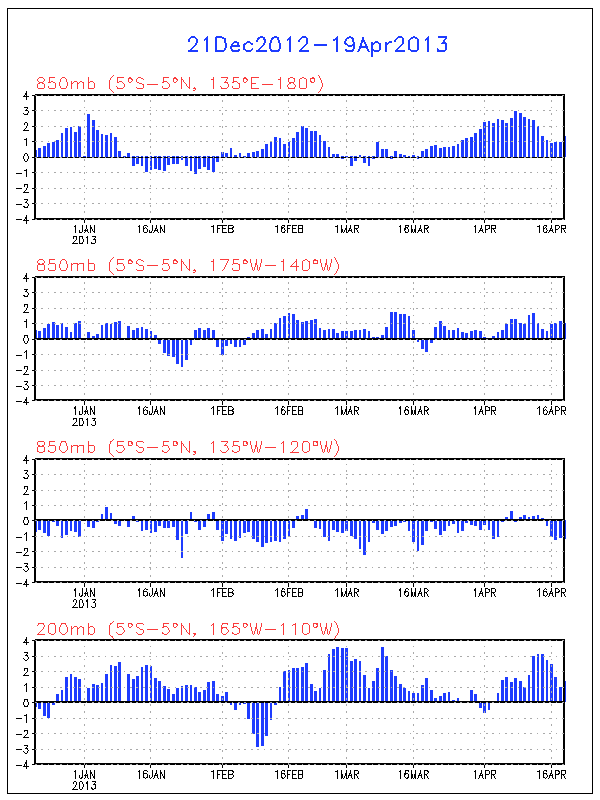
So, I think that provides a nice perspective on the ENSO.
The data used in this post can be obtained here.
http://www.cpc.ncep.noaa.gov/data/indices/
http://www.cpc.ncep.noaa.gov/data/indices/sstoi.indices
Chris Schoneveld (04:11:10) :
trying to frustrate the skeptic community?
Trying to prevent you from going off the rail. You do not combat the bad science of AGW with even worse science.
The trade winds are driven by the coriolis forces that are generated by the vertical movement of the atmosphere in the tropics. The strength of the coriolis forces and hence the trade winds is directly related to the strength of the vertical movement of the atmosphere. This is inescapable. Hence the strength of the vertical atmospheric movement determines the strength of the trades.
The strength of the vertical movement is controlled by the same factors that control atmospheric convection elsewhere. Lapse rates, humidity and heat input are important.
Perhaps a specialist in atmospheric convection could identify the cyclic factors that are causing variations in the strength of convection. However I bet the sun has a lot to do with it.
Chris Schoneveld: Aren’t most of us on this blog interested in the science of “solar influence” on temperature/climate along with the science of other influences (e.g., trade winds “driving” the ENSO) and accurate gathering of data? How can we get to the science if every theory/opinion/belief/calculation is not rigorously tested for its validity and whether or not it can be falsified? Yes, this principled attitude seems to cause some pain (e.g., to Dr. Meier on the preceding thread), but I think we can be grateful that “it” exists on this blog.
Chris Schoneveld (04:11:10) :
I have noted lately that whenever someone dares to suggest
Knock it off Chris. We are lucky to have Leif here to be so generous with his time, patience and expert knowledge. Whatever his personal belief’s are, he is always honest and informative. I’ve taken a few jibes from him in the past, but I still respect his integrity as a scientist. I think he just wants to see science done rigorously.
People are free to disagree with him, and he with them. Let the evidence be produced and the chips fall where they may. I have a lot of time for Erl’s ideas, and Leif does too, or he wouldn’t bother to critique them.
“Without GHCs the Earth would be too cold to live on [255K].”
Arrhenius may have been a father of PChem but here he included the 30% of TSI that is reflected back into space. Plainly, as G&T have pointed out, the calculation is faulty, the heuristic inapt.
Ninderthana: Your links don’t work.
Regardless, you wrote, “And I believe that the following graph shows that it is the PDO that reinforces the ENSO and not the other way around. This third graph clearly shows that whenver the PDO is positive, the level of intensity of El Ninos get strong and strong, and whenever the PDO is negative, the intensity of the El Ninos gets weaker and weaker. Logic tells you that it the phase of the PDO (which seems to flip from a postive to a negative state] that is influencing the intensity level of of the El Nino phenomenon.”
Actually, it’s ENSO that drives the PDO.
First, the process used to calculate the PDO (and it is a process) was first developed to extract the ENSO signal from North Pacific SST anomalies. Refer to Zhang et al (1996) “ENSO-like Interdecadal Variability: 1900–93”.
http://www.atmos.washington.edu/~david/zwb1997.pdf
Second, if you were to plot the monthly NINO3.4 SST anomalies and the PDO in a comparative graph, you’d discover that there is little difference between the two.
http://i25.tinypic.com/14dj904.jpg
Refer to:
http://bobtisdale.blogspot.com/2008/06/chicken-or-egg-pdo-or-enso.html
Third, in “ENSO-Forced Variability of the Pacific Decadal Oscillation”, Newman et al state in the conclusions, “The PDO is dependent upon ENSO on all timescales.” Refer to:
http://www.cdc.noaa.gov/people/gilbert.p.compo/Newmanetal2003.pdf
Refer also to my post about “The Common Misunderstandings About The PDO”:
http://bobtisdale.blogspot.com/2008/06/common-misunderstanding-about-pdo.html
Regards
Leif Svalgaard (05:20:20) :
“the solar influence is due to direct solar heating by UV of ozone in the upper troposphere and that that extra heat drives ENSO.”
Yes.
David L. Hagen (21:18:03) :
Could you please briefly explain what Newell et al. (2007) found and how it does/does not affect the impact of cosmic rays on low level clouds.
The interplanetary magnetic field and the solar wind in general impacts the Earth’s magnetosphere and creates electric currents that cause aurorae and magnetic disturbances on the ground. Even a very large such disturbance is only about 1% of the Earth’s own magnetic field and is of short duration [hours] and rare. The effects of the smaller wiggles are there all the time but are ten times smaller, so 1/1000 of the Earth’s field. Cosmic rays are deflected and guided by the Earth’s field, but the small disturbances caused by the solar wind are not enough to have any measurable effect of the cosmic rays entering the Earth’s atmosphere and thus also not on the clouds.
It seems I am not allowed to use the phrase ‘Conspiracy theorist’ any more but if I could I wouls be struggling to find a more deserving context to use it in.
Leif Svalgaard (05:20:20) :
“Without GHCs the Earth would be too cold to live on [255K].”
I disagree. The ocean, not the atmosphere is the flywheel that keeps the surface warm. Overnight, the temperature in an inland location plummets. If the Earth were 70% land rather than 70% ocean, the climate would be very different. The daily mean temperature would fall while the daily and seasonal range would increase.
It is the lowest kilometer of atmosphere that has seen a temperature change as the globe has warmed. There has been zero change in the troposphere above 1km. The warming below 1km is because of the influence of the ocean which actually stores energy. The atmosphere is incapable of storing energy.
Stratospheric temperature is driven by ozone content and UV. The same consideration applies to the upper troposphere above 300 hPa in some places, 200hPa in other places, depending upon ozone content. The temperature response to ozone at 100hPa is very strong. Its the border zone between the two regimes. In the atmosphere there is no sharp demarcation because there is interchange between the tropsophere and the stratosphere. Pressure cells are not confined to the troposphere. Convection does not end at the tropopause.
All this is very relevant detail.
Double the content of CO2 and it will make no difference to surface temperature at all. Convection removes the energy as swiftly as it is imparted to oxygen and nitrogen by the CO2 molecule. That is amply illustrated by what happens below the tropopause in the southern tropics. Despite gross warming at 100hpa in summer as the northern hemisphere warms there is no effective downward propagation of energy to lower layers. At 100hPa the maximum is in August. at 300hPa the maximum is in February as it is at the surface. That is witness to the power of convection.
‘Tropos’ is Greek for turning.
Just want to say thank you, Bill. I always look forward to everything you post. Clear and easy to understand with good conceptual impact.
Good stuff!!!
Ninderthana (02:27:51) :
Documents not found is the message.
OT but interesting.
An article in the Guardian shows that tropical forests, in reaction to rising CO2 levels, are soaking up far more CO2 than was was thought, equal to the whole CO2 output of the USA.
This sort of ‘real’ science on the ground (instead of playing around with your computer programs) shows how little we really know about how the Earth reacts to changes and how impossible it is to forecast the future based on the puny amount of observed and verified data technological man has aquired so far.
http://www.guardian.co.uk/environment/2009/feb/19/forests-carbon-emissions
“Bigger trees helping fight against climate change”
“Trees across the tropics are getting bigger and offering help in the fight against climate change, scientists have discovered.
A laborious study of the girth of 70,000 trees across Africa has shown that tropical forests are soaking up more carbon dioxide pollution than originally thought. Almost one-fifth of our fossil fuel emissions are absorbed by forests across Africa, Amazonia and Asia, the research suggests.
Simon Lewis, climate expert at the University of Leeds, who led the study, said: “We are receiving a free subsidy from nature. Tropical forests are absorbing 18% of the CO2 added to the atmosphere each year from burning fossil fuels.”
The study, published tomorrow in Nature, measured trees in 79 areas of intact forest across 10 African countries from Liberia to Tanzania, and compared records going back 40 years. “On average the trees are getting bigger,” Lewis said.
Compared to the 1960s, each hectare of intact African forest has trapped an extra 0.6 tonnes of carbon a year. Over the world’s tropical forests, this extra “carbon sink” effect adds up to 4.8bn tonnes of CO2 removed each year – close to the total carbon dioxide emissions from the US.
Although individual trees are known to soak up carbon as they photosynthesise and grow, large patches of mature forest were once thought to be carbon neutral, with the carbon absorbed by new trees balanced by that released as old trees die.
The discovery suggests that increased CO2 in the atmosphere could fertilise extra growth in the mature forests.
Lewis said: “It’s good news for now but the effect won’t last forever. The trees can’t keep on getting bigger and bigger.”
Helene Muller-Landau of the Smithsonian Tropical Research Institute in Panama, said the growing forests could recovering from trauma – droughts, fire and human activity – going back hundreds or even thousands of years.
The research comes as efforts intensify to include protection for tropical forests in carbon credit schemes, as part of a new climate deal to replace the Kyoto protocol.”
Alan
erlhapp (07:15:08) :
Thank you, crystal clear fundamentals with insightful highlights. Just what the majority asks for at WUWT.
erlhapp (07:15:08) :
“Without GHGs the Earth would be too cold to live on [255K].”
I disagree.
The most important greenhouse gas is water vapor and that is what keeps the Earth warm at night [where you have it]. Houston is a good example. The 100% humidity can keep the temperature in the 30s [C] through the night.
I don’t know why you are so hung up on CO2. “Convection removes the energy as swiftly as it is imparted to oxygen and nitrogen by the CO2 molecule.”
The same would be the case with O3, so no heating from that one either [except where you have no convection – i.e. stratosphere.]
gary gulrud (06:22:33) :
the heuristic inapt.
As usual – clueless and opaque.
Alan Millar (07:45:55) :
What this also shows is that this is yet another reason to enforce sustainable management of these tropical forests.
erlhapp (07:15:08) :
Double the content of CO2 and it will make no difference to surface temperature at all.
Make it 50 times higher? no effect?
there is no effective downward propagation of energy to lower layers.
I think this is what I’ve always said: the troposphere is heated from below, not [as you now recognize] from above.
I thought the science was settled. This thread has referenced dozens of papers that have been published recently. Haven’t these folks been listening to the omniscient goracle?
Seriously, this is a thread I have been waiting for. Since I started investigating AGW about 8 months ago I was hoping to get a better understanding of the forces involved. My inital position was that climate was too chaotic to model. In a sense that position has mellowed somewhat. I no longer think it is impossible, just VERY, VERY difficult.
In complex systems there are major drivers that can somewhat control the chaos. The earth appears to have these. However, there will always be minor players that can have short terms effects (yeah, that could be decades). So, where am I now?
About two months ago I came to the conclusion that the oceans drive the climate and hence the termperatures. So, now the question is what drives the oceans. Is it several butterflies? I’ve seen many of the butterfly theories presented here. Clearly, some of them are related but proof remains elusive. I believe there is much work to be done before we really understand what drives the climates of earth. I am pleased to see that work is ongoing in this area.
BTW, did anyone else notice the lack of participation on this thread by natural CC skeptics?
“The 100% humidity can keep the temperature in the 30s [C] through the night”
Might have dropped convection and evaporation from your example. Another fractured heuristic.
Tallbloke: ” Knock it off Chris. We are lucky to have Leif here to be so generous with his time, patience and expert knowledge. Whatever his personal belief’s are, he is always honest and informative. I’ve taken a few jibes from him in the past, but I still respect his integrity as a scientist. I think he just wants to see science done rigorously.”
I realize that Leif has established a solid reputation at WUWT and that it is considered heresy to doubt his motives. And indeed I may do him a great injustice to doubt his motives. My remarks stem from a sense of frustration brought about by my observation that Leif is always quick to point out (perceived) errors by others but never makes the slightest attempt to come up with any constructive suggestion as to why climate is going through colder and warmer phases. Any mechanism that could possibly explain a causal link between the sun and (for example) the LIA will immediately be quashed or ridiculed by Leif.
Chris Schoneveld (11:08:56) :
Any mechanism that could possibly explain a causal link between the sun and (for example) the LIA will immediately be quashed or ridiculed by Leif.
Absolutely not. Only the ones that have been weighed and found wanting. And it is not enough that there is a ‘possibility’ that it might work. Show that it does work, not that it merely might work. Even the latter, I have not seen any convincing [to me at least, but perhaps I’m less gullible than most] examples of. It is not enough that you badly want it to work to counteract the bad AGW boys.
Any complex system goes through fluctuations. These could be completely random on many time scales without needing any overarching ‘explanation’.
Leif,
“Without GHCs the Earth would be too cold to live on”
How is oxygen and nitrogen heated then? I find it highly unlikely that a trace gas can have such significant impacts on heating the other 99.9% of our atmosphere, considering that CO2 only absorbs 3 narrow bands of IR.
How much warming [on earth] do you think is attributed to 0.0385% CO2, considering all known and unknown variables?
Leif
Any complex system goes through fluctuations. These could be completely random on many time scales without needing any overarching ‘explanation’.
Indeed. And when you get several semi-periodic fluctuations on earth coinciding with the sun going into a 50 year funk, voila, LIA.
We know you are a combative man Leif, and we wait with baited breath and overcoats to see how right or wrong you and David Archibald are about the degree of cooling a spotless sun will induce. As someone said on the other thread, it aint over till the red cabbage leaf goes flat. Or curlier than a british rail sandwich.
Fries with that sir? Mayonnaise or sauce?
Meantime, give us your opinion on Hathaway et al’s paper on the Armagh temp series. 🙂
http://solarscience.msfc.nasa.gov/papers/wilsorm/WilsonHathaway2006c.pdf
RICH (11:42:32) :
How is oxygen and nitrogen heated then?
By conduction+convection from the surface. The GHGs sends some of the long-wave radiation back to the surface, heating it up some more, adding to the heating.
CO2 only absorbs 3 narrow bands of IR.
Why is everybody so hung up on CO2. H2O is much more important. Even O3 makes a contribution. Basically, you need a [at least] tri-atomic molecules to get enough IR absorption. Any would do, but the most abundant one [H2O] would have the largest effect, wouldn’t you think?
How much warming [on earth] do you think is attributed to CO2
It seems that different people attribute different numbers. I don’t know what a good number would be, let the experts and ‘experts’ worry about that. One could perhaps work backwards from a 5-10 degree temperature increase in response to a 30-50 times [5-6 doublings] increase in CO2 concentration. ‘Left as an exercise for the student’.
there is no effective downward propagation of energy to lower layers.
“I think this is what I’ve always said: the troposphere is heated from below, not [as you now recognize] from above.”
As Erl has likely retired for the night: 40% of incident TSI is IR, only 1% of this reaching the surface(only 40% of TSI reaches the surface) and half the atmosphere lies below 25,000 feet it could not be more evident that the troposphere is heated roughly equally from above and from below.
The former sentence says simply that back radiation transfers no heat to the surface.