Guest post by Bill Illis
We have often wondered what really causes the El Nino Southern Oscillation (ENSO) climate pattern. It is generally understood and this post will demonstrate that it is really driven by the Trade Winds over the ENSO region.
The Trade Winds blow East to West at the equator. Most of us living in other latitudes expect the wind and the weather to primarily come from the West but, at the equator, the weather comes from the East.
When the Trade Winds are stronger than average for a sustained period of time, the Trades literally blow or drag the warm surface water across the Pacific and it is replaced by colder upwelling ocean water from below. If the Trades are strong enough for a long enough period of time, we have a La Nina.
When the Trades are weaker than average for a long enough period of time, the ocean surface stalls in place and gets heated day after day by the equatorial Sun and we have an El Nino. Sometimes, this stalling even results in warmer ocean water from the Western Pacific moving backwards into the Nino region and this also contributes to El Nino conditions.
Let’s look at the data to see how true this assertion is.
Here is a chart of the Nino 3.4 region temperature anomaly (which is the most consistent measure of ENSO conditions) versus the Trade Winds from 120W to 175W. The Trade Wind data is for 850 MB pressure or about 3,000 feet.

Click for a larger image
To see this correlation a little better, I’ve reversed the sign so that weaker Trade Winds are shown as positive values and stronger Trade Winds are shown as negative values. I’ve reduced the anomaly in meters per second by half as well so the scale is roughly the same as the ENSO.

Click for a larger image
I can’t imagine seeing a better explanation of what drives the ENSO than this.
For some perspective on the Nino regions and the latitude, longitude figures in question here, this is a map of the region produced by the Climate Prediction Centre.

I think you can see this impact in action if you watch an animation of the ENSO region over time. Let this SST anomaly animation load up, then speed it up as fast as your computer will allow and you can see the Nino region waters and temperature anomalies literally move across the Pacific with the Trades.
http://www.osdpd.noaa.gov/PSB/EPS/SST/anom_anim.html
But what drives these Trade Winds? I don’t really have an answer for that question.
The Southern Oscillation Index (SOI) was previously used as an indicator of these winds over the Nino regions. The SOI is a measure of the difference in air pressure between Tahiti and Darwin, Australia. The theory being that high pressure blows toward lower pressure which can provide some indication of the Trade Winds in the Nino region. There is certainly a correlation of this measure to the Nino 3.4 anomaly. In fact, the measure even lent its name to the ENSO.
I’ve found, however, the SOI consistently lags a little behind the Nino region temperatures and the Trade Wind measures so I believe it is more a result of the overall climate pattern rather than a leading indicator. I’ve also found no real correlation to the Pacific Decadal Oscillation or any of the other Oscillation Indices which are sometimes used to predict or measure the ENSO.
There is one leading indicator, however, which provides some predictive power – the Trade Winds just to the West of the Nino area. These Winds are, most often, concurrent with the Nino region Trade Winds but occasionally, they provide a ramp-up which might kickstart the ENSO. The West Trade Winds were a leading indicator of the Super El Ninos of 1982-83 and 1997-98 for example.

Click for a larger image
Unfortunately, I don’t know what drives these Western Trade Winds either, but they are currently pointing to a strengthening of the La Nina conditions which currently exist.
I also wanted to show more closely how the ENSO impacts global temperatures.
The warm or cold ocean conditions of the ENSO eventually impact the Tropics troposphere temperatures and this seems to be quite a direct impact with a lag of 2 to 3 months.

Click for a larger image
The Tropics temperatures then propagate out to the rest of the world with a small lag that may be up to 1 month but is more commonly concurrent with the Tropics anomalies.


Click for a larger image
The Trade Winds drive the ENSO, and the ENSO directly impacts the Tropics temperatures and the Global temperatures.
Who would have thought that Winds in some small region of the Globe could be so important. You can keep track of these Trade Winds on a daily basis at the Climate Prediction Centre.
http://www.cpc.ncep.noaa.gov/products/precip/CWlink/daily_ao_index/zw/zw.obs.gif
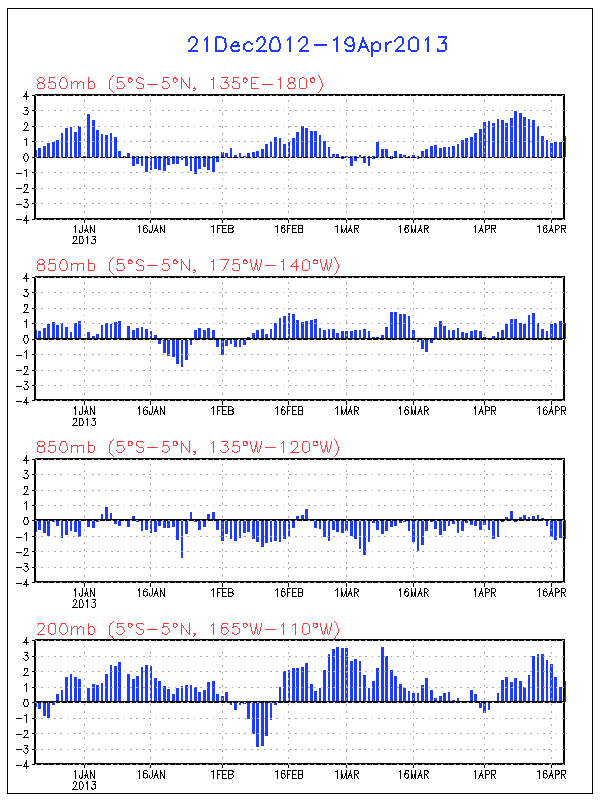
So, I think that provides a nice perspective on the ENSO.
The data used in this post can be obtained here.
http://www.cpc.ncep.noaa.gov/data/indices/
http://www.cpc.ncep.noaa.gov/data/indices/sstoi.indices
Chris Schoneveld (04:11:10) :
I believe Leif has been doing that for all of his professional career. As Grand Exalted Keeper of the Sword of Reason (i.e. his alternate title of pointer-outer of there not being enough energy in that mechanism as far as we know) he’s done a yeoman’s job of keeping the speculation under control. He’s mentioned many times that whenever a new mechanism is proposed, he checks to see if it has promise.
We’re entering a couple good decades of Interesting Solar Stuff, so rejoice in the new data and fading sunspots.
In the meantime, the PDO (or PDO+AMO or even PDO+AMO+TSI) seems to be the best torch to illuminate our climate.
Bernie (05:54:00) :
“The strength of the vertical movement is controlled by the same factors that control atmospheric convection elsewhere. Lapse rates, humidity and heat input are important.”
I agree with wholeheartedly with that statement.
The distribution of land and sea, the size of mountain ranges and the spinning of the Earth on its axis in 24 hours are also important influences.
Speed of spin will effect velocity of east west versus north south circulation. But speed of spin does not change materially.
The Andes dry the trade winds and their presence results in the establishment of a near stationary high pressure cell of dry, ozone rich air in the south east Pacific. That air is very cold because it includes a relatively larger component of higher altitude air. In other words the pressure cell is vertically very deep. The dryness of the air is associated with strong penetration of ultraviolet. Look at any map showing world wide distribution of ultraviolet B and you see that the Andes is a hot spot.
The strength of descent in a vertical column of air relates to the supply of very cold air from above. Warm the air at its entry point into this high pressure cell and you will stall the circulation.
Stall the circulation in the East Pacific and you weaken the east-west component of the Trades.
The strength of the east-west component of the trades across the Pacific also depends upon the strength of uplift over the Indian Ocean and Indonesia.
A primary feature of an El Nino event involves the weakening of the eastern high pressure cell. The low pressure zone over Indonesia also weakens and a new one is established near the date line. Precipitation increases between the mid Pacific and Chile as the ocean warms, weakening the high pressure zone in the east from below.
So, the primary feature of El Nino is a change in the surface pressure difference between the East Pacific and Indonesia.
Add one more factor. When the northern hemisphere faces the sun the pressure difference between east and west pacific collapses. See figure 3 in http://climatechange1.wordpress.com/2009/01/02/the-southern-oscillation-and-the-sun-2/
You can see that in southern hemisphere spring the pressure difference across the Pacific usually increases. El Nino events manifest by March. They appear when the usual strong summer pressure differential across the Pacific fails to establish.
The requirement for loss of summer pressure differential is high ozone content in the upper troposphere at 30-60° south latitude and a greater incidence of ultraviolet radiation.
There is strong variation in ozone content in the stratosphere (and the upper troposphere) between 30° and 60° south with large anomalies south of Australia and in the East Pacific.
One major driver of ozone content in the southern hemisphere is the incidence of energetic particle precipitation events that are solar driven and vary with geomagnetic indices.
The greater the volume of air that is entrained in this tropical circulation that is called the Hadley Cell, the further south the high pressure cells travel and the wider is the relatively cloud free area between these cells and the Equator.
This will be too much for Leif despite his brilliance in other areas but I hope that some others might catch my drift.
Another little wrinkle. Sudden stratospheric warming events manifest in the Arctic when the ozone content is high in northern latitudes. This gives rise to enormous variations in temperature in the polar stratosphere between December and March. High temperature in the Arctic is strongly associated with warming seas in the tropics. This is also indicative of an ozone/UV link in determining temperature in the stratosphere, upper troposphere and the tropical oceans.
erlhapp (15:20:18) :
One major driver of ozone content in the southern hemisphere is the incidence of energetic particle precipitation events that are solar driven and vary with geomagnetic indices.
This will be too much for Leif despite his brilliance in other areas but I hope that some others might catch my drift.
What is too much for me is the vague language. You omitted to say that this may be the case for the mesosphere and the high stratosphere [where it has little or no effect on anything at the surface], not the unqualified whole ‘southern hemisphere’ at all levels. Second, UV and not energetic particles [that do not penetrate lower than 90 km] controls ozone, and the ‘relationship’ with geomagnetic indices is tenuous [no sign of it in the northern hemisphere – I know you did say the ‘southern’, but if it is not spurious it should have been in both] and could be because solar activity and geomagnetic activity happened to be correlated.
Leif
In Northern winter we frequently see temperature jump by 50°C in the middle to upper stratosphere in the Arctic.
The high temperature in the Arctic stratosphere propagates from top down with an increasing lag and more persistent anomaly the lower it goes. The heating following the mid January event has long disappeared at 1hPa at this time but persists at 70hPa and it was still close to an all time high at that level on 18th February. (http://www.cpc.ncep.noaa.gov/products/stratosphere/temperature/index.shtml).
At http://www.cpc.ncep.noaa.gov/products/stratosphere/strat-trop/gif_files/time_pres_TEMP_ANOM_ALL_NH_2009.gif
you will see that the heating went all the way to the surface and has been well and truly in evidence at 300hPa for a month now.
That warm air in the Arctic came from outside the polar zone and persists despite the lack of light. It split the Arctic vortex and reversed the wind direction in the stratosphere.
The temperature in the stratosphere over the Equator fell at exactly the same time and the anomaly manifests in the same way. Consequently we have a persistent cooling in the mid to lower stratosphere over the equator where there is plenty of light.
The question is why?
My suggestion: Atmospheric redistribution favoring enhanced atmospheric depth over the equator and thinning between 30-60 latitude. That will enhance the penetration of UV into the upper troposphere in the anomalously ozone rich area of the east Pacific and a similar area in the southern ocean between Australia and Antarctica.
I think the stalling of the high pressure cell to the south of Australia as it warmed at the top of the troposphere was materially involved in the increase in northerly wind that drove south across Victoria (Australia) resulting in record temperatures over the last month and the bushfire event.
Every skeptic should be required to say this quote before opening their mouth to opine about global climate: “You do not combat the bad science of AGW with even worse science.” Leif Svalgaard 05:24:43
By the way, can someone lead me to a web site with real-time measurements of trade winds? I am just plain ol’ excited about adding that measurement to my daily trip through weather “stuff”!!!!
I know, I kown. I need to get out more often.
Damn. One glass of red wine and I type like this: I kown, I khown, I cneeed to gett out t more otften.
Leif Svalgaard (15:52:01) :
“Second, UV and not energetic particles [that do not penetrate lower than 90 km] controls ozone, and the ‘relationship’ with geomagnetic indices is tenuous [no sign of it in the northern hemisphere – I know you did say the ‘southern’, but if it is not spurious it should have been in both] and could be because solar activity and geomagnetic activity happened to be correlated.”
Wrong.
http://www.atmosp.physics.utoronto.ca/SPARC/SPARC2008GA/Oral/day3_Hood.pdf
Energetic Particle Precipitation (EPP) drives production of NOx and HOx which destroys ozone, mainly at high latitudes. This occurs in both hemispheres but the relationship with geomagnetic indices is only strong in the southern hemisphere where the vortex is maintained summer and winter. There is no relationship with F10.7 in either hemisphere.
The impact of the Antarctic vortex in depleting ozone content is apparent in this paper: http://exp-studies.tor.ec.gc.ca/e/ozone/Curr_allmap_g.htm
I quote:
“the impact of ozone-depleted air mass occurrences on ultraviolet radiation is evaluated by relating total ozone and UV erythemal dose measured at the stations. Twofold or threefold UV dose increases were reached in the 55°–65° southern latitude region during vortex overpasses”.
Hence the positive ozone anomalies in the southern hemisphere are located between 30 and 60° latitude. When there is a strong positive anomaly outside the Arctic we can get a SSW in Antarctica like that in 2002 and perhaps it is associated with the strong warming like that that afflicted the Northern hemisphere in 2003. There is certainly a strong relationship between stratospheric temperature in the Arctic and sea surface temperature in the tropics of the southern hemisphere so I imagine it works the other way too.
The strength of the Antarctic vortex varies with the energy supplied to the tropics and can be seen in an inverse relationship between temperature variation in the tropics versus Amundsen Scott at the South Pole. This is responsible for the fact that Amundsen Scott has cooled while the tropics have warmed. A very small temperature increase in the tropics is associated with a massive fall in temperature at the South Pole.
This relationship is apparent in the Arctic only in Northern winter. Its too warm in summer.
Follow the reasoning and you can see that the Antarctic vortex weakens during La Nina cooling events and stratospheric ozone content will then rise in the southern hemisphere. That makes the transition to El Nino more likely.
erl. Buddy. Have a Coors. You can talk mechanism all you want, but if ozone variations (which have been measured) don’t coincide with temperature changes (which have been measured), ya got to move on! I got myself all in a lather over the ozone hole over Oregon (hey, give me some slack, being a redhead and all, ozone protects me from the Sun!) this past Summer. It was interesting to watch the ozone thin during the day and then thicken up at night. The thinning spread over a larger and larger span of the western states.
But here’s the thing. The thing that kept pinging on my head (not to mention Leif questioning my questions about ozone) is that it did not feel any hotter or colder than usual. And by usual I mean the usual variations that occur with a cold or warm Pacific. I eventually led myself back to weather. Yes weather. Not climate. I re-introduced myself to the old standby definition of climate and returned to weather pattern variation. I think I am on the right track. It ain’t glamorous and sounds a bit “Farmers Almanac-ish”. But it seemed to work for old time farmers. “Earl, what’s the weather like?” “Let me take a look Billy. Looks like its gonna rain.” So I think it will work for me.
Pamela,
“if ozone variations (which have been measured) don’t coincide with temperature changes (which have been measured”
Can you be a bit more specific? Like where and when? Where exactly do you think I am going wrong?
erlhapp (18:53:52) :
Wrong:
Energetic Particle Precipitation (EPP) drives production of NOx and HOx which destroys ozone, mainly at high latitudes.
As usual, you only run with half [or less] the story. First, these things are relevant only at very high altitudes, second [and more importantly], the SEP events are rare [a few per solar cycle] and cannot be said to ‘control’ the Ozone production.
Humm? ocean tempertures drive hurricanes, so maybe they can both drive and be driven by trade winds. “Action and reaction are thus equal and opposite”
Ozone is not well mixed or evenly spread. The atmosphere and its winds move it here and there. It is thick in one place, then thin in that same place the next day or week (and I am only speaking relatively here, the changes are actually quite small). If a lack of ozone causes temperature changes it is as hard to nail down as jello to a tree. Besides, how much change do you expect? The change in temperature, under the current conditions, as a result of ozone affects are as small as CO2, compared to the cold wind that blows up your skirt from an Arctic blast. I think you will find a much greater correlation between long term temperature changes when El Ninos dominate or La Ninas dominate. And it looks like those are partly due to a Pacific Oscillation that may be due to some kind of conveyor belt and/or equatorial trade wind. And the trade winds are due to a dance between the Earth’s rotation and temperature differentials. So if the trade wind is strong or week based on a temperature difference along its sides, you would need to measure ozone along this band, and then only under the conditions you suppose. When the Sun is blank of sunspots.
Here ya go:
http://exp-studies.tor.ec.gc.ca/e/ozone/Curr_allmap_g.htm
Pamela
200hPa at 20-30°S increased by 2°C between 1975 and 1983 for when sea surface temperature at the same latitude increased by 0.2°C . At the Equator sea surface temperature rose by 0.5°C over the same period.
Erl
The Andes dry the trade winds and their presence results in the establishment of a near stationary high pressure cell of dry, ozone rich air in the south east Pacific. That air is very cold because it includes a relatively larger component of higher altitude air. In other words the pressure cell is vertically very deep. The dryness of the air is associated with strong penetration of ultraviolet. Look at any map showing world wide distribution of ultraviolet B and you see that the Andes is a hot spot.
I remember seeing on the TV about people in Patagonia needing to take protective measures because of a higher incidence of skin melanomas there. This is consistent with Erl’s observation of a higher incidence of UV in the southern Andes.
This maybe has an effect on the antarctic peninsula too Erl? Part of the reason for the increasingly high temp anomalies there perhaps? To move your ideas from ‘weather’ timescales to ‘climate’ timescales, can you point to long term changes in particular indices which would support that? I beleive Leif said something about long term changes in UV levels being partly instumental artifacts in the record. Perhaps he could clarify too.
Leif Svalgaard (20:58:34) :
“As usual, you only run with half [or less] the story. First, these things are relevant only at very high altitudes, second [and more importantly], the SEP events are rare [a few per solar cycle] and cannot be said to ‘control’ the Ozone production.”
Your complaints run from one extreme to the other. Mostly too much information much of which is irrelevant and now only half [or less] the story.
Obviously more than one factor controls ozone production and the number and strength of the factors vary from place to place. In the Antarctic where the vortex is strong all year, SEP events play a part as I am sure they do in the Arctic. This is just one mechanism via which the sun influences stratospheric ozone. It is likely to be a more important mechanism in Antarctica where the more active vortex brings the NO agents into the stratosphere.
The first couple of points of the conclusion of Hoods paper are:
1. There is some consensus now that total column ozone varies
significantly with the solar cycle, especially in the tropics.
2. A recognition is emerging that the vertical structure of the ozone
response at low latitudes is characterized by two peaks, one in
the upper stratosphere and one in the lower stratosphere. The
lower stratospheric response is the main cause of the total ozone
variation.
The big unrecognized sleeper in ozone control is atmospheric water vapour. On ENSO time scales rising sea surface temperature in the tropics is associated with falling temperature in the tropical stratosphere. The relationship is very consistent up to 30hPa. see http://climatechange1.wordpress.com/2009/02/04/a-cooling-story-involving-ozone-the-sun-and-the-sea/
Again, its the ENSO time scale that is important, not the solar cycle time scale.
tallbloke (23:51:58) :
To move your ideas from ‘weather’ timescales to ‘climate’ timescales, can you point to long term changes in particular indices which would support that?
The climate shift of 1978 manifests as a strong lift in 200hPa temperature globally with the most extreme change at about 30° of latitude in both hemispheres, a pronounced fall in sea level pressure in the south East Pacific, a jump in sea surface temperature in the tropics, the transition between solar cycle 20 and 21 and a hike in the aa index of geomagnetic activity that has slowly sunk along with 200hpa temperature from that time forward.
The expansion of the Hadley cell at that time is reflected in a southward shift of the the high pressure cells and the jets in the southern hemisphere. This affects the precipitation pattern in Chile.
Chile stretches from 30°S to 56°S. Its climate changes over time according to the shift in the high pressure cells that divide the south east trades (dry regime) from the westerlies (wet regime). The following is extracted from ‘The Physical Geography of South America’ OUP, 2007 by Thomas T. Veblen, Kenneth R. Young, A. R. Orme
“Along the west coast as far as 42°S Mediterranean type precipitation seasonality is associated with the summer presence of a subtropical high pressure cell in the southeastern Pacific. Year-to-year variation in the intensity and latitude of this cell is the major determinant of the variation in annual precipitation in the mid latitudes of the southern Andes. Farther south the seasonal distribution of precipitation is relatively uniform with stormy conditions prevailing year round.
South of 40°S, glaciers retreated during a warming from 1080 to 1250 AD, approximately coincident with the Medieval Warm Epoch of the Northern Hemisphere.
That retreat was followed by a cool, moist trend that peaked about 1340—1640, overlapping with the Little Ice Age of the Northern Hemisphere
The mean annual temperatures reconstructed for the Andes at 37 to 55°S for the period 1900 to 1990 are 0.53 to 0.86°C above the mean for 1640-1899 AD. The rate of temperature increase from 1850 to 1920 was the highest over the past 360 years (Villalba et al., 2003).”
My point is this: ENSO is climate change in action. Sea surface warming is linked to cloud loss. Ice cloud is lost as soon as the upper troposphere warms. The temperature of the upper troposphere is linked with ozone behaviour in the stratosphere and the latter has numerous influences that all come back eventually to the sun.
Erihap and Bob Tisdale,
Thank you for your comments. I do not have a place to post these graphs on the net However the three graphs are available at:
http://www.lavoisier.com.au/articles/greenhouse-science/solar-cycles/IanwilsonForum2008.pdf
if you look at slide numbers 24, 28 and 37.
Bob, I know that you are in the camp that believes that PDO is just a cumulative manifestation of the long term behaviour of the ENSO. However,
I have actually read the papers that you site and I have to say that the conclusions of these papers are in direct contradiction to the
observations (see slide 24).
The model given in these papers that is used to explain the PDO cannot explain why the intensity of the ENSO events progressively get stronger while the PDO remains positive. Nor can they explain why the ENSO events progresively get weaker while the PDO remains negative.
You would not get this observable result If the PDO was a cumulative manifestation of the underlying ENSO activuty. Hence, as a scientist, I cannot accept the conclusions of these papers, to do so would require me to ignore the observational evidence.
Could you please look at this slide [i.e. no. 24]. All of the data shown in this
slide has been [or soon will be] published in perer-reviewed journals – and
explain how your model for the PDO could possibly explain the trends seen in data.
Leif
Back at erlhapp (16:20:40) :
The question is why?
Bill Illis: I went to answer Pamela Gray’s question above about links to the trade wind data when I discovered there appears to be a typo in your description above.
In the sixth paragraph of the post, you wrote, “Here is a chart of the Nino 3.4 region temperature anomaly (which is the most consistent measure of ENSO conditions) versus the Trade Winds from 120W to 175W.” But the link you provided for winds did not have a dataset for 120Wto 175W.
http://www.cpc.ncep.noaa.gov/data/indices/
Under winds, they have the following datasets:
200 MB Zonal Winds Equator (165W-110W)
850 MB Trade Wind Index(135E-180W) 5N-5S West Pacific
850 MB Trade Wind Index(175W-140W) 5N-5S Central Pacific
850 MB Trade Wind Index(135W-120W) 5N-5S East Pacific
Two of them contain one of the coordinates you listed. So, which one did you use?
Thanks
Bob, I put the 120 to 175 datasets together weighted for the size covered by each.
(There is 5 degrees coverage missing but you have to work with what is available. I didn’t think it was important enough to get into in the short post space that is available.)
There is a lot more technical science and theory that could have been discussed in the post like the Walker-Circulation model (from 1923), the Madden-Julian oscillation (which in my mind shows how the ENSO helps drive the PDO and you can see this in the animations of the ENSO region), how the thermocline reacts during ENSO events, Kelvin Waves etc.
The data says there is no reason to make this very complicated and the data doesn’t take you to a theory called the Walker circulation – it takes you to a very simple and a very explanatory “the Trade Winds”. And they are updated daily.
Given the shortage of space and the fact there was no reason to over-complicate this, I didn’t get into everything.
http://en.wikipedia.org/wiki/Walker_circulation
http://en.wikipedia.org/wiki/Madden_Julian_Oscillation
erlhapp (00:33:36) :
1. There is some consensus now that total column ozone varies significantly with the solar cycle, especially in the tropics.
2. A recognition is emerging that the vertical structure of the ozone response at low latitudes is characterized by two peaks, one in the upper stratosphere and one in the lower stratosphere. The lower stratospheric response is the main cause of the total ozone variation.
I don’t know that these conclusions were ever in doubt as the UV that creates the ozone in the stratosphere varies with the solar cycle. They are just irrelevant for the discussion.
Leif,
“The GHGs sends some of the long-wave radiation back to the surface, heating it up some more, adding to the heating. Why is everybody so hung up on CO2. H2O is much more important. Even O3 makes a contribution. Basically, you need a [at least] tri-atomic molecules to get enough IR absorption. ”
If oxygen and nitrogen absorb heat, then clearly they radiate heat. What I conclude is that our air is heated without the help of GHG’s or without a molecule requiring 3 atoms. I am not saying that GHG’s do not add to the heating, but I believe it is impossible for CO2 to have a “significant” impact on heating the remaining 99.9% of our atmosphere.
I am hung up on CO2 because our fearful leaders are about to tax/offset CO2, yet we have no idea how much warming is atrributed to it. This is known as taxation without representation, which is one of the reasons America declared it’s independence from England. Taxation without representation… it lead to a Revolution.
We will soon have the taxation. Where is the representation? The greenies/neo-marxists are treading on thin ice as far as I am concerned. Hopefully, with time, they will drown this nonsense before it causes more economic damage.
With that, we must extract American oil NOW. The revenue and savings generated from home-grown American energy will STIMULATE our economy. We are facing an economic crisis. Is there a [better] time to tap our own reserves? This will help buy us time to recover economically and help pay for alternative energy. Drill here, drill now!
Al Gore and his blind sheep are only fueling the problem. This is simply more proof that extremists, sometimes unknowingly, erode the pillars of national security.
I believe that the planet is not anthropologically unstable. Some of the people are.
Erl, In the current situation, in Oregon, Washington, Idaho, and California we are seeing both high and low records. And all the combinations of these types of events. Record low daily high, record high daily high, record high nightly low, record low nightly low. In other words, hanging near normal. Not AGW CO2 laden hot, not freezing little ice age butt aching cold. If you think there is a correlation, you need to place temperature anomalies in a graph with ozone anomalies, and over several Sun cycles that would also include several ENSO-related cycles. Then the task would be to determine which cycles are just along for the ride and can be eliminated (it is possible in such a short time span that you just happen to be measuring disconnected cycles that are currently in sync). Not an easy task.
Here is the way to do it. If you understand the actual mechanisms, chemically and mathematically, you can begin eliminating these various cycles and potential sources from the mix in your graph. For that you need to go to the experts in each of those areas and ask them. And then listen to their explanation. If the mechanism for any one of these variables is not there for the trends in your graph, you can eliminate that source as a cause of the wavy trend, even if they ride the wave together.
Otherwise, you are going to have to learn how to create models, assigning weight to your potential causes and running the models to duplicate the past, and then run it ahead to see if it can predict the future. I don’t think that has been done before.
RICH (06:48:54) :
If oxygen and nitrogen absorb heat, then clearly they radiate heat. What I conclude is that our air is heated without the help of GHG’s or without a molecule requiring 3 atoms.
Most of your post is just politics, not science. [and there are millions of taxpayers (all green-card holders, for instance) in the US that have no representation already, I don’t see a revolution coming]. Back to science. If there were no tri-atomic molecules in our atmosphere [no H2O, for instance], the Earth would be a very cold place.