Guest post by Bill Illis
We have often wondered what really causes the El Nino Southern Oscillation (ENSO) climate pattern. It is generally understood and this post will demonstrate that it is really driven by the Trade Winds over the ENSO region.
The Trade Winds blow East to West at the equator. Most of us living in other latitudes expect the wind and the weather to primarily come from the West but, at the equator, the weather comes from the East.
When the Trade Winds are stronger than average for a sustained period of time, the Trades literally blow or drag the warm surface water across the Pacific and it is replaced by colder upwelling ocean water from below. If the Trades are strong enough for a long enough period of time, we have a La Nina.
When the Trades are weaker than average for a long enough period of time, the ocean surface stalls in place and gets heated day after day by the equatorial Sun and we have an El Nino. Sometimes, this stalling even results in warmer ocean water from the Western Pacific moving backwards into the Nino region and this also contributes to El Nino conditions.
Let’s look at the data to see how true this assertion is.
Here is a chart of the Nino 3.4 region temperature anomaly (which is the most consistent measure of ENSO conditions) versus the Trade Winds from 120W to 175W. The Trade Wind data is for 850 MB pressure or about 3,000 feet.

Click for a larger image
To see this correlation a little better, I’ve reversed the sign so that weaker Trade Winds are shown as positive values and stronger Trade Winds are shown as negative values. I’ve reduced the anomaly in meters per second by half as well so the scale is roughly the same as the ENSO.

Click for a larger image
I can’t imagine seeing a better explanation of what drives the ENSO than this.
For some perspective on the Nino regions and the latitude, longitude figures in question here, this is a map of the region produced by the Climate Prediction Centre.

I think you can see this impact in action if you watch an animation of the ENSO region over time. Let this SST anomaly animation load up, then speed it up as fast as your computer will allow and you can see the Nino region waters and temperature anomalies literally move across the Pacific with the Trades.
http://www.osdpd.noaa.gov/PSB/EPS/SST/anom_anim.html
But what drives these Trade Winds? I don’t really have an answer for that question.
The Southern Oscillation Index (SOI) was previously used as an indicator of these winds over the Nino regions. The SOI is a measure of the difference in air pressure between Tahiti and Darwin, Australia. The theory being that high pressure blows toward lower pressure which can provide some indication of the Trade Winds in the Nino region. There is certainly a correlation of this measure to the Nino 3.4 anomaly. In fact, the measure even lent its name to the ENSO.
I’ve found, however, the SOI consistently lags a little behind the Nino region temperatures and the Trade Wind measures so I believe it is more a result of the overall climate pattern rather than a leading indicator. I’ve also found no real correlation to the Pacific Decadal Oscillation or any of the other Oscillation Indices which are sometimes used to predict or measure the ENSO.
There is one leading indicator, however, which provides some predictive power – the Trade Winds just to the West of the Nino area. These Winds are, most often, concurrent with the Nino region Trade Winds but occasionally, they provide a ramp-up which might kickstart the ENSO. The West Trade Winds were a leading indicator of the Super El Ninos of 1982-83 and 1997-98 for example.

Click for a larger image
Unfortunately, I don’t know what drives these Western Trade Winds either, but they are currently pointing to a strengthening of the La Nina conditions which currently exist.
I also wanted to show more closely how the ENSO impacts global temperatures.
The warm or cold ocean conditions of the ENSO eventually impact the Tropics troposphere temperatures and this seems to be quite a direct impact with a lag of 2 to 3 months.

Click for a larger image
The Tropics temperatures then propagate out to the rest of the world with a small lag that may be up to 1 month but is more commonly concurrent with the Tropics anomalies.


Click for a larger image
The Trade Winds drive the ENSO, and the ENSO directly impacts the Tropics temperatures and the Global temperatures.
Who would have thought that Winds in some small region of the Globe could be so important. You can keep track of these Trade Winds on a daily basis at the Climate Prediction Centre.
http://www.cpc.ncep.noaa.gov/products/precip/CWlink/daily_ao_index/zw/zw.obs.gif
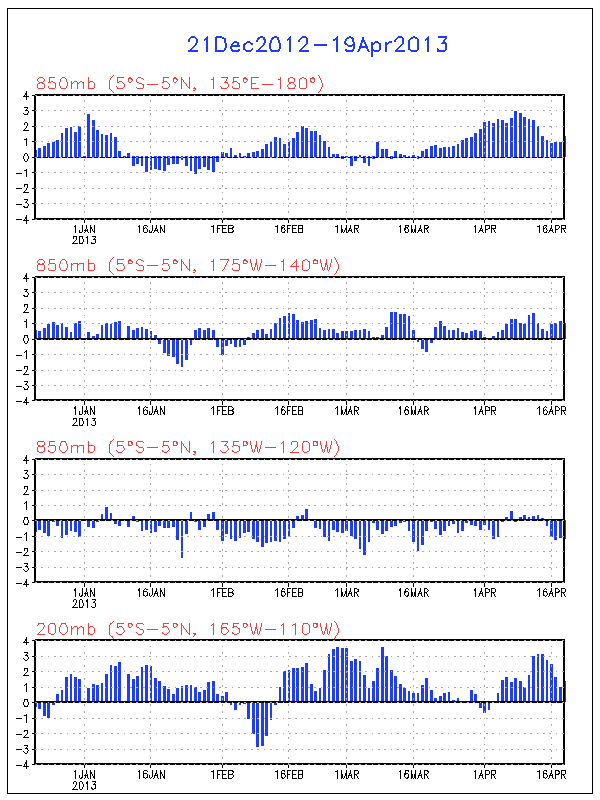
So, I think that provides a nice perspective on the ENSO.
The data used in this post can be obtained here.
http://www.cpc.ncep.noaa.gov/data/indices/
http://www.cpc.ncep.noaa.gov/data/indices/sstoi.indices
“But what drives these Trade Winds? I don’t really have an answer for that question”
Just read Marcel Leroux…
Erl Happ (08:36:52) :
When the intensity of ultraviolet light from the sun increases, temperature rises in this ozone rich air and weakens the downdraft…
In short, its the sun.
No. The amount of ozone in the upper troposphere depends on dynamical processes [waves] and transport mechanisms between controlling the downward intrusions of ozone from the stratosphere, thus driven from below. Solar activity has little [if anything] to do with this.
I wish the term “driver” were not so attractive. It means or implies “controls, steers, forces, compels”, all seemingly in a linear system, e.g., continuous movement towards a goal. The intensity of our desire to find the driver of earth’s weather and climate seems to pull us away from appreciating dynamic or chaotic systems and disenables us from the pleasure of understanding fundamental conditions.
The idea of control (of the driver) also seems to be what energizes the AGW/evil-CO2 camp and gives them the emotional impetus to appeal to a world-wide audience (along with billions, no, make that trillions, of dollars). WUWT enables readers to include an increasing level of complex thinking (and sometimes it hurts), but the desire for “a” or “the driver” continues. IMO as long as the search for linear causation continues, the scientific community will always be on the losing end of the politically motivated pseudo-science. People hear what they want to hear — unless they can bear the pain of understanding for a later, greater good, and maybe even joy.
Similarly, the concept of “the greenhouse” or GHG, when used by the scientific community seems to me to compound the problems of explaining the conditions of solar system, atmosphere, weather, and climate to a larger audience. Greenhouses are created by humans and under our “control”.
Is there a way to clarify the language to help people understand the scientific concepts on their most fundamental level without an appeal to the most basic of human emotions and desires — love and control. Translation: we love our home the earth so much we must find the driver that is destroying paradise and excise it. IMO, this attempt will involve some mental pain, but might be worth the effort.
“In short, its the sun.”
I suspect when we get right down to it, the sun is ultimately driving this mechanism. Maybe not with direct radiation, maybe its magnetic, I don’t know. But if I were a betting man, I’d place a large amount on the sun as the primary influence on ENSO. One way or another…
The Trade Winds blow East to West at the equator.
I never realized that. It makes sense if you consider inertia forces as the atmosphere tappers off with altitude.
We need to take all of our windmills and use them to power windmills in Africa so we can regulate our weather using the trade winds!
Insurgent:
The winds are caused by the linear speed differences caused by rotation. Winds at the equator have to travel faster to keep angular movement equal to the winds at say Montreal. But that would mean a tremendous energy force. But this does not happen. What we get instead are winds at the equator that are slower than the earths rotation. The rest of the earth rotates, and counter winds flow the other way. (Creating tornadoes if conditions are right) Every rotating body has levels of counter-rotating winds, with the winds at the center being opposite the direction of rotation.
These winds also dragon the surface and can reduce or speed angular rotational speed. This then either increases or decreases the accumulated heat, respectively, which modifies the global wind flows.
JamesG (04:22:42) :
I gather from readings elsewhere that there are Earth processes that significantly lag changes in LOD and others that significantly lead it.
Details man, details!
🙂
This thread is fantastic!
Kudos to Anthony for bringing some great researchers and theorists to the table.
What a feast.
In addition to finding studies which state that winds cause ocean currents, compare any diagram of trade winds to a diagram of surface ocean currents. The wind blows the water against a continent, and surface currents flow as best they can around the shoreline.
Bill Illis – Great post in explaining the trade wind links to La Nina/El Nino.
Magnetosphere modulating cosmic rays
On what causes those, one possible cause is variation in earth’s magnetosphere modulating galactic cosmic rays which affect cloud nucleation, which in turn affects the radiated vs absorbed insolation. The higher cloud density near the tropics would result in variation in ocean surface temperatures more in the tropics than in temperature regions.
Marsh (2003) shows correlation between galactic cosmic rays and El Niño–Southern Oscillation trends. Brown (2008) shows about short term correlations between 3% cloud cover variations and cosmic radiation.
The magnetosphere in turn may be modulated by solar cycles and/or internal field dynamics. Rusov et al. (2008) propose internal dynamics modulating cosmic rays.
2009 studies show cosmic rays storms have a strong impact on stratospheric temperatures. e.g. 40 deg C changes.
Following some references to these issues.
David
A brief summary of cosmoclimatology Danish National Space Center
Svensmark, Henrik, Cosmoclimatology: a new theory emerges. A & G, February 2007, Vol. 48 #1, 18-24
Marsh, Nigel, Galactic cosmic ray and El Niño–Southern Oscillation trends in International Satellite Cloud Climatology Project D2 low-cloud properties, J. Geophysical Research, V. 108, No. D6, 4195, doi:10.1029/2001JD001264, 2003
Brian H. Brown, Short-term changes in global cloud cover and in cosmic radiation, Journal of Atmospheric and Solar-Terrestrial Physics Volume 70, Issue 7, May 2008, Pages 1122-1131 See: Whiterose Online copy
“There is an association between short-term changes in low cloud cover and galactic cosmic radiation over a period of several days. This could arise if approximately 3% of the variations in cloud cover resulted from GCR.”
Rusov, V; A. Glushkov, V. Vaschenko, O. Mihalys, S. Kosenko, S. Mavrodiev, B. Vachev, Galactic Cosmic Rays – Clouds Effect and Bifurcation Model of the Earth Global Climate. Part 1. Theory, Atmospheric and Oceanic Physics, (2008) In Press arXiv:0803.2765v2
Rusov, V; A. Glushkov, V. Vaschenko, О. Mihalys, S. Kosenko, S. Mavrodiev, B. Vachev, Galactic Cosmic Rays – Clouds Effect and Bifurcation Model of the Earth Global Climate. Part 2. Comparison of Theory with Experiment. Atmospheric and Oceanic Physics, (2008) In Press arXiv:0803.2766
Cosmic rays detected deep underground reveal secrets of the upper atmosphere, A joint press release issued by the UK’s National Centre for Atmospheric Science (NCAS) and the Science and Technology Facilities Council (STFC), 21st January 2009
http://www.ncas.ac.uk/index.php?option=com_content&task=view&id=446&Itemid=249
Knudsen , Mads Faurschou & Riisager, Peter. Is there a link between Earth’s magnetic field and low-latitude precipitation? Geology 2009;37;71-74 doi:10.1130/G25238A.1
http://geology.geoscienceworld.org/cgi/content/abstract/37/1/71
srchuck (07:05:41) :
Don’t overlook tallbloke’s comments above.
We know LOD varies continually, partly a function of seasonal distribution of ice mass and partly a function of variable magnetic coupling betwixt sun and earth.
We know that as the rotational rate derivative changes, angular momentum is transferred between solid and fluid (atmosphere and ocean). (GLAAM is a poor measure of this.)
Hi srchuck! You’re right about GLAAM, I meant zonal ACI (Atmospheric Circulation Index)
http://www.fao.org/docrep/005/Y2787E/y2787e03a.htm
For the delight of GWrs:”An ice sheet of 14,000 square kilometres has broken off..”
http://www.earthtimes.org/articles/show/256191,researchers-spot-huge-split-in-antartic-ice-shelf.html
The GWrs marching in!: http://news.ino.com/headlines/?newsid=68966926665790
Andre Tahon (22.47.47) “Something else to ponder on;
in the Northern hemisphere water, when in a bath, will, when the plug is pulled will turn in an anticlockwise direction. In the Southern hemisphere it goes down the hole in a clockwise direction, I think Sir, all is not as simple as it seems, as gravity has a very important part to play in our weather systems.”
Untrue.
http://www.snopes.com/science/coriolis.asp
To really assess the impact on global temperatures from ENSO it would be interesting to extract the tropical component of the global temperatures to look at the “rest of the world”. Just a quick glance at your last graph suggests that there would be a more muted response (expected), but also a possible time lag, and some curious -ve anomalies in relation to the drivers seen in your first two graphs.
RE RECENT ARTICLE by Dr . Vickey Pope called “SCIENTISTS MUST REIN IN MISLEADING CLIMATE CLAIMS”
By Matt Vooro
http://icecap.us/images/uploads/PDO_and_AMO_Are_the_Real_Pacemakers_for_Climate.pdf
I totally agree that scientists should refrain from making misleading climate change claims. I think the whole issue that climate change is primarily caused by manmade greenhouse gases is misleading. Natural earth/ocean climate cycles like PDO,AMO, NAO and ENSO are not even talked about by these same alarmists. IPCC climate models are strangely silent on them too. Now I wonder why? How can one trust any climate models that omit the key climate drivers.
The Pacific and Atlantic Ocean temperature oscillations as measured by the PDO, ENSO, SOI , AMO , ETC indices are prime drivers of our climate. The droughts, hot spells, rainy weather and cold spell all have their origins in the temperature oscillations of these ocean climate makers that have existed for thousand of years and explain the natural variability of the global climate. The paper here well illustrates this point.
Adolfo Giurfa (11:46:34) :
For the delight of GWrs:”An ice sheet of 14,000 square kilometres has broken off..”
http://www.earthtimes.org/articles/show/256191,researchers-spot-huge-split-in-antartic-ice-shelf.html
“The scientists pointed out that such a disintegration of an ice sheet would lead to rising sea levels.”
Is the ice shelf in question over land? Will the loss of weight cause the land to rise more than the offset in melting ice (4C denser than 0C)?
Lame-man here…
Is there a correlation between PDO, AMO and the solar cycle
Awhiile back I did a quick look at the Spotless years, then added ~2years as it might take awhile for the oceans to show effect, then I looked at the graphs of PDO an AMO….it seems that PDO and AMO spike negative/and don’t spike positive after spotless years.
Spotless years graph
http://icecap.us/images/uploads/Sunspotless_days.JPG
pdo data
http://jisao.washington.edu/pdo/PDO.latest
pdo graph
http://jisao.washington.edu/pdo/
amo data
http://www.cdc.noaa.gov/Correlation/amon.us.long.data
AMO graph
http://upload.wikimedia.org/wikipedia/co…. resent.svg.png
Talking of wind… it seems that wind turbines can create heat islands miles down. Take a look at this http://www.sciencedaily.com/videos/2005/1012-wind_farms_impacting_weather.htm and the video.
Anthony, have you noticed a rise in temperature on stations located down from a wind farm? If it is true, is Hansen correcting for this effect?
Sun Heats Earth (+ve anomaly)
Sea Surface Warms
Winds Drop Off, Hurricanes Lessen
El Nino Conditions Build Up
Landmasses Warm Up
The oceans have 10,000 times the thermal capacity of the atmosphere. YET… as Bill Illis suggests to me with such poetry, the air’s kinetic energy then seems to make up for its poor thermal capacity.
THANK YOU ALL.
OT, but regarding several recent topics:
2008-12-16
Starting this month, the data will be held, investigated, and potential problems reported to and resolved with the data provider before making them public.
http://data.giss.nasa.gov/gistemp/
Leif Svalgaard (09:12:47) :
Erl Happ (08:36:52) :
When the intensity of ultraviolet light from the sun increases, temperature rises in this ozone rich air and weakens the downdraft…
In short, its the sun.
No. The amount of ozone in the upper troposphere depends on dynamical processes [waves] and transport mechanisms between controlling the downward intrusions of ozone from the stratosphere, thus driven from below. Solar activity has little [if anything] to do with this.
The absorption of ultraviolet light by O2 produces two O atoms which then combine with O2 atoms producing ozone (O3) and releasing heat energy. When ozone absorbs ultraviolet light, it splits into O2 and oxygen atoms and also releases heat energy. The net effect of the reactions above is to convert light energy into heat energy. I’m pretty sure that the ultraviolet light comes from the sun/solar activity.
Also, this reference http://www.jamstec.go.jp/frcgc/jp/press/040316/index_e.html indicates that Erl’s assumption is correct.
David L. Hagen (11:23:23) :
Magnetosphere modulating cosmic rays
On what causes those, one possible cause is variation in earth’s magnetosphere modulating galactic cosmic rays
The Sun’s heliosphere, not the Earth’s magnetosphere for time scales we care about. On very long time scales, e.g. millennia, the Earth’s magnetic field controls the access of cosmic rays.
The account of El Nino that I read claimed that heavy fresh water rains in Indonesia contributed to El Nino spilling out into the larger Pacific.
Leif Svalgaard (09:12:47) :
The NO looks like a knee jerk response. Your statement lacks explanatory power. Are you referring to planetary wave activity in the northern hemisphere?
Transport mechanisms are indeed responsible for the high ozone levels in the upper portion of the subtropical high pressure cells within the troposphere. It comes from the stratosphere because stratospheric air is entrained in these cells.
Transport mechanisms are also responsible for stratospheric warming over the Antarctic. There is an excellent graphic of the 2002 vortex splitting event over the Antarctic that reveals the warmth being generated in high ozone air outside the vortex here: http://planetearth.nerc.ac.uk/news/story.aspx?id=300
2002 was a year of high ozone levels in the Antarctic. Smallest ever ozone hole.
If you look here: http://www.atmosp.physics.utoronto.ca/SPARC/SPARC2008GA/Oral/day3_Hood.pdf
You will see that ozone levels in the Antarctic vary with the presence of degradative nitrogen compounds that in turn vary with the Ap index of geomagnetic activity.
Yes much depends upon transport processes influencing ozone content in those parts of the atmosphere where ultraviolet light is intercepted.
Muon presence at the surface depends upon atmospheric temperature and density. Atmospheric temperature in the stratosphere depends upon the interaction of ultraviolet light with ozone. Muon count increases during sudden stratospheric warmings. Sudden stratospheric warmings in the Arctic depend upon the transport of ozone rich air from above the Sea of Japan. That depends upon activity in the Siberian High pressure cell and the phenomenon described as a ‘Planetary Wave’.
Yes, a great deal depends upon transport phenomena that bring s ozone to a place where it intercepts ultraviolet light. Then we see the temperature jump by 50°C in the middle to upper stratosphere in the polar regions. We also see the temperature fall in the stratosphere over the Equator at exactly the same time. That is a very interesting phenomenon. Perhaps you could tell us what might be responsible for sudden ‘coolings’ in the equatorial stratosphere. Perhaps you could explain why sea surface temperature in the tropics varies directly with 30hPa temperature in the Arctic?
Sea surface temperature in the tropics is ENSO.
‘NO’ is too dismissive. I would go further. I would call it irresponsible.