 Guest post by Steven Goddard
On the same day when President Obama and Prime Minister Brown separately warned of imminent economic catastrophe, the new US Energy Secretary Dr. Steven Chu issued a different catastrophe warning. The LA Times quoted him saying ““I don’t think the American public has gripped in its gut what could happen,” he said. “We’re looking at a scenario where there’s no more agriculture in California.” And, he added, “I don’t actually see how they can keep their cities going” either.”
This is a terrifying warning of drought, coming from a cabinet level official whom the LA Times describes as “not a climate scientist.” And perhaps a little surprising, since it was only two winters ago when the “world’s leading climate scientist” Dr. James Hansen, forecast a “Super El Niño” with severe flooding for California. Dr. Hansen has also warned of a return to wet El Niño conditions during the current year or so.
One of the commonly made claims from the AGW camp is that global warming is causing more El Niño events. Roger Pielke Sr. just did a web log on this topic.
El Niño Impacts: Weaker In The Past, Stronger In The Future?
“What about the future of El Niño? According to NCAR senior scientist Kevin Trenberth, ENSO’s impacts may be enhanced by human-produced climate change. El Niños have been unusually frequent since the mid- 1970s.
El Niño is famous for bringing copious amounts of rain and snow to California. I have spent several El Niño winters in the Bay Area where Dr. Chu lives, including the big one in 1998 when the rain was nearly continuous for months. Living Redwood trees were sliding across Highway 17 in the Santa Cruz mountains. I remember a wonderful weekend in LA in February, 2005 during their second wettest winter on record when they received six inches of rain in three days. It didn’t stop pouring for five seconds the entire weekend. According to NOAA:
(LA 2005) had its 2nd wettest rainfall season since records began in 1877 and the wettest season in 121 years. Over 37 inches of rain (37.25) fell downtown, just failing to reach the record 38.18 inches set during the 1883-1884 rainfall season. Average wet season rainfall for LA is 15.14 inches, making the 2004-2005 season 246% wetter than the 1971-2000 normal.
Snowfall in the Sierras is also normally high during El Niño years. Below is a graph of Lake Tahoe snowfall from 1918-2008 – official data taken from here. Not much of a trend, except to note that the Dust Bowl in the 1930s was dry, as Steinbeck and the Okies observed.
From: this spreadsheet El Niño years bring lots of water to the cities, farms and reservoirs, and allow for periods of high agricultural productivity. So I am not sure what it is that we are supposed to be terrified of – famously dry La Niña years in California, or famously wet El Niño years caused by “global warming?” The official horror story morphs so fast, it is often difficult to keep up. Reading Steinbeck, one might get the impression that dry periods are part of the normal climate cycle in California, rather than a recent invention caused by the burning of fossil fuels. President Roosevelt said at the time – “We have nothing to fear but fear itself.“Heavy rain and snow is forecast for California today.
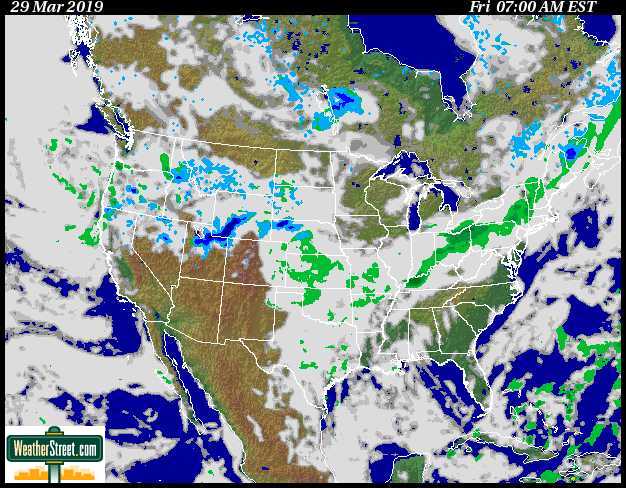
Perhaps we now have the “Chu Effect” working in concert with the Gore Effect?

From weatherstreet.com
@TJA in re: great civilizations in North America
More likely than climate as a controlling factor―it’s no less stable than central or western Asia which birthed all the earliest civilizations―is the lack of domesticable work animals.
John Galt:
The answer, as you know, is YES. This thing has to be maintained or the wheels fall off. If the constant drumbeat of HUMAN CAUSED isn’t continued, people will forget, or worse, will start to remember that climate changes did not start last wednesday
To the moderator.
Sorry.
I was just refering to WW2 radio propaganda voices, no personal slight meant to anyone. Just trying to ridicule some of the rubbish they spout and get printed.
In response to the first comment post on this topic from Roger Sowell.
Your statement: “…knowing that the Colorado River flow is much less than years past, knowing that Lake Mead and Lake Powell are way below the full mark…”
This is sort of misleading. Overpopulation and over-use is why some of the lakes like Mead are only about 50% of full pool. And people forget, we live in a desert (I’ll spell that again: d e s e r t ) …which would otherwise not be so populated if it wasn’t for modern air conditioning and irrigation systems.
When I first moved to Southern California, I read a whitepaper from an expert who presented it to a city council contemplating what to do about the rapid growth in the San Diego area. The paper said we were just coming out of “a prolonged 30 year drought in Southern California”. That was 1986. We have had quite a few very wet years and very dry years since then. One of the lakes by my house that was half empty for about 5 years was suddenly filled up again two years ago because of excess rainfall. Again, this is a desert, and some of the farmers were shameful, when for years, they flooded their fields with un-metered (yes un-metered !) water for crops they had no business growing in this climate here in California.
But I would like you to visit http://lakemead.water-data.com/ and see that this year, the inflows have been running more than 70% above normal for Lake Mead and this has been consistent for more than 100 days…and last year wasn’t bad either. The problem is that the population siphons out way too much and wastes too much.
Oh, and last year, we were still snow skiing until it was almost summer… not sure where they take the snow measurements, but we had snow for skiing much later and longer than usual.
I’ve lived in Northern California for most of my 55 years. I agree that California is very poorly managed by our state government in almost every way. We haven’t increased our water storage because the government is beholden to the most extreme environmental groups.
We barely get by in years of average rainfall. Anything less than average is a problem. I say we need to be able to get by in years with only 50% of average, otherwise we’re in crisis mode every few years. Years that low, at least in the north, are very rare. It’s difficult for me to call a year with 70% of average rainfall a drought.
I keep my own rainfall records and where I live in the Sierra Nevada foothills now the average yearly rainfall is about 30″. Two years ago we had 77% of average and last year 71% of average. We are behind this year too. No one can really say what’ll happen in the next two months but right now this rainfall season is shaping up to be similar to the last two.
I should also note that we can catch up on rainfall very fast. And doom and gloom predictions are nothing new. I bought my first house in the Bay Area in the 1976, right at the start of a two year “drought.” In the summer of 1977 we were collecting wash water in garbage cans to water the garden. Watering restrictions were in place. Predictions abounded that it would take years if not a decade of average rainfall to recover from the drought. Fall of 1977 was dry. Then came January 1978. It rained for 31 straight days. The reservoirs were full. The drought was over. Doom and gloom stories disappeared from the news.
If we can’t store enough water in any year that isn’t at least average, it’s our own fault.
California has a fire ecology; the span varies according to the ecosystem. The If a fast surface wildfire courses through periodically it clears the small stuff, facilitates germination of certain plants, provides nutrients for others… If fires are not allowed to burn cyclically, we get slower, hot-hot ground fires that cause much more plant death, followed by erosion. Thus, the “prescribed” burns in Montana’s forests (they used to be called “controlled” but that was rarely the case so the terminology shifted to a more realistic description).
We’re having a false spring in Silicon Valley, where the plum trees are covered in white blossoms and the citrus are nearly all picked. It has been dry lately with just the slightest dusting of rain over the last few nights. I would love a bit of flooding, a drenching, mossy wet, huge puddles on the low spots of 101 clogging traffic, uprooted trees from the delta washing up on Marin’s beaches like whale skeletons, waves breaking over the sea walls, the need for wellies and sump pumps, sand bags and stout umbrellas…
As for Chu joining Kleiner, they’ve added some odd lots to the greentech team in the last few years, but there are still some good people there, too, and some money. The well of private capital isn’t dry, just less intrigued by risk.
As for Boxer, in high school we were good girls and avoided her block because it was known as a place where the bad kids misbehaved. I was shocked when I found out people voted for her. Yikes!
Yes, we’re overcrowded, and no, San Andreas hasn’t done the big cull yet, and yes, the weather (not climate) on the coast fluctuates a lot. The lotus eaters who moved out here expecting paradise complain, loudly. Those of us whose kin came here back when it was cheap choose to live contentedly within the drought-moss cycle, appreciating Nature in her moods.
Claude Harvey (08:20:27) :
“I suspect nature conspires to make fools of climate and weather prognosticators of all stripes. ”
————————————————————-
Nature makes no effort at all. They do an admirable job entirely on their own.
“Carbon dioxide at atmospheric pressures has essentially no absorption because it has no dipole.”
And no amount of pseudo-scientific jargon and heuristics can change this fact.
@HasItBeen4YearsYet? (00:10:42) :
He’s the guy that told people to paint their roofs white to save energy,…..
http://motls.blogspot.com/2008/12/steven-chu-vs-sane-homeowner.html
…despite the fact that more energy is consumed in the winter to heat than in Summer to cool,…
http://www.carboncommentary.com/2008/02/20/76
…and so what might be saved in the Summer would be lost several fold over in the Winter.
Yeah, but what you and your pals forgot to mention is that in the winter, the sun is lower than in the summer. That is, the white paint in the roof will have a much stronger effect in the summer than in the winter. If you also paint your facade with black and make a small slab to protect it from the summer’s sun (or even build a trombe wall), you’ll get more thermal energy in winter and much less on summer.
It rather seems a good practice. ~snip~
Not a good idea to paint the house white unless you live in a hot country. – MartinGAtkins
Surely it depends whether you’re trying to heat the house or cool it? If you want to keep it cool, you paint your house white, so that it reflects some of the solar radiation. If you want to warm your house, you paint it black, so as to absorb all the solar radiation.
But… if white is a poor emitter as well as a poor absorber, and black is the converse, then to keep your house optimally cool, you should really paint the house white in the morning, and paint it black in the evening – so that during daylight hours the house absorbs the minimum solar radiation, and during the night the house emits the maximum radiation. And conversely if you want to keep your house warm, you should do the opposite, and paint it black in the morning, and then paint it white in the evening.
Hmmm…. All that painting would be a bit of a chore though, but if you covered your house in rotatable slats (just like the blinds you find in windows), painted black on one side and white on the other (not like the blinds you find in windows), you could have a solar cell trigger an actuator motor to turn the slats in the morning and the evening.
A neighbourhood full of houses like this would see all the houses white during the daytime summer months, and black during the daytime winter months. And every day, at about 6 am and about 6 pm (depending on the season, maybe) there would be a tremendous roar as all the houses flipped their slats to turn black and then white again. And there’d be a festival, with beer and music, each year at the vernal and autumnal eqinoxes, to celebrate the neighbourhood turning black or turning white again.
I could go on,.. but I won’t.
Similar back to back dry years in late 1980s. I remember buying hay, primarily alfalfa, from farmers that sold their water rights. Nice source of profit. They were still able to get 4 cuttings, and occasionaly 5 cuttings. They had to forego the lower quality/lower yield late cuttings. Due to shortage, the premium first cuttings were very profitable, and as always made “test”, (high TDN, required by the dairies). Also, many water districts refused to permit any new meters as the supply for current users was barely adequate. Miraculously “new ” water supplies were obtained, and building surged. That drought was no where near as bad as 1976/1977. Salinity issues for many East Bay water districts in 1977 as lack of flow through the delta, allowed greater salt water intrusion. There have been a couple of years, (1990?), when we had a March “miracle”, that filled the reservoirs. I hope so.
Great article from National Geographic on the subject.
http://ngm.nationalgeographic.com/2008/02/drying-west/kunzig-text/1
Painted my pan roof over the lanai last year (for northerners that’s a tin uninsulated roof over the screened back porch). Used 3 coats of a white sealant paint and it actually lowered the summer mid-afternoon temps on the lanai by almost 10 degrees!
For my technical friends, the thermometer location is exactly the same as before the paint job, it is away from the outside wall of the house and direct sunlight does not hit it. It is located about 10 inches down from the roof. BTW, it showed 28 degrees at 8 AM this morning.
TJA said:
There is a reason that no great civilization ever arose in North America. It’s not because the Indians couldn’t do it, there were a few abortive attempts. It is because the climate lacks the required long term stability.
That’s part of it. If you haven’t already, you should read Jarred Diamond’s excellent “Guns, Germs, and Steel”. It expands on many reasons why advanced civilizations evolved in some regions and not in others. It’s ground breaking work.
Rigel (04:41:23) : California is socialist and anti-capitalist.
I hate to seem harsh,
You are being a correct reporter of the facts. I have lived in California long enough to see it under both conservative (in the older ‘Actor as Governor’ Ronald R. sense) and ‘progressive’ government. In the past we built infrastructure and an attractive business environment, we promoted industry. It is now a socialist enterprise leading the way to wealth distribution and is anti-humanity in it’s actions. Business was deemed evil some decade+ ago. Those are just facts.
Unfortunately, we ‘lead’ the nation by about a decade. What we get, you get. So our ‘conservatives’ are now RINOs like Ahhnold who’s agenda is clearly more driven by pillow talk with the Kennedy klan that he’s married to than it is to any understanding of his party; and our ‘liberals’ are more in line with the socialist workers party…
but frankly, I would not shed too many tears if California dried up and blew away, or fell into the sea or simply left the United States. California does significantly more harm to the US than the benefits it provides.
We are well on our way. Large chunks of what was once vitality and innovation are now empty buildings. I know, I worked in many of them. (There
iswas a wonderful “boiler room” area, a cauldron of change, all along Central Expressway from Santa Clara to Sunnyvale. Always dynamic, always new companies starting a new game. Now it’s “for lease 50 cents a foot? Please? Make offer???) The venture capital has packed up and moved to China, and any business with a brain will launch their new venture in Nevada, Texas, Shanghai, anywhere but here.I had a company with a dozen folks in it. I closed down rather than deal with all the, er, crud. I’m now ‘semi-retired’ in that I don’t really see where it will benefit me to start another company. I’m still vaguely interested in working, especially if it were in another state, but there isn’t much here of interest. My lawyer moved his practice to the Nevada side of Tahoe. Ditto several other past associates.
The state ideology is: Tax beatings will continue until business morale improves. And our government is now surprised that the tax revenue has hit the basement floor and is continuing to drop…
We do, however, have thriving industries involving the illegal import of drugs and non-citizens (who, once here, are given all kinds of public assistance including education for all the kids they can pack in the truck, and if one is ‘on the way’ free medical care & citizenship). Law Enforcement and the prison system are also growth areas for employment, as long as you can be selective in what laws you enforce.
By law, 1/2 the state budget must be spent on “education” so if you can put up with
political indoctrinationthe approved curriculum, there are opportunities there as well. (Though not in the classroom. The money stops in the administration level and goes to contracts to endlessly tear down and rebuild shoddy schools and recycle text books to more politically correct ones.)California and it’s citizens are completely expendable to the health and well being of the United States, in fact, it would be desirable for it to go away.
Well, we do provide some agricultural benefits. Sure, you can get good wines from Chile and vegetables from Mexico, but they don’t have as good an education or welfare system! And what about the movie industry? Suddenly all the loony lefty actors would be making ‘foreign films’! How could you feel appropriately guilty about using your heater if it was a foreign film star berating you from their private jet? Hmmm???
Look, it’s a small price to pay for us being your conscience. Just hand over about $14 Billion (oops, my bad, new month… make that $15 Billion) in ‘stimulus’ and we’ll be fine.. No, really. I mean it. Look, pop the cash or we’re gonna wash your windshield.!
Its same old song for CA.. drought, wild fire, mud slide, .. repeat.. but every year they make it sound new and different because the same stupid people keep building back in the same stupid places. I liked CA.. Lived from SF all the way down to San Diego. Theres some beautiful spots along the coast. But theres way too many people there. USGS has a lovely non global warming take on the whole deal:
http://pubs.usgs.gov/ha/ha730/ch_b/B-text1.html
But it sure doesnt sound like an effect of global warming.
PS Lots of earth shakin going on in western US.. anyone know the effects of a very active subduction zone? Have you checked your earthquake kits lately?
California is poorly managed in the fields of water and electricity. The issues
are related.
We could collect a lot more runoff, but the environmental brigades object. We
could have a lot more water used for farming and drinking, but the recent
Federal lawsuit makes it so that the Sacramento Delta Smelt gets the water,
not cities or farms. This could be mitigated by construction of the “bypass
canal”, but the environmental brigades object: farms or people might prosper.
Electricity and cooling has the same sort of idiocy. Few realize the scope
of the idiocy. Run through this thought experiment. If you discovered a free
source of energy in California, and connected it to the grid, thus solving one
of mankind’s most pressing issues, what would happen? You would have
to pay the state for the electricity that the publicly regulated utilities would
have earned! There is a STRONG disincentive to solve the generating
problems here. Even on the small scale, if solar is successful, the state
has to pay the utilities for the power the utilities did not produce.
For about 5 years I have been kicking around a solution for SoCal. The
political will does not exist, but the technology does. I call it the CAX
solution.
1) Kick everybody off Catalina, just like in WWII. Pay them well, but
kick them off.
2) Build 4 2 GW nuke plants. Use the underground pebble bed design,
cool with helium as primary heat transfer and use the ocean as secondary
cooling.
3) Run a constant 4 GW for desalinization. Sure, you need a few pipes
to the mainland.
4) Use the waste heat to do re-gassification of LPG.
5) Water storage is needed. Fine. Go right up the San Gabriel river channel
with that desal water. Cut a big tunnel to the high desert and make a large
res. that can gravity drain back into the basin.
6) Use all that rock from the tunnel and basin to make a 100 meter wide
submerged “roadway” from the shore to Catalina.
7) Any extra power can be used to generate hydrogen. Another good
candidate is arc remelt of steel scrap. Still have extra power? Refine
bauxite.
From such a plan California gets wails, screams and shrieks from the
environmental brigade, plus water, electricity, natural gas, hydrogen and
jobs. There is no new technology involved. Only political will is needed.
Hmmm…… let me see if I can find some water at Google……… ah yes here it is, over 300 in. of snow…… in CA!
http://www.nohrsc.noaa.gov/nsa/reports.html?region=National&var=snowdepth&dy=2008&dm=10&dd=13&units=e&sort=value&filter=0
Click on SQBC1 for Squaw Valley
FWIW:
http://www.sfgate.com/cgi-bin/article.cgi?f=/c/a/2009/02/04/MNV415MGLA.DTL
Gives a capsule view of California. At one time I lived in Bolinas (where Hitchcock filmed ‘The Birds’). It is dominated by a strange mix of: people with more money than brains or not much of either. They have tried to use every means possible to keep outsiders out (including the ritual of sawing down any road sign that tells you what tiny road leads to their village…) That included not expanding any resource that might lead to growth…
I only lasted a year there, the local politics were bizarre. Yet somehow that mindset has come to the rest of the state…
(FWIW, a modestly small desalinization plant that would fit in a large garage would give the town all the water they could ever need and it would not be visible to anyone nor have any detectible environmental impact… but that might lead to lack of guilt, or even, horrors! growth.)
h/t sonicfrog
Below is a link to a California Supreme Court decision that discusses water rights. The case is National Audubon Society v Los Angeles Dept of Water and Power, (33 Cal.3d 419 (1983)).
Click Here
Mike S.
“This is sort of misleading. Overpopulation and over-use is why some of the lakes like Mead are only about 50% of full pool.”
Apologies if I mislead anyone. The point is that population grew (and is growing!) and water resources actually fell — the Colorado River flow trend is negative per the USGS.
See this reference, and scroll down to Figure 3.
The shrinking flow in the Colorado, plus water re-allocation among the river pact states, leaves California more dependent on snowpack, which is rather unreliable. Alternatives that Governator Schwarzennegger proposed for building more dams to store more rainwater were shot down by the legislature (motivated by environmentalists) and at the ballot box.
Then a Federal judge ruled that perfectly good Sacramento river water must be diverted to the ocean rather than sent south to parched Southern California, in order to protect the delta smelt (a small fish that apparently is endangered, or about to be.)
So here we are. Inadequate Colorado river flow, diverted Sacramento river flow, unreliable snowpack, too few dams to catch the rainwater, and environmentalists blocking desalination plants.
Now the entire nation will pay the price, as California farms do not produce what they ordinarily would. Meat prices will likely rise, too, as cattle also require water to drink.
As I wrote before on WUWT, it would be great to see a massive federal project to build a water pipeline across America, from the Mississippi to the Colorado river. Now, that is one stimulus package project I could support. Anybody want to guess if that project is included?
Roger E. Sowell
Marina del Rey, California
Frank Perdicaro (11:46:25) :
‘California is poorly managed …’
————————————————–
Frank, your first four words says it all about California.
During the LIA, from paleo evidence (the more trustworthy type – aquifers, moisture responsive trees, etc) there were the worst mega droughts ever. How’s them apples Chu?
Frank Perdicaro (11:46:25) :
I’d say use San Nicolas Island.
I vote that when the food and water shortages turn up, the environmental lobby is at the back of the queue for receiving anything. If they are the ones causing the problems, they should be the ones that suffer most the consequences, in my opinion.
Ed (a simple old carpenter) (11:56:09) :
Bad data. Those have to be YTD cumulative figures not snow pack. Especially given they are from October.
Do note, I have personally seen 20 foot snow packs at the base of Squaw, but that’s pretty rare. Normally the peak is around 3 or 4 feet there (up a high camp, a different story).