
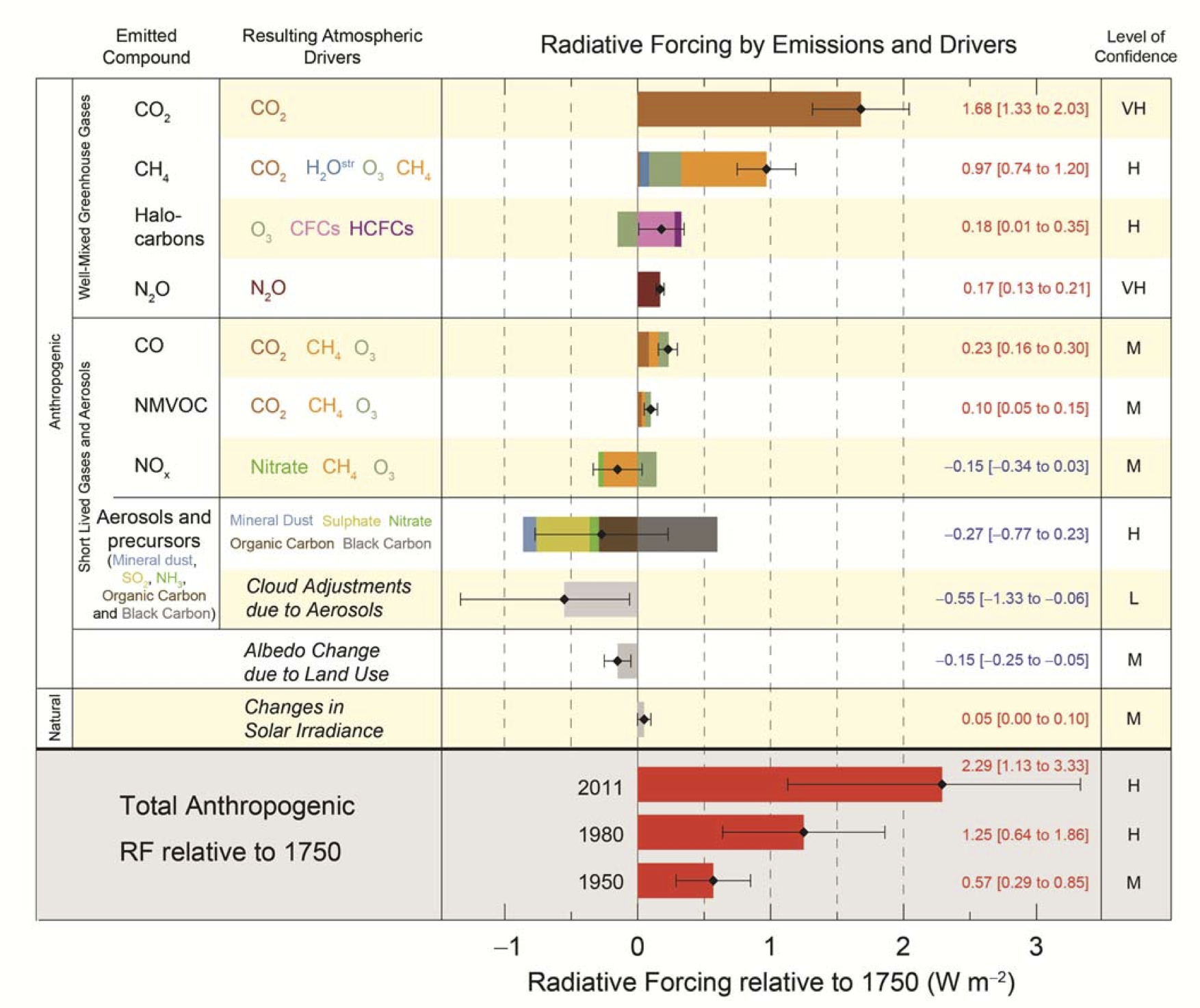
It was just yesterday that we highlighted this unrealistic claim from CMIP5 models: Laughable modeling study claims: in the middle of ‘the pause’, ‘climate is starting to change faster’. Now it seems that there is a major flaw in how the CMIP5 models treat incoming solar radiation, causing up to 30 Watts per square meter of spurious variations. To give you an idea of just how much of an error that is, the radiative forcing claimed to exist from carbon dioxide increases is said to be about 1.68 watts per square meter, a value about 18 times smaller than the error in the CMIP5 models!
The HockeySchtick writes:
New paper finds large calculation errors of solar radiation at the top of the atmosphere in climate models
A new paper published in Geophysical Research Letters finds astonishingly large errors in the most widely used ‘state of the art’ climate models due to incorrect calculation of solar radiation and the solar zenith angle at the top of the atmosphere.
According to the authors,
Annual incident solar radiation at the top of atmosphere (TOA) should be independent of longitudes. However, in many Coupled Model Intercomparison Project phase 5 (CMIP5) models, we find that the incident radiation exhibited zonal oscillations, with up to 30 W/m2 of spurious variations. This feature can affect the interpretation of regional climate and diurnal variation of CMIP5 results.

Why wasn’t this astonishing, large error of basic astrophysical calculations caught billions of dollars ago, and how much has this error affected the results of all modeling studies in the past?
The paper adds to hundreds of others demonstrating major errors of basic physics inherent in the so-called ‘state of the art’ climate models, including violations of the second law of thermodynamics. In addition, even if the “parameterizations” (a fancy word for fudge factors) in the models were correct (and they are not), the grid size resolution of the models would have to be 1mm or less to properly simulate turbulent interactions and climate (the IPCC uses grid sizes of 50-100 kilometers, 6 orders of magnitude larger). As Dr. Chris Essex points out, a supercomputer would require longer than the age of the universe to run a single 10 year climate simulation at the required 1mm grid scale necessary to properly model the physics of climate.
The paper: On the Incident Solar Radiation in CMIP5 Models
Linjiong Zhou, Minghua Zhang, Qing Bao, and Yimin Liu1
Annual incident solar radiation at the top of atmosphere (TOA) should be independent of longitudes. However, in many Coupled Model Intercomparison Project phase 5 (CMIP5) models, we find that the incident radiation exhibited zonal oscillations, with up to 30 W/m2 of spurious variations. This feature can affect the interpretation of regional climate and diurnal variation of CMIP5 results. This oscillation is also found in the Community Earth System Model (CESM). We show that this feature is caused by temporal sampling errors in the calculation of the solar zenith angle. The sampling error can cause zonal oscillations of surface clear-sky net shortwave radiation of about 3 W/m2 when an hourly radiation time step is used, and 24 W/m2 when a 3-hour radiation time step is used.
Ouch. That’ll leave a mark.
[snip – no more Mosher drive-bys, make a point with a reference – mod]
Linking to the SI. ?
good moderation policy.
The reference IS the point for people who can read
I know I’d prefer a brief summary and a link.
Otherwise don’t bother.
The models measure incoming sun light for a flat earth?
?
Oh, you must be talking of the sharia compliant vision of the earth.
Oops!
But they are still adding fluxes which is not correct.
All models make one wrong assumption, that CO2 heats the atmosphere. There is no empirical data that shows it does.
How do you tangle longitude and TOA solar? That’s just nuts.
The sun doesn’t shine at night. (Simple answer to simple question)
The sun DOES shine at night. It shines constantly. It’s just that the Earth has rotated away from light strike!
It’s always 12 noon directly under the sun, isn’t it?
The models don’t like to wait until the sun has passed over the yardarm.
Douglas:
Patrick is correct. Furthermore. “Annual incident solar radiation” averages over all hours of all days, so the day-night distinction is superfluous.
He was being facetious.
That’s why the 49er fans planned their solar landing at night.
It’s always 12 noon directly under the sun, isn’t it?
==============
you’ve hit the nail on the head. In each time zone the sun is only overhead at noon for a single longitude. It is early or late for all others, because each time zone is typically 15 degrees of longitude – the distance the sun appears to travel in 1 hour.
It is this error, the temporal distance between your longitude and the actual longitude of the sun that could lead to an oscillation in the calculated TOA energy, depending on the size of your time slice and your relative position within the slice.
Quite silly actually of the model builders not to correct for this, but given the size of the grid they probably just assumed it would all wash out in the averaging. And since the models showed warming and they expected to see warming, they never bothered to look for errors. If it ain’t broke, don’t fix it.
The energy from incident radiation(the sun) does not average out. That nasty T^4 power in Stefan’s law plays heck with using averages to calculate heat and energy transfer. It’s not coincidence that thunderstorm strongly tend to form in the afternoon, shortly after the ground has absorbed all that heat from the sun. A model would have to integrate the heat input across a grid cell from sunrise to sunset to generate an accurate picture of the energy flow..
A given point has rotated away, not the whole Earth. How wide a strip and duration is noon, anyway? .0001°?
Nitpick: 100 km vs 1mm is 8 orders of magnitude, not 6.
It’s even worse than we thought !
That will undoubtedly be the response of Warmist pseudoscientists and their co-religionists.
8 OOM by distance. That’s 16 OOM by area and 24 OOM by volume. That’s a lot more opportunity for error. An error in the 24th digit would propagate. A numerical butterfly effect.
Ha. Ya got me!
They can just instruct their computers to calculate pi to 10^24 digits for all relevant calculations, thereby cancelling out the imprecision of their blunder with increased mathematical precision for pi.
Fast, Johan. Fast!
Thank you!
Another excuse coming
Hi Anthony –
Thank you for this new information.
This is another example of the deficiencies of these models. For a summary of others, please see our articles
Pielke Sr., R.A., R. Wilby, D. Niyogi, F. Hossain, K. Dairaku, J. Adegoke, G. Kallos, T. Seastedt, and K. Suding, 2012: Dealing with complexity and extreme events using a bottom-up, resource-based vulnerability perspective. Extreme Events and Natural Hazards: The Complexity Perspective Geophysical Monograph Series 196 © 2012. American Geophysical Union. All Rights Reserved. 10.1029/2011GM001086. http://pielkeclimatesci.files.wordpress.com/2012/10/r-3651.pdf
Preface to
Pielke Sr, R.A., Editor in Chief., 2013: Climate Vulnerability, Understanding and Addressing Threats to Essential Resources, 1st Edition. J. Adegoke, F. Hossain, G. Kallos, D. Niyoki, T. Seastedt, K. Suding, C. Wright, Eds., Academic Press, 1570 pp.
http://pielkeclimatesci.files.wordpress.com/2013/05/b-18preface.pdf
Best Regards
Roger Sr.
The hyperbole in the post requires some due diligence
http://onlinelibrary.wiley.com/store/10.1002/2015GL063239/asset/supinfo/grl52723-sup-0002-figs1.pdf?v=1&s=2c70ac93b0eed88d987977cfaf6813bb8bf69ed2
What’s the hyperbole? Can you explain.
Steve thanks for the input. It appears that Models don’t compensate for the Latitude angle at all. They model a flat circular earth instead of a sphere, that is why they all get 417 watts per square meter, when the poles should be receiving ZERO solar insolation..
You have shown exactly why models are completely nonphysical representations.
Genghis:
Quoting from post quoting the paper (my emphasis): “ANNUAL incident solar radiation at the top of atmosphere (TOA) should be independent of LONGITUDES.” so I’m not sure why you’re talking about Latitude angles.
From Mosher’s reference, it appears to me that some models show low variance with longitude, some others do much less well. I’m making some assumptions here, because the x- and y-axes are unlabeled. I also assume the chart titles identify various models.
I’m sorry, but I think solar input is a function of both latitude and longitude, as both have equal angles of incidents towards the “edge” of the earth “disk”.
What am I missing?
Steven
Every now and then (but not often enough to be valuable) you actually say something interesting, meaningful, and understandable.
The rest of the time it’s a couple lines of snark with (at best) a link to what may or may not be relevant.
This egotistical QED game is almost always misleading, usually obscure, not supported by any relation to your point.
You may (think you) understand it, but so what?
Genghis:
Even if the IPCC used a complex calculus formula with the function from zero to the max at the equator (whatever value they used) in total solar insolation, and adjusting for the time of day and angle of the sun from mid day, and then total sunlight at the other pole…. a very complex problem just to think about……… the current data still comes out wrong. Developing a fractal formula made much more sense. Especially in light of ocean, land, clouds, and ice and incident angle of sunlight relative to the earth.
If AND I DO MEAN IF, the IPCC’s number were correct, global runaway warming would already be a reality and not a prediction. We wouldn’t be debating about whether they were right or wrong, it would be obvious.
The error mode, when it occurs, is an almost exactly sinusoidal variation around the equator, with 3h or 1h period according to sampling. It will have no effect on total incoming radiation. The authors say it will have negligible effect on mean surface temperature.
“Now it seems that there is a major flaw in how the CMIP5 models treat incoming solar radiation, causing up to 30 Watts per square meter of spurious variations. To give you an idea of just how much of an error that is, the radiative forcing claimed to exist from carbon dioxide increases is said to be about 1.68 watts per square meter, a value about 18 times smaller than the error in the CMIP5 models!
1. If you look at the SI you will see that only SOME of the CMIP5 models were examined.
2. If you look at the SI you will see that only SOME of this subset had the issue
3. If you look at those that did you will see that only SOME of them had ‘large errors”
4. If you look at the errors you wil see that it is not constant but sporatic.
5. comparing the effect of a sporatic forcing to a constant forcing is a hoot.
6. There is no secular component to the error
next
“Why wasn’t this astonishing, large error of basic astrophysical calculations caught billions of dollars ago, and how much has this error affected the results of all modeling studies in the past?
The paper adds to hundreds of others demonstrating major errors ”
1. astonishing? hardly.
2. Large? it depends.
3. Hundreds of other papers demonstrating major errors? like I said, requires due diligence.
Models are wrong. Hyperventilating in either defense of models or in attacking models.. is bad drama.
What Steven has referenced shows that the GCM’s average solar insolation to be 417 watts for every square meter for the entire Earth.
That means that every cell in the computers calculation for the high latitudes is off by at least 350 watts and every cell in the lower latitudes is off by at least 70 watts, simply based on the angle of incidence.
And furthermore because it is based on a non rotating earth it is off by up to 60 megajoules because of lack of computing the actual insolation. A 417 watt average is meaningless.
No wonder the GCM’s have no predictive power, they can’t even get the inputs correct.
Nick Stokes
March 10, 2015 at 2:12 pm
The authors say it will have negligible effect on mean surface temperature.
Isn’t the scientific method to do the correct calculation to see how it effects model evolution? What if there is a chaotic effect and it changes strange attractors? There is no way to know until you do it correctly.
Another drive-by.
Steven Mosher, ever more predictable, ever more boring.
Ghengis,
No. Just … no. See the main paper:
Fig. 1. Annual-mean incident solar radiation at the top of atmosphere from 8 climate models in CMIP5. The color scale has been adjusted to highlight the zonal variation in the tropics. The model names are in Table S1 of the Supplemental Materials. Units: W/m^2
By way of KNMI climate explorer, I report that the entire CMIP5 ensemble gives an annual average of 400 W/m^2 in the tropics (30N to 30S), vs. 340 W/m^2 for the entire globe.
Mosher writes “Models are wrong. Hyperventilating in either defense of models or in attacking models.. is bad drama.”
Yes and wrong models cant model climate change. They can model weather over the next few days. Parametrisation utterly kills models. It cant possibly be known the parameters vary as the climate changes. Modelling climate is many orders of magnitude harder than modelling weather.
Thanks for the links!
rpielke
March 10, 2015 at 9:14 am
Specify
DOY = Day-of-year (1 – 366 in leap years)
LAT = LAT (in radians)
ATF = Air attentuation (function of latitude and season, if in temperate latitudes)
0.75 if polar
The day and hour angle (for declination) = TAU =2*3.1415*(DOY+D9/24-1)/365 for any hour of the day
The declination (for the entire day) at 12:00
=0.006918-0.399912*COS(TAU)+0.070257*SIN(TAU)-0.006758*COS(2*(TAU))+0.000907*SIN(2*(TAU))-0.002697*COS(3*(TAU))+0.00148*SIN(3*(TAU))
The declination for every hour of the day
=0.006918-0.399912*COS(E9)+0.070257*SIN(E9)-0.006758*COS(2*(E9))+0.000907*SIN(2*(E9))-0.002697*COS(3*(E9))+0.00148*SIN(3*(E9))
Where cell E9 is the hour angle for that day (see above)
For each day-of-year, the TOA solar radiation (to within 1/2 watt/m^2 of SORCE measurements)
TOA=1362.36+46.142*(COS(0.0167299*(DOY)+0.03150896))
Over the year, the actual TOA radiation varies from 1408 watts/m^2 (January 5) to a low of 1315 watts/m^2 (July 5).
You now have a latitude, the actual TOA radiation for that day, and the declination for that hour of the day.
ANY day-of-year. Any latitude to any degree of accuracy desired. 1/100 km, 1/10 km, 10 km, 100 km, 1000 km, 1 deg, 0.1 degree, or whatever.
Get an hour angle HRA = =(RADIANS(D9-12)*15) for cell D9-D32 being 0 – 24 hours. Or whatever time interval is desired.
From those, you get a Solar Elevation Angle (SEA) in radians for each hour angle (also in radians) :
SEA =ASIN( (SIN(F9)*SIN(LAT)) +(COS(F9)*COS(LAT)*COS(G9)) )
for cells F9 and G9 being the declination angle and HRA angle for that particular hour. LAT was already defined in radians.
Note. Some users prefer Solar Zenith Angle SZA rather than SEA.
From Solar Elevation Angle for that hour, you get Air Mass (Kasten and Young, 1989; Kasten & Young, 1994, etc.)
AirMass = =IF(I9<0,0,(1/(COS(3.14159/2-H9)+0.50572*(6.07995+I9)^-1.6364)))
(Note, if the SEA is < 0.0 (the sun is below the horizon, the air mass = 0.0 and the sun has no radiation at that location at that hour. Uses Excel notation for cell H9 being the SEA (in radians))
=IF(I9<0,0,(ATF)^((J9))) for cell J9 = AirMass for that hour of the day.
(Note, if SEA < 0 (the sun is below the horizon, again, the attenuation = 0.0)
Direct radiation on that day at that latitude on a perpendicular surface to the sun's rays =
=TOA*K9 for cell K9 = the attenuation factor for that hour of the day.
Direct radiation on a flat surface depends on latitude.
Direct radiation on a flat surface =L9*SIN(H9)
for cell L9 = direct radiation on a perpendicular surfae and cell H9 being the SEA angle at that hour.
If a mountain slope, the GC Models ignore it.
The GC Models also ignore the effect of high altitude (less attenuation, cleaner air as well, less air mass).
the direct solar radiation is thus calculated in about 9 steps using single formulas at each step.
Diffuse radiation can be modeled as a function of air mass and direct radiation, or as a function of the Link turbidity factor, or as simple percentages of the potential direct radiation. Albedo of many common terrains and substances (particularly snow, soil, plants and water) is different between direct and diffuse radiation, so be careful at what is assumed and what is measured.
You can now calculate the albedo for the oceans based on the solar elevation angle for the ocean surface (which changes from 0.067 to 0.75 at low SEA angles) and the albedo for the land, sea ice, tundra, desert, and farm lands. None of which are "modeled" uniquely.
So, how could they screw this simple a function up? Because they knew the answer they wanted.
“the alleged radiative forcing from all man-made CO2 generated since 1750 is claimed by the IPCC to be 1.68 W/m2”
Let’s see, given the IPCC equation : (dT/dt) (C/year) = Forcing (W/m2) / 3.3
0.51 = 1.68 / 3.3
In other words the temperature of the atmosphere has risen over 5 degrees in the last 10 years.
I don’t see that in the temperature records, maybe that makes me a denier.
“a supercomputer would require longer than the age of the universe to run a single 10 year climate simulation at the required 1mm grid scale necessary to properly model the physics of climate.”
In other words, “All models are wrong. Some are useful.”
That one sentence underpins how little we really understand about “climate change.”
“That one sentence underpins how little we really understand about “climate change.”
Pretty much everything is understand about “climate change”, very little is know about actual climate…
Yikes, let’s try that again,
Pretty much everything is understood about “climate change”, very little is known about actual climate…
I think that is a bit of hyperbole, on two grounds. 1: they could use computers that are on the order of 100x what they are.secondly it only takes a matter of a day or so to do the calculations. 8 orders of Magnitude is 100 billion days ,and the Universe has been around some 3700 billion days. In about 30 years, this will be a reasonable amount of computing power as well.
The real difficulty would be creating sensors that could calculate to weather for each square centimeter. I doubt that will ever be possible.
Actually it’s 10^8 in one direction. (100 x 1000 meters x 1000 mm/meter) With three dimensions we have 24 orders of magnitude total. Admittedly we won’t need quite as many orders in the third dimension as the atmosphere isn’t really a full 100 km high unless you include the ionosphere. But it’s still far more than you’re talking about.
The science is not only unsettled but ludicrously wrong.
I believe the phrase is “not even wrong”. But we have known that about CAGW for a long time.
Too much incoming radiation in their models? Maybe they ran them in a microwave oven. 🙂
Ahh, it is the incoming solar radiation that they screwed up on.
That is truly breath taking stupidity. I can understand how trying to ‘calculate’ how much out going radiation there is could be challenging, but incoming radiation is known quite precisely.
The fact that the models were trying to derive a known constant and failing, tells me everything I need to know about the models.
Incoming radiation at the top of atmosphere is easy to measure but not at the surface.
No, incoming solar radiation at the top of the earths atmosphere is not a constant. Outgoing radiation at the sun’s surface is a near constant (it does vary, but not by much).
However, The earth’s orbit is elliptical, not circular, so the distance between the earth and the sun changes constantly. With the constant changes in distance come constant changes in the intensity of solar radiation at top of atmosphere.
As you get farther from the sun, the total amount of radiation stays the same, but it is evenly distributed over the surface of an ever larger sphere. The surface area of a sphere is 4PiR^2 so the decrease in intensity of solar radiation at any given point is quite rapid. This means that while variations in solar radiation at the sun’s surface are negligible, the variations at the top of the Earths atmosphere are quite significant.
No, No. I think somebody unplugged one of the cooling fans on their computer. That’s why their models run hot.
I’m sure this will be the lead story on all the major News outlets. They are always quick to publicize shortcomings of the global warming narrative. Does this mean we can have two more cycles of CO2 doubling before we get to the point we thought we were at? Maybe climate change was responsible for the error. It’s worse than we thought!
Burning all known fossil fuel resources would be inadequate to achieve one doubling of CO2 ppm.
Anyone remember the old joke, “we don’t test our software, that’s what users are for”?
That isn’t an old joke.. that is how we do it !
He has you there
there are three kinds of software errors:
1. the kind users know about
2. the kind developers know about
3. the kind no one knows about.
typically we only have budget for 1.
sometimes we sneak in a fix for 2.
we hope and pray 3 is small or we find a new job before someone discovers otherwise.
if your math is 18 times worse than the result your margin of error is gonna completely eclipse any “science” you’re attempting to do.
I’ve written this before
What margin of error? Modelers seldom, if ever, acknowledge the existence of error bars.
Perhaps I need to improve my reading skills but I didn’t see a sign (+ or -) on the “spurious variations. Can someone please clarify?
What appears to be happening is that the models are using the solar angle at the start of the time period to determine the incoming radiation over the entire segment. This will tend to reduce solar radiation up to noon and increase it after noon, depending on where the segments are centered.
So maybe the models are on Daylight Savings Time?
Good one Brain after all we do get more sunshine with daylight saving time. I willing to be half the population actual believe we get more sunshine in a day due to daylight saving time.
Maybe this explains why the models all run to the hot side?
Maybe not an “accidental” error?
And the net effect is ……. what?
The temperature adjustments are huge. Judith Curry seems to accept the Zeke explanation they are reasonable, i.e. their net effect is zero. Others disagree. What is done is less important than what happens as a result. Here, the presence but not the effect is noted. But only the effect is important.
We need at least a calculation of what the error does for the basic energy balance of the Earth on an annual level.
Orbital variations are already known, major, bigger than CO2 forcings and cancelled out by natural processes. I suspect this error will disappear into the general +/- of the models but we need to know with certainty before we get too excited.
@NavarreAggie said “In other words, “All models are wrong. Some are useful.”
Depends on who you are. I would posit that the ‘wrongest’ models are ‘mostest’ useful to the warmists.
Why wasn’t the James Hansen’s quantitative howler that Venus’s surface temperature , 225% the gray body temperature in its orbit — a greater solar gain than anything humanity has yet created , been universally repudiated decades ago ?
….. not to mention the Earth’s oceans boiling from positive water vapor feedback to anthropogenic CO2.
Because infinity is unattainable, something terminates the feedback at some point. By the evidence, quite early in the case of water vapor latent heat transactions.
Because why combine what scientists know about ideal gas laws in cosmology to anything here on Earth?
Doesn’t really have anything to do with gas laws because they have to do with change in pressure , not effectively steady state . The equilibrium temperature of a radiantly heated ball depends on the correlation of its absorption=emission spectrum with its sources and sinks . Pressure per se doesn’t enter the equations . It would be nice if it did . We could just fill up giant scuba tanks and use them as sources of perpetual heat .
the lapse rate is related to pressure through gravity. thus the bottom of mine shafts are hotter than the surface, not because they are closer to the center of the earth, but because we have an atmosphere.
the surface pressure of venus is 90 atmospheres. the equivalent of a very deep mine shaft.
Another example of increasingly active Chinese scientists rocking the boat of climate science orthodoxy. Good to see.
one group of communist counteracting another group communist because the self interest collide. what could be better then that.
Assuming (big if) that the errors cancel out, ie, total energy to earth is approx. correct. Still the spurious errors are not explained. I am next assuming they did not screw up the incident at the equatorial regions, I mean how do you screw this up? hence the variation is in the polar regions? Does this explain why the models predict massive warming on the polar regions? If you can’t melt the polar icecaps with correct incident solar radiation, then a little trigonometry trick fixes that. Hey, Mike did it for his stuff, we can too!
Please excuse me for being dense, but I thought Mr. Watts included an article a week or so ago, that stated that the radiative forcing for CO2 had been measured in Oklahoma and the north slope of Alaska to be 0.2 W/m2. Am I remembering wrong, or did I just not understand the article. Any help would be appreciated.
Dan Sage
Dan Sage:
.2 W/ m sq. per decade. Comments showed the interval of 2000-2010 was cherry picked and that figure was merely a measure of temperature differences between the start and the end of that decade.
Dan Sage, I think you are referring to, “Almost 30 years after Hansen’s 1988 “alarm” on global warming, a claim of confirmation on CO2 forcing”, February 25, 2015
There will be rationalizations…
Yes. Look upthread.
I really like the Radiative Forcing graph with the error bars / confidence intervals. The only component I am not able to figure out is “solar irradiance”? What anthro forcing is this trying to quantify? I’m sure it will be obvious after someone tells me… 🙂
The GC models were never intended to do anything except justify an ideology-based economic-political roadmap for the UN. By that metric, they have been somewhat successful. But science they are not.
How many ‘hiroshima equivalents’ is the error margin?
Oh, I second that! How fun it would be to turn the Hiroshima equivalents propaganda into measures of model error!
Paper is paywalled. SI is not. SI1 shows that the spurious longitudinal variation in some, not all models at the equator correlates in a statistically significant way with feedbacks including clouds and precipitation. SI2 shows that none of these are self cancelling (averaging out around the globe).
Indeed, by WE’s governor hypothesis, they are in continual operation to constrain heat accumulation at the tropics,