By Viv Forbes, Rosewood Qld Australia
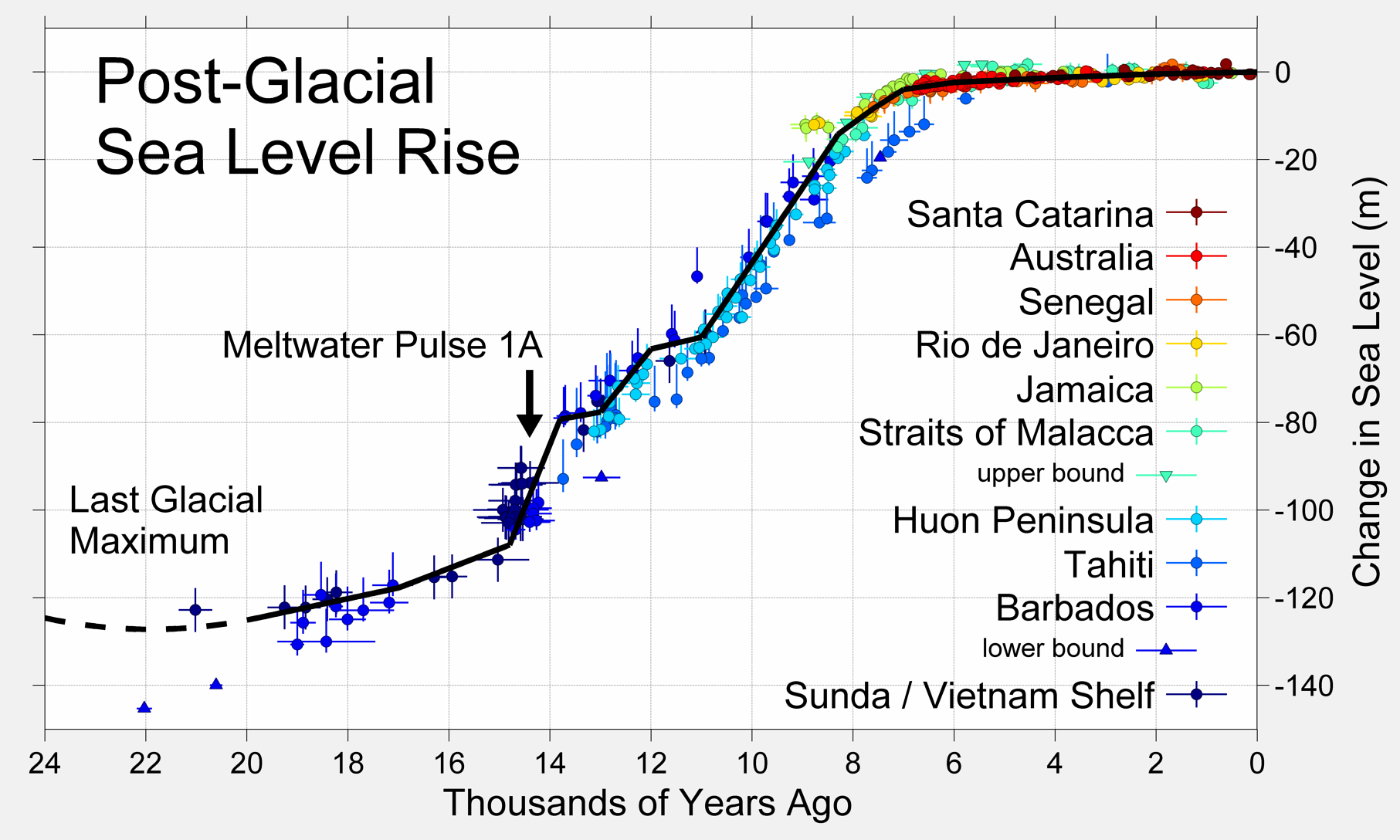 Sea levels have been rising and falling without any help from humans for as long as Earth’s oceans have existed.
The fastest and most alarming sea changes to affect mankind occurred at the end of the Pleistocene Ice Age. Seas rose about 130m about 12,000 years ago, at times rising at five metres per century. Sea levels then fell as ice sheet and glaciers grew in the recent Little Ice Age – some Roman ports used during the Roman Warm Era are now far from the sea even though sea levels have recovered somewhat during the Modern Warm Era.
Many natural factors cause sea levels to rise – melting of land-based glaciers and ice sheets; warming and expansion in volume of the oceans; extraction of groundwater which ends up in the oceans; and sediments, sewerage, plant debris and volcanic ash washed into the oceans by rivers, storms and glaciers. In addition, tectonic forces cause some blocks of land to rise while others fall, hence the paradox of sea levels appearing to rise on one coastline while falling on another.
Currently the world’s oceans are rising at about 1mm per year, which has not changed much with the great industrialisation since 1945. Amongst all the factors moving the restless sea, man’s production of carbon dioxide is obviously an insignificant player.
Sea levels are always changing, at times very destructively. Waves move sea levels by a few metres and at places like Derby, WA, king tides can move sea levels by eleven metres. Then there are rogue waves up to 30 metres high which have sunk oil tankers, and tsunamis which can smash coastlines with a ten metre wall of water moving at over 800 km per hour.
Despite coping with all of the above, climate alarmists say we should be scared to death by the threat of seas rising gently at 1mm PER YEAR. Even a slow-moving sloth could escape water rising at that rate.
King Canute showed his nobles that no man can hold back the rising sea. It’s time the climate alarmists learned Canute’s lesson and focussed on real world problems.
Even if we ceased using all carbon fuels for electricity and transport, no one could measure the effect of that huge sacrifice on global sea levels.
For those who wish to read more:
Rising Seas are Nothing New:
http://carbon-sense.com/2013/11/30/nothing-new-about-climate-change/
History falsifies climate alarmist sea level claims:
http://carbon-sense.com/wp-content/uploads/2013/12/endlich-sea-level-claims.pdf
The Ocean Thermometer:
http://carbon-sense.com/wp-content/uploads/2013/12/ocean-thermometer.pdf
Global Mean Sea Levels:
Tide Gauges show that Average Sea level rise is 0.9m per year:
http://stevengoddard.wordpress.com/2013/12/25/average-sea-level-rise-rate-is-0-9-mmyear/
Rogue Waves – the real sea monsters:
http://www.scientificamerican.com/article/rogue-waves-ocean-energy-forecasting/
High Tides at Derby, Western Australia:
http://www.derbytourism.com.au/useful-information/tides
Well said, and hear hear, Mr. Forbes!
I was especially pleased to see that someone got it right about King Canute!
He is regularly mischaracterized as foolishly sitting just below the high tide line to prove that he, King Canute, could control the sea. Unlike the Puppet in Chief in the Whitehouse, however….
King Canute, as you pointed out, used demonstrative evidence to prove that he was no deity to be worshipped, but a mere mortal, just like his subjects.
Go to the city of Baku on the shores of the landlocked Caspian Sea and check out how they cope with the ever changing level of the sea. The Caspian Sea gets its water from the giant Volga river in the north and has no drainage. The level of the Caspian is on average about -28 m MSL, e.g., about 28 m lower than the Baltic Sea. However, because the flux of water in the Volga river changes on a broad scale, in symphony with general rainfall in Russia, the level of the Caspian Sea goes up and down on a decadal time period with a maximum amplitude of about 3 m !
When I visited Baku first time in 1995, they had flooding of the near-shore city parts, including the navy’s base. We were invited to a meeting there and had to enter the second floor of the building instead of the first floor which was flooded. Since then, the water has gone down to a normal level.
> some Roman ports used during the Roman Warm Era are now far from the sea even though sea levels have recovered somewhat during the Modern Warm Era.
Links please?
Even if we ceased using all carbon fuels for electricity and transport, no one could measure the effect of that huge sacrifice on global sea levels.
True.
But this is not about ‘sacrifices’ or sea levels.
It’s about control.
It’s about power.
It’s about creating the ‘sustainable, progressive new world’.
Dont forget that many of the Roman ports have been subject to tectonic influences.
Re: “natural factors {like waves} cause sea levels to rise … {e.g.,} sediments, … .”
Janice,
My Scottish ancestors appreciate Viv Forbes teaching portrait of King Canute as well!
How the heck are you, Sweet Pea?
Mac
I’ve just come from a week on Hornby Island, one of the small islands between Vancouver Island and the mainland of British Columbia, Canada. I’m a geologist, so I was studying the storm wave level of the beach zone. It is clear that the seas used to be higher than they are today but I’m talking about in the last couple of thousand years. The storm zone platform was cleaned and smoothed and LATER rock debris brought onto the platform, including very large boulders from the mainland that must have been ice-rafted, i.e. brought ashore on small icebergs that storms and high tides moved about.
The short-term HIGHER sea levels are obvious to those paying attention and not stuck in the university lounge. This is NOT an isostasy issue: there have been serious new advances of glaciation AFTER a period of higher water level. And don’t say it is just in the areas of Pleistocene glaciation, as I have seen the evidence in Abu Dhabi and read of others reporting similar evidence in Australia.
The near-past, the human civilization piece, had a lot of movement of sea level. Regional variation were great. Globally? Ahh, here we go … it isn’t global if you say its regional, which means that any observation that is non-IPCC can be dismissed as “regional”.
Steve W. says:
June 17, 2014 at 9:19 pm
‘Not far from Walmer are the remains of the Richborough Roman Fort and Amphitheatre, considered by English Heritage possibly the most symbolically important Roman site in Britain, “witnessing both the beginning and almost the end of Roman rule here”. Although it is now 2 miles from the sea because silted up, Richborough was in Roman times a major natural harbour providing a safe route from Europe to the Thames estuary.’
http://www.britaingallery.com/regions/south-east/sandwich.php
‘ More information about Burgh Castle
The changing coast
Map showing Roman coastline
East Norfolk in Roman times
Burgh Castle’s setting has changed a great deal over the last 2000 years. In Roman times sea levels were much higher than they are now and the coastline quite different. ‘
http://www.norfarchtrust.org.uk/burghcastle
The issue of “Roman ports” seems a misdirection. There are well researched places that have received massive sediments. The Seville-Jerez area, for instance, is down stream from ancient mining activities. Have a look by using Google Earth and Street View using these coordinates
36.94318, -5.96753
Another such place is at the mouth of the Büyük Menderes River in Turkey. See this map for a time line:
http://en.wikipedia.org/wiki/B%C3%BCy%C3%BCk_Menderes_River#mediaviewer/File:Miletus_Bay_silting_evolution_map-en.svg
The author of this post does mention sediments.
Hi, Mister MacKnife,
Thanks for asking. I’m fine. Just putting a lot more time these days into trying to end my “between jobs” time. It’s been a long, hard, march. Also, kind of tired of getting cuffed about here on WUWT every so often, too… .
I hope that all is bonney with you.
Ye’ve been a right trew comrade, me lad. Right trew.
Take care,
Janice
Unfortunately the warmers never learn anything about geology. Their time frame is 50 years or less.
Steve W.
I was lucky enough to visit the ruins of Efes (or Ephesus as us anglos would spell it) last year as part of a Mediterranean cruise. It was an important port in ancient times:
http://www.ephesus.us/ephesus/port_of_ephesus.htm
It is well worth the visit as this site leaves Pompeii for dead. Hmmm maybe not the best turn of phrase, but anywho…
When I came away from the place in the bus back to Kusadesi at the coast (6 miles away – about 4 miles as the crow flies) climate change/sea level modern day myths certainly crossed my mind a few times. There is a reasonable drop in elevation in returning to the coast as well. Looks on Google earth or maps and the old port harbour is obvious in dark green with a channel going west from it … ending in fields.
Janice,
I haven’t had much time of late to really peruse the blogs. The turmoil of ‘corporate reorganization’ and some grass roots political support work has kept me focused on protecting my teammates as best I can and hoping to have a small but positive effect on the coming elections in November.
Truly sorry to hear of your ‘bruises’ here and I’ll say a ‘prayer for employment’ for ya!
Chin up… and walk with confidence, Kiddoo!
Here’s hoping you can ‘turn the page’ soon!
Mac
http://youtu.be/3khH9ih2XJg
Viv Forbes “Currently the world’s oceans are rising at about 1mm per year, which has not changed much with the great industrialisation since 1945. Amongst all the factors moving the restless sea, man’s production of carbon dioxide is obviously an insignificant player.”
Well the accepted figure seems to be closer to 3mm/y so a bland assertion of “about 1mm per year” without any reference or uncertainty estimation is meaningless.
“not changed much” , “….obviously an insignificant player.”
Is that any better than an alarmists saying ” sea level has rise a lot, currently rising about 10mm/y. Man’s production of carbon dioxide is obviously a significant player.”
This is the sort of unfounded commentary that rightly draws criticism of being “anti-science” and justifies comments of being “in denial”.
” climate alarmists say we should be scared to death by the threat of seas rising gently at 1mm PER YEAR.”
Sorry that is an out and out lie. It is non factual and you know it is non factual. It is also totally unsubstantiated. Provide one quote from anyone to back that up. No one is saying we should “scared to death” about 1mm/y. Is anyone but Viv Forbes even suggesting such a figure? He appears to have just made it up.
Why Anthony chose to publish this I can not understand. It does nothing but justify those who would criticise WUWT and sceptics in general.
Conwy Castle in North Wales is another one where its distance the sea has increased somewhat.
http://en.wikipedia.org/wiki/Conwy_Castle
http://www.tripadvisor.com/ShowUserReviews-g186437-d217973-r156819777-Conwy_Castle-Conwy_Snowdonia_National_Park_North_Wales_Wales.html#LIGHTBOXVIEW
…. and, of course, 5,000-year old Skara Brae in the Orkneys originally built by the sea, which I visited fairly recently, now pretty much sits on a hill !!!
http://www.historic-scotland.gov.uk/propertyresults/propertyoverview.htm?PropID=PL_244
@ur momisugly Doug Proctor.
Geologist here too. What you are after are the Peron transgressions. I’ve not looked for the Peron beaches, but I’ve seen the two on Rottnest Island. Rottnest also has a fossil coral reef (above sea level) from the Ipswichian interglacial, about 130,000 years ago. Western Australia is tectonically stable, so its not subsidence/uplift.
http://en.wikipedia.org/wiki/Older_Peron
That would be …. distance to the sea ….
My very favorite indicator of natural extreme and rapid sea level rise is evidenced by the Cosquer Cave in France. This is a blunt force variety of evidence that the mann-made less than 1 degree rise in temperature that is the evidence of unprecedented warming pales in comparison to what nature does with little effort.
http://en.wikipedia.org/wiki/Cosquer_Cave
Ah, it seems the 1mm/y comes for Steve Goddard and is based on _relative_ mean sea level, ie raw tide gauge reading without taking into account movement of the land on which they are sited nor the geographic sampling these sites represent.
So this figure does not represent what Viv Forbes claims it does: “Currently the world’s oceans are rising at about 1mm per year”
>some Roman ports used during the Roman Warm Era are now far from the sea even though sea levels have recovered somewhat during the Modern Warm Era.
==============================================================
A common fate is purely silting up from river sediment. The Romans liked building ports up the tidal portions of rivers. It was handy. Any port like this is likely to silt up without regular dredging.
A couple of examples are Ostia at the mouth of the Tiber, and another is Lepcis Magna in Libya.
The Egyptians regularly built or moved their ports on the NIle delta.
Some sink below the waves from tectonic activity, such as Pozzuol (Portus Julius) in the Gulf of Naples. It pops up and down, or down and up depending on what the earthquakes and Vesuvius decide. It was mostly underwater until recently times when some of it was raised (1980).
Sea levels may not have anything to do with it.
The glaciers in glacier national park are about 3000 years old. Sea levels world wide were higher than they are now since like the relatively newish glaciers show, we are not as warm now as most of this interglacial has been. Likewise, the sea level has been higher for much of this interglacial.
Nor is our rate of increase any surprise or shock as it’s been pretty steady as we’ve come out of the little ice age a couple of centuries ago.
Just not much here to get excited about.
Thanks, Mac. Prayer is the best thing you could do for me.
Hope your storm calms down (at that fine but constantly rearranging company, you’ve weathered a few — “And this, too, shall pass.” (uttered by a famous Roman when Ostia Antica was still a thriving port — there! ON topic! (well, sort of) — soon!
“Soon” — my favorite word in your kind remarks. Thanks for the song.
Here’s to voting in Truth in Science reps in November! Good for you!
Janice
********************
Back on topic (I think I hear the sound of angry feet pounding this way…):
“Coastal erosion — two controlling factors: force of waves and composition of shore”
A 1mm sea level rise (if that is even happening) is obliterated as a putative cause. Utterly meaningless to even discuss it.
Further… (cough, ahem)
“New proposal from NASA JPL admits to “spurious” errors in current satellite based sea level and ice altimetry, calls for new space platform to fix the problem.”
The uncertainty is quite clear in Table 1, which has error ranges larger than the data in some cases: … .
Source: http://wattsupwiththat.com/2012/12/03/why-ice-loss-and-sea-level-measurements-via-satellite-and-the-new-shepard-et-al-paper-are-highly-uncertain-at-the-moment/
(emphasis mine)
“A widely accepted estimate of the current rate of global-average sea-level rise is about 1.8 mm/y
This estimate is based on a set of 24 long tide-gauge records, corrected for land movements resulting from deglaciation. ”
http://curry.eas.gatech.edu/Courses/6140/ency/Chapter10/Ency_Oceans/Sea_Level_Change.pdf