…the predicted size makes this the smallest sunspot cycle in about 100 years

(Updated 2012/05/01)
From: http://solarscience.msfc.nasa.gov/predict.shtml
The current prediction for Sunspot Cycle 24 gives a smoothed sunspot number maximum of about 60 in the Spring of 2013. We are currently over three years into Cycle 24. The current predicted size makes this the smallest sunspot cycle in about 100 years.
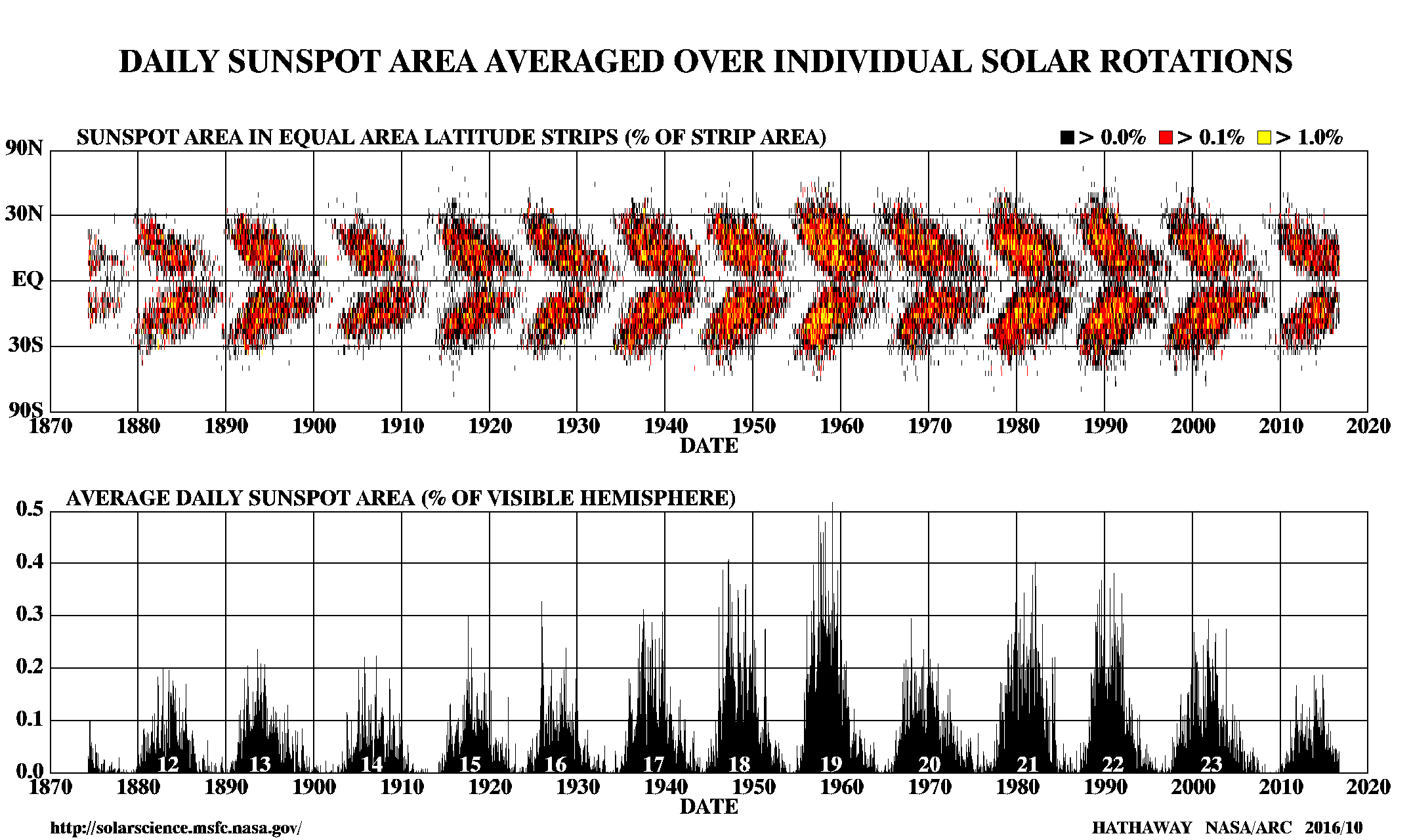
The prediction method has been slightly revised. The previous method found a fit for both the amplitude and the starting time of the cycle along with a weighted estimate of the amplitude from precursor predictions (polar fields and geomagnetic activity near cycle minimum). Recent work [see Hathaway Solar Physics; 273, 221 (2011)] indicates that the equatorward drift of the sunspot latitudes as seen in the Butterfly Diagram follows a standard path for all cycles provided the dates are taken relative to a starting time determined by fitting the full cycle. Using data for the current sunspot cycle indicates a starting date of May of 2008. Fixing this date and then finding the cycle amplitude that best fits the sunspot number data yields the current (revised) prediction.

Click on image for larger version.
Predicting the behavior of a sunspot cycle is fairly reliable once the cycle is well underway (about 3 years after the minimum in sunspot number occurs [see Hathaway, Wilson, and Reichmann Solar Physics; 151, 177 (1994)]). Prior to that time the predictions are less reliable but nonetheless equally as important. Planning for satellite orbits and space missions often require knowledge of solar activity levels years in advance.
A number of techniques are used to predict the amplitude of a cycle during the time near and before sunspot minimum. Relationships have been found between the size of the next cycle maximum and the length of the previous cycle, the level of activity at sunspot minimum, and the size of the previous cycle.
Among the most reliable techniques are those that use the measurements of changes in the Earth’s magnetic field at, and before, sunspot minimum. These changes in the Earth’s magnetic field are known to be caused by solar storms but the precise connections between them and future solar activity levels is still uncertain.
Of these “geomagnetic precursor” techniques three stand out. The earliest is from Ohl and Ohl [Solar-Terrestrial Predictions Proceedings, Vol. II. 258 (1979)] They found that the value of the geomagnetic aa index at its minimum was related to the sunspot number during the ensuing maximum. The primary disadvantage of this technique is that the minimum in the geomagnetic aa index often occurs slightly after sunspot minimum so the prediction isn’t available until the sunspot cycle has started.
An alternative method is due to a process suggested by Joan Feynman. She separates the geomagnetic aa index into two components: one in phase with and proportional to the sunspot number, the other component is then the remaining signal. This remaining signal has, in the past, given good estimates of the sunspot numbers several years in advance. The maximum in this signal occurs near sunspot minimum and is proportional to the sunspot number during the following maximum. This method does allow for a prediction of the next sunspot maximum at the time of sunspot minimum.
A third method is due to Richard Thompson [Solar Physics 148, 383 (1993)]. He found a relationship between the number of days during a sunspot cycle in which the geomagnetic field was “disturbed” and the amplitude of the next sunspot maximum. His method has the advantage of giving a prediction for the size of the next sunspot maximum well before sunspot minimum.
We have suggested using the average of the predictions given by the Feynman-based method and by Thompson’s method. [See Hathaway, Wilson, and Reichmann J. Geophys. Res. 104, 22,375 (1999)] However, both of these methods were impacted by the “Halloween Events” of October/November 2003 which were not reflected in the sunspot numbers. Both methods give larger than average amplitude to Cycle 24 while its delayed start and low minimum strongly suggest a much smaller cycle.
The smoothed aa index reached its minimum (a record low) of 8.4 in September of 2009. Using Ohl’s method now indicates a maximum sunspot number of 70 ± 18 for cycle 24. We then use the shape of the sunspot cycle as described by Hathaway, Wilson, and Reichmann [Solar Physics 151, 177 (1994)] and determine a starting time for the cycle by fitting the latitude drift data to produce a prediction of the monthly sunspot numbers through the next cycle. We find a maximum of about 60 in the Spring of 2013. The predicted numbers are available in a text file, as a GIF image, and as a pdf-file. As the cycle progresses, the prediction process switches over to giving more weight to the fitting of the monthly values to the cycle shape function. At this phase of cycle 24 we now give 66% weight to the amplitude from curve-fitting technique of Hathaway, Wilson, and Reichmann Solar Physics 151, 177 (1994). That technique currently gives similar values to those of Ohl’s method.
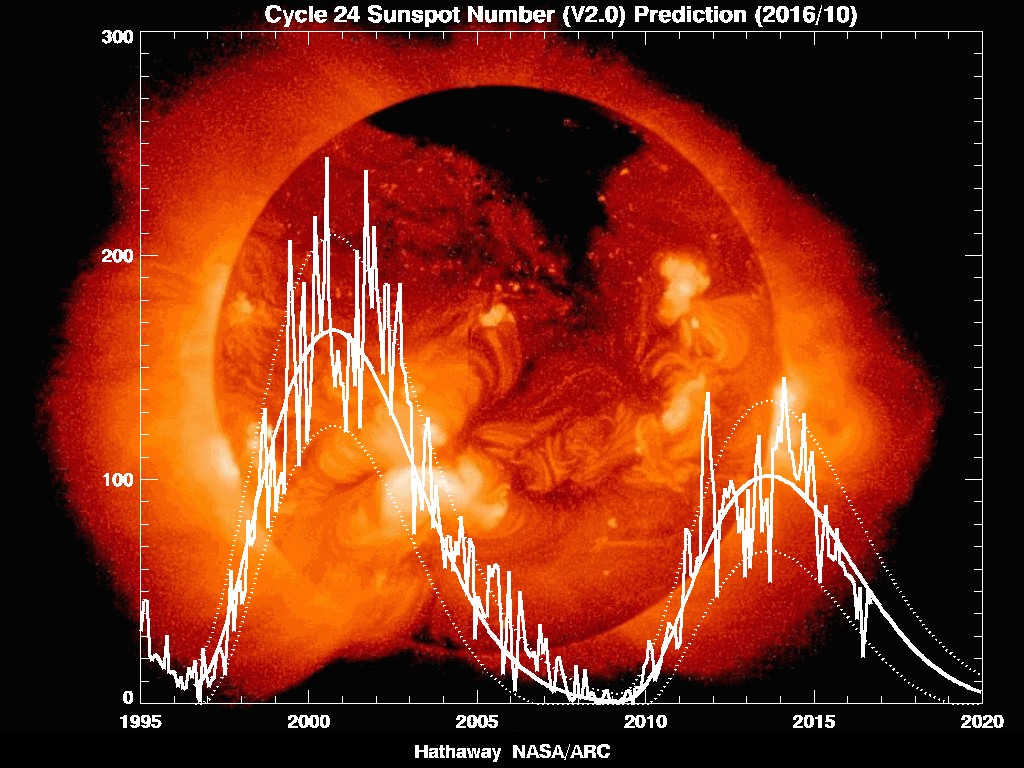
Note: These predictions are for “smoothed” International Sunspot Numbers. The smoothing is usually over time periods of about a year or more so both the daily and the monthly values for the International Sunspot Number should fluctuate about our predicted numbers. The dotted lines on the prediction plots indicate the expected range of the monthly sunspot numbers. Also note that the “Boulder” numbers reported daily at www.spaceweather.com are typically about 35% higher than the International sunspot number.
Another indicator of the level of solar activity is the flux of radio emission from the Sun at a wavelength of 10.7 cm (2.8 GHz frequency). This flux has been measured daily since 1947. It is an important indicator of solar activity because it tends to follow the changes in the solar ultraviolet that influence the Earth’s upper atmosphere and ionosphere. Many models of the upper atmosphere use the 10.7 cm flux (F10.7) as input to determine atmospheric densities and satellite drag. F10.7 has been shown to follow the sunspot number quite closely and similar prediction techniques can be used. Our predictions for F10.7 are available in a text file, as a GIF image, and as a pdf-file. Current values for F10.7 can be found at: http://www.spaceweather.ca/sx-4-eng.php.

Discover more from Watts Up With That?
Subscribe to get the latest posts sent to your email.
Told you.
But you can see where this is going. Falling or stable global temperatures are caused by the Sun and rising temperatures are down to carbon dioxide alone.
Would this be sufficient then to trigger a new LIA?
If so, how low can it go, and how long will it take to kick in?
I see Piers is already predicting the coldest May in 100 years for the UK !!!
Andi
I remember seeing a “prediction” from a while back saying that the next cycle (i.e.: this one) would be the biggest ever.
Not to worry though: climate (global temperature) has nothing to do with the Sun, Some people say it’s all to do with man made CO2. Has anyone else heard of this or was I hallucinating?
Interesting that Dr Hathaway has a predicted solar cycle length for SC24 around 13 years from look of his graph. Suggests the following cycle will also be cool, about 1-1.5 C below average. So, temperatures look like staying down until the mid 2030’s at least.
Is it time we stopped trying to predict a non-linear, chaotic system.
It might cut down on foolish attempts to control same ?
”Climate(global temperature) has nothing to do with the Sun” God please tell me you’re kiding.
EvilDenier says:
May 2, 2012 at 4:08 pm
”Climate(global temperature) has nothing to do with the Sun” God please tell me you’re kiding.
______________________________
If climate has nothing to do with the sun then we can take it completely away and let CO2 warm us. (snicker)
2012 and all that.
not sure id even believe this…ss count is at 140 atm
First time I think he’s error-ing on the low side… ever!!
by 25…
According to my eyeball.
Jimmy Haigh says:
May 2, 2012 at 3:27 pm
i thought that the /sarc tag was implicit in what I was saying…
[NOTE: You really oughtta know by now that absolutely nothing is beyond belief for some people. Reality imitates art, or art and reality are the same…. /sarc tags are best, lest one wonder…. -REP]
For months I’ve been quoting the statistic that up to a quarter of Scotland’s population died in the 1690s during the last Maunder Minimum. I’ve sent letters to MPs, MSPs, the Prime Minister, First Minister. For Scotland, this famine is a bit like the Boston Tea Party .. but in reverse! Instead of giving us independent, this was one of the events that lost us ours. With a new Minimum on the cards, with the an independence vote being on the cards. I thought this book would be in demand. But no! I’ve had it four months without a squeek.
This is the only copy in Glasgow University. For four months as we stare into the face of a new Minimum, not a single academic or student in the whole university (or interlibrary) has bothered to get out the single most comprehensive book on the single most important event in Scottish climate history. Surely just intellectual curiosity would have caused someone to ask for the book with quotes like:
“It was perhaps the fact that the hardships of the crisis were felt by ‘all ranks of People’ that made the increased burden of supporting the poor unpopular….”
“[those people] that are [still] alive can scarce raise their thoughts to any thing that regards the next life: but are wholly occupied how they may find by buyeing, begging or even takeing what may prolong their little remnant of life the worst is that this year most part of their cattle especially milk-kine which could serv’d them for meal, are dead”
“Sea temperatures off Orkney were possibly as much as 5°C lower than the modern day and ‘stories of eskimos in kayaks arriving dead or exhausted in Orkney and Scottish waters date from this period of outward-flowing Arctic currents’
By the summer of 1698 contemporaries were again beginning to comment on the visibility of famine through the deaths of the poor. In both June and November that year news reached Edinburgh of people found dead on the roads throughout the country.l!” No indication was
given for the causes of these deaths, but it seems plausible that starvation or severe malnourishment among poor people, moving between towns and parishes in search of food, were key factors.”
Then yesterday my library book “Famines in Scotland: the ill years’ of the 1690s” was recalled.
I’ll put another plug in for having a post on the entire series of predictions for cycle 24. It would also be fun to watch the pro big cycle/pro small cycle ratio over the same time period.
the predicted size makes this the smallest sunspot cycle in about 100 years
Was part of the title of our prediction paper: http://www.leif.org/research/Cycle%2024%20Smallest%20100%20years.pdf
Andi Cockroft says:
May 2, 2012 at 3:06 pm
I see Piers is already predicting the coldest May in 100 years for the UK !!!
Piers predicted last week would be with heavy tornadic activity in the US. Instead we got a snowstorm. Reminds me of the reaction of a believer when Uri Geller was caught in faking some of his spoon-bendings: “so what that he is a fraud 90% of the time, the remaining time he is for real”
I beat Hathaway’s new solar cycle 24 prediction by three years. I predicted solar cycle 24 to be the smallest in the past 100 years back in February 2008.
Thomas F. Giella says:
May 2, 2012 at 5:11 pm
I beat Hathaway’s new solar cycle 24 prediction by three years. I predicted solar cycle 24 to be the smallest in the past 100 years back in February 2008.
Success has many fathers. Failure is an orphan.
[NOTE: You really oughtta know by now that absolutely nothing is beyond belief for some people. Reality imitates art, or art and reality are the same…. /sarc tags are best, lest one wonder…. -REP]
I remember just a couple years ago, they were predicting that the next cycle would be the highest on record. And as we slowly grew into the new solar cycle, their projection kept gettting smaller and smaller (and being pushed back years at a time). Now to be the smallest on record.
That explains everything, at last! Or at least, it would appear to explain everything about the disparity between the Spaceweather daily sunspot numbers and their subsequent monthly plots, which has been bothering me for quite some time. If the monthly plots are smoothed International Sunspot Numbers, as for the predicted numbers, then the factor is ‘Daily Number’ x 0.65 = ‘Monthly Plotted Value’. Though I still don’t know if they are plotting the ISN number for the last day of the month, or an average value for the month.
LC Kirk, Perth says:
May 2, 2012 at 5:53 pm
If the monthly plots are smoothed International Sunspot Numbers, as for the predicted numbers, then the factor is ‘Daily Number’ x 0.65 = ‘Monthly Plotted Value’. Though I still don’t know if they are plotting the ISN number for the last day of the month, or an average value for the month.
It is much simpler than that. The International Sunspot Number for historical reasons [to be compatible with Rudolf Wolf’s count for 1849 to 1865] is reported as 0.6 x the actual count, while the NOAA count is just the raw count [actually = 10 x number of groups + number of spots].
Leif Svalgaard – “Piers predicted last week would be with heavy tornadic activity in the US. Instead we got a snowstorm.“.
Piers Corbyn is very strong on self-promotion, but even he claims only 85% accuracy on extreme weather events (http://www.weatheraction.com/pages/pv.asp?p=wact45). Thus about 1 in 7 of his predictions can be expected to be wrong. That you managed to find one of the wrong ones isn’t exactly a big deal.
“Also note that the “Boulder” numbers reported daily at http://www.spaceweather.com are typically about 35% higher than the International sunspot number.”
http://solarscience.msfc.nasa.gov/predict.shtml
“The Boulder number (reported daily on SpaceWeather.com) is usually about 25% higher than the second official index, the “International Sunspot Number,” published daily by the Solar Influences Data Center in Belgium. Both the Boulder and the International numbers are calculated from the same basic formula, but they incorporate data from different observatories.”
http://spaceweather.com/glossary/sunspotnumber.html
So is “usually” and “typically” different terms in science? And why would different values be observed at different observatories, when the “same basic formula” – and the same data – is used?
Recent work [see Hathaway Solar Physics; 273, 221 (2011)] indicates that the equatorward drift of the sunspot latitudes as seen in the Butterfly Diagram follows a standard path for all cycles provided the dates are taken relative to a starting time determined by fitting the full cycle.
Except that it’s not following a standard Butterfly Diagram path:
http://www.robertb.darkhorizons.org/TempGr/uvp2324a.PNG
If and when the Southern Sunspot Belt manages to gravitate towards the Solar Equator, I suppose there will be something to base the calculations upon.
Until then, it’s SC24 and it’s ill-behaved monkey business as usual.
No sarcasm intended.
Will this result in a reduction of ocean heat content? If so, how long will it take for it to noticeably decline – and then how long for surface temps to begin dropping?