By WUWT regular “Just The Facts”
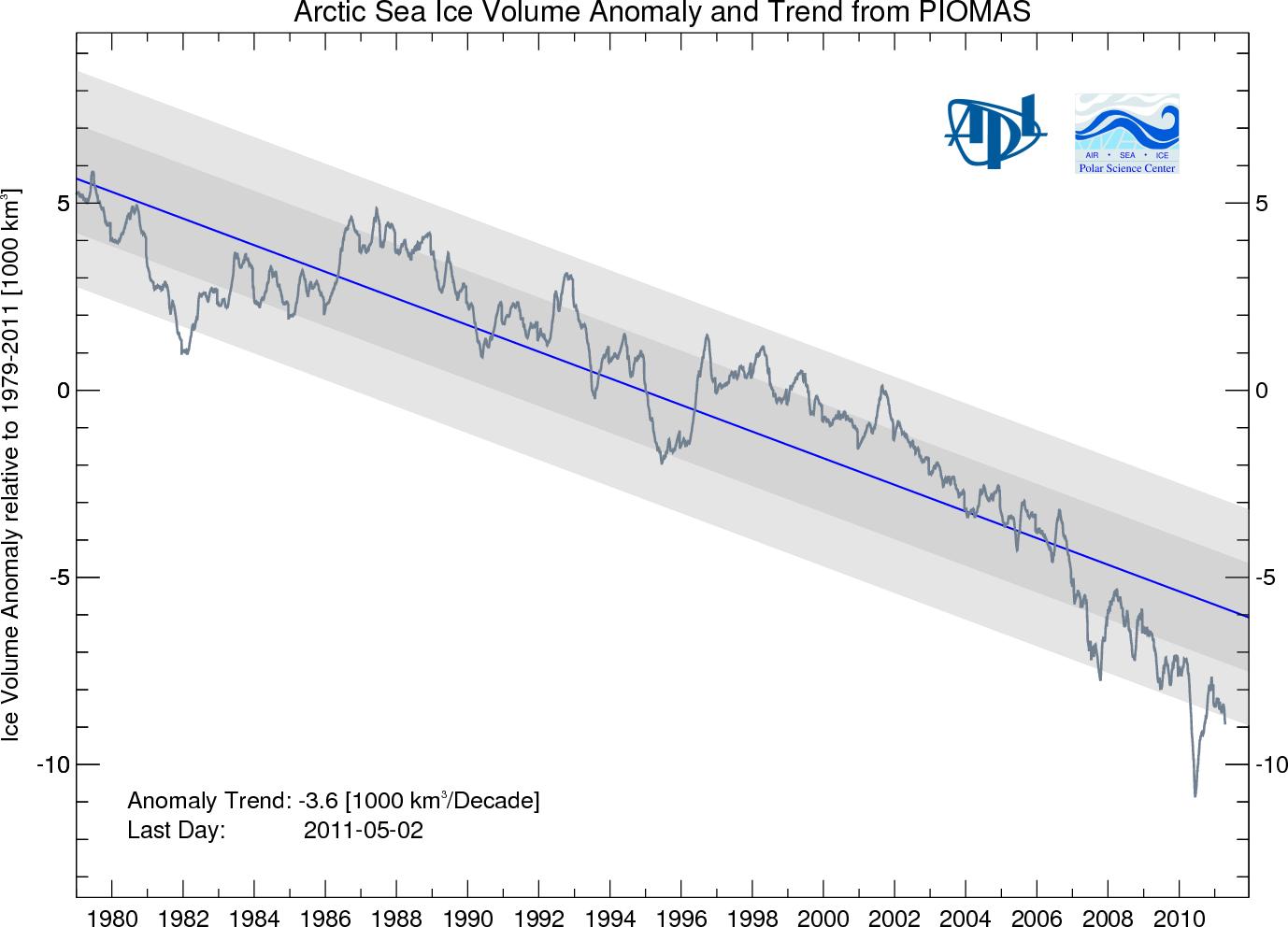
It seems that the Pan-Arctic Ice Ocean Modeling and Assimilation System (PIOMAS) Arctic Sea Ice Volume Model that generated the highly suspect chart above has been corrected to “show reduced errors over the prior version”. According to the University of Washington Polar Science Center website:
“New Version
This time series of ice volume is generated with an updated version of PIOMAS (June-15,2011). This updated version improves on prior versions by assimilating sea surface temperatures (SST) for ice-free areas and by using a different parameterization for the strength of the ice. Comparisons of PIOMAS estimates with ice thickness observations show reduced errors over the prior version. The long term trend is reduced to about -2.8 103 km3/decade from -3.6 km3/decade in the last version. Our comparisons with data and alternate model runs indicate that this new trend is a conservative estimate of the actual trend. New with this version we provide uncertainty statistics. More details can be found in Schweiger et al. 2011. Model improvement is an ongoing research activity at PSC and model upgrades may occur at irregular intervals. When model upgrades occur, the entire time series will be reprocessed and posted.”
Here is the PIOMAS New Model Version:
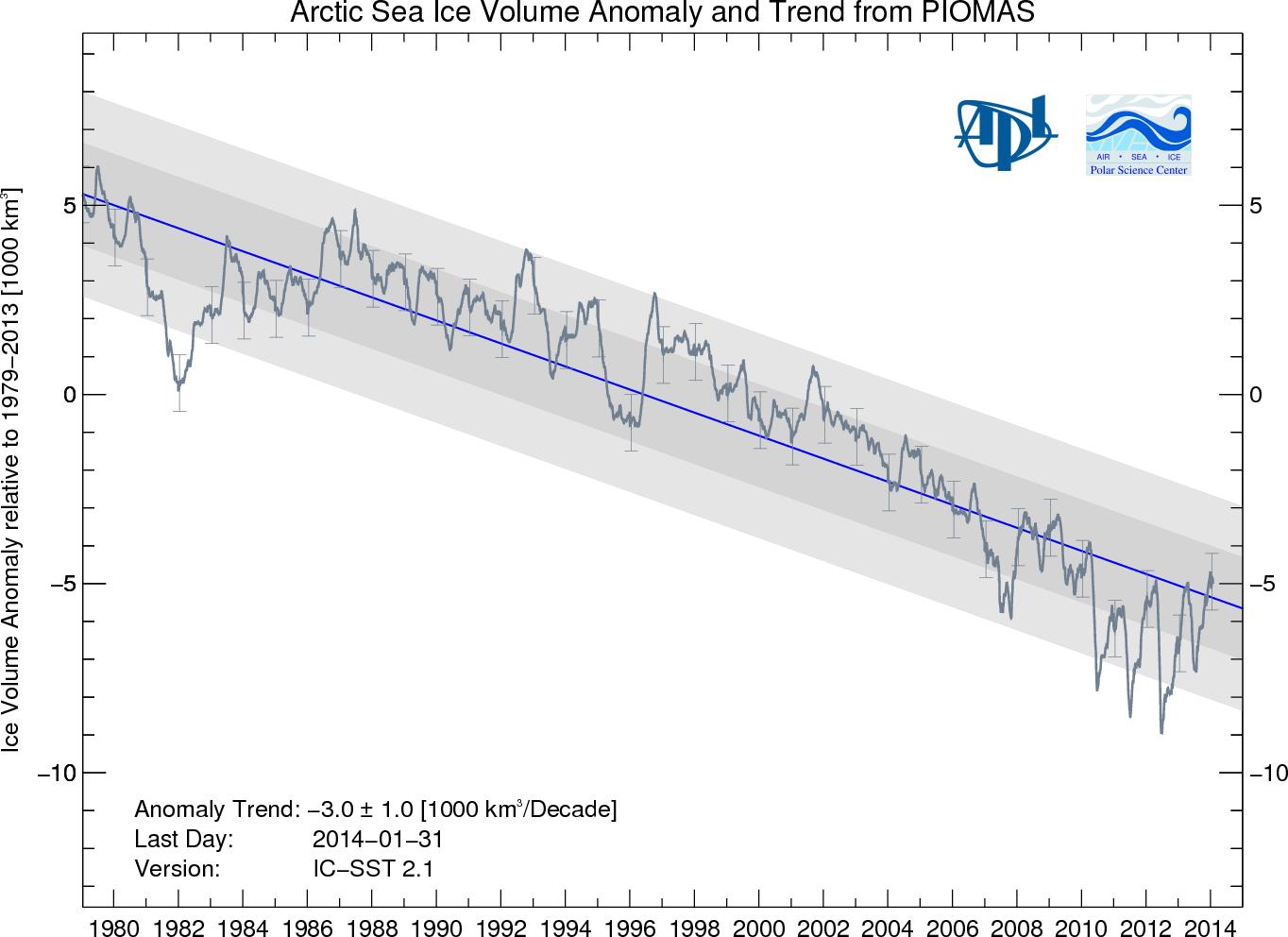
and the chart below appears to show the original “Adjusted” version and the new unadjusted version:
Correction: Per this comment the chart below actually represents an “exercise” “not designed to correct potential model biases” when the “model appears to overestimate thin ice and underestimate thick ice.” The impact of this “exercise” is that the “downward decadal trend increases from -2.8×10³ km3/dec to -3.5×10³ km3/dec” which is the inverse of the impact when they “reduced errors over the prior version” and reduced the trend “to about -2.8 103 km3/decade from -3.6 km3/decade”, however the chart below does not show “the original “Adjusted” version and the new unadjusted version” as was incorrectly stated above.

If you look here you can see how Dr. Jinlun Zhang developed his suspect model. The page states that;
“Satellite sea ice concentration data are assimilated in GIOMAS using the Lindsay and Zhang (2005) assimilation procedure. The procedure is based on “nudging” the model estimate of ice concentration toward the observed concentration in a manner that emphasizes the ice extent and minimizes the effect of observational errors in the interior of the ice pack.”
According to this paper:
“Because of the errors in the summer Gice dataset ice concentration in the interior of the pack (as well as errors in summer ice concentration based on passive microwave observations), assimilation of ice concentration is accomplished in a method that emphasizes the extent over the concentration. The observations are weighted heavily only when there is a large discrepancy between the model and the observed concentration. Each day the model estimate Cmod is nudged to a revised estimate Ĉmod with the relationship.”
So it appears that to develop his model Zhang used an erroneous data set, weighted heavily when observations didn’t fit the model and then “nudged” its output to the results that he wanted.
Zhang has a history of contorting himself to help paint over the gaps in the Catastrophic Anthropogenic Global Warming Narrative. For example, in this NASA article/press release it states that:
“Jinlun Zhang, an oceanographer at the University of Washington, has pieced together a complex computer model that helps explain why Antarctic sea ice is expanding even with signs that ocean and air temperatures are on the rise.”
and in this paper titled “What drove the dramatic retreat of Arctic sea ice during summer 2007?” by Zhang, J., R.W. Lindsay , M. Steele, and A. Schweiger, Geophys. Res. Lett., 35, L11505, doi:10.1029/2008GL034005, 2008, it states that “Arctic sea ice in 2007 was preconditioned to radical changes” and this contributed to “The dramatic decline”. This is not objective science, rather it’s alarmist rhetoric.
Zhang was already looking for an Arctic Sea Ice tipping points in 2005, i.e. the title of this paper paper was “The thinning of arctic sea ice, 1988–2003: have we passed a tipping point?” by Lindsay, R. W. and J. Zhang, J. Climate, 18, 4879–4894, 2005.
In 2006 Zhang co-wrote a paper with Mark “Death Spiral” Serreze and Keith “the lack of warming … is a travesty” Trenberth, titled “The large-scale energy budget of the Arctic” by Serreze, M. C., A. P. Barrett, A. G. Slater, M. Steele, J. Zhang, and K. E. Trenberth, , J. Geophys Res., 112, D11122, doi: 10.1029/2006JD008230, 2007.
Zhang’s history of global warming advocacy aside, I give him credit for correcting his model to reduce the trend from -3.6 km3/decade in the last version to about -2.8 km3/decade in the New Model Version, so that is now less wrong. Then again, he is probably just hedging because, per this article, CryoSat is now generating maps of sea ice thickness and it is just a matter of time before Zhang’s model will be confronted by empirical evidence.
I wonder if all of the Warmist blogs that have used the old inaccurate PIOMAS chart will post updates/corrections to inform their readers of the good news…
To view more reliable sources of sea ice data please visit the WUWT Sea Ice Page.
Do those that quote PIOMAS as gospel know that it is model generated or do they refuse to see the emperor’s gold cloak?
What a lovely model. If the Ice Extent data doesn’t match the model, substitute the Ice Concentration data. Now, who was it that is famous for splicing data from different data-type sets? New & Improved. I liken this to cheat codes in computer games. If you can’t win because your gameplay is inferior, simply apply the cheat codes.
Do you accept the physics models that the CryoSat team uses to create those maps? including physics of the atmosphere?
Am I missing the point here?
Why model ice extent when you can measure it?
Oh silly me – the models are more accurate
As Monty Python so eloquently put it: “Nudge, nudge, wink, wink; say no more. … A nods as good as a wink to a blind bat.”
The only Artic ice extent I trust is Scandinavian, either NORSEX or DMI (Danmark). The rest NDSC, NOAA, CT etc mainly US based, are complete biased to AGW and their data is constantly adjusted down to fit the AGW agenda. THere has been an INCREASE in Ice extent skince 2007 yet all the US graphs show ice declining each year what a joke!
I became aware of the new PIOMAS model when someone asked over on Open Thread #10 about the alarming loss of volume, with a link to Neven’s alarmist blog. To avoid direct contamination I located Google’s cached snapshot of the page.
The new PIOMAS data is freely available, compressed text file with three columns: year, day, volume in 1000 cubic kilometer units. Neven was very happy when one of his devoted followers cranked out some graphs from the data.
First one, using the September data and fitting different trend lines. Exponential fit, r^2 0.899 and the hypothetical best fit, there will be no Arctic sea ice in September in 2015. Log fit, r^2 0.898 (about the same), 2012. So by the two best fits to the PIOMAS data, the Arctic will run out of sea ice in September sometime between next year and three years hence.
Second graph, all months plotted, select months shown with those “best fit” exponential trends. October also goes away in 2015, August holds out until 2016.
Do we really need anymore proof of the sheer robustness of PIOMAS than that?
😉
IDKFA
Nice to see models continually refined. Both PIPS 2.0 and PIOMAS are models and both had/have their issues. The new CryoSat 2 data and future IceSat 2 will make the need for modeling ice volume less important. Regardless, they all show the Arctic heading for ice free summers this century, and probably in the next few decades. What does it really matter that first ice free summer is 2025, 2030, or 2040? The trend is what is important and it’s down down down…
“observations show reduced errors” So does that mean there are still errors out there to be dealt with?
I question this chart because it gives the appearance of a falling area (volume) to those that see just the line, and fail to see that the line crosses through ZERO.
How can there be NEGATIVE ice volume?
Then you read the top and see that we’re dealing with an anomaly – a difference between current and some unknown time period or value.
Most of the time, it’s the choice of the averaging period that causes the anomaly – not so much the current.
Here, they reference the current to the current? Reference period from 1979 – 2011? 2011 isn’t over yet, is it?
Something still doesn’t sound right…
Here’s the latest ice shot across the bow: Bob Weber
Globe and Mail Update
Published Tuesday, Jun. 28, 2011 10:34AM EDT
A 500-kilometre walk over treacherous Arctic terrain has resulted in a possible explanation for why sea ice in northern waters is melting so much more rapidly than anyone thought it would.
“We’re trying to understand why the ice is melting so fast,” said Simon Boxall of the Catlin Arctic Survey. “It’s not just down to simple warming. There are more complicated processes.”
The speed at which sea ice is disappearing in the Arctic has far exceeded almost all predictions and alarmed climate scientists.
A 2007 paper from the National Snow and Ice Data Center in Boulder, Colo., found that the projections of the UN-sponsored Intergovernmental Panel on Climate Change were already obsolete three years after they were published.
When projections from the panel were compared with actual observations, the authors found that between 1953 and 2006 the sea ice was retreating three times faster than it should have. Between 1979 and 2006, when satellite data was available, the actual retreat was twice as fast as climate models predicted.
The report concluded that sea ice retreat is 30 years ahead of where scientists thought it would be. “Decay of the ice cover is proceeding more rapidly than expected based on the model simulations,” said the report published in Geophysical Research Letters.
The team at the Catlin Arctic Survey, sponsored by the Catlin Group insurance company, thought the answer might lie in different temperatures at different levels of Arctic seas.
Such data is usually obtained from ships. But during the spring, when melting is greatest, there’s still too much sea ice for ships to make it through.
So the scientists walked from Borden Island to Ellef Ringnes Island and also from near the North Pole all the way down to the northern tip of Ellesmere Island, slogging about 10 kilometres a day in below-deep-freeze temperatures over rugged, uneven ice.
What they found was a surprise — a layer of seawater about 200 metres below the surface that was actually colder than when it had been measured by previous expeditions.
“That’s counterintuitive,” said Mr. Boxall. “We would expect to see, with global warming, warming conditions generally.”
But when they realized that the colder water was also saltier than they expected, an explanation began to suggest itself.
Mr. Boxall points out that the older sea ice is, the less salt it contains. Ice that’s two or three years old already contains very little salt.
Year-old ice, however, remains fairly salty. And when it melts, it produces meltwater that’s denser than the relatively fresh water from older ice.
As multi-year ice declines throughout the Arctic, more of the saltier meltwater from younger ice is mixing into the ocean. That colder, denser water sinks more quickly and forces less dense water from deeper in the ocean up to the surface.
Because fresh meltwater is colder than seawater, that means relatively warm water is being forced upwards. And that, said Mr. Boxall, may be part of the reason that sea ice is melting so much faster than anyone thought it would.
“What we’re seeing is that (fresh meltwater) being taken away from the surface and replaced by slightly warmer water,” said Mr. Boxall. “The evidence is that the surface waters are (now) slightly warmer.”
Mr. Boxall cautions that his conclusions are based on a preliminary review of data that the team brought back from the ice.
“We need to compare our results with previous data and with groups from other areas.”
A paper is being prepared for publication.
The results do show that the effects of climate change and global warming are not always obvious, suggested Mr. Boxall.
“The evidence is that there’s something interesting going on. The fact that (the climate) is getting warmer is one reason for the ice melting, but it’s more complex than that.”
And yet the Arctic ice continues to melt. Scientists attempt, imperfectly, to model reality. Pseudo-scientists simply deny reality.
Nice going! Once again, IGNORE the shelf ice around Antartica. Combining that measurement (see UI Icecap page) gives nary a 3 or 4% change in 30 years. NOTHING worth worrying about, and most of that coming from the type of ERRORS in the Arctic ice mentioned in this article.
Untruth by 1/2 truth. Classic.
Max
I will admit, this level of data manipulation is highly disturbing and disingenuous. “Nudging” results from a model when the empirical evidence becomes available by “weighting” the output instead of fixing the calculation methods takes this out of the realm of science and into manipulation.
Huh, a better model finds “it’s not as bad as we thought”. Go figure.
Meanwhile on another kind of ice front, I’ve identified something of potential interest to WUWT readers: and apparent step shift in Northern Hemisphere snow cover:
http://devoidofnulls.wordpress.com/2011/06/28/a-step-change-in-northern-hemisphere-snowcover/
Wasn’t R Gates that argued that the PIOMAS was the most accurate model and better than the US Navy one?
Strange, very strange
This is the kind of analysis you expect of a child. Only one cause. I hope he is just saying that this is one item in addition to all the other issues such as winds and currents, multiple volcanos, soot…
I imagine… that if you make a graph of Arctic Sea Ice extent vs Icebreaker commissioning, you will see a direct correlation.
Interesting article from the Globe and Mail. What if… the unexpectedly cold water is not a normal feature to account for in terms of ” the effects of climate change and global warming are not always obvious” but is evidence of a recent change in currents/temps in the Arctic? R Gates often opines that it is warm waters causing much of the increased ice melt, so reasonably we could assume that if those same waters are now trending cooler the effect will be for melting to lessen. The assumption in the article is that the ice is melting and the colder waters found must in some way be associated with that process. But what if it isn’t?
henrythethird says:
June 28, 2011 at 11:17 am
I have never met an anomaly that I have trusted. Anomalies are like fights in Ice Hockey. When they decide to make it a real sport, there will be no fights.
Mike says:
June 28, 2011 at 12:41 pm
“And yet the Arctic ice continues to melt. Scientists attempt, imperfectly, to model reality. Pseudo-scientists simply deny reality.”
You can model reality only after the fact. Scientists are interested in creating hypotheses that enable prediction of reality.
Piomas arctic sea ice volume decline estimates look impressive if the graph starts in 1980 when sea ice extent was at a high and ocean arctic ocean heat content was at a low. http://i53.tinypic.com/214s085.jpg
However the same model can be used to model the sea ice volume before 1980. http://psc.apl.washington.edu/zhang/IDAO/retro.html#Satellite_ice
Then the recent decline in sea ice volume looks simply cyclical.
folks should not confuse extent with volume.
Until you can directly measure volume you have to model it. we measure extent.
Folks should also not read too much into a staright line extrapolation. thats merely a convenient indicator.
What’s ironic though is that the greenbillies can take the last, and only, 30 years of sat data of a fairly high amount of square kilometers of ice and conclude that it’ll progress down to zero in a decade, again, or next decade, again, or well at least within this century, again.
The north pole was, apparently, ice free in some summers during the 1950’s, and probably has been before, and probably will again. The whole arctic wasn’t ice free though just the north pole, but now we’re supposed to fear an ice free arctic because some greenbillies interpret some models that way. At the same time there’s probably a good reason for why energy companies get new and approved icebreakers that can manage thicker ice.