From: Ryan N. Maue’s 2010 Global Tropical Cyclone Activity Update

Figure: Global and Northern Hemisphere Accumulated Cyclone Energy: 24 month running sum through July 31, 2010. Note that the year indicated represents the value of ACE through the previous 24-months for the Northern Hemisphere (bottom line/gray boxes) and the entire global (top line/lime green boxes). The area in between represents the Southern Hemisphere total ACE.
Note: Southern Hemisphere tropical cyclone data is spotty prior to the introduction of reliable satellite monitoring, thus the ACE represented at the beginning of the 1980s is likely underestimated due to missing data. Thus, it is possible that the current global collapse in TC ACE is comparable to lows experienced prior to 30-years ago…
Global TC Activity remains at 30-year lows at least — The last 24-months of ACE at 1090 represents a decrease from the previous months and a return to the levels of September 2009.
Since Hurricane Katrina (August 2005) and the publication of high-profile papers in Nature and Science, global tropical cyclone ACE has collapsed in half. This continues the now 4-consecutive years global crash in tropical cyclone activity. While the Atlantic on average makes up about 10% of the global, yearly hurricane activity, the other 90% deserves attention and has been significantly depressed since 2007. See Figure below.
Northern Hemisphere year-to-date ACE is nearing 50% below normal. The Western North Pacific is at 17% of normal (or the past 30-year average).

Figure: Northern Hemisphere cumulative ACE per day of year from July – December. See legend for appropriate axis of each basin or NH total.
Climatological yearly ACE and HDAYS are based upon 1980-2009 values (last 30 years)
[Month, Day, IO, EPAC, NATL, WPAC, NH]
============================================
Steve Goddard has done some interesting work that complements what Dr. Maue has discussed, see below. – Anthony
Steve Goddard writes:
Everyone in the hurricane forecast business predicted a big season this year. NOAA reaffirmed their position this week, as reported on WUWT.
One of the main reasons cited for the forecasts was “record high Atlantic SSTs.” So let’s look at the SST anomalies in the region between the Cape Verde Islands and the US. That is the normal hurricane formation track.

SSTs have plummeted and are now not much above normal. Compare SST anomalies vs those in late May. The hurricane breeding ground has not kept it’s unusual warmth.

Has this affected hurricane formation? Circumstantial evidence suggests yes. Hurricane numbers are average , and ACE is well below average.

http://www.weatherstreet.com/hurricane/2010/named-storms-climatology.gif
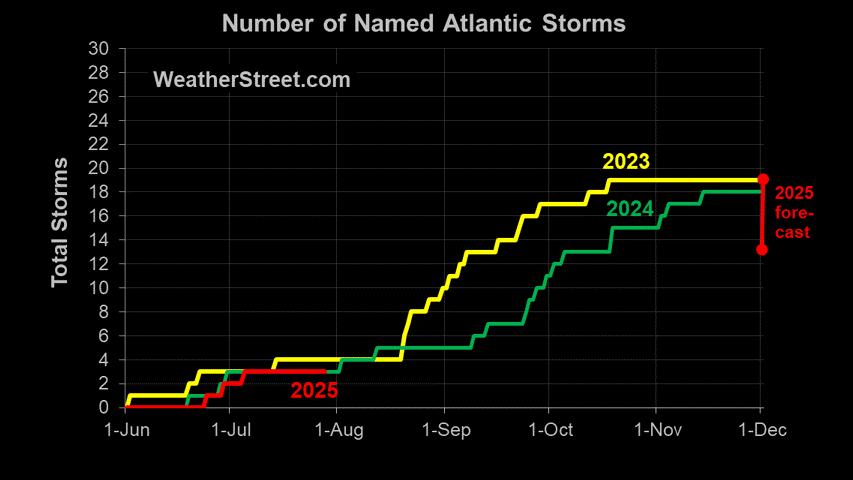
That’s going to be embarrassing for NOAA, half their predicted low number! What was Dr. Hansimian’s prediction?
Hurricanes are down and that’s good news. Joe Bastardi still thinks there could be a strong one to come this year.
6:09 video
http://www.accuweather.com/video/424570870001/no-changes-to-my-hurricane-idea.asp?channel=vbbastaj
I think this information, and it’s ramifications for AGW, should be added to the “Our Climate” app.
The William Gray Forecast, recently updated:
http://hurricane.atmos.colostate.edu/Forecasts/
SG: “Everyone in the hurricane forecast business predicted a big season this year. ”
Did they?
“NOAA’s 2010 Eastern Pacific Hurricane Season Outlook indicates a 75% chance of a below-normal season, a 20% chance of a near-normal season, and a 5% chance of an above normal season.”
http://www.cpc.noaa.gov/products/Epac_hurr/Epac_hurricane.html
The change over from El Nino to La Nina are usually reasonably above average years for hurricane activity in the Atlantic basin.
This year, shear still appears to be a problem with the presence of TUTTs (tropical upper tropospheric troughs) but as JB says, they will be lifting out soon, the Azore and Bermuda highs will solidify and the Cape Verde breeding ground will start to produce.
You can follow along with Mark Sudduth at:
http://www.hurricanetrack.com
Don’t forget that following the AGW crowd’s modus operandi of covering all bases NASA did claim that global warming would reduce the number of hurricanes.
Global warming makes hurricanes stronger and weaker. More common and less common. Sometimes global warming makes them unchanged.
People used to revere gods – now they worship CO2 and government scientists. Zeus vs. Hansen.
Has NOAA ever predicted a low hurricane season?
Dr. Mann of Penn State predicted 23 named storms. Dr. Gray of CSU team predicted 18. Through today we have had 3. Much ground to cover in the next 117 days. The problem is one of speed. Cape Verde waves only come off the continent of Africa about once every 3 to 4 days. There will be less than 40 of these waves in the rest of the season. And of these less than 40 waves, only 10% to 15% are normally productive ie grow into tropical cyclones. This engine just doesn’t have the time or band width to get the job done. Its not a travesty, unless you are rooting for heat transfer to the North.
9 August. It is still early.
Also, the SST area that shows below normal per the map Steve shows is not really the tropical cyclone breeding ground for the North Atlantic.
The breeding ground i s further south, between the Lesser Antilles and Cape Verde, and it shows a positively warm anomaly.
The cooler area to the north doesn’t help, of course. But I would like to know how such a cold anomaly could appear so fast? Is it a giant upwelling?
The latest NOAA weekly SST anomaly map (OK the latest I could pull up which is the last week of July), doesn’t show any such cold anomaly, or anything close:
http://www.emc.ncep.noaa.gov/research/cmb/sst_analysis/images/wkanomv2.png
Neither does the map showing the last month:
http://www.emc.ncep.noaa.gov/research/cmb/sst_analysis/images/monanomv2.png
Something ain’t right here. What gives?
What is the good map showing SSTs here?
Chris
Norfolk, VA, USA
Mike says:
August 8, 2010 at 8:10 pm
Re: Eastern Pacific Hurricane Season Outlook
Okay, Mike. We are truly sorry. Somehow we thought we were talking about the Atlantic Ocean. The names are similar but we won’t let this happen again. Next time maybe Anthony can start with a picture so we don’t get confused.
Or maybe Steve can put a link in the first sentence that when you mouse over it it tells you the area that is being discussed and a previous article on it. You know as an off the wall example, completely picked at random:
noaa-still-expects-active-atlantic-hurricane-season-la-nina-develops
” We are in the midst of the most horrific storm era in the history of mankind. If hurricanes were taxed, there would be less. Until so, all Republicans should be required to be tied to a palm tree in Florida.” Congressmen Markey and Waxman. Majority Report Of The Congressional Science For The People Committee.
stevengoddard says:
August 8, 2010 at 8:31 pm
Global warming makes hurricanes stronger and weaker. More common and less common. Sometimes global warming makes them unchanged.
People used to revere gods – now they worship CO2 and government scientists. Zeus vs. Hansen.
LOL!! Thanks for the imagery, Steve!! Release the Kracken!
Dear World,
re; low tropical storm actitivty.
We can’t explain it and that’s a travesty.
Please send money.
Sincerely,
CAGW Boffins, Inc.
savethesharks
I didn’t say the SSTs were below normal. Where did you get that from?
So, not too many hurricanes for the media to get excited about, so they are having to fall back on a few other (carefully cherry picked) ClimateNotWeather events. Floods in Pakistan, Moscow Burning, The Monster Ice Cube. The WeatherNotClimate cold events in South America, like the severe European winter 2009/10 and the Mongolian Dzud can be ignored or forgotten.
As Richard North puts it:-
“…..we get plenty of coverage about the Russian heatwave, but got very little about the coldest winter in 130 years … in Russia. Thus, the whole subject is wide open to cherry-picking, which distorts even accurate reports of isolated events. Without an appreciation of the whole picture, and a longer-term perspective, there is nothing that can be properly inferred from these events.
The real news, therefore, is not of climate, but of human tragedy and suffering. That we can do something about, and a fraction of the billions spent on “climate change” would go a long way to reducing the impact.
But as long as we are in the grip of the climate zealots, those being killed by the weather now are less important that the lucrative funding opportunities arising from predicting future disasters. How perverse it is that potential deaths in the future get more money than real deaths now – a sad reflection on human priorities.”
http://eureferendum.blogspot.com/2010/08/perverse-set-of-priorities.html
I have said it before and I’ll say it again;
That is an effect from the timing of the synod conjunctions with the outer planets, Saturn on March the 22nd 2010, brought in a nice load of heavy rain, tornadoes and flash floods globally.
Now with no other outer planet heliocentric conjunction until they are all clumped together August 20th till September 24th, the additional power inducted into the tropical storm engine has been lacking. Leaving us with just the lunar declinational tidal meridional pulses that brought us Bonnie and Colin as pulses of tropical moisture (that formed off of the center of circulation) with out the ion energy content to drive the peak precipitation that drives them into cat 2 – cat 5 storms.
They (the bigger storms) are waiting till the ionic discharge of the global atmosphere that happens post synod conjunctions, expect the stronger storms to start on the 20th of August 2010, and run to 28th of August, 2010, and start up again September 21st and run through end of the month, with some after thoughts due to continued further discharges, coinciding with the lunar declinational culmination angle peaks, both North and South.
The lack of severe Tropical storms is a combination of effects of the slow solar cycle activity, with the descending culmination angle of the lunar declination, and the outer planets Saturn /Mars this last spring, and Neptune, Uranus, Jupiter, and Venus all clumped into the fall this year.
The huge clumps of strong hurricanes seen in 2005 will not be back as long as the outer planets Neptune and Uranus are drifting apart and progressing into the fall, instead we will be experiencing their effects as more East coast and European snow storms of increased intensity.
Given also that there will be no outer planet assisted forced intrusions of warm moist tropical air masses, during the next several Northern winters, expect cold and blustery to be the norm for a while (about 15 to 20 more years.) You will see your breath, but not feel the CO2?
As soon as I can get back to Phoenix, where I have high speed internet, available programmers and tech support, I will be plotting ACE values by lunar declination, and outer planet synod conjunctions to form a visual format in the search for correlations and to assist in formulation of causation mechanisms.
Richard Holle
I was trying to understand the comment regarding CUMULATIVE ACE PER DAY graph – “Northern Hemisphere year-to-date ACE is nearing 50% below normal. The Western North Pacific is at 17% of normal (or the past 30-year average). ”
The side bar tables at Ryan’s web site helped me see what he was explaining, and might make a good update to the WUWT article above.
The table data shows
NH Current YTD 84 versus Normal YTD 156 (about 50%)
and Western North Pacific YTD 14, vs Normal YTD 87 (about 16%)
Table data from the link to “Ryan N. Maue’s 2010 Global Tropical Cyclone Activity Update” web page
http://www.coaps.fsu.edu/~maue/tropical/
# 2010 Tropical Cyclone Activity
Updated Aug 08 , 2010
BASIN CURRENT YEAR TO DATE
Northern Hemisphere 84
Western Pacific 14
North Atlantic 10.7
Eastern Pacific 39
Southern Hemisphere 196 [2009-2010]
# 1980-2009 Climatology
BASIN NORMAL YEARLY ACE** NORMAL YEAR TO DATE
Northern Hemisphere 569 156
Western North Pacific 310 87
North Atlantic 106 10
Eastern Pacific 132 50
Southern Hemisphere 204 —
Notes – Southern Hemisphere total for 2010 includes cyclones from October 2009 – April 2010.
Imagine the Warmists trying to sell “fewer intense hurricanes” or “fewer intense tropical cyclones”?
—————
IPCC Fourth Assessment Report: Climate Change 2007
http://www.ipcc.ch/publications_and_data/ar4/wg1/en/ch10s10-es-13-tropical-cyclones.html
I’m too busy drafting stock exchange announcements and editing the latest AIG News issue to get too involved in this suggestion, but it might be useful for one of the folks reading here to plot sunspot numbers versus cyclone activity re above top graph over the period good data exists.
The physics behind this is based on the idea that cyclones/hurricanes etc could be physical phenomena within the gaseous film coating the earth as a result of electric currents entering in/out of the Earth’s equatorial regions via the Van Allen belts.
If the solar variation, as indicated by the proxy of sunspots, is due to fluctuating electric currents entering into the solar system, then peturbations within the system should show some correlation with the sunspots and a time lag as well.
So low solar activity as proxied by sunspots should show correlation with tropical cyclones/hurricane activity/intensity if the latter are due to, hitherto poorly understood, electro dynamics of the earth system. Both phenomena are effects of a common underling cause.
Just a thought.
PJB says:
August 8, 2010 at 8:19 pm
The change over from El Nino to La Nina are usually reasonably above average years for hurricane activity in the Atlantic basin.
This year, shear still appears to be a problem with the presence of TUTTs (tropical upper tropospheric troughs) but as JB says, they will be lifting out soon, the Azore and Bermuda highs will solidify and the Cape Verde breeding ground will start to produce.
There appears to be a trap that everyone is falling into which is pattern matching within the period of our own experience e.g. CAGW’s ‘since records began’ normally means ‘since satellite records began’. Or within the period of historic measurements that apply e.g. hurricane records going back 100 years or so. Even these hurricane recordings are limited prior to satellites and population of the shores of the southern US States.
We may now be moving into a climate shift in the chaotic ocean/atmosphere system and reliance on ‘the Azores and Bermuda highs’ solidifying as they did in the past may be unwise. The jet-stream does not appear to be behaving in a way that imbues confidence in the future weather patterns just repeating what they have done over the last fifty years or even a century.
@richard holle
Thanks for your planetary predictions. The second best laugh since Steven Mosher’s Mannish contribution on CA.
And they say that Americans can’t do satire!
LA UK
Richard Holle says: (August 9, 2010 at 1:01 am )
I saved your prediction from early July (don’t have the thread link), so far you are on the money. Since you are precise in your times it will be easy to check for continued accuracy. If you nail the rest of August and September, I’m with you all the way.