From: Ryan N. Maue’s 2010 Global Tropical Cyclone Activity Update

Figure: Global and Northern Hemisphere Accumulated Cyclone Energy: 24 month running sum through July 31, 2010. Note that the year indicated represents the value of ACE through the previous 24-months for the Northern Hemisphere (bottom line/gray boxes) and the entire global (top line/lime green boxes). The area in between represents the Southern Hemisphere total ACE.
Note: Southern Hemisphere tropical cyclone data is spotty prior to the introduction of reliable satellite monitoring, thus the ACE represented at the beginning of the 1980s is likely underestimated due to missing data. Thus, it is possible that the current global collapse in TC ACE is comparable to lows experienced prior to 30-years ago…
Global TC Activity remains at 30-year lows at least — The last 24-months of ACE at 1090 represents a decrease from the previous months and a return to the levels of September 2009.
Since Hurricane Katrina (August 2005) and the publication of high-profile papers in Nature and Science, global tropical cyclone ACE has collapsed in half. This continues the now 4-consecutive years global crash in tropical cyclone activity. While the Atlantic on average makes up about 10% of the global, yearly hurricane activity, the other 90% deserves attention and has been significantly depressed since 2007. See Figure below.
Northern Hemisphere year-to-date ACE is nearing 50% below normal. The Western North Pacific is at 17% of normal (or the past 30-year average).

Figure: Northern Hemisphere cumulative ACE per day of year from July – December. See legend for appropriate axis of each basin or NH total.
Climatological yearly ACE and HDAYS are based upon 1980-2009 values (last 30 years)
[Month, Day, IO, EPAC, NATL, WPAC, NH]
============================================
Steve Goddard has done some interesting work that complements what Dr. Maue has discussed, see below. – Anthony
Steve Goddard writes:
Everyone in the hurricane forecast business predicted a big season this year. NOAA reaffirmed their position this week, as reported on WUWT.
One of the main reasons cited for the forecasts was “record high Atlantic SSTs.” So let’s look at the SST anomalies in the region between the Cape Verde Islands and the US. That is the normal hurricane formation track.

SSTs have plummeted and are now not much above normal. Compare SST anomalies vs those in late May. The hurricane breeding ground has not kept it’s unusual warmth.

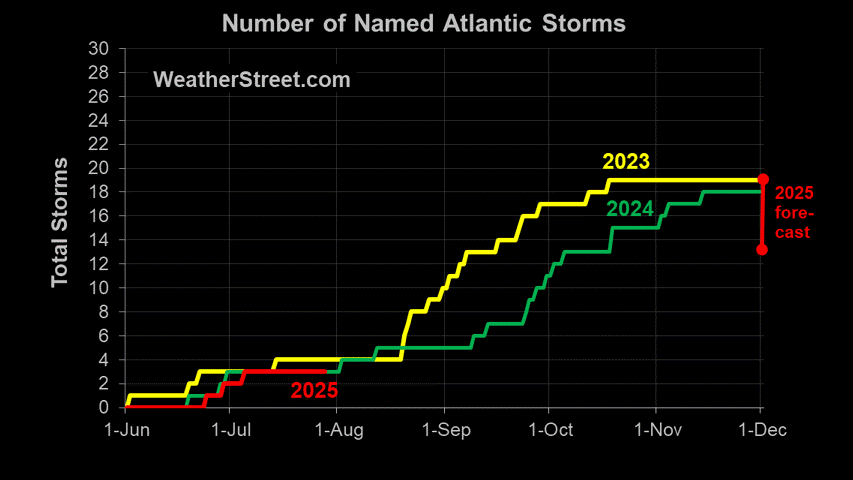
Has this affected hurricane formation? Circumstantial evidence suggests yes. Hurricane numbers are average , and ACE is well below average.

http://www.weatherstreet.com/hurricane/2010/named-storms-climatology.gif
pat says:
August 8, 2010 at 9:53 pm
“… “If hurricanes were taxed, there would be less.”…”
Very true. So the question is, how do you tax a hurricane? I suggest a withholding income tax would be most appropriate. This is readily implemented – simply cover 22% of the sea surface with plastic. 😉
Even NASA likes the IPCC scenarios / forecasts / Nintendo simulations :o)
—–
Global Climate Change: Recent Impacts
Phenomena – Increase in intense tropical cyclone activity in North Atlantic (since 1970)
Likelihood that trend occurred in late 20th century – Likely in some regions
—–
Global Climate Change: Future Trends
Phenomena – Increase in tropical cyclone intensity
Likelihood of trend – Likely to occur
—–
These guys are 95+ certain about man being to blame for most of the 20th century warming. How LIKELY is that? ;O)
MODS: I thought WUWT didn’t allow astrology. ;O(
[Valid point. The post did not specifically refer to astrology, but credible citations would be appreciated. – MOD]
Even NASA likes the IPCC scenarios / forecasts / Nintendo simulations :o)
Forgot the link, here it is:
http://climate.nasa.gov/effects/
Richard Holle says:
August 9, 2010 at 1:01 am
“They (the bigger storms) are waiting till the ionic discharge of the global atmosphere that happens post synod conjunctions, expect the stronger storms to start on the 20th of August 2010, and run to 28th of August, 2010, and start up again September 21st and run through end of the month, with some after thoughts due to continued further discharges, coinciding with the lunar declinational culmination angle peaks, both North and South.”
…
“Given also that there will be no outer planet assisted forced intrusions of warm moist tropical air masses, during the next several Northern winters, expect cold and blustery to be the norm for a while (about 15 to 20 more years.)”
“outer planet assisted forced intrusions of warm moist tropical air masses” — this is a linear and necessary or non-linear but contributing condition of strong hurricanes?
One way or the other, its quite a claim and prediction.
stevengoddard says:
August 8, 2010 at 8:31 pm
Global warming makes hurricanes stronger and weaker. More common and less common. Sometimes global warming makes them unchanged.
People used to revere gods – now they worship CO2 and government scientists. Zeus vs. Hansen.
——-Reply:
Or more to the point, with CO2 increasing about 100 ppm in the past several decades, has H2O increased more than 100 ppm in the atmosphere over the same period? (I’m betting nobody has a clue.) That’s a critical question since water is a superior GHG compared to carbon dioxide.
Jimbo says:
August 9, 2010 at 4:58 am
“MODS: I thought WUWT didn’t allow astrology. ;O(“”
Reply Applied physics not astrology see ;
http://research.aerology.com/aerology-analog-weather-forecasting-method/
This shows that Gaia didn´t like Al´s harassment too. 🙂
Richard Holle says:
August 9, 2010 at 5:42 am
What you quote is the detailed explanation of 19th century Birkeland´s Terrella experiment, confirmed by Nasa:
First Global Connection Between Earth And Space Weather Found
09.12.06 http://www.nasa.gov/centers/goddard/news/topstory/2006/space_weather_link.html
Weather on Earth has a surprising connection to space weather occurring high in the electrically-charged upper atmosphere, known as the ionosphere, according to new results from NASA satellites.
What this means is, the earth acting as a CATHODE it is subjected to a variable current from the Sun, which when strong makes the jet stream get closer to the poles, while when low jet streams will migrate equator ward.
RockyRoad
H2O varies by by tens of thousands ppm from one day to the next. Sometimes from one minute to the next.
When ever I read a climate related paper or article that drifts from trying to resolve the intricate relationships of our climate, into trying to predict events in other hugely complex disciplines (like hurricane forecasts, hydrology, or agricultural production) – my interest wanes very quickly.
No one wishes bad things to happen due to tropical storms, but here in W MD, significant late-summer, early-fall precip often comes from such systems (and can save crops & pastures to some extent). Without them developing, it is often bone-dry here during this period — last year was the perfect example.
An easterly QBO reduces hurricane numbers, but not intensity.
Saharan dust storms limit Atlantic cyclone activity;
http://earthobservatory.nasa.gov/NaturalHazards/view.php?id=44758
The big changes from one year to the next, are largely due to whether a given year has warming spurts in the right months, to provide conditions that are condusive to cyclone formation.
This Autumn has some very strong solar triggers for cyclone activity occurring right at peak season around the equinox, so I am expecting some intense events this fall.
My longest look-back period (1831) suggests a large Caribbean hit in September.
Mother Nature has a quirky sense of humor. Even when she’s trending down, she can knock you for a loop on occasion. Low activity vis-a-vis previous years does not mean no activity. Keep yer storm shutters handy and yer gas tank full!
stevengoddard says:
August 8, 2010 at 10:42 pm
savethesharks
I didn’t say the SSTs were below normal. Where did you get that from?
===============================
I misread. Sorry about that. You did say “not much above normal”. That first map, though, was confusing to look at. It shows a large area which, now that I look at it must be an upwelling from Colin.
Bastardi posts this on his Pro Accuweather blog this AM:
“GLOBAL ACE AT RECORD LOW, BUT IS A RECORD HIGH ATLANTIC ACE ON THE WAY IN SEP OR OCT.”
“Interesting question. The GFS now is seeing what is coming… not in the details, but in the overall pattern with 2, arguably 3 storms on it on day 16. Dont trust the positions, but trust the idea this is going to roar to life. Keep in mind, the southeast Pacific basin, which should be well below normal the rest of the season, had a record high June burst. This was because it warms first and the N American continent was cool enough to focus upward motion there while the water was warmer relative to averages. What do you think is going to happen once cool air gets into the pattern, or the land based normals fall. That is when the MJO will be able to crank well into the octants associated with real trouble bursting and I fully expect that to be the case. You can see the shift in the anomaly pattern about to occur.”
I trust that an independent body names the storms, otherwise it’s Col. Sanders looking after our chickens. I recall in 2006 they were desperately reporting water spouts and light rain.
The earth is a heat engine. Hurricanes are driven by differences in temperature between the equatorial Atlantic and the North Atlantic.
The North Atlantic has well above normal SSTs, so it kinda makes sense that this season might not be quite as intense as the experts are forecasting.
Richard Holle says:
August 9, 2010 at 5:42 am
Jimbo says:
August 9, 2010 at 4:58 am
“MODS: I thought WUWT didn’t allow astrology. ;O(“”
Reply Applied physics not astrology see ;
http://research.aerology.com/aerology-analog-weather-forecasting-method/
Very interesting article Richard; Aerology Analog Forecasting Method. Is this your work or the basis for the cycles you’re discussing?
see also:
Proc. Natl. Acad. Sci. USA
Vol. 94, pp. 8329–8334, August 1997
Colloquium Paper
Spectrum of 100-kyr glacial cycle: Orbital inclination, not eccentricity
http://www.ncbi.nlm.nih.gov/pmc/articles/PMC33747/pdf/pq008329.pdf
But, as far as I can tell, Extraterrestrial Accretion has been eliminated as the Climate Change driver.
This is the problem. Their papers are stuffed full of caveats yet they make predictions about where the climate will be at the end of this century.
Richard Holle says:
August 9, 2010 at 5:42 am
Reply Applied physics not astrology
Your excellent article shows that astrology has now a justification, which is invalid if only considered a “flintstones’ universe” where only gravity among “heaven pebbles” works.
For hurricane forecasts, the pre-and post-1975 stats are most important for the AGW hypotheses – those of at least the pre- and post-1988, when we were told of impending doom. Do you have a graph of those?
stevengoddard says:
August 9, 2010 at 7:18 am
The earth is a heat engine. Hurricanes are driven by differences in temperature between the equatorial Atlantic and the North Atlantic.
The North Atlantic has well above normal SSTs, so it kinda makes sense that this season might not be quite as intense as the experts are forecasting.
=========================================
I see what you are driving at.
But I think what Gray, Bastardi, NOAA, FSU and others are driving at is the above normal SST which provide the fuel for the storms.
The cooling in the Pacific, due to the cold PDO and the reversal of El Nino, displaces the area of upward motion to the Atlantic (and westward to the Indian Ocean region, hence the horrific floods there).
So abnormally above normal SSTs for the North Atlantic (from the warm AMO) + upward motion + the removal of the tropical upper tropospheric troughs and voila.
You can certainly see from the North Atlantic Water Vapor Loop the Cape Verde train at least trying to get organized, and a couple of anticyclonic spins above a couple of the waves in lower left hand of picture, hinting of some high pressure in the upper levels and a developing Cape Verde season.
http://www.ssd.noaa.gov/goes/east/natl/flash-wv.html
As one who lives on one of the most vulnerable and populated sections of the East Coast, I hope your instincts are correct.
Chris
Norfolk, VA, USA
stevengoddard says:
August 9, 2010 at 6:14 am
RockyRoad
H2O varies by by tens of thousands ppm from one day to the next. Sometimes from one minute to the next.
———-Reply:
Exactly. So is the reason some people are stuck on CO2 is because it is much, much easier to track? Seems like it should be relegated to a minor role as we concentrate our efforts on a better understanding of H2O. (Same reason I like to hunt deer far more than elk–the deer are a much easier target. Of course, they’re not as good to eat.)
correction: lower right hand of the picture