From: Ryan N. Maue’s 2010 Global Tropical Cyclone Activity Update

Figure: Global and Northern Hemisphere Accumulated Cyclone Energy: 24 month running sum through July 31, 2010. Note that the year indicated represents the value of ACE through the previous 24-months for the Northern Hemisphere (bottom line/gray boxes) and the entire global (top line/lime green boxes). The area in between represents the Southern Hemisphere total ACE.
Note: Southern Hemisphere tropical cyclone data is spotty prior to the introduction of reliable satellite monitoring, thus the ACE represented at the beginning of the 1980s is likely underestimated due to missing data. Thus, it is possible that the current global collapse in TC ACE is comparable to lows experienced prior to 30-years ago…
Global TC Activity remains at 30-year lows at least — The last 24-months of ACE at 1090 represents a decrease from the previous months and a return to the levels of September 2009.
Since Hurricane Katrina (August 2005) and the publication of high-profile papers in Nature and Science, global tropical cyclone ACE has collapsed in half. This continues the now 4-consecutive years global crash in tropical cyclone activity. While the Atlantic on average makes up about 10% of the global, yearly hurricane activity, the other 90% deserves attention and has been significantly depressed since 2007. See Figure below.
Northern Hemisphere year-to-date ACE is nearing 50% below normal. The Western North Pacific is at 17% of normal (or the past 30-year average).

Figure: Northern Hemisphere cumulative ACE per day of year from July – December. See legend for appropriate axis of each basin or NH total.
Climatological yearly ACE and HDAYS are based upon 1980-2009 values (last 30 years)
[Month, Day, IO, EPAC, NATL, WPAC, NH]
============================================
Steve Goddard has done some interesting work that complements what Dr. Maue has discussed, see below. – Anthony
Steve Goddard writes:
Everyone in the hurricane forecast business predicted a big season this year. NOAA reaffirmed their position this week, as reported on WUWT.
One of the main reasons cited for the forecasts was “record high Atlantic SSTs.” So let’s look at the SST anomalies in the region between the Cape Verde Islands and the US. That is the normal hurricane formation track.

SSTs have plummeted and are now not much above normal. Compare SST anomalies vs those in late May. The hurricane breeding ground has not kept it’s unusual warmth.

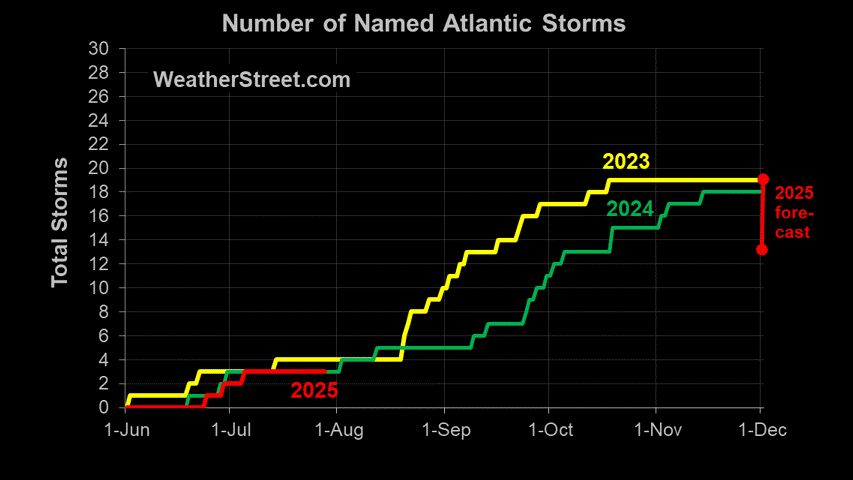
Has this affected hurricane formation? Circumstantial evidence suggests yes. Hurricane numbers are average , and ACE is well below average.

http://www.weatherstreet.com/hurricane/2010/named-storms-climatology.gif
John from CA says:
August 9, 2010 at 7:49 am
“”Very interesting article Richard; Aerology Analog Forecasting Method. Is this your work or the basis for the cycles you’re discussing?””
This link is the result of 30 years of my work, so yes and yes, there is other supporting research quoted on the site, the daily forecasts presented on the National and local pages were forecast 30 months ago, and continue till January of 2014.
This is an analog forecast method very similar to what Ulric Lyons and Piers Corbin use with look backs as they call them, but with out the solar activity they have added in. The outer planet influences don’t show up in the daily forecasts, because they are out of phase with the repeating inner planet and lunar declinational patterns. This is a beta product and has been very helpful in the further development of concepts to include the solar and outer planet influences by deriving algorithms, to be added to the program to increase the accuracy of future development releases .
Jean Parisot says:
August 9, 2010 at 6:21 am
“When ever I read a climate related paper or article that drifts from trying to resolve the intricate relationships of our climate, into trying to predict events in other hugely complex disciplines (like hurricane forecasts, hydrology, or agricultural production) – my interest wanes very quickly.”
They are all intercorrelated, whether climate or waether, with none of the ASSUMED CAUSAL independent variables known for the future so time series models, estimates and conjectures are used in all cases. I read to learn but have little faith in any of the theories or predictions of what will happen next. It gets interesting when predictions start to come true, which rarely occurs and unless they continue to come true can be considered coincidence.
Richard Holle says:
August 9, 2010 at 8:30 am
“This link is the result of 30 years of my work, so yes and yes, there is other supporting research quoted on the site, the daily forecasts presented on the National and local pages were forecast 30 months ago, and continue till January of 2014.”
Very exciting work Richard, I’m looking forward to reviewing the other web pages.
Congrats,
John from CA
My understanding is that La Nina in the presence of a warm equatorial Atlantic produces the temperature/pressure differences and wind shear that spawn hurricanes into the Gulf. Otherwise, during El Nino and a warm Atlantic the hurricanes become northeasters, hitting as far north as Main, especially in the case of negative Arctic Oscillations, which throws cold air South, essentially canceling the calming affect of El Nino’s and setting up the necessary wind shear.
Richard Holle, who is funding your research–Exxon or BP? Inquiring minds want to know.
RockyRoad
Venison is awful. Elk is a delicacy.
Don’t get your “shorts in a knot” Reed Cory says [foolishly] on August 9, 2010 at 9:47 am.
“…who is funding your research–Exxon or BP? Inquiring minds want to know.”
from Richard Holle’s website:
About Aerology [air tides]
http://www.aerology.com/about.aspx
“Currently we provide these forecasts for precipitation, high temperatures, low temperatures, snowfall and snow on ground in the contiguous United States. As funding becomes available, we would like to expand our forecasting methods and maps to outside the contiguous United States. In addition to locations, we would also like to expand the forecasting technique to other natural disasters such as hail, tornadoes, and other severe weather. We would also be interested in requests from our users, if you have a suggestion of additional products you would be interested in please contact us.”
see and read The Process
also please see:
The Research tab on the sidebar; http://research.aerology.com/
Reed Coray says:
August 9, 2010 at 9:47 am
Richard Holle, who is funding your research–Exxon or BP? Inquiring minds want to know.
Reply;
Over the years I have spent up to 25% of my hourly wages working as a production CNC machinist on this project, I have had help from my daughter who does the web site for me, and a programmer she works with freelance, did the map generation data automation process, at a reduced rate as a favor.
The link below is one of the better links I use for looking at global SST’s. Still pretty good positive anomalies across the Tropical Atlantic I’m not so sure I agree with the above analysis. Granted SST’s have cooled compared to the record setting April through June, but they are still plenty warm for increased tropical activity. The biggest hindrance so far has been the elevated vertical wind shear that has plagued the season so far. The second half of August through the end of October should be very busy though. Take a year like 2007 (our last La Nina) where there were only 3 named storms through the first week of August. From August 13th through the end of the season and even into December there were 12 more named storms.
Bottom line, there is still plenty of time for an above normal season.
http://www.osdpd.noaa.gov/ml/ocean/sst/anomaly.html
Richard Holle says:
August 9, 2010 at 10:44 am
“Over the years I have spent up to 25% of my hourly wages working as a production CNC machinist on this project, …”
I don’t want to jump to conclusions but I think I’ve (and possibly Anthony) died and gone to heaven.
CNC on an Aerology project [defined as a branch of meteorology involving observation and research of the atmosphere by means of balloons, radiosondes, etc] implies Real World [not heat Island] data.
I noticed the reference to NOAA TD3200 cooperative summary data on your “About” page but my fingers are crossed the baseline is more.
PS If the baseline produces an accurate display of past events, can the program identify potentially false readings in other forecast models and, if so, within what level of accuracy?
stevengoddard says:
Venison is awful. Elk is a delicacy.
———–
Depends what they graze on—willow buds good, coniferous buds bad. I prefer moose and caribou. Not many around my neighbourhood, tho’.
John from CA says:
August 9, 2010 at 11:24 am
Reply;
The maps produced are set to use medium smoothing in the nearest neighbor method of producing the temperature contour maps with 32 data points selected for the averaging, with 10 degree contour line increments.
When I processed the maps with 8 data points, (minimum smoothing) and 1 degree increment contour lines there appears circles of the heat islands, and cooler regions around large lakes. The net effect was way too busy for easy public consumption, so I went to medium smoothing, but could show local temp extremes in the past data as well as the composite. I don’t know about checking other forecast techniques, I am still trying to work the outer planet influence bugs out of this one.
When I look at the cyclone data and do an eyeball Fourier decomposition I get a strong component at about 6 -11 year periodicity. Didn’t anyone else notice this!? Doesn’t this say the sun drives just about everything?
savethesharks says: “Also, the SST area that shows below normal per the map Steve shows is not really the tropical cyclone breeding ground for the North Atlantic.”
The SSTs for the tropical North Atlantic are far from normal on the map that Steve Goddard cropped. Check the scale on it. Unisys uses light blues from -0.5 to +1.0, so they can be misleading. Tropical Atlantic SST anomalies reached a new high this year.
http://i34.tinypic.com/9vjebm.jpg
Some of that is from the 2009/10 El Nino.
And some of that high results from the upward shift in the South Atlantic SST anomalies in 2009/10 after almost fifteen years of being flat:
http://i43.tinypic.com/vhryjb.png
Recall that the heat is transported from the high latitudes to the tropics in the South Atlantic (the only ocean basin that works that way), and then into the North Atlantic.
That shift in the South Atlantic SST anomalies is discussed in this post:
http://bobtisdale.blogspot.com/2010/05/200910-warming-of-south-atlantic.html
Pete says: “The link below is one of the better links I use for looking at global SST’s.”
The NOAA/NESDIS SST data you linked is prepared by NOAA’s Coral Reef Watch division. It’s biased by the use of only nighttime satellite data.
“Nighttime-only satellite SST observations are used to eliminate diel variation caused by solar heating at the sea surface (primarily at the “skin” interface, 10-20 um) during the day and to avoid contamination from solar glare. Compared with daytime SST and day-night blended SST, nighttime SST provides more conservative and stable estimate of thermal stress conducive to coral bleaching.”
Discussed that here:
http://bobtisdale.blogspot.com/2009/09/note-about-sst-anomaly-maps.html
But yes, as I noted to savethesharks above, tropical Atlantic SST anomalies are well above normal:
http://i34.tinypic.com/9vjebm.jpg
So anomalies moved northwards.
The recent near two-degree rise (in 12 months) in tropical Atlantic SST anomalies is interesting. A series of higher highs are plainly visible on Bob’s chart. One would think that the ACE Index would be off the charts now if there was a strong correlation. Instead, one can see a series of lower highs and lower lows (from 1990 until present). Not sure what to make of this.
I apologize. I meant the question Richard Holle, who is funding your research–Exxon or BP? to be tongue-in-cheek. However, in today’s world of nonsensical or irrelevant comments coming from the AGW community, I should have realized that any comment/question, no matter how silly, must be taken seriously by us skeptics because it could have been asked by a warmist.
Reed Coray says:
August 9, 2010 at 8:00 pm
Reply; I got it, but there are lots of trolls, and newbies coming in here all the time, and I am sure lots of constant lurkers, are the majority of viewers.
I think it best to keep things as clearly stated as possible, and not leave oneself open to partial quote mining, just to keep the clutter down so the message is clearer.
Sean Peake says:
August 9, 2010 at 11:37 am
stevengoddard says:
Venison is awful. Elk is a delicacy.
———–
Depends what they graze on—willow buds good, coniferous buds bad. I prefer moose and caribou. Not many around my neighbourhood, tho’.
Depends on if they are shot dead or run two miles as well.
#
#
Sean Peake says:
August 9, 2010 at 11:37 am
stevengoddard says:
Venison is awful. Elk is a delicacy.
———–
Depends what they graze on—willow buds good, coniferous buds bad. I prefer moose and caribou. Not many around my neighbourhood, tho’.
If anyone wins the moose lottery for whatever management unit it is that includes Mt Cardigan in New Hampshire, look me up – we have moose and I don’t hunt.
Well, NorthWest Pacific (NWP) inactivity is the background of this year’s worldwide inactivity. In the case of NWP, exceptionally strong sub-tropical ringe (STR) have hindered the formation of disturbance even in very low latitude ( because around 70-80% of NWP’s tropical cyclone are formed in monsoon trough, and super strong STR have make it inactivated ), resulting only 5 numbered storm ( max wind reached F6 ) by Joint Typhoon Warning Centre, three of them ( max wind reached F8 ) named by Japan Meteorological Agency, and only 2 have been considered reaching a typhoon strength when we are used to see around 5-8 typhoons already at this point of the season, deafening silence in NWP’s history.
One more point should be noted in NWP’s condition, the year following El Nino are supposed to have the STR weak and East of its normal position so more storms can form in Central North Pacific or the Eastern end of the NWP and we may see 01C or 02C, this year, the STR is so strong that there is neither a tropical cyclone formed in Central North Pacific, nor a single tropical cyclone formed East of 145E.
Results followed, NWP tropical cyclone season have been bored to death not because every cyclone end its life on the sea, but simply no cyclone at all thanks to a STR strength unseen in at least 20 years.
One more point to note, NWP is the most important tropical cyclone formation basin in the world, it alone account for 30% of world’s activity, so if this site have been weak in capturing NWP’s condition and mostly focused on the area around USA, I am very much afraid that WUWT might not be global enough in this particular issue.