California’s Fires Result of a Cooling Pacific, Two Years of La Niña and Environmental Mismanagement
Guest Post By Joseph D’Aleo, CCM, ICECAP
While environmentalists and clueless politicans like CA Representative Linda Sanchez and not surprisingly Climate Progress’ Joe Romm sought to place the blame for the California wildfires on ‘global warming’. the massive California wildfires can be attributed to a cooling Pacific, two years of La Nina and environmental mismanagement.

La Ninas and/or a cold PDO Usually Means Drier California
You can see clearly from the following correlation chart of La Ninas (using the Southern Oscillation Index) with precipitation from CDC, that La Ninas favor dryness in the southwest.

The basin wide Pacific multidecadal warming and cooling affects the frequency and strength of La Ninas and El Ninos. The cold PDO favoring more, stronger and longer lasting La Ninas and the warm PDO more, stronger and longer lasting El Ninos and fewer briefer, mostly weak La Ninas. The PDO turned cold in 1998 bounced some until 2006 when it began a significant decline. See the blue La Nina frequency increasing like it did when the PDO was last cold from 1947 to 1977.
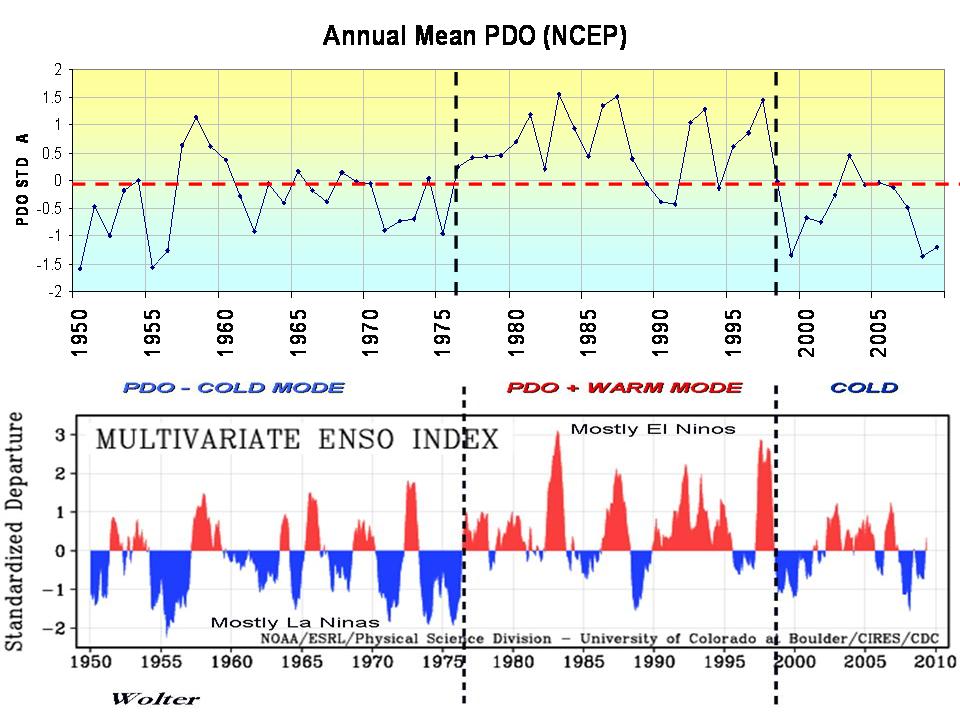

The rapid cooling in the Pacific in 2006 caused the El Nino winter of 2006/07 rains to fail in California. The La Nina that ensued became strong in the late winter and early spring of 2007/08 and came back again for a reprise in 2008/09 winter continued to produce sub normal rainfall.
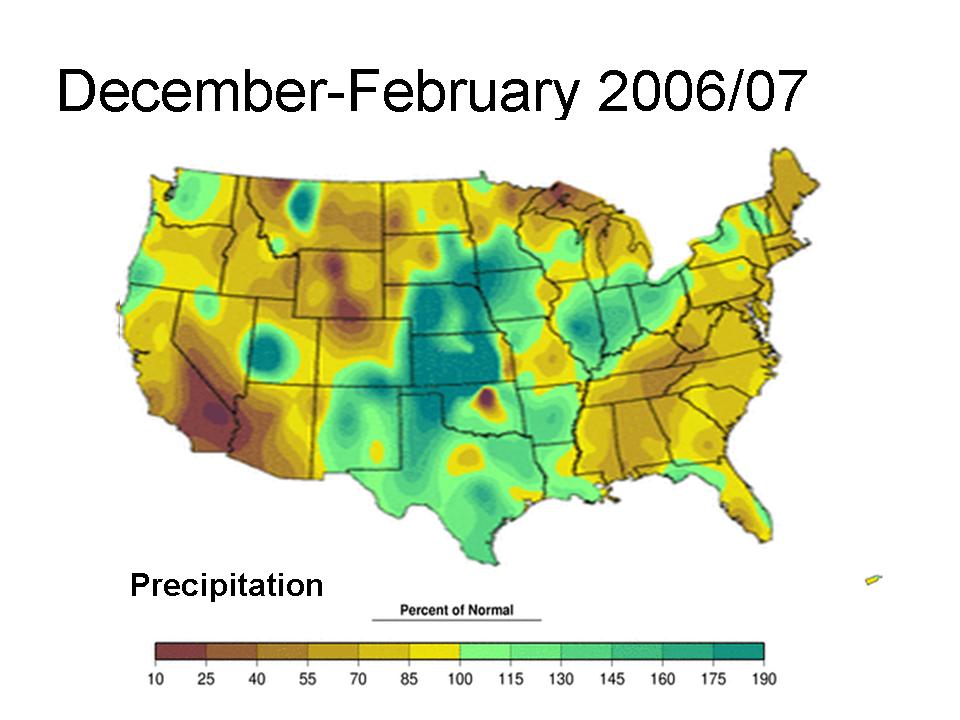
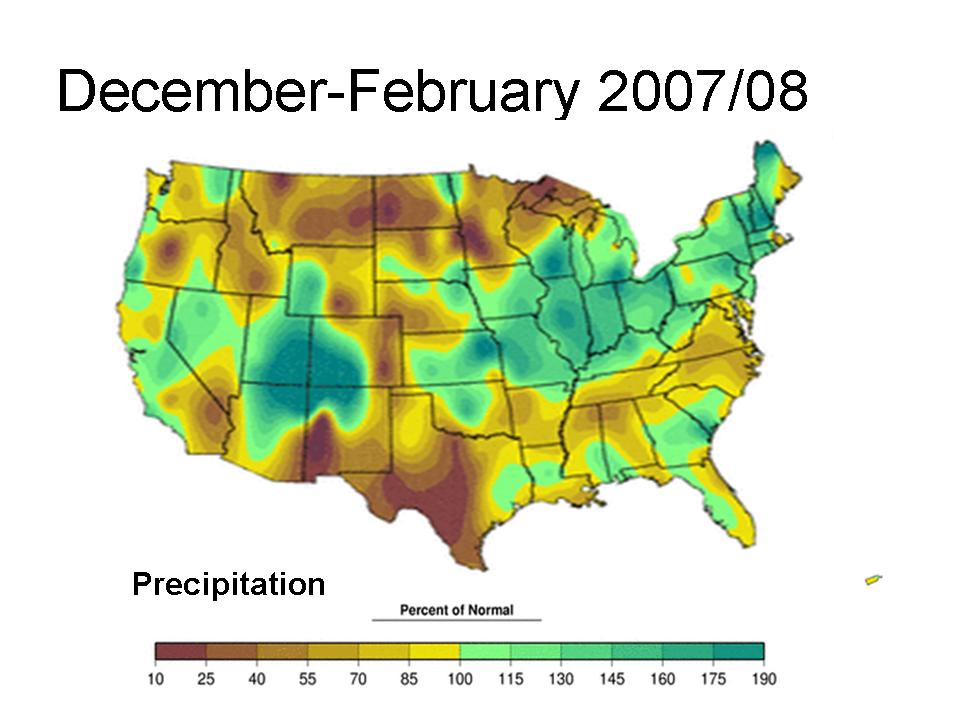
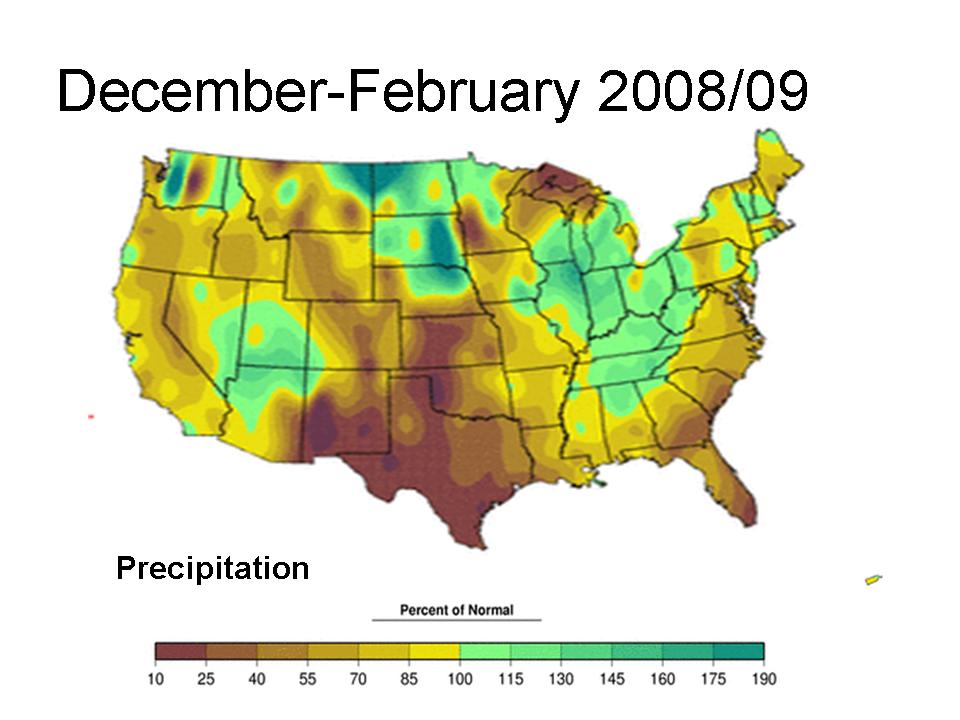


A few years back McCabe, Palecki and Betancourt published a paper that looked at drought frequency across the United States related to both the Pacific Decadal Oscillation and the Atlantic Mulitdecadal Oscillation. Droughts in the United States were more frequent when the Atlantic was in its warm mode. When the Atlantic was warm, and the Pacific was also in its warm mode, the dryness was more across the northwest and southeast and when the Pacific was cold more across the southwest. Red areas have enhanced drought probabilities.


We are currently still have a warm Atlantic mode and cold Pacific mode (D) and thus should expect the increased risk of dryness in the southwest. See these maps and read more here.
Environmental Mismanagement
This natural cyclical lack of rainfall combined with unwise policy that Dr. Scott Campbell reported concerning the prohibition against clearing up accumulated brush from the areas surrounding housing developments that were instituted at the insistence of the Sierra Club and other environmental groups has left more fuel for the fires fanned by the Santa Ana winds. The JPL’s Dr Patzert indicated, in a release, were also more common in La Ninas. The risk is also greater because more people built homes in the cooler hills among the trees, putting more than trees at risk.
In addition, environmentalists have reduced the amount of water that can be used for agriculture. Farmers in the Central Valley are asking for a new canal to get water from the Sacramento River, as well as a relaxation of environmental restrictions resulting from a 2007 court ruling limiting the amount of water pumped south from the delta – a giant sponge that absorbs runoff from the wetter north. The ruling was in response to a suit by environmental groups that held that the water pumping through the delta endangered several species of fish, including smelt, green sturgeon, and winter and spring salmon. More here.
What Lies Ahead
Given the current El Nino is in the cold PDO mode, it should be weak and tend to be brief. It may peak this fall and weaken this winter. The increased tropical activity in the eastern Pacific is favored in El Nino years (in some El Ninos they reach California in the early fall in a weakened state – e.g. Kathleen in 1976). The similar El Ninos in the cold PDO tended to produce normal to below normal wet season precipitation and another active fire season next year.
It is likely a La Nina will return next year. Expect another fire season. See more here.
If there’s been a lot of rain, the wildfire risk is elevated because there’s a lot of brush.
If there hasn’t been much rain, the wildfire risk is elevated because everything is dry as a tinderbox.
If there’s been normal rainfall, the wildfire risk is elevated because… because the wildfire risk in southern California is always elevated.
Maybe the weather (or climate change) isn’t the driver of wildfires. Maybe wildfires are just part of the environment there, and people should have thought about that before moving there in the millions.
This is it: The water cycle:
Hey, kids, repeat after me:
-Sun heats seas
-Sea water evaporates, cloud grow above,
-Cloud rains.
When seas cold, no cloud, no rain. Comprende?
Duncan:
the giant sequioa has adjusted to wildfires:
http://en.wikipedia.org/wiki/Giant_Sequoia
The cones open only after wildfires.
So you are right: wildfires must have been in California for very long times, if the longest living tree has adjusted to them.
There was a story from the Australian fires earlier this year. Bush clearing was illegal. One man cleared the appropiate area around his house and was fined $50,000. After the fires, his was the only house that survived. I cannot vouch for the authenticity.
The law of unintended consequences seems to affect liberal legislation and environmental efforts a lot more than it does conservative efforts.
Is it possible to sue entities such as the Sierra Club ? A lawsuit effectively killed the Aryan Nation in northern Idaho several years ago .
excellent observation. And the Rocky Mountain West has massive fires to look forward to because of years of fire suppression and now a natural cycle of beetle kill in the older, less healthy forrest.
Jim Cripwell (08:59:13) :
There was a story from the Australian fires earlier this year. Bush clearing was illegal.
You find it here: http://wattsupwiththat.com/?s=australia+wildfires
That area hasn’t burned for 65 years according to media reports. So there is just a huge amount of fuel there. This was bound to happen at some point. We had years of torrential rainfall in the 1980’s in that area and all the fuel for all those wet years is still sitting there. Much of that area also experienced a pretty bad pine beetle infestation in the early 1990’s during a 6-year drought so there is a lot of debris from dead limbs and trees that were killed as a result of that.
So they have been sitting on a tinder box for 65 years and it for whatever reason finally got enough of a spark to ignite it just when wind and weather conditions for “perfect” to fan it into a huge conflagration.
One thing “global warming” does is allows politicians to blame “climate change” for things so they are not held responsible for managing things like forest resources more responsibly. Maybe there should have been some controlled burns in some of the wetter years.
The title of this article grossly understates the complexity of the wildfire phenomenon. Duncan makes a good point but seems somewhat distracted by demonising Californians, and, indeed, gets it wrong in the end. His fatuous remarks about average rainfall leading to elevated fire risk belie the quantitative changes in risk from wet and dry season rainfall variability. Wet season rainfall positively correlates with dry season fire risk by controlling the burden of burnable fuel. What Duncan fails to mention is that there is a strong lag attached to this effect of about 6-9 months. Of course, stated the way you say it Duncan you make Californians and forestry service bods look stupid. Joseph, you get it partially right by describing effects which can modulate dry season rainfall, which are negatively correlated with dry season fire risk.
Generally, there will always be at least a week of elevated heat wave temperatures in near coastal SoCal which will lead to extreme fire risk. This is why El Nino nearly always leads to increased dry season fire risk since the wetting effects of the rain 6-9 months ago have gone and you are left with more dry fuel. The trick with regard to the post’s point is that La Nina can increase the length of the hot dry period, as can any other effects which modulate the length and intensity of heat waves. So, to dismiss AGW as an effect seems inconsistent with the established theories of what controls the fire risk when and where. Which seems about par for the course on WUWT and from your good self Joseph.
Duncan does make a good point stating that the increase in property damage due to brush fires is directly related to the intrusion of residential development into areas which are obviously fire risk zones.
REPLY: Since “glug” comes from a NASA JPL address during work hours, why not drop the pretense and give us your “expert on the spot in the middle of the fire opinion” rather than hide? Or is this sneaking around “par for the course” at JPL? – Anthony
Before global warming Southern California, never had steep canyons with dry grass and brush, with hot dry summers and no rain.
But it seems I’ve heard that kind of talk before in the Mama’s and the Papa’s post apocalyptic epic “It Never Rains in Southern California”:
Got on a board a west bound seven forty seven
Didn’t think before deciding what to do
All that talk of opportunities, TV breaks and movies
Rang true, sure rang true.
Seems it never rain in Southern California
Seems I’ve often heard that kind of talk before
It never rains in California
But girl, don’t they warn ya
It pours man it pours.
Out of work, I’m out of my head
Out of self respect I’m out of bread
I’m under loved I’m under fed
I wanna go home
It never rains in California
But girl don’t they warn ya, it pours, man it pours.
Will you tell the folks back home I nearly made it
Had offers but don’t know which one to take
Please don’t tell them how you found me
Don’t tell them how you found me give me a break
Give me a break
Seems it never rains in Southern California
Seems I’ve often heard that kind of talk before
It never rains in California
But girl, don’t they warn ya
It pours man it pours
And after the brush is cleared and the rains come the mudslides. Maybe, just maybe a little of the personal responsibility that I hear so much about is in order and they shouldn’t be building in these locations.
OT – sorry
Does anyone know why http://arctic-roos.org/observations/satellite-data/sea-ice/ice-area-and-extent-in-arctic have not updated there graph for a while now?
I don’t know if the State still uses the signs that say “Keep California Green and Golden” that were along the main roads leading into the State from Oregon years ago. The “Golden” part actually referenced all the “dry season” dormant grass and other vegetation indigenous to this climatic type, often referred to by its common name “Mediterranean” after the dry high-sun season areas near the Mediterranean Sea.
I also remember seeing (at several major parks) very large tree sections with markers for such things as the birth of Jesus and the landing of Columbus. These displays also always had a marker pointing to a fire scar from several hundred (or thousand?) years ago.
One other thing that seems to be indigenous to California is a group of politicians best described as clueless.
“After the fires, his was the only house that survived. I cannot vouch for the authenticity.”
I recall the same story. A similar thing happened in California at Lake Tahoe where the local politicians refuse to allow people to clear trees and brush close to their homes. One individual did so anyway, paid a large fine, and found their home the only one in the neighborhood to survive a wildfire there last year.
A major component of the wildfire problem is too many people building homes up in the hills. They’re free to do so, but not very smart in the long term. Same thing with building on coastal sand dunes. These areas would be better off if those who built there carried the full cost. That might only allow the rich to live in these beautiful but dynamic places, but 1) there are way fewer rich than most people think and 2) the rest of us wouldn’t have to subsidize the risk with higher insurance premiums and tax-funded rescue efforts. The environmental groups would ultimately achieve a goal of wild space preservation if they got smart enough to use undistorted market forces to their benefit.
crosspatch (09:39:42) :
The full PDO cycle is about 60 years, so, yeah, it’s about time.
In the 1990s I went to San Jose on business for a week around the Feb/Mar change, and after being in events like a 40 year flood, mudslides, 11 days of rain out of 12 days, and snowfall almost to the valley floor, I started calling California “The Disaster State”.
Expect one of these up here in the Bay Area sometime over the next ten years. We, like LA, have areas of dense chaparral that have not burned for 60 – 70 years. And like LA there are developments carved out of such areas, and all of the typical human foibles generally responsible in most cases for starting these sorts of blazes.
And this fact was broadcast by how many news organizations?
Duncan (08:37:18) :
“If there’s been a lot of rain, the wildfire risk is elevated because there’s a lot of brush.
If there hasn’t been much rain, the wildfire risk is elevated because everything is dry as a tinderbox.”
I have lived in the Los Angeles County most of my life and I have seen many of these fires. We are at risk in late summer of every year but to get the really wild fires you need a combination of things. First is a string of years with good wet springs. Normally the mountains around here are brown in color but when you have a very wet spring it turns a beautiful green. If you get a few of these years in a row the fuel load grows considerably. If you get a fire during one of these green years it is usually extinguished quickly and receives little media attention. When a string of wet years is followed by a year where we get almost no fall or spring rain everything dries out. This will create moderate to strong fires. If you get many years of green followed by two or more years of drought then you get the perfect conditions for fires. Currently the drought is severe enough that we are under water rationing. Right now the only thing living in my yards are the plants that go deep enough to get their own water. This fire happens to be in a place that has not burned in many decades meaning that the fuel load has had numerous green years to grow in. We have had almost no winds during this fire which to me is what makes its size and ferocity so interesting. If this fire had been started a few weeks later when the early fall winds pick up then it would have been on an unimaginable scale.
It is the weather/climate that drives the fires here but it’s not as simple as it’s dry or wet this year. I am just happy to see someone that isn’t automatically attributing this to AGW.
Any one who has lived in and made a living fighting fire in a fire ecology, can deal with the hazards-it is called “urban interface” you should be allowed to clear the brush from around your home and property. Also i feel Shake roofs should be banned from every building code on the planet.In my logbook as a former Airtanker pilot, I made note of every home with a shake roof that usually went *Poof* right before our very eyes.In total-one hundred and fifty eight homes-Thirty some in Oregon in one fire.Metal or even a good composite goes a long way to saving your home- also concrete based, siding.
Outfits like CDF have a good program on how to deal with it.But local jurisdictions are sometimes willfully ignorant of how to deal with the problem
and, in fact, exacerbate it.CC&R’s too are a big detriment to safety…
Jim Cripwell (08:59:13) :
“Fined for illegal clearing, family now feel vindicated”
http://www.smh.com.au/national/fined-for-illegal-clearing-family-now-feel-vindicated-20090212-85bd.html
“Mr Sheahan is still angry about his prosecution, which cost him $100,000 in fines and legal fees. The council’s planning laws allow trees to be cleared only when they are within six metres of a house. Mr Sheahan cleared trees up to 100 metres away from his house.”
Well the big fire in the LA National desert; aka LA National Forest can be laid directly at the feet of the Federal Government. That fire was almost certainly set (either deliberately, or by accident) by pot growers who plant their crops in the National Forests. The Feds don’t bother to police their activities; and State Police who often overfly those forests, and see those pot fields, are prohibited by law from reporting what they see; the Feds say it is an invasion of privacy issue. We are not talking of people growing pot on their own lands, but on the National Forest lands.
The feds, have remote sensing that can find a quarter on the ground, and can tell what subspecies of pot the chumps are growing; but they aren’t going to waste their time looking for a cash crop that eventually leads to the collection down the way of tax revenues (figure that one out).
The State has no jurisdiction, and the feds say it is invasion of privacy for State Police to report illegal activities in those forests. They know this fire started by human hand; just haven’t determined exactly by whom, and whether deliberate.
Most California fires are not wild fires; they are human caused.
As for the Delta water situation, the people who have contracts to export all that water; mostly do it for resale, since they get it for almost nothing. Much of it is pumped to SoCal to fill all the reservoirs down there. (Pyramid Lake over the grapevine, you couldn’t add another thimble full of water; it is fed by the bountiful waters of the LA National Desert/Forest, augmented by pumping over the mountains from the central valley aqueducts, and eventually from the Sacramento/San Joachin Delta.
The farmers in the central valley do have water for agriculture; they would rather not use it, if they can steal Delta water for peanuts; and ultimately the whole of the Monterey Bay fisheries sytem depends on adequate fresh water coming out of the Delta on its natural run to the Pacific.
The striped bass and other introduced species like black bass (large, small, and spotted) have all lived in harmony with the native salmon, and steelhead for over a hundred years; including the Delta smelt. It is the water pumping activituies, and water removal that has destroyed the Delta , along with raw pollution that communities put into the Sacramento and San Joachin , and Tuolumne rivers; and that includes chemical runoffs from those same farms that are screaming about the water. They need to clean up their own effluent, before they point the finger at others. The delta was fine before they started pumping water to Socal water speculators.
George
[quote]Duncan you make Californians and forestry service bods look stupid. [/quote]
What is the definition of Stupid?
A forestry service that pays rangers to protect forests and put out natural fires for 50 years and then only recently starts paying rangers to start controlled “burns” to reduce the new huge risk of a massive conflagration that they are responsible for creating in the first place.
We have the same legacy problem in Canada – it is completely moronic. Fire fighters are being killed. All because we try to control nature and do what is best for nature?
In 1000 years time, as we head into a bitterly cold glaciation period with the ultimate potential for MILES of ice to build up over many highly populated Northern Hemsiphere Cities, will we be on a massive GOVERNMENT project to un-sequester CO2??
Areas with a strong dry season will always be fire prone, but sometimes humans make things worse. Fires usually occurrs much more frequently when humans are around, which in turn changes the composition of the vegetation. Some plants are “pyrophytic”, i e they actually benefit from frequent fires. Either because they survive fires better than other plants, or because they germinate and grow after a fire.
The classic example is eucalypts. There has always been eucalypts in Australia, but they have never been nearly as widespread or as dominant as they are today. During earlier interglacial australian forests and woodlands vere much more diverse, and much less fire prone.
So wha happened? About 40,000 years ago the aborigines arrived and started “fire-stick farming” Australia. By now eucalypts have become dominant almost everywhere and the process is probably irreversible. Other trees simply don’t have a chance to mature and replace the eucalypts, there is always a fire first. So there you have it: an extremely fire-prone continent, and there is nothing much you can do about it.