
,
The Global Warming Policy Foundation
In this episode, we speak with Roger Pielke Jr. about how what was lauded as the “business as usual” climate scenario known as RCP8.5 became “implausible” to the IPCC. Pielke also shares his insights on natural decarbonisation through greater efficiency and how he was investigated by the White House when he broke with the climate consensus.
00:00 – Introduction & The Significance of Climate Scenarios Roger Pielke Jr. introduces the role of socioeconomic scenarios in climate modeling and the personal challenges he faced when his work was investigated by Congress.
01:21 – What is RCP 8.5? An explanation of the “Representative Concentration Pathway 8.5,” how it was developed, and how it became the baseline for “worst-case” climate projections.
04:53 – How Scenarios Influence Policy and Infrastructure A look at how these scientific models are embedded into government policies, banking stress tests, and global infrastructure decisions.
06:57 – The Self-Correction of Science & Retiring Extreme Scenarios Discussion on the decade-long process it took for the scientific community to move away from extreme scenarios like RCP 8.5.
10:10 – Why Emission Trajectories Have Changed Evaluating whether the shift away from worst-case scenarios is due to climate policy or flawed original assumptions about future energy use (e.g., the “coal-heavy” future).
14:31 – Academic Freedom and Political Pressure Pielke Jr. reflects on being labeled a “climate criminal” and the lack of institutional support for academic freedom during intense political debates.
21:24 – Extreme Weather Events: What Does the Data Say? A summary of current scientific understanding regarding heat waves, precipitation, hurricanes, and the difficulty of “detecting” changes in rare events.
26:15 – The Rise of Attribution Science A critique of “attribution science,” which attempts to link individual weather events directly to climate change, and its role in media and litigation.
32:16 – Climate Litigation and International Agreements Analyzing the success (or lack thereof) of climate lawsuits against companies and governments, specifically in Europe and the US.
36:24 – The Reality of Net Zero Targets A deep dive into the UK’s Climate Change Act and the practical challenges of meeting Net Zero by 2050 given current energy and economic trends.
38:30 – Modeling the Relationship Between Climate and Economy Discussion on the “inscrutable relationship” between global temperature and GDP, and the limitations of both top-down and bottom-up economic modeling.
46:08 – The Social Cost of Carbon & Energy Decarbonization Exploring the “social cost of carbon,” the natural trend of decarbonization in growing economies, and the future of energy policy.
52:20 – Closing Thoughts: Looking Back on 20 Years of Analysis Final reflections on the progress toward a more rational discourse around climate and energy.
A guy named David Maddox asked a great question at 1:14:30 on The Climate Realism Show:
Now that the IPCC RCP8.5 model is invalid, shouldn’t all the studies that used it be retracted?
Yes, but never gonna happen.
Too many vested interests in reputations, careers, conferences, journals, and of course $$$$$$s.
Just as everything stacked on GHE should implode like the Titan.
RCP8.5 isn’t a model. It is a scenario. And it wasn’t declared invalid. It was deem implausible due to declining renewable costs, emergence of climate policies, and emission trends. [Van Vuuren et al. 2026]
“RCP8.5 isn’t a model. It is a scenario.}
-That models a physically impossible emissions scenario that was treated as the business as usual baseline contrary to all available data.
Studies have shown we don’t have enough provable reserves to reach that level of emissions. That’s why it is implausible.
It wasn’t deemed “physically impossible”. It was deemed ‘implausible’; not because its high-emissions scenario couldn’t have caused its projected warming, but because current trends in renewables make such ‘high-end’ emission scenarios unlikely.
“It wasn’t deemed “physically impossible””
I and many scientists deemed RCP8.5 to be physically impossible because there aren’t enough known reserves to reach that level of emissions.
The simulated forcing of 8.5W/m2, would need a combination of unrealistic emissions and assumed high-co2 sensitivity and lies far outside any real world measurement or reconstruction.
It is actually COMPLETE NONSENSE anyway…, because there is no evidence that human CO2 effects the climate in any way whatsoever.
Current trends of “renewables” have had basically no impact on global emissions.
Mr. Nail: So good of you and the weatherman bd..x to stop by, to explain complicated science principles like “a scenario based on a model isn’t a model” and “implausible” means what you say it means…….
Actually, all you guys got is wordplay, and you are bad at it. We can see your tautologies snap like celery, because you folks in CliSci never understood your theory well enough to pry into it (like any curious person would). Instead, you accepted it and now can’t defend it. Better bring in the A team.
The wordplay isn’t mine. Neither is the definition of “implausible” It is from Van Vuuren et al. And just so we’re clear…I’m not defending the publication per se. I’m just a messenger that posted it as a reference containing the reason why the IPCC dropped the high emission scenario that way people don’t have to guess or make up reasons.
Mr. x: Saying a scenario based on a model isn’t a model is wordplay, and it was yours, so your denial isn’t mere wordplay, it’s a lie. You messengers have carried so many false reports, curious people see the “reasons” cited to the IPCC and still wonder if the IPCC tells the real reasons behind the action we all see. Not you, though.
I think you may conflating models with scenarios. Models are rules, equations, algorithms, and/or heuristics that operate on inputs to produce outputs. The inputs are the scenario. The outputs are the result.
Fossil fuel use has not declined globally. Next theory?
Waiting to see that final nail. Waiting, waiting
Someone buys kool-aide by the barrel.
He finally outs himself as an IPCC shill, after years of claiming: “I’m not political.”
More like by the tanker…..
Any “scenario” that is based on human emissions of CO2 is NONSENSE FANTASY anyway.
From here we have RCP8.5 at 940ppm CO2 by 2100
So that’s an average of 7ppm per year over the next 75 years. Right now after maybe 100 years of increases we got to about 3.75ppm
Projections are around 55 years left for oil and gas and their consumption rates have been reasonably stable for years.
There’s a fine line between “implausible” and “impossible”. People who have hung their hats on AGW and dedicated their life’s work to the “upcoming disaster” prefer implausible whereas people who aren’t monetarily invested in the science see it as impossible.
I expect the AGW advocates are seeing peak funding in their rear view mirrors now. They’re seeing a disaster looming, but its not the one they were banking on.
Give it up it is a sinking ship you are refusing to leave as it was stupid from day one.
You can also stop LYING since RCP based scenarios are part of the CHMIP modeling program.
LINK
Here is another explanation:
What are climate model phases and scenarios?
Excerpt:
Modern climate models were first developed by the World Climate Research Programme (WCRP) in 1990. The Coupled Model Intercomparison Project (CMIP) creates standards and sets experimental protocols for climate models. These protocols ensure that those who contribute to CMIP follow common standards, coordination, infrastructure, and documentation of their work. All models in CMIP follow similar guidelines about which input variables must be used and which output variables must be included. As our understanding of the natural world has improved, new editions or phases of climate models have been produced. The most recent and most used phases of climate models are the fifth and sixth phases of CMIP (CMIP5 and CMIP6, respectively).
Climate models are run under several different greenhouse gas emissions scenarios that represent different possible futures. Scenarios specified by CMIP provide all modeling groups the same information to use in their climate models. In CMIP6, scenarios are referred to as shared socioeconomic pathways, or SSPs. SSPs represent changes in population, economic growth, education, urbanization, and the rate of technological development that would affect future greenhouse gas emissions, providing a storyline of how we could reach certain levels of warming. SSPs are closely tied to the representative concentration pathways, or RCPs, the scenarios used in CMIP5, which are based entirely on greenhouse gas concentrations in the atmosphere. RCPs tell where we could end up without helping us understand the path we took to get there. SSPs and RCPs can be used by policy makers to plan for the type of future they hope to help create.
What do RCPs and SSPs represent?
Both SSPs and RCPs have numbers associated with them (e.g., RCP 4.5 or SSP5-8.5). The numbers represent the expected change in radiative forcing from the year 1750 to the end of the 21st century, 2100.
Radiative forcing is the change in the amount of net energy that enters Earth from solar radiation minus the energy that is reflected back or that the Earth emits, due to external drivers such as increased greenhouse gases and aerosols. If radiative forcing is positive (more energy comes in than goes out), the Earth warms. If it is negative (more energy goes out than comes in), the Earth cools. Changes in greenhouse gasses, cloud cover, and sea ice can all affect the balance of energy on Earth.
The Intergovernmental Panel on Climate Change (IPCC) uses 1750 as year “zero” because it predates the industrial revolution, and radiative forcing was considered mostly stable at that time. SSP5-8.5 represents an increase of 8.5 watts per meter squared (W/m2) between 1750 and 2100. RCP 4.5 would mean an increase of 4.5 W/m2 for the same time period.
LINK
I think you have me confused with someone else. I’ve never claimed that RCPs or SSPs were not part of CMIP.
That is what you wrote unless you have a twin brother who posted this in your place.
Stop the B.S.!
Mr. tommy: He’d hafta stop posting.
Right…and where in my comment exactly did I say that RCPs and SSPs were not apart of CMIP? Also, did you read the citation I provided? What is the title of that paper?
You’re right – RCP8.5 is a scenario, not a model. That’s an important distinction, and it matters.
A “scenario” is essentially a “what if” story: a set of assumptions about future population growth, economic development, energy choices, technological progress, and emissions.
Scenarios aren’t science.
Science, at its core, is about empirically testable claims about how the world actually works or will behave under observable conditions. You propose hypotheses, make predictions, gather data, and try to falsify them. Good science thrives on scepticism, replication, and updating when evidence contradicts the prediction.
A scenario, by contrast, is a constructed input – a narrative plugged into models to explore “if this happens, then what?” It can be informed by science, but it isn’t science itself. It’s more like speculative fiction with numbers attached.
Roger addressed this point at 10:10 in the video above.
In short, the retiring of RCP 8.5 has nothing to do with climate policy, emission trends or renewable costs, it was just plain wrong from the outset.
Then he’s wrong. The IPCC told us exactly why RCP 8.5 was dropped. If Pielke had just read Van Vuuren et al. 2026 he wouldn’t have had to guess.
Roger’s latest post directly addresses the claim you and a few others have made.
https://rogerpielkejr.substack.com/p/no-rcp85-did-not-become-implausible?utm_source=post-email-title&publication_id=119454&post_id=198181402&utm_campaign=email-post-title&isFreemail=true&r=y4nmn&triedRedirect=true&utm_medium=email
I read the blog. He’s not challenging the reasons for why the IPCC dropped RCP 8.5. What he is saying is that RCP 8.5 was not plausible when it was introduced.
It was the AR7 will be informed by a new set of scenarios developed by the Van Vuuren et al paper.
https://gmd.copernicus.org/articles/19/2627/2026/
Now, Roger obviously read the reasons given by Detlef as stated in a number of his posts on the subject.
https://rogerpielkejr.substack.com/p/rcp85-is-officially-dead
He didn’t guess. He provided his analysis which was included in the previous link I provided.
If you think the reasons given by Roger are incorrect, then please state which and why.
bdgwx:
No, Dr Pielke addressed your point in the interview: climate policy had little to do with emission trends. Nations have been decarbonizing per unit of GDP long before any climate policies, and the linear decrease in carbon intensity per GDP has essentially been unaffected by said climate policies.
RCP8.5 scenario was implausible the day it was announced, and it was knowingly mislabeled as the “business as usual” trend.
Please rewatch the interview,
It’s not my point. And we don’t need Pielke or anyone else speculating, guessing, or fabricating the reason since IPCC tells us exactly the reason. It’s in the publication I cited. Which was the main reason I posted here. You may not like or agree with it but it’s still THE reason nonetheless.
wrong- -RCP8.5 was always “implausible”- -or, more accurately, impossible- -and its usage was based on a lie by the g.w.industry- -“we just want to fool around with it- -see what would happen if it was somehow adopted”- – then, voila- -it became the “business as usual” scenario- -hey, nobody ever said the industry lacked cojones– -even if they were lies from the get-go
What specifically is Van Vuuren et al. wrong about?
Very unlikely. See a brilliant example at https://retractionwatch.com/2019/09/27/did-the-ipccs-new-oceans-report-mean-to-cite-a-now-retracted-paper/
This happened in 2019. The IPCC authors referred to a retracted paper and were made aware of this. Below is the story:
“What makes the flawed citation more remarkable is that researchers have been aware of errors in the analysis for more than 10 months. As we — and others — have reported, almost immediately after publication of the paper Nic Lewis blogged about his concerns with the analysis, concerns that eventually prompted the retraction.”
But you are talking about thousands of articles, papers and reports…
And, no, RCP8.5 is not a “model”, this is a scenario, which turned out to be “implausible”. And, yes, implausibility actually resulted from invalid assumptions.
‘Implausible’ is a polite term for just silly wrong. The three big problems were
Earth is cooler w atmos/water vapor/30% albedo not warmer.
Ubiquitous GHE balance graphics don’t + violate GAAP & LoT.
Kinetic heat transfer processes of contiguous atmos molecules render “extra” GHE energy from a surface BB impossible.
GHE = bogus & CAGW = scam.
I too am happy 8.5 is off the list but the alarmism is not over. In the last collective modeling exercise — CMIP6 — a lot of the models suddenly got a lot hotter, some with CO2 sensitivities over 5 degrees C per doubling. These hot models can likely get the same catastrophic warming with the milder scenarios still listed. That may be why the IPCC dumped 8.5.
The IPCC dumped the high emission scenario due to declining renewable costs, emergence of climate policies, and emission trends. [Van Vuuren et al. 2026]
And yet now, and for decades at least, fossil fuel consumption is hitting all time highs.
Right, but the rate of increase has greatly reduced (+0.3% per year over the past decade compared to +2.0% per year during the previous decade) and it is expected to start trending downwards shortly, thanks to the advances in renewables (you may have noticed more electric vehicles, wind turbines and solar panels, for instance).
RCP8.5 projections were based on a scenario of continually accelerating emissions. Since the emission rate has greatly reduced over recent years and is expected to decline shortly, the RCP8.5 projections are no longer considered plausible.
The science behind RCP8.5 remains valid. All that has changed is the likelihood of the scenario it projects actually occurring. This is (yet another) non-story dressed up as a drama by fake ‘skeptics’
Production of fossil fuels, particularly OIL and GAS are SURGING around the world.
https://www.gep.com/blog/mind/south-americas-offshore-oil-boom
https://energyinafrica.com/insights/oil-and-gas-projects-africa/
https://angolanminingoilandgas.com/africas-energy-sector-surges-in-2025-with-major-oil-and-gas-discoveries/
https://www.moore-global.com/news/africas-41-billion-upstream-oil-and-gas-investment-surge-in-2026/
https://www.el-balad.com/17006073
(Norway’s massive expansion.)
https://energyinafrica.com/insights/nigeria-libya-race-oil-producer/
https://www.mordorintelligence.com/industry-reports/malaysia-oil-and-gas-market
https://www.afr.com/companies/energy/qld-s-taroom-trough-emerges-as-australia-s-new-oil-frontier-20260210-p5o11p
https://oilprice.com/Energy/Energy-General/Argentinas-Shale-Boom-Is-Rewriting-South-Americas-Energy-Map.html
https://panamericanworld.com/en/magazine/homepage-sections/guyanas-oil-boom-growth-records-and-challenges/
https://oilprice.com/Energy/Energy-General/Brazils-Oil-Production-Keeps-Growing.html
“The science behind RCP8.5 remains valid”
Wrong.. it was NEVER valid.. it was baseless anti-science guesses and assumptions… backed by erroneous conjectures and unvalidated models..
In principal, every paper that projected based on RCP8.5 ought to be withdrawn and that’s most of alarmist climate science.
This is science, not some story that remains valid with different result. Science progresses by updating with new information, not by honouring old results based on invalid assumptions or data.
That’s very far from a non-story. The only “non-story” here is your attempt to brush over the disaster that is befalling climate science.
He is high on pseudoscience which is why he is always clueless.
Any rate decreases as the base number gets bigger. You need accelerating for the rate to stay the same.
5% of 100 = 5
5% of 1000 = 50
5% of 10000 = 500
Now here is FF data … it increasing but the rate is going down because of the increase in base number.
https://ourworldindata.org/grapher/fossil-fuel-consumption-by-type
More crap. it will not trend downwards, We both know it will trend upwards (just as t always has) more decades to come. What is actually your problem?
FN is correct. We are indeed starting our glide down Hubberts Curve. Most of the (relatively small) new plays on your list are in conflict areas and/or kleptocracies.
And we’re continuing to improve extraction even at the expense of the environment, somewhat. Fracking is not good for the environment and sometimes pollutes groundwater but we accept it because it keeps the oil and gas flowing.
As a result, the longer it takes to get to the obvious-in-retrospect peak, the sharper the decline, the more pain we’ll experience and less time to progress the transition.
So do you think it was wrong for the IPCC to drop the high emission scenario?
I think it was absolutely wrong to use any “emission scenario” from the very start.
NOT SCIENCE.. pure speculation backed by unscientific conjecture
It was wrong for scientists to frequently use RCP8.5 to project results in their papers to push their agenda.
Scientific reality is that climate science just fell apart with most papers becoming invalid and the whole thing tumbling down like a house of cards.
Or course nobody in the climate science community will be acknowledging that because they need to save face and save whatever they can of their budgets.
The issue is much too subtle for most and it’ll just go under the radar and its impact will slowly be felt over years rather than the body blow it is.
Funny how declining renewable costs are always more expensive than last year.
I checked the link. This paper has 40 authors. I once read that the importance of a paper is inversely proportional to the number of authors. So the importance score is about zero.
The two publications announcing the discovery of the Higgs boson by the CMS and ATLAS groups had 2,899 and 2,932 authors respectively. Most people would agree that the discovery of the Higgs boson is of monumental importance. Some would even argue that it is one of the most important discoveries in all of science.
The number of authors on the papers is ridiculous. Did the senior authors include the janitors of research facilities? If I had been editor of one of the journals, I would told the senior author to put only the major contributors to research on the by line and put the rest of workers names in the acknowledgement section.
Yawnnnnn……. Zzzzzz……
“authors”
Yet it only takes one paper and author to make it all false … a fact you climate cultists struggle with.
Do you think a paper by a single author will one day disprove the existence of the Higgs boson?
Not “will it”
“Could it”
If all existence were a simulation, then what is a Higgs boson?
Just because a thing sounds sciency and important does not make it the most important thing.
I do not see where it says that re 8.5. Also this is CMIP not IPCC. Nor do the factors you list render 8.5 implausible.
Section 2.2.2.
The paper you link to is flawed.
As the authors admit, these are “plausible alternative descriptions” built on subjective socio-economic assumptions, population guesses, technology bets, and policy fantasies out to 2100 (and stylised extensions to 2500). That’s storytelling with equations, not falsifiable empirical prediction. No experiment can test 2100 global energy systems.
They finally concede SSP5-8.5/RCP8.5 is “implausible” based on real-world trends in renewables, policy, and emissions. Sceptics have said this for years. But why was the extreme baked into AR6 as the headline case for so long? It generated the scariest impacts literature and headlines. Now they dial it down while keeping the framework intact, quietly burying their own scare stories.
The authors “plausible” subjectively, conditional on no major climate feedbacks disrupting society (convenient for high scenarios) and anchored to “current policies” or Paris goals. IAMs spit out what you program in: optimistic tech deployment, fertility rates, coal phase-outs, or nuclear revival. Garbage in, scary ranges out.
Policy theater dressed as science.
Flawed or not it tells us why the IPCC dropped the high emission scenario.
Now they just have to wake up to the fact that all their other “scenarios” are just “Grimm Bros” type make-believe. !
Yet it did absolutely nothing when companies like Swiss Re, Mckinsey and many others around the world built a multi billion £ ‘climate intelligence industry’ on the back of these unrealistic scenarios
No. They dumped it because t was always crap.
All of the RCPs, no matter what the number are based on pseudoscience. Man’s CO2 emissions have no measurable, real-world effect on climate. It cannot be distinguished from the noise of climate, and worrying about it is idiotic.
THEY know this fact very well.
If CO2 were really relevant and impactful they wouldn’t act mad, use scare tactics and ad hominems ;
Instead they’d argue like ….scientists.
But they can’t argue a rational and fair way, because they know they’d lose the argument.
You should check out the late John L. Daly’s website: “Still Waiting For Greenhouse” available at: http://www.john-daly.com. From the home page, go to the end and click on: “Station Temperature Data”.
On the “World Map”, click on “Australia”. There is displayed a list of weather stations. Click on “Adelaide”.
The chart shows (See below) a plot of the annual mean temperature from 1857 to 1999. In 1857 concentration of CO2 in dry air was ca. 280 ppmv (0.55 g of CO2/cu. m. of air), and by 1999, it had increased to 368 ppmv (0.72 g CO2/cu. m. of air, but there was no corresponding increase in air temperature in this port city. Instead there was slight cooling. Darwin also had a slight cooling. In 1857 Tav was 17.2° C and by 1999 it declined to 16.7°C. Note how little CO2 there is in the air.
Use the back arrow to redisplay the list of stations. You should check out the charts for Australia. These show no warming up ca. 2000. To return to the “World Map” from the list stations, use the back arrow again. The charts show that CO2 has no effect on air temperature in Australia. John Daly found over 200 weather stations that showed no warming up to 2002.
The empirical data falsifies the claim by the IPCC that CO2 causes global warming and is the control knob of climate change. Check the chart for Brisbane. CO2 has no effect on seasonal temperatures.
NB: If you click on the chart, it will expanded and become clear. Click on the “X” in the circle to contract the chart and return to Comments.
Bruce, wrote, “Man’s CO2 emissions have no measurable, real-world effect on climate.”
“Climate” is more than just temperature.
CO2 emissions have increased the atmospheric CO2 concentration by about 52%. That increase has had major environmental effects.
1. “CO2 fertilization” makes plants more healthy and more productive, greatly improving crop yields. That fact—surprising to most climate alarmists—has been settled science for over a century. Here’s a 1920 Scientific American article about it.
Gradenwitz A. (1920). “Carbonic Acid Gas to Fertilize the Air.” Scientific American, Nov 27, 1920. doi:10.1038/scientificamerican11271920-549
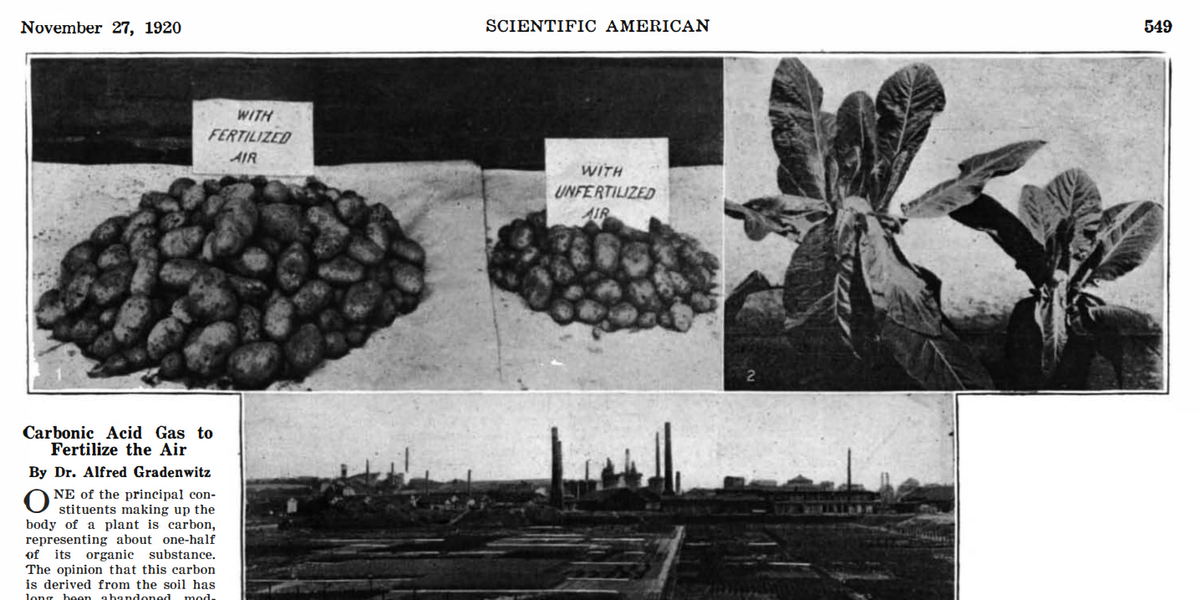
2. Elevated CO2 mitigates drought damage. As CO2 levels have risen, drought impacts have decreased considerably. The reason is well understood.
Drought impact mitigation results from improved water use efficiency and drought resilience, from reduced stomatal conductance. Here are some papers about it:
De Souza, A.P. et al. (2015). “Changes in Whole-Plant Metabolism during the Grain-Filling Stage in Sorghum Grown under Elevated CO2 and Drought.” Plant Physiology, 169(3), Nov 2015, 1755–1765. https://doi.org/10.1104/pp.15.01054
Fitzgerald GJ, et al. (2016). “Elevated atmospheric [CO2] can dramatically increase wheat yields in semi-arid environments and buffer against heat waves.” Glob Chang Biol. 22(6), 2269-84. https://doi.org/10.1111/gcb.13263
Chun, J.A. et al. (2021). “Effect of elevated carbon dioxide and water stress on gas exchange and water use efficiency in corn.” Agricultural and Forest Meteorology, 151(3), 378–384, ISSN 0168-1923. https://doi.org/10.1016/j.agrformet.2010.11.015
EXCERPT: “There have been many studies on the interaction of CO2 and water on plant growth. Under elevated CO2, less water is used to produce each unit of dry matter by reducing stomatal conductance.”
Those are two of the reasons that catastrophic famines are fading from living memory, for the first time in human history.
That is a very, VERY BIG DEAL. In the 1870s (with CO2 around 289 ppmv) a three-continent drought and consequent famine killed an estimated 3% to 3.7% of the entire world’s human population, even though they had only 1/6 as many mouths to feed as we have today. (For comparison, Covid-19 killed about 0.1%.)
3. Additionally, additional CO2 has a warming effect. It is modest and benign, and far less important than the direct benefits for plants, but the warming effect is not zero.
https://sealevel.info/sensitivity.html
We … realists … are picking away at AGW but the doubt among many people still remains. It will take longer to disprove than it took to indoctrinate them..
The indoctrination part was ‘easy’. Originated with UNFCCC 1992–how could so many countries be so wrong? Ratified by thousands of leading ‘IPCC scientists’ who made their lucrative careers therefrom.
Scam went on for 30 years before the Climategate emails exposed it 2009. Only been 16 years since then. I reckon it will take another 15 to ‘de-indoctrinate’ most people. But us skeptics now have the wind at our back in several ways.
I disagree with Roger Pielke Jr in that he accepts that there is a perceptible risk from emissions of CO2. That misconception about how the atmosphere works is not in his academic discipline. Nevertheless, at least he ought to have been able to see the circular nature of the modeling exercise from the start. It was always implausible that a pre-stabilized, step-iterated computer model could ever provide reliable diagnosis or prognosis of GHG effects in ANY scenario. The rapid buildup of uncertainty completely obscures the hypothesized influence of the factor being investigated.
He deserves a lot of respect for his straightforward and careful manner of speaking about the issues. I enjoyed watching the whole interview just now. Thanks to Youtube’s settings, I was able to speed through it at 1.75X normal speed.
That is all for now.
Scroll up and read my reply to Bruce Cobb. John Daly’s empirical temperature data showed over 20 years ago that CO2 did not cause warming of air. Roger needs to learn of the following:
At MLO in Hawaii, the concentration of CO2 in dry air is currently 431 ppmv. One cubic meter of this air has a mass of 1,290 g and contains a mere 0.85 g of CO2 at STP. It is not possible that this trace amount of CO2 can absorb enough out-going IR light emanating to heat up such a large mass of air. When winter in the the northern countries CO2 and H2O go into hibernation. Last winter in the Yukon and NWT air temperature plunged to -50° C, which broke all previous low temperature records.
The greenhouse effect contributes little to the warming of air. The process of air warming is quite simple: sunlight warms the surface. The air contacts the warm surface, warms, and then rises up and away.
What a breath of fresh air. I disagree with Roger on the carbon tax or whatever else you want to call it. It is nice that he thinks the proceeds should be used to develop more and better energy sources but there are far better avenues to raise funds for energy development than getting the government involved. The government will certainly screw things up we have already seen that.
I live in Burnaby, B.C. and the province has had carbon tax since 2009 and it had no effect on weather and climate. In 2009 the tax was $10 per tonne of CO2 equivalent and by 2024 it had risen to $80 per tonne of CO2 equivalent. On Jan. 1, 2025 the carbon tax was cancelled. The price of gasoline declined by 25 cents per liter. We don’t need these carbon taxes.
I agree with your reservations about a carbon tax. I do not know why Roger Pielke considers it necessary or desirable. In the youtube thing he says ‘we can use it to…[do desirable energy-ish things]’. But who is the ‘we’? As you note, governments have screwed this up on a never-before-imagined scale. Why should we trust them? Perhaps we need a few decades of thinking about who ‘we’ are, before ‘we’ start trying to second-guess our good old friend, the free market.
CMIP6-models have shown without any doubt that the lower resolution and incomplete physics of any older models affects their results.
Climate alarmists know that, which makes the citation of old publications without discussing these nowadays known issues specifically for the results presented fraud!
This is independent of the plausibility of the assumptions going into those models.
Same problem in baseball. Do you throw out Bonds, Clemens and McGuire?
Same problem in 1980s Olympics. Google image Jacki Joyner Kersie’s quads?
Just have to wait until kids ask “who the heck was Jose Canseco?”
Who the heck was Michael Mann?