When a “Drought” NOT a Drought?

From the Cliff Mass Weather Blog

Cliff Mass

This year, the Washington State Department of Ecology and others (e.g., the Seattle Times) are claiming we are in a drought emergency.

In several of my recent blogs, I explained why I think they are wrong. 

Precipitation has been above normal, reservoirs are full, substantial snowpack is in place (about 50% of normal), soils are moist, current forecasts are for substantial spring precipitation, and there is little evidence of any impacts of the low snowpack on water supplies or agriculture.  

Remember, a key aspect of a drought is that it has to have substantial IMPACTS. 

To quote the drought.gov website:

A drought is a prolonged period of abnormally low rainfall or, generally, a severe deficiency of moisture, resulting in water shortages for people, agriculture, and ecosystems.

Droughts need to have impacts, and the negative impacts of the high precipitation/low snowpack situation this year will be minimal 

It would be interesting to evaluate the track record of drought advocates in government, the media, and climate advocacy groups.

So let’s do it!

Consider last year (2025).

The Department of Ecology put out a drought EMERGENCY declaration in early April and expanded it greatly on June 5, 2025:

The Seattle Times and other media outlets had several drought stories, becoming increasingly ominous over time, about the serious drought threat (see sample below).

In my blog last year, I argued against the extreme drought mania, providing the actual water supply numbers, which suggest little or no impact.   But the dire warnings continued and amplified.

A year later, we know the truth:  there was no problem with water supply for the population, and Washington Agriculture flourished.    The dire warnings were totally wrong.

Seattle’s water supply?  Never got close to low-reservoir conditions in 2025 (dashed lines below).  Other major water supply reservoirs (e.g., Tacoma, Everett, etc) were similar.

How about the 2025 crops?

Apples?  There was a RECORD-EQUALING harvest of excellent quality (color and size).

Cherries? A strong, bumper crop with some of the best quality in years, with a long season.  Excellent quality and big fruit.

Potatoes?  The 2025 crop was characterized by high quality and excellent growing conditions, with a similar yield to 2024.   Chris Voigt, Executive Director at the Washington Potato Commission, noted that 2025 lacked extended periods of heat and overall had ideal weather conditions for potatoes.  

Wheat? USDA’s Small Grains Summary, Washington, noted that the state produced 141.5 million bushels of wheat in 2025, which is down 1.5% from 2024, but still 12% above the five-year average. 

Raspberries?   Last year’s total production exceeded 60 million pounds, which will be the highest harvest since 2018.  


I could discuss more crops, but you get the message.  2025 was an excellent year for Washington State agriculture, with little evidence of drought impacts.

Did drought greatly reduce Northwest hydropower output (see U.S. government analysis below)?

 Nope.   According to Federal data, NW hydropower was close to the long-term average, with a nice recovery from 2025.

The bottom line in all this is that there was little evidence of drought over our region based on impacts, and such impacts are required to call a situation a drought.

Some locations are fortunate to receive more precipitation than is required, and we are lucky to be in such a place.

For me, a more interesting question is why Washington State officials don’t understand this basic fact?  

And why are Seattle Times reporters not completing the simple research that indicates that last year’s drought warnings were without any basis in terms of impacts?

I bet you guess why such deceptive, scary language is being used by those responsible for informing us.  

But whatever the motive, it is very harmful, resulting in unnecessary worry and leading to bad decisions (like the wasteful, corrupting Washington State CCA, which preferentially hurts low-income people while enriching special interest groups).

The climate data they don't want you to find — free, to your inbox.
Join readers who get 5–8 new articles daily — no algorithms, no shadow bans.
5 9 votes
Article Rating
Subscribe
Notify of
48 Comments
Inline Feedbacks
View all comments
2hotel9
April 13, 2026 6:27 am

I seem to remember about 2 weeks ago they were screeching about flooding in Washington state.

drednicolson
Reply to  2hotel9
April 13, 2026 7:02 am

Those pesky floodroughts, amirite.

Reply to  drednicolson
April 13, 2026 11:44 am

The Pope might declare floodroughts to be a miracle! Kinda reminds me of the Zen thing, “what is the sound of one hand clapping”.

Jeff Alberts
Reply to  Joseph Zorzin
April 15, 2026 8:06 am

One hand can’t clap.

Reply to  Jeff Alberts
April 15, 2026 8:24 am

bingo- you are now enlightened!

The Expulsive
April 13, 2026 6:30 am

It’s called propaganda, and it is used extensively by all governments. Currently the Democrats, like the Liberals in Canada (and I include Progressives) are still pushing on the climate issue button, which includes water supply in many places. After all, what do we hear non-stop about weather from these people? That it is the hottest ever (just don’t look at the 30s) and we are all going to die, unless we do exactly what they tell us to do (now hand over your money).

Curious George
Reply to  The Expulsive
April 13, 2026 8:23 am

Are they supposed to do propaganda – and nothing else?

strativarius
April 13, 2026 6:44 am

1970s: global cooling
1980s onward: global warming

Brought to you by the Erroneous Reasoning Research Academy – ERRA, formerly IPCC

April 13, 2026 6:52 am

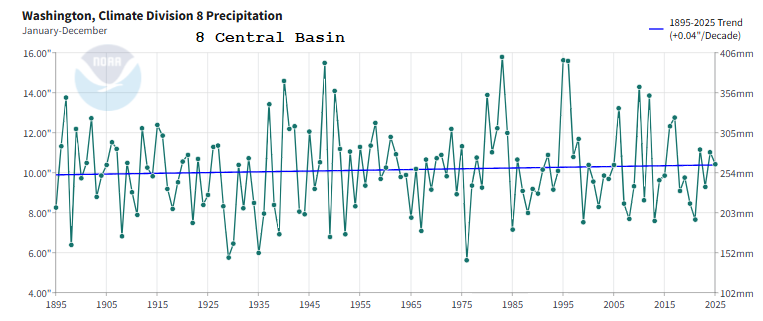
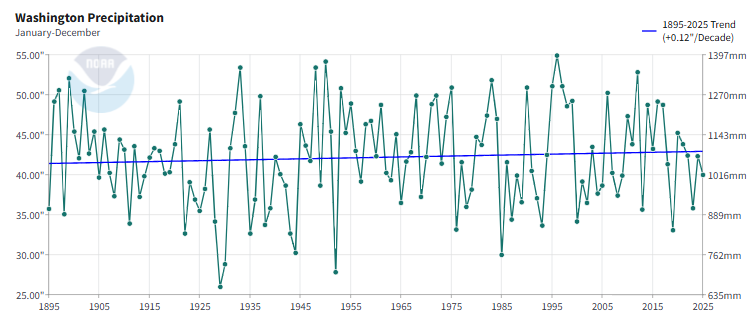
Here’s NOAA’s precipitation chart for Washington State: Climate At a Glance

comment image

Jeff Alberts
Reply to  Steve Case
April 13, 2026 7:19 am

This really provides an incomplete picture. Climates east and west of the Cascades are drastically different.

Reply to  Jeff Alberts
April 13, 2026 8:24 am

NOAA offers a selection of state regions
1 West Olympic Coast
2 North East Olympic San Juan
3 Puget Sound Low Lands
4 East Olympic Cascade Foothills
5 Cascade Mountains West
6 East Slope Cascades
7 Okanogan Big Bend
8 Central Basin
9 North Eastern
10 Paloluse Blue Mountains

Probably #8 Central Basin is what you’d like to see:

comment image

Jeff Alberts
Reply to  Steve Case
April 13, 2026 2:00 pm

I’m west of the cascades. I dug in and plotted by county, Island County where I live. The precip trend is higher here, but we’re still considered a Mediterranean climate.

Thanks Steve. That’s an awesome page.

hdhoese
Reply to  Steve Case
April 13, 2026 8:35 am

Graph has interesting 1930s and 1950s drought, even earlier ones not as well studied. 
‘Tall Tales’ belong to Texas for ignoring the water plan after the well known 50s drought. Rio Grande has long been often dry due to water overuse, now Nueces drainage into Corpus Christi due more to increasing industry and people. Currently it is more similar to this, so far! Nielsen-Gammon, J. W. 2012. The 2011 Texas Drought. Texas Water J. 3(1):59–95.  https://doi.org/10.21423/twj.v3i1.6463

Corpus Christi TV recently asked a resident who responded–“they don’t know what they are doing!” How many centuries will it take? 
Köppen, W.1884. The thermal zones of the Earth according to the duration of hot, moderate and cold periods and of the impact of heat on the organic world. Meteorol. Z., 1, 215–226.

Texas Water Development Board (.gov)
https://www.twdb.texas.gov › 2007StateWaterPlan
“The year 2007 represents the 50th anniversary of the creation of TWDB, established in part in response to the drought of the 1950s. The 2007 State Water Plan is the eighth water plan developed by TWDB as a part of its core mission to ensure that sufficient, clean, and affordable water supplies are available for the citizens of the State of Texas and that those water supplies foster a healthy economy and environment. This chapter is a brief historical perspective of water planning in Texas over the past half century.”

Sean2828
April 13, 2026 6:54 am

The CCA or Climate Commitment Act sounds very much like CARB or California Air Resources Board. Do their powers expand during crisis or emergency. Are they able to extract higher fees during emergencies?
The amount of money distributed by the state is substantial. At least $500 million per year. This website has an interactive graph which shows you what is spent for individual projects.
CCA Dashboard: How Climate Commitment Act funds are invested | Climate
Most of them sound like maintenance. Some are returning money collected in carbon taxes to organizations that are exempt from those taxes. These sound like things that should come out of general revenue.

Jeff Alberts
Reply to  Sean2828
April 13, 2026 7:20 am

If you believe anything they say the CCA is doing…

April 13, 2026 6:55 am

The Pacific Northwest is blessed to possess resources that not only allow it to generate the substantial amounts of cheap and reliable hydroelectric energy that power its economy, but also allows its Leftist politicians, as well as their fellow travelers in CA, to bask in the virtue of green energy. An extended period of real drought might bring them to their senses, but I doubt it.

Sean2828
Reply to  Frank from NoVA
April 13, 2026 7:12 am

Bring them to their senses? Remember it was a Democrat (Rahm Emanual) who said never let an emergency go to waste.

Reply to  Sean2828
April 13, 2026 2:18 pm

Yes, and to make matters worse, ol’ Rahm is considered a right-wing reactionary among today’s Democrats.

Jeff Alberts
Reply to  Frank from NoVA
April 13, 2026 7:24 am

Sorry, Frank. Anything weather-related which they perceive as bad (which is pretty much everything) just means they will double and triple down. It happens over and over.

Reply to  Frank from NoVA
April 13, 2026 11:48 am

Aren’t there enviros out there trying to have dams removed?

Reply to  Joseph Zorzin
April 13, 2026 1:23 pm

Well, that too…

Jeff Alberts
April 13, 2026 7:18 am

In several of my recent blogs, I explained why I think they are wrong.”

If their goal was truth, then yes, calling them wrong is the correct thing to do. But their goal is not truth, it is to further the globalist agenda of de-industrializing the West via “climate” policy.

Reply to  Jeff Alberts
April 13, 2026 11:54 am

Some regions can survive after de-industrializing (mostly meaning smokestack industries). Seems to be the case here in Wokeachusetts thanks to having world famous hospitals, universities, some high tech, tourism and others. But not every region in the US can do this. Meanwhile, people in those enterprises (and the very large state burro-ocracy) are very well paid, driving up the cost of living for lesser mortals- along with very high energy costs. So, it’s fine for such elites who can afford a starter home for 600 K.

JD Lunkerman
April 13, 2026 7:19 am

Liberal governments whether city, county, state or countries now seem to compete against each other for who can pass or proclaim the most outrageous policy or law. It used to be we just laughed when Berkeley or Cambridge passed a sanctuary law. But the disease has metastisized. Watch Canada throw out the zillion lgt acronym. Both Washington state and Oregon have gotten into the drought business seeing how California got its citizens to bow to the drought ninnies. I really like how they have a part on the map of the Olympic Rain Forest as being in a drought. How can a rain forest be in a drought? Put a liberal in charge.

Jeff Alberts
Reply to  JD Lunkerman
April 13, 2026 7:27 am

Drought is a relative term. Anywhere can be in a drought.

strativarius
Reply to  Jeff Alberts
April 13, 2026 7:35 am

Especially common sense and logic.

StephenP
Reply to  Jeff Alberts
April 13, 2026 7:49 am

IIRC weren’t there megadroughts in the South West US from 800 to 1300 CE. Well before the modern industrial era.

strativarius
Reply to  StephenP
April 13, 2026 7:57 am

Shhh….

Reply to  strativarius
April 13, 2026 11:58 am

Forbidden truth- not to be mentioned in blue states.

Reply to  Jeff Alberts
April 13, 2026 11:57 am

Not likely though in a rain forest. Over an extended time frame, of course it’ll happen.

Jeff Alberts
Reply to  Joseph Zorzin
April 13, 2026 2:52 pm

I asked Grok for the definition of drought:

Drought is generally defined as a prolonged deficiency of precipitation (rain or snow) over an extended period—typically a season or more—that leads to a water shortage and causes adverse impacts on people, animals, vegetation, agriculture, or the environment.

And it added this without me asking:

Drought is relative—what counts as “dry” depends on the normal climate of a region (e.g., a few weeks without rain might be a drought in a normally wet area but normal in an arid one).

JD Lunkerman
Reply to  Jeff Alberts
April 13, 2026 9:18 pm

Of course there is a definition of a drought, but there are over 150 named major rivers in Washington St. There are 170,000 tributaries feeding those 150 rivers. They are all jam packed full of water 365 days a year not to mention god knows how much is in the ground. They just found an acquifer under the Sierra Nevada mountains with more fresh water than anywhere else on earth(Calif). The entire state of WA is likely sitting on barely calculable amount of groundwater. 200 million acre feet of water flow into the ocean each year from the Columbia River. That alone covers all the households in the whole country with a bunch to spare. Sure a drought less rain than an average, but holy cow that is likely saying they will have a problem with enough sand in the Saraha. Talking about droughts in Washington or Oregon for that matter is brain dead stupid.

Jeff Alberts
Reply to  JD Lunkerman
April 14, 2026 6:21 am

Again, there are many different climates in Washington State. I live on Whidbey Island. There are no rivers on the island, nor is there any snowpack. Summers are very dry here, grass is green in the Winter, brown in late Spring and Summer. We are often in drought conditions in the Summer.

22GeologyJim
Reply to  Jeff Alberts
April 14, 2026 9:28 am

John Wesley Powell, the one-armed explorer of the Colorado and later Director of the Geological Survey, recommended political boundaries in the western lands based on drainage basins. Even before carbon-14 dating, he recognized the physical evidence for cyclical changes in climate, especially precipitation. When political boundaries follow arbitrary straight lines, decisions do a poor job of honoring the native character of the land.

Sparta Nova 4
Reply to  Jeff Alberts
April 13, 2026 12:35 pm

The Trans-Reality Alarmists have a drought of honesty.

Beta Blocker
April 13, 2026 8:46 am

The irrigation district here in eastern Washington State which supplies my irrigation water issued a warning last week that water rationing will commence in June. The district didn’t give a figure in its announcement, but the local press is saying that irrigation subscribers in our area will be getting roughly half of their normal water allotments. Nothing is being said about the storage reservoirs being full at this point in the season.

Reply to  Beta Blocker
April 13, 2026 12:00 pm

How is the water table in that area? Is it being tapped much? By the farmers? By cities? If so, is it becoming a problem?

April 13, 2026 9:07 am

A few years ago, NC officials were talking about how we were in a drought. At the time, all the ponds & reservoirs in my area were full or even overflowing, and we couldn’t get through a week without rain.
Nobody was listening to them.

Reply to  Tony_G
April 13, 2026 12:02 pm

Were those officials “scientists” educated at elite New England colleges? I hear/see such nonsense all the time here.

Reply to  Joseph Zorzin
April 13, 2026 1:13 pm

JZ, mostly government types, and maybe a couple of the weather people. “We’re in a drought” as they’re in a boat floating down the street…

Jeff Alberts
Reply to  Tony_G
April 13, 2026 2:54 pm

Obviously they meant they were a drought drought.

April 13, 2026 9:42 am

The official US drought monitor is a glass half empty system. Normal on the map is white. But to be thorough, it should also map above normal moisture, very wet and extremely wet conditions as well, showing them in shades of green. As currently shown, the maps give the visual impression that practically everything is in some stage of drought.

April 13, 2026 11:42 am

“Droughts need to have impacts, and the negative impacts of the high precipitation/low snowpack situation this year will be minimal ”

With a low snowpack, that COULD be a good thing, lessening the chance of spring floods, assuming a normal or close to normal spring rainfall. (wild guessing here as I know little about meteorology)

Jeff Alberts
Reply to  Joseph Zorzin
April 13, 2026 2:56 pm

It’s a balance. We got a lot more rain and almost no snow (none at all in my area) West of the Cascades. Too warm. So the rain that would have fallen as snow simply filled up the reservoirs earlier than usual. Same thing, different method.

April 13, 2026 1:29 pm

“Remain calm, all is well” doesn’t sell newspapers or get funding from the taxpayers.

Reply to  More Soylent Green!
April 13, 2026 1:29 pm

Just for fun, I attached the clip from Animal House.


April 13, 2026 5:52 pm

Here’s what an actual drought looks like with serious impacts:

Well, this is not the happiest page we’ve ever done, but our weekly newsletter from Black Cat Farms told us it was time to do it. Martin has been watching the Colorado snow pack plot and was going to do a page on it eventually. Well, here’s what Jill & Eric Skokan had to say:

Happy Saturday, friends.

We’ve got some tough news to share. We will not have vegetables this week at our Farmers Market outlets in Boulder and Longmont today. In fact, we may not bring vegetables to our stands at all for the entire 2026 farmers market season. One word sums it up: drought. 

http://theviews.org/Life%20at%20the%20Views/2026/april-11-2026-drought.html

Rational Keith
April 15, 2026 5:38 am

The Seattle Times gets money from climate alarmists – enough said.

(While right there in Seattle WA researcher Cliff Mass explains weather phenomenon.)

Years ago jurk alarmist politician perfessor Andrew Weaver used a photo of parched earth on the cover of a report he edited. But parched earth is normal in some locations with certain soil types (I’d guess clay from my experience in an area of dry summers (NE BC)). Weaver is in an area of dry summers – midwet coast of NA. Indeed, some locations are well known for vegetation staying dormant for years then springing to abundant growth after a rare rain, one in California and one in South America are well known.