Guest “V’ger is coming! V’ger is coming!” by David Middleton
Carbon-free?
September 25th, 2025 | Earth & Climate
Study reveals roadmap for carbon-free California by 2045
A new study shows California can go carbon-free mostly using current and emerging solutions – but to get there, it must overcome regulatory challenges and scale technologies at an unprecedented pace.
In brief
- California will need to more than double its electricity generation capacity to achieve net-zero emissions by 2045.
- Half of emissions cuts are achievable with existing technologies like electric vehicles, pending regulatory barriers, while another quarter could come from early-stage technologies.
- The final fourth of reductions will require breakthrough technologies still in the research phase, such as decarbonized planes and ships, low-emission refrigerants, and removal of carbon dioxide from the atmosphere.
A 2022 California law mandates net-zero greenhouse gas emissions by 2045 and negative emissions every year thereafter.
[…]
“Reaching net-zero by 2045 is not so much a challenge in cost,” said Benson, “but a challenge in getting the necessary technologies available in time and establishing the social, political, and economic environment to deploy these technologies rapidly and broadly.”
That’s a relief! The carbon units are off the hook. Carbon-free is just another meaningless slogan.
California will need to more than double its electricity generation capacity to achieve net-zero emissions by 2045.
In 2006, California’s total solar generation capacity was 112 MW. It’s now almost 17,000 MW… More than 7 doublings.

And, contrary to the propaganda, solar power isn’t getting cheaper in California.

In 2006, California’s wind generation capacity was about 2 MW. It’s now almost 72 MW… Almost 5 doublings.

Over that same time period, California’s electricity generation actually declined.

Doubling solar and wind capacity will just yield more of this:
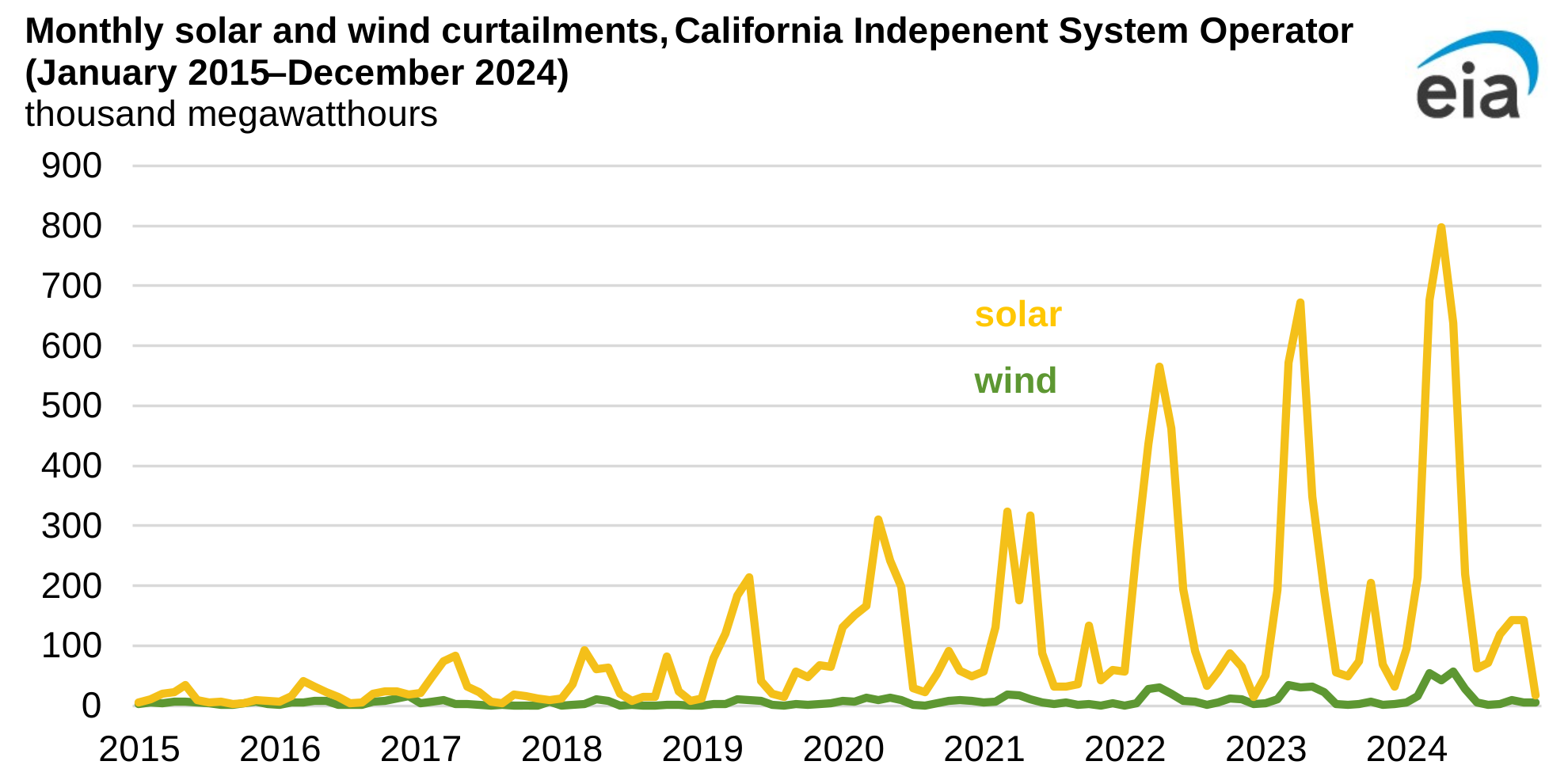
And that’s the bit semi-grounded in reality!
First 52%: Commercial technologies
The necessary technologies already in commercial use that could halve California emissions include renewable electricity generation, batteries for storing that energy, electric passenger vehicles, heat pumps, and machines that produce methane fuel from wastewater, manure, and food and plant waste.
[…]
The authors estimate electric passenger vehicles, solar and wind power, reduced in-state oil production, and replacement of fossil-based gas with methane fuel made through anaerobic digestion could eliminate 44% of the state’s greenhouse gas emissions (based on estimated 2045 emissions if the state were to continue business as usual).
Batteries? There’s “no Moore’s Law for batteries“.

California is already well-ahead of the curve in reducing “in-state oil production.”

“Methane fuel made through anaerobic digestion” WTF?

California actually ranks first in the nation in biogas potential, with the capacity to generate over 280 billion cubic feet (Bcf) of “renewable natural gas” per year. In 2023, California consumed 2,085 Bcf of natural gas. Even if California maxed out its “methane fuel made through anaerobic digestion” capacity, it could only replace a bit over 10% of its current natural gas capacity.
Regular natural gas, renewable natural gas and biogas all rely on the same chemical equation for energy production:
- CH4 + 2O2 –> CO2 +2H2O
Can someone explain to me the carbon freeness of biogas? I suppose they plan to dispose of the CO2 this way:
Next 25%: Early-stage technologies
The authors estimate a quarter of emissions abatement could come from technologies in the early stages of commercialization, including zero-emission heavy-duty vehicles, clean industrial heating from electricity and hydrogen, and carbon capture and sequestration (CCS).
[…]
While CCS will technically work, it takes at least four years to get a Class VI CCS permit approved by the EPA or state agency with primacy. The EPA currently has 240 CCS well permit applications that it has received since 2021. Only 3 are are in the “Prepare Final Permit Decision Phase.” Only 55 of those permit applications are in California and none have moved beyond the preliminary “Technical Review Phase.” In contrast, 64 permit applications are in Texas or its state waters. All 3 of the “Prepare Final Permit Decision Phase” applications are in Texas. The odds are that Texas will be sequestering CO2 long before California, while increasing oil & gas production… Irony can be so ironic.
Might as well add pixie dust and unicorn flatulence to this section:
Final 23%: Research-phase technologies
Nascent technologies still in the research phase include decarbonized trains, planes, and boats; low-emission refrigerants; and carbon dioxide removal (CDR) from the atmosphere. Replacing fossil fuels for planes, trains, and boats with electricity, hydrogen, and renewable fuels faces challenges from their weight, cargo capacity, costs, and the limited availability of clean fuels.
[…]
Decarbonized trains? California can’t even build a carbonized train!

V’Ger actually seems less science fictiony than this “roadmap for a carbon-free California.” For what it’s worth, here’s their publication:
- Neutel, Joshua, Andrew Berson, Sarah Saltzer, Adam Brandt, John Weyant, Franklin M. Orr, Sally M. Benson. What will it take to get to net-zero emissions in California?. Energy Policy. Volume 208, 2026,114848, ISSN 0301-4215, https://doi.org/10.1016/j.enpol.2025.114848.
If it is all about collapsing the economy, then progress seems to be just fine.
Cloward-Piven, but instead of a welfare system it’s the economic one. Would make the California communists proud.
Necessary corrections to the Stanford report (first quoted sentence in above article):
“A new study shows California
cancan’t go carbon-free mostly using current and emerging solutions –butto get there, itmustwould have to overcome regulatory challenges and scale technologies at anunprecedentedimpossible pace.”I’m not at all surprised that the editors of the Stanford Report missed these corrections.
I think the accurate edit is to remove everything after “solutions.”
Also remove the word “solutions” and, “carbon-free”
Just throwing in the term “emerging” shows a lack of understanding of the real world. I.e., experimenting on a massive scale and expecting an economic outcome. Have any of them ever really worked on a physical project?
As they pretend to go “carbon free”, how much have electricity imports increased from power generated outside of Cali, say, over the last decade. And when will the kindness of strangers run out, much like it seems to be with the Norwegian people and the UK energy disaster.
“Study reveals roadmap for carbon-free California by 2045”
Thanks Mr President, after the recent UN speech I feel free to ask… “Why?”
I see no mention of decarbonising road haulage. Wouldn’t want to upset the unions with this threat to their livelyhood.
It talks about zero emissions heavy duty vehicles somewhere. (Imagine an electric combine harvester. The batteries would be so heavy that it would sink into the field.)
I still don’t understand how an electric vehicle is “emission free”. The power is just made somewhere else but still gives off “emissions” which should be attributed to the vehicle which is where that power is finally used.
It’s really shocking that so few people understand that.
Zero Emissions Here Vehicles.
What about blacktop for the roads? Nada.
That’s a concrete example of their ignorance.
“Half of emissions cuts are achievable with existing technologies like electric vehicles”
Seems like this must be wrong. An entire debate could be had about what was included and excluded from calculations. It was brave of the author to throw that bullet point into the ether with their name attached – it’s almost as if they’re expecting no one will bother reading their report.
Near the end of the above article:
“Decarbonized trains? California can’t even build a carbonized train!”
Excellent! So far the California High Speed Rail project is “nearing completion” of 171 miles of train track at the outrageous cost of $216 million per mile of track. First trains to do test runs on that segment are expected sometime in 2028.
Oh, and this too: construction on that 171 mile segment began in 2015!
So, yeah, for all intents and purposes, the bureaucracy (both governmental and civilian-contractors) established for California’s HSR is INCAPABLE of even laying train tracks in any reasonable sense. If the planned route of this HSR project (800 miles from LA to SF) is ever realized, it will likely be no earlier than the year 2080 and it will have bankrupted the state by then!
“$216 million per mile of track”
Yikes!
Yep, that’s not a typo.
This today from Google’s AI overview:
“The 171-mile Merced-Bakersfield segment of the California High-Speed Rail project currently has an estimated cost of $36.8 billion as of August 2025, which is a roughly $1.8 billion increase from the previous estimate. This figure accounts for cost increases and includes a $8.6 billion funding gap that the Authority still needs to address to complete the segment.”
$36.8 billion/171 miles = $216 million per mile.
I calculated from the chart.
2020-2008 = then-expected 12-year project
2033-2025 = now expecting 8 more years
then expected cost = $33B/12y = $2.75B/year
now expected added cost = (88-to-128 – 33)/8 = $11B-to-$16B/year
People lose track of just how big a billion is.
The RR figure is enough that the government could send out 128,000 one million dollar checks to random lucky citizens. Likely that would have given them more new millionaires than train riders during the lifetime of the 2008 electorate.
… OR they could have sent every citizen of the US state of Vermont $100,000/year for 2 years. THAT would make some friends.
The Edinburgh (Scotland) 11.5 mile tram line, from the airport through the city centre to nowhere important, cost approximately $1.13 Billion, so almost $100 million per mile (not counting losses suffered by businesses during construction, etc). I thought this was terrible, but seeing California spend double the cost per mile casts it in a better light.
The first link they claim they will complete is from Bakersfield to Modesto. Cause, ya know, people are just clamoring to take trains between those two cities.
It just pisses me off to no end that if the stupid commies running this state had invested in water infrastructure instead of this piece of cr@p, the lives of people they claim they are representing would actually be improved.
Instead of building something virtually no one wants or would use, build something everybody absolutely needs.
The HSR is electric. The electricity comes from
…
It is not 800 miles from LA to SF.
It was the above article’s author, David Middleton, that made the statement:
“Decarbonized trains? California can’t even build a carbonized train!”,
I only offered comments related to the cost of laying the train track for California’s HSR project.
As to your second statement, you are correct. The California HSR segment from LA to SF is indeed only about 500 miles in length . . . I wrongly stated 800 miles, which is slated to be the final length that includes planned extensions to Sacramento and San Diego. Thank you for this correction!
Remember, ALL of California’s climate efforts have resulted in ZERO reduction of atmospheric CO2.
They wont even say how much their quarter century efforts have reduced global warming which is the ONLY reason they are doing ANYTHING climate related anyway.
The losers are ALL California citizens who must PAY MORE for NOTHING.
People who want to reduce your standard of living are not your friends.
The ONLY reason they are doing ANYTHING climate related is to siphon money from taxpayers. They have been VERY successful.
a challenge in getting the necessary technologies available in time
And if they aren’t? Then what, darkness until….?
“And if they aren’t? Then what, darkness until….?”
It’s entirely possible no one will care. California is leading the entire US in out-migration. The state is becoming uninhabitable with the number of retail outlets completely shutting down becasue of uncontrolled looting of stores. Its electrical power rates are insanely high already. Its municipal services like police and fire protection (Los Angeles) are disintegrating.
California is well on the road to being the New Brazil – a huge, impoverished underclass, a ridiculously rich group of entitled aristocrats, and nothing in between. So, like Detroit, who cares if there’s only rats scurrying through the ruins?
Hawks and owls care. Maybe someone in Detroit is keeping track.
The end result of socialism everywhere.
““Methane fuel made through anaerobic digestion” WTF?”
California politics certainly has enough BS to make it work.
(But instead of blanketing the state with solar panels, they’d have to blanket it with wastewater plants!) 😎
PS Anaerobic digestion doesn’t just produce methane. It also produces such fun things as hydrogen sulfide.
At least hydrogen sulfide is carbon free.
But it’s toxic – which carbon dioxide isn’t!
But the climate idiots are the champions of “clean air.”
/sarc
CCS is a useless technology, its a solution in search of a problem, the market for it only exists in green fantasies, its a cost with 0 benefit.
Just like every other ‘green’ “solution.”
I hope no Texas taxpayer money, or federal taxes are going to fund the CCS in Texas.
Taxpayers should not be paying for useless technology.
U.S. Preserves and Increases 45Q Credit in “One Big Beautiful Bill Act”
There are still Republicans who need to be educated. Or they are getting a cut.
The final fourth of reductions will require breakthrough technologies still in the research phase, such as decarbonized planes and ships …
Gliders and sail boats. There … done!
“We’ll have the solution … tomorrow.”
Nah they’re all “a decade away” and always will be, just like cold fusion.
😎
I was thinking of a sign I saw painted on the side of a sea food restaurant.
“Free crabs tomorrow!”
Of course, “tomorrow” is never today.
That would be wooden sailboats with cotton sails, steel, carbon fibre and dacron need oil and/or coal.
Side note.
V’ger was a recycled Nomad from original series.
And (I think it was) the director of “Star Trek The Motion Picture” had never seen an episode of the TV show.
I’ll say! Every time Gavin Gruesome opens his mouth!
“Carbon Free”???
Well there’s nothing” Carbon Free about Solar.
Solar requires Coal (CARBON) in the refine!ent of Silica into Silicon to make the PV wafers for the panels (which can still be destroyed in moderate winds or hail storms).
Solar requires Coal (CARBON) for the manufacture of Steel Supports that hold and anchor the panels to the ground or rooftop.
Wind requires Coal (CARBON) for structural Steel to manufacture the 350′ – 500′ tall mast (which can still be demolished by high winds)
Wind requires Concrete which releases CO2 in the process and must be replaced every 20 years or so as they don’t last 1/3 as long as Gas/Coal Generation does.
Nope…Sorry,.neither.Wind or Solar are Carbon Free
It would be hard to find carbon free graphite electrodes. The best graphite for this is made from calcined petroleum coke, which made Gavin Newsom all excited.
Thanks Scissor. Comment made me think: Graphite electrode implies DC generator, but I’ve always associated naturally spinny things like wind turbines and water turbines with AC generators, so I Googled around to verify hydro plants naturally make AC, and was reminded how few Internet writers actually know how electric generators and motors work, or which Netflix series Michael Faraday starred in. I’m almost inspired to write my own blog article explaining how spinning magnets make hot air come out of an electric hair dryer.
All they’ll wind up with is train service from Fresno to Bakersfield that won’t ever get up to “High Speed” thanks to Rail Crossings and Station Stops and won’t recover initial costs through ridership sales. It won’t go beyond that much like BART never extended up to Sonoma County, it’s too costly to run any extensions.
Roadmap for a carbon free California.
A plan that complex, especially given no contingency plans, is doomed to fail from the start.
But it’s a model, so it must be correct. /sarc
To be truly carbon free:
How does California plan to replace all the polymer based products consumed?
No polymer components on ANY product should be allowed in CA. (No car interiors, no iPhones, no appliances, no tires, no lubricants, no paints, etc, etc)
The list could go on for miles! Virtue signaling idiots.
Sadly, Stanford is variously ranked second or third among top world universities. This laughable ‘report’ says much about those ranking systems.
Ze, zem is found wanting.
One party state. 44% of registered voters are Democrats but they hold 83% of the House seats. Gerrymandering, voter fraud, or both?
Both.
I always get amused whenever the Democrats whine about Republican gerrymandering. They perfected the art, and the Republicans are just copying them.
I always get a laugh when I hear mention of California’s high speed rail plans, especially the stretch between Los Angeles and the Bay area. If there was really a genuine demand for this, it would have been completed at least a decade ago, but now it seems like just another green pipe dream. So Canadian advocates of a similar line between Windsor, Ontario (just across from Detroit) and Quebec City should take note: does the actual demand for such a route exist? Obviously not, or construction would have at least been started.
Sometimes you can get a round trip flight between LAX and SFO for as little as $60.
What is missing is the bit that says “and then a miracle happens”
Far Side
Humans in California exhale 90 million pounds of CO2 per day. What is Gov. Gavin plan for reducing CO2 emissions from humans? Then there is the CO2 from all the domesticated animals.
If California goes “carbon free”, what fuel would be used by the heavy machinery used in agriculture and by the fire departments?
Why is California so screwed up?
California is screwed up because 4 counties out of 58 decide ALL statewide elections due to population density in those counties. The voters in 54 counties can all stay home and the election results would not be any different.
That’s the reason that all California statewide elections are called by the TV networks for democrats about 2 minutes after the polls close. Despite it’s vast area it is a one party state.
“Why is California so screwed up?”
Because California is run by radical Democrats
Notice that everything in the United States run by radical Democrats is a failure.
Radical Democrats are Bad News for Good Government.
If you want good government, don’t vote for radical Democrats. They are the Root of all our current problems. Radical Democrats are nothing but trouble.
Very nice. California is hopeless.
“A 2022 California law mandates net-zero greenhouse gas emissions by 2045 and negative emissions every year thereafter.”
The easy solution is to nullify the law.
Capacity, capacity, capacity nobody gives a damn about capacity, generation is the only measure that matters. If capacity meant anything wind, solar and storage would have already solved our problems but it doesn’t so they haven’t.
Fire up all fossil fuel and nuclear generators, build new fossil fuel and nuclear generators, remove all wind and solar from the grid, stop building generators that endanger the grid and can’t sustain the grid.
CO2 can’t cause catastrophic global warming, everybody knows that.
No carbon – No life. 🙁
I seem to remember that a Stanford professor published a report about a decade or so ago in which he claimed that California could be run exclusively on renewable energy. The California intelligentsia, uni-party, academia and NGOs all fell for it and believed it whole-heartedly. Now comes a group of folks from Stanford (indoctrinated by him in grad school?) publishing more of the same claptrap.
There is a metric used in the aerospace industry (an maybe others) called Technology Readiness Level. A TRL of 1 means that the technology is a gleam in someone’s eye. A Value of 10 means that the technology has run its useful life. We would look for technologies with a TRL of 6 or 7 during development, which basically meant that the technology had been demonstrated in an environment (operational, maintenance / support, manufacturing, political, economic …) representative of the products environment, as used by user personnel representative of those who would be operating the product in the field.
The authors have identified technologies that are at best a TRL of 5, and in the last case, a TRL of, maybe, 3. Pie-in-the-sky.