By Kennedy Maize — June 5, 2025
“… model-observation discrepancies can arise from three causes: the observations could be wrong (unrealized biases etc.), the models are wrong (which can encompass errors in forcings as well as physics), or the comparison could be inappropriate…. [I]t may well be that these discrepancies will resolve themselves in the course of ‘normal’ model development … Or not….” – Gavin Schmidt, Real Science, May 31, 2025.
One of the most enduring themes of the popular discussion of a man-made warming globe has been sea level rise as a result of the melting of ice from the planet’s two frigid poles.
Former Vice President Al Gore’s 2006 film “An Inconvenient Truth” featured images of icebergs calving off the Antarctic continent. He proclaimed that if the world proceeded to warm at its current rate, worldwide sea levels would rise “20 feet.”
On Oct. 16, 2009, then Sen. John Kerry (D-Mass.) and later presidential candidate and secretary of state, proclaimed, “Scientists project that the Arctic will be ice-free in the summer of 2013. Not in 2050, but four years from now.”
Last year, an Antarctic iceberg named A23a, floating in the southern ocean since 1986, the size of the state of Rhode Island and weighing a trillion tons, threatened to smash into South Georgia Island (site of explorer Ernest Shakleton’s grave) before it harmlessly spun away and melted. Catastrophe avoided.
New Data, Research
Is the apocalyptic scenario an unavoidable future? Two new scientific studies have found that melting ice in Antarctica has reversed and slowed in the Northern Hemisphere’s Arctic. It’s too soon to reach any overarching lessons from this new data, but worthwhile acknowledging that few scientific “facts” are immutable.
At the South Pole, a team of Chinese researchers led by Wei Wang of Tongji University of Shanghai found that ice on the Antarctic ice sheet increased from 2021 to 2023, following 19 years of decrease starting in 2002.
Published March 19 in the peer reviewed Springer Nature journal Science China Earth Sciences, the research team found that Antarctica’s melting glaciers caused the “global mean sea level” (GMSL) to rise by “5.99±0,52 mm ( milllimeteres) by February 2020. Then the ice began accumulating in the followed three years, “ultimately resulting in a total GMSL contribution of 5.10±0.52 mm by the end of 2023.”
Moving to the North Pole, a March 29 analysis by four researchers led by Mark England from the University of Bristol, published in the ESS Open Archive research platform wrote, “Over the past two decades, Arctic sea ice loss has slowed considerably, with no statistically significant decline in September sea ice area since 2005. This pause is robust across observational datasets, metrics, and seasons.”
What to make of these surprising findings that contradict the popular notion of the impact of climate change, long promoted by some researchers who appear to have more interest in advancing policy positions than science? Researcher England titles his team’s research paper as “Surprising, but not unexpected, multi-decadal pause in Arctic sea ice loss.”
The Arctic paper, in typical low-key scientific language, says, “The modelling evidence suggests that internal variability has substantially offset anthropogenically forced sea ice loss in recent decades, although possible contributions from changes in the forced response remain uncertain. Overall, this observed pause in Arctic sea ice decline is consistent with simulated internal variability superimposed on the long term trend according to the bulk of the climate modelling evidence.”
The Wang Antarctic paper concludes modestly, “Overall, the study presents the mass change characteristics of the [Antarctic Ice Sheet] over the past 22 years, highlights the instability of four important glacier basins in the [East Antarctic Ice Sheet], and provides valuable scientific insights for related polar research.”
Pielke View
U.S. climate scientist Roger Pielke, Jr., wrote in an op-ed in the New York Post, “When it comes to climate change, to invoke one of Al Gore’s favorite sayings, the biggest challenge is not what we don’t know, but what we know for sure but just isn’t so.”
Taken together, says Pielke, “the two studies remind us that the global climate system remains unpredictable, defying simplistic expectations that change moves only in one direction.”
Writing in The Honest Broker, Pielke observes that “climate research is not a scoreboard in a Manichean debate, but instead offers certainties, uncertainties, and even areas of total ignorance that establish a nuanced context for developing robust mitigation and adaptation policies.”
He adds, “Humans affect the climate system in many ways, including greenhouse gas emissions, but also through land management, air pollution, and vegetation dynamics. At a planetary scale the net effect of these changes – driven by carbon dioxide emissions from the burning of coal, natural gas, and oil – is a warming of the planetary system. Anticipating regional and local consequences is far more challenging.”
Pielke recalls the lament of the late, great climate scientist Steve Schneider (1945-2010) in 2002: “I readily confess a lingering frustration: uncertainties so infuse the issue of climate change that it is still impossible to rule out either mild or catastrophic outcomes, let alone provide confident probabilities for all the claims and counterclaims made about environmental problems.”
Conclusion
What is supposed to be in the world of unsettled climate science cannot substitute for data. And climate models cannot rescue theory or data. Climate modeling is hope-in-process. Gavin Schmidt states:
models are always wrong, but the degree to which they can be useful needs to be addressed – by variable or by model generation or by model completeness etc…. an accumulation of improvements – in physics, resolution, completeness, forcings – have led to a gradual improvement in skill (not just in the sea ice trends!)…. The history of Arctic sea ice comparisons shows that it might be premature to conclude that any specific discrepancies imply that something is fundamentally wrong, or that climate modeling is in a ‘crisis’ (Shaw and Stevens, 2025), it may well be that these discrepancies will resolve themselves in the course of ‘normal’ model development (and as the observed signals become clearer). Or not ;-).
Only the future will tell…. or not.
They’ve been sounding the alarm for 35 years at least and nada. Not one of their predictions has come to pass. So, back to the future:
“By the year 2100, the Intergovernmental Panel on Climate Change estimated, there could be between 43 and 84 centimeters (1.4 and 2.8 feet) of sea level rise, and an increase of two meters (6.6 feet) “cannot be ruled out.”
https://www.newsweek.com/california-map-underwater-sea-level-rise-climate-change-1886335
Interactive map shows which US cities could be underwater in 2050
While Manhattan is largely spared under these moderate conditions, there’s substantial sea level rise in nearby Hudson and Bergen counties in New Jersey.
https://pix11.com/news/interactive-map-shows-which-us-cities-will-be-underwater-in-2050/
The evolving landscape of sea-level rise science from 1990 to 2021
Abstract
As sea-level rise (SLR) accelerates due to climate change…
https://www.nature.com/articles/s43247-023-00920-4
If they repeat it enough… it will happen, but it does require mental gymnastics.
Current sea level rise is 4.4mm/year. It it stays constant over 75 years = 33cm. An increase of over 43cm by 2100 doesn’t need mental gymnastics at all, only a small acceleration of ice loss which is almost certain. Sea level rise on east cost of USA will be faster. https://tamino.wordpress.com/2025/01/02/climate-new-year-2025/
“doesn’t need mental gymnastics”
Au contraire, matey. Anyone who believes in the religion of AGW and Latter Day Morons clearly needs the ability of doublethink at the very least.
How do you expect to be taken seriously?
“KIDS’ LIVES MATTER so let’s stop climate change”
https://tamino.wordpress.com/2025/01/02/climate-new-year-2025/
Stop climate change??? More French chalk for you?
Perhaps look back a photo of the east Coast of USA in 1950 (25 years ago) and get the newsflash you won’t even recognize east Coast of USA in 2100. The problem with your sort of argument and stupidity is it assumes nothing will change in 75 years. Imagine if those who lived in 1950 used your sort of logic 🙂
The Antarctic icecap is growing.
Antarctic ice mass loss/gain:
2019: 153Gt loss
2020: 140Gt loss
2021: 36Gt loss
2022: 290Gt gain
2023: 196Gt loss
2024: 230Gt loss
So apart from outlier year of 2022 (and possibly 2021) then no.
Ice mass for March 2025 is lowest value for any March measured by Grace. See: https://climate.nasa.gov/vital-signs/ice-sheets/?intent=121
That’s what the numerically literate call noise.
That sounds about right, but what is the relevance of this March data series for sea level rise, model behavior and climate alarmism?
There is a sold trend in sea level and arctic ice coverage since the end of the little ice age.
See, I can write correct, but irrelevant stuff too:
Yesterday the sun rose in the east.
Yesterday the sun rose in the east.
But my model says tomorrow it will rise in the west and we must not argue with models. Well computer models anyway.
Antarctic ice mass since 1900..
Antarctic has been cooling for a long time
Examining the graph at the link that you so graciously provided, it is evident that the general trend bottomed in January 2021 (2781 Gt) and has yet to again reach that low up to March 2025.
March is not always the lowest month. It seems that in recent years, January is usually lower. Rather than cherry-pick certain months, I would suggest looking at the general behavior with your eyes.
The Arctic ice is above the 2012 statistical low and Antarctica has been adding ice mass. “Ice loss” may actually be a negative number now (—> Ice gain).
What has Arctic ice got to do with sea level rise?
Antarctic ice mass loss/gain:
2019: 153Gt loss
2020: 140Gt loss
2021: 36Gt loss
2022: 290Gt gain
2023: 196Gt loss
2024: 230Gt loss
So apart from outlier year of 2022 (and possibly 2021) then no.
Ice mass for March 2025 is lowest value for any March measured by Grace. See: https://climate.nasa.gov/vital-signs/ice-sheets/?intent=121
There was a post here a few weeks back putting these figures in perspective. 151Gt represents something like 1/20,000 of 1% of the total ice in the arctic.
Antarctic?
Even though it may only be a flea on the back of a dog, one can’t argue that the dog is now taller (until the flea wanders off.)
Sea ice does not affect sea levels.
Land ice can.
Grace measures gravity.
West Antarctic sits right over a large moving magma sac.
Recent studies using better methods have shown that East Antarctic and everywhere except the very volcanic western peninsula region is GAINING mass.
Extremely dishonest post. Current sea level rise measured by tidal gauges is 1.5mm/yr with no increase for a considerable period of time. Also ‘sea level rise’ on the east coast of the USA will NOT be higher. It will appear higher because of continental subsidence but that is not sea level rise. Very distorted reporting typical of the climatologist alarmist industry.
Sea level rise at tide gauges, where it matters is around 2mm/ year.. and is not accelerating.
There are many comparative pictures of coastlines from 50-60 years ago.
There is no discernible difference.
Go find the photos of the Statue of Liberty from the 1920s, compared to today. No discernible difference, and we all know full well, if the island was occasionally flooding at high tide, we’d hear about it, every time.
Fort Denison in Sydney Harbour high tide water mark has basically not changed at all.
But then, at only 1mm/year on trend, with some peak years earlier in the series.. one wouldn’t expect to see any change. 😉
According to Dr. Welch [ https://wattsupwiththat.com/2025/06/06/measuring-and-analysing-sea-levels-using-satellites-during-2024/ ]:
“The slope of the data has settled down to about 3.3 mm/year.”
It could be the solid earth itself is slightly shrinking, causing an increased height of water wrt the shrunken earth, plus there is some land ice melting.
Nobody – and that’s the crucial part – nobody knows.
You are right
I am saying it is possible.
It would be a long term issue, not related to recent glaciation periods.
And long-sequestered aquifer water finding its way into the oceans.
I vaguely remember that Al Gore’s ‘favourite saying’ is by Mark Twain.
A new biography of Twain by Mark Chernow. Just got it. And, Conan O’Brien just had Chernow on his podcast.
Anyone can be a climate scientist.
All you have to do is self-identify.
Climate scientist is just the latest gender identity.
(Gender is a classification system, historically used in languages.)
Likely one of the things that just ain’t so!
The trouble with our Liberal friends is not that they’re ignorant; it’s just that they know so much that isn’t so.
Ronald Reagan
I find that is also true with regard to their rationalizations for prior restraint-style gun control.
Regan Joke:
There were three brains for sale: a libertarian one for $25, a republican one for $100, and a democrat one for $1,000. When someone asked why the price for the democrat brain was so much higher he was told “well, that one has never been used.”
LOL. I doubt CO₂ can do anything that bad to the Mediterranean, or the USA.
It’s not on my top 100 things to worry about. 🙂
Yep it is down the bottom because we will all be gone and the world will be very different.
Good. You exhale a lot. As do I and 8 billion other humans.
Whatever causes the ice to increase it sure ain’t carbon dioxide.
Didn’t you know, global warming causes Antarctic freezing. Obviously!!!
If it’s wetter than last year, CO2 caused it.
If it’s drier than last year, CO2 caused it.
If it’s warmer than last year, CO2 caused it.
If it’s colder than last year CO2 caused it.
If nothing whatsoever has changed, then CO2 caused that as well.
You nailed it.
Not quite.
”If nothing whatsoever has changed, we need more money for research. We’re missing something….”
North Pole comment:
“no statistically significant decline in September sea ice area since 2005”
That is twenty years, I repeat, twenty years, not a change over a couple of years.
Empirical observation and not artificial lab models should be the nail in the coffin of climate alarmism.
It tells you nothing about the amount of ice.
You could have an area with 15% covered by 1mm of ice, or the SAME area 100% covered with 10M of ice.
The actual amount of ice has continued to decline according to DMI,the last max and min were new lows.
Slightly off topic but still sea level rise. I’ve been watching the NBC/Peacock TV documentary series “The Americas” narrated by Tom Hanks, which has featured brilliant nature photography. But inevitably, when they got to the part about the Gulf Coast (Texas to FL), there was the obligatory hat tip to sea level rise due to global warming. The writers, mouthed by Hanks, astonishingly claimed that rising sea level would inundate all the barrier islands that protect the cost.
I mean, really, couldn’t they have talked to at least one real marine scientist or coastal engineer who knows anything about coastal morphology and the natural processes of deposition and erosion that have always been at work in coastal areas … that barrier islands come and go all the time and will keep coming and going no matter what the absolute sea level elevation is, since the creation and destruction of barrier islands is a function of wind and waves and currents, not the absolute sea level.
Anyone who lives, boats, or beaches in the coastal areas along the Gulf knows all about this.
They also forget that barrier islands are created through a dynamic process that would likely still be there with higher sea levels. The current height is irrelevant to the process. They will likely not be in exactly the same spots, but they will be there due to the effects of currents alongshore.
https://www.earth.com/news/healthy-dune-systems-on-barrier-islands-protect-coastal-cities/
“Future research could include advanced computer models….”
https://www.nature.com/articles/s43247-024-01611-4
This is one of many papers in this millennium on features which seem only explainable by higher than present sea level. Three decades ago I wrote a review on a barrier island book and said that they were, in the long run, uninhabitable. It has been long known that they are important barriers, but doesn’t stop development on them and their access. Models, if useful, are after the fact. Blum, M. D., et al., 2001. Middle Holocene sea-level rise and highstand at +2 M, central Texas. Journal of Sedimentary Research. 71(4):581–588.
“Anyone who lives, boats, or beaches in the coastal areas along the Gulf knows all about this.” Those that control things must be an exception.
Those who have no real skills or useful knowledge have to seek employment in government or welfare — but I repeat myself.
Yes, as a recent example, tropical cyclone Alfred reshaped a large sand barrier island off the southern coast of Queensland Australia.
What was Bribie Island is now North Bribie and South Bribie.
No doubt tides, winds and waves over time will restore the shore to the previous state.
Or not.
This is a classic 1965 educational film from Encyclopedia Britannica Films and the American Geological Institute, courtesy of the LSU Center for GeoInformatics:
https://www.youtube.com/watch?v=FqT1g2riQ30
It explains how sand beaches are affected by manmade structures and the forces of nature. The same factors also affect barrier islands.
(Note: It is 20 minutes long at normal speed, but I preferred watching it sped up to 1.5x normal.)
When given the option, I prefer watching most educational YouTube videos at at least 1.25X.
I predict a lot of ice in the future and this year will set many new snowfall records across the NH.
The reason I know this is that it has happened regularly throughout recent geological history and the conditions are identical to last time the precession cycle began its progressive increase in NH solar intensity and the NH land masses were mostly ice free..
The increase in NH solar intensity this year is just starting to bite but the coming advection after September will bring record snowfall.
WUWT should bookmark RickWill’s comment and repost on 4/1/2026. 🤠
At the latest RealClimate (RC) post G Schmidt writes about the CMIP6 generation of models and their arctic ice coverage trends. I think it is very interesting that the first comments to his post by Williams are very critical. (RC seems to allow now critical comments on their page!)
Williams summarizes that all older models including CMIP5 did not model the arctic sea ice trends correctly at all, yet another fundamental flaw in past global climate modeling.
My take on it is that figure 3 in Schmidt´s RC post is quite revealing:
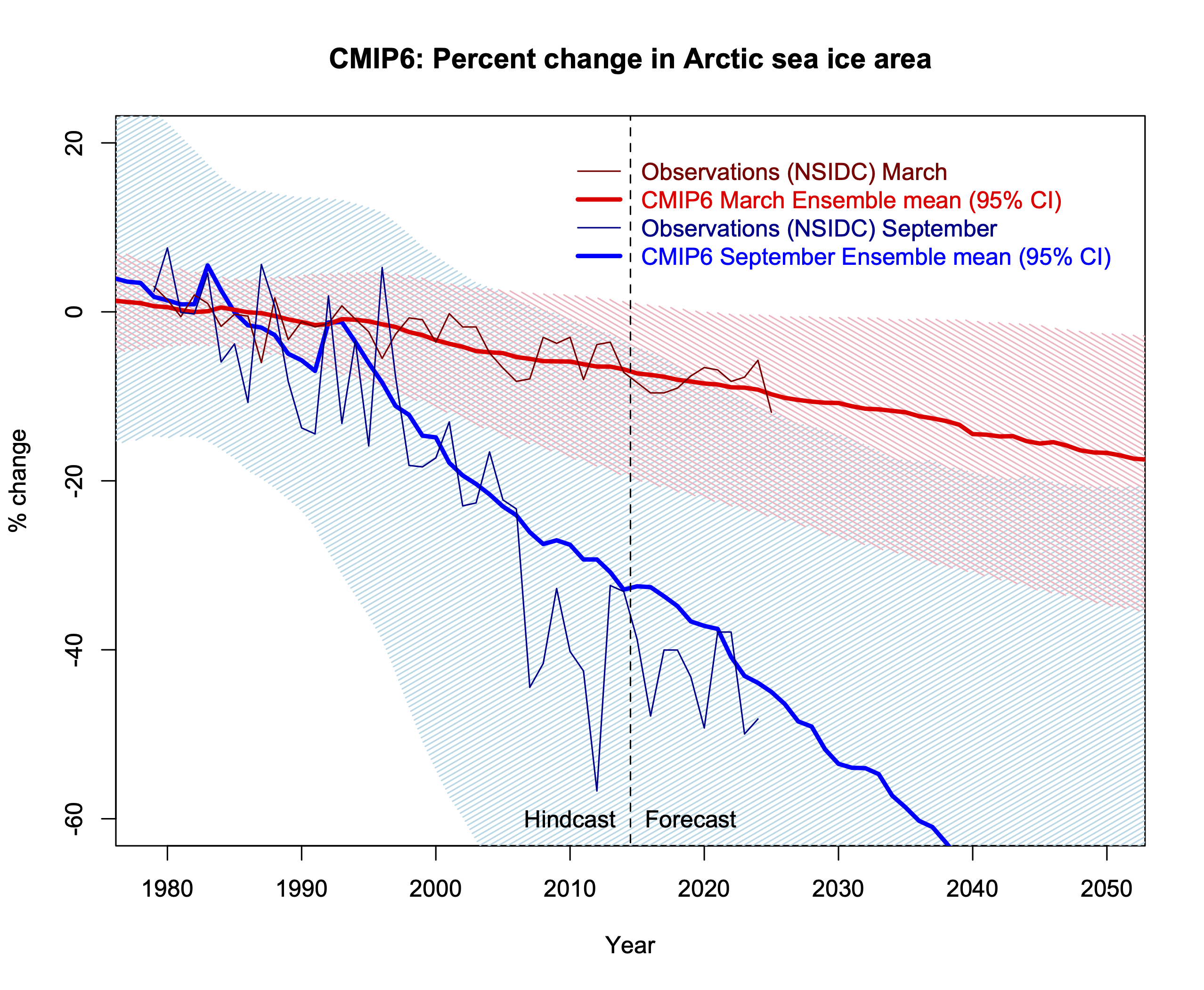
While I admire his honest summary I struggle to see the point of Schmidt´s post as CMIP6 models still seem very incapable to provide any useful information about arctic sea ice trends.
Laws:
[Thanks Kennedy Maize for the link, and the article.as well ]
Yes, the Schmidt link was well worth reviewing.
My take on Schmidt’s CMIP6 graph that you graciously included:
Note the utter lack of any significant variation in ice loss, either summer or winter compared to
actual observations. The models all (including CMIP 3 & 5) show relentless declines.
CMIP6 completely misses the relative leveling-off beginning ~2008, yet Schmidt thinks they understand the physics better. I am unconvinced.
[btw: how did you attach the graph to your post? The old graphic icon seems to be missing]
Hmm apparently I am not clear enough.. for the evaluation of these models not the line in the middle, but the uncertainty cloud matters!
Like I wrote they predict is a possible doubling or halving of this year´s September arctic sea ice extent over the next decade or so with 95% certainty, which seems the definition of useless to me.
Your slowdown is certainly included in the models prediction as everything else is too!.
BTW any time a charlatan writes
“” I haven’t screened the CMIP6 models by climate sensitivity (as I’ve done for the temperatures). These choices might make small differences, but not effect the main conclusions.””
be very alarmed!
To post the image I just went to the RC page copied the image link and pasted it here.
But you are correct that I really like how this feature works here!
Coastal sea-level rise from AGW is a nothingburger. It’s so slow & slight that in many places the “global” (average) sea-level trend is dwarfed by local factors like isostatic rebound, erosion, and sedimentation.
Greta Thunberg’s hometown of Stockholm is one such place. Sea-level is FALLING there, because the land is rising faster than the ocean:
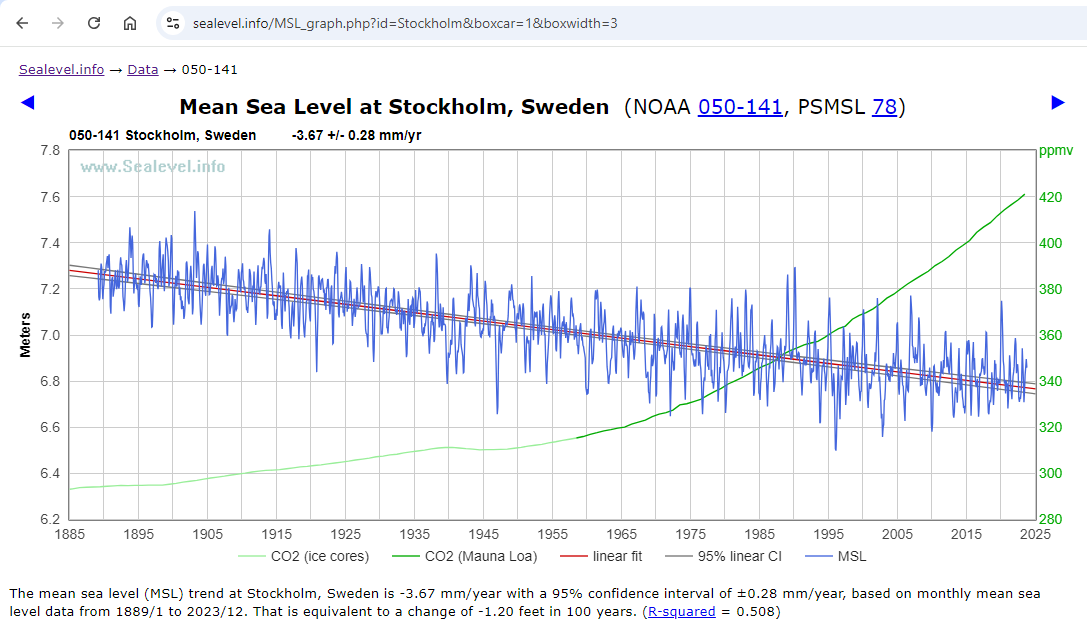
https://sealevel.info/MSL_graph.php?id=stockholm
There’s no risk manmade climate change could cause worrisome sea-level rise. Stockholm’s sea-level trend is atypical, but Harlingen’s is about average:
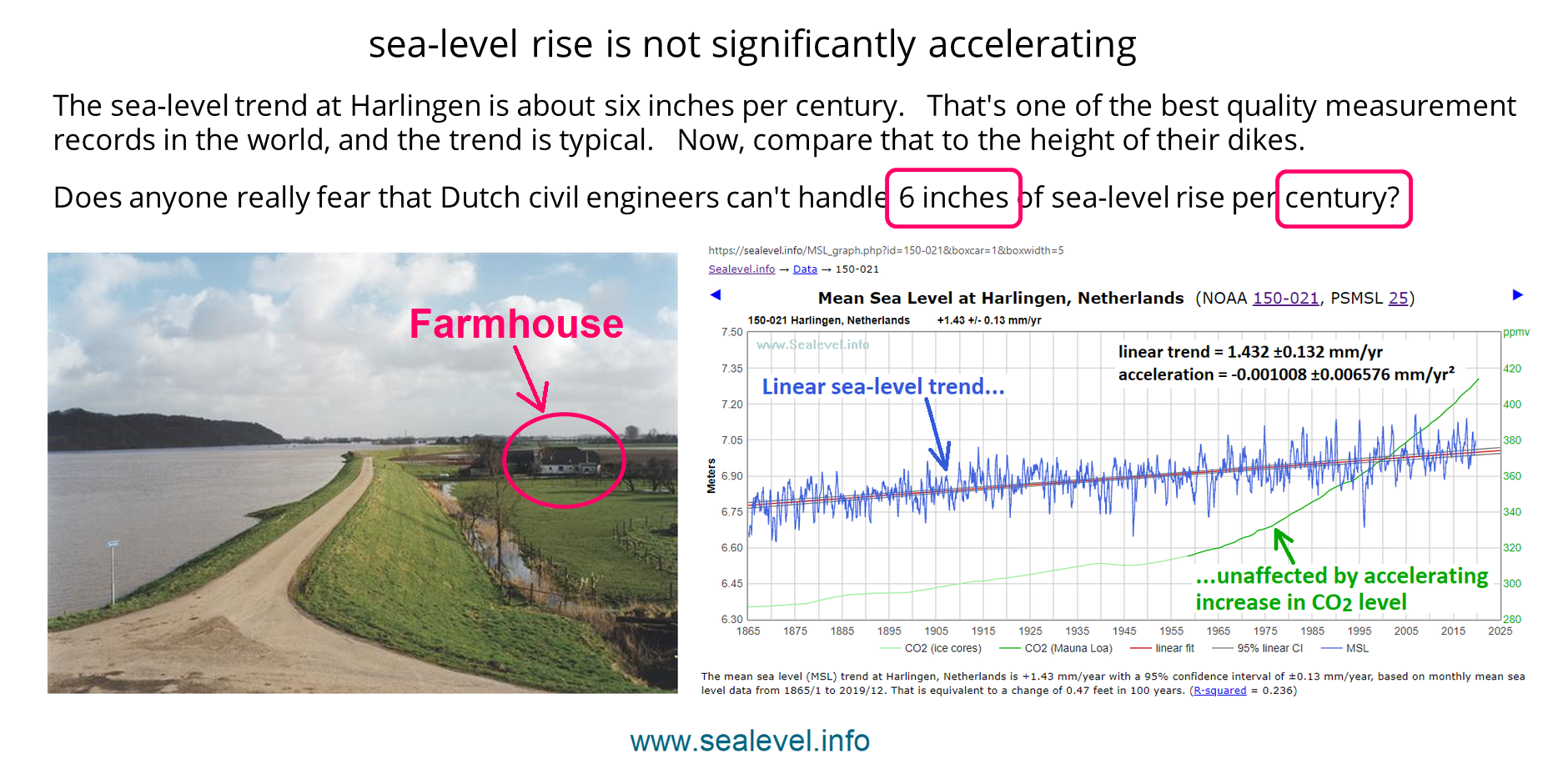
https://sealevel.info/MSL_graph.php?id=150-021&boxcar=1&boxwidth=5
The best-sited long measurement record is from Honolulu:
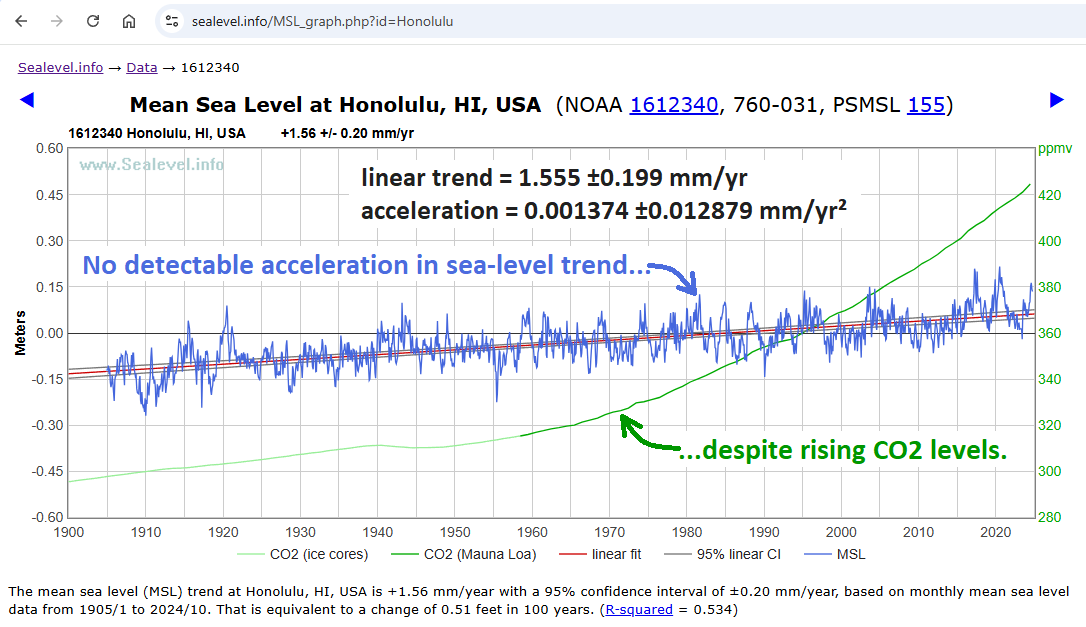
https://sealevel.info/MSL_graph.php?id=Honolulu
The modest warming trend over the last 50 years hasn’t caused worrisome sea-level rise acceleration. Some careful studies have detected a very small acceleration, typically about 0.01 mm/yr², but that’s so slight that it’s of no practical significance. That much acceleration, were it to persist for 150 years, would add just 4.4 inches to coastal sea-levels (in addition to the current linear trend, which varies with location, but averages about +6 inches per century). In many places there’s no detectable acceleration at all.
Nor is there a realistic chance sea-level rise could greatly accelerate, due to AGW. Antarctica averages more than 40° below zero, so a degree or few of warming won’t melt it. It’s sublimation, iceberg calving, and a bit of submarine melting (where ice is grounded below sealevel) that reduce ice mass, and snow accumulation that increases it.
Some studies report that Antarctica is gaining ice, others that it’s losing ice, but the rates of gain or loss in all cases are tiny. There’s some year-to-year variation in ice mass fluxes, but the net flux averages approximately zero. The best study to date is still this one by Jay Zwally and his team at NASA:
Zwally, et al. (2021). Mass balance of the Antarctic ice sheet 1992–2016: reconciling results from GRACE gravimetry with ICESat, ERS1/2 and Envisat altimetry. J. Glaciology, 67(263), 533–559.
They reported that Antarctica’s ice mass trend is −12 ±64 Gt/yr. That’s basically zero, because the confidence interval straddles zero. But even if the CI were ±0 it wouldn’t matter, because 12 Gt/year is equivalent to only 0.1 inch of sea-level per century.
Greenland is different. It’s losing ice most years, but at a glacially slow pace: only about 200 to 250 Gt/year, depending on whose study you trust, and it’s not detectably accelerating. At that rate, to lose the entire Greenland Ice sheet would take 100 to 150…
…you thought I was going to say “years,” didn’t you?
No, not years.
Not decades, either.
Centuries. 100-150 centuries!
200 – 250 Gt sounds like a lot, but it’s actually negligible for most purposes. It takes 9190 Gt of meltwater to raise global sea-level by 1 inch. (9180 / 225) = 41 years.
What’s more, we know that during the MWP Greenland was substantially warmer than it is now, because Norse settlers grew barley there; the growing season is too short for that, now. They also buried their dead in soil that is now permafrost. Yet despite those warmer temperatures, there was not enough ice loss from the Greenland Ice Sheet to notably affect sea-levels elsewhere in the world.
Some people worry that meltwater from Greenland could affect climate by slowing the AMOC (thermohaline circulation). But that would require an implausibly huge acceleration in meltwater production from Greenland. What’s more, if Greenland ice loss were to accelerate enough to cause AMOC slowdown, that would cause Greenland to cool, reducing its ice loss: a negative (stabilizing) feedback.
A point of terminology clarification:
“Ice sheets” and glaciers are “grounded” ice. Their weight is supported by land, and when they melt the meltwater adds to global ocean volume, and contributes to sea-level rise.
But “ice shelves” and “sea ice” are floating ice. They already displace their mass in the oceans, so when they melt there’s no effect on sea-level (except, locally & negligibly, by very slightly affecting salinity).
There’s also an in-between case. Some ice sheets are “grounded below sea-level.” They rest on land, but below sea-level, so they’re effectively “partly floating,” and if they were to melt the meltwater would have a reduced effect on sea-level.
Sea ice coverage also has a small indirect effect on sea-level. Sea ice impedes evaporation, so a decrease in sea ice coverage causes increased lake-ocean-effect snowfall (LOES) downwind. When the snow falls in ice sheets and glaciers, it sequesters water from the ocean, reducing sea-level.
Kennedy Maize, I am surprised that in an article about sea level rise, you did not cite coastal “tide” gauge data that shows beyond any question, that sea level rise has been slow, constant and unchanging since at least 1850. Shouldn’t that be enough to settle the question of ice melt affecting sea level?
Tony Heller has been saying this for many years.
But we have satellites now, and they are way cool, so we trust those data.
G. Schmidt: “model-observation discrepancies can arise from three causes: the observations could be wrong (unrealized biases etc.)”= garbage in garbage out …sadly this is oh so common with the reams of “technician phds” who spend countless hours at their workstations plugging homogenized datasets into their climate model playstations. “Unrealized” is “unrealistic” understanding of real world complexity by modellers who have likely never either collected or built an observational dataset. The computer nerds who never do anything outdoors stayed indoors and used their computers to create an imagined outdoor scenario.
Note that he questions observations first.
This research team can resolve 10 um (micrometers) in sea level data.
Absolutely amazing.
Another indication of not knowing how to create an uncertainty budget that includes resolution. Plus not knowing how to handle significant figures. As someone above mentioned, tech guru’s sitting in front of a screen plugging in “data” without any concern other than how accurately the program handles calculations.
The cackling climate caterwaulers have always had this crazy notion that the reason things aren’t heating up even faster than the tarmac-biased temperature sensors apparently show is that “the heat” is doing a deep dive into the oceans, where it can’t be detected, but the dangerously rising sea levels and collapsing ice sheets are giving the secret away.
Models are tools.
Tools can be used for constructive or destructive purposes.
Right.. but you need the right tools for the job, a sledgehammer is simple useless for your fine clockwork!
Schmidt´s models predict is a possible doubling or halving of this year´s September arctic sea ice extent over the next decade or so with 95% certainty,
Bad AI generated imagery in the lead in photo. How exactly would sea level rise move the Mediterranean sea to the Central US?
Please wake me up when the Maldives are under water. Before that i have several grains of salt to put on various places..
Shouldn’t that be “West?”
Originally attributed to Mark Twain.