From NOT A LOT OF PEOPLE KNOW THAT
By Paul Homewood
I am becoming increasingly impressed by Kathryn Porter. This latest interview covers a lot of ground:
Autogenerated and formatted transcript.
Lee Hall: Welcome to British Thought Leaders. I’m Lee Hall. Today, I’m sitting down with independent energy consultant Katherine Porter. Katherine, welcome to the show.
Katherine Porter: Thank you.
Lee Hall: So, we’re here to talk about blackouts, the loss of electricity supply to the public en masse. How close have we been to blackouts, and how likely are they going forwards?
Katherine Porter: Well, obviously, there was a very serious blackout in Iberia last week when the entire Iberian Peninsula and part of Spain, as part of France, sorry, lost power fully. Now, the electricity in France was restored relatively quickly, but it was many hours before it was restored in Spain and Portugal, and unfortunately, at least seven people lost their lives during that blackout. So, these are very serious incidents. We had a near miss in January for different reasons. I think the issue in Spain was almost certainly a grid fault that they weren’t able to recover from because they’re operating the grid in what we call low inertia, which means our power grids are based on alternating current, but renewables like wind and solar deliver their electricity to the grid as direct current. That has to be converted to alternating current using electronics, and this creates weaknesses in the grid. It is fundamentally not the way the grid was designed, and it makes it much harder for the grid to withstand a fault.
So, on a conventional grid with lots of conventional generation, because they’re big spinning machines, they really resist changes to their mode of operation. That acts as a brake on changes in the grid when there’s a fault. And so, that’s really why that blackout that affected Iberia didn’t spread through France, because the French grid is very strong. It’s based on nuclear and hydro, so conventional generation using big, heavy turbines. In Iberia, there’s a lot of wind and solar, and really, the grid was too weak to withstand that initial fault, causing the cascading blackout.
The problem that we had in Britain on the 8th of January was we nearly just ran out of electricity. We didn’t have enough available generation to meet demand. So, fundamentally, those are the two ways that you can have a blackout: it’s either a fault that the grid can’t overcome, or you haven’t got enough electricity to meet demand, and you don’t respond to that fast enough. Because the way you’d have to react to that is basically to turn off some demand, so have maybe regional blackouts to preserve the grid as a whole. But if you don’t do it quickly enough, then you could have a whole country blackout, and we came pretty close in January.
Lee Hall: So, I know you’ve been warning about this for a while. How likely are blackouts going forwards, would you say?
Katherine Porter: So, I think since the 8th of January, we’ve seen the authorities here in Britain taking steps to avoid that. They’re doing that in a variety of different ways. They’ve started to audit the way they forecast demand because one of the problems that day was they underestimated demand. And so, obviously, if you don’t anticipate the demand you’re going to get, you can’t make sure you have enough generation available. We’ve seen an extension for the subsidies for the biomass plants, Drax and Lynmouth, which otherwise would have closed in 2027, so they’re now going to stay open for longer. We’ve seen the old nuclear reactors having their lives extended. So, all of these steps are really being taken to make sure that we don’t run out of generating capacity.
Unfortunately, our gas-generating fleet is really old, and quite a lot of those units are going to close in the next five years. It’s something you don’t have visibility on because, really, there’s no reason for them to tell the market until they’re doing it. But if you look at the ages of these turbines, they’re getting to end of life. And so, as they start to retire, we’re going to have this increasing problem of lack of generating capacity. And it’s obviously particularly crucial when you have low wind days in the winter because, in the winter, your peak of demand happens at nighttime, so you have no solar contribution at all. And if you don’t have any wind either, you’re fully reliant on conventional energy sources and your interconnectors.
And the problem on the 8th of January was interconnector availability was very low because a lot of them were doing maintenance work that carried over from December. To me, it seems bizarre to do maintenance at that time of year. NISO had it in its winter plan but clearly didn’t really plan for it. And, of course, the more countries that are following a wind-led transition strategy, which is the case with many of the countries that we’re connected to, they might all have shortages at the same time we do. So, you can’t guarantee that those interconnectors will deliver when you need them to. So, it is quite a serious situation.
Lee Hall: So, we get some of our electricity from other countries through these interconnectors, but we can’t necessarily rely on them. We can’t demand it if we want it?
Katherine Porter: No, and so normally, they’re based on short-term price differentials. So, electricity goes from the lower-priced market to the higher-priced market. And obviously, if you have a shortage in both markets, then both markets will see their prices rising, and you could potentially end up with a bidding war between the two countries, at which point it’s likely that the system operators would just step in and turn off the interconnector altogether because the political fallout of having a bidding war would just be too big. And, of course, if one country ends up exporting and then they have a major blackout, then that you just couldn’t really deal with the public scandal that that would create.
The other problem we have is that we have quite a lot of interconnection with France, but the French system is dominated by nuclear. But those nuclear reactors are also getting old. Twice in six years, they had to take large parts of the fleet offline to test for and rectify systemic problems within the reactors. Most recently, it was due to an aging issue, and the regulator there has said that the risk of that happening again is high because, as the fleet ages, and they only have maybe half a dozen different reactor technologies, if you find an age-related flaw in one reactor, then you have to test all of the reactors of that class to make sure they don’t share the same flaw, which they’re likely to, given the same technology and have experienced the same aging process. And when that’s happened in France, when they’ve had their reactors offline, they suddenly became massive importers of electricity rather than exporters. They also tend to import in cold weather because they have more electric heating than we do, so their demand goes up faster in cold weather.
And then the other country is Norway, but Norway has twice amended its Energy Act to restrict exports, and it’s become such a hot-button political issue. This is something that people in the streets have an opinion about. If you went and stopped a Norwegian on the streets of Oslo and said, “What do you think about electricity interconnectors?” they would have a very negative, hostile view because they see that the interconnectors with Britain and Germany have brought a lot of price volatility into the Norwegian market that they feel they’re not really compensated for. And the Norwegian government is subsidizing end consumers to 90% of their bills because of the impact of this cross-border trading on their domestic prices. So, they have parliamentary elections coming up in September, and the frontrunners for that election are saying they want to renegotiate the interconnector deals that they have with Britain and Germany. And I would imagine that if those renegotiations are unsuccessful, they’ll just simply apply an export tariff onto that electricity to reduce the amount of time that you have a favorable price differential for us to import. So, you’re starting to see these headwinds, if you like, around the whole interconnection question.
Lee Hall: So, I want to just go back to something you said about the Iberian blackouts and there was loss of life, which I found surprising. Can you talk us through what the dangers are when a blackout happens? It’s obviously not just you can’t charge your phone, but there’s a lot more to it than that.
Katherine Porter: Yes, I mean, I’ve always said that I felt there would be a risk of death with blackouts, and I’ve always had the sense that people thought I was being a bit dramatic. But seven people are known to have died: one person in Portugal, and I don’t know what the cause of that was, but the six people in Spain, one person died in a house fire relating to the use of candles, and the other five people, it was to do with medical equipment, so specifically ventilators that would help people breathe. In two instances, the generators that were supposed to power these ventilators in the event of a blackout failed, and in the other instance, the generator was giving off carbon monoxide, so both the person using the ventilator and two of their relatives that they lived with all suffocated, unfortunately.
So, to have seen a death toll in what you might say was sort of benign environmental conditions, because it’s spring, it’s not cold, it’s not getting dark early, if you think about a blackout in Britain in the winter, you know, five o’clock on a December evening in London, when you have no street lights, no traffic lights, no ambient light from buildings, none of the illuminated bollards in the road would be illuminated, so you’d just have car headlights and hopefully some police directing traffic. But you’d have old people falling over in the home, you’ve got schoolchildren coming home from school still at that time of the day. And what we saw in Iberia was they had a lot of people trapped in lifts, a lot of people stuck on trains and things, so we’d have people stuck in the Underground, stuck in lifts. And anybody with a medical vulnerability in that scenario, you know, if they’re stuck in a lift on a cold day, and there’s no heating, no light, and they’re there for 12 hours, that’s not a very good scenario. So, probably much more dangerous in a winter blackout than summer, correct?
Lee Hall: Yeah.
Katherine Porter: So, I was somewhat surprised to see fatalities in a spring-summer blackout, but obviously, one of the big differences between now and the ‘70s, because people always say, “No, in the ‘70s, we had rolling blackouts, we all coped well,” our lives were very less technologically driven in the ‘70s, and you didn’t have people with home ventilators keeping them alive in their homes the way you do now. So, yes, I mean, it might be annoying you can’t charge your phone and so on, it’s significantly more annoying if you can’t power your ventilator that is the thing that’s keeping you alive. So, yeah, I mean, I think it’s a very different scenario, and just because we used to be okay with blackouts doesn’t mean it’s fine now. And also, if you’re having rolling blackouts, you know they’re going to happen, and you can plan for them. It’s the unplanned blackouts that are particularly dangerous because nobody sees them coming, and so you haven’t necessarily tested your generators to make sure they’re working properly.
Lee Hall: So, we have this organization, NISO, National Energy Supply System Operator. What are they responsible for, making sure the supply meets the demand?
Katherine Porter: Yes, what should the government be asking them to kind of mitigate the risk of all of this? So, they have this statutory duty to both hold a certain amount of reserve, which is supposed to be equivalent to the single largest infeed loss, so the biggest source of generation or import onto the grid, which currently, we’ve got two interconnectors, both 1.4 gigawatt, so they’re the two biggest. They have to hold reserve for the loss of one of those, so if the single biggest contributor to your electricity production, if you like, disappears suddenly, you have to have the ability to ride that through.
And then they have another duty around what we call the system frequency. So, because the grid is alternating current, the way the current and voltage alternate is in a regular pattern, or it’s supposed to be a regular pattern, and it’s a sine wave, and the sine wave has a rate of change, if you like, the frequency. Electrical equipment is extremely sensitive to this frequency measure, so if it goes outside certain parameters, protection measures will activate, and things will disconnect themselves, which is what happened in Iberia. The fault occurred, this created a disturbance to the grid frequency, and then it went beyond the operational tolerance of all sorts of equipment around the grid, so generators, transformers, factories, all sorts of things, their protection systems are activated, and they just disconnected themselves from the grid. Now, obviously, when you’ve got generation doing that, that amplifies the disturbance, so if you lose generation, typically the frequency starts to fall, and then the next generators along go, “Oh no, the frequency is too low, we’re going to disconnect,” and that makes it fall even more, and you get this cascading effect.
So, NISO has to do two things: maintain this reserve and maintain the frequency in its operational bounds. It’s a plus or minus 1% around 50 Hz, which is the statutory duty. And then, to achieve that, it has to procure all sorts of different services from the market. So, there’s some batteries that respond really quickly to changes but only for a short amount of time, and then you have pumped hydro that you can activate within 16 seconds. So, Dinorwig, which is a really big pumped hydro in Wales, they can go from cold to full load in 16 seconds. That’s 1.8 gigawatt in total across six turbines. And then that gives time, that can run for about five hours at full load, and then you can have, that’s enough time to bring up your gas power station. So, a combined cycle gas turbine can go from cold to full load in about half an hour.
So, they have all these stages to go through, but that obviously relies on you having enough power stations in the first place. And the government deals with that through the capacity market, so they have auctions every year for the following winter and also four winters ahead. So, the following winter is really targeted at existing assets, and the four winters ahead is incentivizing new assets to come onto the grid, and essentially, they get a financial incentive to get built, fundamentally. But, in my opinion, we’ve not been procuring enough, and we haven’t been sufficiently mindful of the likely retirement schedule. And now we’re seeing quite long lead times for the delivery of all sorts of electrical equipment. You’re looking at four to five years to deliver new gas turbines, it’s about two to four years for transformers, it’s four years for super transformers.
So, I don’t think that they’re really planning for that in a sufficiently robust way. So, even if we decide something now, it’s four years just to buy the kit. And this is why the whole Clean Power 2030 plan is just a fantasy. NISO has said that it relies on us building twice as much grid infrastructure in the next five years that we built in the previous ten, but it’s just not achievable because nobody is ordering a super transformer unless they have planning permission. And if it’s four years to get the thing delivered, and it’s five years between now and 2030, that doesn’t leave a lot of time for the planning process and then the installation process once it turns up. So, I just can’t see it, to be honest. It just seems completely not feasible to me.
Lee Hall: So, there was this summit recently, and the International Energy Agency said the premature retirement of less volatile sources of energy is a threat to energy security. So, is that basically what you’re talking about here? How does that map onto us?
Katherine Porter: Yeah, so we closed all our coal power stations, and some of them could have stayed open. And I think that was a big mistake because the UK is responsible for 0.8% of global carbon dioxide emissions, so less than 1%. So, a few coal power stations, even if they ran all the time, which they are unlikely to, are not really moving the dial on climate change, but they could be the difference between a blackout and not a blackout. And I always come back to this point about why do people care about climate change. I know there are some people who care about it for its own sake, but most people worry about it because they think it’ll have a harmful impact on people’s lives and livelihoods. So, it’s quite perverse to enact strategies that are very likely to cause harm to lives and livelihoods in the effort to prevent harm to lives and livelihoods. So, if you cause blackouts to happen because you prematurely closed your coal power stations, and people die in those blackouts, well, that’s not better than people dying from climate change.
So, I think we need to be a lot more mindful of the risks and to be cognizant that these choices could be putting people’s lives at risk. And for what, really? You know, it’s not, as I said, going to make the difference between life and death in a climate change context. And in Germany, they closed their nuclear power stations prematurely, and that was a really ridiculous choice because then they had to burn more gas and coal. And their coal is brown coal, which has a lower calorific value and much higher emissions and higher particulate pollution, which is even worse because that’s immediately damaging to people’s health. So, these ideologically driven choices aren’t really that smart in the scheme of things.
Lee Hall: So, you mentioned the Clean Power 2030 plan. What is the main thrust of the plan, and what do you think are the main challenges that we’ll encounter?
Katherine Porter: So, the idea of Clean Power 2030 is that the electricity system is effectively 95% zero-carbon generation, so gas, unabated gas, would only run to meet, on average, 5% of demand per year. The challenges for this are, first of all, you’ve got to build a huge amount more renewable capacity, which we’re already behind schedule. Today announced the cancellation of the Hornsea 4, which I think was 2.4 gigawatt, and that had a contract under the subsidy scheme, the Contracts for Difference, in Round Six. My personal view is they’ll be back for Round Seven. I think they’ve canceled it because they think Round Seven is going to be more lucrative for them. It’s like a stick-or-twist kind of thing.
Lee Hall: Well, it is, yeah.
Katherine Porter: And the developers have been playing all these types of games really from the beginning, so I wouldn’t be surprised to see that come back, but obviously, that pushes it back in terms of its delivery. So, it’s going to be very expensive to try and deliver the amount of renewables that Ed Miliband wants to bring in. The only way you can really do it is by throwing an awful lot of money at the problem. So, you could potentially get it built. I have strong doubts that you can get it built, but it is one of the few things you can try and influence by throwing money at it.
But the next problem is, can you use the electricity these things are generating? Our whole approach to connecting renewables has been called “connect and manage,” so the priority has been just to hook them up to the grid. Much less thinking has gone into, well, once it’s connected to the grid, can you actually move that electricity to where the consumers are? And the best example of this difficulty is with the Seagreen wind farm that opened in October 2023. In 2024, it was turned off twice as much as it ran because the electricity couldn’t be moved to consumers. So, National Grid had to instruct a gas power station to turn up downstream of the grid constraint, and then they had to tell Seagreen to turn down. But because it has a Contracts for Difference, and because they only get paid under the Contracts for Difference if they’re generating, if you tell them to turn off when they could be generating, you have to pay them, you have to compensate them for that subsidy payment that they didn’t receive. So, you pay them to be turned off.
So, the consumer then pays twice for that electricity. They pay for the electricity that they actually use, which is generated by the gas power station, and they pay for this totally spurious wind farm to just sit there doing nothing, but you have to pay them. And last year, we spent a billion pounds on these curtailment costs, and NISO forecasts that’s going to increase by, you know, like eight times or something to 2030. So, that’s the second problem: you can’t bring the electricity from these wind farms to where you need them. And the easiest sites, the easiest locations for all these wind farms to be built, have already been used, so this problem is only getting bigger.
And so, then they’re trying to build more grid capacity, but obviously, that costs money, so that’s adding significant cost onto consumers’ bills, which means that there’s no money left to upgrade the legacy infrastructure. So, we saw a few weeks ago a major substation fire in West London, which took out Heathrow Airport and 60,000 homes. And Heathrow was out of action for basically a day. Now, Heathrow has some questions to answer about its own internal resilience, but the issue with the substation was you had 1960s transformers in this substation, so they are end-of-life transformers, and they were being run at higher than their rated capacity. I mean, this had been identified a few years earlier. People had said there are concerns within this part of the grid that this particular substation is running at 106% of capacity. And not only that, so you had three transformers in this substation: there’s one, then there was a gap, and then there were two next to each other, and the middle one exploded, and the adjacent one suffered heat damage because there was no blast wall between them.
So, best practice is to put blast walls between them for exactly that reason, so if one blows up or suffers damage or whatever, you don’t have a contagion issue, but they didn’t have that. So, two transformers now need replacing instead of just one. And this is not by any means unique. Our legacy infrastructure, and not just in Britain, across the developed world, our legacy grid is end of life, and it hasn’t been refreshed and renewed at the pace it needs to. So, at the same time that we’re trying to do this energy transition, where we’re putting generation that generates direct current onto an alternating current grid, so it’s a square peg into a round hole, we’re trying to do it with old kit. So, it’s not just that it wasn’t designed to do that, it’s struggling to do what it was designed to do because it’s getting old.
And then we’re building all this other new infrastructure because wind farms are not built where there’s existing infrastructure because we didn’t have a grid offshore, for example. And so, the whole grid piece around Clean Power 2030 is a huge challenge. It’s almost impossible for them to manage this challenge because of things like supply chain constraints, and the cost to the consumer of that is going to be significant because we’re going to end up building a lot of renewable generation that we can’t use. And then you have the other issue, which is around the stability question. We’re going to have to restrict the use of renewables also to protect the safety of the grid so that you can withstand faults and not have countrywide blackouts in the event of a fault.
So, all of the sort of day-to-day behind-the-scenes holding of reserve and managing this inertia property that I was talking about, that will all have to be beefed up, and that’s going to cost money.
Lee Hall: So, you mentioned cost several times. We also had Ofgem saying they need hundreds of billions of pounds to run a clean energy system and decarbonize the economy. I mean, that’s a lot of money, and it seems it’s going to come from upping people’s bills even more, even though we’re paying pretty much the highest bills in the world, it seems. What can you talk to a bit about the financial impact this is having on ordinary people?
Katherine Porter: Okay, well, I want to start with busting this myth that renewables are cheap. Renewables are the most expensive form of energy on the British grid, and the reason for this is you have to look at the full system cost, so the impact on the consumer bill. And a lot of people, they say renewables are cheap because the short-run marginal operating cost, so that immediate cost of whether you’re going to turn on in the moment, that’s next to nothing because the wind is free, well, when it’s windy. So, it doesn’t cost you anything to turn on your wind turbine, but it cost you a huge amount of money to build it in the first place. So, the fact that wind and sun don’t cost anything in the moment is really irrelevant in terms of what people have to pay to have electricity generated from the wind and the sun.
So, you have to subsidize them. They don’t get built without subsidies, and the subsidies are going up. The most recent subsidy round, AR6, the price for that, so they always quote the prices in 2012 money, so they look cheap, it was like £54 or something for offshore wind, but that was £83 in today’s money. Now, the today’s market price is actually £82, and the average price through the year is slightly below the £83. So, it’s actually, this just, the subsidy is the same or higher than the market price, and it’s going up. You know, we’re hearing, because of supply chain costs and various other things, that they’re going to need more money in the next subsidy round. So, the subsidy cost is high.
Then, you have, they’re weather-related, so they don’t work all the time. Solar power doesn’t work at all at night, and winter has a lot of night, and obviously, our highest demand is in the winter because then it’s colder, and because it’s dark, people need their lights on more. And the capacity factor of wind is about 35%, so that’s roughly saying it works a third of the time. So, then you’ve got to have other stuff to come on when it’s not windy and sunny. We can’t store it. Guess what? You’ve got to pay for that. So, well, even if you’re going to store it, you still have to pay for the storage, right? So, you basically, you have to procure an entire separate system to function when it’s not windy and sunny. And we can have days of next-to-zero contribution. So, we have, we’ve had times, at the moment, we’ve got about 30 gigawatts of wind installed, but we have had many instances in the last few months of going below one gigawatt, so that’s effectively nothing.
And then, if that coincides at nighttime or evening in the winter peak demand, and there’s obviously no solar, so functionally no renewables, so you need an entire separate system of generation to operate when it’s not windy and sunny. So, obviously, that’s going to make it expensive as well. So, now you’ve got your subsidies, and you’ve got your backup cost. Now, wind and sun are very variable in real time. You know, gusts of wind, clouds, they affect the output moment to moment. Now, when I was talking about that frequency property of the grid, that is impacted by these variations, so it makes it more expensive to keep the grid stable with all those variations going on. So, that’s adding a couple of billion pounds a year to bills as well.
So, okay, so now you’ve got your subsidies, you’ve got your backup, you’ve got managing the real-time intermittency. The next thing is you’ve got to connect all of these things to the grid. Now, renewables have really low energy density. If I wanted to build an 800-megawatt gas plant, which is kind of a decent size gas power station, you need one grid connection. An equivalent-sized wind farm would be about 60 turbines, but of course, with the 60 turbines only working a third of the time, to have an equivalent annual output, you’d need 180 turbines. So, approximately 200 times more wires required for your wind farm than for your gas plant. That all has to go onto bills.
And then, because you’re building these things in places where you don’t have existing infrastructure, and you have bottlenecks in the grid, like the whole issue with the Seagreen wind farm I was talking about, you then need to upgrade and build new power lines for that. So, that’s also billions of pounds a year that also gets added onto bills. And then, the cost of turning off the wind farms when we can’t use them, you know, another billion pounds a year onto bills. So, by having renewables, you have to pay for all of those different components, and that is extremely expensive, far more expensive than even if we went to nuclear.
People think nuclear is the most expensive. It’s actually not because when you factor in all of these different costs, nuclear has very high availability, it has extremely high energy density, you get an awful lot of electricity from a very small site with a relatively small grid connection, and you have no issues with intermittency, you don’t need any kind of a backup, and it just runs and runs and runs. They have really high reliability. So, it’s the most expensive way to generate your electricity, and the reason we have the highest electricity prices is because we put all of these costs through the bill. We don’t recover any of it through taxation.
So, other countries, they will have different regimes where some of the money will get recovered through taxes. That obviously has a reducing impact on bills. Some of those subsidies and costs don’t exist at all. We have carbon taxes that don’t exist in other countries, and they get added onto bills. You know, everything just gets added onto bills. So, although they’re called a carbon tax, they’re kind of paid through bills. So, the impact on consumers is significant. They are being basically sold a fairy tale about renewables making their bills cheaper. They are not going to make their bills cheaper. They’re going to make them more expensive.
You might potentially lower your bills if you install your own solar panels, although obviously, you’ve got to find the money to buy them in the first place. But you’re never going to see lower bills through renewables on the grid, ever. And it’s just, it’s just a fantasy. So, when they say they’re going to reduce bills by £300 to 2030, no. And actually, the report by the consulting firm Ember that was the origin of the £300, they were using an old price cap figure based on a higher gas price related to the Ukraine crisis. Gas prices have fallen significantly since then, so actually, you did see a £300 reduction in bills when that gas price reduced, but you’re not going to see another £300 reduction. That was just an artificial artifact, and people forget that gas was incredibly cheap for 20 years before the Ukraine crisis happened.
So, I’ve written a report that’s going to be published in a couple of weeks’ time on the full costs of net zero, and in that report, I have some findings around a cost analysis, and essentially, in 2025 money, we have spent almost £220 billion since 2006 on decarbonization and seen zero financial benefit, really. Yeah, so had we just stayed with gas, even with the high cost of 2022 when we had the whole Ukraine situation, we would still have been £220 billion better off if we had not built any renewables.
Lee Hall: So, all these things you’re saying about renewables, not as effective, not as easy to install, more expensive, why is the government pushing ahead with it, in your opinion?
Katherine Porter: So, it’s extremely difficult to answer that question because I don’t like to think that anybody’s corrupt or dishonest, but they are just really tied to an ideology that renewables are the way forward. And Ed Miliband talks about the climate emergency, CO2 will cost more, but the trouble is, because the result of our high energy costs is that manufacturing is getting offshored, primarily to China, where their energy is dirtier, and then you’ve got to ship the stuff back to the UK, which obviously incurs emissions from shipping. So, this is a very incoherent policy because, in our effort to reduce UK production territorial emissions, we’re just simply moving those emissions somewhere else and actually increasing them. So, global emissions are going up as a result of our net zero policy. So, this is not a coherent strategy.
So, why are they following this strategy? Now, part of the problem is that, unfortunately, this Labour government does not listen. They don’t engage with anybody within the energy sector that doesn’t share their ideology around wind and solar. And you saw, just a few days ago, Mary Archer being removed from one of DESNZ’s boards, and she was one of the people who was having more of a tempering voice. They just don’t want to hear it. Now, why do they not want to hear it? This is a question that none of us can answer because they won’t talk to us. But the results and the evidence all indicate that costs are going up, that they’re not going to come down, and common sense tells you that with offshoring, global emissions are going up. So, then why are they insisting on carrying on with this approach? I don’t know. I can’t answer that question. I wish they would tell us. I wish they would explain their logic, if they have one, as to why they think this is the right approach, but they’re not doing that. They’re just continuing to repeat these false statements about renewables being cheap, and they’re not, and that there’s a climate emergency we need to address. Well, our policy is making that worse, so how are we addressing it? How is what we’re doing in any way useful in that context? These are not coherent strategies that contain an internal logic, and they are not answering those questions.
Lee Hall: We’re even seeing Tony Blair question the government’s net zero plans. Where do you see things going? Do you think the net zero thing could kind of implode on itself?
Katherine Porter: Yes, absolutely. And I think Nigel Farage is right to draw parallels with Brexit here. I think net zero, in common with EU membership, was something that was done to the British people by political elites that didn’t really have a mandate to do it. And I’m not here to debate the rights and wrongs of Brexit, I’m just saying that there was never really an electoral option for people to express an opinion on Brexit because all of the main parties shared the same approach to EU membership. And yes, then you had UKIP come along, but that was not really a viable option in terms of voting for a government that was going to change that. And net zero is the same. There’s never been any sort of voter mandate for net zero. It was, again, all of the political parties shared the same approach, which was, “Oh, we’re going to do net zero.” There was, what, 12 minutes of debate when the net zero target was agreed?
So, now you’re starting to see some difference. Obviously, Reform is against it. The Conservatives have now repudiated net zero 2050 as a target. And that actually is providing a choice for voters. But I think the Uxbridge by-election, for example, was quite instructive, and I think that was really what started to wake the Conservatives up to the problem. The Uxbridge by-election results very much reflected public dissatisfaction with the emissions charging scheme in London. So, and then you see that, you know, things like the EV mandate and the boiler mandate are all pretty unpopular. You’ve pretty much reached the saturation point of willingness to accept smart meters. And people are not making the choices that they would need to make to progress net zero, and that pushback is making a difference to the choices of the government.
Well, it is. I mean, even with Labour, you’re seeing some softening there. But it’s interesting because then people say, “Oh, well, the polls suggest that the public is really keen for the government to act on climate change.” But this all very much depends on what questions you ask because other polls have shown, yes, the public wants the government to act on climate change, but no, they’re not willing to pay for it, or they’re willing to pay £10 a year more than they would otherwise, or some ridiculously low amount that will never achieve anything. So, I don’t think the public is willing to engage with the sacrifices.
And it’s interesting that NISO, in its, so every year it produces these future energy scenarios, and two years ago, in its net zero compliance scenarios, it had determined that people would heat their homes by one degree less than they heat them normally. Now, last year, they reduced that to half a degree. So, I wrote to them, and I said, “Please tell me the evidence that you have for this change. What’s the current temperature that people typically target with their heating, and why do you think they would be willing to reduce it?” And they came back, and they said, “No, we don’t really know.” They showed me some government data on indoor temperature that only went up to 2013, there’s nothing more recent than that. And they were just basically saying, “Yeah, we think that people might be willing to heat their homes less.” I’m like, “Okay, well, I think pretty much the opposite because, really, the trend has been going in the other direction, anecdotally, because I haven’t been able to find any data on this from any other source.” But if you don’t have the data, then how are you going to know?
There’s another organization called UK FIRES, which said that we would have to reduce our heating by 60%. It’s like, on what basis do you think people are willing to do that? So, I really think that the low-hanging fruit have largely been picked, and now, to move to the next stages of decarbonization, you need to see people making real lifestyle changes, and it’s going to cost them money, and I don’t think you’ll get engagement. I mean, you can’t persuade people to invest in their own futures in terms of pensions, so why the government thinks they’d be willing to invest in other people’s future in relation to climate, it doesn’t make sense to me.
Lee Hall: What do you think is the answer in terms of our energy situation? If you were Ed Miliband, what would you do?
Katherine Porter: Nuclear. It’s the only way to, I would stop wind altogether, I would stop solar, and so I would stop subsidizing renewables full stop. And I would probably ban wind because I just think it’s really, I think it’s also not environmentally sustainable if you look at the supply chains. I would let people build solar on brownfield sites and rooftops if they want to, but without subsidy, but I wouldn’t be putting solar on prime agricultural land. I mean, the World Bank believes that we’re the second-worst country in the world after Ireland for solar power, right? Ed Miliband is spending public money on solar panels, he wants to, with GB Energy, to put solar panels all over schools and hospitals, at the same time he wants to spend public money to make the sun less bright. I couldn’t understand. So, these solar panels will not work anywhere like as efficiently. So, again, incoherent policies. You’re doing two mutually exclusive things. If one of them works, the other one won’t, and you’re spending public money on both. This is just, this is just ridiculous. It’s a waste of public money.
The government says it cares about public money, they know where every penny is going, or whatever. How can they then justify these two contradictory approaches to energy? Nuclear is just, you know, you can run the reactors for 60, maybe 80 years. Yes, they’re expensive to build, but once you’ve built them, they’re very profitable to run. They’re extremely reliable, they’re extremely safe. Nuclear and solar jointly have the lowest deaths per unit of electricity, and they’re both so low, it’s sort of in the statistical error area. Waste, nuclear waste, is very manageable. So, the Canadian regulators did some analysis, and their technology is a little bit different to ours, but it’s not that much difference, and they basically said, if you were to meet your entire energy needs your whole life with nuclear, the waste would fit into a Coke can.
So, people, I think, exaggerate the issue of waste. They see it as being a much bigger problem than it is. It’s small in volume, we know exactly how to handle it, at some point we will build a geological depository, and that will be that. We’ll just store it, and that will be the end of it. And that will be perfectly safe, and because it’s volumetrically small, it’s perfectly feasible. I think people have this notion that there’s just like piles of toxic waste. Now, there are piles of toxic waste at Sellafield, but that goes back to the ‘50s when this wasn’t being managed in at all a good way. If we stopped nuclear power today, Sellafield would still need to be dealt with, so we have to really block that off as a separate problem. Modern waste, small volumes, clean, containable, not a problem.
So, I would do that, stop wasting money on wind. I mean, all this weather-related stuff, this is not the Middle Ages. We don’t want to go back to pre-industrial living. We need to, you know, there’s a reason we stopped using sailing ships. We need to, we have a modern economy has to be powered in a modern way, and wind turbines are just not it.
Lee Hall: So, you mentioned the dimming the sun. I talked about this to people in my kind of life, and they didn’t believe me. They said this is a conspiracy theory. I had to show them the news, but this is a real thing, right?
Katherine Porter: Yeah, it is a real thing. And I mean, it’s funny because I was speaking with an MP recently, and he’d said that, you know, he’d had constituents approaching him about these conspiracy theories, and then having to accept that this dimming the sun was not actually a conspiracy theory because it sounds like, and it’s like, yeah, there’s a difference between when they announce it, then that’s not a conspiracy, you know. They’ve announced they’re going to dim the sun, so it’s, when it’s, when they haven’t announced it, and you think they’re doing it, that’s the conspiracy. So, if they’ve announced they’re doing it, then it’s not really a conspiracy, it’s just a policy, you know.
But, yeah, I mean, it just sounds, it sounds like a wind-up, but it’s not. And, you know, I would say, I wouldn’t mind, I do mind because I don’t think we really have the right to start trying to dim the sun. I’m not sure it’s going to work, and I don’t think it’s a good use of public money. But I definitely don’t think it’s a good use of public money if you’re also spending public money on solar panels, which clearly, if you succeed in dimming the sun, the solar panels aren’t going to work. So, it’s, pick a strategy and do it. Don’t, one of these things is going to turn into a big waste of money, and I don’t appreciate governments wasting my money.
Lee Hall: Finally, I just wanted to ask you, how do you see China’s role in this whole kind of green energy revolution?
Katherine Porter: Well, I think China’s laughing at us. They’ve spent the last couple of decades securing mineral supply chains. They’ve been doing deals all around the world with developing nations to get access to ore. They’ve built up a huge amount of processing capability within China to the extent they dominate a lot of these supply chains. And then, some of it is just basically because no one else is willing to create the environmental harm that some of it involves. So, China is far and away the world leader in rare earth metals. So, the rare earth elements are very similar to each other in chemical terms, so to separate them out from each other, you need a lot of energy and a lot of harsh chemicals. And so, that creates, that whole process, obviously, you’ve got emissions from the energy component, but the chemicals and so on that you need creates a lot of toxic waste.
And they have a tailings river of toxic sludge that’s moving across China at, I think, it’s about 20 meters per year or something, heading towards the Yellow River, which is a major source of drinking water for millions of people. And they’ve also got a lot of unauthorized rare earth mining and processing going on, which they’ve admitted to. They’ve held up their hands to about $5 billion worth of cleanup. So, if that’s what they’re holding up their hands to, just imagine what the actual scale of it is. And the reason nobody else is processing rare earths is because it’s so toxic. But we all need it, you know, it’s an essential component in wind turbines. So, and so, this is part of the reason I think we shouldn’t do wind turbines because the supply chain is just really dirty.
And then, you look at something like electric cars, it’s the same story. You need a lot more minerals and different types of minerals to make an electric car than a conventional car. You need a lot more energy because the batteries require a lot of energy to produce. So, you then have to drive maybe 15,000 miles before you just break even on the production emissions. Now, if you drive low mileage, like me, that doesn’t make any sense. So, if I don’t need to change my car at the moment, but if I did, I’d just go and buy a secondhand petrol car. I wouldn’t buy an electric car.
So, you, I think we’ve turned carbon dioxide into the sole target, really, that we’re focusing on and ignoring the fact that, well, actually, dirty water is not better than dirty air. Offshore wind takes, it requires something like 15 tons of copper per megawatt. There is a huge amount of copper mining in Chile, where the soil is really rich in arsenic. So, when you open up a new mine, you’re just blasting all this arsenic into the air, and then people breathe it, it falls down on the ground, it contaminates water sources, it contaminates crops, it kills the fish, you know, so then you have lots of people having cancer and all that sort of stuff. So, there are significant harms to this, and the Chinese are really not very sensitive to all of that.
So, they’ve built this dominating position in all of these supply chains, and then they have really cheap labor costs, they have cheap energy, they have cheap everything because they just don’t conform to the same standards of operation that we have in the West. And then we buy their stuff. Ed Miliband had to have his arm twisted to prevent GB Energy from buying products made in China associated with forced labor. I mean, he, so, Lord Alton of Liverpool had proposed an amendment to the GB Energy bill that would do this, that would say you can’t buy things with forced labor in the supply chain because a lot of solar panels and the polysilicon for solar comes from the Xinjiang region of China, which is associated with abuse of the Uyghur people.
And the Labour Party whipped their MPs to vote down this amendment. So, it passed in the Lords, but it was voted down in the Commons. But they had a significant backlash from their own backbenches, although no Labour MPs voted against it, about 90 of them abstained. And so, then he announced a few weeks later that, actually, he would bring in his own amendments that were essentially the same as the Alton amendment. So, his effort to take the credit for this U-turn to say that they would exclude this, you know, forced labor from the supply chains. So, he really had to have his arm twisted. This is not a good ethical place to be, you know.
And it comes back to, why do you care about climate change? Preventing harm to lives and livelihoods. So, you can’t then be indifferent to the suffering of people within the supply chain. You can’t say, “Oh, well, it’s fine, those people are being oppressed and living in terrible conditions because we’re preventing climate change.” It’s just not an acceptable position to take. So, and, of course, with our high energy costs, a lot of our manufacturing is moving to China. So, yeah, the Chinese are laughing at us.
Lee Hall: Katherine Porter, thanks for joining us.
Katherine Porter: Thank you.
[Music]
“[T]here’s a reason we stopped using sailing ships. We need to, we have a modern economy has to be powered in a modern way, and wind turbines are just not it.”
______________________________________________________________________________
Wind mills, 12th century technology to solve a 21st century non-problem.
Great point.
I have asked a number of proponents of windpower why the we don’t go back to using sailing ships instead of diesel. I have never had a coherent reply.
The problem is Parliament. It passed the Climate Change Act with next to no debate on the matter. There was a petition:
Petition
Repeal the Climate Change Act 2008 and Net Zero targets
We consider that Parliament must revoke The Climate Change Act 2008 and related Net Zero targets as since 2008 when The Climate Change Act became law many hundreds of scientists up to the highest Nobel Laureate level have jointly declared “There is no climate emergency”.
Interestingly the response was
Government responded
This response was given on 6 February 2025
https://petition.parliament.uk/petitions/701600
Kathryn is a rather lonely voice in the wilderness; neither Parliament nor its friends in the media are in the least bit interested in hearing the truth about the energy catastrophe they are engineering.
“The first major project for publicly owned Great British Energy (GBE) will fund solar panels on the roofs of hundreds of schools and hospitals, in an effort to save hundreds of millions of pounds on energy bills and free up cash to reinvest in frontline services.” – The Guardian
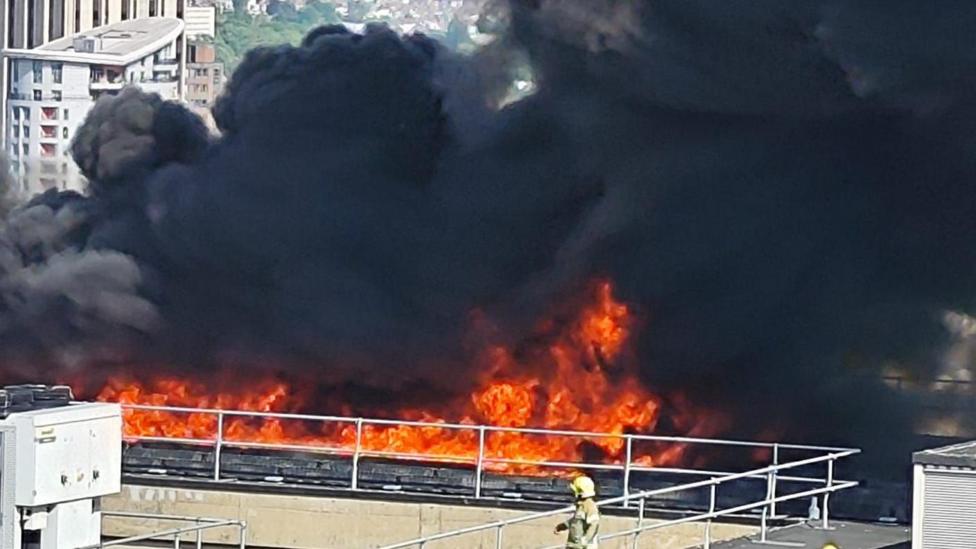
Of course, they might need millions of pounds to repair and rebuild…
The scene at St. Michael’s Hospital in Bristol
She certainly is a breath of fresh air. What is amazing is that, even within the context of the Climate Religion, their own energy policy is insanity on steroids. Of course, she misses the elephant in the room – that the Climate Religion itself is based on complete fantasies and lies.
And on hating most of the population .
Those polys are EVIL.
Kathryn is an expert on how the grid operates and sensibly keeps to that topic. If she pronounced on the climate scam her efforts would just be be ignored and dismissed by those who need to take account of what she is saying.
This is the first time I have heard about the deaths associated with the Iberian blackout. Was it reported in the LSM?
Nice to see that Drax is having its life extended. I own stock in a company that creates wood pellets in Georgia and ships them to Drax, so it means more money in my pocket. Of course it’s silly to chop down trees in the United States, convert them to wood pellets, and ship them across the Atlantic to burn for power.
If you aren’t silly… you’re out of a job.
From the Ministry of Silly Walk?
Trees are not chopped down to make wood pellets which are made from wood waste from a variety sources. Go to the Drax website to learn how wood pellets are made.
Wood pellets have a huge carbon footprint. Much heavy machinery is used to get wood waste from the forest or mills to the pellet plant. The pellets are shipped from USA to UK in ships with big marine Diesel engines or with a steam boiler which use heavy bunker fuel. The pellets are taken from the port to the power plant by trucks with Diesel engines. Wood pellets have low energy density compared to coal, oil and nat. gas. So large amounts of the pellets are required for power generation.
They claim it’s from wood waste, but the reality is that they’re taking the entire output of several wood plantations, as that’s simply how much fuel drax requires. In addition, the owners of Drax have been in hot water twice now, for using pellets sourced from “old growth” forests, which were essentially ground up whole to fuel the plant.
The pellets are taken from Liverpool docks to Yorkshire by train, not trucks. I’ve seen the special rolling stock in sidings on the way into Liverpool by train. It will be a diesel locomotive pulling them however.
Intermittent renewables are a waste of time, money, and effort, if the continuous supply has to cope with maximum load.
How do you know you are facing maximum load? The machinery powering the generators is working as hard as it can, at maximum capacity, and it’s not enough. The rotors slow. If the overload condition lasts for more than a couple of seconds, the only option is to disconnect part of the load – load shedding. Using intermittent power as part of maximum output is lunacy. It’s intermittent for goodness sake!
Some people have the bright idea of using intermittent power to lift water, pressurise air, charge batteries, and so, so that energy is stored to be tapped on demand later on.
Not cost effective, except in niche areas – using solar power and batteries to supply power at night, or in a remote off-grid location, for example.
Not even massive government subsidies can overcome the laws of physics, or economic reality.
Not even massive government subsidies can overcome the laws of physics, or economic reality.
Unfortunately, that doesn’t stop Western Governments from trying.
Looking more and more that adversaries, including those within the “West” with “environmental” intent above all else, have knowingly caused UK and the rest of us to be incapacitated by “fears” of Amegeddon.
Like our willing destruction of electrical and gas infrastructure.
Amegeddon is already here.
Our industrial base is decimated. Our citizens are energy impoverished. Trust in governments and media going or gone. Trust in science and engineering has collapsed.
Our defenses have been weakened by massive subsidies and destructive energy policies.
We’ve had the killing blackouts that are the last “canary”….
Software and human invasions have shown that we can’t protect ourselves or our infrastructure.
We have no time left to rescue ourselves.
We have nothing left but the last nuclear war.
Are adversaries only need to trip off a couple of connectors, mess with DNA, and crash our systems.
Goodbye.
As a resident of the UK I only wish I could disagree.
The real reason for net zero is to create two classes of people … beggars & thieves.
Not that CO2 emissions need reducing but, if one believes they do, a logical and sensible way to do it would have been by using wind and solar where appropriate (my bold) to supplement fossil fuel generation and produce a degree of reduction.
Somehow, this original aim morphed into a lemming-like rush towards “net zero”. That’s the problem with zealots – they never know when to stop. As a result, we now have a potentially unstable grid that could collapse at any moment.
God (if she exist) please save us from stupid people who are so stupid that they think themselves clever!
You can’t “supplement” with something that can’t produce “on demand.”
The only “appropriate” use of solar and wind is for OFF GRID applications.
With renewables, we are all “off grid”.
Perhaps instead of “where appropriate” I should have said, “…when conditions are favourable”.
Story Tip
Russia unveils plasma rocket engine prototype
Rosatom scientists have developed a laboratory prototype for a plasma electro-reactive rocket engine based on a magnetic plasma accelerator with elevated traction parameters (at least 6 Newtons) and specific impulse (at least 100 km/s). The work was carried out as part of a comprehensive programme for the development of atomic science, technology and technology in Russia, which in 2025 became part of the national project,
New Nuclear & Energy Technologies.
Sounds a lot like an ion drive which the NASA has been using for years.
Seems to be something new, as I understand it.
The whole transcript; semiconductors don’t have angular momentum.
We need a lot more Kathryn Porters in this world.
Except for her belief that limiting CO2 emissions would do a thing about “climate change,” and the belief, implicit in the way she discusses it, that a warming climate during an interglacial period in the midst of an ice age is in any way “bad” news (quite the reverse, in fact).
But it is very important to recognize that the damage caused by “climate” POLICIES will be far worse than even the IMAGINARY harm that would supposedly be avoided by limiting “climate change” (which of course we will never do).
I think you will find that she couches what she says as “if you believe that CO2 emissions would affect climate” then you wouldn’t be following Ed Miliband’s policy.
If you want a decent public forum, you cannot tell the truth about lack of climate change caused by humans. That just gets you labeled “denier” and dismissed by the media. Ms. Porter is just doing what she needs to in order the get heard. She obviously has full command of the facts and the ability to communicate effectively. Maybe Farage will replace Mad Ed with her when he takes over as PM.
Kathryn has a post about the recent fiasco in Spain and Portugal at
https://watt-logic.com/2025/05/09/the-iberian-blackout-shows-the-dangers-of-operating-power-grids-with-low-inertia/
The climate cult is a religion. Facts have nothing to do with beliefs that the climate is getting worse and it’s due to Man. Not all religions are equally good, or equally bad, of course. The climate cult religion is so full of false prophecies, contradictions, and denial of facts, that it ranks near the top – of bad religions.
And many have pointed out – use of logic and reason and facts seldom works to argue someone out of a viewpoint that they did not arrive at by use of logic and reason and facts. It’s all emotions and feelings, and they have chosen those as their basis for decision making. It doesn’t make sense, but for them, it doesn’t have to…
The “why”? Even though it sounds almost unbelievable, I think there is evidence that it really is a mental illness, certainly a mental delusion, a mental condition. It is not incorrect to say that many people choose to live in a fantasy world rather than reality. And too many of those people have access to the levers of power and government, and are rewarded rather than chastised for their poor decisions and poor performance.
An observation of the Austrian School of economics is that any real price information is lost in a socialist system. So discussing administered “prices” is mostly useless.
The UK has interfered in the energy market to a degree where electric prices are as meaningful as wages in Cuba.
Speaking of Commie pricing-
BYD Sparks Price War In China, Slashes New Car Prices By Up To 34% – CleanTechnica
That sort of discounting in an already tight profit market spells cash flow problems. Bear in mind BYD already relies heavily on their suppliers’ credit and many in turn on derivatives sales of said IOUs with the finance sector taking a cut along the chain. If the market got whiff of BYD seriously defaulting on bills due the whole EV house of cards would end up like Evergrande.
Notice also Trump’s tariff play may be all it took to tip the Chinese EV dumping industry over the edge.
I always thought, at the highest level, “climate change” was invented to to accomplish two things:
1. End Western civilization, and all that represents, as we know it.
2. Remove the concept of state sovereignty from the world while simultaneously building an all powerful, unelected, unimpeachable non representative world government.
At less esoteric levels, each climate zealot will have his/her own specific motivation. I believe the two most common motivators are financial and appealing to authority.
This what I believe to be the motivation behind the climate cult.
3: Grotesque enrichment of many members of the Global Elite (Al Gore, for example).
Very well stated Kathryn. I have shared this transcript with many in the hope that one or two more will see the nonsense we are living through.
“We’ve seen the old nuclear reactors having their lives extended…….our gas-generating fleet is really old, and quite a lot of those units are going to close in the next five years.”
How easy would it be for an anti-Net Zero government, taking power in 2028/29 to significantly reduce the UK’s use of renewables and to increase supply from fossil fuels and nuclear? How quickly could it be done to the extent that anybody would notice a reduction in the bills they pay?
Here in the UK it is impossible to understand how our electricity bills are calculated. It is beyond the understanding of politicians that is for sure.
Kathryn is at least starting to shine a light on how these costs are arrived at and how much of it can be apportioned to the rush to renewables.
This has been sorely lacking in the debate until recently. For example, there is too much concentration on the wholesale price, when that is only 40% of the total bill we have to pay. Where is the other 60% going to, that is what needs the answers.