From NOT A LOT OF PEOPLE KNOW THAT
By Paul Homewood
More lies from the BBC:

Hurricane Milton is heading towards Florida, bringing “potentially catastrophic” winds, storm surges and heavy rainfall, American forecasters have warned.
The storm is due to hit the heavily-populated city of Tampa Bay less than two weeks after the state was badly hit by Hurricane Helene.
Milton is the ninth hurricane of the 2024 Atlantic season, which continues until the end of November.
https://www.bbc.co.uk/news/world-us-canada-42251921
Being the BBC though, they just could not resist the usual disinformation:

This is what the IPCC actually say:

In other words, there is no evidence of trends either in the frequency or intensity of hurricanes.
The IPCC also state:

It is generally accepted that Atlantic hurricanes tend to be weaker during the cold phase of the AMO, which ran from the 1970s to 90s. But clearly the longer term data, which extends back to the 19thC, trumps any shorter term data, particularly given the known ocean cycles.
NOAA are even more explicit about this:

https://www.gfdl.noaa.gov/global-warming-and-hurricanes
Yet there is no mention of the longer term trends by the BBC. Nor is there mention of this very clear statement from NOAA regarding both US and Atlantic hurricanes:

https://www.gfdl.noaa.gov/global-warming-and-hurricanes
.
To cap it all, the BBC even include this deliberately deceitful chart:
.

The apparent increase in major Atlantic hurricanes since 1920 is due to the fact that we now have satellites to observe them in mid-ocean. This is why there is a step change in the 1990s.
A glance at US landfalling hurricanes shows there is clearly no long term increase in the strongest hurricanes:

As of July 2024, there is no trend in global sea surface temperature.

Since your graph begins in July 2024, I think you mean “since July 2024” rather than “as of July 2024.” Right?
Can you please provide a link to the source of that graph? I see that it says tropicaltidbits.com, but I don’t find it on that site.
A longer duration version of the graph would be more interesting, I think.
https://www.tropicaltidbits.com/analysis/ocean/
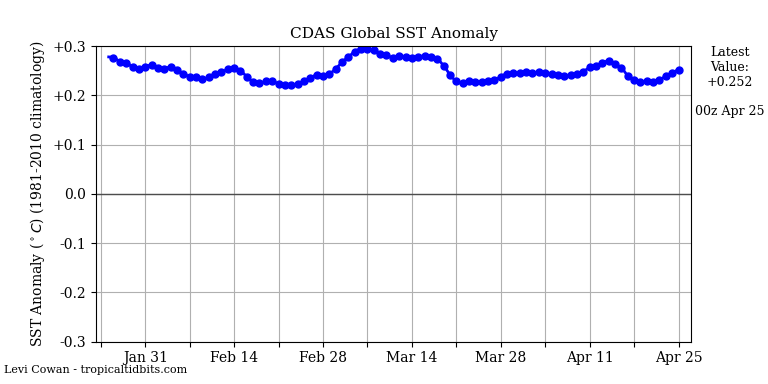
Since the beginning of May, the global sea surface temperature has slowly declined.

Thank you for that. Where did you find this earlier (early April to early July) version?
Are there versions which extend longer than 3-4 months?
I wrote it down earlier on Facebook.
“IPCC Says They Are Not!”
No, they don’t. The first quote just says that in thelong term, data homogeneity is a problem. That doesn’t mean, as they explicitly say, “They Are Not”. It just means the older data isn’t good, so you can’t say.
And of course the second IPCC quote does correspond to what the BBC said. We do have a trend over forty years of good data.
“NOAA are even more explicit about this:”
No, they are not. Again it just says that an apparent trend over forty years, which is real, can’t be said to have existed further back, because of bad data. That isn’t saying that it didn’t. But anyway, it isn’t even the NOAA speaking. It is Tom Knutson on the GFDL site. Immediately under the author’s name, it says:
“Any views expressed here are the author’s and do not represent official views of NOAA or the U.S. government. “
With you guys data is always a problem – of your own making.
You are a great advocate of anomalies. Yet, you can’t justify your computation of anomalies that is valid science.
If there is no good proof from the older data as you wrote, then it means you warmunists are spouting bullshit. It’s ALL about the real world data, not models that purport to predict the future.
But we KNOW the CO2 is 1880 was 280 ppm or was it 275 ppm?
In 1820 it was measured by scientists at 420 ppm with some measurements of 450 ppm.
Yes, we do. Courtesy of the ice, we have actual samples of that air.
No. Courtesy of over a dozen scientists performing chemical analysis of the AIR.
That temperature data is from E.-G. Beck’s paper and from measurements in mostly in central and northern Europe
I spoke of CO2, not temperature.
Yet they use older data for temperature and atmospheric CO2 and those are GOSPEL.
Nick, would you be happier if we said, “the IPCC says hurricanes have not detectably worsened?”
That’s not as pithy, but it’s more precisely correct.
Yes, it is. No use being pithy and wrong.
You being the expert in pithy and wrong certainly are qualified.
The real world data with a longer history relates to landfalling hurricanes, which are largely what matters to humans (although plainly many seafarer lives were lost before we had radio communications and satellite based weather system tracking). Although human habitation was on a far lesser scale in the 19th century, it was sufficient to ensure that records of landfalling hurricanes are unlikely to have been missed. It is a considerable stretch to suggest that this is not evidence of trends (or lack of them) in hurricane frequency and severity.
Thanks for reading, Nick.
There is no such thing as an “official view” from either NOAA or the US Government. All views are opinions about policy agendas instituted by political parties.
This becomes clear when watching executive branch bureaucrats testify before congress.
The BBC is getting cautious about what it puts in its Climate section on the website. This article only appears under the US/Canada banner. Not the first instance in recent months.
The Guardian does something similar, it trumpets an article and then buries it deep in its Australian edition. At first glance you’d think the article either never existed or disappeared.
Weasel words: That sums up the BBC, Guardian, Independent, Times, Financial Times etc etc.
It is likely. It is very likely.
I can well imagine back in my old lab days reporting the results of various analyses, eg Kjeldahl (Nitrogen), to the duty chemist as likely [add result here] or very likely [add result here]… What would have been very likely is a disciplinary. Why didn’t you repeat and confirm etc?
The media is leading the charge to the idiocracy. As the BBC states:
Human activities are causing world temperatures to rise, with more intense heatwaves and rising sea-levels among the consequences.
Things are likely to worsen in the coming decades, but scientists argue urgent action can limit the worst effects of climate change.
https://www.bbc.co.uk/news/science-environment-24021772
For the media the narrative is gospel.
Story tip in the Mail:-
The Gulf Stream is on the verge of COLLAPSING, leading climate scientists warn – ‘impacting the entire world for centuries to come’ | Daily Mail Online
I guess that the Grants are up for renewal.
What is collapsing is their ‘mental elf.’
I wonder where children get these sinister ideas that make them afraid.
Beware of a 7 foot tall roo.
I used to have a ~ 7ft eastern grey in my back paddock.
He wasn’t carnivorous though, and I was careful to never cross his path when his clutch of does were grazing nearby.
These big boys do get awfully territorial and aggressive towards perceived intruders.
A couple of dogs in our locality got disemboweled by ‘roos when the dogs chased the ‘roos into dams.
This is a learned defensive tactic – the ‘roo holds the swimming dog with its ‘arms’ and lifts up one leg and rakes the dog’s stomach with a huge sharp toe. Game over, and not a pretty sight.
They just twigged that after all Arctic ice is not collpasing, so they’re getting their exccuses in first.
There’s no scientific basis for the claim that manmade climate change has caused hurricanes (and other tropical cyclones) to worsen. That’s just climate industry propaganda.
https://sealevel.info/learnmore.html?0=hurricanes#hurricanes
References:
1. https://doi.org/10.1038/ncomms8182
2. https://doi.org/10.1175/JCLI-D-15-0188.1
3. https://doi.org/10.1038/s41558-022-01388-4
Tornadoes & nor’easters haven’t worsened, either. In fact, strong tornadoes have actually decreased:
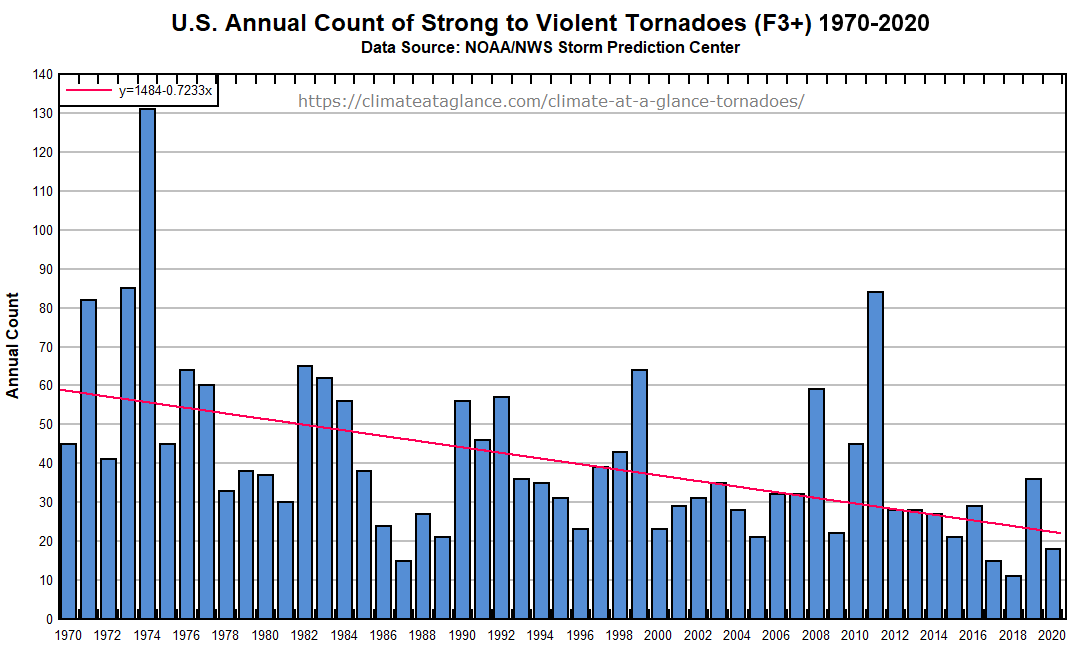
https://climateataglance.com/climate-at-a-glance-tornadoes/
The IPCC’s authors are sly. They know tropical cyclones aren’t worse, but they dodge & weave to avoid admitting it. They “project” worsening, but, despite > 3/4 century of rising CO2 levels, it still hasn’t detectably happened.
That tricky quote from AR6 is an excellent example of how they dodge & weave:
That’s a textbook illustration of Chesterton’s famous observation that, “Falsehood is never so false as when it is very nearly true.”
It’s “spin.” It is calculated deception without quite lying.
Look at the graph:
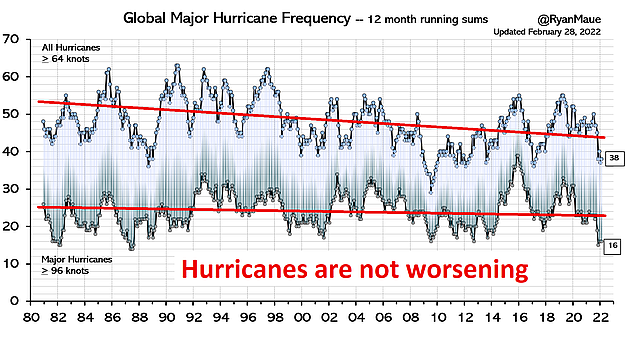
(Or look at this updated version.) The upper red line is the trend in number of all hurricanes, the lower red line is the trend in number of major hurricanes.
Note the word they chose: “proportion.”
Do you see it? The frequency of MAJOR hurricanes is only down very slightly, but the frequency of ALL hurricanes is down significantly. That means “the global PROPORTION of Category 3–5 tropical cyclone instances has increased.”
It SOUNDS like bad news, but it’s really just a dishonest spin of what is actually good news.
Because nearly all of the decrease in hurricane frequency has been in the form of a decrease in Cat 1-2 hurricanes, the average strength of an individual hurricane has increased slightly. So climate industry propagandists say, “hurricanes are getting stronger.” It is technically true, but thoroughly dishonest. It’s an absolutely classic example of lying with statistics.
It’s no wonder that so many smart people distrust climate industry institutions like the IPCC.
“It’s “spin.” It is calculated deception without quite lying.”
No, it’s a simple statement of fact that isn’t quite the fact you wanted to hear. The BBC as quoted above set it all out very plainly:
Proportion is the relevant term, in fact the proportion of any particular category in a set of categories can increase without any change in the actual number in a category simply by decreasing all or some of the numbers in the other categories. For example the number of tall men in a population is x and at a particular time x is 10% of the population. If x is unchanged and the population changes, either up or down, the proportion of tall men also increases or decreases. Implying that an increase in the proportion of tall men indicates that there are more tall men is a lie by commission.
In the BBCs case the careful wording of the paragraph and the inclusion of the chart was clearly meant to imply that major hurricanes had increased.
If the total number of hurricanes is down, but the number of strong hurricanes is less down than the total – then the proportion of stronger hurricanes increase.
Story tip:
https://www.msn.com/en-au/news/australia/the-gulf-stream-is-on-the-verge-of-collapsing-climate-scientists-warn/ar-AA1sLVPX?cvid=b78dae7935bf4f90929cf947dd597a7a&ei=31
The Gulf Stream is on the verge of COLLAPSING, climate scientists warn
They used the movie The Day After Tomorrow as a reference for credibility.
Story tip:
https://www.theguardian.com/commentisfree/2024/oct/22/meteorologists-climate-change-hurricane-extreme-weather
Meteorologists could be climate change heroes by relaying its urgency to the public
This is emotionalization to sway public opinion.
The BBC Headline says:
How Is Climate Change Affecting Hurricanes, Typhoons and Cyclones?
The answer is: Climate does not affect weather. Weather affects climate by definition.
As long as the propaganda is not questioned and shown to be false, the more the propaganda machine will publish it.
The BBC will be right. They’ll have fact checked themselves.
“The apparent increase in major Atlantic hurricanes since 1920 is due to the fact that we now have satellites to observe them in mid-ocean. This is why there is a step change in the 1990s.”
So if climate = 30 years of weather, then we have 1 total data point to calculate the trend?
The mainstream media have no credibility, the BBC,Guardian, New York Times, Washington Post and PBS in particular. Why should anyone believe anything they say?
As I’ve said before, the BBC and The Guardian are having a running contest over who can blow the most extreme weather events out of proportion and attribute them to what else but man-made climate change. That’s the reason that any of their blurbs has to be checked for both accuracy, omissions and distortions. The above article is a typical example.
The BBC lost all credibility years ago, not many people believe a word that they say.
Sampling a 30-year interval in a 20,000 year cycle does not give any kind of credible trend results.
Sample 1/4th of a sine wave from the minimum to the zero crossing and plot it. It strikingly resembles and exponential function. Extrapolate the upward curve into a trendline and shazzam, it goes to infinity.
The point? A 30 year interval for defining GLOBAL climate change is grossly inadequate and misleading when we know the 1st order cycle has a period of approximately 20K years.