Kevin Kilty
While reading the article “A Semi-Competent Report On Energy Storage From Britain’s Royal Society” by the Manhattan Contrarian a few days ago, I was reminded by Figure 1 of the variations in flow of the Nile River which was the inspiration for Mandelbrot’s development of fractals.[1] This naturally brought to mind Hurst’s algorithm for determining the required storage of a reservoir.[2]
Hurst’s explanation of the algorithm is very simple.
“For example, if a long-time record of annual total discharges from the stream is available, the storage required to yield the average flow, each year, is obtained by computing the cumulative sums of the departures of the annual totals from the mean annual total discharge. The range from the maximum to the minimum of these cumulative totals is taken as the required stornge(sic).”
If we think of energy conversion as equivalent to river inflow, electrical demand as equivalent to reservoir discharge and water storage behind a dam as the equivalent of chemical energy storage in a battery, then we can make use of this simple algorithm to explore the storage needed to get us through any hypothetical period with only intermittent wind or solar or some combination available to us. Hurst didn’t consider evaporation – we won’t consider inefficiency of charge/discharge.
Rather than base my analysis on seasonal weather from Monte Carlo modeling, I thought to take some of my own advice. I had made a suggestion in a public service commission hearing last January that a regional utility could do no better than to take the most inclement weather period of the last sixty or seventy years, real data in other words, and show us how their hypothetical energy system would fare. Thus, I decided to marry Hurst’s algorithm with data from this past summer gathered from the EIA hourly grid monitor for the Northwest region which is where I live.
I decided on the time period stretching from June 24, 2023 through September 30, 2023. This period includes the season of heavy demand for air conditioning and irrigation and probably the poorest wind resources overall.
Conditions of Analysis
Here are my assumptions for this first cut analysis:
- Wind energy only
- I assume wind can be scaled up to meet season demand without degrading capacity factor
- Storage level ends the season at the same level it began (one of Hurst’s conditions)
- Storage level is adjusted upward to avoid negative storage
- I include no losses from internal battery leakage, inefficiency of charge/recharge, no provision for line losses
- No provision for equipment outages or reserves
- No inter-balancing area transfers
Pattern of Demand
Figure 1 shows the pattern of demand in the Northwest. The EIA uses units of MWhr of demand during each previous hour. One might think of this more simply as the hourly average power in MW required from all sources to meet demand. There is a single daily peak that may rise above 60,000 MWhr each hour of the day when there is great demand for air conditioning and irrigation (these two sources of demand are highly correlated). The full daily swing in demand is typically around 20,000 MWhr per hour. On any given day this swing might have to be met with a combination of coal, natural gas, hydro, and solar – natural gas generally balances the swing in solar that occurs early and late in the day and has a rapid slew rate. Only gas turbines can follow it easily and it would wear a typical thermal plant to tatters to try to follow solar and wind each day. A combination of hydro, coal, and natural gas is needed to balance the fluctuation in wind generation. The seasonal average demand is 42,661 MWhr each hour.

Figure 1.
Wind Generation
Our analysis assumes wind generation alone. Figure 2 shows actual wind generation during our test period. The generation is highly variable. It rises above 12,000 MW on some days but drops well below 1,000MW on others.The swing in output can take place in a matter of hours. Extended wind droughts lasted as long as 36 hours during the season.
The seasonal average wind generation is about 5,140 MW. Thus, in order to provide all demand in the Northwest, and not leave storage in any worse condition when the season is over, wind has to supply at a minimum the seasonal average demand (the actual figure turns out to be 42,735). Thus, current wind energy capacity has to be scaled up by a factor of about 8.32 to accomplish this. It is not very likely that this can be done without having to place wind farms in less than optimal locations. The best locations for wind production are very likely taken, or at least planned to be taken, already. So, this is a minimum figure.
An interesting calculation at this point is to estimate how much land area is required for this much wind generation and what the first cost, the cost of capital expenditure, is likely to be. Assuming an annual average capacity factor of one-third means we will have to install three times our 42,735 MW of actual capacity to reach a minimum needed nameplate rating. This is 128,205 MW of nameplate wind. A couple of the most recent applications for wind plants in Wyoming propose to use 125 acres per MW of nameplate rating. Thus the required wind would need something like a minimum of 16 million plus acres. For comparison this is a bit greater than one-fourth the State of Wyoming itself. The cost of constructing and equipping a wind farm I would have estimated at $1,200 per kW, but after the inflation reduction act (IRA) has raised costs this might be as high as $1,500 per kW. Total is then maybe between $150-192 billion dollars.

Figure 2.
The Resulting Required Storage
With a few iterations of guess, assess and modify, I arrived at the following solution to the problem posed here. Average wind energy generation is 42,735 MW. By starting the season (on 6-24-2023) with 4,600 GWhr in storage, we will end the season at midnight on 9-30-2023 with 4,600 GWhr of storage. The maximum energy in storage over the season is 5,221 GWhr. This is 122 hours of average demand. The minimum is only 71,000 MWhr, which considering this has occurred during a lull in the wind and in mid-summer with air conditioning and irrigation demands is little more than an hour of reserve. During 172 hours of the season there is less than 24 hours of reserve. In other words, this is not a robust solution by any means. There is a lot more work to do. Figure 3 shows what goes on in this particular season. Storage rises a bit at first only to be whittled away as the wind dies and the season becomes hot and dry. As summer recedes, storage rises again to finish the period with the same storage it began.

Figure 3. The storage level time-series.
What about cost? The last time I checked on lithium battery storage in the form of a Telsa Megapack it was $600 per kilowatt hour. This would put the cost of the maximum storage energy of 5,221 GWhr at around $3.13 Trillion (yes capital ‘T’ dollars).
Before any battery storage proponent tries to tell me that I am over-estimating because such batteries are only $200 per kWhr, let me state something about estimating industrial facilities. One does not just purchase batteries and wire them together. One needs a facility with all sorts of services in order to house said batteries – land, grading and foundations, roads and parking, a building, environmental control, safety systems, switching, transformers, AC/DC conversion, lines, labor and so on. The same is true of chemical plants or power plants or any major facility. Take the functional part of a facility and multiply its cost by around 1.5 for all this ancillary stuff. Take a GE quotation for a 300MW ultrasupercritical boiler and turbine of $240M (probably a bit too low after all the inflation reduction of the IRA); multiply by 1.5 and the rest of the power plant is probably $360M – $600M in total. Under-estimating costs is common – let’s not do it.
This estimate for an all-wind/storage system is not likely to be an order of magnitude in error. You see, 3.3 or so trillion dollars is probably an under-estimate considering my liberal assumptions. Storage needs equal to 122 hours of average network demand, or more, is something one should expect. It’s like 5 years worth of national savings just to supply energy for the Northwest with its roughly twenty million people (7% of the U.S.). In order to make a fantasy modern energy system work, a person needs a fantasy modern energy storage system too; and to pay for that a person needs modern monetary theory.
Making Better Estimates
Keep in mind that what I have done here is a first cut. I’d have to begin adding the complications that I assumed away early-on to do better. Maybe I could get a lower cost by adding solar energy and reducing wind. Maybe not. But keep in mind the big plan is to rely on wind/solar and storage only in the future. No coal. No gas. Even hydro is a target. Nuclear? What a horror. No way!
Also, this is just one realization of something that is a stochastic process. I’d get a bit more robust estimate by not only adding the losses of a real system, but by looking similarly at multiple seasons back in time. It takes about 25 years to gain another standard deviation of uncertainty. Thus, those 60 years worth of seasons I suggested to the PSC would reach around 2.5 standard deviations which translates to 99% certainty. Except, weather and climate don’t follow a gaussian distribution, but rather something like that of a fractal – a hyperbolic or power-law distribution. There have been weather events in the past which in their extremes of magnitude and persistence we have never observed before.
Beware. Expect surprises. Expensive ones.
References:
- Benoit Mandelbrot, The fractal geometry of nature. 1982, ISBN: 0-7167-1186-9
- Hurst, H.E., Long-Term Storage Capacity of Reservoirs, Transactions of the American Society of Civil Engineers Archive, Vol. 116, No. 1, January 1951.
I did a similar analysis here for the whole CONUS, but allowing for solar as well, and also assuming existing hydro and nuclear were preserved. It was based on four years of hourly data. I got costs of $5-6T for the whole US. The big thing lacking in Kevin’s analysis is the possibility of importing from elsewhere in the US (or Canada). I have erred somewhat on the other side by assuming no barriers to interconnection. But there really shouldn’t be any.
I think hydro will be increasingly valued because of its ability to come into action when the wind dies. Hydro is constrined by rain, but if you preserve it by using only when wind fails, it will last much longer (and earn higher prices). The NW is well placed to make such enhanced use of its hydro.
Hydro? Your friends in Kalifornia are in the process of removing all of the hydro power dams on the Klamath River, thereby damaging your hydro calculation. Nuclear? Kalifornia again? Somebody needs to face Reality.
Klamath river is 169 MW.
Klamath is just one example.
Environmentalists are against hydro and want even existing dams to be torn down.
Everywhere.
Utility to utility transfer capability is typically a small fraction of peak demand, plus nobody has the transmission capacity to pass large amounts through while meeting local peak. Thus assuming massive interconnection is a fantasy. The cost would be astronomical.
Cost of land interconnectors is much less than storage, and we already have them on a large scale. China is criscrossing the country with 1.1 MV HVDC lines. each carrying 11 GW. We can do it too.
The big problem is that when the wind dies in the NW US it has probably already died in locations to the east because of nightfall. Meaning where is the electricity for the interconnects going to come from?
You *do* realize that the insolation from the sun is a big creator of wind, right? And when the sun goes down so does the wind?
Try telling the enviros that you want to crisscross North America with such power lines. A proposed power line from Canadian hydro down into New England is fiercely resisted. There are no enviros in China.
Supply from Quebec to New England is well established. There was kerfuffle about a line to NY. But it is happening.
not so well established
https://en.wikipedia.org/wiki/Quebec_%E2%80%93_New_England_Transmission
NY isn’t part of New England
China’s interconnectors are to coal stations in the NW where demand is limited. The alternative would be to rail the coal to power stations nearer demand, but minemouth is much more economic, just as with Loy Yang or Four Corners or Drax. They will operate in baseload, guaranteeing a high utilisation.
That is not the case if you are trying to balance renewables where you have to provide for all sorts of rare configurations of supply and demand. Intermittently used interconnectors become very expensive, and if you are also wheeling over large distances losses start to loom large as well.
No doubt lines that have been built to transfer dispatchable energy.
Rube, meet Goldberg.
BUT, utilizing Interconnections to meet Peak Demand for one underpowered sector is dependent upon neighboring sectors actually being overpowered during the same peak conditions.
Depending on interconnections to meet demand is folly
Bryan, Not complicated is it?
No level of interconnection would have saved Texas in February 2021, as the same storm hit most of the country.
Gotta have that interconnection with China…where reliable Coal Power is regularly generated
China is criss-crossing the Country? Are you sure? It’s a big Country.
And where’s all the copper going to come from?
Few seem to consider all the new electric appliances, electric motors, grid equipment and power cabling, nobody is asking, when the whole World is engaged in this madness, where will all the copper come from for the wiring?
However since money is no object when ‘saving the planet’ we could always use gold which is even a better conductor than copper.
HT transmission lines are typically aluminium and steel.
Correct: ACSR (aluminum conductor, steel reinforced)
See “Components”, here:
https://en.wikipedia.org/wiki/Pacific_DC_Intertie
LOL… What an amazing little FANTASY mind you developed to protect your fragile and delusional ideology. !
Fantasy is right. When night comes, the wind typically dies down. So where is the interconnect power going to come from since locations to the east of NW US will have already seen the wind die down at night?
Does Nick think we can build interconnects to China, i.e. halfway around the world?
The transmission interconnect could be installed along the right-of-way of Biden’s trans-pacific high speed rail line, which would also be electrified. (sarc off)
I’m so glad Nick is not involved in energy planning – not a clue
Do you think that a country should implement energy policies based on four years of hourly data? Would you be prepared to get your hands dirty and manage the implementation if you were seriously accountable for the results?
Kevin’s analysis is based on three months data. Four years hourly data is the maximum we have.
We may have only four years worth of data on wind turbines. We have at least forty years of data on UV (i.e. sun) and wind data from automated stations.
There is also the MERRA 2 data that underpin work I have done on the UK, and which the Royal Society used for their version (which has lots of assumptions that result in underestimates of storage requirement at any particular build level).
It sure is sad the way Nick has to lie about what others have said.
Kevin explicitly said that to be accurate, this analysis should cover the entire 60 to 70 year record.
Kevin has no intention of actually designing a system, he’s doing an example just to show how ludicrous the very notion is.
You on the other hand are claiming to have definitive numbers.
If you can’t tell the difference it could only be because you don’t want to.
“You on the other hand are claiming to have definitive numbers.”
I said $5-6T. Kevin said
“This would put the cost of the maximum storage energy of 5,221 GWhr at around $3.13 Trillion (yes capital ‘T’ dollars).”
Sounds more definitive than mine.
And again, Nick has to twist the words of others in a desperate attempt to continue deflecting attention from his own failures.
Kevin was talking a small scale example. You on the other hand have been claiming to have an over all solution.
If you can’t see the difference, it’s because you are paid not to.
Nick Stokes,
You can get over 12 years UK data from Gridwatch.
I suggest you donate 10$ download the data and do an analysis and I’m sure Anthony will be happy to let you post a report here.
Electricity generation data Gridwatch Data Download
Renewable data is available at REF from that you will be able to get the amoount of installed renewables.
Combining these two datasets you should come close to an decent answer for Net Zero Electricity Only generation
“Four years hourly data is the maximum we have.”
Doesn’t mean its adequate to the need. The problem is extreme calms for long periods do happen, every decade or few decades, and the system has to be sized to deal with them. And no, imports are not going to cut it. Insecure and most likely, in the case of these calms, not available in anything like the scale needed.
This is energy planning by literary criticism.
I really don’t think anyone with a rational mind is going to take much notice of a Nick Stokes analysis !!
You can absolutely guarantee it will be manifestly twisted, highly biased, and full of nonsense assumption.
I’m sure you wouldn’t risk your rational mind by actually reading it.
I think you should do it. I want to see something systematic and quantified from you. I am sure Anthony will publish it. I and the rest will read it carefully.
But I think you won’t do it, because the case cannot be made.
There are far better things to do that reading twisted delusional fantasies from rabid zealots.
Your comments are a solid indication that NOTHING you produce is worth spending even one second on.
Nick probably thinks excess SA wind can power Victoria and NSW.
So funny !
It could work.
SA wind “firmed” by more banks of the diesel powered generators that SA already uses.
They’d need more than a shedload more generators though, and bog knows how much more fuel, but they wouldn’t see cost as a problem.
Because they never do.
“I think hydro will be increasingly valued…”. Yuh, but, the enviros now HATE hydro. Their goal is to take dams down.
Hydro is constrained by all sorts of requirements including a minimum pool for fish and so forth, by Ron Long is correct that people of all sorts want to breach dams.
In many locations, hydro can’t be started up on a moments notice. In many places where the areas below the dam have become recreational areas, Sirens have to be sounded in order to give the people time to move to high ground. The time delay between the sounding of the sirens and the start of water flow is usually something like 20 to 30 minutes.
Too many people see dams as only power plants. Most dams are built for 1) flood control – keeping water out of important things, and 2) drought control – having water when Mom Nature is feeling stingy.
Getting electricity when you release water to go further downstream is a nice <i>extra feature</i>.
Nick, it’s Always amazing watching you fumble around a basically very simple concept: How much ADDITIONAL renewable backup to supply PEAK DEMAND for when renewables are diminishing/diminished? The formula for calculating it is equally simple.(Peak Demand/measured current minimal renewable’s outputs). Ex: (100/5) = 20 times current installed renewables. These numbers are available for nearly every grid using renewables.
To estimate costs multiply the 20 by investment cost for the installed renewables base.
Even this simple estimating tool is conservative, but is surely higher than Nick’s $5T for the US. What Nick conveniently forgets is that renewables outputs can go to ZERO.
To translate for the Nick and the other dim bulb renewables blind believers, renewables CAN NOT be used to meet any level of demand. The unreliability of renewables can not be replaced with more renewables.
When the sun doesn’t shine in Topeka it doesn’t shine in Tulsa. Building more solar won’t change that. Zero output = Zero output.
When the wind doesn’t blow in Hays, KS at night, it doesn’t blow in Salina, KS at night either. Zero output = Zero output.
“The unreliability of renewables can not be replaced with more renewables.”
When it is snowing in Iowa, it is usually snowing in Illinois. When it’s snowing, neither wind nor solar is working, regardless of what time of day it is.
Nick, I suspect that you are being downvoted more because of who you are than what you’re saying — which in this case seems kind of reasonable.
… But do you clearly understand the consequences of the approach you’re proposing? Things like turning off Niagara Falls to preserve the hydro storage of the reservoir usually called Lake Erie. I guarantee you that not only will namby-pamby environmentalists get up in arms, so will the business interests in nearby cities like Buffalo, NY and Niagara Falls, ON. Not good for the tourist industry ,,, Not good at all.
Not to mention landowners around Lake Erie when the water stored during rainy years starts lapping up toward their living rooms.
And the need to find around 6GW of reliable generation to replace the current generation at the falls — which in your proposed world will become intermittent — spun up only when wind and solar are having a bad day/week/month/year.
I suspect that $5-6T is a gross underestimate. More like 50-60T when it all settles out I should think.
The water flow in the Niagara river is regulated to ensure there is enough left after diversion to hydro plants for The Falls to still be The Falls. Even still, water flow over the falls is notably less than when I was a kid in the 1940’s and ’50s because of hydro diversion. Buildings and grounds nearby rumble a lot less than they once did.
This is not the first time that Nick has posted his numbers. It’s also possible that people recognize how inadequate Nick’s “proposal” is, and are downvoting him for that.
“Nick, I suspect that you are being downvoted more because of who you are than what you’re saying — which in this case seems kind of reasonable.”
No, its not reasonable at all. What he is saying is that the US could be run with the same rough level of storage as the author of the post says will be needed for a tiny proportion of it. And the reason he gives is a generality about how there will be interconnect enough available to make up the difference. Imports from some other country or part of the US.
Its not reasonable at all. I said above, this is energy planning for a country of 250 million people by literary criticism.
Nick’s analysis is quite good, within its scope, and given the available data.
The extent of interconnects required, transmission losses, switching, frequency synchronisation, etc would necessarily add complexity and cost.
The safety margin seems too tight, which makes a big difference to the degree of overbuild, amount of storage required, or both.
The US has a very large east-west range, as well as north-south. This reduces its sensitivity to individual synoptic features compared to Kevin’s more limited area analysis. Total US overbuild/storage requirements won’t scale linearly with area, so the analyses aren’t necessarily incompatible.
New Zealand or the UK would be a very different matter because of their area and orientation.
Couple of problems, even though the US is large, there are still instances when most of the country is under clouds and areas that are becalmed can also cover huge portions of the country.
As a result of this, each subsection would need to be able to produce enough wind and solar energy to provide power for the entire country.
The other problem is that transporting electricity for large distances means large energy losses.
Nick’s analysis is incomplete at best, outright fantasy at worst.
Yes, it’s incomplete, just as Kevin’s is incomplete.
Kevin and Francis have separately looked at generation vs demand for particular regions of the US, while this covers the US’s 48 contiguous states.
The first pass of Nick’s analysis covered hourly generation vs demand for 1 year. The second pass extended the analysis to use the available data, and put costs to various mixes of generation and storage.
The next step could be to
Based on the analysis to date, it appears to be comparable in price to new build fission or fission/hydro, with a higher output variability. Further analysis may continue to show this, or change the relative costs.
“most of the country is under clouds and areas that are becalmed can also cover huge portions of the country.:
Yep. Especially when the summer doldrums hit because of stagnant high pressures and during the winter because of stagnant lows. Think Texas when it almost froze to death. The entire center of the country, from the Rockies to somewhere east of the Mississippi had the same weather – clouds, snow, ice, etc.
The UK grid relies quite heavily on imports to support the dark, windless periods – that’s no way to ensure your national security, as Ukraine has shown recently
Todays friends may be tomorrows enemies
Only self serving, greedy globalists naively believe in a one world order
Hydro has limited opportunity, both in location and capacity
What we do need is coal, gas and nuclear power generation, lots of it
It’s not unusual for all of Europe to be in the doldrums at the same time. It’s also not unusual for all of Europe to be in the dark at the same time.
In imports you’re assuming several things, neighbours will have capacity to spare, they aren’t suffering from the same or similar wether conditions as you are. If they have storage have they got spare to cover them and you for the forecast drought.
Morally if you’ve removed Fossil Fuel, Nuclear and Hydro from your grid to save the planet can you import electrons from a neighbour who is generating using any of these at the same time as exporting to you?
Importing from others just moves the problem.
Nick, Show your work so we can point out your errors.
I linked to my work. There is even computer code.
Storage cost has increased from $350/kwh to $550/kwh. Solar C.F. In winter in northern cities is about 10% not 33% suggesting the need for triple solar installs or storing for months not hours. 100 hours of cloudy and calm happens. Have you provided for the 100 hour absolute minimum?
Nick, did I miss simething, are you estimating salt cavity hydrogen storage?
HySource, the Netherlands reports:
If all goes according to plan, the first hydrogen cavern will be ready for operation in 2028. Project is for 216 GWH storage.
(I helped flush out a salt cavity for propane storage in the ND Williston Basin.It collapsed. I worked for a major NG Company that had to abandon their formation NG storage near Chicago. The surrounding strata leaked. Just saying).
No, looking at battery storage only.
What battery lifetime was used?
Did you base on 100 hours storage? Some argue at least 400 hours are required, not the 4 hours that is for peak loading only. Even 10 hours of storage is off the chart expensive.
Bro the Mississippi is currently going dry. I would say the only “natural” source of heat/energy that is guaranteed 24/7 is geothermal, but that is exceedingly expensive where it’s not available at will (think Iceland or Yellowstone) . Nuclear is our best energy source moving forward, along with fossil fuels. Solar should be relegated to roof top and isolated regions (like wind) where it makes sense.
As well as power production, hydro storage and release is constrained legally by irrigation and recreational demands, seasonal carryover storage min/max and by min/max streamflows (plus a myriad other operational constraints/realities). And there are real barriers to interconnections like system constraints, excess cost, land use, social opposition, inter-political dynamics & etc.
The Northwest already maximizes the use of its hydro resources in balancing the above-noted constraints. Assuming electric production will subsume other uses and overcome existing legal constraints is more Leftist wishful thinking (ideology) along the lines of Nut Zero “planning.”
Nick, I’ve actually worked on and managed these systems for decades and I tell you you are full of shit. Your fatuous cost estimate is not even in the ballpark. Your scheme isn’t even in the possible physical realm.
Interesting, and probably realistic. The flaw to me is that we cannot expect ANY of the alarmists, whether politicians or members of the protesting type, to actually read this and understand just how conservative those assumptions are. If we were to assume that failure would result in the destruction of civilisation as we know it, surely we would at least TRIPLE the cost thereby making it even more unaffordable?
Adding to the total cost is the fact that building wind farms, solar and battery storage, all with 10-15 year lifespans, is like painting the Golden Gate Bridge; once you finish you will need to start over again.
…or maybe sooner.
And pay again. People who own too mach property (for their income) usually go broke at some point. We are headed toward owning too much energy generation and transmission assets.
My back-of-the-envelope analysis a couple of years ago based on wind-only ERCOT data and no overbuilding came up with a storage requirement equal to over a month’s demand.
But overbuilding drastically reduced the storage requirement.
Worth pointing out that the ratio of mean turbine output to load is effectively a multiple of the wind LCOE, to which you add the costs of storage and backup generation, and all the necessary extra grid facilities.
If you used cavern hydrogen as the storage medium the large round trip losses would require a greater wind capacity for any given amount of supply ex storage/backup, and much larger stores of energy as hydrogen.
In reality marginal economics mean that it is never worth exploiting all of the rare largest surpluses, and so the economic solution always includes a good dose of curtailment.
I was going to mention this but failed to do so, so I’m glad you did. It’s cheaper to overbuild capacity than it is to add storage and so this makes sense. It is way more economical to curtail wind and solar than to fixate on saving the resource for some use for the same reason.
Exactly. Here’s the trade-off I based on a really low battery price.
You are assuming some very cheap wind (?$30/MWh) along with your very cheap batteries.
Indeed.
If I remember correctly, I used mid-range values of the then-current Lazard numbers for levelized cost of wind, and, of course, I assumed that batteries would get really cheap.
As Mr. Kilty pointed out, I’ve thereby put my thumb on the scales in favor of wind–particularly since the costs of battery interconnections, etc. don’t necessarily fall with the cost of the batteries themselves.
Also, I haven’t gone back to my notes, but I probably ignored (for the sake of simplicity) the fact that the inverter cost doesn’t come down proportionately as increased overbuilding reduces the required battery storage.
I we look at some recent wind CFD prices – £70/MWh for UK onshore in AR5, €100/MWh for onshore in Ireland or call it $90/MWh It does shine a different light: 90×2.8 is $252/MWh for useful wind.
2023 prices…
Nice, now simply multiple the cost times seven. $560,000/MWH.
The fault with that analysis is that you scale up to average load. FF generation does not to that, and would be hopeless if it did, since it has very little storage. Instead it scales to cover peak load (and then some). Your high storage requirement results from requiring storage to cover seasonal variation in demand. If FF generation was restricted in the same way, it also would require huge storage.
For the benefit of any lurkers, it’s apparent that Mr. Stokes failed to read the analysis. Don’t be like Mr. Stokes.
I didn’t read your update, which came just before my comment. But the graph you showed is without overbuilding.
He supplied a link to his article. Which you failed to read before commenting.
From your analysis. Note the heading
Again for the benefit of any lurkers: The plot Mr. Stokes cites is entirely consistent with my piece‘s discussion of the plots I cited. As is typical, it’s not clear what point, if any, he’s attempting to make.
Nick doesn’t make points, he makes noise.
Master of FUD.
So we can see wind is totally volatile and never reaches nameplate capacity. So how much overbuilding is needed? Well that’s just a SWAG.
Simple guesstimate: (Peak load divided by minimal renewables output). If you note in Joe’s graph wind goes to very near zero many times, and it’s those periods that overbuilding values are key for grid reliability and stability.
Just look at Joe’s chart to see how often wind fails. Adding solar and battery backups can reduce the number of times that renewables fails, but will not eliminate them.
The only time Nick actually reads something is when he’s looking for something to take out of context and criticize.
The high battery storage requirement does not come from covering variation in demand, it comes from having to cover variation in supply. With a fuel-based system, you can vary supply to meet demand. With wind or solar your battery must cover variation in both supply AND demand – and as I said when you do hit zero you have NOTHING.
…and variation in supply includes seasonal variation, which requires long-duration storage.
It also has to cover weather variations, There are many multi-year and even multi-decade long patterns in weather, and these have to be covered as well.
or fuel.
Actually the variability of demand us also important. If demand has a flat profile, and particularly if it has little seasonality the problems are much smaller than if you have to deal with a winter evening peak and high seasonality.
Surely the whole point of FFs is that they are massive stores of energy waiting to be released when demand rises. Miners dug coal out of the ground all year round building huge mountains of coal beside coal fired power stations ready to meet winter demand quickly. My FF diesel car with a full tank stores sufficient energy to propel my vehicle 700 miles without refuelling.
Yes, they provide more than enough. But enough will do.
“ But enough will do.”
Really, Nick? No safety net, no margin for error. How very now.
Enough is enough, and always has been.
No, that’s silly.
But then you’re slack approach speaks volumes.
Enough is enough, until it isn’t.
And when it isn’t, people die.
“Enough is enough” i’m glad Nick doesn’t design bridges
Everyone who designs bridges, or anything else, ends up with enough. Otherwise you can’t build anything.
Your complete IGNORANCE of engineering is shining like a beacon of idiocy !
Nick, you said in an earlier comment “Yes, they provide more than enough. But enough will do.“. You clearly indicate no safety margin.
The “huge mountains of coal” are not there to provide a safety margin.
“are not there to provide a safety margin.”
Utter BS.
What do you think they are for, virtue-seeking ???
Technically correct, but as usual utterly irrelevant.
The coal is mined to produce electricity. That is what the piles are technically “there” for.
However the mere existence of those piles also provides a safety margin.
Nick, that is one of the most nonsensical replies I’ve ever seen from you, and that’s saying a lot.
There is always a large safety margin designed in. Improved materials have allowed the margin to be reduced slightly.
Recently built blocks of flats in Sydney might work on the “enough is enough” basis, though 🙂
So, Nick, if you were designing a railroad bridge and the specifications said that the largest expected load on that bridge would be 10,000 tons, what load would you design the bridge for?
Probably 5000lbs. Enough is enough. Heavier loads should find a different way around!
“Enough is enough.”
Back to where we started 🙂
“Back to where we started”
It was an idiotic statement then.
It is even more idiotic now. !
As usual, you have started by taking 5 steps backwards,
… then taken another 5 step…. backwards
I love how Nick responds to Tim’s obviously sarcastic/joking comment but doesn’t answer my question.
As I said, I’m glad he doesn’t design bridges.
Among the many things that Nick has proven he has no concept of, we can now add mechanical engineering.
The idea that any engineer is satisfied with just enough, is something so stupid that only a mathematician could say it with a straight face.
That statement is so stupid, that it takes my breath away.
Enough will do, but only till the sun goes down or the wind stops blowing.
No competent engineer ever designs a system so that there is just enough. If they fail to cover reasonably foreseeable contingencies, they will be sued out of existence by the survivors.
“My FF diesel car with a full tank stores sufficient energy to propel my vehicle 700 miles without refuelling.”
And you can refill it very quickly from even larger storages, called petrol stations.
And they get refilled whenever they need to be, from even LARGER storages.
And when your car runs low on fuel- you can refuel it almost anywhere in minutes. Such convenience has value which is too often ignored by some.
You are talking arrant nonsense, yet again, Nick.
Fossil fuel power stations REGULARLY store a few weeks of supplies.
And the supply chain is always there to continue that storage.. !
The restriction imoosed is on MW of production for wind, to match average load in MW. If FF generation had that requirement, it would fail to meet peak load, whatever stockpile they had. Of course no-one would do that. And nor for wind.
Strange Nick, because that is exactly what the UK does. Have you had a load caused power cut in the last 20 years? No.
The things that Nick knows that are actually true can be counted on the fingers of one hand. Assuming that hand has been amputated.
Nick, why the nonsensical point? No grid is used to meet Avg demand. Any point regarding Avg demand is nonsensical, as are3 your comments.
The point is that Joe Born postulated a wind grid to meet average demand. Here is his plot again:
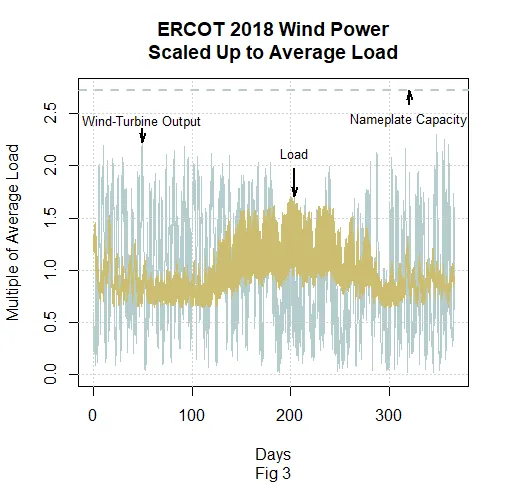
So, if you have to rely on storage to make it work, you’ll need a lot.
But he did show that overbuilding (ie meeting peak load) really does help.
Nick, look more closely at the graph and note how often “enough is enough” doesn’t happen. For your poor deluded mind that is all those periods when wind output is BELOW that average.
However, we do agree; that managing to the average leaves even more periods where grid coverage fails.
“(ie meeting peak load)”
You can NEVER build enough wind to reliably meet peak loads.
And the mount of “overbuilding” of battery storage requirements is a complete and utter waste of money.
We have had coal, gas as reliable supplies, and by gradually expanding and renewing those plus building in nuclear to meet requirements there would be zero need for the erratic parasitic instability that occurs when wind and solar infections gets into the grid.
More gibberish and ignorance from Nick.
Your comment makes no sense whatsoever.
Coal used to meet peak load all the time , BECAUSE IT COULD.
Wind can NEVER follow load curves.. it is an erratic parasite in the supply system.
Your mindless zealotry is destroying what little ability you may once have had for rational thought.
Nick, you have misread the article. Wind was not being ‘constrained’ – the article was being deliberately conservative to make sure that the figures calculated for wind were not too high. Obviously a functional system for wind plus batteries would need a safety margin, and that would make the figures for wind even worse.
“to match average load in MW”
The chances of wind ever “matching average load” is infinitesimal and is trite and meaningless nonsense anyway.
FFs can match any load needed, and do so all the time.
The only thing that will cause a problem is getting rid of fossil fuels in favour of unreliable and erratic wind and solar.
The issue with storage has nothing to do with peak demand. Storage is needed to cover time when wind and solar aren’t producing at their rated capacity.
This is a problem that is unique to renewable energy sources.
Another Naptown Numbers piece suggests that geographical diversity would tend to reduce the overbuilding problem but could prove problematic.
Nice analysis, Joe. There are lots of useful numbers in there to ponder. As you know my 122 hours of storage was based on one summer where we never encountered any departure between generation and demand like the February 2021 Texas mess. February 2021 was actually a near disaster across the entire central portion of the country. Xcel energy burned through so much unbudgeted natural gas that they are still clawing back the cost and I suppose other midwest utilities are doing the same.
The EIA estimate of 4.3% return on capital is likely to be low. I am opposing a rate request out here where the utility wants 7.6% return on capital and 10.3% return on their rate base. At some point in the next few months I plan an essay on rate-setting, and then a full discussion of this generate rate case that I have been at odds with for the past six months. I think the future battle over renewables is going to occur in the Public Service Commissions.
Darnit — “general rate case”. I wish we could edit again.
Europe has had 2 different, month to multi-month long shortfalls of 30% or more. And that is on top of seasonal differences.
Overbuilding also results in costs from curtailment. Texas curtails in the high 3.x% range with ~30% renewable output. Germany and Spain/Portugal curtail in the low 4.x% range with ~50% renewable output – and expectations are that curtailment would hit 5.x% with 75%/80% renewable output. The latest report I saw said that entire sections of wind installations were getting 1/6 curtailment (over 15%). Note that Texas is paying in the $200m/year range for curtailment whreas Germany and Spain/Portugal are paying in the billion euro range.
So 1 month of storage is certainly insufficient even as greater levels of overbuild would also increase systemic costs.
Curtailment would be much higher at 75-80% renewables supply. Remember surpluses only start to appear once capacity is high enough to meet demand lows. Add more capacity, and more hours result in a surplus while the size of surplus grows in the lower demand hours. There is little reduction in shortage hours because output is low. Absent storage you would end up with curtailment of over a third of total output, with marginal curtailment at 80-90%. An extra wind farm would only add 10-20% of its output that was useful, making its effective cost 5 to 10 times the basic LCOE.
I’m not sure what “much higher” means numerically, but it seems unlikely that it would hit 1/3 levels.
The question is just how much overbuild is necessary for 75%-80% renewables output. In Spain/Portugal case, it means a roughly 145 GW on top of existing 80 GW of renewable production – in turn displacing ~20-30 GW of fossil fuel base load.
All I can say is that the utility companies in Spain and Portugal are expecting curtailment to only rise to maybe 5% or so – but I also think that the present natural gas situation in Europe plus Spain LNG hubs means that these countries may well think they can achieve Denmark levels of renewable generation via full natural gas dispatchables that are subordinate to the renewable production.
Germany, far less clear since they are a net natural gas sink – but maybe their rapid deindustrialization will take care of that problem.
It may seem unlikely, but I have done the sums for GB. A quick look on electricitymaps suggest Spain is at 39% wind and solar, and Portugal at 35%, which is some way below the point at which curtailment really begins to bite.
Here is a somewhat stylised model of how wind penetration and capacity are related for a simplified UK system that just uses CCGT for balancing.
The idea of relying on storage is terrifying. When you hit zero, as occurs in the middle of the chart in the article, if the wind doesn’t come back then, you have NOTHING. Even if you see it coming and frantically build and install new batteries, they won’t help because you can’t charge them. Even worse, you have used lots of energy that you can’t spare in order to build them. None of those issues apply to fuel-based systems.
Yes mike, the story is also that we need to recharge the battery fully, before the next event where they are required. With 30% nameplate power, that means a battery for full load (in the UK for abouit a MONTH) and three times the average load installed capacity. This year we had a few weeks with little generation from wind, in a couple of times only a week apart. Anyway this quantity of storage in batteries is simply too dangerous to contemplate, one tiny fault and you will get a nuclear sized explosion, the energy density is simply too high and very dangerous.
From what grid source does that battery charge come from when the wind doesn’t blow?
You are dead right here. There is no substitute for the immediacy of combustion. It’s why the two greatest advancements of the human race are 1) combustion (control of fire), and 2) agriculture. Half of our society hates them both.
Half of out society hates society.
I had a debate with one young socialist who proclaimed that the worst mistake mankind ever made was to abandon the hunter gatherer lifestyle.
Ukraine The Latest has an interview with former deputy national security advisor to President Donald Trump Victoria Coates as part of their Wednesday, October 4, podcast.
Coates clearly understands that ‘renewables’ aren’t viable. So, some kind of sanity has seeped into the upper part of the political world. Importantly, Coates is willing to speak the truth out loud.
I suspect that the hard facts of physics and economics will seep into the Democrat consciousness enough that some of them will be willing to speak the truth out loud.
Like the people finally being willing to say out loud that the emperor had no clothes, almost everyone will admit that renewables are impossible and we should have had a Manhattan project for small modular reactors.
I am losing hope that climate science will self-correct any time soon but the utter futility of renewable energy should be well nigh impossible to ignore.
“I am losing hope that climate science will self-correct “
It isn’t going to change tack, only double down. It – science – is the fig leaf of authority and respectability that covers their true intentions. Intentions summed up many years ago now by Herr Edenhofer of Potsdam fame.
And now we must de-industrialise and de-develop.
The IPCC baseline is the preindustrial period the end of the Little Ice Age around 1850 when life expectancy was 29 years.
Spet 2021 the UK had a month of no wind. Electricity prices shot up 250% (year ahead prices). So we need a month of storage. Given we use 300 TWh a year, we need 25TWh of storage. And that is a ridiculous amount.
There is some more pumped hydro planned, if constructed, would add 4.9GW to the UK’s existing capacity of 2.8GW to go over halfway towards achieving the 15GW of capacity that is expected to be needed by 2050
We are so far off 25 TWh of storage it is insane
Pumped storage is now on the hate list of the greens- at least here in New England. There is only one here in Wokeachusetts – and it’s up for license renewal – the greens are fighting that renewal.
“I assume wind can be scaled up”
Assumptions are de rigeur these days and scaling up in the UK is somewhat difficult. In the case of solar energy:
“Planning permission for 23 solar farms has been refused across England, Wales and Scotland between January 2021 and July 2022”
https://www.localgov.co.uk/Planning-permission-refusal-for-solar-farms-sees-significant-uplift–/54753
And more recently:
“Rejection of huge Nottinghamshire solar farm met with applause”
Councillors unanimously voted against the project, with a round of applause from local residents
https://www.nottinghampost.com/news/rejection-huge-nottinghamshire-solar-farm-8245923
“Rishi Sunak has eased an effective ban on new onshore wind farms”
https://www.bbc.co.uk/news/uk-politics-66715141?at_medium=RSS&at_campaign=KARANGA
Storage is going to be just as difficult.
“The leader of Leeds City Council has criticised plans to build two separate battery storage sites in the south-east of the city. Councillor James Lewis has joined around 800 residents in objecting to the proposed schemes on greenbelt land near Allerton Bywater.
Concerns around the risk of fire linked to such sites have fuelled widespread opposition to proposals.
“The fire service haven’t minced their words in terms of expressing their concerns about battery energy storage systems. “In the worst-case scenario, we could end up with firefighters standing on the site fighting fires for days. That’s not something any of us want to see.”
https://www.bbc.co.uk/news/uk-england-leeds-66671847.amp
The way things are going very little is going to surprise me, I’m sure.
As for scaling up wind- it’s time to pray to Aeolus to blow harder.
The thing with a large battery site fire is that it wouldn’t just burn, it would explode, with some significant proportion of the stored energy. 25 TWhr is many, many nuclear bombs at once. Total destruction could be a 100 mile radius circle. No fun at all.
“I assume wind can be scaled up”
Let’s scale up wind when it’s not blowing and solar at night. Those impossible cost limits have not yet been realized in the general populace.
“”Except, weather and climate don’t follow a gaussian distribution, but rather something like that of a fractal – a hyperbolic or power-law distribution.
No they don’t and they never did.
They did follow a very slow trajectory = basically that of drip, drip, dripping a weak acid onto a chemically basic substance.
i.e. Rain (carbonic acid) vs Rock = as found in mountains everywhere.
Plant-life, similarly everywhere or certainly should be, depends on that process and because of the immense control that plants exert on water (capture, retention/storage and release) – plants effectively control weather and thus climate (on the land)
Plants also depend on bacteria, bacteria require Oxygen and Oxygen can only percolate a very shallow depth into the ground.
As time progresses and the rain continues relentlessly, the thin/shallow surface layer becomes poorer and poorer in the nutrients both plant/bacteria need and they inevitably perish.
Ice Ages occur at that point.
The arrival of an Ice Age is a Step-Change in climate, weather, temperature, humidity, winds, clouds, solar energy and simply everything thus is= A Division by Zero
Atmospheric Carbon Dioxide levels also ‘step change’ at that time but as a consequence, not as the cause.
Did Gauss know how to achieve such a thing? Divide by Zero?
Methinks not hence a Gaussian analysis is hardly appropriate.
Of course Climate Scientists everywhere know exactly how it’s done BUT, if you ask them, you’re met with a torrent of abuse.
The significant Antropogenic Contribution comes in that we humans have immeasurably ## accelerated that drip, drip, drip process.
(Which is what we ‘see’ with thermometers = the output of a system that is undergoing rapid change)
## That was a lie. It not immeasurable at all.
It is that no-one wants to measure it – everyone wants to deny it is even happening.
Everyone wants to believe that ‘Everything has never been better’
While the list of civilisations that existed in similar denial is as long as your arm.
Too damn right ‘Expect a surprise‘
Wind is often modelled by a Weibull distribution with shape parameter around 2. Much better to use real data of course, but the distribution does allow some quick and dirty estimates.
The Earth is still in a 2.56 million-year ice age named the Quaternary Glaciation in a cold interglacial period named the Holocene that alternates with very glacial periods. The interglacial periods last around 10,000 years while the glacial periods last around 90,000 years.
https://en.wikipedia.org/wiki/Quaternary_glaciation.
Good write-up Kevin Kilty, of a good illustrative exercise. Some don’t seem to understand that a simplified exercise is for the purpose of highlighting the severity of the issues. It’s not intended to be a design, or even a proof-of-concept preliminary design.
If it can’t be made to work, even using these very generous assumptions, then there is no way it will work given real world numbers.
I don’t have enough experience/knowledge of the power sector to comment on the details, but I did want to commend you for an excellent post. Easy to follow your logic and particularly I liked how plain you made your assumptions. You made it very plain how someone else could modify this analysis with different assumptions, for a different geography, or with a larger safety margin. Well done!
The price of lithium will go up with more usage….massive usage if world backup is provided…is there that much lithium? The answer is just use Thorium Liquid Salts Cooled Reactors…..no storage needed….use the lithium for the EVTOL fleet.
The Administration’s “all-electric everything” goal would require a rough tripling of generation, transmission, distribution and storage. That might have some impact on Kevin’s numbers. (sarc off)
This has become a sort of Nick Stokes vs. everyone else thread, but let me restate a couple ofpoints. First, the lowest reserve found here is so close to the edge that it is unworkable. First, I would remove most simplifying assumptions, add many more years of data, push this analysis out to a five month season May-Sept because record heat can occur as early as May in many locations. In fact add October as it can be a hot month in the southwest. I’d repeat for the 5 or 6 month long heating season Nov-May. Sixty years worth of such analyses is probably a minimum. Add inter balancing area transfers, but these are constrained by line capacity and he fact that in extreme conditions everyone will want the same resource. I don’t think such transfers will solve the problem, but why not figure on spending yet more money in hopes that geographical diversity will solve the issue?
Now ponder that we have to scale up by a factor of 2.5 eventually because people think we can run everything in the country on electricity. This will change seasonality in the analysis to heating season being that of greatest demand. The entire transmission and distribution system has to be built 2.5 times too.
The whole scheme founders on limits to materials, labor, transportation, but the biggest issue I see as the problem being mainly full of unaffordable solutions, not even remotely affordable. One cannot use all of savings on any single issue no matter what it is, and printing money will reach its limits as this just destroys real wealth. It’ll be an environmental nightmare too.
Exactly.
Although I found the geographical-diversity issue murky, I wrote up what little I thought I could glean about it from some ERCOT-only data. It’s all based on questionable assumptions, but it does tend to support your skepticism about the degree to which that can help.
It is interesting to see that a certain mind-set pervades thinking of solutions so many of our societal problems. That mind-set is that solutions which will not work at the micro-economics level at all suddenly become possible at a macroeconomics level. I’m not talking about it being better to say have a large paper-mill rather than have everyone trying to make their own paper, but that some problems are not solved with economies of scale. At scale the problem remains the same. One good example is private/public debt. Another is that supplying one’s own power with wind/solar plus storage, which is darned expensive if a person thinks about it rationally, is suddenly viable for the national as a whole if the system is dispersed enough geographically.
Donald Boudreaux, who I think of as a fabulous economist, has a great article out this morning at the American Institute for Economic Research making this exact point with regard to social behavior. It’s well worth reading.
Roger Andrews made a study of the New England grid which has a load of about 120 TWh per year and maximum demand of about 30,000 MW
He assumed only wind and solar as energy sources; no hydro, no nuclear, no fossil, no bio, no garbage burning power plants.
He found storage required was 10 TWh, and the installed capacity of the storage had to be at least 20 TWh, because of:
1) 20% losses from HV AC to HV AC
2) aging
3) downtime of some parts of the system
4) not charging to more than 80% and not discharging to lee than 20%, as recommended by Tesla,
to hopefully achieve a 15 year life
20 billion kWh x $600/kWh delivered to the high voltage grid = disaster
The losses are lower if the storage is co-located with the wind and solar generators, making them dispatchable. However, that would destroy the “cheaper than fossil” fantasy.
Anything subsidized at 50% of project costs, already for about 30 years, to make it look palatable compared with fossil, is a total loser, from a national competitiveness point of view, whether storage is co-located or not.
He didn’t include grid losses, which are probably around 2% at transmission voltages. The loss is the round trip through the inverter and the battery and back again, and applies to co-located storage every bit as much as storage located elsewhere. Not sure about trying to set up a battery park in the middle of an offshore wind farm… the ones being built are onshore at the nearest large substation.
See my above clarification
Yes. Disaster. A very large number.
For clarification:
The roundtrip losses are from HV connection, through step down transformer, through front end power electronics, into the battery, from the battery, through the backend power electronics, through the step up transformer, to the HV connection.
Very close. The important point is even $60/kwh is cost prohibitive and the associated cost for switch gear, ft
Dang it, my computer is in the shop and this tablet has a mind of its own.
Fire suppression and more costs $200/KWH. If the batteries were free, storage would still be too expensive.
The $600/kWh is the all-in turnkey capital cost of large scale, Tesla Megapack battery systems. The Tesla supply is only part of a complete system
Story tip
https://www.netzerowatch.com/callous-callanan/
No amount of money will make ruinables work – they will continue to force more and more people into energy poverty, hunger and ill health
Spreading the perverse costs of wind & solar and possible storage systems by more and more electricity and gas subsidies, levies and taxes is making energy a luxury – it is a human right that every citizen of earth should reliably and affordably enjoy
A plague on their houses
I don’t think the analysis would discourage a single politician or your average sheep. “We are all going to die” justifies (to them) quadrillions while $3 Trillion looks relatively cheap – even if the $3T only lasts 5 years before needing to be replaced due to either degradation or catastrophe. (Man, we’d all pay big money just to watch a 5221 GW battery fire).
Correct – you can just print the money.
First and foremost in my mind when I see anything about Energy Storage is the amount of energy that needs to be stored and the ability to turn these things into “non-nuclear devices”.
The recent Royal Society Report included a study modelling solar and wind generation using 37 years of weather data which found variations in wind supply on multi decadal timescales, as well as sporadic periods of days and weeks of very low generation potential.
“For this reason, some tens of TWhs of very long duration storage will be needed. For comparison the TWhs needed are 1000 times more than is currently provided by pumped hydro, and far more than could be provided cost effectively by batteries”
They concluded batteries would only provide short term grid balancing services and not large scale storage
Indeed. If you look at the integrated resource plans of utilities (IRPs) due every other year to your local PSC, you will find that they explain away many impossibilities with hydro or pumped hydro. The reality is that grid scale hydro is not a couple of puny ponds separated by 300 meters of elevation, but something more like Lake Mead. Those opportunities are taken already. In addition people fight new reservoirs tooth and nail and there are any number of “environmental” groups who want dams removed.
Let the lib liars have their $200/kwh, it doesn’t matter. In this example.that dropped the cost from $3 trillion to $1 trillion, still a prohibited cost. Even if the batteries were free the associated costs destroy the business model. Battery storage for more than four (4) hours is forever too expensive. It’s not conplicated.
Yes, indeed. Yet, the utilities and enthusiasts keep looking for the right battery chemistry. Xcel, I believe it is, now has more free government money to do two things 1) build a huge solar farm near Minneapolis (yes, that is the town in central Minnesota near 45 degrees north that is gloomy and snowy in winter, you can’t make this stuff up), and 2) a grant to evaluate so-called 100 hour batteries of the iron-air chemistry.
There is much talk of iron-air and aluminium-air batteries.
How about iron oxide-aluminium?
Going to aluminum is almost as bad as lithium from a national security viewpoint. The US mining of bauxite has been cut in half since 2015. Leaving us dependent on imports from China, Russia, India, and OPEC nations. The Greens are pushing the US into being a 2nd world dependent country.
That is absurd. There will be no shortage of alumina for batteries. The world currently prodices about 0.7 Mtons Li carbonate a year. It produces 140 Mtons alumina. Even the US produces about a Mton.
Someone is bound to suggest air-air batteries and receive a grant to study them. /s
The Search for the Magic Battery continues…
That must have been obscure, even by my standards.
How about rust – aluminium batteries?
Fe2O3 + 2 Al → 2 Fe + Al2O3
Isn’t that also known as thermite?
Somebody got it.
It must have been a crap joke if nobody else picked up on it, so I won’t quit my day job for a career in stand-up comedy:(
It does not matter, if the batteries were free storage for more than four hours is forever too expensive.
Lithium battery storage? How long would it take just to refine enough assuming it was available? And like all large renewable hardware projects you get to the point of diminishing returns as replacement outstrips the growth.
I think this is a very well-done article. I think it is a conservative cost estimate because it is only a first-cut. As noted, longer evaluation periods are appropriate. I believe that costs for the support needed for extreme weather cases would overwhelm potential cost reductions by adding solar.
I disagree with Nick Stokes that interconnection ties could significantly affect the results. I just published an article on my blog looking at New York offshore wind and the implications for energy storage. I quoted Off Shore Wind Data Review – NYSRC Preliminary Findings that found
“Lastly an analysis was performed to identify the most persistent wind lull experienced in the 21-year wind data with net capacity factor less than 10% for the entire period across all seven wind sites. Analysis indicates wind lulls of up to 86 hours with an average energy output of approximately 5% net capacity factor occurring across all seven sites were observed in the DNV dataset (this compares to an average annual net capacity factor of approximately 45%). While data associated with longer periods than 21 years were not readily available it may be appropriate to characterize this as a 1 in 20 year extreme weather event.”
The Trust, yet verify blog described a graphical explanation why over-building and interconnection are not a solution. It shows that the lower range of the percentage of solar and wind to demand stays low no matter how much additional solar and wind are built. This is because the spatial correlation of solar and wind resources is high and that is because the weather patterns that cause wind lulls at night are very large. So large that depending on the wind that is blowing somewhere for interconnection power would require an enormously large grid that would only be used on an infrequent, but critically important, basis.
Energy storage and interconnection are both too expensive. This is why the dispatchable emissions-free resource is being discussed.
Roger, your newsletter is a great resource for summarizing the craziness in the Northeast and has many useful links in it. I read it fully every issue.
To comment for just a moment on your remark about interconnection, also a point that David Wojick made in a comment above, if you take Figure 3 and ponder the middle portion of the graph where storage is almost exhausted and demand is greater than generation by more than 60,000MW, utilities are just now building expensive new transmission lines with capacities of about 2-3 GW. One would need 20-30 times as much transmission network and that is with my highly optimistic analysis and assuming that there is some source to transfer from. Dreamy stuff.
I looked at the wind availability for the NE following the Feb 2021 Texas energy blackout debacle. Wind was available in Nebraska and further west. Dreamy does not do justice to just how inappropriate the interconnection “solution” is.
It’s no dream. Here is a map of HVDC lines in China as at 2020, built for renewable energy
You believe propaganda too readily. Look at where China produces its coal. Then look at your red lines again.
“You believe propaganda too readily.”
The map from J.P.Morgan.
PV from Northern China.
You are really a gullible idiot, aren’t you.
Sorry dolt… they are using COAL-FIRED power.
Just think about how disrupting it is when the power goes out even for a relatively short period of time in your area. If you do not have emergency generation at home in your business at the gas station etc. 12 hrs irritating , @ur momisugly 24 hrs day to day society really starts to break down. Productivity drops phenomenally- local economic loss substantially accelerated. There cannot be anything marginal or iffy in modern society power generation/ distribution.
There is absolutely no room for wishful thinking in this field. 100% proof of concept is essential.
Yes. There is an old engineering maxim that says ” don’t replace what works with anything new until that new has been proven to work at least as well as what it replaces. ” I might add, if it only works as well, why even contemplate using it?
January that a regional utility could do no better than to take the most inclement weather period of the last sixty or seventy years, real data in other words, and show us how their hypothetical energy system would fare. Thus, I decided to marry Hurst’s algorithm with data from this past summer gathered from the EIA hourly grid monitor for the Northwest region which is where I live.
I decided on the time period stretching from June 24, 2023 through September 30, 2023. This period includes the season of heavy demand for air conditioning and irrigation and probably the poorest wind resources overall.
Now, we consider the structural uncertainty. that is te uncertainty due to analysis choices.
first choice: use te past 60- 70 years. This choice can bias the answer. that is why we
a: use the past 60
b: use the past 90
c use the past 120.
d use the entire record.
second choice data from this past summer again another source of bias
third choice: EIA hourly grid
4th choice: for the Northwest region
Im prett sure If i looked at the code I would find more arbitrary choices. Why?
Skeptics always reduce datasets. its a disease,
So whats the problem with making Choices?
Any time you make a choice you introduce the possibility of STRUCTURAL bias.
so typically we check methods for being stable with respect to data choices.
lets take surface measurements.
we start with 40000 stations.
A. we remove all the airports— what happens
B we remove all the large cities.
etc etc etc.
F. we remove 5000 randomly, 10000, 15000, 20,000
every time we note the effect of our choice.
otheerwise our approach may hide a secret bias
So, you are telling us that by my not looking at Ercot, and by choosing the summer season, and looking at only wind — then I might be wrong that in summer 2023 an all-wind Northwest region would need storage of 5,221 GWhr at minimum, and have an hour of reserve at minimum, and so forth?
It is difficult to classify such an absurdity.
It’s what you get when an English major pretends to be a scientist.
If that is the best an English Major can produce..
.. the institute he was at needs to be shut down, immediately, for gross incompetence.
Again moosh manages a load of completely incoherent non-english gibberish
That has zero meaning and zero point. !
Having lived through the Texas freeze of 2021 I would say if they can’t guarantee at least 10 days of peak grid demand in storage that it’s a complete and utter failure because if you can’t guarantee something along those lines people start dying.
I am all in favor of any energy input or solution as long as it reduces the cost to the consumer. If it doesn’t what good is it?
Do you know if grid energy storage systems would make fossil fuel inputted electrical generation and distribution cheaper? If not currently, is there a solution on the horizon that would make the difference?
The cartels and the Green Regime want us to pay higher and higher prices for energy. High cost energy is the problem. Low cost energy is the goal everything else is political BS.