Guest essay by Eric Worrall
h/t observa; Orbital space vehicle re-entry grade fireproofing technology is being deployed to prevent Electric Vehicle batteries from creating another Felicity Ace disaster. My question – when are fire blankets going to be provided to EV owners?
EV fires become hot issue
Maritime operators wrestling with solutions to EV fires as another car carrier burns
By John Mellor on 26th February 2022
…
The cars on the ship burned with such intensity that parts of the hull above the waterline melted.
…
According to data provided to Australian fire fighting services, these burning batteries reach temperatures of more than 2700 degrees celsius!
This latest fire on the Felicity Ace is the fourth since, in 2019, the Grande America, a roll-on roll-off vessel with more than 2000 new and used vehicles on board, sank in the Bay of Biscay after the cars ignited. The crew of 26 tried to combat the fire but, within hours, the heat was so intense that it weakened the structural integrity of the ship’s bulkheads and hull. There was little that any of the crew members could do but to abandon ship.
…
As the industry searches for answers, some operators of car carriers are no longer accepting used EVs and some are also banning accident-damaged used EVs.
…
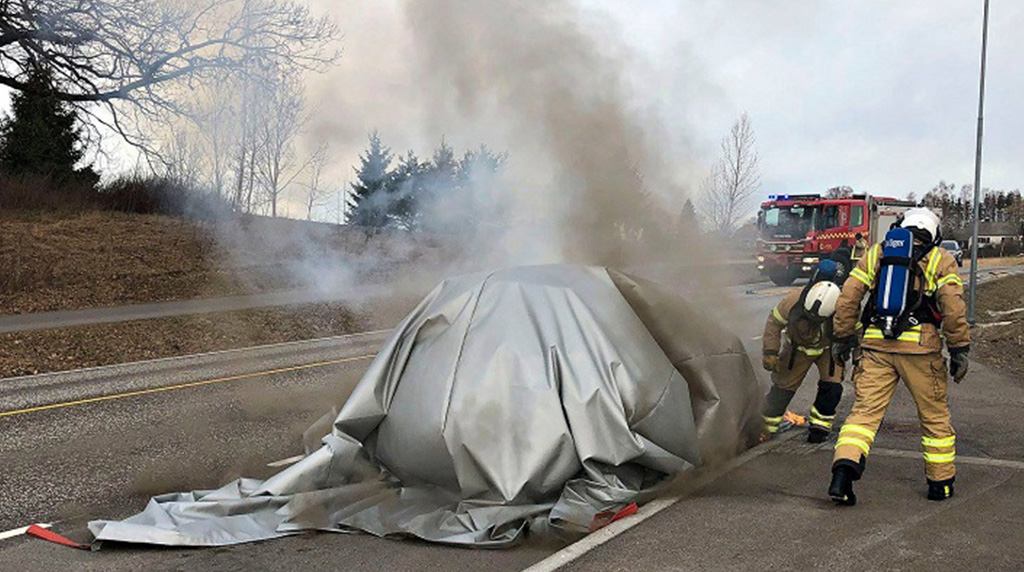
One possible solution would be to cover each EV with a special fire-proof blanket at the time an EV is being loaded and tied down to the car deck.
These would have the fire retardant qualities along the lines of those used by Bridgehill car fire blankets which in normal use are unfolded and dragged over burning cars thus containing the fire under the cover.
Some car carriers and ferry operators have already begun equipping their vessels with these blankets.
The blankets are made from similar material to that used on space vehicles to protect them from the intense heat generated on re-entry into earth’s atmosphere.
…
Read more: https://premium.goauto.com.au/ev-fires-become-hot-issue/
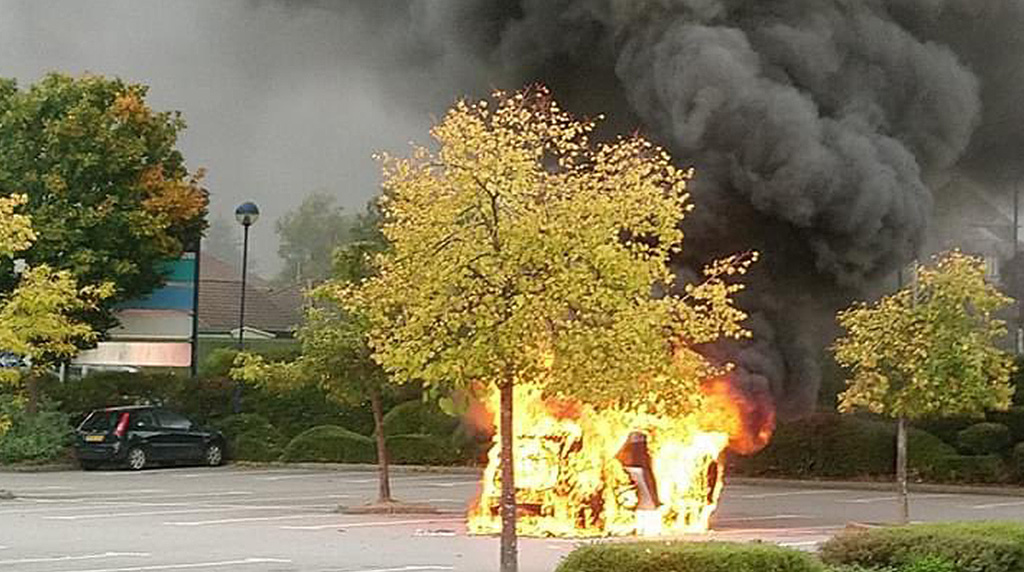
I have to admit I made a mistake in previous articles. I thought electric vehicle fires burned at around 2700F (1500C), but if this article is correct, the actual temperature is more like 4900F (2700C).
What house building material can withstand large fire emitting heat of that magnitude? Just looking at a fire that hot can injure your eyes, let alone trying to fight it.
Now that maritime transport companies have noticed the catastrophic risk of transporting EVs by ship, surely it is only a matter of time until home insurance companies wake up to the catastrophic fire risk of owning an EV.
Chinese video of an e-scooter catching fire, and burning with a white hot flame. An EV battery is much larger than a scooter battery.
Suggestion, fully discharge the batteries ? Reload after arrival? Ground the vehicle poles to the ship?
They have very real problems with lithium battery storage and its increasing adoption yet here’s where they’re coming from-
Lake Pedder was dammed 50 years ago for hydro power, but could it now be time to drain it? (msn.com)
Not to worry as the brains trust are into internet electricity now and who needs pesky storage?
How to balance renewable grids WITHOUT energy storage! – YouTube
Warning: You’ll likely only take that in very small packets.
This in Enron on IOT – Internet of Things.
Enron, the Ranch at the Crooked E, an energy trader, spectacularly imploded in 2001.
But hey, why let the resulting CA-sized budget crater get in the way of millions of household budget craters?
Exactly like cashless chip wallets, at any moment your spending or energy use can be vetted for green targets for your age, health, family size, number of pets, car type, and WUWT comments.
The Crooked power!
Anyone know what exactly started the fire?
climate change, of course.
Well, I am now completely convinced that I do not want an EV within 50 miles of me.
What causes me to pause upon reading this is the fact that just placing a fire retardant blanket over the EV before it is BOLTED DOWN TO THE METAL DECK won’t be enough. The fire can melt through the deck and if below the water line, melt through the hull of the ship, especially since the heat from the fire is approximately 4,900F. I think something more should be done but what? Heat resistant tiles like the space shuttle on the decks of these ships that carry these mini-bombs?
Only a Class Delta fire can melt steel like that.
Rushed in and bought yourself an NMC battery EV did you? Perhaps you shouldn’t have been a pioneer/guinea pig for battery cars and waited more cautiously to see how they pan out-
BYD blade battery – What makes it ultra-safe and comparison with ternary batteries • EVreporter
Oops! We don’t really want your dangerous incendiary on our ferries and charging in the basements of our Grenfell Towers etc as they’re just too damn dangerous. Same deal sticking such batteries on house walls or trying to make the power grid reliable with them. They’re clearly not fit for purpose. This needs Regulation that either your lithium battery passes that BYD nail test etc or it’s clearly labelled and severely restricted as to where it can be housed parked or charged.
What’s in your garage?
My new drone has an optional fire prove bag to allow these Lithium batteries to be transported on a plane. The bag is supposed to snuff and limit the fire if it breaks out. The manufacturer suggests that the batteries NOT be fully charged until they are going to be used and should be stored at 65% charge for long term storage.
i think we really need to stop the mindless removal of gasoline driven cars from society until these batteries are a little more reliable and not s prone to catching on fire.
Notebook/laptop computers are all allowed on planes without restriction and many other devices that have lithium batteries.
Different formula
Here is an article on “RO-RO” ship accidents from AutoWeek. That is a lot of accidents and lost cargo, mainly cars. The last one is the Felicity-Ace, which was loaded with EV’s. The presumption is that the fire either started because of or was made dramatically worse by the presence of the lithium batteries. Seems reasonable. Volkswagen is apparently going to eat the loss, but it’s nothing to them according to the article. The article also points out that fires are less likely with an EV than a conventional vehicle (admittedly, the EV fires can be much worse). This is something to be sorted out, but it is not the end of the road for EV’s. Felicity Ace Fire is Out | Why Do Car Carriers Have Such Trouble? (autoweek.com)
Nobody said that the is accident was going to immediately cause the end of EV cars.
To many political jobs on the line for that to happen.
BTW, I see you are still ignoring the many credible responses to your various claims.
Mr. W.: IMO Mr..1 does not respond out of a tender concern for the commenters here who don’t bring data and mock him. If anyone here predicted the immediate end of EVs from this catastrophic fire (ooops, there I go again) it was jsut wishful thinking. Mr. .1, you seem to think that “the end of the road for EVs” is a bad thing, but if not for AGW kraziness, there would be NO EV fires AT ALL. I think that the loss of this boat (the latest is, sank) would lead rational actors to make sure not to put another EV on a RORO, period. You seem to think, ah well it’s insured and we’ll learn from this. So no, I don’t predict the end of EV, only that it would be the end of EV if reason/risk assessment prevailed. You think we should keep going, how many ships you want to lose?
When I shipped my car across the ocean I had to have the gas tank under a quarter tank. I can’t believe they would allow fully charged EVs that can burn for days? They should drain them completely.
It’s the battery itself that is burning. The charge in the battery is only a small portion of the available energy.
Looking at pictures of Russian Army convoys I am trying to imagine the scene if the armoured vehicles and support vehicles were EV.
And considering the fleet probably of almost as many back up generator vehicles and diesel tankers to refuel them.
No wonder the people chose Henry Ford’s Model T internal combustion engine cars and stopped buying the lead acid battery electric cars, they couldn’t carry liquid electricity in cans to extend the range for trips outside of cities.
I think the real question is if any of the EV religious zealots are ever going to wake up.
In the 1980s the Pontiac Fiero gained a reputation for catching on fire, even making it to the national news. That very obviously damaged sales, even though very few caught fire. Imagine if GM had legions of radical fans threatening and cajoling anyone reporting on Fiero fires the way EVs do today.
Why, the Fiero might still be on sale as a baby Corvette (though obviously no longer a Pontiac).
It’s dead Jim.
Massive cargo ship carrying cars sinks in mid-Atlantic – ABC News
That’s going to make determining the cause of the fire a bit tricky.
Problem solved! Burning ship full of luxury cars adrift at sea sinks in the mid-Atlantic : NPR
You’re probably trying to be funny, so I’ll keep it light. EV fire stories will kill EVs. If people are aware that they can’t be parked inside, the market disappears. I don’t need to fluff the story at all by claiming that EV fires happen all the time, just let people know about what happens when it happens. EV enthusiasts understand this and clearly are on a mission to downplay the risk. You come here to downplay it and accuse commenters here of somehow inflating the risk. No need to inflate it, just let buyers know that it can catch fire spontaneously and can’t be put out. So why do you think the story should be downplayed?
It’s possible that if people become sufficiently afraid of them, then what you say could come to pass. I just can’t predict that. To the extent that the problem is there, or the perception of the problem is there, I’m sure the companies making EV’s and the government wanting you to buy an EV will do what they can to alter the public’s willingness to accept the risk, whatever it is. It might depend on instances of sufficiently bad fires ignite a public reaction. We’ll have to wait and see on that. It may be that underground parking where you have an occupied building above it will have to have much more aggressive fire detection and suppression systems. You may never be able to be able to totally engineer out the risk, but you can manage it. You also have the reality that fire rate for EV’s is very low, and it will probably improve over time. IMO, if EV’s die it will be from other causes, not the fire risk. I worked in oil refineries all my life and every one I was ever associated with had significant fires. That risk is always there; you manage it, you don’t just decide you’re not going to have refineries. And if you think the fire risk is awful, look into what could happen with an HF (hydroflouric acid) loss of containment. It could be a disaster, but we still have HF units.
Mr. .1: I get that EV manufacturers will “do what they can to alter the public’s perception”, what I don’t get is why you are doing it. Do you manufacture or sell EVs? “[B]ut you can manage it.” No, you can’t, or the ship would not be destroyed. Did you ask somebody for data above? Give us data on managing these fires. Fires at refineries are a problem, and have been for awhile, right? If we had a choice, we could get rid of refinery fires, right? If EV’s were fit for purpose, we could have built them after WWII and saved alot of refinery fires. We have an alternative to EVs, and they should be ashcanned before somebody gets fried- it could be you!!!
Nobody here is talking about “perception” of risk. We are talking about actual risk. You have always been the one trying to down play the risk.
PS, I love the way you keep making proposals that always involve other people spending even more money, in order to somehow mitigate the increased risks caused by EVs.
PPS: You have claimed that the fire risk for EVs is very low, you have not demonstrated it.
1)The total number of EVs are only about 1% the total number of ICE cars, yet you insist on comparing absolute number of fires.
2) EVs are new, most are less than 5 years old, many ICE cars are over 10 years old with many up to 20 years old. Until you account for age in the fire risk, you aren’t dealing with real numbers.
3) Almost all ICE fires are the immediate result of collisions.
4) The few ICE fires that are spontaneous are almost all the result of electrical shorts, EVs have as much if not more electrical wiring than do ICE vehicles, so as they age, the risk is as great or greater.
5) The vast majority of EV fires come from the batteries spontaneously combusting. ICE cars simply do not do that. This is a unique threat that only exists for EVs, no matter how hard you try to spin this otherwise.
6) At least you finally stopped trying to claim that batteries and EVs are an infant technology. I guess even you were eventually overwhelmed by the data presented.