Guest essay by Eric Worrall
Researchers in Maine have expressed concern that if they experience a few degrees of global warming, they will no longer be able to grow potatoes. But given Maine potato varieties are extensively grown in subtropical Bundaberg, my question is, what problem are the researchers actually trying to solve?
Researchers try producing potato resistant to climate change
Nov 28, 2021
BANGOR, Maine (AP) — University of Maine researchers are trying to produce potatoes that can better withstand warming temperatures as the climate changes.
Warming temperatures and an extended growing season can lead to quality problems and disease, Gregory Porter, a professor of crop ecology and management, told the Bangor Daily News.
“The predictions for climate change are heavier rainfall events, and potatoes don’t tolerate flooding or wet conditions for long without having other quality problems,” Porter said. “If we want potatoes to be continued to be produced successfully in Maine, we need to be able to produce varieties that can be resistant to change.”
Around the world, research aimed at mitigating crop damage is underway. A NASA study published this month suggests climate change may affect the production of corn and wheat, reducing yields of both, as soon as 2030.
…
Read more: https://mcdowellnews.com/news/national/researchers-try-producing-potato-resistant-to-climate-change/article_b3aa39c7-a682-5152-9b94-fb44b0493a2d.html
Bundaberg, Australia (24 degrees south, average annual temperature 77F) is a major potato and root vegetable growing region, along with sugar cane, strawberries, pineapples and bananas and who knows what else. Bundaberg experiences lots of tropical rainfall and occasional flooding.
Subtropical Bundaberg actually grows MAINE potatoes. They are no different to the varieties farmers plant or have planted in Maine.
The Subtropical Bundaberg grown Sebago potatoes at the top of the picture were developed by the United States Ministry of Agriculture in partnership with Maine Agricultural Experiment Station in 1938.
What is the secret of Bundaberg’s success with potatoes developed in Maine? Very simple – Bundaberg farmers plant the potatoes in Fall, the plants mature over winter, and they harvest in Spring, before the Summer heat kills them. The closer to the tropics you get, the sooner you need to plant, if you want to grow temperate climate vegetables, until somewhere around 27 degrees from the equator you swing right through winter and start planting in Fall.
My point is the problems of how to grow crops like potatoes in warm climates have already been solved, by farmers who have been growing potatoes in warm climates for centuries. Suggestions that this is any kind of a challenge seem a little far fetched.
There is no remotely plausible level of global warming which Maine could experience in the next century which would come close to Maine matching Bundaberg’s climate. Any warming in Maine could be addressed by simply changing the planting time by a few days, a little drainage work, and maybe importing some Australian tropical potato farming knowhow.
Growing food increases the human Carbon footprint
You are obliged to starve to save the planet
Potatoes come from Peru on the Equator, albeit in the mountains.
Like many orchids found in the same locale, potatoes don’t like frosts or freezing, but grow excellently in the mild temperatures from growing at altitude near the equator.
The new potato will only grow at the equator or in a hot house, will yield up to 10 kilograms per hectare, and will taste like dirt. They will have it ready for commercial use in 40 years.
More researchers and their bosses who do not know their sacroiliacs from potatoes.
Potatoes are originally tropical to sub-tropical plants.
What kills potatoes thoroughly are hard freezes. Farmers in seasonally cold areas where the ground freezes can not leave potatoes in the ground over winter. Nor can they be stored where the potato will freeze.
University of Maine researchers do not know what or why they are doing anything with potatoes.
They must not be accountable for their work and are probably working from home away from any potatoes or potato science.
Will the lobsters notice the difference in the boiling pot?
Maybe this “global warming” potato will produce some really good French Fries.
The point of growing potatoes in a place like Maine (or the best spuds, in Idaho) is that their growing season is too short to grow many other crops. If Maine were to get a couple of degrees warmer, that would only expand the list of crops that they can grow.
The parts of Idaho that have the shortest growing season, such as in the upper Snake River valley, are generally limited to seed potatoes, which are smaller than the typical baking spuds associated with Idaho grown in the warmer (due to lower elevations and more southerly latitude) in the middle Snake River valley. The growing season in the middle Snake River valley is about 6-8 weeks longer than the growing season in Maine. And they produce better potatoes in Idaho than Maine.
Soil types are the biggest reasons for where potatoes are commercially grown.
Where I live in Virginia, potatoes are grown in the sandier fast draining soils below the Fall line (Tidal reach).
Above the Fall line, soils are frequently underlain by hard clay. Hard clay causes potatoes and carrots to grow deformed and when excessive water fails to drain off the potatoes rot before harvest.
Wait, wait WAIT!
Are you insinuating that the climate is DIFFERENT not just at different locations around the globe, but at DIFFERENT times of the year, such that one could simply move their growing season on the calendar?
Unpossible!
Sounds like those fellows that 30 years ago advertised and sold “beer without cholesterol”…
Did they check if potatoes suffer a lot with 3 or 4 C than now? Remember, potatoes are cultivated in latitudes ranging from Canada and central Europe to Kenya…
I have seen ads on UK TV for ‘gluten free’ shampoo…
Well done, griff
For once…
Upvote for griff, what’s next? Maybe cats and dogs living together!
It is worth pointing out that 99% of all potato varieties grown world wide originated in coastal central Chile, which has a Mediterranean climate and a latitude centering about 32 degrees south, with prevailing winds coming off the Pacific that moderate the climate. Maine, on the other hand, has a humid continental climate with extremely cold and long winters, and sits at about 45 degrees north latitude.
So growing potatoes adapted to a climate that is a couple of degrees warmer would actually much improve and lengthen the growing season for potatoes in Maine, and also make other crops that require longer growing seasons feasible in Maine.
Now you see why they call it catastrophic
I had dinner last night with a couple, in their 60s, who grew up in Maine.
They now (and have for over 30years) live in Las Vegas, NV. They are surviving in a slightly warmer climate.
Of course they can afford AC, etc. which makes this climate acceptable to most people.
Most of our electricity is generated with natural gas.
Chiming in from potato capital of Florida. Two of three rotations per year are potatos, including Sebago. U FL extension station Hastings – mean monthly soil temps Nov 2020 to Nov 2021. Hope I can make this work -lurked for almost 2 decades, first post.
Testimony to the fact that many academics are in the get the grant and write the paper business regardless of the facts
“Around the world, research aimed at mitigating crop damage is underway. A NASA study published this month suggests climate change may affect the production of corn and wheat, reducing yields of both, as soon as 2030.”
Now the damage won’t start until 2030????……….as trendline yields have continued higher for the past 30 years………….despite the dire predictions of crop disasters looming just around the corner the entire time:
I reinserted the original title and date from the article below…….. that they removed from the article to make it harder to find and so that people wouldn’t know when it came out.
U.N. Predicts Disaster if Global Warming Not CheckedPETER JAMES SPIELMANN June 29, 1989
https://www.apnews.com/bd45c372caf118ec99964ea547880cd0
UNITED NATIONS (AP) _ A senior U.N. environmental official says entire nations could be wiped off the face of the Earth by rising sea levels if the global warming trend is not reversed by the year 2000.
Coastal flooding and crop failures would create an exodus of ″eco- refugees,′ ′ threatening political chaos, said Noel Brown, director of the New York office of the U.N. Environment Program, or UNEP.
He said governments have a 10-year window of opportunity to solve the greenhouse effect before it goes beyond human control.
“Shifting climate patterns would bring back 1930s Dust Bowl conditions to Canadian and U.S. wheatlands”
So let’s see what those wheat yields have actually been doing for the past 30 years.
https://www.nass.usda.gov/Charts_and_Maps/Field_Crops/wwyld.php
How about corn:
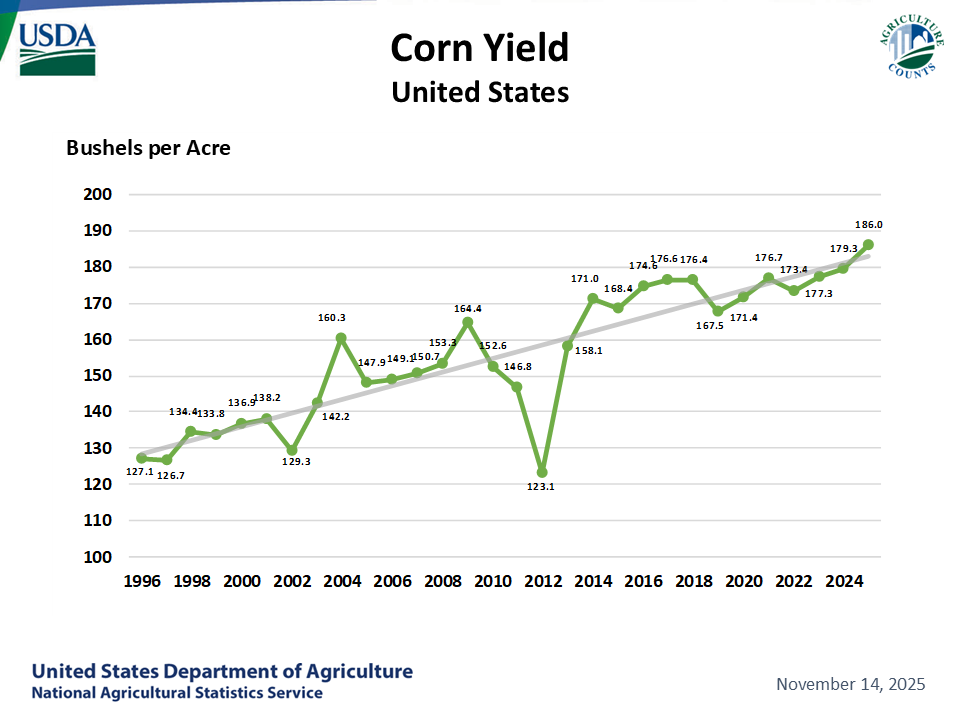
Soybeans:
https://www.nass.usda.gov/Charts_and_Maps/Field_Crops/soyyld.php
That’s more than 3 decades of being wrong almost every year. The response?
Manufacture even scarier scenarios because people aren’t acting fast enough to the previous scares.
It’s not about science, its about the politics of scaring people to convince them to follow an agenda, using a “save the planet” ruse.
Meanwhile, an Extinction Rebellion spokesperson appeared in front of media with an assortment of allegedly endangered potatoes glued to himself …….
“.. what problem are the researchers actually trying to solve?”
The problem they’re trying to solve is to fabricate a scary scenario consistent with the physics defying narrative of a global climate catastrophe caused by the technological advancement of mankind that has arisen from inexpensive, widely available and arbitrarily dispatchable energy.
Consult with the experts. Pelosi, Zucker, Obama, Biden, Kerry, etc… They even know how to stop Climate Change from making the Sea Rise… otherwise they wouldn’t be buying multi-million dollar beach front property.
funding their beach house …
My experience with potatoes is that they aren’t particularly happy being expected to grow in cold, frozen dirt, but will happily sprout and grow more potatoes once the dirt warms up a bit. But that was in the central Midwest where farmers generally have better sense about such things than lab rabbits. 🙂
“There is no remotely plausible (high) level of” grant money that a professor of crop ecology and management, will not find a “research” project to waste on….
“Gregory Porter, a professor of crop ecology and management”
Is he the guy who always wears a Kangol Summer Spitfire hat?
Brilliant. Now if they can just make a Stupid resistant potato.
Dunderheads.
A politically correct potato. There is no limit to what science can do with imagination and the carrot.
I’m not in academia, but where I work if you want to get some project funded or need to get equipment upgraded you tie it to the latest “big deal” pushed by corporate. This looks like somebody wanted to study potatoes and needed funding.
”…what problem are the researchers actually trying to solve?”
And the answer is… How do we keep the grant money flowing??
The story mentions the problem of increased rainfall.
So, I went to “WolframAlpha.” This is a question-answer engine, a high-level “Ask Jeeves” or ask Siri.
I entered “average rainfall trend Bangor Maine past 60 years.”
Guess which way their rainfall is trending?
Anything living that is resistant to change is also resistant to evolution.
Attempting to promote this in agriculture is of course no different than evil intent.