Guest Post by Willis Eschenbach
OK, folks, for everyone who wanted to put forth your favorite theory about how downwelling radiation from the atmosphere is a fantasy, or how a cool atmosphere can’t leave the surface warmer than no atmosphere, or how pyrgeometers are fatally imprecise … this is the thread for you.
However, I’m going to ask that before you start, you understand my actual position on these questions. So I strongly request that before you comment, you read the following four posts. That way, you’ll be clear about my thoughts on the matter.
Can A Cold Object Warm A Hot Object? 2017-11-24
Short answer? Of course not, that would violate the Second Law of Thermodynamics —BUT it can leave the hot object warmer than it would be if the cold object weren’t there. Let me explain why this is so. Let me start by introducing the ideas of individual flows and ne…
Radiating the Ocean 2011-08-15
Once again, the crazy idea that downwelling longwave radiation (DLR, also called infra-red or IR, or “greenhouse radiation”) can’t heat the ocean has raised its ugly head on one of my threads. Figure 1. The question in question. There are lots of good arguments against the AGW consensus, but this…
The Steel Greenhouse 2009-11-17
There is a lot of misinformation floating around the web about the greenhouse effect works. It is variously described as a “blanket” that keeps the Earth warm, or a “mirror” that reflects part of the heat back to Earth, or “a pane of glass” that somehow keeps energy from escaping. It is none of these things.
People Living in Glass Planets 2010-11-27
Dr. Judith Curry notes in a posting at her excellent blog Climate Etc. that there are folks out there that claim the poorly named planetary “greenhouse effect” doesn’t exist. And she is right, some folks do think that. I took a shot at explaining that the “greenhouse effect” is a…
OK, now that y’all have read those four posts, and you are all clear about my position, let me offer some data to focus the discussion. Figure 1 shows the month-by-month surface shortwave (solar, “SW”) and longwave (thermal infrared, “LW”) radiant energy flows at the SURFRAD station in Goodwin Creek, Mississippi. The US maintains something called the SURFRAD (Surface Radiation Budget) Network of eight surface measuring stations. These have a variety of sensors that, as the name suggests, measure a variety of surface radiation flows. Each station has a Downwelling Pyranometer, Upwelling Pyranometer, Downwelling Pyrgeometer, Upwelling Pyrgeometer, UVB Sensor, Photosynthetically Active Radiometer, Normal Incidence Pyrheliometer, and a Shaded Pyranometer. These are calibrated annually to assure accurate measurements. They collect data on an almost continuous basis, 24/7/365. The stations have data from 1995 to the present.
So I picked a SURFRAD station at random, Goodwin Creek, Mississippi. And I picked a year at random, 2014, and downloaded the monthly average data from here. After I plotted it up I thought “I wonder how well this agrees with the CERES satellite-based dataset?” So I added the corresponding CERES data to the chart. Here is the result.

Figure 1. SURFRAD and CERES data, Goodwin Creek, Mississippi. The CERES data is for the 1° latitude by 1° longitude gridcell where the SURFRAD station is located. The background shows the Goodwin Creek SURFRAD station.
Now, folks have been questioning lately whether the CERES data is accurate enough for the type of analyses that I do, whether it is fit for the purpose … this should allay some of their concerns.
With all that as prologue, here’s the important part of this discussion.
The red|orange lines show the amount of solar energy that is absorbed by the surface. It’s the net of the downwelling solar minus the solar that is reflected back upwards from the ground. As you can see, the annual average solar energy absorbed by the surface is about 150 watts per square metre (W/m2).
The yellow|gold lines, on the other hand, show the upwelling longwave (thermal infrared) energy, energy that is radiated upwards from the surface. The annual average upwelling longwave energy is about 395 W/m2.
Now, for all of you that think that downwelling radiation from the atmosphere is a mirage, here’s the question.
If on an ongoing basis the surface is only absorbing 150 W/m2 of solar energy and is radiating 395 W/m2 of energy … why isn’t it frozen solid?
Seriously. If it is constantly radiating far more energy than it is absorbing … why isn’t it a block of ice?
To me, the obvious answer is, the surface is also absorbing downwelling radiation from the atmosphere. In Figure 1 above, the blue|cyan lines show the total of the net solar (SW, red|orange lines), plus the downwelling longwave thermal infrared (LW) from the atmosphere.
The annual average of the net downwelling radiation at the surface (SW +LW), the total energy absorbed by the surface, is about 490 W/m2. This is about a hundred W/m2 more than the energy that is lost to radiation, with the rest of the surface energy loss being in the form of the net of the sensible and latent heat lost gained and lost by the atmosphere via convection and conduction.
So there you have it. If you don’t think that downwelling LW radiation leaves the earth warmer than it would be if there was no atmosphere, you need to explain the mystery source of the additional energy necessary to keep the earth from freezing. And no, it’s not geothermal heat. We know from borehole measurements that geothermal heat, in general, is on the order of a tenth of a W/m2 or so … and we’re missing about 395 W/m2 emitted minus 150 W/m2 absorbed equals 245 W/m2 necessary to prevent freezing.
So what is the mystery source?
Let me add that the most excellent agreement between the SURFRAD and the CERES data means that it’s not instrumental error, or scientists who don’t know what they are measuring.
So where is the energy coming from?
My best to all, let the bunfight begin, and please, keep it civil … I may be wrong, but I’m not an idiot …
w.
As Usual I Politely But Loudly Request: QUOTE THE EXACT WORDS YOU ARE DISCUSSING. I can defend my own words. I can’t defend your interpretation of my words.
Discover more from Watts Up With That?
Subscribe to get the latest posts sent to your email.
Nice try Willis, but unfortunately there is no shortage of people whose understanding of this issue is guided only by their politics or their religion. You are never going to persuade them of anything using logic and scientific arguments.
Certainly, the “politics or religion” is a motivating force for those who deny the radiative “greenhouse” effect. I think another factor is that most of us don’t notice the radiation around us from objects at “ordinary” temperatures. We only really notice radiation from hot stoves, or from direct sunlight, when we can’t ignore it. It’s hard to grasp that all solid objects are both radiating and absorbing radiation all the time; it’s even harder to grasp that the air we breathe is absorbing radiation and radiating back at us.
So, when told that the atmosphere is radiating heat back to the surface, some folks will refuse to accept it because it is something outside their everyday experience. Even if we know the physics, most of us still go through our daily lives without noticing or thinking about the radiation we are exchanging with our environment. If we can’t feel it, it takes an intellectual effort to accept it as reality.
It’s similar to our understanding of relativity. We can read that clocks in orbit run slower than clocks on earth. We can understand the mathematics of it, which aren’t at all difficult if you have a decent high school education. We can accept that it happens every day with adjustments that have to be made to the time signals from GPS satellites, but I suspect that most of us, with our Newtonian brains, can’t really “feel” it. If we were exposed to internet postings that portrayed general relativity as some sort of leftist trick designed to destroy our industrialized society, no doubt we’d be hearing a lot of relativity-denials too.
Clocks in orbit run faster – not slower. Gravity slows time….velocity slows time. Also, it may not be necessary to daily correct GPS satellites.
Actually, both smart rock and antigriff are correct in part and incorrect in part. Was covered in my introduction to ebook The Arts of Truth. GPS satellite atomic clocks need to have 20 nanosecond precision relative to their equivalent earth clocks. They are in orbit at 20000km altitude at a velocity of 14000km/hr. Thanks to velocity time dilation (special relativity) they ‘tick’ 7 microseconds per day slower. Thanks to spacetime curvature from Earth gravity (general relativity), they tick 45 microseconds per day faster. The net error is 45-7=38 microseconds per day faster, or 38000 nanoseconds. If not corrected for continuously, the daily GPS positional error drift would cumulate to about 10 km.
Newton’s truth is good enough to figure the GPS orbit, but not the GPS atomic clock net error.
Hence one of hundreds of illustration of ‘the arts of truth’. The book is mainly about untruths artfully disguised in various ways. The penultimate long examples chapter is global warming, reviewed by Richard Lindzen.
How do you know that?
Smart,
You are part of the problem by describing energy using the moniker of heat. They are two separate things.
One can differentiate between thermal energy and heat. Two bodies interchange thermal energy, but the flow of heat between them is only in the direction from the warmer body to the colder one.
Of course this makes problems when you talk about heat content and similar things, but you can be consistent and avoid the ambiguity of natural language.
I thought the rabbit done died…. 🙂
I love CO2.
Well, the Earth would die without it. 1000ppm would be more comfortable.
You said it direct sunlight, climate models reduce the amount as much as possible to inflate trace gases (from less than a watt to 100’s of watts) and ignore the big things like the ocean (71% of earth), 78% nitrogen,21% oxygen emitting 98 watts and clouds (water droplets) 79 watts. As you go up temperature falls yet radiation increases above the clouds (does it slow temperature decrease, no). Once globally absorbed heat 242 (340-98) watts dissipates temperature stops falling. Radiative gases heat up (stratosphere) heating the thin air of 400g/ cubic meter another 150 watts is absorbed. Cooling above this layer occurs thanks to carbon dioxide. This process happens in the mesosphere. The laws of thermal dynamics states a cold object cannot heat a warm object. 278.3 kelvins 1.38 e-21/K x (86 watts every second and every meter) heats earth by 5.3°C. 287.8 kelvins 1.38 e-21/K (sunlight) x (254 every second and every meter) heats earth by 16.2°C.
We’re always told that a cooler object cannot increase the temperature of a warmer object but it can cause the warmer object to lose heat slower and thus increase its temperature via a new thermal equilibrium. This argument completely ignores two important things: the work that went into placing that cooler object there in the first place and the time dependent heat transfer between the two objects that occurs before the cooler object can increase the temperature of the warmer object via a slower rate of cooling.
If you have an object at thermal equilibrium in a vacuum (like a planet) and then place a cool gas around that object it will eventually find a new equilibrium temperature that is higher. However, the gas must first increase in temperature to the point where the gas molecules in conductive contact with the surface are at the same temperature as the surface – the cooler gas above it doesn’t simply back radiate IR to the surface and warms it instantly with the gas in contact at the surface still at a lower temperature.
Their argument is like saying you can decrease the rate at which your coffee cools by pouring it from a hot mug with relatively high radiative cooling into a freezing thermos with very lower radiative cooling. In order for the rate of cooling of the coffee to decrease, the coffee and thermos that are in thermal contact must first reach the same temperature.
This works the same way for a planet surface. The surface temperature will not be increased by feedback from the atmosphere when the gas in contact with the surface is cooler than the surface itself – the surface will always decrease in temperature when the air in contact with it is at a lower temperature and do so at a higher rate than if that object were in a vacuum. The surface is warmed or cooled via the atmosphere depending on whether the gas in contact with the surface is warmer or colder respectively, regardless of how much IR the sky is emitting. And the gas temperature in thermal contact with the surface is not dependent on radiative heat transfer (see my reply above linking Einstein, 1917), but rather conduction/convection. If radiative heat transfer controlled thermal equilibrium of the planet surface/atmosphere, then night time temperature inversions would be impossible.
The diatomic gases that comprise 98% of Earth’s atmosphere were not magically placed there like in a thought experiment, a lot of energy went into them to create the gas phase in the first place and they retain this energy in the form of latent heat. Once in the gas form it doesn’t rapidly release that energy via radiation and condense, but rather it primarily transfers energy via conduction/convection with solid or liquid surfaces and other gas molecules. Thus an atmosphere acts as a thermal capacitor for a planet regardless of its composition.
I implore Willis et al to read Einstein’s Quantum Theory of Radiation and these:
https://www.researchgate.net/publication/276048562_Scrutinizing_the_atmospheric_greenhouse_effect_and_its_climatic_impact
https://arxiv.org/pdf/0707.1161.pdf
https://arxiv.org/pdf/1012.0421.pdf
If the difference between the warm object and the cool object has the expected heat required from the external source. Then cooling isn’t being slowed down. Each year the surface heats in the summer as land absorbs more heat than ocean. Object warms up and cool object cools further. Only the external source (the sun) can produce this effect. Not the cool object assumed controlling temperature. As winter (land snow extends) surface cools and cool object warms. Paragraph 2 (two objects 5°C (Sun 340w), 5°C Earth (340 watts) equilibrium. Place a cool gases (99%) nitrogen & oxygen and they have to increase to be in equilibrium with earth and sun. And they do. But a trace gas 0.04% does not, remains cooler than the surface. The energy 0.136 watts and even a slow increase in the gas will only add a few 100ths of a watt. Last paragraph confused me as your confusing nitrogen and oxygen with water. Trace gases remain cold gases therefore cannot warm a warmer object. Water changes states as it absorbs heat, rises and cools to dew point. Releasing latent heat while condensing into water droplets. Only this 2-3km is where cooling slows (otherwise clouds cannot form if cooling was to rapid) but after 6km cooling speeds up (as moister decreases) so total atmosphere isn’t controlling surface. Only the sun as it moves to from a more heat absorbing hemisphere increasing earths temperature which the other cools and ice expands slowing earth’s increase. Trace gas has no control as composition is almost equal in both hemispheres.
If the difference between the warm object and the cool object has the expected heat required from the external source. Then cooling isn’t being slowed down. Each year the surface heats in the summer as land absorbs more heat than ocean. Object warms up and cool object cools further. Only the external source (the sun) can produce this effect. Not the cool object assumed controlling temperature. As winter (land snow extends) surface cools and cool object warms. Paragraph 2 (two objects 5°C (Sun 340w), 5°C Earth (340 watts) equilibrium. Place a cool gases (99%) nitrogen & oxygen and they have to increase to be in equilibrium with earth and sun. And they do. But a trace gas 0.04% does not, remains cooler than the surface. The energy 0.136 watts and even a slow increase in the gas will only add a few 100ths of a watt. Last paragraph confused me as your confusing nitrogen and oxygen with water. Trace gases remain cold gases therefore cannot warm a warmer object. Water changes states as it absorbs heat, rises and cools to dew point. Releasing latent heat while condensing into water droplets. Only this 2-3km is where cooling slows (otherwise clouds cannot form if cooling was to rapid) but after 6km cooling speeds up (as moister decreases) so total atmosphere isn’t controlling surface. Only the sun as it moves to from a more heat absorbing hemisphere increasing earths temperature which the other cools and ice expands slowing earth’s increase. Trace gas has no control as composition is almost equal in both hemispheres.
Actually, the cooler gas does simply back-radiate IR to the surface. It will instantly slow the rate of surface cooling, provided the gas is warmer than the temperature of the radiation the surface was previously interacting with (i.e., the 3 K background radiation).
The planetary surface always has a rate of net radiative heat loss. This is given by radiative power emitted minus radiative power absorbed.
In the absence of the atmosphere, only only “radiative power absorbed” is on the order of σT₃⁴ where T₃ = 3 K, so that this power is negligible.
A gas at any temperature higher than 3 K will increase the amount of radiation being absorbed by the planetary surface, and thereby slow its net rate of heat loss.
There is no need for any of the gas to reach the same temperature as the surface before this effect starts to come into play.
This is just plain false.
In general, whether the surface is heating or cooling relative to what would happen in a vacuum depends on a comparison of (a) convective cooling and (b) reduced radiative heat loss due to back-radiation.
When convection is happening, this will often be the dominant heat transfer mechanism. But, if the atmosphere warms to a point where there is a sub-adiabatic lapse rate, then convection will stop. Conduction to the air, without convection, is a rather weak heat-transfer mechanism. So, at this point, it’s easy for reduced radiative heat loss due to back-radiation to become the dominant thermodynamic effect, at this point.
True, but so what?
Why do you say that? I’m pretty sure that’s false.
I’m also not sure if it’s relevant (it depends on what you mean), insofar as thermal dynamics between the surface and the atmosphere are controlled by a dance between radiation and convection.
Why would it? It releases energy via radiation, but is also being warmed by radiation, and sometimes convection. On balance, these keep the atmosphere from condensing.
It transfers energy both via conduction/convection and radiation. Both modes matter.
The atmosphere does act as a thermal capacitor (insofar as air and water vapor have internal energy).
And, some components of the atmosphere interact radiatively.
Both things are true.
“unfortunately there is no shortage of people whose understanding of this issue is guided only by their politics or their religion. “
Are you describing yourself, Tom? Are you a member of The Church of the Holy Back Radiation?
“Are you describing yourself, Tom?”
No, but he has you totally nailed down!
How so, Ed Bo?
Maybe I missed Tom’s reply. Did you get one?
It’s hard fighting these Willis groupies.
“Willis groupies”??? How about you dial back on the personal attacks and deal with the issues … people here are individuals. Some agree with me, and some with you. Calling them “groupies” is a sign of weakness. It just shows you are trying to negate their arguments through a personal attack because you can’t attack their ideas.
Protip—hating on people is like taking poison and expecting your enemies to die. It destroys YOUR reputation, not theirs.
w.
Ed Bo is supporting you by insulting me. In my book that is the behaviour of a groupie.
If you wish to argue with Ed Bo’s ideas, quote them and do so.
Claiming that he is a “groupie” is a shabby underhanded ad hominem attack, and all it reveals is that you don’t have either the knowledge or the albondigas to dispute his ideas.
w.
Willis Eschenbach: Purveyor of thermodynamic sophistry.
Where is your evidence for all your claims about the warming properties of DWLR or back radiation or in fact the existence of the GHE?
You have zero, zilch, nada. I know it, you know it and every honest poster on this blog knows it.
The claim by Berkeley Lab concerning Feldman et al (2015) was
“First Direct Observation of Carbon Dioxide’s Increasing Greenhouse Effect at the Earth’s Surface”
That’s it since 1988 when James Hansen stood before a Congressional Committee prophesying with accents terrible of dire combustion and confused events. And after an 11 year experiment they could not separate the effects of natural CO2 from anthropogenic CO2.
But you, Willis, seem to know better and you are well supported on this once superb website. Anyone who disagrees with you gets a negative uptick from the lukewarmers, even respected scientists and engineers who have contributed to WUWT for years.
You put out warnings, delete and snip if your arguments are shown to be wrong and sometimes I feel I am on the Skeptical Science blog run by arch warmista, John Cook.
Take your bullshit cargo cult science and as you rudely said to me a few days ago, stick it where the sun don’t shine.
You are a disgrace to open scientific discussion and as for albondigas, yours fell off years ago.
leitmotif, either you are unable to read or unable to follow a polite request. I said:
Come back when you muster up the nerve to do that, and we can discuss your objections.
w.
You don’t write a totally fact free article and expect people to “follow a polite request”.
You are a fanciful amateur who has been allowed to print what he wants on a major climate change website about things going around in his head.
I don’t need to muster up the nerve to tell you this; I just need to stop laughing long enough to be able to use my keyboard.
Do you have a huge block of ice in your house that exchanges energy with you and makes you warmer than you would have been without the huge block of ice?
You probably do.
Just delete what you don’t like, Willis. You usually do.
Oooh, leifie is butthurt! So leifie is doing what he’s best at—ignoring the facts, ignoring science, and spewing ugly personal attacks in all directions. Stand back, everyone, leifie is lying on the floor and having a tantrum!
So tell us, leifie … how many comments have I deleted on this thread?
What’s that? Speak up, I can’t hear you …
Yep. That’s right. None.
w.
Well done, Willis or should I call you Willie or Wilbur in the leifie childish mangling of my name?
You may be more familiar with lying on the floor and having tantrums, Wilbur, but as an adult it is alien to me.
I didn’t say you had deleted comments on this thread. You have been guilty of deleting comments on your previous threads, even in the last couple of weeks. Do you want me to to list them? It would be tedious and time-consuming as there are so many of them.
I said, “Willis Eschenbach: Purveyor of thermodynamic sophistry.
Where is your evidence for all your claims about the warming properties of DWLR or back radiation or in fact the existence of the GHE?
You have zero, zilch, nada. I know it, you know it and every honest poster on this blog knows it.
The claim by Berkeley Lab concerning Feldman et al (2015) was
“First Direct Observation of Carbon Dioxide’s Increasing Greenhouse Effect at the Earth’s Surface”
That’s it since 1988 when James Hansen stood before a Congressional Committee prophesying with accents terrible of dire combustion and confused events. And after an 11 year experiment they could not separate the effects of natural CO2 from anthropogenic CO2.
But you, Willis, seem to know better and you are well supported on this once superb website. Anyone who disagrees with you gets a negative uptick from the lukewarmers, even respected scientists and engineers who have contributed to WUWT for years.”
You decided not to reply to my observations and chose a visceral, childish reply instead.
When are you going to back up your fanciful hypotheses with real world observational evidence, Willie?
Never I fear.
As they say, you are a busted flush, Wimpie.
leitmotif May 29, 2021 5:15 pm
Oooh, now leitmotif is really angry.
And no, I’m not mangling your name. I’m mangling the alias you hide behind.
Come back when you want to stop your insults and discuss the ideas. You say I “decided not to reply to [your] observations” … what observations? All you’ve done is call me names and make vague claims that I’m wrong.
OK, if you think I’m wrong, quote what I said that you think is wrong, and tell us why it’s wrong. Because your claims that e.g. I’m a “purveyor of climate sophistry” or a “fanciful amateur” are totally meaningless in a discussion about science.
w.
Ok, Wilbur, since you refuse to address my comments above let’s cut to the quick.
Wilbur, you are an idiot.
Is that a better way of replying to you? I think it is.
Btw, I think you suit Wilbur. He was the hapless owner in Mr Ed.
Have a warm night snuggled up to your huge block of ice. 🙂
Byeeeee!
“You decided not to reply to my observations and chose a visceral, childish reply instead.”
LOL. You mean like you did in your very first post in this subthread? Buddy, you set the tone. That you are so butthurt over the tone being given back to you is just too ironically funny. Your’ve reaped what you sown.
Geoff Sherrington has not got 1 upvote.
The votes is a combined total of the ups and downs, so you cannot know that.
Sorry, I meant surplus. Geoff may have some who agree with him but more that don’t. I’m obviously on the negative side. 🙂
leitmotif,
Can you give me an example of any comment of mine that some agreed with but more did not? In real life on WUWT, I have many, many upticks. I think this post today is the first where I can see a downtick. Geoff S
leitmotif,
Pop down to here:
Geoff Sherrington
Reply to
Frank from NoVA
May 29, 2021 5:18 pm
There is an uptick there.
There is also an explanation for the game I was playing, which I usually do not play. Geoff S
Ed Bo is insulting you? How? By redirecting your own insult of “Are you describing yourself, Tom?” back to it’s source. Pot stop calling the kettle black. (or to use another familiar phrase, when you live in a glass house, you shouldn’t throw stones).
Willis writes good stuff that’s interesting. Your writings don’t measure up to that. Can you put together a coherenet criticism of what he wrote about in the article?
He seems to have adopted the style of the warmistas when they talk to skeptics, and in fact to have perfected the most exaggerated version of it.
Say nothing, say it loudly and rudely, and say it often.
I honestly wonder if he knows how he comes off to anyone observing these conversations?
Gosh, another person who thinks that attacking me personally makes them look oh-so-smart and convinces people that their ideas are correct … bad news on that front.
Nicholas, my ideas are either right or wrong, REGARDLESS of my shoe size, my sex, my style, or my scholastic accomplishments. If you want to prove my ideas are wrong, there’s only one way to do it:
1) Quote exactly what I said.
2) Use logic, facts, math, or other scientific methods to demonstrate, not claim but demonstrate, that my claim is incorrect.
Your claim that I “say nothing” is risible. In the head post, I laid out a host of facts, claims, and ideas. In the comments, I’ve discussed a wide variety of subjects and answered questions and objections.
All the rest of it, all of you guys that are hating on me? Meaningless. Actually, it’s worse than meaningless, because when people start throwing mud at me, the only logical conclusion that can be drawn is that they’re out of real ammunition …
Here’s a graphic showing the hierarchy of disagreement.

I discuss it here. Let me encourage you to move your discourse upwards on the pyramid.
w.
Mr. E,
After all that I have written here and elsewhere, why is it that I need to point out to you I was clearly talking about the guy who is insulting you?
Have you truly not ever noticed I have spent hundreds of thousands of words backing you up for literally years on end, including a large number of times in this and several recent posts of yours.
I even do so in the few cases where I have nothing to say one way of the other about the topic under discussion.
I know you do not like me, and so just assume the worst about me, reflexively.
That is your prerogative.
I do not talk about people badly who do not deserve it.
And I have never, ever, once, not a single time, talked badly about you, ever.
And I am not even gonna take it personally this time either.
I can count on one hand the number of times you have even spoken to me directly in a reply, and three of them were along the lines of this one.
As for the pyramid…
Have you not noticed that I post scads of evidence to back up what I assert?
When I criticize someone, I criticize what they say, and only return insults, never instigate them.
When I am wrong or mistaken, I say so and I apologize.
Very few others ever do, that I have seen.
I am at the top of the pyramid, and intend to stay there.
But I do wonder how it has escaped your attention that I have never hated on you even slightly, or that I was clearly talking about the person Ragnaar was replying to?
BTW, What I said about LM is true.
He says nothing, just issues drive by insults.
I never said he was wrong about anything, because he has not said anything to be wrong about.
He just says other people are wrong, and gives not even an argument, let alone anything backed up.
I really does kind of hurt my feelings that you imagined I insulted your shoe size, though, and all that other stuff.
But not because of what you said to me when you thought I was talking about you, but because it must mean you pay zero attention to anything I write.
I simply asked for evidence and I get none. I pointed out that the only paper ever written that claims that DWLR has been measured is Feldman et al (2015).
It is you Nicholas who is behaving like a warmista. You reject those who ask for evidence because the science is settled.
https://climateofsophistry.com/2021/05/19/green-plate-analyzed-and-demolished/
leitmotif
In addition to the continuous DWLR measurements done at each of the SURFRAD sites, and at the ARM sites, and the DWLR measurements at the array of TAO/TRITON buoys in the ocean, a very superficial search finds the following. There are literally hundreds more.
A Google search for “measurement downwelling longwave radiation -CERES -MODIS -model” finds over 13,000 hits. The same search on Google Scholar finds 713 journal studies.
The fact that you make the hilarious claim that there is only one paper on the subject is totally typical of your lack of depth of understanding of the issue.
w.
http://www.ibpsa.org/proceedings/BS2017/BS2017_569.pdf
https://ams.confex.com/ams/pdfpapers/83452.pdf
https://agupubs.onlinelibrary.wiley.com/doi/abs/10.1029/2020JD033590
https://www.researchgate.net/profile/Kaicun_Wang/publication/232772217_Evaluation_of_ASTER_and_MODIS_land_surface_temperature_and_emissivity_products_using_long-term_surface_longwave_radiation_observation_at_SURFRAD_sites/links/5a7fbab3a6fdcc0d4baa8337/Evaluation-of-ASTER-and-MODIS-land-surface-temperature-and-emissivity-products-using-long-term-surface-longwave-radiation-observation-at-SURFRAD-sites.pdf
https://core.ac.uk/download/pdf/132551676.pdf
https://www.sciencedirect.com/science/article/pii/S0360544214014029
https://agupubs.onlinelibrary.wiley.com/doi/10.1029/2019JD030763
https://www.tandfonline.com/doi/full/10.1080/07055900.2012.760441
https://www.jstor.org/stable/26185489
https://aip.scitation.org/doi/pdf/10.1063/1.4975560
https://www.nsstc.uah.edu/atmchem/docs/DEPSCOR_progreport_9_13_07.pdf
https://1library.co/document/nq7xe0ry-atmospheric-downwelling-longwave-radiation-cloudless-overcast-conditions-measurements.html
https://www.arm.gov/publications/tech_reports/handbooks/sirs_handbook.doc
http://www.scielo.org.mx/scielo.php?script=sci_arttext&pid=S0187-62362014000300007
Mc,
By some weird way,
you just described in that above comment, exactly the position the one that got upset, stands at firmly… in the proposition of this blog post article.
cheers
Nicholas said:
You need to point it out to me because YOU DIDN’T QUOTE WHAT YOU WERE TALKING ABOUT, and so I came to the wrong conclusion.
Thanks for clarifying it, and I do appreciate your support, but don’t bust me because you can’t be bothered to make it clear who and what you are referring to.
My best to you,
w.
Wilbur sticks his chest out.
Bust you?
Look what you said to me.
I was agreeing with and responding to someone who was criticizing LM, and it never even crossed my mind that anyone might be unclear to whom I was referring.
You might have asked who I was referring to.
It was my mistake, not yours.
When I frist read your reply, I thought you were going after Willis. Then you explained you were not. The issue may be the people who post things like back radiation is not real. Or since the CO2 varies by a lot each year, it’s not our fault. It can be frustrating to always have them around. I think it a good idea to exclude (or push away) the nut jobs even when they are on our side. The same as expecting the Left to condemn looting minority owned businesses.
Just pointing out that Willis has no evidence to support his rantings.
Look at my post a few minutes ago about the sophistry of his steel greenhouse debacle.
I believe it might be a confusion about what comprises the “surface”.
Could it be the case that the Non-greenhouse gases – heated by conduction – might be confounding the issue?
What I find odd about this debate is that the reality is actually more nuanced than it first appears. The devil is in the detail and if you look closely at the problem – there is probably some ground that would have to be conceded by both sides.
I don’t believe “Back Radiation” alone provides a proper account of the real situation.
To be clear, radiation moves at the speed of light and when we are discussing the weather, the climate or air temperature we are dealing with energy exchanges at the far lower speeds of conduction and convection!
A hot body in a vacuum will cool slower than one in an atmosphere*.
Q: “Why is it so?”
A: It is because conduction exchanges heat more efficiently than radiation.
This fast radiation / slow heat loss v slower conduction / faster heat loss is the heart of the issue in my opinion.
Even without a GHG the atmosphere in contact with the surface will move heat quicker than radiation can move that same amount of energy. But now this heated air – nitrogen and oxygen, transparent to both in and out-going radiation – can no longer escape to space at the speed of light but its ability to transfer that heat via direct contact is more efficient than the radiation – “Back” or otherwise – that it might supply!
*Where the gas is at a lower temperature than the body and same volume as the vacuum given at least 1 atm
Photons move at the speed of light, but they energy they convey around the atmosphere does not instantly go from one place to another, and mostly does not transfer from Earth to space very fast.
Nothing like speed of light fast, that is for sure.
Even rapid cooling in very dry and cloudless air after sunset, is like five to ten degrees F or so an hour. Maybe a little faster under ideal radiational cooling conditions.
If it did, one second after the Sun set, we would be at the nighttime low.
The reason is simple: The atmosphere is transparent to relatively small bands in the part of the IR spectrum at which things at Earthly temps radiate.
Energy makes it’s way to space in a series of steps controlled by the mean free path length, rates of collisions between molecules, and some other parameters that are decidedly less rapid that the speed of light.
Having said that, CO2 can only add a little time to how long it takes for energy to makes it’s way out.
And besides for that, there are other factors that have a far larger influence.
How can I be sure?
Because the whole Earth can warm up or cool down in a matter of months even as CO2 is increasing apace, and that seems to have changed not at all compared to the past, recent and distant past at every interval examined.
http://www.drroyspencer.com/wp-content/uploads/UAH_LT_1979_thru_April_2021_v6.jpg
Between the jackass skeptics and the jackass warmistas, it seems a rather small number of people are maintaining a hold on reality and what counts as good science.
Bringing the speed of light into this discussion confuses matters, in that it’s referencing a type of “speed” that is not what is meant when one talks about how “fast” things cool.
What is important in these discussions is really thermal conductance — how much heat transfer occurs per degree of temperature difference? “Faster” cooling corresponds to higher thermal conductance.
GHG reduce the radiative thermal conductance between a planetary surface and space.
Convection typically has higher thermal conductance than radiative heat transfer does, in situations where convection is happening—which is not all the time in an atmosphere.
Conduction in air, in the absence of convection, has even lower thermal conductance than radiative heat transfer.
Your answer is not always valid. It depends on the composition and temperature of the atmosphere.
For a transparent atmosphere, cooling will initially be faster with an atmosphere, because radiative heat loss will be unchanged, and there will be additional cooling via heat transfer to the atmosphere. However, once the atmosphere equalizes temperature with the surface, it will not provide any more cooling. The surface will loose heat at the same rate that it would in a vacuum. The transparent atmosphere will have no impact on the final equilibrium temperature of a planetary surface (except insofar as the atmosphere helps equalize temperatures around the planet).
For an atmosphere with GHG, there will be a reduction of radiative heat loss from the surface. There will also be cooling via conduction/convection heat transfer to the atmosphere. The net effect depends on working through the details of the sizes of these effects compare. In equilibrium, the GHG atmosphere tends to lead to a warmer surface.
Convection does occur most of the time. Not even clouds stop it. Less at night but still there. It is controlled by conduction from the surface and collisions with GHG molecules like H2O and CO2. Only if there is a temperature inversion, will convection be limited to the lower troposphere but it still exists.
Convection occurs where potential temperature is not increasing with altitude. However, at higher latitudes, potential temperature is generally increasing, i.e., on average, there is an inversion.
There is also, of course, a permanent inversion in the stratosphere.
Yes, convection is common in the troposphere, but it’s not happening in a major way everywhere or always.
Willis, nor any other luke-warmer or climate cultist for that matter, has properly addressed the quantum theory of radiation. Has anyone even bothered to read it?
http://web.ihep.su/dbserv/compas/src/einstein17/eng.pdf
LWIR from the surface is absorbed by IR active gases but also causes stimulated emission and thus cools the atmospheric IR active gases just as often as it warms them. None of this claims that LW spontaneous emission from the atmosphere doesn’t exist or that it isn’t absorbed by the surface – the same red herring arguments that keep appearing in these posts – it claims that LW from the surface doesn’t simply warm the atmosphere which in turn warms the surface via back radiation.
The GHG back radiation hypothesis is simple pseudoscience with no bearing in reality. This has been known since the days of Maxwell and solidified in 1917 when Einstein wrote quantum theory of radiation.
Robert W Turner May 29, 2021 7:45 am
As the poet said:
A little knowledge is a dangerous thing.
Drink deeply, or touch not that Pierian spring.
There shallow draughts intoxicate the brain,
And drinking largely sobers us again.
Robert, you are 100% right that stimulated emission exists. It’s why we have photocells and solar cells. Visible light energy knocks electrons loose from substances like germanium and creates electricity.
Ever wonder why we don’t have the same thing for thermal longwave?
The answer is simple. Thermal longwave simply doesn’t contain enough energy to knock an electron loose from any known substance. Its simply too weak. The energy associated with radiation is proportional to frequency and inversely proportional to wavelength. Thus, electromagnetic waves with shorter wavelengths have more energy … and LWIR waves have less energy.
So I fear that your claim, that “LWIR from the surface is absorbed by IR active gases but also causes stimulated emission”, is not true at all. LWIR simply doesn’t contain enough energy to do that.
Best regards,
w.
Willis, that is simply not true. I learn’t in high school years ago that the photoelectric effect is frequency dependant; intensity of energy makes no difference!
You are also wrong because we have any number of Infrared Detectors, IR CCDs use photoconductive material composed of various elements (e.g. Si) that respond to very low energy levels (1.0 eV, 1.24μm). These rely on the photoelectric effect using various “substances”:
Your overarching argument might be correct but the way you put it here is wrong. And that is very important in a scientific debate.
cheers,
Scott
Stimulated emission source does not need to be ionizing energy. All incident photons cause it if the momentums of the photon and gas molecule are of opposite sign. Otherwise the law of conservation of momentum would be violated.
https://www.sciencedirect.com/science/article/abs/pii/0020089193900286
I’m pretty sure Einstein even stated that at all photons must cause this effect.
You’re right that stimulated emission relates to all quantum transitions, not just those associated with ionization or excitation of electrons.
However, you have misinterpreted the significance of this.
RT’s claims are entirely wrong, but not for the reason that you suggest.
You’re right that “[Photons of] Thermal longwave simply [don’t] contain enough energy to knock an electron loose from any known substance.” But, that’s irrelevant to the argument about stimulated emission.
Einstein’s quantum theory of radiation applies to all interactions between matter and radiation. It doesn’t matter if that interaction involves electrons being excited, or some other type of energetic excitation.
Carbon dioxide, for example, absorbs and emits radiation with a wavelength of 15 microns because radiation is interacting with a quantum transition into a flexing vibration mode of the molecule. It’s a mechanical vibration; no electronic state transition is involved. But, this is still a quantum transition, and Einstein’s quantum theory of radiation still applies.
Carbon dioxide and other IR-absorbing gases do experience both stimulated and spontaneous emission, as is the case for any other interaction between matter and radiation.
However, under the conditions that apply in the atmosphere (i.e, for gases at a finite positive temperature) the rate of IR absorption will always exceed the rate of IR stimulated emission, and always leads to net warming of the IR-absorbing gas.
Thus, RT is wrong, though not for the reason you thought.
Lukewarmers give warmers the credibility they do not deserve.
You can use your own definition of lukewarmer, but it changes nothing.
Warmistas are just like you, or you like them…anyone who does not agree with everything they preach must be cast down into the depths of Hell.
More and more, it is jackasses like you that are giving them a leg up they do not need.
Oh Nicholas, you think I use the term lukewarmer because I am a warmista?
Wow! You claim to know my type but you do not know I am the opposite of a warmista?
What a numpty you are.
My constant mantra on here is, “lukewarmists give warmists the credibility they don’t deserve.”
Think before you leap, Nicholas.
For all your insults about other people’s intelligence, you’ve just shown that you lack the intelligence to understand what you read. Nicholas did not say you were a warmista, he said that warmista are just like you (or you just like them) and then gave an example of how they are just like you. IE you and they exhibit the same bad behaviors.
I am very aware of your position.
I am criticizing your inability to refrain from insulting and demeaning those you disagree with.
I am trying to keep my criticisms very specific.
I am not calling you names, or saying you are a bad person, or lack intelligence.
I am saying you are not even trying to back up what you say with any specific information, and therefore you are adding all heat and no light with your commentary.
I know that you can do better, which is what I am trying to get you do to.
I am quite familiar with Einstein’s theory of radiation. I was trained as a laser physicist. Understanding lasers is dependent on understanding Einstein’s theory of radiation.
I’m also aware of treatments of the Greenhouse Effect which start with Einstein’s theory of radiation and derive everything from Einstein’s theory as the starting point. There is no inconsistency.
Yes, stimulated emission occurs. No, it does NOT mean that “LWIR from the surface… cools IR active gases just as often as it warms them.”
The ratio of cooling to warming via incident IR radiation is determined by the population ratios of more and less energetic quantum states. Higher energy quantum states are always less populated (because they are populated in accordance with the Boltzmann distribution).
Consequently, in the atmosphere there is always more absorption than stimulated emission, and always a net warming effect.
You keep citing Einstein’s work, but you apparently have not understood it.
Your analysis is wrong.
Tom, you’ve been proven right. Just look at some of the moronic & hateful comments from leaf-brain (leitmotif) below. He actual cited Eli Rabbet, the rabbit who done run yrs ago…..
The UK is milder in winter if there is water in the atmosphere and does not have clear skies, while we lose some solar radiation in winter there is not so much of that and retaining surface radiation is more important.
That’s due to the latent heat of the water vapor and the real greenhouse effect of clouds – nothing to do with “back radiation” from WV.
Wrong.
You are wrong.
Wrong.
Hey if you simply say “wrong” enough times maybe you’ll be right.
No, saying it does not make any proposition true, and never will.
So when someone makes claims without backing them up, it seems a valid refutation to simply state the opposite, using the same principle of argumentation as the person I am disagreeing with.
Nicholas you are doing it wrong. You have to call him wrong while also insulting his intelligence and engaging in other childish name calling. 😉
“Extra” downwelling energy requires “extra” upwelling energy which requires the surface to radiate BB.
NONE of the above actually exists.
The fact that you ignore measured quantities causes me to question your reasoning abilities, Nick. Within the accuracy of the measuring devices, these quantities have been measured for decades. Exactly what is it you deny the existence of?
The IR measurements are incorrect because they assume the surface radiates as a BB ala cold fusion.
Circular orbits, plant Vulcan, luminiferous ether, phlogiston, caloric, etc. were all “measured” – incorrectly.
1) the earth is cooler w atmos not warmer.
2) GHGs need “extra” energy
3) BB upwelling can’t be it.
4) no RGHE.
Please tell us the Earth’s emissivity relative to a BB. How close is it to a BB’s? Does it in any way affect the answers presented by Willis?
Your four items are nonsense. Please listen to actual skeptical scientists/physicists that work on these issues. You don’t know what you are talking about.
Please tell us the emissivity of CO2 that is emitting this IR being measured?
I don’t know. Has anybody measured the emissivity of a single molecule?
Why?
Serious question.
Because this warming is being blamed on CO2. The control knob! If it has no emissivity then it cannot be the issue.
Hoyt Hottel and others have done experiments that show the emissivity of CO2 is almost zero below 33 C. If true then where is the IR the charts WE posted come from?
Also if all this IR is running around how is it possible to take a picture with an IR camera? Or why don’t we have a picture of all this energy?
So what do you or Dave Fair say is the emissivity of CO2?
[your browser is autofilling an incorrectly spelled email address. that’s why every post has been moderated lately. i have to go in an correct the spelling each time~ctm]
mkelly, the experiments you cite on CO2 & air emissivity with an optical path length on the order of a furnace flue are not useful for a planetary atmosphere’s much longer CO2 & air emissivity optical path length.
I agree with Dave Fair…those four items are incoherent nonsense.
And I wish it was not necessary to say such things about what someone else has said.
How convenient.
Unless the measurements show what you wish to believe, then the measurements are wrong.
Nick, I assure you that the upwelling radiation measurements do NOT assume that the earth is a blackbody. The measurements are just that—measurements.
However, the error if you were to assume that the earth is a blackbody is small, because the emissivity of most natural surfaces is ~ 0.96 – 0.98.
w.
Willis,
A pyrgeometer works on the same principle as a thermister. All you’re MEASURING is Net IR. Downwelling IR is DERIVED via philosphy and math.
It’s incorrect and inappropriate to say Downwelling IR is MEASURED by SURFRAD.
Zoe, always good to hear from you.
Next, if a pyrgeometer is only measuring “Net IR”, please explain why every SURFRAD station has a Downwelling Pyrgeometer and an Upwelling Pyrgeometer.
And yes, just as with most modern measuring instruments, the raw pyrgeometer instrument values have to be mathematically transformed to get the underlying values of interest … and?
Does this mean that radio telescopes and FLIR and digital car speedometers and IR thermometers and radars and the thermistor that shows your oven temperature should all be thrown in the trash because the input is mathematically transformed into an output value of interest?
Finally, if the Goodwin Creek pyrgeometers are not measuring IR as you claim, why do their values agree so well with the CERES values? Coincidence? Conspiracy?
My best to you,
w.
Willis,
The orientation of a pyrgeometer doesn’t matter. The whole device is essentially just two thermometers.
You can place a hot object in direct physical contact, and ruin the “Downwelling IR”. You won’t be measuring IR at all.
CERES is definitely not measuring Downwelling IR. Satellites can’t detect IR moving AWAY from it. That’s a very big tell that it’s derived.
Best regards -Z
Not even close to true. From the Wiki overview:
A pyrgeometer consists of the following major components:
https://en.wikipedia.org/wiki/Pyrgeometer
Great, but you missed:
“It measures the resistance/voltage changes in a material that is sensitive to the NET energy transfer by radiation that occurs between itself and its surroundings (which can be either in or out)”
NET.
Either in or out. But if you believe in Downwelling IR, then there is only two INS, along with UPLW.
Two Ins sounds strange to me. I only believe in heat flow.
You cannot say solar is solely shortwave. Downwelling is the infrared part of solar. This is why a car dashboard can reach 70°C. So solar is 70C going through -63C atmosphere the surface will heat by 7°C 348 watts.
Willis,
Let’s say you have a planet (no sun) that is experiencing surface cooling at 400 W/m^2.
You cover the entire planet with pyrgeometers.
Now, as you claim, the conductive flux must equal the outgoing radiation flux.
So you get 200 W/m^2 conductive and 200 W/m^2 radiative. The bottom is still obviously at a temperature consistent with 400 W/m^2.
The NET flux thru the pyrgeometer is the conductive flux, or 200 W/m^2.
According to your theory, there is 200 W/m^2 of Downwelling IR.
Question: Given that there is nothing but space above the pyrgeometer … where is this downwelling radiation coming from?
I would really like to know!
Thank you, -Z
Reminder: To me it seems like Downwelling IR is just Upwelling-from-the-instrument IR, not to be confused with Upwelling-to-the-instrument IR (Surface OLWR).
Zoe Phin May 28, 2021 11:38 pm
Zoe, there is a reason I ask people to QUOTE MY EXACT WORDS. I have not used the term “conductive flux” in this thread anywhere. In fact, I also haven’t used the word “conductive” in this thread … so I fear I have no clue what you are talking about, and your statement about what I “claim” is simply not true at all.
Next I ask again … if the Goodwin Creek scientists are so incredibly stupid that they’re just measuring the instrument itself instead of downwelling radiation, despite the fact that their instruments are routinely calibrated once a year, why do their results agree so well with the CERES results? Coincidence? Conspiracy? Cheating?
I’m sorry, but I’m simply astounded by the fact that you can seriously believe that hundreds of scientists all over the world think they are measuring downwelling and upwelling IR but they’re actually measuring the instrument itself …
… really? That makes sense to you???
And nobody on the planet but you ever noticed this? The folks who invented the pyrgeometer didn’t catch this? The people calibrating the pyrgeometers against known IR sources haven’t figured this out? Are you secretly some kind of pyrgeometer expert and never mentioned it?
Here’s how a pyrgeometer works. Nothing like what you claim.
w.
Willis,
But can you please entertain what I said? What would pyrgeometers measure in the scenario I described?
How about a pyrgeometer on a hot pan?
I need falsification, not dismissal and appeal to nomenclature.
Thank you
Zoe the main problem with Willis rationale is that it evolves into a circular reasoning at some point.
Willis does a good job with all his knowledge and math;
all this derived calculations based on measurements,
these averages about the earth’s surface,
which mostly is ocean,
the most thermodynamicilly active part…
and still Willis makes a stark and pompous statement conclusion relying on boreholes data.
At least the AGWers when addressing the “missing” energy they still stay with the Oceans.
cheers
whiten May 29, 2021 5:43 am
1) My post was about the difference in downwelling solar and upwelling IR at GOODWIN CREEK, MISSISSIPPI. So no, Whiten I did not discuss geothermal heat flow in the ocean. See if you can reason out why.
2) You call some unidentified “statement” of mine “stark and pompous”. Please. At least have the balls to QUOTE THE STATEMENT you are raving about.
3) If you think a statement of mine is wrong, calling it “stark and pompous” is meaningless. Quote it and explain to us why it is wrong, using logic, math, and observations. It’s called the “scientific method”. Google it.
w.
Yes your post is about whatever radiation mate, but that did not stop you to hand wave geothermal,
in the most silly way possible.
As I said you suffer from circular reasoning.
Yes genius, you did not discuss geothermal in the oceans, as boreholes happen to be non oceanic… but still you dismissed geothermal all together with a hand waving… and declared the thing a mystery.
“2) You call some unidentified “statement” of mine “stark and pompous.”
That was me being kind.
As I have said before this, doubling down on Occam’s razor is ugly.
There is only two main options, either Radiative or Geothermal, or a combination of both where radiations do not hold the Lion share.
No any room for an option of mystery there to be considered… unless one trying a sell a plot of land on Mars.
cheers
Whiten,
Are you internetting while sh!tfaced drunk again?
Or is it hard drugs this time?
Man,
You keep doing this weird thingy,
you will keep upsetting EW even more.
🙂
Never done drugs, or how you call it, hard drugs…
and tending to keep it that way.
Please, for goodness sake don’t like me, even a little bit, when me internetting sh!tfaced drunk.
🤪
cheers
Zoe, you are asking me about a statement I never made about something that you call “conductive flux”. I have no idea what it is you are calling “conductive flux” so I fear I cannot answer.
As to a “pyrometer on a hot pan”, that’s like asking “what would an IR thermometer on a hot pan measure”? To which I can only say “Depends …”.
w.
OK. You are suggesting pyrgeometers are the only non-conductive objects in the universe?
On a hot pan, on a hot surface, with no atmosphere. Surface emits 400 W/m^2.
You can choose other parameters. I will accept them. You can even ditch the pan. Let’s see some math!
* kiss on the cheek *
Go!
Refusal is an admission!
Zoe,
That guy has no understanding of conductivity,
whatsoever
cheers.
I do love folks who think that what is important is not facts, evidence, logic or citations. What matters is their opinion.
w.
The product instructions assumes CO2 is above -40°C and that their is no infrared part from the sun. Both wrong. The infrared part of the sun is 527 watts. And CO2 is -80°C. I’ve worked out the rate of increase (temperature with solar irradiance). Temperature depends on the speed of molecules. All molecules emit IR or collide with this pyrgeometer and IR is coming from only 1.5 km level. CO2 is only 0.136w-m². Water vapor will only by 16 grams per 1200 grams (5 watts). Conclusion air emitted IR from 1.5km is your downwelling longwave radiation.
This is nonsense, there is no net flux through a pyrgeometer, the black thermopile is designed to absorb everything passing through the dome.
Did you even read the wikipedia page you linked?
If net flux = 0, then Ein = Eout, i.e.:
UPLW = “DWLW”
Notice the word “out”?
“The pyrgeometer’s thermopile detects the net radiation balance between the incoming and outgoing long wave radiation flux and converts it to a voltage according to the equation below..”
But Willis’ et al’s idea is that there is only two inputs. There is no output at all. The two inputs are: UpLW and DownLW.
The “outgoing” is what the instrument itself radiates; there is only one input. This why it includes a temperature sensor.
You said it yourself: There is only ONE input (Surface Upwelling IR)
Thank you for belaboring the obvious:
You call this outgoing radiation “Downwelling IR”. What is DOWNwelling about it?
1) The rear of a pryrgeometer is metallic and no radiation can reach the thermopile sensor through it; all of the detected radiation can only come through the silicon dome.
2) With the instrument horizontal, and the dome oriented toward the sky, it measures radiation from the sky ONLY. This radiation is mostly moving toward the ground, thus it is called DOWNWELLING.
3) Turning a pyrgeometer upsidedown with the dome is oriented toward the ground, it is then detecting radiation from the ground, which is called UPWELLING.
4) The SURFRAD experiments have TWO pyrgeometers each, one pointing to the sky, and the other to the ground. This is how both upwelling and downwelling radiation is measured.
¿Comprende?
Why are you trying to confuse the issue by invoking two pyrgeometers?
Let’s focus on one: the one measuring “DLWR”.
Those measurements show that there is always a NEGATIVE! NET Flux. The CASE temperature is always HOTTER than the dome. SURFRAD reports the case&dome T for both UP and DOWN pyrgeometers.
Do you fancy that DWLR causes the bottom to be hotter than the top because of passing through a thermopile?
The REAL energy input is the HOTTER bottom, not the colder top!
There is no DWLR.
You can’t take cold, subtract a negative net flux, and produce hot. But that’s what you philosophically do.
Forget the atmosphere. Just have a pyrgeometer in space with the bottom pointed at the sun.
A conductive flux will from “bottom” to “top”. There will be a decreasing T gradient from “bottom” to “top”
The outgoing radiation at the “top” is what you call DWLR!
You get it?
So no, no su comprende.
There is very little solar radiation at wavelengths greater than 4um.
Zoe, are you stupid or just arrogant? QUOTE MY EXACT WORDS!!!! Stop with the bullshit about “Willis’ et al’s idea is” … I ask people to quote what I said because folks like you twist the hell out of my words for your own purposes. Stop it.
w.
I don’t want to argue about arguing.
Remember that conductive cubic meter block in space thought experiment?
Replace that block with a pyrgeometer.
My argument is that DWLR is just cold-side outgoing radiation. But here it becomes obvious because there is no atmosphere to produce this DWLR.
Do you disagree or not? Why?
That’s all I want from you.
Sorry to get you upset. -Zoe
Zoe, your argument boils down to a claim that the people who invented the pyrgeometer, the people who manufacture the pyrgeometers, the people who routinely calibrate them so that their readings are equal to known IR sources, and the hundreds of scientists around the globe using pyrgeometers to measure upwelling and downwelling radiation are all so abysmally stupid that they don’t realize that they are not measuring what they think they are measuring.
Instead, according to you, they’re just measuring the temperature of the case or the temperature of the surroundings or the “cold-side outgoing radiation” or somesuch.
If you wish to show that that outrageous and frankly ludicrous claim is true, you’ll need a whole lot more than a thought experiment …
My best to you,
w.
My argument boils down to what a thermometer is and what a thermopile detects.
“A thermopile is an electronic device that converts thermal energy into electrical energy.[1] It is composed of several thermocouples connected usually in series or, less commonly, in parallel. Such a device works on the principle of the thermoelectric effect, i.e., generating a voltage when its dissimilar metals (thermocouples) are exposed to TEMPERATURE DIFFERENCE.” -wiki
A pyrgeometer measures absolute T at one location (leveled with bottom of thermopile) and delta-T between two locations: bottom and top of thermopile.
You know a pyrgeometer in space, powered by the sun on one side, with empty space on the other will have both a T at some location, and delta-T between two locations – you proved this yourself!
All you have is T and dT, the rest is philosophical interpretation.
My interpretation considers heat flow – energy moving from where there is more to where there is less.
I’ll repeat: All you have is T and dT.
Outgoing cold-side radiation, in this example, IS what you would call DWLR.
You have no choice. You’ve philosphically eliminated conduction thru thermopile. Your only explanation can be empty space radiating to top of thermopile (beyond 2.7K). Which is absurd.
Do you disagree?
Only on the planet you inhabit.
Good day.
“Only on the planet you inhabit.”
You should read your own wiki link. It tells you right there, under “components”. lol
““Only on the planet you inhabit.”
You should read your own wiki link. It tells you right there, under “components”. lol”
I do not seem to be able to find the part where it instructs the reader of the article to digest the explanation, and ruminate on it until it spews back out of the brain as crazy talk.
Can you please specify where it told you to do that?
I cannot find the section where inane sophistry is described either.
Zoe,
As usual, you are not convincing anyone, but you sure are annoying while you are not doing that.
I have to think this is no accident.
No woman is even a little annoying by accident, it is always always always on purpose and for a contrived purpose.
So why not just tell us all why you wish to annoy everyone with arguments that are not even arguments, but rather just word salad?
Please do tell.
Denying you are doing it is an admission that you are.
Ridicule is a sign of concession.
Solve the pyrgeometer in space problem yourself and you will see.
All matter emit radiation even nitrogen and oxygen. There is the Hadley cell, a circulation of air from the tropics where at the mid tropics (Mississippi) air descends. IR is coming from air at 1.5km.
I think it is the fact that the sensor is aimed upwards, that allows one to call it, correctly, “downwelling”.
This is apparently a difficult concept for some to grasp.
For what it’s worth, Zoe claims that the mean emissivity of Earth’s surface has been measured to be 0.94.
Cold Fusion has nothing to do with BB radiation. No one ever claimed that it did. You made that up. Besides, you should know that cold fusion is fake but BB radiation is real.
Cold fusion was a huge assumption/naming mistake. Turns out the Naval Research Labs were able to prove the phenomenon is real, but not readily reproducible. The reasons why, and the actual Widom-Larsen theory weak force explanation, having nothing to with strong force fusion, are covered in a chapter of The Arts of Truth.
Not only did the Naval Research Labs prove the observations of “excess heat”, the Electric Power Research Institute has a set of reports on “Anomalous effects in Deuterated Metals” detailing their $5,000,000 invested in reproducing the “Pons and Fleischmann” effect with excruciatingly accurate calorimetry. https://apps.dtic.mil/sti/pdfs/ADA315020.pdf
LENR now up to TLR4. See Lewis Larsen co-author of the
Widom Larsen Theory of Low Energy Nuclear Reactions
Widom-Larsen Theory Papers, Tutorial, and Critiques (newenergytimes.com)
See Larsen’s presentations on LENR at
https://www.slideshare.net/lewisglarsen
Lewis Larsen CEO Lattice Energy Inc. on LinkedIn
Lewis Larsen | LinkedIn
and at
Lewis Larsen ResearchGate
https://www.researchgate.net/profile/Lewis-Larsen
I will pile on, because of my recent Koonin inspired post advocating ridicule. Here come some.
Circular orbits were assumed until Keplers careful measurements proved them elliptical and Newton then explained why.
Phlogiston was assumed until Lavoisier observations explained chemical combustion.
luminous aether was assumed until the Michelson Morley experiment proved it did not exist.
And so on.
You assume GHE does not produce backradiation, when observations prove that it not only does but must from first principles. Tyndall showed experimentally in 1859 that water vapor and CO2 were ‘greenhouse’ (IR coupled) gasses, while oxygen and nitrogen were not. And for his day, using very good experimental technique. Read his two papers? I have. You should.
So your above stated belief that the atmosphere makes Earth cooler, not warmer, is BS. Without a GHE atmosphere (mainly water vapor) the Earth would average about -18C and you would not exist to spout such nonsense.
The IR is coming from nitrogen and oxygen. It is a lie that says they do not emit IR. It is also a lie that CO2 absorbs between wavelengths 8-14µm earths incoming solar longwave infrared and outgoing radiation band.
Nonsense.
The facts that you’re disputing were established long before controversy about climate arose.
There are engineering fields where it’s important to measure and understand these issues to make industrial processes work correctly. They rely on the realities that you allege are “lies”, and wouldn’t work properly if you were right.
Nick,
You brought up everything but the answer to the question.
First you ascribe assumptions made by others that are not in evidence, then say the assumption is incorrect without saying why, then bring up cold fusion (huh!?).
Then you mention a bunch of things that have zero to do with any topic at hand.
Then you list some things which are dubious at best.
1) Comparing Earth to the Moon, there are parts that are warmer and parts that are colder.
The surface of the Moon gets both hotter and colder, by far, than any part of the Earth does.
2)It is hard to know what you are saying here without making some inferences, but again it seems you are basically making a false attribution.
It is not a question of extra energy, but how energy bounces around between when it enters and when it leaves the Earth’s atmosphere.
And there is plenty of bouncing.
3)Can’t be what? Why not? Because “sez you?”
Just asking.
4)So are you asserting that the gasses that are described as “radiative gasses” have no such physical property?
“the earth is cooler w atmos not warmer.”
What does that mean?
That without an atmosphere Earth would be like the Moon and so warmer?
This too hard to translate into reality as to be reasoned with.
They may be measured quantities but they are presented incorrectly. The 97.1 is solar not greenhouse gases. Solar has a visible part and a infrared part. The cold atmosphere cools the high energy from the sun, enough so we can feel it and not be harmed by it. Heat from a oven is longwave, light from the flame is shortwave. Earth is 65% covered in cloud and 11% covered in ice. So the whole 340 heats the planet not 163 w. 397 is mid latitude in June. Not global at any point in time. August globally reaches 365 watts. Lack of stations in the polar regions makes mid-latitude dominate how high the average is set. Lower average means no greenhouse effect. 25 above 340 can be explained by way of land, as this extra heat occurs when sun is over northern hemisphere.
Nick, the simplest way to address your first sentence is to note that there is NO “extra” downwelling energy . . . there is only downwelling energy from the atmosphere that provides the energy to make the total radiation budget balance, as Willis has irrefutably shown quantitatively.
Thus, there is no such thing as “extra” upwelling energy. There is only upwelling LWIR energy radiated from Earth’s surface (as Willis correctly notes, accounting in the balance for “the net of the sensible and latent heat lost gained and lost by the atmosphere via convection and conduction”). Energy can only escape from Earth via radiation (in this regard, let’s not quibble about the insignificant amount of energy carried away by light molecular weight gases that “boil off” into the vacuum of space).
I can balance a check book.
Can you?
Nick,
397 watts worth of photons up, 334 watts worth photons down, for an amount of 63 watts net HEAT from the warm ground to the cool sky. Its just not that hard to see that everything balances.
GAD,
Why does the Moon not get hotter and hotter, because it has no GHG which you say are the only way to send heat to space? Geoff S
If you have to lie about what the other person’s argument is, then you might as well just go ahead and admit that you know you can’t win on the facts.
MarkW,
So, what is the answer to my question? Geoff S
Geoff,
I have read what Gordon said over and over again.
He said, “…energy radiated from Earth’s surface…”
And, “Energy can only escape from Earth via radiation…”
He only used the word “heat” once, as part of the phrase “latent heat”, as far as I can see.
He clearly said energy is radiated from the surface.
Which is exactly what happens on the Moon, only there it is uncomplicated by any surrounding gasses to speak of (although there there are likely some completely inconsequential gas molecules floating around up there).
You have to read what people actually say.
Radiation to space does not depend on GHGs alone. The Earth system in its totality radiates LW to space. For example, a certain amount of Earth’s LW radiation goes directly to space, avoiding interference from the atmosphere. Are you purposefully obtuse, Geoff?
Geoff,
I have read what Gordon said over and over again.
He said, “…energy radiated from Earth’s surface…”
And, “Energy can only escape from Earth via radiation…”
He only used the word “heat” once, as part of the phrase “latent heat”, as far as I can see.
He clearly said energy is radiated from the surface.
Which is exactly what happens on the Moon, only there it is uncomplicated by any surrounding gasses to speak of (although there there are likely some completely inconsequential gas molecules floating around up there).
You have to read what people actually say.
NM,
That was my poor way to stress that many times I have seen statements that greenhouse gases high in the atmosphere are the way that radiation goes to space and hence there is cooling.Some evn claim that an atmosphere without GHG is unable to radiate and so no GHG means runaway heat (or, for a few authors, runaway cooling).
I was trying to get more accuracy into the balance of the several processes that seem to be involved in GHG theory. Of course I know that the Moon surface gives off light. We can see it at night, so it must.Geoff S
Geoff posted: “Of course I know that the Moon surface gives off light. We can see it at night, so it must.”
What you see as light coming from the lunar surface is reflected visible light energy that originated from the Sun. The radiation emitted from lunar surface due to its temperature at any given time is long wavelength infrared, when cannot be detected by the human eye.
If the Moon’s temperature was the source of the light “given off” by the Moon, there would be no lunar phases.
This is a very important point which I have raised elsewhere on the thread.
The daytime maximum temperature of the sun is 390K.
This produces an outgoing LWIR of 1292W/m2 according to Mr Eschenbach’s Formula below.
It averages during the Lunar Day 380K giving 1064W/m2
Where in the Earth’s Energy Budget does this 1198W/m2 or 1064W/m2 appear?
And where does it appear in the models.
Also where does the earth’s 397W/m2 appear in the calculation of the Moon’s surface temperature?
Sorry The daytime maximum temperature of the Moon is 390K.
Comparing the power flux balance of the Moon to that of the Earth is basically a waste of time. (Note: firstly, it is a fundamental mistake to call it an energy balance when expressing the units being exchanged to comprise the “balance” in terms of W/m^2)
1) The Moon has no atmosphere and no oceans that greatly complicate both Earth’s absorption of solar radiation and the various system components into which it is distributed.
2) Likewise, the Moon has no atmosphere and no oceans that greatly complicate Earth’s radiative emissions of power that combine to produce the very stable average system temperature which Earth maintains over millennial timescales. (That is, the power in = power out balance.)
3) The albedo of the lunar surface is pretty uniform and constant at about 0.12, whereas the average albedo of Earth and its atmosphere is about 0.3 and can vary significantly over a matter of days and months with cloud type and percentage coverage variations. For reference:
— the albedo of Earth’s land masses varies from about 0.1 to 0.4, largely depending on vegetation coverage
— the albedo of Earth’s oceans in a typical sea state is about 0.06
— the albedo of bare sea ice varies from about 0.5 to about 0.7
— the mean albedo of snow on ice (such as found on the continent of Antarctica) is about 0.82
— and the albedo of clouds can vary from about 0.1 (high thin clouds such as cirrus) to about 0.9 (low thick clouds such as stratocumulus).
4) Unlike the Moon, the Earth has short-term atmospheric phenomena (e.g., vertical convection, such as thermals and development of clouds and thunderstorms; and horizontal convection, such as prevailing winds, cold fronts, warm fronts and jet streams) which fairly rapidly distribute energy across the planet.
5) Unlike the Moon, the Earth has significant bi-directional energy-exchange processes between the land, the oceans and the atmosphere, including the process of evaporation/condensation and LWIR surface-atmosphere coupling enabled predominately by the presence of water vapor.
6) Finally, unlike the Moon, the presence and dominance of the oceans over surface land masses (a 71:39 ratio by area) provides an immediately-available, massive reservoir of energy/power to stabilize short-term natural transients (e.g., day/night variations) and longer-term natural transients (e.g., Earth’s seasonal variations due to solar orbit elongation and tilt wrt the ecliptic). The Moon has a much greater range in its surface temperature over the course of its single-rotation-wrt-the-Sun than does the Earth in its single-rotation-wrt-the-Sun.
It is interesting that the albedo of the Moon is so low. I think most people do not realize that the bright thing they see up in the night sky is actually about as reflective as asphalt.
“…I have seen statements that greenhouse gases high in the atmosphere are the way that radiation goes to space and hence there is cooling.Some evn claim that an atmosphere without GHG is unable to radiate…”
I have seen people say these things too.
But we cannot have a real conversation unless we each listen to what the others say and respond to those particular things, yes?
If we do our best to stick to doing just that, then no matter our disagreements, at least we can all move a conversation forward.
“I have seen statements “
That’s all well and good, but when you are replying to someone, it’s not the statements that you have seen elsewhere that matters, it’s the statement the person you are replying to that does. When you attack statements they did not make in reply to them, you are simply tackling a strawman rather than anything they said.
Geoff Sherrington posted, rather foolishly” “. . . because it has no GHG which you say are the only way to send heat to space.”
I do very much appreciate others coming to my defense to point out that I never said any such thing.
Geoff, you appear to have a reading comprehension problem, so I will address the basic question you asked me as simply as possible, thusly:
1) Any object with a temperature above absolute zero will radiate energy to deep space most efficiently when it does not have an atmosphere (with or without GHGs).
2) The surface of the Moon cycles through nighttime (no solar illumination) and daytime (full solar illumination) temperatures on a lunar-month frequency. Even the lowest temperature within this range is relatively far above absolute zero; for example, scientists estimate that the far side of the moon gets as hot as +260 F (127 C) during the day, and as low as -297 F (-183 C) during the lunar night, and this range of temperature has been very stable over many thousands of years.
3) The reason for the long term stability of this range of lunar surface temperatures (that is, the moon NOT getting “hotter and hotter”) is that, when averaged over an Earth-year to account for the Moon’s varying distance from the sun, the total power absorbed from the Sun is exactly balanced by the total power radiated to space from the lunar surface at its surface-averaged temperature.
Geoff, I gently suggest reading up on the Stefan-Boltzmann law if you want a deeper understanding of the Moon’s radiation capability.
Would an atmosphere with no GHGs be warmer then the surface or cooler?
Simplep,
Moon, our moon is dead.
Radiation makes no any significant thermal variation normally,
when one considers the difference between life and death.
Simply Moon is geothermally truly Dead.
cheers
It’s internal temperature is not Zero though.
Very naughty boy… 🙂
But ain’t zero because geothermal or thermodynamics…
maybe radiations?!!!!
Like neutrino radiation perhaps!
Nope, Gravity pressure is more like it.
Yes of course, that one too sounds logical,
perhaps more so than neutrino radiation.
But what Gravity pressure you think…
that of the Earth versus Moon… perhaps?
C’mon, guys . . . gravity is an acceleration (experienced as a force), it is NOT a pressure.
C’mon Gordon.
What produces a Star?
Gravitation Collapse.
The internal temperature of the moon is estimated to be 1400C.
Ummm . . . it is properly known as gravitational collapse.
Even that phrase in no way changes the fact that gravity is NOT a pressure parameter, as any amateur scientist should know by just considering the irreconcilable difference in measurement units:
— pressure is measured in N/m^2 (or equivalent)
— gravity (acceleration) is measured in m/sec^2 (or equivalent)
N.B.: to be completely accurate, the gravitational force F experienced along the vector between two objects having masses M and m, and separated by a distance r, is calculated by the equation F=(G*M*m)/r^2, where G is the “gravitational constant” and has been measured directly to be approximately 6.674×10⁻¹¹ m^3/(kg⋅sec^2).
Then what drive solar fusion?
Solar fusion is driven by the mediation of the strong nuclear force, and to a lesser degree by mediation of the weak nuclear force, and the associated conversion of mass to energy (per E=m*c^2) in the multi-step process that ultimately converts hydrogen to helium in a continuous process. Specifically, the nuclear reaction process is known as proton-proton fusion.
This website can help you understand the basics of solar fusion: https://energyeducation.ca/encyclopedia/Nuclear_fusion_in_the_Sun
But what causes it?
Despite what you might imagine, I am not your lap dog.
Because the moon’s surface radiates?
OK, OK, I shall stop playing games.
A couple of my assertions were merely repetitions of words of others that are common from people without a good grasp of the topic. Like I was doing Devil’s Advocate stuff. Throwing out wrong impressions to get a feel for the calibre of the responses. Of course I know that we see the Moon in reflected light. In my uni exams we were required, for example, to derive Erwin Schroedinger’s famous equation from first principles, to give you some idea of my learning level. And to tie together Wein’s displacement and Stefan Boltzmann and that whole gropu of research. As I said, most of my spectroscopy experience was atomic, not molecular, so I am undereducated there.
But I have stopped doing these games now. Geoff S
Nick,
Your diagram shows 397 W/m^2 of UWIR and 334 W/m^2 of DWIR. This is in the ballpark of other estimates like those from Trenberth 2009, Wild 2013, etc. so I’ll accept that. And note that Trenberth ascribes about 6 W/m^2 and 1K of “rectification effects” in a nod to the fact that there is a small error when attempting to model the Earth as a homogenously radiating BB, but that small of an error is hardly worth quibbling over. I am curious though, how would you construct a balanced energy budget model that gets Earth radiating at 397 W/m^2 without invoking DWIR?
The
earth’s
SURFACE
does
not
radiate
at
397
W/m^2.
That’s a new twist. In this model Earth has a surface with an average emissivity of 0.16. It also has an atmosphere that only radiates upward with an intensity higher than that of the surface. I must give credit where do though…your energy budget does balance.
I’m curious though…what materials have an emissivity of 0.16? What causes the atmosphere to only radiate upward? Why do all of our radiometers, pyrgeometer, thermopiles, etc. provide observations that are inconsistent with this model?
Even if that number is incorrect, and I would not be in the least surprised if it is indeed not entirely accurate, it hardly follows that this represents the entirety of the arguments made by warmistas.
And it certainty does not follow logically that therefore there is no such thing as radiative gasses or that such gasses as they exist in our atmosphere do not radiate.
And if they radiate, they must do so in every direction.
Or is there some mechanism directing photons that are emitted from molecules to only do so in directions that do not intersect with the surface of the Earth?
If there was, would this effect not have to occur in every situation?
There is an entire field called spectroscopy, after all.
Nicholas asked: “Or is there some mechanism directing photons that are emitted from molecules to only do so in directions that do not intersect with the surface of the Earth?”
Very good question . . . maybe Maxwell’s demon on steroids? 😉
Many scientific theories come with fine print that are not always considered, i.e. assumptions, boundary conditions, etc.
For instance, all systems above absolute zero radiate energy in all directions.
Well, maybe an isolated system in the void of space, but depending on the particular system not always and everywhere. A contiguous participating media compromises that fine print.
The popular definition of emissivity assumes constant temperature.
My experimental emissivity assumes constant energy.
See attached table.
Emissivity is a measure of the radiative/non-radiative distribution of the energy leaving the system.
An IR instrument assumes BB and when presented with an upwelling temperature of 16 C, 289 K, will display a BB value of 396 W/m^2.
This result needs to be multiplied by 0.16 emissivity to display 63 W/m^2.
The GHG upwelling loop net of 333 then disappears as does the downwelling component.
.
Your theory of emissivity has been known to be false for over a century. That’s not how it works, as countless experiments and industrial processes have demonstrated.
Excellent. I expect to see some, shall we say, ‘very creative’ responses. And a question [clarification really]. When you say “So I added the corresponding CERES data to the chart.” Is that data from CERES corresponding both temporally and spatially to the SURFRAD station in Goodwin Creek, Mississippi? The correlation is quite remarkable.
Randy – the caption to Willis’ figure 1 includes “The CERES data is for the 1° latitude by 1° longitude gridcell where the SURFRAD station is located“. Which answers your question.
What Rock said. Same location, same time.
w.
WE, a couple of your posts back commenters who are also reviewers urged you to discuss the CERES ‘models’ (data processing algorithms). Your figure one here makes that unnecessary. Surprisingly good match.
Hvorfor kan ikke den ekstra varmen komme fra havet, AMO PDO og ikke fra retunerte stråler fa oven ?
Karl said:
Because if it did the ocean would be a block of ice …
w.
I suggest people look at the flows of energy into and out of the atmosphere (including clouds) rather than play math games with the Earth’s surface. Willis appears to have the correct answer.
Dave, I can understand where you are attempting to go, but the problem with that approach is that a large quantity of SW solar radiation is directly absorbed by Earth’s surface, while a significant amount of LWIR radiation from Earth’s surface goes directly to space. These two energy flows do not balance at all times, and thus need to be accounted for despite what’s happening with energy flow into/out of the just the atmosphere.
Gordon, those two flows can never ‘balance.’ Work the math out for yourself.
Dave, there is no need to appeal to math when simple logic will suffice.
Considering that for any fixed location on Earth (excluding the special cases of areas contained within the Arctic and Antarctic circles) nighttime has zero solar input to Earth’s surface as compared to peak solar input in daytime when the Sun is near peak elevation in the sky, it is rather obvious that there will be times between night and day when the direct solar input to Earth’s surface must match the lower-than-solar-peak-radiation power emitted by LWIR off Earth’s surface directly to space.
“As sure as night follows day”, as they saying goes.
I agree that we do not need math or complex and specialized sensors to reason this out.
We can do so using unrelated observations and measurements.
We can even do so just using logic and the ACTUAL laws of physics, as well as the known properties of materials.
Fair comment!
Nobody who cares abut his career is going to point an IR instrument at the sky and NOT find downwelling IR.
But an IR instrument can very easily be “tweaked” to display energy that is not there.
The purpose of this little experiment is to demonstrate: 1) configuration of the IR thermometer/instrument can easily create temperature/power flux readings where none exist and 2) radiative heat transfer from a surface is not independent from the non-radiative processes.
One:
Emissivity is the ratio between the radiative energy leaving and ALL the energy leaving the surface. ALL is the sum of (conduction+convection+advection (wind)+latent (condensation & evaporation) and radiation) = ALL.
Emissivity = Radiation/ALL
When the instrument is set at an emissivity, say 0.4, it believes that what it sees is 40% of ALL, i.e. sees = 0.4 * ALL. A temperature and power flux consistent with the calculated ALL is then displayed which is much higher than the observed T/C/power flux reading.
The assumed surface temperature of 16 C, 289 K is inserted in the S-B equation assuming an emissivity of 1.0 to get a result of 396 W/m^2. The assumption of 1.0 is incorrect. Actual radiation from the balance is 63 W/m^2 for an emissivity of 63/396=0.16.
This explains how IR instruments read “extra” upwelling and downwelling LWIR values that defy both reality and physics.
These IR instruments are also not independent measurements because it appears from USCRN & SURFRAD data and procedures that they are “adjusted” to match surface temperatures which are measured, per WMO, 1.5 m above the ground and not the ground per se.
Two:
The fan reduces the surface temperature by about 20 F and radiation decreases as well. This is why ideal BB LWIR upwelling “extra” energy from the surface is not possible especially over the oceans where non-radiative heat transfer processes are the major heat transfer modes.
There are those who claim to measure the up/down, trapped/”back” radiated energy of the GHGs. I have explained and demonstrated how that energy cannot exist without violating the conservation of energy laws. Their extraordinary claim demanding extraordinary evidence is in their court not mine.
“Emissivity is the ratio between the radiative energy leaving and ALL the energy leaving the surface”
No Nick, that is NOT the definition of emissivity. Why don’t you look it up for yourself.
He is right, Nick (about that definition)…
See attached.
Please note that the Arrows for the where the energy comes from is NOT the surface, it is the average energy/temperature of the object.
I that not on all the Radiation flux descriptions?
If so, what is the average energy/temperature of the Earth?
Where the heck did you get this diagram? It makes no sense. What is the box? Where does the transmitted 30% go? I assume the 100% is Solar at TOA.
The left box is correct. It measures absorptivity, which absorbed radiation/incident radiation.
The right box is nonsense. We know that from Kirchoff’s law, which states that absorptivity = emissivity … but your diagram says absorptivity ≠ emissivity
Plus, the radiated energy comes from the SURFACE, not the average temperature of the object. The average temperature of the earth is hot enough to melt solid rock … but it emits ONLY per the surface temperature.
w.
That is only true for vacuum surely?
Doesn’t the wind change cooling rates?
If so it isn’t blowing away the radiation, is it?
The only place a surface radiates BB is into a vacuum.
The non-radiative processes cool the surface and that reduces radiation.
Any BB surface at 16 C or 289 K radiates at 396 W/m^2. Check.
The earth’s surface at 16 C or 289 K radiates at 63 W/m^2 per the arithmetic balance. Check.
Emissivity = 63/396=0.16.
IR instruments are designed, fabricated and calibrated assuming. BB. The readings must be diminished to reflect the 0.16.
Who says the surface radiates BB?
Trenberth.
For Pete’s sake Nick! Is the distinction between gross and net radiative flows really beyond you? (They seem to be!)
You claim to have formally studied heat transfer. But the idea of “radiative exchange” is the very first topic covered in the subject of radiative heat transfer in every heat transfer text I’ve ever seen (and I’ve seen many). Did you sleep through those classes?
Here’s a link to MIT’s engineering heat transfer textbook:
A Heat Transfer Textbook, 5th edition (mit.edu)
Look at the start of Chapter 10, where they start to discuss radiative heat transfer. It’s entitled “The problem of radiative exchange”.
Is it really your assertion that MIT is teaching its thermal engineering students completely erroneous science?
I can answer that last question.
The answer is yes, apparently, and more than that.
This argument is saying quite clearly that everyone who has ever studied these subjects are not just wrong, but deluded, and liars, and just making stuff up.
What it all amounts to is some very transparent sophistry.
But sophistry, very often only becomes obvious and transparent when one is well versed in the topics at hand.
Guessing you’ve never seen an electric oven operate.
Are you saying that with an object in an atmosphere there is no conduction or convection?
That the only way that an object loses heat energy is via radiation?
If not where do they appear in the heat flux transfer between an object and a completely surrounding gas?
The heating element glows orange when the oven is on.
Why?
You did not answer the question.
AC:
A body radiates a power flux density (W/m2) a function of its material emissivity and present temperature alone, regardless of other heat transfer mechanisms occurring at the moment — incoming radiation, conductive/convective transfers, evaporative losses.
This is describing the “gross” radiative output, not the “net” radiative exchange. Nick does not understand this simple difference.
Nick is also horribly confused about the difference between what happens at any instant and what the results over time are. So if there are also non-radiative cooling processes as well as the radiative cooling, the result over time for a given input is that the object will be cooler.
But, as any halfway competent thermal engineer could tell you, that does NOT mean the radiative emissivity has changed. You will get completely wrong results if you think so. (A BB is simply an object with the maximum possible emissivity of 1.0. Most solid and liquid substances on the earth’s surface have an emissivity of around 0.96, so close to blackbody.
So Nick is just completely wrong when he claims that “the only place a surface radiates BB is into a vacuum”.
Definition of emissivity
: the relative power of a surface to emit heat by radiation : the ratio of the radiant energy emitted by a surface to that emitted by a blackbody at the same temperature
K-T diagram
“…the ratio of the radiant energy emitted by a surface…”
63 W/m^2 at 16 C or 289 K
“…to that emitted by a blackbody at the same temperature…”
396 W/m^2 at 16 C or 289 K aka the same temperature
63/396=0.16
Looks to me like it fits the definition like a glove.
SURFRAD
“…the ratio of the radiant energy emitted by a surface…”
80.2 W/m^2 at 16 C or 289 K
“…to that emitted by a blackbody at the same temperature…”
A BB emits all the energy it absorbs.
378.4 W/m^2 at 16 C or 289 K aka the same temperature
80.2/378.4=0.21
Looks to me like it fits the definition just fine.
Nick:
I keep repeating: You DON’T understand the difference between gross and net radiative flows, or the very basic concept of “radiative exchange”, which is the very first thing you learn on the topic of radiative heat transfer in any heat transfer course.
The “emissivity” term refers to GROSS radiative output, not NET, and is a material property alone. I look at tables of emissivities for different materials in my heat transfer textbooks and now on-line references, and NOWHERE do they say anything about how the emissivity changes based on radiative inputs or non-radiative transfers.
The concept of radiative exchange is no more difficult than providing change for a purchase, but you cannot get it no matter how many times it is explained to you. It appears you don’t even have the competence to be a cashier!
Yeah, emissivity is the rato of actual to black body radiation. A perfect reflector therefore has an emissivity of 0.
Yes, and for everyone measuring it looks as if it would be 1. All energy you throw at it comes just back immediately.
Definition of emissivity
: the relative power of a surface to emit heat by radiation : the ratio of the radiant energy emitted by a surface to that emitted by a blackbody at the same temperature
K-T diagram
“…the ratio of the radiant energy emitted by a surface…”
63 W/m^2 at 16 C or 289 K
“…to that emitted by a blackbody at the same temperature…”
396 W/m^2 at 16 C or 289 K aka the same temperature
63/396=0.16
Looks to me like it fits the definition like a glove.
SURFRAD
“…the ratio of the radiant energy emitted by a surface…”
80.2 W/m^2 at 16 C or 289 K
“…to that emitted by a blackbody at the same temperature…”
A BB emits all the energy it absorbs.
378.4 W/m^2 at 16 C or 289 K aka the same temperature
80.2/378.4=0.21
Looks to me like it fits the definition just fine.
Nick, go outside on a clear night and point an IR thermometer at the sky. Unless you believe someone has snuck in during the night and tampered with your thermometer, you will have just proven to yourself the existence of downwelling IR.
I’ve done this.
IR thermometers cannot do that.
All you “measure” is noise.
Funnily enough, I’ve also done this experiment, and my IR thermometer returned a temperature reading. What “noise” might it have been picking up, given the claim that downwelling IR does not exist?
Nick:
This paper by the legendary Forrest Mims:
Measuring Total Column Water Vapor by Pointing an Infrared Thermometer at the Sky in: Bulletin of the American Meteorological Society Volume 92 Issue 10 (2011) (ametsoc.org)
shows that you can very accurately determine the water vapor content of the atmosphere with an inexpensive IR thermometer pointed up. The lower the water vapor content, the more transparent the atmosphere is to IR, and the higher and colder the levels of the atmosphere emitting the radiation that reaches the sensor.
Hardly “noise”!
And this can be easily confirmed by such phenomenon as frost formation, and how fast the ground and the air near the ground cools off after sunset under various conditions of humidity.
I am curious about how the “no such thing as back radiation” people explain the fact that in locations in the tropics where humidity levels are extremely high, the temperature barely budges at night?
In some such locations, six months later the air is very dry, and it does cool off a whole lot at night.
Weekly, unless you cool down the thermometer close to zero Kelvin you will get false reading coming from IR rays from the instrument itselves.
johan:
These instruments have a second reference sensor inside. The radiative input is calculated from the difference between the sensor exposed to the external radiation and this isolated sensor.
Merriam Webster: “Definition of emissivity
: the relative power of a surface to emit heat by radiation : the ratio of the radiant energy emitted by a surface to that emitted by a blackbody at the same temperature” Your ‘calculations’ are BS.
Sorry, you lose the Physics Game, please play the game again later.
First, everyone who disagrees with you is measuring wrong.
Now they not only are measuring it wrong, they are doing so deliberately.
Are they all in the pay of big oil as well?
“Are they all in the pay of big oil as well?”
Obviously, they must be. They’re also liars and kickers of puppies, clearly. 😉
You are conflating IR cameras with prygeometers, they are completely different.
“Kirchhoff’s law of thermal radiation, postulated by a German physicist Gustav Robert Kirchhoff, states that the emissivity and the absorptivity of a surface at a given temperature and wavelength are equal.” What is Kirchhoff’s Law of Thermal Radiation – Definition (thermal-engineering.org)
For formal math see Kirchoff’s Law Section 2.3.2; Thermal Radiation Heat Transfer – Google Books
Well, Willis, you have upward conduction and convection as a surface cooling effect but how would you deal with downward conduction and convection which is entirely missing ?
Good question. The difference between downwelling and upwelling radiation is the NET of conduction/convection, not “upward conduction and convection”. I’ll edit the head post to clarify that.
w.
In the other article thread someone wrote that a pyrgeometer measures net IR irradiance; if this were true, the SURFRAD measurements would have only one instrument, but they in fact have two: one oriented horizontally with the dome facing upward, and the other facing downward.
Radiation is not like air temperature. You have to point the sensor in the direction of interest.
I was easily able to infer that this must be so, without even looking for any confirmation.
Now I am wondering if there are people who do not intuitively understand this?
(Stand in any room with a light meter (or an old style camera), and point it at a window, then stand near the window and point it away from the window.
I know from my days selling plants to people, that it is common for those who are not very thoughtful or knowledgeable, to not understand that our eyes are not a very good light meter. Or more precisely, our perception of what our eyes are telling us, can trick us. Our eyes adjust the aperture of the pupil as the amount of light entering the eye changes…so there is obviously a good light meter built into our actual eye that rapidly changes this aperture in response to changing light levels.
Most members of the general public have no idea how much less light there is inside even a brightly lit room, than there is outside on even a cloudy day, or under a dense tree)
I like to know how things work. I play with sensors of various kinds and was involved with scientific equipment for many years. I design equipment, just for fun. I always look for flaws in the design. Currently designing a handheld spectrometer for IR. I make my own mirrors and gratings. The headaches of the minor details are incredible fun. It forces me to learn new things and look at things from a different perspective.
Common sense isn’t as common as you would like to think. People get stuck on an idea and just won’t let it go.
What is quoted is generally net convective/conductive heat transfer, which reports the net of upward and downward energy flows.
The downward energy flow is not “entirely missing”, it’s included in the “net” figures.
The physics of atmospheric gases re-radiating back to the surface part of the thermal energy that would otherwise escape to space is well understood. In fact, knowing what wavelengths are not absorbed and simply pass through the atmosphere is the basis of some interesting passive cooling technology.
Alarmists have been smothering us with claims about CO2 causing global warming. Is it? If so, by how much?
So far I’ve seen no precise or convincing answers to those questions. I’ve seen the plot of the radiation absorption spectrum of CO2 at 3 primary wavelengths, 14.9, 4.3, and 2.7 μm, two of which (14.9 and 2.7 μm) overlap with water vapor (H2O). I’ve seen the math that indicates that as CO2 concentration doubles, it can raise surface temperature by 1° C, which seems to have no experimental support as far as I’ve been able to determine; correct me if I’m wrong. And I’ve read some dense discussions of the absorption characteristics of CO2 at the surface and higher in the atmosphere and come away with the impression that, once again, there seems to be no experimental support for the claim that the fractional amount of CO2 in our atmosphere (0.04%) is “trapping” a significant amount of thermal radiation, much less that it’s the “primary cause” of global warming over the last 50 years or so.
Any thoughts?
Water vapor and clouds are the main absorbers and radiators, while CO2 and others are smaller players. Nevertheless, CO2 effects are not unimportant, but do not dominate the issue. Lab absorption measurements support the possible CO2 1C per doubling effect in the absence of feedbacks. However there are feedbacks, and these are the real issue. Generally nature has negative feedbacks, otherwise many small changes in a factor would cause more problems than observed, so it is likely that less than 1C would result from doubling CO2. One possible positive feedback is melting of ice over water or land, which changes absorption, but it does not seem to dominate at present conditions.
I think their case is even worse than just negative feedbacks. As I posted, you have to subtract out the surface cooling from evaporation. Eventually everything is radiation (at height), but not at the surface.
You have to adjust for percent of cooling. Grabbing numbers, if 80% of surface cooling is through evaporation, and 20% by radiation, then you have to factor that into the effect of CO2 doubling. Obviously it would significantly reduce the effect for my made up scenario, but that’s the concept.
I did not follow the link, but passive cooling is even used by animals. I think Willis posted something about this a while back — silver ants or some such. Also, the engineering figure of merit for solar heating and cooling is emissivity at object temperature divided by solar absorptivity. This ratio varies over a broad range of values.
Two comments about lines of evidence: With regard to the question of absorption of IR by a trace gas (you point to only 0.04% CO2) a second factor is path length, which in the atmosphere is quite long. The product of the two, which is what engineering correlations regarding emissivity of CO2 and H2O atmospheres in enclosures like boilers and furnaces is based on provide a figure of more than 400 (kPa-m) for CO2 which is an equivalent emissivity of 0.2 or so (the engineering correlation doesn’t actually go out so far, but is on such a slowly rising asymptote that 0.2 isn’t too far wrong). The bigger effect is from water vapor. So, engineering experiments would suggest 0.04% is plenty of CO2 for a measureable effect.
The other observation is that the effective emissivity from above the atmosphere is around 0.6 even though all surface materials at surface temperatures are generally black at emissivity of 0.92 or more. There has to be IR active gases in between to explain this observation; and while the dominate effect is from water vapor, CO2 in the absense of water vapor would probably be about 1/3 as effective even at its very low concentration.
The only real direct effect I could see from CO2 increasing would be to absorb in the ~15um band a bit closer to the surface than it currently does. The effect seems to be fully saturated for the atmosphere from what I’ve seen, so net warming is largely bogus unless you’re measuring a specific altitude (in this case, I think we’re talking about just a few dozen meters from the surface already).
Scientists have had for a long time a lot of information about what the temperature of various places on the Earth was in the past, as well as a lot of information about past CO2 levels.
We also know that the same processes and principles and physical laws that have operated in the past are the same one’s operating today, and will be operating in the future.
Even if we knew nothing else but this information, we can confidently say that the notion of CO2 controlling the temperature of the planet is pure malarkey.
As is the notion that we have anything to fear from small increases in temperature, or even large ones.
Another way to study these data is to look at the net IR using (5.67*10^-8)*(t1-t2)^4 where t1 is the surface temperature and t2 is the dew point at the bottom of clouds. Radiation is “line-of-sight” and “fast-as-light”. Dew point can be calculated from reported atmospheric temperature and relative humidity.
Fred: You have the formula wrong. It should be
(5.67*10^-8)*(t1^4-t2^4). Temperatures in Kelvin. Proper application would also need in include emissivities of both objects and areas involved. The form above would apply when both emitting (warmer) and receiving (cooler) surfaces have emissivity 1.0 and unity area.
Engineers who routinely deal with heat exchange concerns are very familiar with this form of the SB equation and understand that it accurately determines the net heat exchange between objects at different temperatures by combining the radiant flux emitted in both directions.
Two comments: Your “net” value seems to be in error it should not be (5.67*10^-8)*(t1-t2)^4, but rather (5.67*10^-8)*(t1^4-t2^4), and
You leave out the contribution in the region from ground surface to base of clouds — absorption and emission.
Thanks for the correction. My look at the data at Pen State 2020 shows a very strong relationship between dew point and down welling IR.Use the SB equation and the dew point in Kelvin.
This data is from Desert Rock 6/19/20.
SURFRAD records data every minute for 1,440 data points per 24 hours.
A watt is not energy, it is power, energy over time, i.e. 3.412 Btu/Eng h or 3.6 kJ/SI h.
So, the column can simple be added for the accumulated total Btu or kJ for the 24 hours.
Column 20 records 40% more energy leaving the surface than arrived from the sun column 13.
Pretty good trick.
If one assumes the atmosphere (including clouds) doesn’t radiate both upwards and downwards, yeah, its a pretty good trick.
Clouds don’t/can’t radiate downwards.
Nick, please go somewhere else to spout your nonsense. Are you telling me that clouds are at 0 K?
I believe Nick is trying to claim that clouds only radiate upwards. I’d love to know how molecules know which way is up and which way is down, so that they only radiate up.
Considering especially that they are moving extremely fast and tumbling and turning in three dimensions all the while.
That is where gravity comes into play. The molecules, when falling down concentrate their energy, which isn’t affected by forces, at their upper part and so it comes that when it’s time to radiate the preferred direction is upwards. See? It’s that simple.
I hope you’re joking.
So clouds have tiny sensors that orient their tiny dish transmitters away from the planet??? How exactly does a water molecule not radiate in any random direction, some of which contain a “downwards” component?
That water molecule exists in the E-M field. It will only transmit downfield not up. It is not like a gatling gun spraying EMR energy pulses in all directions. It equilibrates the field at the speed of EMR as in a vacuum in the atmosphere and will transmit the energy pulse only toward something at lower potential (lower temperature in this case) – the EMR stands for electric-magnetic radiation and behaves the same way as EMR in a power line. The energy flows at the characteristic impedance until the source and sink equilibrate the field. A power line is a tad slower than a vacuum or atmosphere and the delay in equilibrating the field is still observable when the line is powered up.
will transmit the energy pulse only toward something at lower potential
The gift of second sight? Magic? So it looks for a moving target? And itself moves too. Then it calculates where the target will be after the transfer time. Oh wait, meanwhile the target may change its speed by collisions with other objects or the ‘energy pulse’ may be reflected by another object moving in its way.
Funny thing Nick…when I point my IR thermometer at the cloud deck I actually get a much higher value than if I point it at clear sky. It’s 6C pointed at the cloud deck to be precise. RAP sounding analysis for my neck of the woods has LCL heights at about 500 meters where it is…wait for it…6C!
Yeah, well, what you are measuring, obviously, is the difference between “cloud noise” and “clear sky noise”.
The rest of it you must be either making it up yourself, or are being paid to say that!
Well which is it…don’t, or can’t?
Seriously Nick, are you even listening to yourself at this point?
This includes both daylight and nighttime hours.
How much solar irradiance arrives at night?
There is no trick involved. That’s what happens inside any sort of “resonating cavity.”
See my blog post Atmospheric Energy Recycling.
In winter the atmosphere can be warmer than the surface if there is an inversion so the flow of energy would be from the atmosphere to the surface and the warmer air could have relocated from somewhere else.
That can and does happen in every season, for numerous reasons besides for advection.
Consider when dew forms on grass in early evening.
The dew point might be 65°, and the air at 75°.
So, what is the temperature of the blades of grass?
It can be readily proven from everyday observations that heat transfer from warmer air to colder ground is extremely slow.
Even if we did not know that the air has far less thermal mass than the ground. Orders of magnitude less.
Let’s look at some numbers, using the midpoint between june and july.
Incoming SW (red) looks like about 200 w/m^2. The down welling SW and IR (blue) is about 600 w/m^2. Meaning something is radiating toward the earth at about 400 w/m^2 in the IR band.
If *all* of the SW (200 w/m^2) was re-radiated by the earth in IR and then re-radiated by the atmosphere toward the earth you should only get a total of 400 w/m^2 of down welling IR radiation still leaving a difference of 200.
Where is that extra 200 w/m^2 down welling radiation coming from? What am I missing? Is that 200 w/m^2 of incoming SW radiation somehow turning into 400 w/m^2 IR radiation being sent from the earth to the atmosphere and then being sent from the atmosphere toward the earth?
To paraphrase: Its the atmosphere (including clouds), stupid. The atmosphere both absorbs energy (from the Sun (SW) and from the Earth (LW + sensible + latent)) and radiates energy (to space and to the Earth (LW)). All one has to do is sum the various fluxes, SW and LW. And Nick’s calculations based on an erroneous definition of emissivity are a misuse of math.
Huh? What in the atmosphere absorbs SW radiation from the sun? Most everything I’ve read says the atmosphere is transparent to SW radiation.
So the LW from the earth (and some escapes to space) plus the sensible and latent heat would have to equal 400 w/m^2.
So let’s say the atmosphere re-radiates about 80% of the sun’s insolation back to earth or 160 w/m^2. That would mean the latent and sensible heat would have to be 240 w/m^2 and since some of that latent and sensible heat is also radiated to space that would make the actual total radiation from the atmosphere more than 240 w/m^2.
Since the Ceres (space based) and Surfrad figures match, there still seems to be a discrepancy somewhere.
Tim Gorman May 28, 2021 4:19 pm
The answer is lots of things—haze, soot, dust, sulfur dioxide, black carbon, aerosols, water vapor (~ 70% of clear-sky solar absorption is from H2O vapor, particularly in the shortwave infrared region), and more than anything else … clouds.
Between all of them, the atmosphere absorbs something on the order of 75 W/m2 of solar energy.
Best regards,
w.
The atmosphere is not just gasses. Lots of dust and aerosols. If you want to find out more details then check some astronomy-related websites. They will tell you more about it. Basically, the particles intercept SW/LW and heat up and radiate. The direct ‘ray’ from the sun (SW)is intercepted and then re-emitted as LW in all directions (a simplistic explanation). The net result is an apparent reduction in SW and increase in LW. Less atmosphere when the sun is directly overhead versus, say, at 45 degrees.
What Willis said.
It is overly simplistic to divide terrestrial solar radiation into just two bands, “SW” and “LW”, with the divide between the two being 4um.
Within the SW band there is Rayleigh (molecular) scattering, aerosol scattering, and lots of molecular absorption bands, including H2O, O2, O3, and CO2. Similarly, the LW chunk contains lots of H2O and CO2 absorption bands.
It is incorrect to blindly state that “the atmosphere is transparent to SW radiation”. These back-of-envelope energy calculations just cannot represent what it really happening.
(The incident solar radiation at the top of the atmosphere has very little irradiance at 4um, and at 50um it is essentially zero.)
You are correct, as far as it goes.
Everyone is discussing these things from a hugely simplified point of view.
People do that all the time when complex topics are being discussed.
Think about what happens after large volcanic eruptions, in which sulfur dioxide is injected into the stratosphere in huge quantity.
Yes, it’s a positive feedback loop. Gain=1/(1-B) where B is the feedback fraction. Set B=0.67 and gain will be 3.
Tim, that was what stood out to me too. In a nutshell, the LW radiation from the atmosphere greatly exceeds the SW (sunlight). I find that hard to believe.
The sunlight (SW) has a fairly minor role to play in warming the atmosphere.
The SW only contributes to the monthly totals during daylight hours, while the atmosphere and the ground continue to radiate at night, so these numbers will be higher.
Why does it not cool off much at night when it is very humid, even though the huge ball of fusion fire is no longer shining it’s energy down after sunset?
Ignoring the CERES curves, keep in mind what these numbers are—monthly averages of:
Downwelling SW: irradiance measured with a hemispherical pyranometer mounted horizontally with its dome toward the sky, 0.3-4um
Downwelling LW: irradiance measured with a hemispherical pyrgeometer mounted horizontally with its dome toward the sky, 4-50um
Upwelling SW: irradiance measured with a hemispherical pyrgeometer mounted horizontally with its dome facing the ground, 4-50um
At night, the downwelling SW goes to ~zero, but the atmosphere and the ground are still radiating. This means that you can’t just make a simple addition calculation on these monthly averages, they won’t balance.
Carlo, Monte
I’m sorry, but that makes no sense. That’s like saying you can’t balance your checkbook because the deposits and the spending occur at irregular intervals.
Look, in the longer term, the amount of energy entering and leaving the planet needs to balance, because the average temperature changes very little. So what goes in must come out.
But despite that, half the planet at any instant gets no solar radiation at all. According to your misunderstanding, that would mean we can’t use averages because “they won’t balance” … sorry, but that’s simply not true.
w.
Many scientific arguments over the centuries have been resolved by the realization that we have been asking the wrong question.
The question is not whether downwelling radiation exist. Of course it does, because our atmosphere is not perfectly transparent.
But is this downwelling radiation the cause or the result of warming? That is the question we have failed to ask. As a result, downwelling radiation has become a red herring.
The true cause of warming is a change in the effective radiation height coupled with the lapse rate. This is well established science. As you increase the effective radiation height to a cooler portion of the atmosphere, this reduces outgoing radiation. And since incoming and outgoing radiation must be equal over time, the earth must warm to increase outgoing radiation to restore the radiative balance.
As such downwelling radiation is the effect, not the cause. This misconception is likely why folks intuitively reject the idea that downwelling radiation causes warming. Because it doesn’t. Downwelling radiation is the result, which explains why there is a poor correlation between temperature and CO2 over the past 500 million years.
What causes the warming is an increase in the effective radiation height coupled with the lapse rate, which reduces outgoing radiation, which forces the earth to warm to restore the long term radiative balance.
Agree. As have commented before, the GHE isn’t really a warming—that comes mainly from inbound Solar. It an absence of equivalent OLR cooling. The radiative reason for the absence is shown by downwelling OLR that did not make it to space.
Radiation is not heat. And that is why so many people from academics producing these diagram to those who comment here, get so muddled.
Heat is a statistical property of an ensemble of items (usually molecules). Radiation is a form of electromagnetic Wave.
Heat has one property: “temperature” and heat flow is a flow of energy in one direction with no other property. So you cannot have “IR heat”. Because as soon as you ascribe any other property to it, it stops being heat under the strict rules of thermodynamics (which unfortunately are badly taught in most Universities).
And this is where people get confused. In order to apply the laws of thermodynamics, they have to be applied to heat, not to radiation.
More problematic, IR radiation in the atmosphere comes in three forms …. which are exactly the same physically, but from a thermodynamic point of view, they are completely different.
1) There is IR which is part of the heat flows within the atmosphere – and being internal to the atmosphere it is considered part of the heat of the atmosphere and if it is moving from one part of the atmosphere to another it is a heat flow (along with convection and conduction flows).
2) And there is IR which is merely going through the atmosphere
3) and then there is IR which is work being done on the atmosphere or by the atmosphere. That is energy leaving the thermodynamic ensemble and interacting with the external world.
And, if you apply these rules correction this is what happens:
1) You chuck away the present diagrams which are utterly ridiculous
2) All the thermodynamic laws are obeyed.
“Radiation is not heat” followed by “1) There is IR which is part of the heat flows within the atmosphere” followed by “3) and then there is IR which is work being done on the atmosphere or by the atmosphere.”
Huh??? In the fundamentals of thermodynamics, heat (energy) can be considered as equivalent to work (energy).
I think it better that we hold onto the “present diagrams” for the time being.
Radiation is not heat. Mike Hassler is correct.
I can put a ceramic cup or some other such item in my microwave and hit it with all kinds of radiation and it will not get hot.
Besides if radiation was heat the hottest spot on earth would be at the bottom of a 50,000 W AM radio transmitting antenna.
mkelly,
Please cite exactly where I ever sated—or even implied—that radiation was heat or equivalent to heat.
I am well aware that the radiation is generally expressed in units of power flux (e.g., w/m^2) whereas heat is expressed in energy units (e.g., watt-seconds or, equivalently, joules).
Anyone schooled in basic physics should know that two physical quantities/processes cannot be the same if the units they are expressed in are not equivalent. “w/m^2” in definitely not the same as “watt-seconds”.
Your example of placing items in a microwave oven to show that microwave energy cannot make items get hot is . . . well, let’s just say it defies logic based on consumers buying millions upon millions of microwave ovens for food preparation. (You would need to understand the physics behind microwave absorption by molecules to see why your example fails miserably.)
Read what he said .. you can put a ceramic in a microwave and it will not get hot and it doesn’t … it contains no water and hence doesn’t resonate and absorb that frequency of RF.
Don’t argue against something he never said.
LdB, maybe it’s you who should re-read what mkelly posted.
Here, let me help you: mkelly posted on May 28 at 2:52 pm “I can put a ceramic cup or some other such item in my microwave and hit it with all kinds of radiation and it will not get hot.”
So, I believe an aluminum cup would qualify to be “some other such item”. Also, perhaps a not-microwave-safe glass cup? Maybe a steel cup? Even better, what about a ceramic cup embossed with metallic gold artwork or logo?
I would not suggest doing such . . . electrically conductive items, not just water and certain classes of organic molecules, do absorbed microwave energy and thus can be heated in a common microwave oven.
No he specifically said ceramic … so no it doesn’t qualify … the ceramic means he understands the importance of the material. Your answer also shed no light on why the ceramic won’t get hot it just ignored it.
That is the sort of sophistry Nick Stokes does and if you can’t make an argument clearly and in context you have already lost.
Uh-oh.
Do I need point out that mkelly used the phrase “some other such item“, and not the phrase “some other such material“? I guess I do.
“Your example of placing items in a microwave oven to show that microwave energy cannot make items get hot is”
That’s not what he claimed. His claim was “Radiation is not heat.” and it’s not. Tackling a strawman only shows how lacking your own argument is. How about sticking to what he actually said rather than the strawman you invented about it.
“Do I need point out that mkelly used the phrase “some other such item“, ”
yes “some other such item” along the lines of a ceramic cup hence the unsnipped phrase “I can put a ceramic cup or some other such item”. Items that aren’t along those lines are not “other such items” they “different items” with different properties. If he meant “any item” as you try to twist his words into meaning, he wouldn’t have had to phrase it the way he did.
Gordon, when you have to take things out of context and/or twist them into pretzels (as you did) you know you’ve lost the argument before you even started.
“Please cite exactly where I ever sated—or even implied—that radiation was heat or equivalent to heat.”
Since you seem to agree here that radiation is not heat, why are you so hellbent on taking what mkelly said out of context and twisting the meaning of his words out of all recgonition?
mkelly,
And lest I be criticized for not responding fully, the microwave portion of the EM spectrum goes from 300 MHz to 300 GHz. In comparison, the EM spectrum frequency band used for AM radio goes from about 550 to 1720 kHz, two to five orders of magnitude lower in frequency. (Again, you would need to understand the basic physics behind radiation absorption to see why AM radio transmissions heating earth soil/rock/moisture is an insignificant issue).
“I can put a ceramic cup or some other such item in my microwave and hit it with all kinds of radiation and it will not get hot.”
Indeed. I often reach into the microwave oven with my bare hands to carry out the ceramic dishes we have by their side handles, because the handles (and the dish) don’t heat up from the radiation, it’s the objects (food and liquids) inside the dish that do (it should be noted that heat from the object does transfer to the cooler dish, as you would expect, thus the bottom and sides of the dish usually heat up quite nicely, it’s only when the dish is particularly full that the heat spreads to the handles making them too hot for bare hands). Put an empty ceramic dish in a microwave and zap it all day long and no part of it will get hot enough to bother your hands when you go to pick it up.
Objects in a microwave oven aren’t being hit with heat (as the empty ceramic dish shows), the radiation causes certain molecules (like good old H2O) to become active and the movement of those molecules causes friction and thus heat.
When you say “Radiation is not heat.”, Mike, do you notice Willis does not reply?
That’s because Willis does not know the difference between radiation and heat.
Willis thinks all radiation that is emitted is also absorbed even by objects that are too hot to absorb it.
Willis should transfer to Skeptical Science.
leitmotif,
Please cite any scientific reference—just a a single citation will do—that states an object’s ability to absorb radiation is affected by its absolute temperature.
Note: I am absolutely making a distinction between “absorbing radiation” and “having net total energy transfer”.
I didn’t say that. Read it again Gordon. Btw, I think Hoyt Hottel 1954 may answer your particular question.
You may not have directly said such in so few words, but you certainly implied it by your snarky statements: “Willis thinks all radiation that is emitted is also absorbed even by objects that are too hot to absorb it” and “Willis should transfer to Skeptical Science.”
Since you seem to be familiar with/have a copy of Hottel, H. C. Radiant Heat Transmission-3rd Edition. 1954. McGraw-Hill, NY and I am not/don’t have, please quote the relevant wording stating that an object’s ability to absorb radiation is affected by its absolute temperature.
I do believe such a statement coming from one “skilled in the art” such as MIT Professor Hottel, even if made 67 years ago, would be quite shocking to most readers of WUWT.
Sir, many of us have not had the benefit of conversing with you in years past, and so any conversations in which you delineated exactly what the limits of the argument about photons from cooler objects and how and when they may or may not interact with warmer objects, is unknown to us, and perhaps unknowable.
So in the spirit of honest discourse, perhaps you would simply state what exactly the argument you are making is.
We cannot very well discuss something when one side of the discussion makes their position a matter of guesswork.
I for one am serious about understanding what everyone believes to be the case on this subject, and figuring out some way to resolve it once and for all.
I would think you would want that as well, no?
I for one stayed largely on the sidelines on this issue for a number of years, only asking questions.
And all along I have pored over reference material, textbooks, papers, and such, trying to find a definitive answer to what I believe is the central point being made.
At this point though, it is fairly clear that various people in the “no back radiation” camp have different views on at some parts of this question, and it seems to me, seems at least, that some new arguments are being made.
It is not being unreasonable to ask someone to clearly state what argument they are making, is it?
Please.
Pretty please.
Help me understand.
My understanding is that you are a physicist.
I have a whole file of papers from a topic in astronomy regarding stars in close binary orbits, and the effect they have of heating each other up.
In every case, one star is hotter than the other, frequently far hotter.
And yet they heat each other up.
These papers go all the way back to Eddington and Chandrasekhar and other noted physicists.
In none of them is there ever a single reference to any phenomena to the effect that photons from a cooler object that impinge upon a warmer object, cannot heat it up, or that these photons will not be absorbed and re-emitted.
In fact this very phenomenon, that of two stars heating each other up, even has a name, and is one of the so-called proximity effects.
If there was some physical law preventing photons from cooler objects impinging upon and being absorbed by warmer objects, would not this effect have to be observed to be true in every single conceivable instance of photons from a cooler object interacting with a warmer object in those photon’s paths?
That is what it means to be a physical law after all.
How long must one think about that to realize it would lead to absurd outcomes, and cannot possibly be true in every case involving warm and cold objects.
So let’s be conversational about it, and just have a simple back and forth so we can delineate the parameters of this argument.
Is the proposition made that in no case can photons from a cool object be absorbed by a warmer object?
Where do you think IR is “work being done”? This seems like nonsense.
You seem to be omitting the IR radiation that mediates heat transfer between the surface and the atmosphere. (Unless that’s what you meant by your odd phrasing about “work”?)
All the thermodynamic laws are obeyed in the present diagrams, if you interpret them as intended. So, why would you want to “chuck” them away?
Willis,
Living here as I do in the foothills of South Carolina, I often observe a phenomenon on mornings before sunrise that easily supports what you are saying.
Let’s say that it’s December and the air is clear. The local surface temperature (at my house) is 36 F, well above freezing at 32 F. There is frost on my truck’s windshield. So, what happened? Well the windshield, being a surface with non-zero emmisivity, is radiating to outer space through the atmosphere and its surface temperature has dropped below the sublimation point for the atmospheric humidity. So I get frost.
Let’s now take another morning with identical surface temperature conditions and atmospheric humidity, but now there is a stratus cloud cover at say, 5,000 ft. There is no frost, or even dew, on my truck’s windshield. Why? because now, although the radiation from the truck windshield (a function of its temperature) isn’t significantly different than before, it now receives radiation from the cloud which is definitely warmer than outer space. So the windshield temperature is now above the sublimation point, and no frost forms.
I have to defrost the windshield often during the winter months here, even though we often have days where the surface air temperature is above freezing. The differential where conductive heat transfer from the atmosphere to the windshield becomes enough to prevent frost seems to be about 6 F; at morning temperature above 38 F it is unlikely that frost will form, although there may be a layer of dew if the relative humidity is high enough. If there is a significant breeze, frost is also unlikely.
People that keep their vehicles under carports never see this. That’s because that, although carports are open air thingies that just keep the rain off the truck but don’t affect air temperature, they also act just like the cloud. One might argue that it’s the shadowing of the carport roof to outer space that does it, but that would be wrong. It’s the fact that the carport roof radiates energy back to the truck that keeps the frost from forming. The windshield cannot know about outer space, or anything for that matter; it only ‘knows’ that with a surface temperature and given emmisivity, it must radiate energy at some rate.
I use this phenomenon to explain some real physics to my grandsons, who otherwise would go through life with faces stuck in Android phone screens and with minds trained by science fiction CGI graphics.
-BillR
Only at night when convection stops.
Convection dominates during the sunlit time which provides the sensible heat to the boundary layer for the temperature that provides downward radiative resistance to upward surface cooling by radiation at night.
I do not think you would get much convection at higher latitudes during winter because there are fewer hours of sunlight and a lower angle above the horizon. We have to accept the idea that convection only stops at night because some observe this but not all of us.
Convection may stop at night under some conditions in some places, but does not stop at night in other places and under other conditions.
There are even circumstances where convective thunderstorms become stronger after sunset, because the upper levels of the atmosphere cool off faster than the surface when there is a humid surface layer and a capping layer above which humidity is much lower.
Over water that is adjacent to land in the tropics and in such places as the Gulf of Mexico and over the Gulf Stream, convection often becomes enhanced at night.
Much of the rain Florida and adjacent offshore regions gets in the wet season occurs due to a cycle of convection called the land breeze/sea breeze exchange.
In fact this occurs at sea side locations over a wide range of latitudes during certain seasons and weather conditions.
What happens is this:
During the day, the Sun heats up land surfaces far faster and to a higher temp than it does so over nearby water surfaces. This bends the isobars up on land and down over the water during the day, and the result is a convective cell called a sea breeze, in which air rises over the land, moves laterally offshore at altitude, descends over the water covered area, and moves onshore in a layer at and near the surface.
http://www.fccj.us/vocabulary/Tarbuck/Chapter18/SeaBreeze25.jpg
http://www.skysailtraining.co.uk/images/seabreeze.gif
At night the opposite occurs. The water is warmer than the land, and the isobars are bent up over the water, and down over the land. Air rises over the water, moves onshore at altitude, and descends over the land, and moves offshore at and near the surface.
http://www.fccj.us/vocabulary/Tarbuck/Chapter18/LandBreeze25.jpg
For this to occur, geostrophic winds (also known as pressure gradient winds) must be light, meaning it happens where there is a low pressure gradient in the atmosphere. ?w=1600&fit=min&auto=compress%2cformat&q=70
In places where the wind is in a certain range, the land breeze or the sea breeze portion of this exchange will be enhanced when the geostrophic winds reinforce the sea or land breeze winds, and they will suppress the land/sea breeze where they counteract each other.

This effect is central to understanding the pattern of daily Summer rains in the peninsula of Florida. And other sorts of important weather:
When there is very little geostrophic wind, such as in the Spring or Summer in some years here, sea breeze fronts will set up just inland all around the peninsula on both coasts, in a pattern that mirrors the shape of the coastline. When these two fronts move far enough inland that they meet, explosive thunderstorm development can occur. This is often how we get the most violent and heavy of our daily air mass thunderstorms here in these seasons.

When there is somewhat more geostrophic wind, it can come from the East or West, often alternating over the season with a few weeks of one direction then a few weeks of the other direction.
Summer winds from the West here are called a reverse flow, since the most common wind direction here in late Spring and Summer is from the East with the trade winds along the southern extent of the Bermuda high.
When we have west winds here in the rainy season, huge towering thunderstorms build up offshore of the West Coast in the predawn hours every morning in response to the rising leg of the land breeze. Once the Sun rises and geostrophic winds increase, these thunderstorms begin to move inland. The result is morning thunderstorms along the West Coast of the peninsula, and afternoon ones over the East Coast when they get over to there.
When the normal (Easterly) wind flow is prevailing, we will see these towering cumulus build up over the areas just off the East coast at night and in the predawn hours, and around sunrise they will begin the march inland, giving morning rains to the East Coast and afternoon thunderstorms here on the West Coast of the state.
At times this pattern will repeat day after day like clockwork.
Typically, the afternoon storms will be the heaviest and the longest lasting ones bringing the most rain.
The ITCZ consists of convective cells, and these may have a strong diurnal component, but they are rarely entirely absent during the night time. They often do become more spotty at night. But not always. Over places like some portions of Venezuela (for example) thunderstorms that become heavy after sunset are a regular feature, and bring some of the heaviest and most reliable rains on the planet.
It is most typical for the sea breeze leg of the exchange to be stronger, since that is when the most energy is available…during the day when the Sun is strongly heating the land. And in most places, the water is not hot enough to cause convective cells at night, but the influence of the land breeze can be just enough to trigger them on a nightly basis in places like Florida that are seasonally adjacent to very warm water.
In Florida, we can get sea breeze thunderstorms in any month, but they are far more common in the high sun seasons.
I have seen on some occasions a sea breeze front extending all up the entire east Coast of the US.
And then there are “Mountain and Valley Breezes”…
http://www.shodor.org/os411/courses/411c/module04/unit03/images/mtn_valley.gif
At risk of exposing my pedant badge, you left out some detail. This was an actual example problem in my Heat Transfer class, it has to do with the shape of a droplet of water. That shape, radiating to BB space, loses heat faster than convection (on a windless night) can restore it. Thus, the temperature of the droplet of water drops to below freezing and you now have frost on your windshield. Otherwise, everything you said was correct, I’m just filling in some additional detail.
Thanks. I work at a power plant where we study the properties of water during phase change extensively; however we hope to always operate in a thermal region *well* above freezing. 🙂
This also explains why sometimes I see rime ice and also sometimes supercooled liquid which instantly freezes when I turn on the windshield wipers, because it looks like dew.
-BillR
Question: Who was the leader of the pedants revolt?
Answer: Which Tyler
Quote: “and we’re missing about 395 W/m2 emitted minus 150 W/m2 absorbed equals 245 W/m2 necessary to prevent freezing.” Then Willis gives his answer for the missing energy gap 245 W/m2: “To me, the obvious answer is, the surface is also absorbing downwelling radiation from the atmosphere.”
Those people, who do not accept the existence of GH effect, and who also deny the reradiation from the atmosphere, will not give this right answer. I do not remember a single case in any web page conversations that somebody, who has his/her own strange ideas of physics, would have written after discussion: Oh my, now I do understand the whole point, I was wrong, and now I see. I would be really, really surprised, that it would happen in this conversation.
As I have referred, Dr. Spencer wrote that he had been thinking two hours, is the GH effect magnitude really so simple that it is the total energy absorbed by the surface 510 W/m2 minus the net solar energy 240 W/m2 meaning the difference of 270 W/m2 = the magnitude of the GH effect. He could not accept it but he did not write what is the magnitude of the GH effect according to his opinion, and if he accepts the GH effect magnitude of 155 W/m2 of the IPCC to be correct. The GH effect is simply the “extra” energy to the surface in addition to the net solar energy 240 W/m2. Basic things are very simple indeed.
Antero Ollila posted: “The GH effect is simply the “extra” energy to the surface in addition to the net solar energy 240 W/m2. Basic things are very simple indeed.”
That is far from true. The “greenhouse effect” is far more complicated than most people would like to believe. The “greenhouse effect”, as it actually happens in Earth’s environment is only slightly comparable to the physical processes that occur in a physical greenhouse, such as one used to grow plants.
In Earth’s atmosphere, certain gases, identified as “greenhouse gases” (most significantly water vapor) are able to absorb LWIR emitted from Earth’s surfaces (land, water and ice) by virtue of their molecular structure. Other atmospheric gases, predominately nitrogen (N2) and oxygen (O2), and not able to absorb LWIR radiation due to their molecular symmetry and absence of a permanent dipole moment.
As a result of these particular LWIR absorption/transmission differences, greenhouse gases preferentially absorb LWIR radiation that would otherwise pass directly to space through the N2 and O2 that comprise 99% of Earth’s atmosphere.
Now, here is the key process that is so often overlooked: the collision time between the “greenhouse gases” (water vapor and CO2 and methane) and nitrogen and oxygen molecules is so short, microseconds to picoseconds, within 10 km of Earth’s surface, that the LWIR energy absorbed by the greenhouse gases is almost entirely transferred to (aka, “thermalized” with) the nitrogen and oxygen throughout the atmosphere before it can be re-radiated.
It is this LWIR coming off Earth’s surface being absorbed by “greenhouse gases” and then being transferred over to the majority of the Earth’s atmosphere (nitrogen and oxygen) that enables the entire atmosphere to radiate energy (due to inherent temperature being significantly above absolute zero) both vertically upward and back downward towards Earth’s surface, thus providing the “downwelling radiation” that is so necessary to keep the Earth’s surface habital.
I think most of the people who have been involved in debating the general topic of CO2 caused catastrophic global warming, are familiar with the subject of thermalizing of absorbed quanta of radiation by subsequent molecular collisions.
But since we are on that topic, is it not also the case that collisions can and do excite molecules of radiative gasses to an energy that lets them emit a photon?
IOW, the opposite process.
Is this not one of the ways the air cools off at night, separate from conduction with the ground?
I believe some have made the argument that this does not happen to any significant degree (of course, since it seems no detail relating to any of this is uncontested).
I am curious what thoughts others have on this?
Regarding geothermal heat – we know that just a few metres down it’s a constant 25 degrees C and for every km down, temperature rises about 25C more per km. That means we have 25C-ish radiating upwards over the whole continental surface and probably a lot more at the bottom of the oceanic plates. If heat flows from hot to cold (it does), then we must start at about 25C-ish at the surface. It’s just a fact.
If this isn’t sarcasm, I’m appalled.
OK. So you are saying it’s not a constant (approx) 25c a few metres down, and temperature doesn’t rise going down. Really ?
The temperature rises going down. But it’s not 25°C a few meters down. Here’s a typical borehole record, one of about a thousand borehole records here:
Date of measurement (year): 1977.41
Estimated prior steady state GST (°C): 18.00
Estimated mean conductivity (W m-1 K-1): 2.50
Estimated mean thermal gradient (K km-1): 17.00
Depth Below Surface (m)   Temperature (°C)

         50.00                18.56
         60.00                18.70
         70.00                18.82
         80.00                18.95
         90.00                19.15
        100.00                19.25
        110.00                19.35
        120.00                19.54
        130.00                19.80
        140.00                19.93
        150.00                20.05
        160.00                20.17
        170.00                20.42
        180.00                20.57
        190.00                20.70
        200.00                20.85
        210.00                21.00
        220.00                21.17
        230.00                21.32
        240.00                21.50
        250.00                21.60
        260.00                21.75
        270.00                21.92
        280.00                22.10
        290.00                22.20
        300.00                22.45
You can see that 300 metres down it’s still not 25°C.
Not only that, but the temperature down below is NOT the rate of heat loss. That depends on the thermal conductivity. Here’s the surface heat flux data from the 1,012 boreholes listed above:

As you can see, the maximum heat flux is about 0.4 W/m2, and the average value is about 0.05 W/m2 (50 milliwatts per square metre).
Regards,
w.
Willis so where does all that rising underground heat go?
It doesn’t “go” anywhere. It slowly works its way upward through the rock and soil.
Consider a thermos bottle full of scalding hot coffee. Where does all that heat go?
Same as with the earth, it slowly works its way out of the container.
The crucial number is listed above: For that particular borehole:
This means that if you have a temperature difference of 1 kelvin (1°C) over a meter, heat will be conducted at a rate of 2.5 W/m2.
But we don’t have a 1°C/metre temperature difference in that borehole, far from it. From 200 metres down to 100 metres down, there’s a temperature difference of 20.85-19.25 =1.6°C. This is 0.016°C per metre, so the heat flow will be 2.5 * 0.016 = 0.04 W/m2 … so per my graph above, it’s a pretty typical borehole.
w.
Good thing it is so slow too, or the Earth would have become long since tectonically inactive.
There is thought to be significant energy being converted to heat in the core of the Earth on an ongoing basis due to radioactive decay, but it makes it’s way to the surface slowly enough for the Earth to still be molten or partially molten even 4.5 billon years or more after it formed.
Water at the bottom of the ocean that is adjacent to the thinnest crust on the planet is nevertheless very close to freezing.
Entire continent sized areas can remain covered in ice even with two miles of insulation between the surface and the cold air above.
And that permafrost does not seem to be in much of a hurry to melt just because the interior of the planet is molten rock.
The point is that you have completely lost the difference between temperature and heat flow.
Ooops! Another Willis groupie.
Damn dude.
What happened to you?
Huh?
I used to hear you make reasoned arguments, and back up what you say with factual data.
It is unseemly to speak this way, groupies and such.
As far as I can tell, almost no two people have exactly overlapping views on any of these questions, but mostly we do not talk about each other like this.
Most of us here are grown men and women.
Serious people, to some degree at least.
Certainly most of us take the essence of what we are here to discuss, contesting the warmistas, very seriously, and consider it one of if not the most important issue in the world today.
I do not think there is any tendency whatsoever amongst skeptics to simply parrot what someone else believes, and I have seen nothing that makes me think there is any degree of subservience of sycophantism going on.
On the contrary.
Every discussion on every topic engenders a lively debate with all sorts of disagreements, from mere nuance, to general principles, and everything in between.
What Willis said.
You know, this is the internet, and faster than you can type such comments, you can look up from authoritative sources what the temp is under the ground.
It baffles me that anyone would come off looking so completely misinformed when it is a simple thing to check on such information.
Then again, when one is just using some anonymous initials instead of a name, the impact of showing one’s self to be such is blunted.
Personally, I am curious where such an idea came from?
I knew better than that when I was in grade school.
If what you say is correct, then, explain why we have permafrost.
ggm,
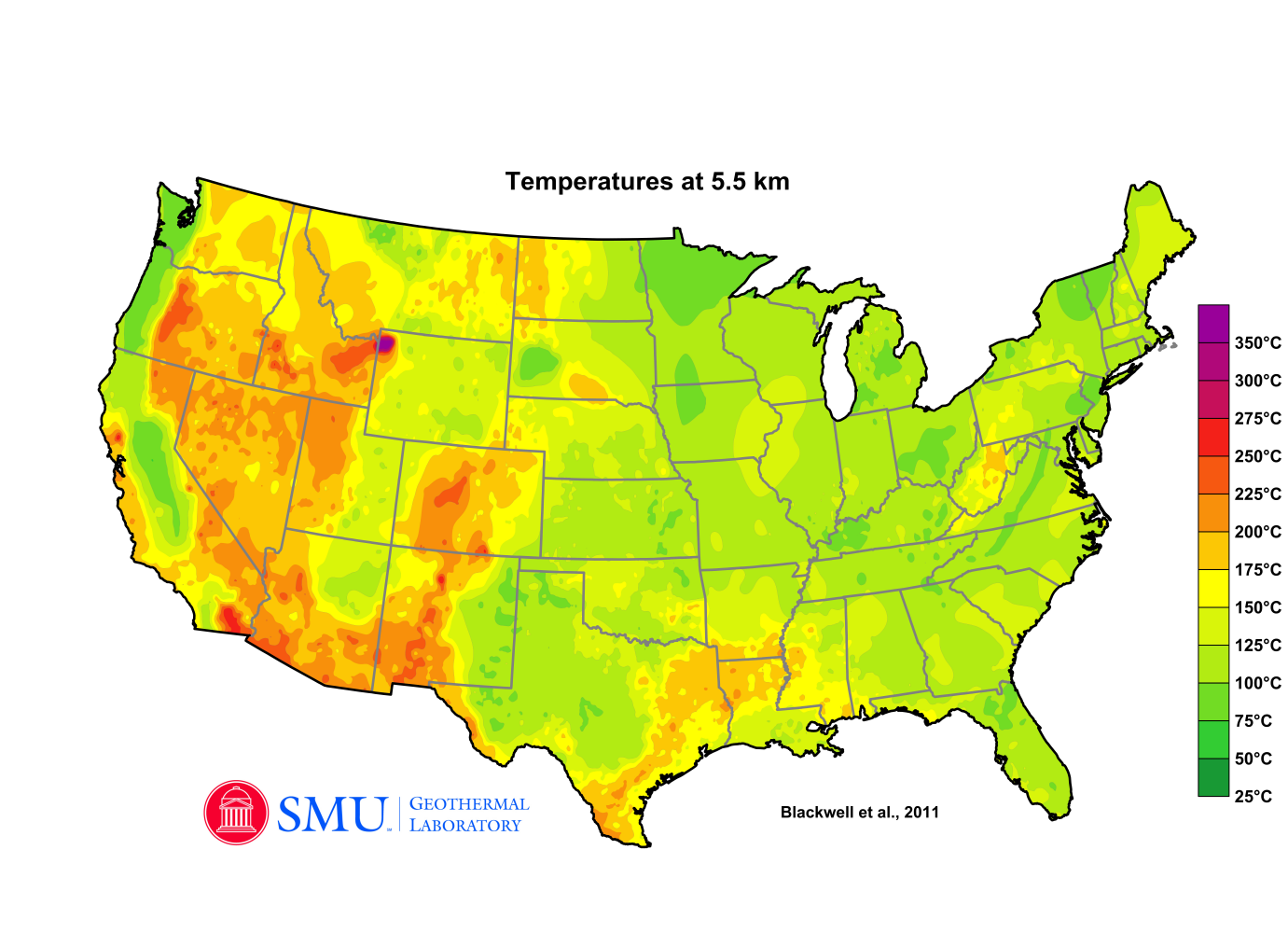 ?la=en
It is not true that the ground a few meters down is a constant 25°C, or any other temp, as a general rule for the whole planet.
The general rule is that, below a meter from the surface, daily variations in temp do not effect the soil or rock temp.
Below that, there a range of depths that tend towards what the average daily surface temperature has been in recent years.
This holds true in most places for depths that include the local water table, and it is found in most places that ground water will come out of the ground at about the mean annual temp for that location.
This changes quite a bit as one moves around.
The Floridan Aquifer underlies most of the state, but down in the southern part of the peninsula, groundwater is several degrees warmer than it is farther north in the peninsula.
And Florida ground water is far warmer, generally between 68 and 74° F, and up to about 77° in the southern tip, than in most other places in the country.
So no, it is definitely not 25°C under most of the US or any other mid latitude countries. Unless those places have an annual average temp that is that warm.
http://aztechgeo.com/wp-content/uploads/2016/03/how-it-works-graphic1.jpg
Temperatures at great depth vary quite a bit as well:
SURFRAD measures solar energy reaching the surface, pt 13: dw_solar real.
And they measure a solar energy leaving the surface, pt 14: uw_solar real.
uw is 22% of dw.
Some say that the missing difference, dw – uw, is the “back” radiation.
I say it’s the non-radiation, i.e. cond + conv + advec + latent.
Kirchoff said absorptivity = emissivity, i.e. more can’t leave than arrived.
But less radiation can leave if the non-rad shares the load.
Say what? DW solar (shortwave, aka “SW) is sunshine hitting the surface. UW solar is sunshine (SW) reflected from the surface. The difference is solar absorbed by the surface.
Nothing to do with back radiation, nothing to do with longwave, nothing to do with sensible or latent heat, nothing to do with “cond + conv + advec + latent”. It’s just the surface albedo at work.
w.
Willis, how does LW Downwelling compare to LW Upwelling (i.e. without the SW downwelling component?). just curious, is it easy to show this? I can sort of eyeball it from the chart.
JCM
I would wager they are about the same. This seems important to me. I’ve never understood dividing the ambient heat arbitrarily into directions of up and down. The whole idea of that seems imaginary – seems rather dependent on the perspective of the observer. Are they not both a measure of the same thing? correct me if I’m mistaken, please.
First, there’s nothing called “ambient heat”. Heat is defined as thermal energy which is flowing spontaneously from hot to cold.
What we are talking about is radiation, not heat. Radiation does NOT flow spontaneously from hot to cold. Radiation is just emitted in some direction and travels until it hits something. There, some is absorbed and some is reflected, regardless of the temperature of the object it hits. Whatever is absorbed is generally converted to heat. (The exception is when it is converted into chemical energy, as in photosynthetically active radiation.)
If you think of light it might make more sense. If I shine a flashlight at the sky, that’s upwelling visible radiation. Sunshine, on the other hand, is downwelling visible radiation.
And curiously, if I shine a flashlight at the sun, the sun gets warmer. Of course, the net flow of radiation (aka “heat”) is from hot to cold, that is from the sun to the flashlight. But there is a two-way radiation flow, and both end up warmer.
More questions?
Ask’em …
w.
ya ya heat vs radiation I know I know. Is there an assumption here that solar input is all SW?
JCM: 99% of solar radiation has wavelengths less than 4um (so is called “shortwave”). 99.9% of terrestrial thermal radiation has wavelengths greater than 4um (so is called “longwave”). This separation makes a lot of analysis easier.
This is basic, basic stuff…
Surely some proportion of solar input is warming the atmosphere directly at various altitudes. It then becomes a part of the “terrestrial thermal radiation” longwave spectrum that is measured with these instruments. I think in this case it would be labelled “downwelling longwave” despite having never cycled through the surface in a classic longwave sense. This proportion goes into the temperature regime of the atmospheric soup like anything else. I think too many energy flow schematic diagrams have people thinking in terms of up and down arrows. In reality your LW sensor will simply read as a function of the temperature in the field of view you’re looking at – it doesn’t much matter the angle, or if you’re thinking in terms of imaginary up and down fluxes or whatever. The blob of air is warmed from various mechanisms. The specific mechanisms influencing the temperature of a given blob of air are certainly debatable but are most definitely not limited to vertical radiative fluxes. Regardless, an air parcel should read the same temperature no matter the perspective, looking up, down, sideways or diagonal. Trying to attribute this LW to some forcing agent in up-down radiative flux measurements/diagrams is most certainly problematic.
Put another way, the observed LW radiation is simply describing some properties of the system. For example, today I am wearing a red shirt. I can describe this radiatively by showing that my shirt is reflecting strongly around 650 nm. But this radiative description is not what is causing my shirt to be red. My shirt is red due to the chemical properties of the dye in my shirt. It doesn’t much matter the vantage point of the observer, it wil appear red. A purely radiative perspective might lead one to the false conclusion that the observed 650nm reflection is causing the chemical properties of the red dye. Nonsense. The same goes for observing the radiative properties of the atmosphere. LW observation is way one to describe the current state of the system but it in no way explains the mechanisms that created those properties. Suggesting that observed radiation is forcing the system to a certain temperature is backwards. It is merely an observed property, like my red shirt.
JCM:
Go outside on a sunny day, first wearing a white shirt, then wearing a black shirt. The colors are different due to the different “chemical properties of the dye” in the two shirts. The first reflects virtually all visible light, the second absorbs virtually all virtually light.
Do you seriously believe that there will be no difference in temperature between the two shirts?
You’ve missed the point of the analogy. The observed color in my example, or the observed temperature as you have interpreted, is not causing my shirt to be red. The mechanisms that result in the observed color, or temperature, are not described by the observations (or modelling) of the radiative properties of my red shirt.
From my current vantage point those looking past the observed radiative properties to understand the underlying mechanisms relating to mass, convection, pressure, and solar dynamics are in a better position to describe the observed radiative fluxes. This is analogous to looking at the properties of the dye in my red shirt to explain its color instead of saying that the reason it’s red is because it is observed to be red.
JCM:
I look to the underlying electrical and physical molecular properties of H2O and CO2 (tri-atomic, polar covalent bonds) compared to those of N2 and O2 (di-atomic, non-polar covalent bonds) to understand why the former absorb and emit longwave IR, and the latter do not, regardless of temperature.
Then I analyze how these differences impact real thermodynamic energy flows.
This should offer some interesting micro details and I’m certain they are well described in classic textbooks. regards
Does radiation emit then hit something or can it only emit if there is something to hit?
Radiation just emits. For example, we can see galaxies that are a million light-years away. The radiation was just emitted and by chance it hits our telescope. And if it didn’t it might go on for another million years …
w.
Not sure that is true, from the point of view of the radiation time doesn’t pass.
Well using that example from the question. The photons from that galaxy were emitted a million years ago, at which time we were not in the same relative position that we are now, and yet they still hit our telescope.
That’s because radiation is emitted equally in all directions. It is an expanding electromagnetic wave. That is why its power diminishes with distance. Since it is constantly expanding sooner or later we will encounter it. Detecting it is a different issue.
If your wife speaks and you are not in the room, has she actually spoken?
Of course. How long have you been married?
Long enough to not disagree with my wife
”And curiously, if I shine a flashlight at the sun, the sun gets warmer”
Which means it’s radiation increases right? So what does this do to the flashlight?
Bet you couldn’t measure either effect.
We know that the energy of motion is converted to heat via friction, right?
So presumably, an ant walking across my patio is heating it up.
So what?
Is the fact that no one can conceive of such tiny energies as “heat”, mean that what we know about friction is wrong?
Willis, now I understand why you have no understanding of thermodynamics.
Have you thought about going into politics?
Do you have anything substantive to add to any of these conversations, or do you now simply decide to relegate yourself to a comment bombing troll who adds nothing?
Nicholas McGinley: Another Willis groupie. Pops up to defend his hero without addressing the validity of my comment.
Yeah, he is my hero!
If you keep saying things that are this funny, that would be a notable improvement.
Just to be clear, it is not snarky comments or even insults and name calling that irks me, it is making a multitude of such comments while simultaneously not doing anything to move any part of any conversation forward.
What is the point of that?
Imagine if a whole bunch of people just hung around saying nothing but insulting people and name calling?
I am asking you to step up and add what you know to the conversation.
True, though radiant heat transfer occurs spontaneously from hot to cold, i.e., the net balance of radiation being exchanged by two bits of matter is always determined by the temperature difference.
* * *
It seems like a lot of people get confused that think that for this to work, radiation needs to flow in only one direction, or have an effect only when it flows in one direction.
But, the net flow of radiant heat from hot to cold happens naturally, just by virtue of the amounts of radiation that are emitted by matter at different temperatures.
It’s actually essential that the “back radiation” flow from cooler to warmer be taken into account for all the math of radiant heat transfer to work out properly.
(I’m guessing WE knows all this; I’m articulating it for others’ benefit.)
Globally, DLR (downwelling longwave radiation) is ~ 340 W/m2, and ULR(upwelling LW radiation) is ~ 390 W/m2.
w.
I don’t believe that’s what your chart data shows in any given month for 34.3 -89.9 but I could be mistaken. The chart is supposedly measurements, correct?
JCM, the chart is monthly averages measured at one point on the earth. The data I gave you is global long-term (20 years) averages covering the whole planet. No reason to expect them to be the same.
w.
will you admit the chart data presented shows basically the same value of LW considered from both downward and upward perspective?
Will I “admit” it? Say what? You’re talking like I’m trying to deny something and you are pressuring me to admit it. Come back when you can ask like a decent human being, and maybe I’ll spend the time and effort to figure out the answer.
Or you could go to the page I linked to and do the homework yourself …
Until then, stay well.
w.
Willis
Your previous post made me check Ceres against NorESM (lacking your skills I used global data). 2000-2020 I found that Net SW was 3.5 watts higher and LW down 7 watts higher than NorESM. May I ask you to plot the difference between the datasets you have used this time?
The difference is shown in the graphs, and for my purposes, it’s immaterial. You’re talking about differences on the order of 1% of the size of the values.
w.
Willis
I hate averages of averages of averages….
What I would like to see is…
What is the wavelength specific radiation (upwelling and downwelling) from 1 micron out to say 25 microns. Correlate that to temperature….
Not an average across several microns, the individual absorption spectra from the different absorption/emission modes of the CO2 molecule.
As is easily determined, most (but not all) of the individual wavebands are already saturated. The USAF has been measuring the upper atmosphere to an accuracy of individual wavelengths since at least 1955-57. What is the difference in absorption/emission at stratospheric altitudes (B29 flight operations altitude) between then, and now.
There are two curves of interest.
The Gaussian…
The Lorentz transformation of the Gaussian.
These are both measurable, statistical quantities…
In 1960 Kaplan noted, (probably some of it was classified at the time), that the model based absorption/emission spectra modeled by Plass was 2x-3x higher than observationally recorded. Our old pal Gavin Schmidt uses Plass as his touchstone, that is before harkening back to Svante Arrhenius, who’s non QM continuum model is bollox from the beginning to end.
In 30 years of looking at this issue, I have not seen in any climate change studies, what is explicitly described in the quantum theory of light physics as the principal forces involved in CO2 absorption/emission.
Not doubting, just would be very interested in the answers…
As an aside, my student satellite that we flew in 1998 carried narrowband (5, 7 and 10 nanometer wide) filters to look at this data in the visible spectrum, of the same time flown as the CERES experiment. We worked with the same scientists at NASA MSFC who were designing these systems and looking at the science. These filters looked at H2O absorption in the longer 600-900 nanometer band.
I asked this question on the other thread.
When you measure the downwelling LWIR and get a minimum of 250Wm2 what height and Temperature in the Atmosphere does that represent?
I answered the question on the other thread.
w.
Thankful I have found it.
However I am not sure why you chose 500mb, aren’t there other heights that also fit?
Quote: “and we’re missing about 395 W/m2 emitted minus 150 W/m2 absorbed equals 245 W/m2 necessary to prevent freezing.”
Willis, how many replies you can find so far for this simple question? I find zero, except me. As somebody wrote, you are asking a wrong question, since they have not a good answer.
We have a local election campaign going on in Finland right now. In tv programs, the party leaders have been asked real and simple questions. If a politician has not a good answer, he/she will not answer but talk this and that around the question itself. These comments have the same feature: this and that but not the answer to a simple question.
Again, the question is not if “back radiation” exists. Radiation is ubiquitous and a function of temperature, and “back radiation” is no exception. Explaining the GHE with “back radiation” is nothing but tautology. I do not know what IQ it requires to see this trivial fact, but from my own experience I can tell 145+ suffices.
Yes, the issue is heat, not energy.
E. Schaffer:
Please explain to us dummies how this is a tautology.
You have it here..
https://www.greenhousedefect.com/2/the-back-radiation-idiocy
Yet I can try to creep into your minds. You probably think like, if there was no “back radiation” the surface would be much colder. And that is true! It is likewise true that if you were dead, you would not live. Question: is it the reason why you live? Or is the reason more like mom and dad mating and so on… you know?
In fact you can choose ANY counterfactual scenario and reason things are like they are, because they are not different. If I assume your name is Ed, we could reason you are Ed because you are not Mike, or Joe, or Tim.. There is an endless number of alternatives, but not a single one is a valid causation.
Equally “back radiation” like any radiation emitted is just a function of temperature, as the SB law tells us. If “back radiation” was different, there would be a different temperature, sure, cause it is a law. But there is no causation here, except for the opposite direction.
E: You say, ‘ “back radiation” like any radiation emitted is just a function of temperature’.
Wrong! It is also crucially a function of the emissivity of the emitting body. The major constituents of the atmosphere – O2, N2, and Ar – have essentially zero emissivity in the LWIR range, no matter what the temperature.
But using your logic, I have concluded that the idea that operating my house’s furnace keeps the interior temperature above ambient is just a tautology. That realization is going to save me a lot of money next winter. Thanks!
Well.. maybe it is just an IQ thing after all, and all explaining in the world is futile 😉
Is the ability to communicate one’s ideas successfully part of IQ?
Or is that just a “caring enough to make an effort” thing?
What IQ is sufficient to explain what is true to people who say there is no such thing as back radiation at all?
And what IQ suffices to comment in such a way that one does not leave other’s trying to guess what on Earth one is even trying to say?
What I am saying is straight forward and actually easy to understand. The problems you may have are in what I call “socio-logic”. You try to understand by averaging bits of information, even if they are contradicting. Also you are judging the accuracy of any statment by how close it comes to this average. Also any statement, regardless of how wrong it is, will become true with this “socio-logic” if it only gets repeated often enough.
I suppose I may have such problems.
And if I had any idea what on Earth you are talking about, I might even have some chance of telling you if I actually DO have such problems.
One thing I know for sure it, you are terrible at getting into my head, and intuiting my thought processes.
I am not doing any judging.
Just reading.
But you seem to be doing plenty of judging when you issue a string of assessments about what other people understand, etc.
You jump in with some haughty claims, but then appear to be demeaning the people whom it appears you agree with.
Sniping is easy.
Conversing is more difficult.
Adding something positive to a conversation is not hard, but changing someone else’s mind about something is.
Typing words is not difficult, but writing something down in a way that the people who read what one writes, can understand what it is one means to communicate…that can go either way.
Some can do it well, others seemingly not at all.
Mind reading is impossible, and truly intelligent people understand that.
Maybe you are, as you imply, the smartest person ever.
Fat lotta good it is doing anyone else.