Guest Post by Willis Eschenbach
Now that the cherry trees have bloomed in Kyoto this year, I’ve been seeing people claiming that the cherry blossoming record shows the dreaded “Climate Change!!!”, and we’re all gonna die. Here’s an example:

Now, cherries blossoming earlier on that chart mean the temperature is warmer. I looked at that and thought “Hmmm … why would the full flowering dates of the cherry trees be relatively stable for about a thousand years, and then suddenly start moving earlier in the year?”
The first thing that came to my mind? “Population”. As a city’s population increases, the “urban heat island” effect causes the temperature inside the city limits to increase. And the more people in the city, the warmer than the surrounding countryside it usually becomes.
So I went and got the cherry blossom data here. And I dug around and after much frustration and a reasonable sprinkling of expletives, I got Kyoto population data here and here and here. What I found is that after the Meiji restoration in 1868, the population of Kyoto rose very rapidly.
Below is the result. Unlike the graphic above, I’ve inverted the left-hand vertical axis so that warmer is higher and colder is lower on the graph. Here you go:

As is usual in the world of climate … things are rarely as simple as folks make them out to be. Are there other factors involved in cherry blossom timing? Absolutely—temperature, humidity, rainfall, and changes in tree species have to be some of the players in the game … and it certainly seems that population is among them. No surprise there. Willis’s First Rule of Climate states, “Everything is related to everything else, which in turn is affected by everything else … except when it isn’t.”
Here on our springtime forest hillside with a tiny bit of the ocean visible in the distance, I spent half the day yesterday with a digging bar and a posthole digger, trying to get the remains of a rotted 6″x6″ (150mm x 150mm) wooden gatepost out of the ground so I can put in a new one. It was most recalcitrant, held in the ground by the remains of the concrete it had been set in, plus plenty of temporal inertia. Even after I’d used the digging bar to crack up the concrete, it still held fast.
After far too much sweat I thought “You idiot!”, and I went and grabbed my Hi-Lift jack, threw a strap around what was left of the post, and yanked it out of the ground like a rotten tooth …

… sometimes it takes me a while, but I generally get there in the end.

Best to all on this marvelously complex planet,
w
My Perennial Request: I can defend my words, but not your interpretation of my words. Please quote the exact words you’re discussing so we can be clear on your subject.
Proxies just seem to be a regression to the days before reasoning that you needed to control other variables in order to see a relation between an independent and dependent variable.
Proxies are an indicator of a trend that is never direct evidence. It’s in the name. It’s like circumstantial evidence in a court case and, in some cases, like a damning fingerprint reconstructed from cherry picked partials that doesn’t look anything like the partials joined together.
Indeed the the alarmists at WAPO, the Capital Weather Gang, ignore the documented different shifts to early bloom times due to population differences. They ignore the urbanization effect as well as the fact that early bloom times have been noted before
From Primack (2009) The impact of climate change on cherry trees and other species in Japan:
“The cumulative flowering record over this 1200-year period shows a 6-week range in flowering dates from as early as late March to as late as early May”
“At locations near Kyoto, Osaka, and Tokyo, urban, suburban, and rural locations had similar times of cherry blossom festivals in the 1950s (Omoto and Aono, 1990; Aono, 1997). The similarity in phenology indicates that urban, suburban and rural areas had essentially the same temperatures in the spring. However, over next 50 years, flowering times in urban, suburban, and rural sites at each of these cities gradually began to diverge, with urban areas flowering earlier than nearby rural and suburban areas. By the 1980s, the warmer temperatures in the city had shifted the flowering of cherry trees 8 days earlier in central Tokyo in comparison with nearby rural areas, and 4–5 days earlier in central Kyoto and Osaka than nearby rural areas.”
Nice find, Jim. For those not familiar with Jim, his bio is here, and he’s always worth listening to.
w.
His book, Landscapes and Cycles, is a great source for weaning alarmists off their reality altering mind drugs!
Thanks Willis,
I missed the media’s cherry blossom hype until I saw your post. It seems every few years cherry blossoms get pushed as evidence of climate change. A quick google and twitter look revealed nearly every media outlet is pushing it. So added my own take to FaceBoo and NextDoor
Cherry-picking to promote a Climate Crisis
This is another blatant example of the media spreading misinformation to foment a climate crisis to an unsuspecting public.
On March 29th, the Guardian ranted, “Climate crisis ‘likely cause’ of early cherry blossom in Japan”. Washington Post blasted “Japan’s Kyoto cherry blossoms peak on earliest date in 1200 years, a sign of climate change.” The BBC proclaimed cherry blossoms “in the city of Kyoto peaked on 26 March, according to data collected by Osaka University. Increasingly early flowerings in recent decades are likely to be a result of climate change, scientists say.” Similar stories suggesting evidence of climate crisis were repeated by virtually all the media outlets.
This year’s bloom was indeed very early, that much is true. But how does published science compare to media narratives that suggest crisis after crisis to attract readers and profit. First consider the previous record was set during the Little Ice Age, when peak flowering in Kyoto happened on March 27, 1409. More importantly, urbanization is known to cause earlier bloom times. So observing the earliest peak blooming date is just 1 day earlier after 600 years, certainly doesn’t suggest a climate crisis.
In the 2009 peer-reviewed research paper “The impact of climate change on cherry trees and other species in Japan”, scientists compared peak blooming date in cities compared to dates in nearby rural areas to estimate the urban heat effect. Researchers determined, “At locations near Kyoto, Osaka, and Tokyo, urban, suburban, and rural locations had similar times of cherry blossom festivals in the 1950s. The similarity indicates that urban, suburban and rural areas had essentially the same temperatures in the spring. However, over next 50 years, flowering times in urban, suburban, and rural sites at each of these cities gradually began to diverge, with urban areas flowering earlier than nearby rural and suburban areas. By the 1980s, the warmer temperatures in the city had shifted the flowering of cherry trees 8 days earlier in central Tokyo in comparison with nearby rural areas, and 4–5 days earlier in central Kyoto and Osaka than nearby rural areas.”
Osaka is just 34 miles from Kyoto. A detailed study in 1989 from 80 locations around Osaka City “determined the first flowering was recorded starting on March 19 at locations in the city center Flowering was recorded at successively later dates at distances farther from the city center. At around 7 km from the city center, plants were starting to flower as much as 8 days later than in the city center.” Peak flowering happens about 1 week after first flowering, so that would make Osaka’s peak flowering date March 26, 1989, the exact same as Kyoto in 2021.
Finally consider the science presented by NOAA’s Thomas Karl in his 1988 publication Urbanization: Its Detection and Effect on the United States Climate Record. After controlling for other factors, NOAA scientists determined to what degree a larger population affected the average temperature. Tokyo’s population is 13.5 million, Osaka’s population is 2.7 million and Kyoto’s population is about 1.5 million. According to Karl that would increase Kyoto’s average temperature by about 1.8F (1C), and Tokyo’s by 4.6F (2.6C), relative to natural habitat or rural areas. That’s the same or more than is attributed to the increased global average from rising CO2.
Make no mistake about it, the media is inciting climate alarm where there is none, and they imply their false narratives really represent “good science”. Beware. Like the range of peak cherry blossom flowering dates, the wisdom shared in an 1849 Edgar Ala Poe short story also remains unchanged. “Believe nothing you hear, and only one half that you see.”
Jim: “So observing the earliest peak blooming date is just 1 day earlier after 600 years, certainly doesn’t suggest a climate crisis.”
WR: Given the large urban heat island effect and the higher input of artificial light, about the same date proves that the rural temperatures of the present are still lower than 600 years ago. The present climate is colder.
Not taking into account all differences and just looking at the date (as mass media/science do): that is cherry-picking. This post + comments give a good rebuttal.
Thanks, Jim. Regarding your last line, “Believe nothing you hear, and only one half that you see,” I follow my grandma’s rule on this matter. She said:
“You can believe half of what you see, a quarter of what you hear … and an eighth of what you say.”
She was an amazing woman, I wrote about her here.
w.
Willis: “and I went and grabbed my Hi-Lift jack, threw a strap around what was left of the post, and yanked it out of the ground like a rotten tooth”
WR: Just tonight I was contemplating a bit about the role of convection – the upward movement of energy. Convection is not ‘cooling the surface’ in the way evaporation or conduction does. But convection is a process needed to get the surface energy at elevations from where it can be radiated to space and if it does not happen other forces develop. Finally one of those processes results in bringing surface energy (latent and sensible heat) upward to where it has to be.
In the case of the post, no ‘lift’ occurred. By ‘throwing a strap around what was left of the post and yanking it out’, the post’s lift became organized.
On the surface of the Earth the same happens. When latent and sensible heat stays below at the surface, at temperatures of 25-30 degrees Celsius over open oceans huge convective processes develop: your thunderstorms. If they cannot develop, for example because of the lack of surface wind like in a water cooker, the heating up continues until the huge forces of ‘created bubbles’ will transport the energy from the heating place below to elevations where energy can be released.
Nature always finds a way to have things happening, as you did. When lifting has to happen, it will happen. But new means sometimes are necessary. Like in nature you found your way.
Convection is enabling extra surface cooling by enabling the release of extra latent and extra sensible heat. In itself, convection is no item you can find back in energy balances or in models in the right way. But if convection is not present ‘other forces will develop’ or ‘other ways will be used’ by nature: your emergent phenomena.
Convection is a supporting process, necessary for the release of energy (spaceward radiation) at altitudes without water vapor. In calculations for ‘surface energy loss,’ the process is easily forgotten. But it is a fundamental process that should be well represented in the models and the Earth’s earth-atmosphere energy balances. Only then processes of ‘surface cooling’ can be well understood.
This is why your emergent phenomena deserve their place in the models. All have for specific circumstances a specific temperature at which they will happen.
Wim Röst
Thanks, Wim. You’ve hit on the critical insight about emergent phenomena, which is that they are based on a temperature threshold, not a forcing threshold. As a result, they tend to maintain an even temperature regardless of forcing.
w.
WR: Indeed. “Regardless of forcing.” The most important words.
Wim, I read the entire documentation for an earlier model (NCAR v3?) prior to publishing Blowing Smoke in late 2014. None of these climate models can incorporate emergent phenomena like Tstorms. Their grid sizes are too big. Illustrated in guest post here ‘The Trouble with climate models’ a few years back.
On page 10 of https://leif.org/research/Climate-Change-My-View.pdf I note that:
The recent rise of temperatures is attributed, primarily to the warming associated with the urbanization of the Kyoto area (estimated to be of the order of 3°C), and secondarily with the general global climate warming of Japan.
This has been the long accepted view of Japanese researchers.
Thanks, Leif. I’m glad that my insight that earlier flowering is from UHI, based on nothing but my experience, agrees with your more extensive research and the view of the Japanese researchers.
And for those who don’t know Leif, he’s a solar researcher who is generally right. He’s the man who led to one of my many rules of thumb for life, which is “Be cautious when disagreeing with a man who has a scientific effect named after him” … in his case, it’s the Svalgaard-Mansurov effect.
w.
Climate change is claimed by the collective (Left/Libtards/Greens/AlGore/JohnKerry/MoronsRus) to be inducing a global climate crisis.
Even if we simply accept uncritically at face value this claim by the CapitolWeatherMorons, is earlier blossoming cherry trees evidence of a climate crisis???
Just off track a bit,want to save the planet and eat red meat? Get rid of methane belching cattle and eat Kangaroo , they don’t fart and will be in plague proportions after the big wet
On the subject of kangaroo, down-under a high-lift jack is commonly known as a “kangaroo jack”
“This is climate change” – maybe. But what’s wrong with earlier flowers? Why is it scary?
“The first thing that came to my mind? “Population”. As a city’s population increases, the “urban heat island” effect causes the temperature inside the city limits to increase. And the more people in the city, the warmer than the surrounding countryside it usually becomes.”
I think your right about this factor, and as others have pointed out the factor of artificial light. Today we think of Japan in terms of high population density and mega cities. But this a very recent development in terms of Japan’s known history. Historically, Japan has been rural, without large cities at all. Where most cities are now there were originally just farming villages. This is due mostly to the geology and geography of Japan. It is mostly all mountains. The suitable ground to build cities is the same ground that traditionally was used for agriculture. Even as late as 1890 the population of Japan was about 90% rural. Today it is flipped. We only begin to see rapid urbanization during the late Meiji period. Kyoto was a cultural and religious center but in no way could be it described as urban until rather recently.
OMG another hockey stick that proves the tipping point has pushed us from a crises into an emergency (or was it the other way round), we now only have 24hrs ’til the next proof.
I suspect that there are good records somewhere of annual maple sap run dates in Vermont, Wisconsin, Minnesota, Ontario, etc. Since the sugaring season is highly dependent on temperature requiring freezing nights and above freezing days for several consecutive days it might show a trend or not. The peak sap run can occur any time from late Jan to March. It seems unlikely that urbanization would have an impact as sugaring is a rural industry. No idea how one would find such records though.
Next time, do as I did, and borrow an electric jack hammer from the neighbor.
Farm jack, railroad jack, or as you call it a Hi-Lift jack will get ‘er done! No real man should be without a farm jack, a 4wd, and a shotgun!
Indeed, eyesonu, I have all three … here’s my story about the shotgun.
w.
Your data analysis is exceeded only by your writing!
Thanks, Clyde, much appreciated.
w.
Yes, it’s called a ‘kangaroo jack’ in Australia which I think is the very best name.
It’s a Jackall here in western canada
And, do not forget, that higher CO2 make plants more tolerant of both high and low temperatures. In the UK, they have noted earlier flowering times that highly correlate with increasing CO2, because the temperatures in the UK have not been rising in tandem.
If you do not have a hi lift jack, an old wheel works fine too.
…as does wrapping a chain around a tractor tyre and moving forward ever so slightly.
However, let’s not forget every ‘real’ man needs a chain saw and a log splitter too.
Chain saw I have. Haven’t split a log in years, I heat my house with gas.
But I must confess that in my youth, I used to cut firewood around Santa Cruz, split it with a splitting maul and wedges, then take it up to Berkeley and sell five “quarter-cords” out each cord from the back of my pickup to professors and such … just stack it good and loose and it all works out.
w.
Unfortunately here in NZ, thanks to our socialist Prime Minister, gas is a four letter word. We have to heat our Stargazers B&B with wood, yet sadly this is becoming another four letter word in some other parts of our country!
“sometimes it takes me a while, but I generally get there in the end.”
Willis tell me you did not put the new one in cement !!
Not in yet. Today I painted the base of the post with sealant. My plan is to wrap the base of the post in tarpaper and then concrete it in, so the concrete isn’t touching the wood anywhere. You have a better plan? I’m always willing to learn …
Also, I set the post on a bed of drain rock and sand so that the concrete doesn’t make a “cup” under the post, it stays open on the bottom so it can drain freely.
w.
Hi Willis,
I’m going to try this on my new mailbox post. https://www.amazon.com/gp/product/B01N1Q5YNE/ref=ppx_yo_dt_b_search_asin_title?ie=UTF8&psc=1
We’ll see if it keeps the post from rotting off in the rainy environs of coastal Oregon.
pbh
Have you ever tried Black Jack roofing compound? Did a lot of custom work for a client using locally milled rough cut Ponderosa Pine, and he swore by it for fence posts! I went through three sets of planer blades before moving on to another job!
This is my view on fence posts in coastal and interior BC;
As the farmers say, whether it’s in sand or clay, a red cedar fence-post lasts 15 years.
They rot at the ground-line and a few inches down. That’s where there’s water and oxygen.
Surface coatings are ineffective if they’re not toxic to bacteria.
Drainage below the post is irrelevant; in fact, if the ground remained saturated longer, oxygen would be depleted, aerobic bacteria would die and decay would be slower.
That doesn’t actually matter, since it’s rotting at ground level, anyways.
Tarpaper around the post will not slow rot but it might make it easier to extract the rotten post in the future.
However, the question then is will you be able to square the new post to the old concrete hole when you are 15 years older than you are now?
In the Netherlands (the part below sea level) the possible problem of rot is common. Houses are built on piles often around 15 meters long to fund the house on the sand layers below the peat and clay. The piles need to remain below the water level to remain conserved. When pumps dry the land problems arise. Therefore water level is controlled well. But to avoid eventual problems the modern way of constructing is by driving the wooden piles deeper into the soil and putting around one o more meters of concrete piles on top of them: there where the moisture problem could play a role. On the concrete piles a concrete construction is made to build on the walls.
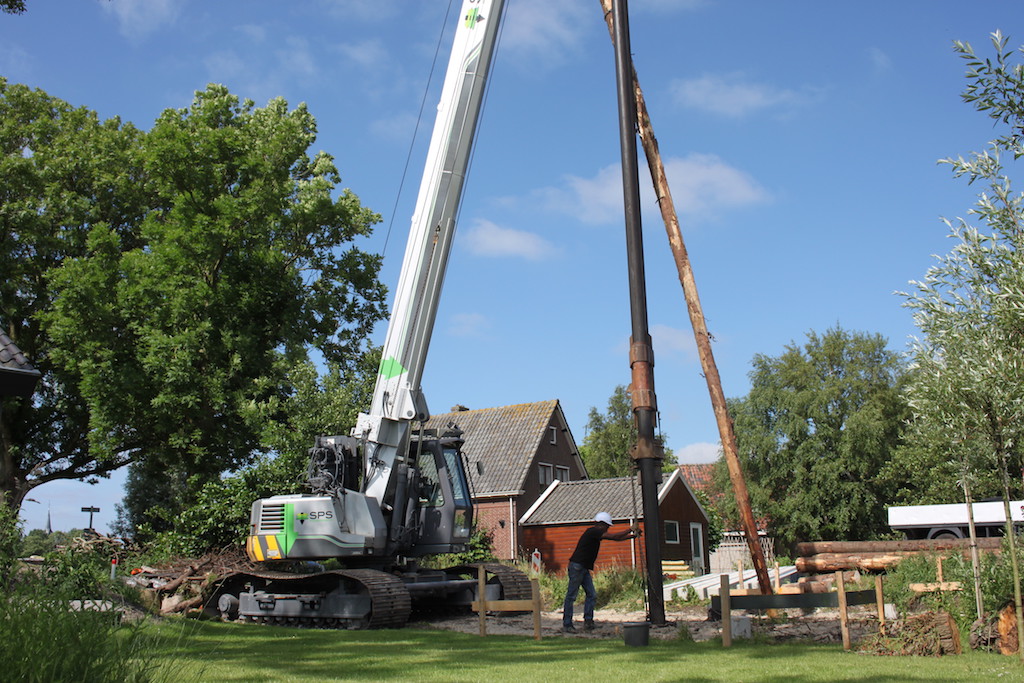
You prompted me to read more on this; Wow!
And they’ve been doing this for centuries.
For me as a kid this was the ‘normal way’ of building a house. When I discovered that nearly everywhere else people were not driving 15-meter piles into the ground before constructing a house I was very surprised.
good post as always Willis
and chuckling re the post
have done the same myself
friend had a little poster on a wall
“think..there must be a harder way to do it”
I always laugh when i pick the hardest way first ..and then really think
worst post digout ever?
a steel post that someone had stuck a bolt through,right down low, so very well entrenched
that damned bolt really provided serious sticking power to stay in place,couldnt use a carjack cos it was a verandah post, woulda lifted the porch too
A other long term data record from Japan may also be of interest. It appeared in WUWT on April 27th 2016. lt reported a paper that did a study of the ice freeze dates on a Japanese lake since 1442. The post has a link to the paper, sadly the data paper does suffer with “adjustments to the data”.
Car Guys use their engine hoist for jobs like that. Best $100 I spent at Western Auto, 30 years ago.
Admittedly I don’t have records that go back to the 1800s, but we have a real 800 tree cherry orchard in NW Montana. Been doing this since the 70s. I don’t know about flowering date, but harvest date used to be in mid to late July. In recent years it has been moving later and later to early Aug. Last year was about Aug 10.
Vancouver BC used to have many Japanese Cherry trees. Perhaps fewer now as old trees do die.
As for getting old posts out, just don’t think like a couple of high school classmates did.
Cleverly thought they could make nitroglycerine to remove stumps on a farm.
Snuck into the chemistry class room late one afternoon, and proceeded to mix some up in a glass beaker.
When it started to boil vigorously they ran for the teacher, fire department came. No explosion fortunately, I don’t know if the students knew how sensitive nitroglycerine can be to handling.
These days anti-terrorism forces might be after you. Police in Canada almost detected the Sikh terrorists who blew up Air India flights. They observed suspicious persons on Vancouver Island blowing up stumps in a logged area, the blast felt at their car a ways away behind trees. But since blasting stumps in farming and logging areas is expected, they did not query the blasters (perhaps also did not want to reveal that they were tailing them). A person in the area of Duncan BC made bombs inside large portable radios (‘ghetto blasters’ they are ironically called). He was convicted of deaths on an airport ramp in Tokyo (flight was delayed, baggage was being transferred) and of deaths by explosion of an airliner over the Atlantic. Forensic examination of the bits of the radio in Tokyo and tracing of sales of it led police to him. (Sometimes quantities of a product made are small, in that case only two sold in the Duncan area, and of a small truck windshield wiper arm in the Seattle area (a hit and run case, police and security of large employers then checked parking lots for the type of vehicle they identified from the pieces).)