Guest Post by Willis Eschenbach
Now that the cherry trees have bloomed in Kyoto this year, I’ve been seeing people claiming that the cherry blossoming record shows the dreaded “Climate Change!!!”, and we’re all gonna die. Here’s an example:

Now, cherries blossoming earlier on that chart mean the temperature is warmer. I looked at that and thought “Hmmm … why would the full flowering dates of the cherry trees be relatively stable for about a thousand years, and then suddenly start moving earlier in the year?”
The first thing that came to my mind? “Population”. As a city’s population increases, the “urban heat island” effect causes the temperature inside the city limits to increase. And the more people in the city, the warmer than the surrounding countryside it usually becomes.
So I went and got the cherry blossom data here. And I dug around and after much frustration and a reasonable sprinkling of expletives, I got Kyoto population data here and here and here. What I found is that after the Meiji restoration in 1868, the population of Kyoto rose very rapidly.
Below is the result. Unlike the graphic above, I’ve inverted the left-hand vertical axis so that warmer is higher and colder is lower on the graph. Here you go:

As is usual in the world of climate … things are rarely as simple as folks make them out to be. Are there other factors involved in cherry blossom timing? Absolutely—temperature, humidity, rainfall, and changes in tree species have to be some of the players in the game … and it certainly seems that population is among them. No surprise there. Willis’s First Rule of Climate states, “Everything is related to everything else, which in turn is affected by everything else … except when it isn’t.”
Here on our springtime forest hillside with a tiny bit of the ocean visible in the distance, I spent half the day yesterday with a digging bar and a posthole digger, trying to get the remains of a rotted 6″x6″ (150mm x 150mm) wooden gatepost out of the ground so I can put in a new one. It was most recalcitrant, held in the ground by the remains of the concrete it had been set in, plus plenty of temporal inertia. Even after I’d used the digging bar to crack up the concrete, it still held fast.
After far too much sweat I thought “You idiot!”, and I went and grabbed my Hi-Lift jack, threw a strap around what was left of the post, and yanked it out of the ground like a rotten tooth …

… sometimes it takes me a while, but I generally get there in the end.

Best to all on this marvelously complex planet,
w
My Perennial Request: I can defend my words, but not your interpretation of my words. Please quote the exact words you’re discussing so we can be clear on your subject.
Willis Good article, as always.
One more thing that urbanization does, is light pollution. This paper quantifies the effect on earlier budding. Its as important a factor as warmth. Perhaps even a greater factor.
http://rspb.royalsocietypublishing.org/content/283/1833/20160813
Interesting, Les, I would have never thought about that factor.
Thanks,
w.
Plotting the flowering date against use of fertilizers would be interesting too….don’t forget guano staring in the mid – 1800’s…and the expanding use of automatic sprinklers from the 1960’s….
I was taught that length of day is the determining factor, not temperature.
Willis,
Although probably not a problem at the Kyoto location, the amount of light pollution at the USNPS Indicator Tree for Cherry Blossom near NPS Headquarters in Washington, DC, is enough to potentially make a difference there. The current LED fixtures along Interstate 395 are just one block away, and elevated above the tree.
A pedantic point, but worth bringing up: are we sure that the data are based on a consistent calendar? I’m pretty certain Medieval Japan did not use the current Julian Calendar.
Yes, it’s all been converted.
w.
I’ve also noticed that deciduous trees along the sides of streets near street lights tend to keep their leaves longer in the autumn than the same species of trees in nearby forests without artificial lighting. In early November, one can even see more leaves on the side of a single tree facing the street light than on the side away from the street light.
Dang those polluting trees and their water vapor contributions.
Ronald Reagan once claimed that trees cause more pollution than cars.
And even the Graniad agrees with Ronnie. So stated, not claimed.
https://www.theguardian.com/science/2004/may/13/thisweekssciencequestions3
I understand trees emit particles, which are the cause of haze in some mountainous areas to the west of the US Capitol.
I don’t mean pollen.
Yes l have noticed the the same thing happen with the trees near where l live. The leaves that are directly under the street light,will remain on the tree for a week or 2 longer. Compared to those on the other side of the tree that are shaded from the street light.
In 2018, organic aerosols made up about 23% of the aerosol pollutants in Los Angeles, a large portion of which is due to chemicals emitted by plants.
The Happening!
Light pollution is probably not something that we in the UK are going to have to worry about, as our government switches us from fossil fuels to unreliables 🙂
Does anyone know how much the increase in atmospheric CO2 affects blossom time?
Not much time for searching today…
but
https://www.ncbi.nlm.nih.gov/pmc/articles/PMC4921480/
Seems increased CO2 may also cause early blossoming…
… more searching needed for cherry blossom specific data..
Sadly, not enough data to be significant, viz:
w.
Yep.. inconclusive. Too busy to do a further search though.
A forensic bio-climatologist could answer your questions, but those guys are expensive….though extensive in answer.
That is a good piece of lateral thinking. And if you continue to tug on that thread, and assume lighting crudely follows electrification, this may be pertinent:
Electricity Generation in Japan by Source (1955 – 2017)
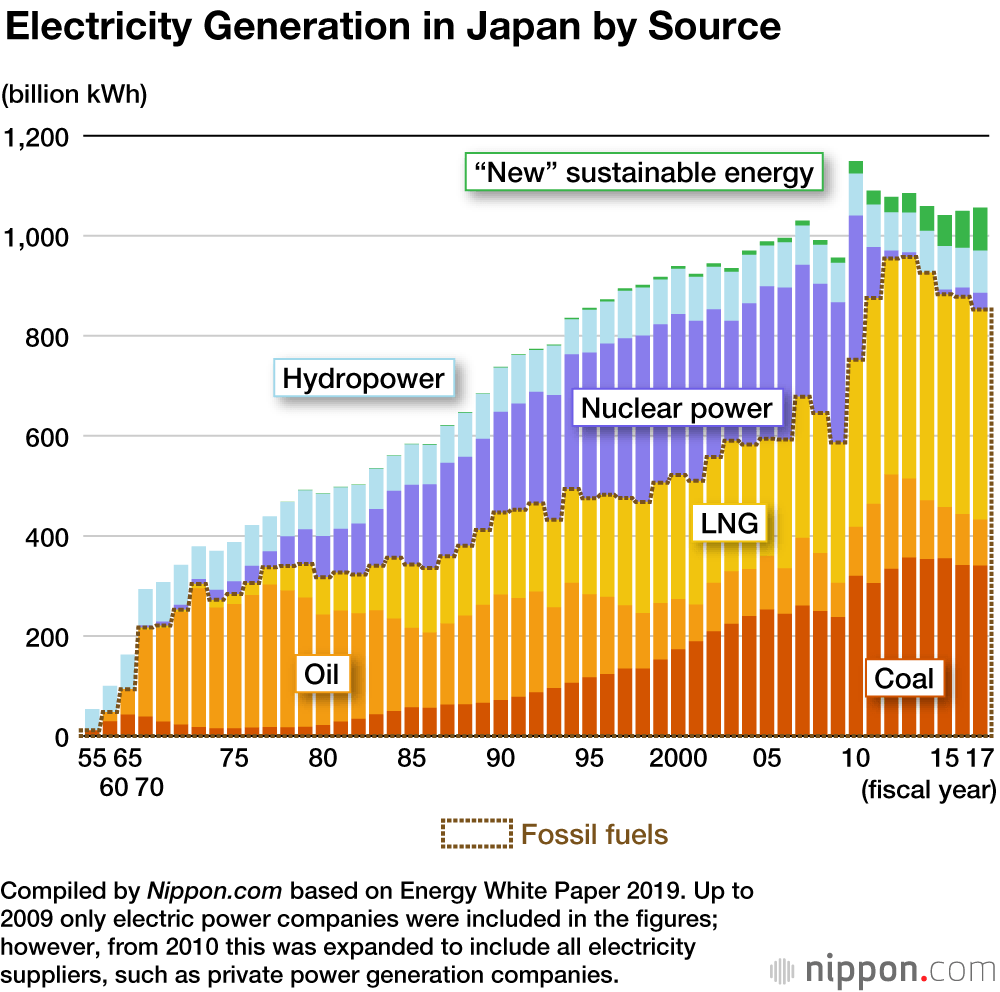
A shame, they’ve replaced nuclear power with fossil fuel power. (Not that fossil fuel power is bad.)
I read that Germany has replaced its nuclear power with natural gas from Russia.
Nuclear power stations are of course good for base load, natural gas is good for rapid response (more necessary with variability of solar and wind, if hydro dams or other storage not available).
Paving and buildings store heat during the day and release it at night. Air conditioning moves heat outside. Vehicle exhausts, home, office shop and factory heating in winter, plus light, as you say, all good for cherry trees. Plus the more abundant CO2 as plant food and reducing water requirements.
Warmer nights sound good, as freezing kills people and food sources.
I know that adding potassium to the soil will stimulate lawn to continue growing for longer into Autumn, and earlier in Spring. ImFertiliser might also be a factor.
Different elements have different benefits, IIRC three in common home-garden fertilizers – roots, leaves, …. You want good roots to get moisture into the plant. where I live, watering of new trees is important in summer, after a few years they can handle life themselves.
Adding specific wavelengths stimulates flowering. In greenhouses where flowers are grown the adding of specific wavelengths is planned well.
Some more information:
‘” Blue Light Wavelengths (400–500 nm)
Blue light has distinct effects on plant growth and flowering. In general, blue light can increase overall plant quality in many leafy green and ornamental crops.”
and
“Higher intensities of blue light (>30 μmol·m-2·s-1) can inhibit or promote flowering in daylength-sensitive crops. Blue light does not regulate flowering at low light intensities (<30 μmol·m-2·s-1), so is safe to be applied at night to influence the other plant characteristics listed above”
Source: https://www.lumigrow.com/learning-center/blogs/the-definitive-guide-to-grow-light-spectrum/
To be added: even in mid-winter plants in greenhouses are forced to blossom by adding sufficient light of a specific wavelength. Of course temperature, plant nutrition, water and not to forget the artificially added CO2 have to be right as well.
I wonder whether the change over to LED street lighting which are brighter make a difference?
You’ve hit the nail on the head. Light is so important to growing plants, anyone who grows hydroponically indoors (whether the crop is legal or not) will know this. Some growers keep lights on up to 20 hours a day it brings the crop to maturity far far earlier. Mike Tyson might be able to give you more detailed information.
Would not the increase of airborne plant fertilizer aka CO2 also help the cherry trees grow faster and bloom earlier?
I don’t suppose there is a rural area of Japan with cherry blossom records extending back cneturies. Maybe a monastery. Ideally the trees would always have had the same degree of shade and sun exposure.
https://www.tsunagujapan.com/20-sites-to-enjoy-cherry-blossoms-in-japan-except-metropolitan-areas/
While centuries-old data from rural Japan may be hard to find, the Urban Heat Island effect should be apparent by comparing rural and urban blossom dates in any given year over a much shorter timeframe. Spacial mapping of blossom dates might make a good proxy for the both the extent and magnitude of the UHI.
I can’t find anything comparing urban and rural cherry blossoms. Here’s a more general map …
w.
And what appear to be earlier ‘nodes’ around the major cities
Better yet, locate peach blossoming dates in Japan by year and contrast to the cherry blossoming dates. Peach orchards are usually located in rural farming areas, less influenced by the urban heat island effect.
Willis,
Sky News in the UK covered it:
Japan sees earliest cherry blossom since 1400s – and scientists say it’s down to climate change
http://news.sky.com/story/japan-sees-earliest-cherry-blossom-since-1400s-and-scientists-say-its-down-to-climate-change-12260765
Aside from being generally absurd, it contains the following gems:
1) “Climate change has led to the earliest cherry blossom season in Japan in 1,200 years, experts say. The peak bloom arrived on 26 March in Kyoto, the earliest since 27 March 1409, while in Tokyo they reached full bloom on 22 March – the second-earliest date since 1953.”
2) “Evidence, like the timing of cherry blossoms, is one of the historical ‘proxy’ measurements that scientists look at to reconstruct past climate,” climate scientist Michael Mann told The Washington Post. “In this case, that ‘proxy’ is telling us something that quantitative, rigorous long-term climate reconstructions have already told us – that the human-caused warming of the planet we’re witnessing today is unprecedented going back millennia.”
3) ” Scientists have tracked the Japanese cherry blossom 732 times since the year 821, the longest and most complete seasonal record.”
It’s good to know that such proxy records are so absolutely complete. It’s also heartening that our climate hero Mann has got his ducks in a row, informing us that a subjective and patchy record going back hundreds of years proves what climate computer models have been telling us that present day warming is unprecedented “going back millennia”.
Oh, and, by the way Micky, these records appear to have been taken in the middle of major cities. So, no UHI effect “going back millennia” then?
‘Fact checkers’ will say
Arguments about UHI or light pollution will be ignored or belittled. It’s depressing.
So one day earlier than 1409. That sounds like runaway warming to me.
Didn’t we see an article earlier this week where the forsythia blossoms were later than usual this year in Germany?
Does that mean that the climate is warming in Kyoto but cooling in Germany? So much for “global” warming!
Probably the “urban heat island” does have an effect. Transplant those cherry trees to a rural area at the same latitude and elevation, and they would probably bloom later in the year.
Japan is one region that does not necessarily reflect cherry blossom timing in other regions.
I like the coincidence of the population and DOY hockey sticks. But more interesting are all the pink dots showing the yearly values. The recent <90 for DOY must be concerning for the alarmists. But we had some in year 900, 1400, and 1600 also. Must be those non-existent medieval warm periods !
/s
As if earlier cherry blossoms is something to panic over.
“You idiot!….”, Living in Louisiana for 3 decades where you can watch things rot, I am sure that I would win in an idiot contest. Been watching RFDTV since its inception, latest had an ad for a metal fence post installer. Required an air driven hammer device, air compressor, vehicle to carry it. Don’t recall seeing one for a puller.
Invasive tropical mangroves just got killed way back in Texas and Louisiana.
My forsythia in Kansas look like crap–worst they have ever looked in the 30 years they have been here. Also very late blooming this year. Must be global cooling, or at least the freeze of the century a month ago.
From, “Artificial light at night — the impact on plants and ecology”
https://ec.europa.eu/environment/integration/research/newsalert/pdf/artificial_light_at_night_impact_on_plants_and_ecology_455na2_en.pdf
Is there a cherry blossom record for a more remote location?
The Urban Heat Islanders in the leftist urban centers get off much too easy on their contribution to climate change. Take for example the urban planners and their professional; associations that have gone all in on the climate religion. They still dictate vast swaths of land for asphalt parking lots for maximum Christmas shopping times in the case of retail stores and strip mall developers but don’t own up to what this did over time.
Introduction of neon and lately LED street lighting (emitting UV light wavelengths) enhanced plant growth in its vicinity.
Was Kyoto on the target list late in WW2?
Kyoto was specifically spared because it was assumed the bombing on the cultural sites would further inflame the japanese people and possibly prolong the war.
Saved by US Secretary of War Stimson, who had often visited there while governor of the Philippines, allegedly honeymooning in the sacred city:
https://www.bbc.com/news/world-asia-33755182
I am certain that the Capital Weather Gang knows that all of Japans cherry trees that bloomed in 812 AD are still alive and therefore are giving us a continuous record of bloom time to rely on.
Because if they are not still all alive, then their whole premise of cherry bloom records is faulty because it’s spliced. And they would never ever do that.
Good point, Willis. It is hotter in town. Not the whole world.
The theory of global warming due to AGW actually is claimed to be due to a delay of heat escaping into space. Consequently, it should be minimum temperatures that should be increasing. My first step was therefore to look at minimum temperatures, especially in winter.
Here in Pretoria we have dry winters but it gets cold and people burn coal and wood to stay warm at night. I was surprised to find Tmin dropping:
https://breadonthewater.co.za/2021/01/26/am-i-a-climate-denier-denialist/
despite a large increase in the population over the past 40 years.
Tmean is a red herring. Tmin will tell you all you need to know….
Note the increase in Tmean versus latitude.
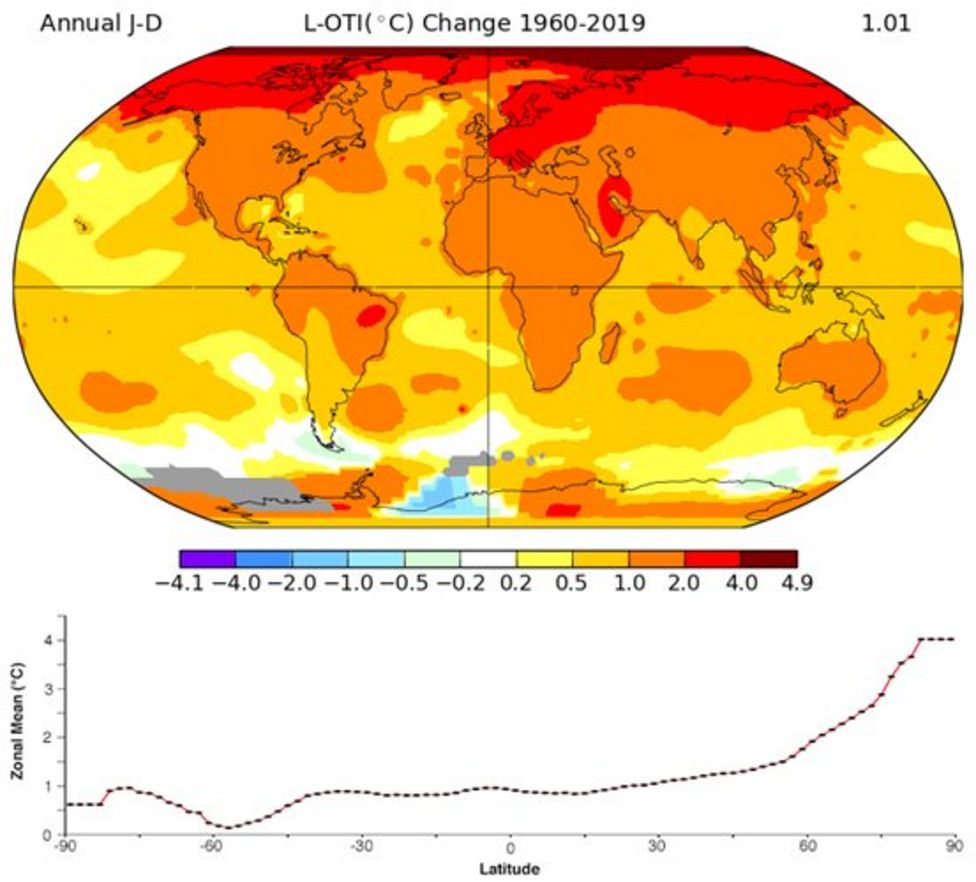
If only we had same data for Tmin.
4C in northern Russia and Canada since 1960 ? Show us your data…or is it all from those Northern Russian outposts that got their allotment of winter heating fuel depending on temperature, so they would push the thermometer bulb down as much as possible every year.
I am trying a cherry, “Stella,” in a large pot in a small garden. This is now the second year (4½ feet) and it is forming many flowers. Any good advice about when and how to prune the roots and replace the soil? I want to limit the size of the tree but not go the Bonsai route.
I have a dwarf ginko now 20 years old in a large pot. I have pruned heavily every 3-4 years, including cutting off the outside of the root ball where it is choked. For the cherry, having dwarfing rootstock to start with would also help.
Our sweet cherry tree just started blooming a couple of days ago. The pie cherry tree hasn’t bloomed yet, but the buds are swollen. The sweet cherry tree is about ten feet further south, so I’m sure it’s latitude.
Good news about the blooming because it got down to -20F a couple of months ago (very, very, unusual around here) and it killed a lot of things.
Hi-Lift jacks are a good thing.
hydraulics are my friend.
I had one metal fence post 2 ft in ground with 6″ diameter cement poured that I had to hook the bed of a 14 cu yd dump truck to with a chain to lift out of the ground.
it bent the bed rail on the dump body.
roots in field had taken hold of it.
Excellent article, as always.
Decades ago, I regularly rode a motorcycle from upstate New York into the city over a multi month timeframe.
Motorcycle riders are particularly sensitive to temperature changes.
There was a very precise location, coming down a long hill in Westchester county, where the temperature abruptly changed to several degrees warmer (a welcome relief).
This was especially noticeable at night time.
While we all recognize the significance (or should ) of the urban heat island effects, the degree (no pun intended) of the impacts ought not to be underestimated.
Willis
Short but sweet; like a dwarf bing cherry tree! Did you consider trying to pull out the cycles in the data and what is the correlation between the two (besides reallly high?)
As a devoted Japonophile I’m always happy to see pictures of the beauty of Japanese architecture and culture. Spent the last couple of weeks viewing and digesting Kurosawa’s great samurai films with Toshiro Mifune; next month it will be the Samurai trilogy with Mifune starring under the direction of Inagaki.
Speaking of cherry, have you ever worked much with cherry wood? I did an home office remodel with cherry casing, crown and wainscoting about thirty years ago. I like to use a combination of a jigsaw and small angle grinder with a sanding disc for my cope joints in crown. The smell of the cherry as it was being sanded was a definite plus; the dot com boom sure was great until it wasn’t!
Mifune was a Methodist, born to missionaries in China.
He’s in my top ten actors list after watching Seven Samurai, Hidden Fortress and Yojimbo! I wonder how much Eastwood studied him for his Sergio Leone characters!
AM
We have something else in common.
Clyde,
You mean besides disliking the lies and deceptions of the alarmists and their acolytes, and enjoying the shared truths and wisdom of the writers and commenters here!?
I’m very glad to hear it!
A other factor that casts doubt on man made CO2 been the cause of this earlier blooming.
ls the fact the trend started as early has around 1850. Which would have been to early for man made CO2 to be the cause.
And is it actually “warming” in Kyoto ?
Not much happening in Japan overall
See the same blossoming phenomenon with crabapples between my Chicagoland townhome and my SW Wisconsin dairy farm. In both cases the trees are close to the houses, within about 50 feet. But in the NW Chicago suburb (Northbrook), the bloom is almost always at least a week to ten days before the farm mainly because of UHI even though I overlook the second green on an 18 hole golf course (Mission Hills) that should mitigate some UHI. Farm is slightly more north (about 60 miles) and at a slightly higher elevation (about 400 feet), but in the same west to east weather patterns temporally offset by about 180 miles. Good enough UHI indicator.
Once again, proxies are never as simple as they seem to be. They are using the “cherry picking” date as a proxy for temperature change, but in fact it isn’t that simple. A few things I can think of of the bat is:
1) Amount of water – are the trees getting supplemented with water?
2) Amount of nutrients – are the trees being fertilized?
3) Pesticides – are the trees being protected from disease?
Then there are the other obvious factors – urban heat blanket, constant gardener care, additional CO2 in the atmosphere.
I would think a longer growing season is good, but they will find some way to spin this as bad.
(Side note: The Eastern Dogwood I took from northeastern Oklahoma and planted into my Texas clay yard-from-hell survived the freezing binge quite well. Many of my Texas native or Texas Hardy plants and shrubs are dead, Dead, and DEAD. I take good care of my dogwood and this year it bloomed both early and more splendidly then ever. It must be climate change.)
Nearby buildings create a solar-cooker effect (diffuse radiation from larger surface area).
Nighttime lighting helps.
Yeah population built all that.
What a farce of a conclusion. Nice job, Willis.
Thanks, Willis.
This is such an obvious confirmation bias example. It highlights the type issues found in a lot of “peer reviewed” articles–look only at the “key” variables identified by the author, while
failing to consider other [well-known] variables such as ones discussed in the comments–change in lighting. UHI, CO2 fertilization, precipitation trends.
It is parallel to the failure to give prominence to the Climate Reference Data Stations Network (modest warming). At the same time, hype the stations used by GISS and others that are plagued by changing environmental factors. Both this article and GISS get the answer they are expecting, while ignoring “the science.”