Guest essay by Eric Worrall
Why bother with natural trees when you can construct a forest of mechanical trees to remove CO2 from the air?
How do we solve a problem like climate change? With innovations like Mechanical Trees
Opinion: With the right investments, Arizona could be the home of a flourishing carbon dioxide removal sector. Mechanical Trees are a good start.
Klaus Lackner
Jan 1, 2021…
Researchers like myself in Arizona and across the United States are advancing carbon dioxide removal, a diverse suite of innovative strategies with support growing among industry leaders, across the business sector and in Congress. Much of the recent focus in the media has been on natural techniques, such as planting trees.
These solutions are necessary, but not sufficient.
To truly change the game and solve for climate change, we will also need technological solutions, such as direct air capture (DAC) machines that pull excess carbon dioxide out of the air.
…
I am proud of the work on such innovation taking place at Arizona State University. At ASU’s Center for Negative Carbon Emissions, we’re exploring how we can efficiently and economically have the wind deliver carbon dioxide to Mechanical Trees. Envision a forest of these trees removing carbon dioxide from the atmosphere – several times more efficiently than real trees – which then can be stored deep underground or used in products from cements to fresh, carbon-neutral fuels.
…
More breakthrough innovation requires more funding. The federal government is best positioned to do that and make the United States a leader in developing and deploying this climate-saving technology.
…
Klaus Lackner is director of the Center for Negative Carbon Emissions and a professor in the School of Sustainable Engineering and the Built Environment at Arizona State University. Reach him at Klaus.Lackner@asu.edu.
Read more: https://www.azcentral.com/story/opinion/op-ed/2021/01/01/mechanical-trees-innovative-way-address-climate-change/4027597001/
Mechanical trees may be one of the less damaging climate ideas. At least they probably won’t mass cremate wildlife like California’s solar collectors or strike endangered eagles out of the air like wind turbines. A forest of mechanical trees might even have some minor value as a robotic art installation.
Klaus Lackner is the first candidate for the 2021 January Idiot-Award, my proposal 😀
I don’t wonder that he is German
NASA measures the consequences of eCO2 and manmade climate change:
The Center for the Study of Carbon Dioxide and Global Change is a wonderful 501(c)(3) educational charity. They maintain a huge and extremely useful plant growth database, which catalogs scientific studies of the effects of varying CO2 levels on hundreds of plants.
On average, very roughly, about a 20% improvement in agricultural yields, so far, can be attributed to rising CO2 levels. If we didn’t have that improvement, we could nearly make up for the loss by converting all the world’s rain forests to agriculture.
eCO2 also makes plants more drought-tolerant and water-efficient, by improving stomatal conductance relative to transpiration, which is especially helpful in arid regions:
https://agupubs.onlinelibrary.wiley.com/doi/full/10.1002/grl.50563
When air passes through plant stomata (pores), two things happen: the plant absorbs CO2, and the plant loses water through transpiration. When CO2 levels are higher, the ratio of CO2 absorbed to water lost improves, which improves both plant growth and drought resistance. The plants also commonly respond to elevated CO2 by reducing the density of the stomata in their leaves, which reduces water loss. A 2017 paper has reported that, thanks to rising CO2 levels, “Land plants are absorbing 17% more carbon dioxide from the atmosphere now than 30 years ago…” [yet] “the vegetation is hardly using any extra water to do it, suggesting that global change is causing the world’s plants to grow in a more water-efficient way.”
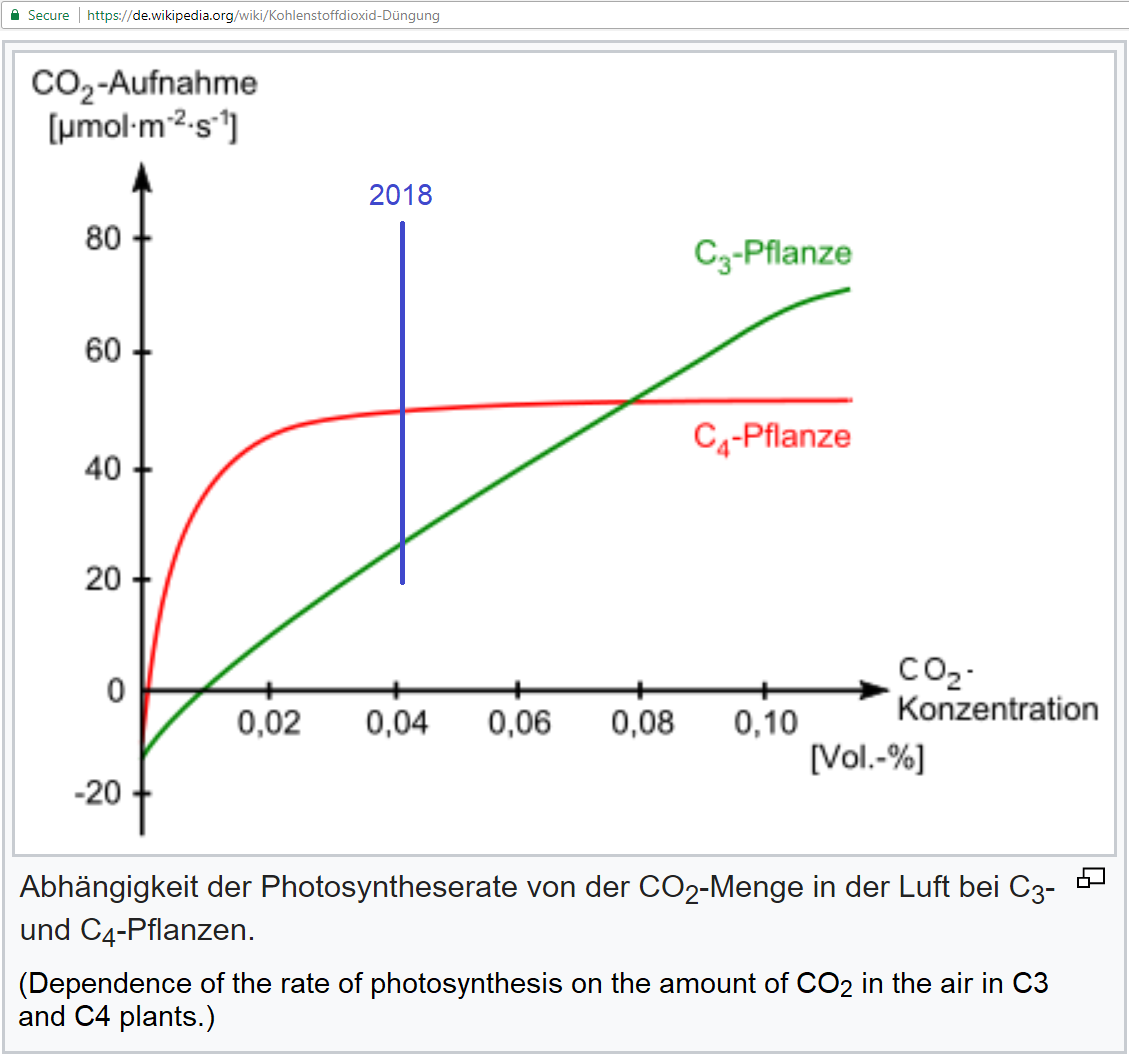
As CO2 levels rise, so do the agricultural benefits. As you can see in this graph, we have a long, long way to go before those benefits begin to taper off:
Won’t these also require energy that itself will put CO2 into the air (at least until renewable technologies can be manufactured without any fossil fuel inputs)? Once tge carbon is captured, how is it sequestered?
Please do not confuse the deep thinkers with real-world issues.
Moving up and down, out of their canisters, they are like giant thrusting dildos to the sky. really.
On a related wacky note on this Climate Religion from ASU, they write the rationale for these CO2-sucking, thrusting dildos as,
“Research and innovation, like the work we are doing at ASU in partnership with industry, are needed to transform a nascent concept into a large, revenue-generating industry that not only stabilizes the climate but also provides well-paying jobs.”
It’s like those Ginsu-knives of 70’s TV commercials, the “Buy 1, Get 1 free” deal apparently with the climate scam. Free stuff for everyone.
And so… stabilizing the climate by removing some trivial amount of CO2??? These ASU guys and gals have been completely duped into believing in magic and unicorns.
So, where will the power come from and all the steel etc? Put CO2 in the air only to take it out in exchange for some green?
While you could get me to agree to spend more of my tax dollars on reforestation, or in the case of places like Arizona dedesertification, for the sake of the wildlife and forestry, etc., carbon capture is not a reason or even an excuse for it, much less an excuse for expensive research into Rube Goldberg schemes that supposedly fix imaginary problems, and from its wasteful expenditures cause real problems, like the simple fact of wasting resources on fake solutions that creates real garbage.
We definitely need a vaccine to deal with this CAGW VIRAL INFECTION which has now reached pandemic levels. Meanwhile a Media lockdown on catastrophic climate stories would be the best way forward. Otherwise our capability for rational thought will be severely compromised.
CO2 is the gas of Life on Earth, because it is necessary for photosynthesis. Thanks to its current rate in the atmosphere (0.04%, or 410 ppm -280 ppm in 1900) the planet is turning green and harvests are better. According to the IPCC AR5 report, our anthropogenic emissions are only around 4-6% and there is no scientific proof that CO2, whatever its source, has a measurable action on the global average annual temperature. Therefore, wanting to reduce the level of atmospheric CO2 is unnecessary, harmful and stupid.
Is it only me who thinks this is actually a good idea?
The captured hydrocabone could for instance be used to generete syntetic gasoline.
Of course, it will only be reasonable if it turns out to be true that mechanical trees can capture energy and CO2 many times as efficient as natural photosynthesis.
/Jan
“Is it only me who thinks this is actually a good idea?”
Apart from Klaus Lackner…Yes
Have you asked 7.8 billon people?
I sincerely hope this place is not developing into an echo chamber. Such places are all too common and always very boring.
/Jan
Where do the birds build their nests on those things ?
The question begs to be asked, what are they made of and how energy intense is building them?
Envision a forest of these trees removing carbon dioxide from the atmosphere…
Now envision the 100% useless destruction of land and huge sums of money required for such an idiotic installation.
It’s enough to make one weep.
If this is such a great idea why can’t he get investors? Gates and Soros and Suckerbergermeister all dump billions into stupidity like this, perhaps someone should explain this to Mr Lackner since he appear to lack the intelligence to figure it out on his own.
For their part, Ford is now marketing their new electric “Mustang”, an ugly beast that does not even faintly resemble their iconic Mustang. They had to make it a so-called crossover because they couldn’t fit the battery and gear in a conventional body and chassis. So I could go out today and buy a FUN basic Mustang for less than its MSRP of $27K or pay full sticker price of $43K for the base “Mustang” Mach-E. So assuming electricity to recharge the car is free (which of course it is not), at current gas prices I would have to drive it 200,000 miles just to recoup the price differential, having a lot less fun in the process. But wait, there’s more … If you act today, middle class Americans will happily pay you an $8K Federal Tax Credit to help you with your virtue signaling.
How soon Ford forgets. When they had a winner back in the ‘60s, they soon morphed it into the post-Arab embargo Mustang II, whereupon the brand immediately died. Today, they have already been heading that direction with their annual morphing of the retro-Mustang (as they did before), and now they are releasing the retro-“Mustang” Mach-E. Of course, this time, they hedge their bets by continuing production of morphed Mustangs, which only remotely resemble the iconic design.
Okay, so you say nobody buys the base model, I’ll grant you that. How about a Mustang GT? Now we’re talking. Compare the conventional V8 Mustang GT at $37K (MSRP) to the “Mustang” Mach-E GT at $62K, for a $25K price differential. After a mere 300,000 miles, I will have recouped the difference, if it even lasts so long. At the rate I drive, my wife and I would have long been in our graves before the car goes so far. Again, this wrongly assumes that electricity is FREE and generated by clean, green nuclear or hydro power (wind, solar and biomass being neither clean nor green).
Ford’s propaganda commercials (showing obligatory wind turbines and green roofs) are also making the idiotic claim that their operations will be run on 100% “renewables” at some future date certain. If Ford engineers are really that stupid, then it makes me question their ability to build quality automobiles.
Not to be outdone, Amazon is likewise vomiting out prideful, self-aggrandizing ads, including big Green claims. Personally, I go out of my way to avoid buying ANYTHING through Amazon, but I am just one person. (How much cardboard and packing material is wasted individually boxing and shipping cheap Chinese knock-off inferior products?)
Given the solar farms, the wind farms, and now forests of fake trees… there isn’t going to be much open land left for human development. Nobody seems to be calculating the usage of finite resources to create this CO2 free utopia. The real inconvenient truth. Renewables are more polluting and costly to recover than fossil fuels. The amount of lithium needed to replace the gas powered car in total would deplete known lithium reserves in about 20 years, or less. Then what?
First-order thinking. They only focus on the immediate results with no concern about the consequences of the actions.
Lithium is a chemical element, and can therefore be reprocessed and re-used infinitely.
There has not become less lithium on the planet than it was in the stone age. The lithium used in the space rockets which have left the planet is the only exception.
On the other hand, fossil fuels can only be used once.
Can be recycled. Are not.
Only between 2-5% of li-ion batteries are being recycled. Most go to landfill.
Very little effort has been put into recyclability.
Most of the batteries that do get recycled undergo a high-temperature melting-and-extraction, or smelting process similar to ones used in the mining industry. Those operations, which are carried out in large commercial facilities—for example, in Asia, Europe, and Canada—are energy intensive. The plants are also costly to build and operate and require sophisticated equipment to treat harmful emissions generated by the smelting process. *And despite the high costs, these plants don’t recover all valuable battery materials.
“Mechanical Trees are a good start.”
I hate to think what he might consider a bad start.
I’m ROFL, plain ROFL.
I assume mechanical trees don’t produce oxygen.
Mebbe the same effort could be put into finding low-water trees and more sources of water?
(Actually, haven’t snowbird retiree been accused of planting so much vegetation in AZ that people now have allergies?
AFAIK all plants produce oxygen and absorb carbon dioxide.)
I am concerned that tree-huggers focus on ‘canopy’ and height instead of volume of foliage that enough air can reach so there is good CO2<>O2 exchange.
But trees with much foliage volume do not grow leaves near the trunk, they die off (probably for lack of sunlight which is essential). Dramatic example is the cypress/juniper hedge trees popularly called ‘cedar’ – empty near the trunk as needles die.