[note, I believe the term cyclomania was invented by Willis, so I want to make sure he gets credit. Rud got it from me.~cr]
Guest post by Rud Istvan
WUWT reader DS (you know who you are) sent a tip to Charles concerning the retraction of a recent Nature publication on solar cycles, predicting a ‘modern Maunder Minimum’ before 2050—thus debunking anthropogenic global warming (AGW, aka climate change).
Previous investigative forays of this solar cyclomania sort have not ended well, so Charles asked me to investigate this one.

I did, and at first was not certain the simple obvious answer was worthy of a guest post. Charles differed. Having reconsidered most of today while hunting and pecking at additional factoid tidbits, I now agree with him. Here is the sorry saga plus some maybe neat sciency stuff: gravitational ideas like barycenters for those that want to learn more themselves.
The retracted paper is Zharkova et.al. 2019 . This is already interesting, because Valentina Zharkova is a well-known ‘mini ice age coming’ ‘skeptic’. She got published, and then retracted. A Skeptical set up? Nope.
Her saga is reported in three parts: what she did, why Nature retracted over her objection, and why she should never have been published by Nature in the first place because of fundamental background math and physics issues.
What she did
Her team took satellite measurements of the solar whole disk magnetic fields from solar cycles 21-23, so about 33 years. They used this independent variable to model the crucial dependent insolation variable. Note the unproven assumption that insolation is a function of solar magnetic flux. (Sunspot theorists do, but their observational substantiation is at best sketchy.) Their model used principle components analysis (PCA, of Mann hockey stick fame) to find TWO magnetic flux components (so much for THE principle component) collectively explaining only 67% of their insolation data.
That seems an overt admission of poor fit statistics, which should have been flagged by peer reviewers. Then they used a theoretical causal model of varying solar magnetic fields to ‘backgenerate’ 3000 years of solar magnetic flux, finding a max/min/max cycle of roughly 350 years full wave form (peak to peak). So the paper concluded that in the last 3000 years, we have seen about 9 insolation minima caused by solar magnetic flux, including (conveniently, except observationally wrong decadal timing wise) the Maunder. And so the next ‘grand minimum’ will be before 2050!!!
An admonition to potential persnickety WUWT critics, like DS. The above is not exactly precise, but captures faithfully the essence of the matter. There is no poetic license. And her paper Figure 2 makes her ‘scientific’ situation MUCH worse than represented here. I am being kind to her in what follows.
Why Nature retracted 9 months later in 2020
Post publication, a number of astrophysicists pointed out that a key calculation assumption—Earth/Sol barycenter fluctuations are random—was just wrong. Nature editors therefore had no choice but to retract the faulty paper when this was easily verified. (See the linked retraction notice footnotes.)
Insolation depends on the barycenter between Earth and Sol. Zharkova assumed that this barycentric variation was random (it matters for insolation, since as you get closer to a hot object you get hotter—something about an inverse square law of radiation physics). For Earth-Sol, the barycenter is always somewhere within the Sun since the Sun has so much more mass than Earth. But Earth does wiggle a bit closer and farther, affecting incoming insolation energy. Random washes out statistically. A very convenient but since proven false assumption.
But for Jupiter, the barycenter is actually always OUTSIDE the Sun, because Jupiter has so much more mass than Earth compared to the Sun. As a result, the Earth-Sol barycenter actually is closely linked to the 12 year Jupiter orbit that much more strongly influences the Sun’s solar system barycentric wobbles. Jupiter on the ‘Earth side’ of its orbit pulls the Sun closer to Earth, and on the ‘far side’ of its orbit pulls the Sun away from Earth. So the paper’s assumptional math was just wrong. Showing yet again that ‘climate scientists’ need to be generalist polymaths, while most (as shown by this paper) are not.
My personal issue with this retraction specific is not that it happened, rather it is that NASA has had the Earth/Jupiter barycenter explanations on an easily accessible website for several years, so the paper’s ‘random’ assumption is inexcusable intellectual laziness by the authors and then by Nature’s peer reviewers. Heck, Newton sorta figured these gravitational basics out long ago. We have been measuring it precisely for decades.
Side comment. The solar cycle is supposedly ~11 years, Jupiter’s orbit ~12 years. So the barycentric ‘drift’ per solar cycle is ~11/12, or about 8% per Jupiter orbital cycle. So a max to min Jupiter kiltered Earth/Sol barycenter would be about 13 Jupiter orbits, and back another 13, so about 26 for a full insolation wave form. So about 312 years in total for a full peak to peak barycentric Jupiter cycle. And her beyond sketchy PCA found about 350. Huummm???
What is REALLY wrong
What I found beyond incredible is that none of the authors, Nature’s editors, or the peer reviewers spotted a much more fundamentally fatal mathematical problem in this paper’s analysis.
Recall what the paper did. Used about 33 years (three solar sunspot cycles) of satellite observations of solar magnetic flux to reconstruct a solar magnetic flux amplitude wave form of about 350 years peak to peak frequency, supposing that then related to equivalent relative insolation energy.
There is an analog/digital conversion mathematical thingy called the Nyquist sampling theorem. It says a band limited (excluding any higher frequencies) continuous time signal comprising multiple wave frequency amplitudes (analog) can be digitally sampled and perfectly reconstructed from discrete (digital) samples of the simple net analog amplitude waveform at a sampling rate >= 2x its highest frequency component.
We experience the Nyquist sampling theorem every day in CDs (now also all digitally streamed music). The sampling rate was set originally by Sony at 44.1kHz (44,100 digitally sampled net amplitude of recorded analog audio sound samples/second). That will faithfully reproduce any sound wave (pitch, frequency) below about 22kHz. Average humans can hear from about 20Hz to 20kHz. The best younger ears can hear 12 Hz to 28KHz. Most older adults experience a drop in hearing acuity above 15kHz, used to design hearing aids centered on about 3kHz.
Sony set a practical Nyquist analog/digital audio music sampling standard, which analog groovy record audiofiles continue to deny to this day to their utterly foolish great analog equipment expense. They believe one thing; Nyquist proved otherwise. Climate analogies abound.
The fundamental physics/math problem with this now retracted on other grounds paper is that they used 33 years of satellite data to very poorly reconstruct via discredited and ill fitted PCA a ~350 year frequency full solar magnetic field strength wave form, when Nyquist says you need at least 700 years to reliably do that. And 700 years of solar magnetic field strength amplitude variation data DOES NOT EXIST.
Any generally knowledgeable peer reviewer should have rejected this paper on first principles of high school math and physics: CD basic digital music stuff. And that is why I reconsidered, now think Charles original opinion was correct, and then wrote up this ‘trivial’ guest post for him in thanks.
Principal Component Analysis.
Yup. Neither CR nor I caught that 2x goof. So not a typo, a real goof. Will try harder.
Was always phonetically spelling challenged. Like my other goof audiophile not audiofile.
Yep Rud,
I got chipped the other day for using “flaunted” instead of “flouted”. We all slip into errors that we would prefer did not happen.
It is interesting that this article of yours has drawn comments from top researchers. Does not often happen, sadly, on WUWT.
Maybe we should have an Anthony Watts award for the best author response each month. Maybe then we could even get one a month.
Top marks this time go to Dr Svaalgard, whose brain works in ways compatible with good science. So does mine, so I can write that, but I am not famous as he is. Geoff S
Hi Rud
As far as i remember the Zharkova et.al. paper validity was questioned as soon as it was published.
First time I came across term ‘cyclomania’ was when I was working on sunspot formula in late 2003 (published on 7th January 2004).
Alexei N. Peristykh: Persistence of the Gleissberg 88‐year solar cycle over the last ∼12,000 years: Evidence from cosmogenic isotopes
Received 15 March 2002; revised 2 July 2002; accepted 9 July 2002; published 3 January 2003
Quote:Suggestions of a role of the Sun in climate change were frequently not taken seriously or even ridiculed because of the excesses of the Schwabe cycle correlations sometimes referred to as “cyclomania”. /quote
Page12/15 https://agupubs.onlinelibrary.wiley.com/doi/epdf/10.1029/2002JA009390
This is a blog of poorly educated scholar in mathematics, I am afraid.
We have published last week a preprint with the confirmation using the real ephemeris of the daily Earth-Sun distances that our results reported in paper Zharkova et al, 2019 are correct. So the paper Zharkova et al, 2019 has been retracted without any grounds!
Read our preprint paper and the Appendices which use the real ephemeris of the distances.
Archive paper https://arxiv.org/pdf/2008.00439.pdf,
Appendix 1 – S-E distances from the ephemeris https://solargsm.com/wp-content/uploads/2020/07/Appendix-1.pdf
Appendix 2 – solar irradiance variations based on this distance changes https://solargsm.com/wp-content/uploads/2020/07/Appendix-2.pdf
I assume now the author will try to overturn the ephemeris calculations? Or what else?
Regards
Valentina Zharkova
Well, no. Nature had very valid grounds for the retraction.
I haven’t checked your new preprint, but IF your 2019 paper also got the ‘ephemeris’ correct according to your new work it was by luck, not by sound analysis.
From Zharkova:
We have published last week the confirmation using the real ephemeris of the Earth-Sun distance that our results reported in paper Zharkova et al, 2019 are correct. Read our preprint paper and the Appendices which use the real ephemeris of the distances.
Archive paper https://arxiv.org/pdf/2008.00439.pdf,
Appendix 1 – S-E distances from the ephemeris https://solargsm.com/wp-content/uploads/2020/07/Appendix-1.pdf
Appendix 2 – solar irradiance variations based on this distance changes https://solargsm.com/wp-content/uploads/2020/07/Appendix-2.pdf
Regards
Valentina Zharkova
It’s interesting that Zharkova et al. have published what looks like very similar papers in a number of journals, starting in 2015, but no reviewers noticed any problems till it landed at Nature. Perhaps the Nature publishers felt the need to publicly nail a climate skeptic for doing what alarmist authors do all the time, with a prominent retraction.
Just for the records:
Our first paper on solar GSM in 2015 (Zharkova et al, 2015) has been published in Nature Scientific Reports https://www.nature.com/articles/srep15689.
Zharkova et al, 2019 was the 4rth paper published in Nature.
I also have published in Nature 1998 another paper discovering sunquakes in 1998 https://www.nature.com/articles/30629
and another paper explaining H-alpha line spectral observations with large red shifts in solar flares published in Nature Communication in 2017 https://www.nature.com/articles/ncomms15905
Funny story about the people who think music sounds better the more money you spend to listen to it: One of the things that these people spend (translation: waste) money on is super expensive speaker wires, some going so far as to use actual gold for terminals, etc.
So some skeptics of all of this decided to test some particularly snobbish individuals to find the limits of what could be discerned.
Ok, sounds reasonable…a blind sound test between different setups.
To get a baseline level, they decided to pull a fast one…they told the people being tested they were comparing two high priced speaker wire setups, but in reality, they hooked up the speakers on one rig using the most expensive crap they could come up with, and on the other one, they connected the speakers using a coat hangers. Yeah, actual coat hangers, untwisted to make them straightish.
Well, you may have already guessed what happened.
The results (meaning which setup was chosen as “best”, soundwise) were completely random, pretty much no matter what they did, even using coat hangers instead of speaker wire.
My guess is for long runs it does make a difference, but the calculation for voltage drop(and other types of attenuation) in a conductor is very well known, used by every electrician in the world every day.
Nicholas
You said, “…a blind sound test between different setups.” Shouldn’t that be a “deaf sound test?” 🙂
Then they would not be able to hear it!
What was important was, they could not see they were listening to coat hangers, and not 8 gage gold plated Monster cables.
That was funny, Clyde!
Made me laugh.
In the interest of full disclosure, I have for almost my entire life been what what might call an audiophile.
I always had among the best sound equipment and the biggest music collection of any of my friends.
My love of music was only one reason.
But I did long ago notice that at a certain point, spending more money was not necessarily evident in the sound.
Back when vinyl albums were the dominant medium of purchased music, there was definitely an audible difference if one could get ahold of a disc pressed from the “master”.
The fact that you personally cannot tell the difference does not mean it is not there.
In fact a 1000 people may not be able to hear the difference because it would depend entirley on how good your hearing was or is now.
When I was much younger I had the privelege of hearing a very expensive sound system owned by an audophile who’s system was used in the UK as a test reference by many audio manufacturers and HiFi magazines. He tested many new products for them.
He was also an avid live music goer and chose his system to be the closest he could get to the live sound.
The sound, stage, depth, width and positioning were truly superb.
Would his system suit everybody, probably not, would they find it too warm, too clinical, it all depends on personal taste doesn’t it?
“The fact that you personally cannot tell the difference does not mean it is not there.”
Now hold on there Sparky!
I never said that I could not tell the difference.
I most often choose my words carefully, to convey what I mean to say…not something else.
I said spending more money, “at a certain point”, was not “necessarily” evident.
I did not say it did not matter, ever.
Or that I could not tell the difference, ever.
Clearly on the low end, one gets what one pays for.
But not necessarily so on the high end.
Then as now, objective testing shows that no matter what one is buying, some stuff is overpriced, and this is often (not always) most evident for some very pricey devices and equipment.
With careful shopping, one could get very good fidelity with modestly priced equipment.
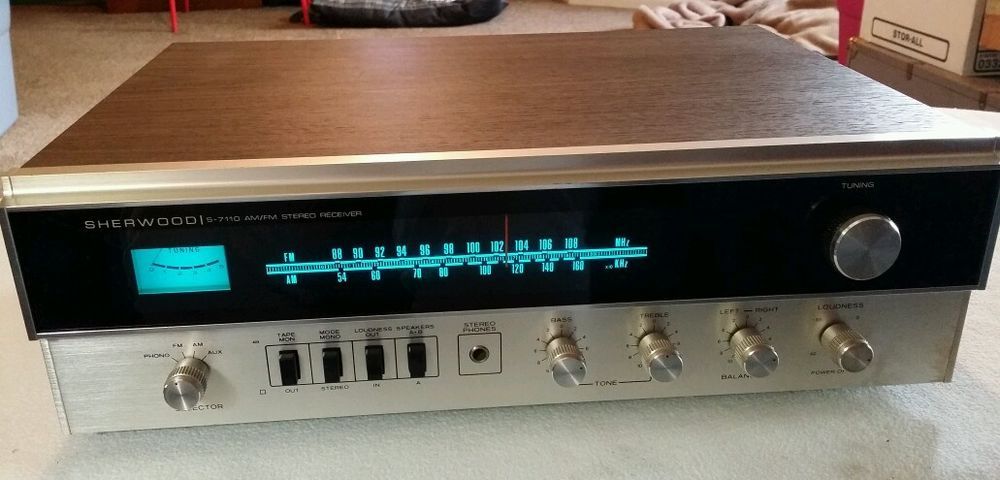
I still have a Sherwood S-7110A amplifier that I bought second hand from my much older brother back in the mid 1970s, and it still sounds great. It is a simple but rather elegant piece of equipment, and it did not cost a lot of money.
Here is what it looks like:
I should break that thing out of the closest and hook it up one of these days.
For the time period, it was amazing…but is pretty much obsolete nowadays.
Although there does seem to be a burgeoning market for such old school stuff.
Nowadays, people are paying huge sums to buy stuff made with vacuum tubes!
Some very expensive audio equipment provides incredible fidelity.
And at a certain point, small increments of improvement might come with a high price tag, which many might deem silly, wasteful or ridiculous.
Some stuff looks amazing, and some stuff has a name plate that carries with it cache’.
Sometimes people spend money as a symbol of status, or for bragging rights.
I am not talking about any of that…just talking about what I said.
By the way, my impression back then was that live sound was usually crappy as all get out compared to the sound on produced studio recordings.
I can recall the first time I ever saw Pink Floyd at the Philly Spectrum, and although thrilling and amazing, it was certainly not so due to sounding better than the same music when played back on good equipment on one of their records.
Years later, that is so so much the case.
Recently I went to NYC to see David Gilmour for a few shows…one at Radio City Music Hall, and then the next night at Madistone Round Garden.
Amazing sound.
I was right up close at The Garden, a few rows back on the floor.
Walking out of the arena, the feeling I had when it was over was of being in a sensory deprivation tank.
The sound felt like it was focusing right into the core of my body…I felt every note internally, with no detectable noise at all.
And the lights!
I thought at the finale, when all the lasers focused on one point, that the air was going to ignite.
It sure looked like it was or had done so.
I knew, and still know, some people too.
My friend was a sound engineer at Sigma Sound, and I was lucky enough to sit in one some truly amazing studio sessions.
Darryl Hall for one stands out in my memory.
I saw the David Bowie show at the Tower Theatre where he recorded his first live album.
That place had/has good sound, although not like RCMH.
(Other memorable shows from that venue…
Blondie in 1979, second row center, feet from Debbie Harry, from this same tour:
https://youtu.be/8Bgbpm7aFp4
And Devo…yes Devo. They were amazing…I got dragged to the show and wound have having the musical surprise of my life at how tight and good they were. That was around this time period:
https://www.youtube.com/watch?v=PBoj-JzQDnc)
English Beat live on Daytona Beach…I mean the actual beach, in the sand…for free, Spring Break 1983. Wow!
Bruce Springsteen was among the first I saw though, who brought studio album-quality sound to live shows at places like The Spectrum.
Amongst my favorite concert memories over the years, seeing Springsteen play the night after John Lennon was killed was one…he opened with Twist and Shout after recounting his early memories of the Beatles, and how the first song he ever learned to play was Twist and Shout.
And then there was the last concert ever played by anyone ever at Philly’s John F. Kennedy stadium (the stadium concrete structure was found to be dangerously damaged…I always wondered if it was from Pink Floyd that night)…it was Pink Floyd on September 19th, 1987…one week after the start of the tour.
Their first real tour in over ten years.
It was pea soup fog that night, and they started playing when no one was expecting it, the fog was split in two by the haunting sound of Richard Wright playing the first note, on his electric piano through an echo box sound effect, a Binson Echorec unit, of the tune called Echoes.
AFAIK, it was the first time they had played that song live since the early 1970’s.
They only played it 11 times before retiring it again.
Gilmour never played it live again until 2006.
I will never forget that amazing moment, or that sound, or the feeling I got from it.
I can still hear it on foggy nights.
(There are some you tube videos of this show, although no one, AFAIK, caught that first note.)
https://www.youtube.com/watch?v=L1365RI9xfY
https://www.youtube.com/watch?v=rsnLyM20EA0
That tour was their first live performances in many a year…since the Wall in 1980. AFAIK
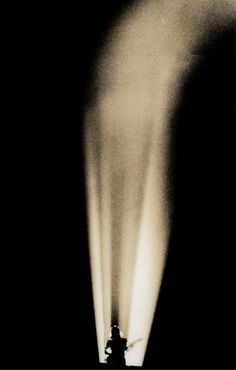
I saw one of the shows of that promotion tour, The Wall…not a real tour…just a few shows…at the Long Island (Nassau) Coliseum…and the sight of Gilmour standing on that wall in a dark stadium, playing the solo at the end of Comfortably Numb, with a single bright white spotlight sending his shadow through hundreds of feet of thick smoke right into my face…now that was memorable.
Here is a you tube of that song from that show:
https://www.youtube.com/watch?v=XX3jpBVG1Q8
And here is a picture of how it looked from near where I was sitting…but this pic is from below line of site of the spotlight…I was in nosebleed seats directly in front of the spot backlighting him:
 ?nii=t
Memorable, yes…
But not as good sound-wise as sitting at home with my headphones on.
Terrible acoustics in places like that.
Nothing wrong with my ears.
On closer inspection, that Sherwood amp is not the model i have.
I have one that looks pretty much exactly like this:
http://3.bp.blogspot.com/-r_654gscHlA/Ve5Tq-2V8vI/AAAAAAAADik/Yp4brBneX_M/w1200-h630-p-k-no-nu/Sherwood%2BS-7100A%2Bfront2.JPG
Nothing fancy, not high end.
Just good fidelity for a low price with enough power to deafen someone in a small closed room.
I use thick heavy, not very expensive, speaker wires because it is in their nature to get tripped over. The thick ones don’t tug out of the equipment so easily and are harder to trip over.
Be careful when you decide why other people do things, yo mainly only reveal your own pre-conceptions.
Yeah, I said nothing about people having others reasons for buying stuff besides how it sounds.
I was specifically talking about one thing: People that believe things that do not make logical sense or are not supported by objective evidence.
The best conductor is silver.
Copper is second.
Gold conducts less well than copper.
Gold will not get an oxidation layer, but the layer of copper conductors is so thin and the metal itself so soft, it is effectively not an issue under any ordinary circumstance.
There is no objective factual basis for buying overpriced or excessively heavy wire, or conductors of exceptional purity, or special gold terminals, or any of that.
As for wire pulling out if tripped over, if you have wires where someone can trip over them, you are probably not the person I will take advice from on such matters.
And if I was worrying about the wires pulling out, I would not want ones that would cause the speaker to tip over rather than pulling the wire out of the terminal. That makes no sense.
Something has to give…either a person takes a dive, or the wire pulls loose, or something falls over or gets dragged across the room.
Having the wires simply pull out and needing to be reattached seems like the least bad option…if one is gonna run wires in a manner which can be tripped over.
But that is just my opinion.
Maybe you would prefer to go to the hospital to get a broken armed set than have to reconnect speaker wire.
Or maybe you find it such a chore to reconnect a wire, you would rather your equipment is damaged or completely smashed.
IDK.
Maybe follow every recommendation every written and do not route wires in such a manner.
Like you say, wire is cheap. You can run one through the walls or ceiling or attic for not a lot of money. Less than the cost of an ER deductible.
I just do stuff like that myself for free…but that is just me.
The signal processing word you are looking for Rudd is “aliasing.”
https://en.wikipedia.org/wiki/Aliasing
Thanks. I am an almost econ Ph.D (undergrad thesis was accepted for the Ph.D) with a JD/MBA from a famous (infamous?) University. Am actually mostly a math model junkie with con law credentials.
So this Climate stuff is my amateur, not professional, math model research world. Why CR asked me to investigate for WUWT. He knows me well, as we have lunch now about once a month since his relocation to South Florida.
Thanks, Rud. The problem was larger than what you report above. Her calculations of the earth-sun distance were simply wrong.
I pointed this out a couple months ago on a site I can’t remember where newly published papers are discussed. I actually went and got the ephemeris measurements and pointed out that her numbers were simply incorrect. So I’m very glad that it went this way.
There is another unmentioned error. This is the belief that the gravity of two objects in free-fall, like say planets circling the sun, affect each other. There is such an effect, but it is solely tidal.
So if you were in a small closed escape pod floating in outer space with no windows, you wouldn’t know if a planet came zipping by … because you, the pod, and everything within the pod are affected equally by the gravity of the planet.
Well, almost equally … the one exception is the tidal force. However, unlike gravity, the tidal force falls off as the cube of the distance between the objects. So while the sun is massive enough to cause tides on earth, and the moon is near enough to cause tides on earth, Jupiter is neither near enough nor massive enough for any significant tidal force on the earth.
So all of her calculations about the barycenter are meaningless, because the forces that she thinks are related to the barycenter don’t exist because all of the objects are in freefall.
Funny side story. Searching for the mystery discussion site where I’d posted the ephemeris data, I came across the report of Zharkova’s “Major Breakthrough” at Tallbloke’s Talkshop. In the midst of boasting how he and others had finally been proven right, he says:
Down in the comments someone said, very reasonably:
To which Tallbloke replied:
That comment aged about as well as the “cutting edge research” … but don’t worry, Rog Tallbloke won’t be either dismayed or apologizing …
w.
Here’s the Nature quote from the retraction:
===
“Current ephemeris calculations [1,2] show that the Earth-Sun distance varies over a timescale of a few centuries by substantially less than the amount reported in this article.”
===
As I said, I pointed this out a month or so ago.
w.
Just looked at Zharkova’s new claims. She finds it very significant that the timing of the equinoxes w.r.t. the aphelion/perihelion times (when it is furthest and nearest to the sun) shifts by twenty days in two thousand years. She says this slow change in equinox timing, which is about a quarter of an hour per year, “has important implications for changing the solar irradiance magnitudes incident on the Earth.”
It’s not clear to me that Prof. Zharkova understands that the solar variations from differing distances to the sun make no difference to total radiation received by the earth. Yes, the variation from aphelion to perihelion is quite large, about 22 W/m2 peak to peak at the top of atmosphere compared to the average solar irradiation of 340 W/m2.
But despite that very large variation, we see no corresponding variation in the temperature of the planet.
The reason is that when the earth is nearest to the sun (perihelion), it’s moving faster so it spends less time there. And on the other hand, when the earth is furthest from the sun (aphelion), it’s moving slower so it spends more time there.
And by the magic of the inverse square relationships, those two exactly cancel each other out, so there’s no difference in the total energy received. None.
As a result, yes, Zharkova may indeed be right that the equinoxes are shifting at a quarter of an hour per year. I say “may be” because I haven’t run the numbers.
But assuming she is right, I am totally unclear as to what difference she thinks this might make.
w.
Gosh, I wish I had spotted that to add to my sarcastic takedown. But did not bother to even look. My post in response to a CR request was only was about her retraction, not her new defense. Well done, WE.
The length of this cycle is about 26,000 years. Closer to 25,770 years.
So in 1000 years, we should expect that the precession is about 365.25/25.7. About 14 days and a few hours.
So in two thousand years, the actual change is close to 28 days than 20 days.
This cycle has historically been called the precession of the equinoxes, but it has more recently been agreed that this terminology is at best an incomplete descriptor.
The 112,000 year cycle of apsidal precession combines with axial precession to influence the time of perihelion.
It seems to be generally recognized that the gravitation influence of Jupiter and Saturn have the largest contribution to this cycle, with the oblateness of the Sun and the effects of relativity (similar to those noted for Mercury, but smaller in magnitude) two lesser known factors with a sizable contribution. Of course, all manner of interactions have some effect, including the combined influence of the gravity of the smaller planets.
If the Earth was uniform with respect to albedo and land surface area compared to that of water, etc, between the northern and southern hemisphere, we could expect this change to not mater for the Earth as a whole, but it would still tend to make Summers warmer when the perihelion coincides with the solstice for that hemisphere, than when the opposite is true 13,000 years later.
Having an ocean at one pole and a continent at the other is surely a large factor as well.
It has occurred to me while writing this comment that there might be another subtle factor…that of the shape of the Earth, which is not particularly close to an actual sphere, and not even very close to the oblate spheroid if the interior of the planet was uniform, and if the Earth did not have huge differences in land mass and mountain ranges between the hemispheres.
And, what if the northern hemisphere weighs more than the southern, or vice versa?
I do not known if anyone has calculated the magnitude of this class of parameters on the amount of solar radiation received by the two hemispheres. The Earth is kind of lumpy, but my sense of it is that this factor is small. Still, if it is significant, it will be additive to other changes.
https://upload.wikimedia.org/wikipedia/commons/f/f9/Earth_oblateness_to_scale.svg
One thing is for sure…stuff is complicomated.
Back when the signs of the zodiac used in astrology were originated, if one was an Aries, for example, it meant that the Sun was in that constellation at sunrise.
Now though, it has shifted to a sufficient extent to move the Sun completely out of that constellation in the morning sky during the interval defined as “Aries”, ~March 20th to ~April 21st.
Another perspective:

Also interesting to note that for the Earth, the difference in the distance from the Sun from perihelion to aphelion is about 3.11 million miles.
For Jupiter, the range is from 507 million miles at aphelion, to 460.24 million miles at perihelion with a precession rate of 0.21252668 degrees/century, which works out to about (check my math) 180,000 years for a full cycle.
http://classicalastronomy.com/wp-content/uploads/2015/06/2-CELESTIAL-YEAR-2-April.png
Note that this amount of obliquity in the orbit of Jupiter amounts to a difference of over 47 million miles between perihelion and aphelion…fully 10% of the distance between the Sun and Jupiter at Jupiter’s perihelion!
I said obliquity, when I should have said eccentricity, of course.
Do you think so? The pull from Jupiter is the main cause for the changes in Earth’s orbit eccentricity. But if you think that changes in Milankovitch forcing are insignificant…
Javier August 13, 2020 at 2:18 pm Edit
I said TIDAL FORCES, Javier. Not “the pull from Jupiter”. Tidal forces.
As to whether the “changes in Milankovitch forcing are insignificant”, depends on the time scale. Over a hundred or two hundred years they make no measurable difference.
w.
Well, you said:
This is clearly not correct. Even in free fall the space deformation caused by Jupiter mass, which we call its gravity, together with those from Venus and other planets, affects the Earth changing its orbit. That’s why our planet’s orbital eccentricity changes. That same space deformation produces the gravity gradient responsible for tidal forces.
So yes, planets circling the Sun in free fall affect each other through gravity. In essence free fall means that there are no other forces acting but gravity, therefore gravity is still acting in free fall.
And in my book, forces capable of moving planets out of their orbits are never insignificant even if they take thousands of years.
Javier,
Good point on space deformation. I’m waiting for a Willis response. ?? Newtonian physics is only an approximation of what is going on and some folks forget that. Of course relativity might also be an approximation, but a better one.
Javier says:
Even in free fall the space deformation caused by Jupiter mass, which we call its gravity, together with those from Venus and other planets, affects the Earth changing its orbit.
Irrelevant in the context of SOLAR cyclomania. Maybe relevant in long-timescales regarding earth-orbital “cyclomania”, which Milankovitch described.
There is another unmentioned error. This is the belief that the gravity of two objects in free-fall, like say planets circling the sun, affect each other. There is such an effect, but it is solely tidal.
So if you were in a small closed escape pod floating in outer space with no windows, you wouldn’t know if a planet came zipping by … because you, the pod, and everything within the pod are affected equally by the gravity of the planet.
Well, almost equally … the one exception is the tidal force.
Exactly. Not sure why this seems so hard for some to understand. And the tidal forces from any or all of the planets on the sun are insignificant.
Will Valentina Zharkova and/or someone who doesn’t like the term please define and specify what a mini-ice age actually is, and where the definition can be found for it. Thank you.
You can look at the paper by Schindell et al., 2001 (Science paper) https://pubs.giss.nasa.gov/abs/sh05100g.html and their press-release here
https://www.giss.nasa.gov/research/news/20011206/
Recently this was covered by NASA website https://www.giss.nasa.gov/research/briefs/shindell_06/
And more references here https://www.tandfonline.com/doi/pdf/10.1080/23328940.2020.1796243?needAccess=true
Thank you but those are about a “Little Ice Age”; I want to know how you define a “mini ice age“. I accept the definition of the Little Ice Age as it relates to the Maunder Minimum, and please – they are not the same thing.
From the article:
This is already interesting, because Valentina Zharkova is a well-known ‘mini ice age coming’ ‘skeptic’.
Which brings me to ask, isn’t it irresponsible and misleading for your many youtube followers to be claiming we are in a grand solar minimum right now?
Wouldn’t you agree we are a long way from meeting the Usoskin etal definition of a grand solar minimum?
Today it’s well above 33 –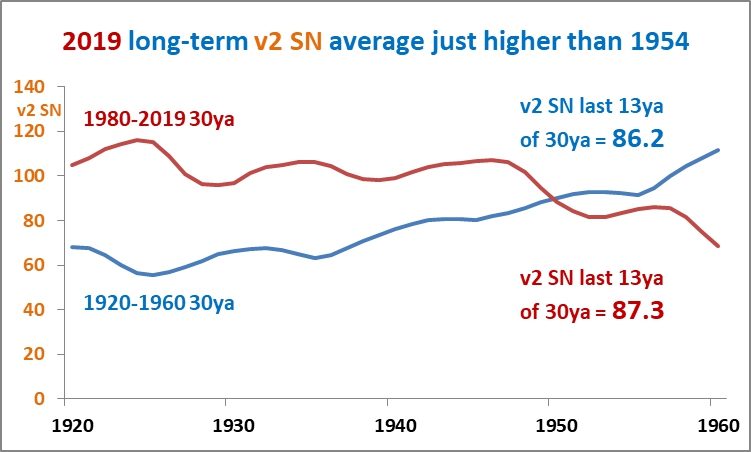
Please do not call me the GSM sceptic, this is not correct! Thank you.
We were the first who announced in 2015 the upcoming Grand Solar Minimum with the paper in Nature SR:
https://www.nature.com/articles/srep15689
This was covered by the newsreels of the Royal Astronomical Society:
https://nam2015.org/press-releases/64-irregular-heartbeat-of-the-sun-driven-by-double-dynamo
and widely covered by the press in 2015-2018
https://www.sciencedaily.com/releases/2015/07/150709092955.htm?fbclid=IwAR2mV_j-WPx2ycQ9GLUQ_ZvROsqilMIPXaoeUl13o-7MNGXvbrPuB-B3f-8
Thank you but that didn’t address the issue I raised, and you can credit this article writer Rud Istvan for the words I quoted from this article where he called you a well-known ‘mini-ice age coming’ skeptic.
I fault you with allowing your supporters to claim we are in a GSM right now when we aren’t in a GSM right now. This is the same kind of error people here made much of this year when claiming we were in a La Nina after being only a month or less under the line.
As it stands today there are a few years to wait and see if peak SC25 sunspot activity is within Dalton minimum levels, because if future cycle activity is no lower than SC24, there won’t be any grand solar minimum this century.
Now, back to my original question. What is a mini ice age?
Incorrect use of Nyquist sampling theorem but the original results are still dubious.
1) Sampling must be atleast double the frequency you wish to detect.
They didn’t do just 2 measures for start and finish but for every year ie. rate of 350/1 which is atleast 175x the rate required for detection of a 350 year cycle.
However..
2) You would need to be sampling for a whole period (cycle) eg. +1, -1
The problem is not the 33 samples but the fact they can only see a 33 year span. You may suspect cycles less than 33 years but you can’t verify them unless you have atleast 3 cycles in the data. It would be unreliable to extrapolate 33 years into 350 years. A 350 year span may show a cycle but you would need another 350 to check once and better with a total of atleast 1050 years.
Bad example: You could use 33 years to identify a 7 & 11 & 14 yr cycles then extrapolate them to 350 years but that ignores any possible 17+ year cycles which occur independent of the smaller cycles measured.
What you can do is use data from sun, moon & planet positions and model the gravity effects and estimate positions into the past and the future. If the paper measures B (cycles) & C (climate) can we find the A (related to movement in our solar system) which determines B?
function(B) = C
function(A) = B
then
function(A) = C to cut out the middle man
There are more factors impacting our climate than just Sun, clouds, albedo & GHG. How much each contribute are still being debated and simulations using averages don’t simulate the real climate behaviour. Our weather changes because the inputs vary from the mean. Our climate is the average of those weather changes not the average of the inputs.
Earth/Sol barycenter fluctuations
Stopped reading there.
Yah, I could have phrased that better. Thought the Nasa reference would suffice, wrong.
A barycenter is a mathematical ‘center of gravity’ around which objects orbit eccentrically. It is the orbital eccentricity that varies, not the constant mathematical barycenter. Which thanks to nonlinear dynamics is only precisely calculable for two body problems, and not N body solar systems.
Unbelievable, you guys, or most of you, valentina has made a prediction starting this year, it will be years till it be known if she is right or wrong,you simply do not know,yet the tone of some of you , her science is not proved wrong or right ,it is too be seen ,not ridiculed, youl all come back now and apologise if she is proved right ,wont you boys?
Unbelievable, you guys, or most of you, valentina has made a prediction starting this year, it will be years till it be known if she is right or wrong
Well, she has also [using the same method] ‘postdicted’ solar activity in the past [for thousands of year, no less] and those where all wrong, so trusting her to do better for future activity does not seem to be worthwhile.
I shall personally offer to wash her feet, at Midnight on Christmas Eve.
Another example of how this thread has turned into a ridiculous “I know better than you” take sides” with the chief muck stirrer wadding in, not only that the fallout from alienating yourselves from GSM folk who happen to agree with the lie of global warming which this forum advocates, one has to ask why this topic which the producer knew would cause controversy, what exactly are you trying to do slag of a scientist who has only made a prediction ,a prediction not one of you can prove false or correct even the ” willis” cant foretell the future let alone come up with his own paper of a prediction.
B d, I fear your comment doesn’t make sense. Who is the “chief muck stirrer”? You? Me? Javier? Nicholas?
Next, you talk of the “the lie of global warming which this forum advocates” … I haven’t the slightest idea what you are on about.
Next, NOBODY can prove a prediction false or correct until the deadline is past … but two months ago I clearly showed that her math was total crap. Took a couple months, but she’s had to retract the paper because as the journal found out … her math was total crap.
So I can’t tell if her prediction is correct, B d, nobody can. But I’ve shown she is very poor at math. And by “very poor”, I mean that as soon as I read her paper back then I knew her math was total crap. And I demonstrated it by ACTUALLY DOING THE CALCULATIONS.
Finally, she diagnosed and detailed a 300-year-cycle based on 33 years of data. That is scientific ignorance and arrogance beyond belief. You’re welcome to think she’s on to something. Sane folks think differently.
And when I’m able to see that something’s wrong at first glance, a huge error that she didn’t even notice during the entire process of writing the paper … do you really think I should pay attention to her predictions?
Really?
w.
” do you really think I should pay attention to her predictions?”
But you are Willis ,not only are you paying attention, you have gone beyond attention ,your point such as it is could of been made in two sentences, so now that your contradiction has been pointed out.
For those who are bystanders in this ridiculous thread what we are seeing is a witch hunt ,exactly like what happens to climate skeptics, not only has her prediction been ridiculed, personal insults have been thrown,
If a prediction is wrong/ part wrong,part right ,right then we learn from it ,it is a contribution to science ,
Dismissing a prediction before the time of the prediction has run its course ,is not science , the tone of the article is dismissive, which like sheep most of you have followed suit,
WIllis if you disagree so strongly you get the funding for research in this subject ,you get published, and let’s see if your paper can stand scrutiny, not ridicule.
And Willis I have not said I agree or disagree with zharkova, I have read the paper in question that does not make me a follower of zharkovas, I think it’s fairly obvious Willis what I’m saying is I’m very surprised at the tone ,and ridicule a prediction attracts,
40 years of failed climate predictions rightly deserve ridicule , barely 2 months into a prediction that will take years to show if it’s in part correct or not does not deserve ridicule.
B d Clark August 17, 2020 at 3:05 am Edit
Discussing someone’s prediction ≠ paying attention to their prediction.
I didn’t ridicule her prediction. I pointed out that her math is crap. I pointed it out a couple months ago and guess what?
Her math WAS crap.
Not only that, but she used her method to hindcast the past, and guess what?
Her hindcasts were crap.
Now, that is not any kind of “witch-hunt”. That’s the normal scientific process. Someone makes a claim, a hindcast, or a prediction. Other scientists then try to poke holes in their ideas. In her case, I didn’t have to poke a hole, there was an error big enough to drive a Greyhound bus through.
Her subject is the putative effects of sunspot-cycle-related phenomena on earth’s climate. Here are 24 of my posts on the subject. And they’ve been reviewed, but not by the kind of crappy peer-review that let Valentina’s paper slip through with an error so big it stood out like a stubbed toe.
They’ve been subjected instead to WUWT review, which is harsher and more penetrating than any peer-review could be. If you can find errors in any of them, let me know.
B d, if I were to predict that the sun would not rise tomorrow, and my prediction was based on incorrect physics, and someone found a huge mathematical error in my work, and my predictions of past sunrises were out by miles … yes, people would point and laugh at my prediction without waiting for the denouement.
And that is exactly what has happened to her. You seem to think that she’s the first person to be seduced by the barycenter. Those of us who have played this game for a while know that there are a bunch of people who made predictions based on the barycenter … and AFAIK, not one of them has panned out.
Hey, if you want to sit up all night and see if the prediction that the sun won’t rise tomorrow is true, be my guest. I’m just saying that you don’t need a weatherman to know which way the wind blows …
Regards to you, stay well,
w.
Her science has been proven wrong. It is not only that her model has been demonstrated by Ilya Usoskin that it is no better than random when hindcasting past solar activity even from 1700.
Her retracted paper is based on a misconception about something that it is very well known, the orbital movements of the Solar System bodies. She found out that the Sun moves around the barycenter of the Solar System and she just assumed that the orbit of the Earth was fixed around the barycenter of the Solar System, so the distance of the Sun and the Earth would change on average from year to year, changing the insolation the Earth receives on an annual basis.
This notion is nuts and one wonders what knowledge the reviewers of the paper had on something that is so fundamental to the paper. The Earth does not orbit the barycenter of the Solar system, the Earth orbits the barycenter of the Sun + the interior planets, which is very close to the Sun’s center of mass. Thus the Earth follows the movements of the Sun around the barycenter maintaining what essentially is a constant year average distance to the Sun (1 A.U.) that is only modified very slowly through the changes in Earth’s orbital eccentricity produced by the pull of all the planets relative to their mass and distance producing the well-known 95, 105 and 405 kyr periodicities in eccentricity that have a huge effect on Earth’s climate.
If Jupiter was placed in the orbit of Mercury then we would be talking about an irregular orbit of the Earth around the Sun. But thankfully that’s not the case and the differences in the distance between the Earth and the Sun are averaged over a year so the insolation doesn’t change from year to year except in the small amount due to solar activity variability.
Her model is wrong, her concept of the Solar System dynamics is wrong. When the science is wrong, who cares if the predictions pass or not? If the Earth enters a mini-ice age that would not make Zharkova’s science right, so we would still have to look for a different explanation.
You really are a joke Javier you argue her science is wrong ,yet you and a solar physics guy argue on this thread about the fundementals of basic solar science, you cant even agree on basics, yet your telling another scientist there wrong, science jarvier is about predictions and reproduction, her predictions will take years to prove right or wrong, another fundemental your not willing to follow.
You along with Willis have a lot more going than just saying she is wrong , every opportunity you get you attack this woman,stating she is wrong is a opinion and you have every right to do so, stating a prediction is wrong that takes years to show if it’s right or wrong ,is wrong and is here say, means nothing , your continual attacks rather than a opinion shows to me you and others have a vested interest, agenda .as I’ve already said any science good or bad forwards that branch of science,because we learn, by your continual suppression, attacks goes against the fundementals of good science,. A point you and Willis are in denial about.
You don’t seem to understand that I don’t say she is wrong about her predictions. Nobody knows the future. I say she is wrong in her methods and assumptions, and that has been demonstrated. If her science is wrong her predictions are irrelevant.
I also criticize her attitude for the same reason I criticize Leif’s. They are both too sure about things nobody really knows. Past interpretations of the evidence have overwhelmingly been wrong or incomplete, yet there is a cognitive bias that most people assume our knowledge of science is now adequate and the majority of our interpretations will turn out to be correct. That is risible. Future generations will “know” that our knowledge was not adequate. We should always be cautious about saying things like “the 11-year cycle is the only one real” or “we are entering a grand minimum in solar activity”. They are based in an inadequate level of knowledge.
No Javier you dont seem to realise you and sval are drawing upon decades of solar science which contradict each other, with both of you flying the flag for a opposing camp.
So according too you two there is no consensus on the workings and mechanisms of the sun, yet you criticise another scientist for a different approach. You really need to get your own camps in order before you attack another scientist, it seems on such basics and in depth analysis of the solar system according to you two all you have is a bunch of theroys contradicting each other.
That is not correct. Leif and I agree on the evidence, we just disagree on its interpretation, and this is the most usual reason for scientific discussions.
– We both agree there is a 11-year sunspot cycle that reflects on an 11-year cycle in TSI.
– We both agree there is an extended cycle when one looks at other solar features migrations that take longer than 11-years from when they appear to when they disappear.
– We both agree that there is a 22-year cycle manifested in the polarity of polar fields.
Those are the facts and we agree on the facts.
We disagree on whether the evidence supports that the fundamental cycle is the extended cycle (Leif’s view), or the 22-year cycle (my view). But the evidence is insufficient at this point to rule out conclusively any of the alternatives. There are no opposing camps. It is more a matter of point of view like arguing about a glass half-full or half-empty. There would not be a discussion if Leif was more humble about what he really can demonstrate and did not try to invalidate my position while insulting me. There are no discussions about this in the literature because unlike Leif most solar experts consider this a matter of opinion at this point. As I have shown several scientists share my point of view.
There are no camps to sort, but even if there were, that would not be an impediment to point that Zharkova’s model and assumptions don’t hold water as that is a completely unrelated matter. She seems to be very good at mathematics, but has a very poor understanding of some important physical aspects, like Astronomy and Climate and rests her conclusions on very poor sources, like the barycenter crowd or Akasofu’s deprecated temperature charts.
I understand she has a following because she goes regularly to the press with her popular predictions of an impending mini-ice age to sooth the global warming burns. But that has exactly zero value in science. Manipulating the public one way or the other is usually a sign of bad science.
There are no discussions about this in the literature because unlike Leif most solar experts consider this a matter of opinion at this point.
No, this is not correct. Real scientists do not have ‘opinions’. Pseudo-scientist and Fringe people have ‘opinions’; real scientists may have ‘working hypotheses’, that should not be confused with ‘opinions’. Scientists do not ‘insult’ each other; they may attack the hypothesis but never the person. Stating that a hypothesis is without merit [or is nonsense] is not an insult of the person holding that hypothesis. Saying that one scientist ‘misrepresents’ another one, or ‘not telling how it is’, is an attack of a person and marks the attacker as a pseudo-scientist or even an activist of a fringe world view. We see a lot of that here on WUWT, to wit: your postings.
If you want to call your opinions hypotheses that is fine with me. Is this a working hypothesis or an opinion?:
https://www.leif.org/research/Climate-Change-My-View.pdf
The concept of real scientists and real science gives me the creeps. Who decides who is a real scientist? You? Apparently you label yourself as a real scientist and others as pseudocientists, particularly those that do not share your hypotheses. As far as I know anybody that learns to use the scientific method and puts it to use to research a question is a scientist. There are good and bad scientists, though, but that is to be judged on merits. Kicking scientists out of the club for not being real climatologists is what the alarmists do. You share too many traits with them. You defend the orthodoxy, you invalidate anybody that disagrees, you speak for all “real” scientists and know what they think even if they write the opposite. All very authoritarian.
Isn’t calling somebody an ignorant a personal attack? Who sets the bar on ignorance? You again? So anybody that knows less than you is an ignorant? Or only those that don’t agree with you.
If you don’t want to be accused of misrepresenting what others say, perhaps you should limit yourself to exact quotations of what they say, as Willis always demands. Particularly since I remember when you claimed you had shaded a figure to indicate periods of contamination when the shading had been done by the authors of the figure to claim just the opposite.
https://wattsupwiththat.com/2016/11/24/the-bray-hallstatt-cycle/#comment-1910750
Is this a working hypothesis or an opinion?:
https://www.leif.org/research/Climate-Change-My-View.pdf
That is, obviously, as stated [‘my view’] an opinion. Strange, that you cannot see the difference.
Who decides who is a real scientist?
The postings, comments, [and papers] make the distinction clear. One know pseudo-science when one sees it.
anybody that learns to use the scientific method and puts it to use to research a question is a scientist.
Except that that does not fit you. You do not ‘research’ anything, just ‘search’ for phrases that support your views. You claimed to have done ‘research’. I asked for a link to what you consider your best research of the topic at hand. So far, you have not produced any…
Isn’t calling somebody an ignorant a personal attack? Who sets the bar on ignorance? Ignorance shows. It is obvious when presented. You have shown many examples. What more is needed?
Particularly since I remember when you claimed you had shaded a figure to indicate periods of contamination when the shading had been done by the authors of the figure to claim just the opposite.
I clarified that issue right away. I presented that figure to make a point, not to promote it to be my work.
If you don’t want to be accused of misrepresenting what others say, perhaps you should limit yourself to exact quotations of what they say
In that particular case, I was saying that I knew exactly what Cliver meant, because we have worked on this together [as he mentioned]. That was not misrepresentation in any sense, so your accusation was baseless, but typical.
I re-iterate: you are not a scientist. You do not use ‘the scientific method’. You do not do research. All this is so blindingly obvious. To pretend otherwise does a disservice to WUWT.
Sure, sure. Everything is based on your personal criteria. And you like to give your opinions about everything and call them hypotheses, even if you don’t know about what you are talking about. For example, I have stated many times that I am a molecular neurobiologist with papers in journals like Science and Cell. So yes, I am a real scientist with a good knowledge of the scientific method. For scientific fields outside my specialty I can read the bibliography and see what is based on suppositions, what is actually demonstrated and how solid is the evidence, like any other scientist. That’s why I know climatologists have not demonstrated that the increase in global temperatures is due to the increase in GHGs despite they been as confident as you are. So I know that when you say the the Hale cycle is not a real cycle you are bullshitting. There is sufficient evidence of the existence of the Hale cycle and every scientist that writes about it treats it as a real cycle. Even more, some scientists declare it to be the fundamental cycle. So since “Nullius in verba,” I know that you are not telling the truth about it. You are telling your opinion [or hypothesis] but you treat it as it was a fact. So you are the one that is not talking like a scientist. Good scientists are less confident and more careful when they talk about their hypotheses, particularly when there are competing hypotheses that have not been proven wrong.
A hale cycle one magnet cycle of the sun is a term not a cycle in its self .its the two schwabe cycles or 11 year cycles going full circle , hale is a convenient way or less long winded to explain one complete magnetic cycle of the sun ,its seems convenient in helping explain increase and decrease of GCR at a given time in a schwabe cycle. The true cycle of the sun is a schwabe cycle.
I think you guys are splitting hairs.
Can I be a scientist now please.
I know that you are not telling the truth about it.
How one knows who is not a ‘real scientist’?. I know hundreds of scientists in our and other fields and they NEVER accuse other scientists of lying, not telling it as it is, accuse anyone of misrepresenting other scientists., etc. They know the difference between opinion and scientific hypotheses. In short, they never behave like you.
It may well be possible to be a scientist in one field and a lay and ignorant person in another field. You have still not demonstrated any knowledge or expertise in the field under discussion here; still not produced a link.
We should always be cautious about saying things like “the 11-year cycle is the only one real” or “we are entering a grand minimum in solar activity”.
Scientists are generally a very conservative lot. It takes very convincing [even extraordinary] data or theories to overthrow generally accepted ideas [current paradigm or dogma]. These are accepted because they work. The onus is on dissenters who say otherwise to show that their ideas work ‘better’ in some sense. Just being contrary does not cut it.
Past interpretations of the evidence have overwhelmingly been wrong or incomplete
Even if not generally true, there are cases where past interpretations were wrong, e.g. that the 22-year Hale Cycle is a physical ‘cycle’ driven by mysterious processes in the solar interior and given rise to the ordinary sunspot cycle in some unspecified manner. The very word ‘evidence’ is normally frowned upon in physics. It is too intimately connected with a belief indicating whether the belief is true or valid. So, ‘evidence’ presupposes a belief. We would rather use the words ‘data’ or ‘observations’.
particularly when there are competing hypotheses that have not been proven wrong
You have this backwards: it is not up to us to prove hare-brained hypotheses wrong; it is up to the proposers to prove them right, and mostly they are not.
Now you are describing your opinion of the club from which you think you are entitled to kick me out. Except that I have also known my share of scientists and have the opportunity to watch a good deal of scientific misconduct, so scientists lie, don’t tell it as it is, and misrepresent things and people when it is important to them, exactly the same as other human beings. So according to you to be a scientist one has to turn a blind eye to scientific misbehaviour and never say anything bad about other scientist even if true. Because the alternative is that you think that scientists are a special kind of human beings that never do wrong.
Not being an expert in a field does not mean that one cannot get things right while the experts get it wrong. A mind is a powerful instrument when properly used. In 1815 Jean de Charpentier met with a villager in the Swiss Alps, Jean-Pierre Perrudin. He told Charpentier that in earlier times glaciers had a very much larger extensions, completely filling the Val de Bagnes and being responsible for transporting the erratic blocks that were too big for being transported by water. At the time the expert consensus was that the blocks were a relic of Noah’s flood. Charpentier wrote “I nonetheless found his hypothesis so extraordinary, indeed so extravagant, that it merited the effort of being contemplated and taken into consideration.” From that he developed his theory of greatly expanded glaciers and together with Karl Schimper view of alternating expanding and receding glaciations explained it to Louis Agassiz, who made the hypothesis his own, never acknowledging his since ex-friends contribution. From that incident is thought to come the quote attributed to Alexander von Humboldt, who knew them all well, “There are three stages of scientific discovery: first people deny it is true; then they deny it is important; finally they credit the wrong person.”
I see you have a problem with the scientific method and it is you who has this backwards. Hypotheses cannot be proven right. At most people fail to prove them wrong and if they have enough supporting evidence they are accepted by the majority, but in Thomas Huxley’s words, a single ugly fact can slain the most beautiful theory. Karl Popper explains this in a way that even scientists who are not very good with the scientific method can understand. Whereas verifying the claim “All swans are white” would require assessment of all swans, which is not possible, the single observation of a black swan is sufficient to falsify it.
If a hypothesis is hare-brained it fails to gain traction so nobody bothers trying to falsify it. If it gains traction because it explains a great deal of the available evidence then it is the duty of scientists to try to falsify it. Richard Feynman was very clear about this: “Real science is all about trying to prove your theory wrong. You do everything you can to prove it wrong, then have other people do what they can to prove it wrong. When all of you fail at doing that, when the theory has been refined such that it fits all the evidence and you can’t figure out how else to test it, then it is most likely the truth.”
You are the one that is saying that the Hale cycle is not real. That is your hypothesis. I have not developed any hypothesis about this. I am just going with the scientific bibliography where everybody accepts the cycle and talks about it. If you think the Hale cycle is not real you should be able to falsify its existence. So I don’t have any hare-brained hypothesis respect the Hale cycle that I need to support. The Hale cycle is what has been described, a 22-yr cycle in solar magnetism. I am not adding anything.
Exhibit D (I might run out of letters):
“Generally speaking, many of the intriguing problems in solar physics are related to the causal connections between the Schwabe and Hale cycles. Most of the numerical indicators of solar activity are associated with the 11-year Schwabe cycle, while the Hale cycle seems to reflect the quasi-periodic recurrence of generally complex magnetic phenomena.”
Balogh, A., et al. “Introduction to the solar activity cycle: Overview of causes and consequences.” The Solar Activity Cycle. Springer, New York, NY, 2015. 1-15.
and have the opportunity to watch a good deal of scientific misconduct, so scientists lie, don’t tell it as it is, and misrepresent things and people when it is important to them, exactly the same as other human beings.
You miss the point: it is not scientific behavior to accuse other people of such things. Science is conducted at the level of observations and experiments, not at the slimely level of going after the person. That is the difference between us. And, as I have stressed: ‘real’ scientists do not behave as you do.
You quote Feynman “Real science is all about trying to prove your theory wrong”. What have you done to prove your theory wrong? Nothing. You have made no contributions to the field whatsoever.
On hypotheses: the fundamental dynamo solar cycle is not a hypothesis [and not mine]. It is derived from, supported by, and forced upon us by observations, and is well understood theoretically. You have not understood that the so-called Hale Cycle has long just been a handy mnemonic. Even the recent promoters of that cycle concept have begun to walk back from it. They now talk about the ’22-year magnetic polarity cycle’ instead of the solar activity cycle and even go so far as to refer to *22-year cycle* in quotation marks.
On the other hand, the [recent] idea [a hypothesis] of the magnetic activity bands driving the 11-year activity cycle [as well as shorter eruptions] is, however, an interesting [and new] one. It makes the strong prediction [using their idea of ‘terminators’] that SC25 will be one of the strongest one ever observed. If this is borne out, one will need to take the idea more seriously. If not, the hypothesis will fall. This is normal science, and can be conducted without the venom that you dish out.
Last, you have still failed to produce a link establishing any credentials at all.
Of course, but we are just discussing science at a blog, not conducting science, and you seem to forget that you have a history here at WUWT of personal disqualifications and attacks to a lot of people that defend theories that you deem unworthy. Your pattern is to attack people and if they respond in kind like I do then you accuse them of unscientific conduct. How hypocritical. If you have a personal problem with me the solution is to ignore me. I am not going after you, just criticizing your unsupported assertions that the only real cycle is the 11-year cycle and that the Hale cycle is a mnemonic, for which you have produced no evidence. I don’t have to produce anything just because you ask for it. You are free to stop discussing with me anytime.
What theory? I don’t have a theory regarding the Hale cycle. I am just following what is published in the literature, and producing evidence for that. You attack me, call me ignorant, doubt my mental capacity, and judge me unscientific just because I say what is written in the papers, and then you want to take the role of the victim here. What a joke!
Your role here at WUWT is that of a scientist bully trying to impose your views over things that are far from established as if they are the revealed [by you] truth, attacking anybody that disagrees. That is a very unscientific conduct.
Quite frankly I don’t see any difference between you and the climatariat, except that you believe in different things. The behavior is the same. Anybody that disagrees with the orthodoxy and authority must be attacked and disqualified. No disagreement is allowed.
The Solar Dynamo theory is not at odds with the Hale cycle, and quite the contrary, as NASA states a successful model for the solar dynamo must explain among other things “Hale’s polarity law and the 22-year magnetic cycle.”
https://solarscience.msfc.nasa.gov/dynamo.shtml
I just have your word for it and I don’t trust you. Remember: “Nullius in verba.” Why should anybody trust what you say? Because you are the authority? That is very unscientific too.
I don’t think you understood their hypothesis. The prediction could fail and the hypothesis could still be right. The prediction is not born out from the hypothesis but from an observation:
“A visual comparison of Fig. 2d and 2a hint at relationship between the separation of terminators and sunspot cycle amplitudes: low cycles appear to correspond with widely separated terminators while larger amplitude cycles correspond to more narrowly separated terminators.”
These type of “rules” based on a few occurrences tend to be weak and fail sometimes (violations), like the Gnevyshev-Ohl rule.
Prior to that observation they were predicting a weak SC25 in their 2017 paper: “We anticipate that a short ascending phase would appear to favor a weaker cycle 25 (than 24; cycle 24’s ascending phase was shorter than that of cycle 23) as there is more overlap time between the oppositely signed bands.”
McIntosh & Leamon magnetic bands hypothesis does not yield so far a good method for solar activity prediction, as they are based on extrapolations of the magnetic bands and future temporal intervals that given intrinsic cycle variability cannot be trusted much.
So no, a failure of their prediction cannot be blamed on the hypothesis but on their observation of a relationship between terminator distance and solar activity. This observation can be wrong without affecting the hypothesis. The magnetic bands are still real since they are based on observation.
What ever “we means” that prediction of a low SC25 is still on course, we still have a relatively low sun spot count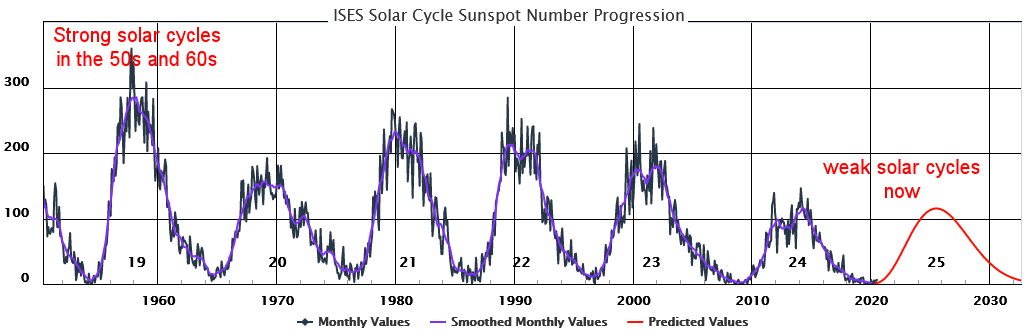 . Never mind the so called hale cycle it is mnemonic, look at the decadle decline in the sun in the graph ,that’s a cycle you need to be concerned about.
Quite frankly I don’t see any difference between you and the climatariat, except that you believe in different things
And that is precisely your problem and your bias. WUWT is a useful forum for discussion of climate change. It would be a pity if the discussion is marred by assertions [such as your cyclomania] that are colored by political considerations. I have striven to provide a scientifically sound background for the solar aspect of the discussion. You, on the other hand, have constantly labelled my contributions as ‘bullshit, lies, misrepresentations, and worse, while at the same time shown that you have little [if any] understanding of the science at hand [while refusing to link to credentials you claim to have]. The readership is ill served by your behavior.
I’ll try to summarize the McInstosh et al. claim here:
Bands of the 22-year magnetic polarity cycle are embedded in the Sun’s convective interior and first appear at high latitudes (∼55°) before travelling equatorward. These bands interact with the oppositely polarized magnetic band from the previous cycle at lower latitudes in each hemisphere, modulating the occurrence of sunspots on the low-latitude bands (which have opposite magnetic polarity and sense of handedness) until they eventually cancel across the equator. This equatorial cancellation signals the end [the ‘terminator’] of the sunspot cycle and leaves only the higher-latitude band in each hemisphere. Sunspots rapidly appear and grow on that band for several years until a new oppositely signed band appears at high latitude — an occurrence that defines the maximum activity level of that new cycle and triggers a downturn in sunspot production. The interaction of these 22-year activity bands drives the (quasi-)11-year cycle of sunspots that form the decadal envelope of solar activity. McIntosh et al. claim that rotational energy at the bottom of our Star’s convection zone is the major driver of the Sun’s long-term evolution [which, BTW, is not original with them; that is what many others also believe].
As I have already explained, the bright point bands have a natural and simple explanation in terms of conventional solar dynamo theory driving the true 11-year solar activity cycle, so no new hypothesis is necessary. The strong prediction of a very strong SC25 [after an abortive earlier prediction of very weak cycle] is a do-or-die thing for their hypothesis. According to McIntosh et al. the terminator has already arrived [April, 2020] so their prediction is now firm.
To re-iterate, the magnetic bands and associated phenomena are satisfactorily explained by conventional theory and no ‘fundamental 22-year cycle’ is needed.
I’ve got no problem with anybody here except apparently with you, and since you have problems with several other people, it is clear that you are the cause and I am the consequence. That’s my hypothesis anyway. My sin, not yielding to what you say.
There are several things that don’t repeat the same way for 22 years, the modulation of cosmic rays has a rounded top at A>0 cycles and a pointy top at A<0 cycles. The 11 yr cosmic-ray cycle appears to lag the sunspot cycle by ∼1 yr for odd cycles but is in phase for even cycles. The Gnevyshev-Ohl rule groups sunspot cycles in pairs. And then the magnetic bands described by McIntosh and Leamon. It is clear that a Hale cycle is more than just two Schwabe cycles.
If your going to copy text Javier get it right its ,qA0 there is no hale cycle Javier however you dress it up any manifesttation from a cycle A Becomes part of cycle B depending on transition and + – minima in my example . A cycle starts with a magnet point ,ends at a opposing point ,transition through B to start at the original point, that’s why we number SCs 24 25 ect we dont number a imaginary hale cycle.theres no point.
I see you graced me with science Javier atta boy, now Javier you seem to think I disagree with people and you use that in a derogatory sense, correct Javier but I happen to agree with more people than I disagree with , its human nature Javier, it does seem I disagree with everything you say because I have only seen you argue with other people in sun physics, I cant recall you ever commentating on any other subject, but try expanding your social skills and you might find other people agree with you.
Correction to my last post should read qA0
qA 0 cant seem to reproduce to less than great than symbol
B d, I don’t know what you are talking about. A>0 refers to 11-year magnetic cycles where the North polar field strength is >0, and A<0 to the opposite. This is the terminology used by Balogh, A., Hudson, H.S., Petrovay, K. and von Steiger, R., 2015. Introduction to the solar activity cycle: Overview of causes and consequences. In The Solar Activity Cycle (pp. 1-15). Springer, New York, NY.
See their figure 2 (panel b) entitled “Schwabe and Hale cycles.”
Besides solar activity I usually engage also in conversations about paleoclimatology. I have published a fair number of articles here at WUWT and at other places between 2016 and 2019.
I know what it means , you did not correctly write down the symbols, as is seen in every paper I’ve read on this subject.
Take your quibbles to Balogh et al. Their address is in the paper. I did quote it correctly as I have shown. I do not know what exactly qA stands for but the meaning is clear.
This is the terminology used by Balogh, A., Hudson, H.S., Petrovay, K. and von Steiger, R., 2015. Introduction to the solar activity cycle: Overview of causes and consequences.
As they, correctly, point out: “The 11-year activity cycle is a dominant characteristic of the Sun. It is the result of the evolution in time the solar dynamo that generates the solar magnetic field.” The solar dynamo cycle maintains the magnetic field. Because of Joy’s law the polarities change every 11 years. The polarity change [easily remembered using a 22-year magnetic periodicity as a good mnemonic] is thus a simple consequence of the actual physical 11-year real activity cycle.
As I have reminded you, a large part of what is known about solar magnetism and its variation in space and time derives either directly or indirectly from my work on this subject over the past half century. It is satisfying that with the current extensive spacecraft missions and the great ground-based new observatories now coming into use, our modern view of the solar cycle is being consolidated on a firm foundation and may lead to better predictions of space weather and hazards, so sorely needed for a space-faring civilization increasingly relying on assets in space.
They don’t say what you add to the quote. What they say is:
“Generally speaking, many of the intriguing problems in solar physics are related to the causal connections between the Schwabe and Hale cycles. Most of the numerical indicators of solar activity are associated with the 11-year Schwabe cycle, while the Hale cycle seems to reflect the quasi-periodic recurrence of generally complex magnetic phenomena.”
Instead of the mnemonic you mention they see the Hale cycle as the reflection of the recurrence of solar magnetic phenomena. That’s what they say. A more fundamental role that the one you are trying to convince us most solar experts entertain.
Javier said:
A more fundamental role that the one you are trying to convince us most solar experts entertain.
Arnab Rai Choudhuri [one of the foremost experts on the solar cycle] in “The Meridional Circulation of the Sun: Observations, Theory and Connections with the Solar Dynamo” [arxiv 2008.09347 Aug. 21, 2020] reviews what is known about the solar dynamo:
“Sunspots are regions of concentrated magnetic field (typically of order 3000 G) and the 11-year sunspot cycle (also called the solar cycle) is the magnetic cycle of the Sun. This cycle is believed to be caused by a magnetohydrodynamic or MHD process known as the dynamo process”…
That is the fundamental cyclic process that “solar experts entertain”.
C.R.A. Augusto et al. in “The 2015 Summer Solstice Storm: One of the major Geomagnetic Storms of Solar Cycle 24 Observed at Ground Level, Solar Phys (2018) 293:84 https://doi.org/10.1007/s11207-018-1303-81 also get it right:
“Solar Cycle 24, has been weaker than prior periods in recent cycles. Historically, sunspots (intense magnetic activity areas that appear as dark spots compared to the surrounding regions) are indicators of the 11-year solar magnetic activity cycle.”
https://doi.org/10.1007/s11207-018-1303-8
Then you have a problem with them too, since you defend that the cycle is not 11-years, but 17-years.
https://wattsupwiththat.com/2018/04/12/it-appears-solar-cycle-25-has-begun-solar-cyle-24-one-of-the-shortest-and-weakest-ever/
By the way, you were wrong then. SC25 started December 2019, not April 2018. Check:
http://www.sidc.be/silso/node/166
I personally have no problem with the 11-year, 22-year and extended cycles. They are all manifestations of the same phenomenon, and therefore they are all real.
B d Clark August 18, 2020 at 4:59 am
B, you seem to think that whether Javier is disputing science with Leif means he can’t say Valentina is wrong … BZZZT. The two are not related. Javier could be totally wrong about Leif and right about Valentina, or vice versa.
Longest sentence in the thread to date, you really out to invest in a few periods, they look like this (“.”). You can use them to divide it up your thoughts into digestible chunks.
In any case, you say “stating she is wrong is a opinion ” … do you understand how math works? I showed her math was totally wrong a year ago. That is not an “opinion”, it is a fact, as exemplified by another fact—she had to retract the paper. Again, not an “opinion”.
As to her prediction, her theory is unable to hindcast the past, so there’s no need to wait to see if it can predict the future.
You are defending the indefensible. And as to the barycenter, neither you nor Valentina seem to have grasped that it is a mathematical fiction. It doesn’t radiate. It doesn’t have any mass. She thinks when the earth-barycenter distance changes the TSI must change … sorry, not true, and again that’s not an “opinion”. TSI depends on the earth-sun distance alone, no other heavenly bodies or barycenters are involved.
In summary:
• Her math is crap.
• Her theory is not physically supported.
• She is unable to hindcast the past with her theory.
Now, if you want to sit around with your thumb up your … fundamental orifice waiting to see if her prediction is right, be my guest.
The rest of us have things of actual importance to do, so you’ll forgive me if I don’t join you.
w.
So yet another contradiction , and being rude, the nature of the beast, and your playing folk,
You also seem to be playing me into agreeing with zharkova, I’ve already told you I am not taking any sides I havent expressed a opinion if shes right of wrong, as well you know,
And now your playing the grammar game again, your getting desperate Willis.
B d Clark August 18, 2020 at 10:49 am Edit
No clue what you’re talking about. Quote what I said that erroneously makes you think that I care about whether you think she’s wrong.
You don’t seem to get it. I have no interest in the slightest in your opinion of whether Zharkova is right or wrong. None. You’ve given me no reason to.
One of us showed that her math ability is … thin. The other of us might not even be able to do the calculations, and still doesn’t seem to grasp that she made a huge, obvious error and never noticed it.
I know which one I trust …
I “played the grammar game” in the hope that you’d see the humor and use it to improve your English. Please excuse me for trying to assist you in that regard. Forget I said anything.
But “desperate”??? Dude, you don’t seem to understand your position in this. You’ve contributed NOTHING of scientific value to the discussion. You’ve claimed I shouldn’t say Valentina is wrong, when I’ve PROVEN she’s wrong by doing the math. You’ve insisted that despite her math error, and despite her clear misunderstanding of what the barycenter is and does, and regardless of her theory not being able to hindcast … despite all of that, you say we should suspend judgement for twenty years so we can see just how wrong she is.
And you think that makes me “desperate”???
I’ll tell you what it makes me.
It makes me laugh …
w.
Willis I’ve told you umpteen times I have no opinion wether zharkova is right or wrong ,why do you keep thinking I do, obsessive ridicule for over a year by yourself against zharkova which you freely admit too, says to me theres something wrong with you, your continual vulgar and thinly vailed insults to me,says your losing any grasp of a reasoned debate, ,Willis you cant flaw a prediction tills its run its course, however much you insult the author.
B d Clark August 18, 2020 at 6:32 pm
I guess I wasn’t clear. I have absolutely no interest in whether or not you have an opinion of Zharkova. Your mentation about this, regardless of the form it takes, is of no importance at all on my planet.
QUOTE THE WORDS YOU ARE REFERRING TO! I have done NOTHING about Zarkova from the time a year ago when I demonstrated she was wrong, up to the publication of this post. NOTHING. Not one word. So your claim that I have engaged in “obsessive ridicule for over a year by yourself against zharkova” is a DAMN LIE, and an ugly one.
You tell flat-out lies about me, you falsely accuse me of things I’ve never done, and now you want a “reasoned debate”?
Fine.
When you regain your reason and stop lying about what I did, let me know.
Bullshit. If I predicted the sun wouldn’t rise three days last week, and the sun still rose, and you looked at my math and found huge errors … at that point, with that history, when I pompously declaimed that the sun wasn’t going to rise tomorrow you wouldn’t wait for sunrise. You’d just laugh in my face as soon as I predicted the sun wouldn’t rise … and deservedly so.
So no. Some predictions are worth waiting for, and some aren’t. Hers aren’t. I know this because unlike you, I actually understand and went through the mathematics involved in her theory. Her theory is a joke. You are free to follow it. You are not free to bust me for not believing in your foolishness.
And I have NOT insulted Zharkova, and if I have implied anything like that I apologize. I said her math ability is crap. It is. Not an insult. A fact. I said her theory was a joke. It is. Again, not an insult. I said she didn’t seem to understand what the barycenter is and what it means. True.
But AFAIK I have not said one word about her personally, except to point out that she made a huge math mistake, one that I saw as soon as I read the paper. All true, none personal.
w.
“I have done nothing against zharkova from that time a year ago”DAM LIES”
As you said in this thread Willis “Thanks, Rud. The problem was larger than what you report above. Her calculations of the earth-sun distance were simply wrong.
“I pointed this out a couple months ago on a site I can’t remember where newly published papers are discussed. I actually went and got the ephemeris measurements and pointed out that her numbers were simply incorrect. So I’m very glad that it went this way.”
I’m not lieing Willis as I said your own addmission, I’ve also noticed you having a pop at her on other threads on here, so by your reaction to my previous post you dont like it being pointed out you are obsessive against zharkova, a couple of lines of your own opinion would of sufficed.
You play character assassination Willis you are trying to do it to me, and zharkova.
B d Clark August 19, 2020 at 2:03 am
Thanks, Bd. Everything is easier when you quote what I said. I’d said:
When I wrote that I thought it was a couple of months ago. Then someone upthread said it was at PubPeer, so I went and looked at it. To my surprise, it was a year ago. The joys of late youth, the river of time accelerates. Like the frog said, “Time’s fun when you’re having flies”.
Since that time a year ago, I can’t recall having said anything about her, although I may have mentioned her in passing. I certainly have NOT had any kind of year-long obsession about her as you falsely alledged.
Once again you wander off into handwaving rumor. If you have EVIDENCE of what I said, I’m happy to discuss it. However, I cannot argue against your vague allegation that I said … something … sometime …
And “obsessive against Zharkova”??? Dude, you have no clue how unimportant she is in my life. She’s way down there with you on the list of folks I NEVER think about unless someone else brings up their name.
Not true, Bd. There’s no reason for me to go to the trouble of trying to “assassinate” either your character or that of Zharkova—you two are doing an excellent job on your own.
w.
Bd, you ask why I don’t wait to see if her prediction pans out. I don’t have to wait because
a) her theory is unable to hindcast the past, and
b) her theory is based on a totally incorrect understanding of solar and planetary movement.
Although I often disagree with Javier, in this case he is 100% correct when he says:
That is indeed the error I mentioned as sticking out like a stubbed toe, the one I saw as soon as I read her paper … and the combination of an incorrect theory and an inability to hindcast tells me I don’t need to wait 20 years to know if she is right.
We already know today that she is wrong.
w.
So you dident bother to answer to my last reply ,the one were I showed you had replied to zharkovas 2 months ago your relentless hate campaign, by your own addmission , I doubt anyone will take you assumptions serious after I’ve exposed you ,
B d Clark August 19, 2020 at 12:02 pm
It seems you missed my answer, which is just two comments above your comment. Here’s a link to it.
Best regards,
w.
I’ve got no problem with anybody here except apparently with you, and since you have problems with several other people
First, why do have a problem with me?
Second, I don’t have problems with anybody. Some [including you] say things that are not right [most out of ignorance, some because of their agenda], so they must be corrected so we can keep at least some standard at WUWT. After a while, though, such correction becomes too tedious and people tune out.
There are several things that don’t repeat the same way for 22 years, the modulation of cosmic rays has a rounded top at A>0 cycles and a pointy top at A<0 cycles. The 11 yr cosmic-ray cycle appears to lag the sunspot cycle by ∼1 yr for odd cycles but is in phase for even cycles.
I have already explained that these things are not due to solar activity being different in even and odd cycles, but are due to the cosmic ray themselves behaving differently depending on the sign of the heliomagnetic field. The G-O ‘rule’ [even<odd] is often broken, e.g. for SC22 and 23, 4 and 5, and 8 and 9, so is not a real solar property, but just coincidences [with no explanation]. The magnetic bands and the extended solar cycle are both explainable as consequences of the 11-year cycle as I have repeatedly explained to you, so are not of interest as fundamental issues, nor useful as just empirical rules.
Javier, an example of your ignorance and how that pollutes WUWT. You claimed in connection with the Zharkova debacle about what influences TSI::
“The Earth does not orbit the barycenter of the Solar system, the Earth orbits the barycenter of the Sun + the interior planets…
This is incorrect [apart from the nonsense about what orbits what]. TSI comes from the shining sun not from some [non-radiating] barycenter [no matter how defined], so the actual distance to the sun is what is the determining factor. There are small corrections due to the Doppler effect: The first order Doppler parameter is d = (dR/dt)/c which can be as large as ±25 ppm (R is distance; c is speed of light, dR/dt is speed in direction of the sun). When we approach the Sun, d is negative so:
a) The incoming photons have more energy by a factor (1-d),
b) The Earth collects photons at a rate larger by a factor (1-d),
so the resulting Doppler correction becomes (1-d)^2. Thus is but a small correction, so to zeroth order TSI depends just on the distance to the shining sun. No barycenter nonsense is involved.
P.S. you have still not shown us a link establishing your credentials.
A large part of what is known about solar magnetism and its variation in space and time derives either directly or indirectly from my work on this subject over the past half century. Because the solar convection zone is a place of turbulent overturning of millions of convection cells it is hard to maintain any coherent structures in either space [circulations] or time [cycles, the solar ‘clock’]. Proponents of such structures therefore tend to place the origin [or ‘home’ so to speak] of them in the interior below the convection zone [the tachocline]. There are tantalizing clues to the existence of ‘clocks’ in the radiative interior, e.g. for sector strucure https://leif.org/research/Olsen-Rotating-Dipole-Revisited.pdf , for flare organization https://leif.org/research/Magnetic-Fields-at-Hale-Solar-Sector-Boundaries.pdf, and for a possible fossil field https://leif.org/research/Gough-Is-the-Sun-a-Magnet.pdf . A note: Douglas Gough is the greatest living expert on the dynamics of the solar interior [in addition to being a student of Fred Hoyle] (and yes: it sometimes pays to pay attention to experts, lots of good stuff in his ‘verba’). All this stuff is, of course, highly speculative. But speculation [clearly marked as such and not being pushed as ‘fact’ or ‘evidence’] is a very valuable commodity on any frontier of science.
Javier claimed:
They don’t say what you add to the quote.
But they did say exactly what I quoted.
they see the Hale cycle as the reflection of the recurrence of solar magnetic phenomena.
But not, as you would have it, as the underlying cause of the 11-year cycle. Indeed, as I have shown, the ‘reflection’ is a consequence of the one and only solar cycle [what they, correctly, called the ‘dominant’ cycle]. Again, you are trying to twist their words to fit your agenda. Bad behavior.
The entire book is a celebration of the 11-year true cycle. Indeed, its very title:
“Introduction to the Solar Activity Cycle”. Also note that they stress that “The polarities reverse every 11 years, producing the 22-year Hale cycle”, not the other way around. The Hale ‘cycle’ is not the cause of the polarity reversals. Although this seems to be a trivial difference, it is at the root of this whole discussion about what are consequences and what are causes. The polar field reversals are well-observed and well-understood as part of the normal evolution of the fundamental Schwabe Cycle.
Advice for Javier:
https://medium.com/starts-with-a-bang/you-must-not-do-your-own-research-when-it-comes-to-science-31211ae8c5b0
“The reason is simple: most of us, even those of us who are scientists ourselves, lack the relevant scientific expertise needed to adequately evaluate that research on our own. In our own fields, we are aware of the full suite of data, of how those puzzle pieces fit together, and what the frontiers of our knowledge is. When laypersons espouse opinions on those matters, it’s immediately clear to us where the gaps in their understanding are and where they’ve misled themselves in their reasoning. When they take up the arguments of a contrarian scientist, we recognize what they’re overlooking, misinterpreting, or omitting. Unless we start valuing the actual expertise that legitimate experts have spent lifetimes developing, “doing our own research” could lead to immeasurable, unnecessary suffering.”
Leif Svalgaard August 22, 2020 at 10:17 am
Mmm … I see a couple problems with that, particularly in climate science. First, which of these are the “legitimate experts” with “actual expertise” that you describe?
• Michael Mann
• Steve McIntyre
• Kevin Trenberth
• Judith Curry
• Anthony Watts
• Nic Lewis
• Gavin Schmidt
• Naomi Oreskes
• James Hansen
Next, there is a huge problem with “legitimate experts”, which is that while their knowledge is often very deep, it is also often not very wide. This is a funny thing to me, because I’m a generalist. Scott Adams talks about a “skills stack”, a list of all the varied skills you have … mine is more varied than any man I know of.
And this leave me in a funny position with respect to “legitimate experts”, a position that I can describe no better than you have, so let me steal your words.
A great example of this are thunderstorms. “Legitimate expert” climate modelers either ignore or parameterize them in their models.
Me, I worked in refrigeration, so I look at them as natural emergent refrigerators using water as the working fluid. This gives me a whole host of both insights and tools to examine the thunderstorms that might never occur to a legitimate expert.
Next, having worked with heat engines allowed me to see that a thunderstorm is a dual-fuel engine that is powered by of a combination of excess heat and excess water vapor, a most curious insight that I’ve never seen from anyone else.
In addition, I’m a long-time seaman. This gives me the insight about the winds underneath and around the thunderstorm, and how they affect both the albedo and the evaporation. What happens is that the thunderstorm-generated winds increase the evaporation at the base, and this allows the thunderstorms to continue in existence as the surface temperature falls. This means it can drive the surface temperature BELOW the initiation temperature.
Why is that important? Well, my experience with governed and thermostatically controlled systems lets me recognize that driving the temperature BELOW the initiation temperature is a requirement for governing a lagged system like the surface temperature.
You can see that Scott Adams idea of a “skill stack” is a most important insight … without being a generalist I couldn’t have seen a tenth of that.
In any case … that’s where “legitimate experts” are on my planet. My challenge and my advantage is that I learn things backwards from most folks.
When most folks want to understand something, they first look to see what all of the “legitimate experts” have said. You know, they go to school, study what is known about the subject. After four years they’re allowed to have an independent thought.
In my case, that’s a mistaken path. Probably not for you, but I’m clear that I’m a freak of nature, and it’s a mistake for me.
Me, I figure until I try to understand a subject myself, I won’t know which of the modern multitude of experts is actually legitimate. Plus I want to maintain what in Zen Buddhism (another part of my skill stack) is called “beginners mind”, a very desirable state of affairs where you can look on things without prejudgment.
So when I start studying in a new field or sub-field, I just go and get the data and play with it. I don’t work at understanding it, not my style. I play with it. I pull it apart and put it back together to see what I can find out about how it works. I make pretty pictures of it that bring insight. I try to tease the real relationships out of the actual observations.
Then, and only then, do I go to see how my ideas line up with the experts who might or might not be legitimate. I see if they’re following the same path or not. I harvest whatever insights I can from them. I see what they seem to be overlooking.
Then I go back to play with the data again.
That’s how I ended up studying the critical and totally overlooked question of why the climate is so stable—I wasn’t already indoctrinated into the incorrect idea that the important issue is the tiny variations of a percent or so in the global temperature.
So … like I said, I agree with you, Leif, we do need to listen to “legitimate experts” … now if only our experts could agree on which one(s) of them are legit … me, I think about 97% of climate scientists are trying to answer the wrong question. See here for a discussion.
Best to you, and thank you for the marvelous education regarding the eighteen-year-long 11-year cycle … most fascinating.
w.
First, which of these are the “legitimate experts” with “actual expertise” that you describe?
I would say:
• Steve McIntyre
• Judith Curry
• Anthony Watts
Next, there is a huge problem with “legitimate experts”, which is that while their knowledge is often very deep, it is also often not very wide.
That is very true. ‘Climate Science’ is very ‘wide’, spans several disciplines. But more importantly, has become political so science has taken a back seat.
The field of solar-terrestrial relations is also ‘wide’, and few scientists have the broad expertise [that I am fortunate to have, at least in some measure] that is needed. But then, even fewer arm-chair ‘scientists’ qualify. Now, one can accumulate practical, observational expertise [e.g. you and Anthony] that can serve as ‘legit’ background and as a sound substitute for formal training. In addition, actually working with the data instead of merely quote and cherry pick other people’s work gives one legitimacy.
This is one of the reasons I insist on seeing a link to Javier’s purported work to see how well he has applied ‘the scientific method’ he boasts of having done. But, alas, he has resisted to provide a link. Perhaps for good reason…
Good demonstration of your bias, Leif. You are given a list of 5 consensus and 4 skeptic people, and you pick 3 skeptics. But I already knew you are an easy prey to your biases.
Your advice is unsolicited. Plenty of people from out of a scientific field made very important contributions to it. Alfred Wegener was a meteorologist and polar explorer. James Croll was a self-educated janitor.
I don’t aspire to that. I just aspire to get a better understanding of how climate changes on Earth over time and what are the main causes. The Sun is an important piece of that according to paleoclimatology.
Plenty of people from out of a scientific field made very important contributions to it
But you have not, and considering your comments here, will not.
And I pick skeptics because skepticism is a valuable attribute.
Would you rather go with the infamous 97%?
Even if I’m not a janitor, I have, in fact made important contributions to several different scientific fields [because I have long time experience in them]. What have you done?
The Sun is an important piece of that according to paleoclimatology.
That is sometimes believed, but the evidence is very weak and the fervent wish for it to be so have repeatedly been dashed. I was once part of distinguished group of scientists credited with reviving the sun-weather-climate debate [https://www.amazon.com/Sun-Weather-Climate-John-Herman/dp/1410221997]. Alas, our hopes did not pan out.
The major changes of climate have not been due to the sun. One may cite the ‘faint sun paradox’, ice ages and glaciations, and surely the recent climate changes [‘global warming’].
You may find it instructive to read Herman &Goldberg’s book [report of a NASA conference almost 50 years ago]: https://leif.org/research/1976NASA-1973-Sun-Weather.pdf
Gives you a overview of where we stood and how little has been accomplished since…
The Earth does not orbit the barycenter of the Solar system, the Earth orbits the barycenter of the Sun + the interior planets
TSI comes from the shining sun not from some [non-radiating] barycenter [no matter how defined], so the actual distance to the center [actually the surface, offset at a constant distance (the radius) from the center] of the sun [actually of where the sun were 8 minutes ago when the radiation was emitted] is what must be considered; no barycenter nonsense enters the issue.
In between centennial solar minima, each sunspot cycle maximum occurs close to when the Earth-Venus inferior conjunctions are lining up with Uranus, and with Jupiter roughly in line with Uranus in even numbered cycles, and with Jupiter roughly in quadrature with Uranus in odd numbered cycles. [This defines the shorter roughly 10.4 years length cycles between centennial minima] This series can repeat only a limited number of times before the Earth-Venus syzygies get ahead of Jupiter, at which point a centennial minimum occurs. Earth, Venus, and Jupiter then continue the same qudrupole alignments with Neptune as a surrogate for the duration of the centennial minimum, until they can regain quadrupole alignments with Uranus again. Which in the case of the current centennial minimum will be from solar cycle 26. So no grand minimum this time, this centennial minimum is short as they ever get, effecting only solar cycles 24 and 25. But the next two centennial minima from the late 2090’s and from 2200 will be the longest pair for some 3500 years.
https://www.linkedin.com/pulse/schwabe-cycle-variability-ulric-lyons/
It would be instrumental for folks to view the original source of the “rumbling” of the paper and the Pubpeer thread resulting, where Zharkova responds to her critics …..
https://andthentheresphysics.wordpress.com/2019/07/07/nature-scientific-reports/
https://pubpeer.com/publications/3418816F1BA55AFB7A2E6A44847C24#
Thanks, Anthony. If you read the pubpeer discussion you’ll see that I pointed out the glaring error in her math last year.
w.
principAL component, please
I think we are agreed that we often comment here on matters involving lack of principle.
I’m very sorry to arrive to this post so late, I’ve been on holidays. But I am very, very surprised that nobody seems to have noticed something fundamentally wrong in the author’s (Charles Rotter’s) understanding of the Nyquist limits. The author writes:
It makes NO SENSE to talk about a frequency of either 350 years or 700 years. Frequency’s units are the INVERSE of time. 1Hz is 1second^(-1). You can talk about periodic signals with PERIODS of 350 years or 700 years, but those would mean frequencies of (1/350y) or (1/700y). And Nyquist limits are about FREQUENCIES, not periods. What the Nyquist limit says is that to properly sample a periodic signal with a period of 350 years you need at least a sampling frequency of 2*(1/350y), or 1 sample every 175 years. As the authors of the original paper are most probably using DAILY samples in their 33 years signal, rather than 1 sample every 175 years, they are already sampling waaaaaay faster than anyhting needed to capture signals with a period of 350 years.
I am sure that the retracted paper has a million flaws, but breaking any Nyquist limits is not one of them.
I’m sure someone will correct me if I’m wrong … but AFAIK the Nyquist limit assumes a basically unlimited sample size which encompasses many cycles. I mean, clearly if you take three samples, one every 175 years, you can’t reconstruct doodley-squat … you need data over a bunch of cycles to do that.
For me, the issue is not Nyquist. It is the length of the cycle compared to the length of the sample. You can see it in discrete Fourier analysis — if you have a sample length of 30 years of monthly data, a discrete Fourier analysis won’t identify any cycles with a period longer than 15 years.
And while other analysis methods like CEEMD can push somewhat past that, there’s no mathematical method I know of to diagnose a 350-year cycle if all you have is 33 years of data.
And this is triply true in climate science, where what I call “pseudo-cycles” often appear out of nowhere, last for some period of time, and then disappear completely.
As a result, I like to have at least three and preferably five complete cycles to declare an actual cycle … and even then I’ve been fooled.
TL;DR version? In climate science, diagnosing and defining a cycle when you have less than a tenth of a cycle’s data is a fool’s errand.
w.
Willis,
When the data allow it, your method os splitting it into an early part and a late part to see if periodicities still happen in each part, is a good rule of thumb that had served you well. But, I have been puzzled by the seeming absence of a more sophisticated math way to do that sort of validation over many breakdowns of the data, not just first part versus second part. There might be an overall test, but if there is I cannot put a name to it. Geoff S
Interesting thought, Geoff. I’ll look into it.
w.
One last thought, Geoff. Generally, what I use for this question is CEEMD analysis, which has the huge advantage of showing the evolution of the cycles/pseudocycles over the period of record. Here’s an example. Someone said that sunspots lined up with Lake Victoria levels. I did a CEEMD analysis of each one and compared the relevant cycles.
As you can see, although a Fourier analysis will indeed show some strength in the Lake Victoria data in this range, the CEEMD analysis shows that it’s a spurious correlation.
All the best to you,
w.
The thread was getting way too long, so Javier, I’m continuing here.
You said:
Although not stellar, my contribution to science is far from insignificant.
And I responded:
“It would be of interest for you to show us a link [if any] to what you consider to most relevant to the topic at hand.”
We are still waiting for that link. So, if you have any, please post it here.
David Hathaway in Living Reviews in Solar Physics volume 12, Article number: 4 (2015) summarizes what we know about the solar cycle:
“1. The solar cycle has a period of about 11 years but varies in length with a standard deviation of about 14 months.
2. Each cycle appears as an outburst of activity that overlaps with both the preceding and following cycles. This overlap is only about 18 months when measured by the occurrence of sunspots but stretches to years when measured by ephemeral regions, torsional oscillations, and coronal emissions. [the extended cycle]
3. Solar cycles are asymmetric with respect to their maxima — the rise to maximum is shorter than the decline to minimum, and the rise time is shorter for larger amplitude cycles.
4. Big cycles usually start early and leave behind a short preceding cycle and a high minimum of activity.
5. Sunspots erupt in low-latitude bands on either side of the equator, and these bands drift toward the equator as each cycle progresses with little variation from cycle to cycle.
6. The activity bands widen during the rise to maximum and narrow during the decline to minimum. This width is primarily a direct function of the sunspot number or area with little, if any, further dependence on cycle size or phase.
7. At any time, one hemisphere may dominate over the other, but the northern and southern hemispheres never get out of phase by more than about 10 months. [internal clock]
8. Sunspot groups tend to emerge at longitudes where previous groups had emerged (active longitudes/activity nests).
9. Sunspots erupt in groups extended in longitude but more constrained in latitude, with one magnetic polarity associated with the leading spots (leading in the direction of rotation) and the opposite polarity associated with the following spots.
10. The magnetic polarities of active regions reverse from northern to southern hemispheres and from one cycle to the next, but exceptions occur. [3% of active regions do not follow this Hale Law]
11. The polar fields reverse polarity during each cycle at about the time of cycle maximum.
12. The leading spots in a group are positioned slightly equatorward of the following spots, and this tilt increases with latitude.
13. Cycle amplitudes exhibit weak quasi-periodicities like the 7 to 8-cycle Gleissberg Cycle (100 years).
14. Cycle amplitudes exhibit extended periods of inactivity, like the Maunder Minimum, where sunspots are not observed but low level magnetic activity continues.
15. Solar activity exhibits quasi-periodicities at time scales shorter than 11 years (quasi-biennial).
16. Predicting the level of solar activity for the remainder of a cycle is reliable 2–3 years after cycle minimum.
17. Predictions for the amplitude of a cycle based on the Sun’s polar field strength or on geomagnetic activity near cycle minimum are significantly better than using the climatological mean.
Nowhere does he mention any 22-year cycle, which is in any case just a intellectually undemanding mnemonic describing facts #10 and 11 without firm observational support for a deeper physical cause hiding in the solar interior. From time to time, attempts have been and are being advocated for additional [but generally unspecified] physical processes operating to produce real 22-year variations [e.g. to explain the even-odd rule], but these have met with very limited or no acceptance.