Guest News Brief by Kip Hansen — 23 May 2020
 In keeping with the NY Times’ Editorial Narrative on climate change (“every story is a climate story”), Henry Fountain writes this piece: ‘Expect More’: Climate Change Raises Risk of Dam Failures. It carries the sub-title “Engineers say most dams in the United States, designed decades ago, are unsuited to a warmer world and stronger storms.”
The story is the sad tale of the dual dam failures in Michigan – the Edenville Dam failed and the resulting downstream flow overtopped the Sanford Lake Dam situated 10 miles further downstream on the Tittabawassee River.
Don’t know where that is?

About 65 miles north of Lansing.
Fountain reports: “The dam that failed in Central Michigan on Tuesday gave way for the same reason most do: It was overwhelmed by water. Almost five inches of rain fell in the area in the previous two days, after earlier storms had saturated the ground and swollen the Tittabawassee River, which the dam held back.”
I give Fountain some credit for his clear statement:
“No one can say yet whether the intense rainfall that preceded this disaster was made worse by climate change.”
The facts do not deter Fountain from then claiming – using the magic ball of “experts” – that:
“But global warming is already causing some regions to become wetter, and increasing the frequency of extreme storms, according to the latest National Climate Assessment. The trends are expected to continue as the world gets even warmer.
That puts more of the nation’s 91,500 dams at risk of failing, engineers and dam safety experts said.”
He then quotes Amir AghaKouchak, a professor of civil engineering at the University of California, Irvine “We should expect more of these down the road, It’s unfortunate but this is what the trend is going to be. …. Overall, he and others say, dams in the United States and elsewhere are unprepared for the changes coming in a warming world.”
This string of expert logic goes like this:
- A single dam failed in rural Michigan because it received too much water coming downstream.
- Some places in the U.S. are getting wetter and some places are getting drier (ref: the latest National Climate Assessment).
- In the future, some places will continue to get wetter and some places will continue to get drier (and some places, oddly, will remain the same).
- Therefore: “More” of the 91,500 dams in the United States are at risk of failing.
Gotta love those experts.
What’s the real story here? Despite spinning to story to gloom-and-false-doom, as his editors require, Fountain at least admits, halfway through the story:
The dam, at Edenville Township, about 30 miles upstream from Midland, had severe design problems: It had been cited for having spillways that were inadequate to handle a maximum flood, whether affected by climate change or not. …. But the Edenville Dam was hardly alone in being outdated, with design or maintenance deficiencies or other problems that might make it unsafe. The American Society of Civil Engineers, in its latest report card on infrastructure in 2017, gave the nation’s dams a “D” grade.
As was the case with the Oroville Dam (and subsequent posts) in California in 2017, an emergency that forced the evacuation of 188,000 people, the problem was not just “too much rain”. There were design flaws and mismanagement of the water flows. They had not planned properly even for the present, no less predicted maximum stream flows.
Fountain unfortunately links to a model-driven study that he claims: “…found that human-caused warming had increased early season runoff in the Sierra Nevada, contributing to the high water levels at the dam.”
“This study investigates temperature impacts to snowpack and runoff‐driven flood risk over the Sierra Nevada during the extremely wet year of 2016–2017, which followed the extraordinary California drought of 2011–2015. By perturbing near‐surface temperatures from a 9‐km dynamically downscaled simulation, a series of offline land surface model experiments explore how Sierra Nevada hydrology has already been impacted by historical anthropogenic warming and how these impacts evolve under future warming scenarios.”
We already know that good snowpack years followed by early and warm springs cause heavy run-off – more run-off, less soaking in — which is generally good for California’s reservoirs.
Stream flows, higher or lower, are caused by weather. Long-term averages are considered climate.
This flood event on the Tittabawassee River:

[ link ]
For the Tittabawassee River, the recent event was a record, but we find that the historical crests (highest flood waters) have, as usual in climate science journalism, been neglected and left out of the report in favor of alarming news about the present.
20 Highest Historic Crests — Tittabawassee River at Midland
35.05, 05/20/2020 – This recent event.
33.89, 09/13/1986
32.15, 06/24/2017
29.70, 03/28/1916
29.50, 03/21/1948
28.80, 03/08/1946
28.37, 04/20/2013
28.26, 04/15/2014
28.00, 06/03/1945
27.82, 04/04/1959
27.75, 04/29/2011
27.60, 03/22/1976
27.52, 02/22/2018
27.45, 03/07/2004
27.08, 09/02/1975
27.08, 04/01/1960
26.98, 04/13/1965
26.97, 03/15/2006
26.80, 04/13/2013
26.34, 07/10/1957
I could find no reliable historical precipitation records for Central Michigan, though there is some observational evidence that the spring season has been wetter in recent years, but we can see that flood events are spread out over the decades, and happen every couple of years.
So – what is the real problem that resulted in this disaster for so many residents and businesses in the Midland area?
GREED: “The wrestling match among four communities in Michigan’s heavily flooded areas, state and federal officials, and Boyce [Boyce Hydro Power LLC] goes back several years. The company and the community have been trying to get the other to pay for improvements as far back as 2012.”
And self-interest: “When Boyce stopped generating power at the Edenville Dam, which is on the border of Midland and Gladwin counties, the company let the water level on Wixom Lake fall. Four area homeowners associations that had banded together to form the Four Lakes Task Force crafted a plan to have the two counties buy out Boyce and give oversight of the dams to the task force…. “People were upset because they couldn’t use the lake the way they wanted to,” said Stacy Trapani, a spokeswoman for Four Lakes.” [ link ]
In short, everyone – local, state, federal and corporate officials knew that the dam was unsafe and would not stand up to a major flood event. But no one wanted to pay for the needed upgrades to make it safe. Local residents were upset when the power company used the water in the lakes to make electricity as that caused the water levels to fluctuate and interfered with their recreational boating and marinas – thus they advocating for leaving the lakes full.
These two overlapping and competing interests caused a disaster – not the weather, not the climate, not climate change.
[Editing Note: Several editing errors were corrected 2145 ET 22 May 2020 ]
# # # # #
Author’s Comment:
And that’s the news for the day….
I have not mentioned the other factors that generally add to the flooding of America’s rivers – dredging, diking, narrowing of the stream bed and other human interference with Nature’s unavoidable need to let water flow downhill. You can bet there is a some of that on the Tittabawassee River as well.
# # # # #
The Future of Wixom Lake” (online PowerPoint PPT Presentation) dated before the recent dam collpase
https://www.slideserve.com/brosh/the-future-of-wixom-lake-powerpoint-ppt-presentation
The Future of Wixom Lake. “We’re all in this together”.
Why the Lakes exist.
The dams at Sanford, Edenville, Smallwood and Secord were built by Frank Wixom in 1925 Wixom owned all the upstream lands that were flooded The flooding created four reservoirs and lots of waterfront real estate ….
_Jim, from my relatives with cabins on (what was) Wixom Lake, the Smallwood Dam upriver also was breached. That, along with the heavy rain, caused the Wixom Lake flooding. YES, Wixom Lake 1st flooded causing damage to many cottages. Later the Wixom Lake Dam breached causing further flooding downriver. https://gladwincounty-mi.gov/dam-information/
“Smallwood Dam
The Smallwood Dam is located on the Tittabawassee River about 34 miles upstream of the City of Midland, Michigan. The dam is located in Gladwin County Michigan approximately 8 miles southeast of the City of Gladwin. It is the third in a series of four dams operated by Boyce Hydro, LLC, the others are Sanford and Edenville (downstream from Smallwood), and Secord (upstream from Smallwood). All were built in 1924 for the purpose of water power development to generate electricity….”
and
” Flooding at Smallwood usually occurs in the spring as the result of heavy spring rains or snow cover over ground in a fairly saturated condition. Major floods occurred on June 24, 2017, September 13, 1986; March 21, 1948; March 8, 1946; and June 3, 1943.”
and
“Edenville Dam
The Edenville Dam is located on the Tittabawassee River about 21 miles upstream of the City of Midland, Michigan. The dam is located on the County Line between the Counties of Midland and Gladwin, Michigan. It is the second in a series of four dams operated by Boyce Hydro, LLC….”
and
“Flooding at Edenville usually occurs in the spring as the result of heavy spring rains or snow cover over ground in a fairly saturated condition. Major floods occurred on June 24, 2017, September 13, 1986, March 21, 1948, March 8, 1946, and June 3, 1943, when peak discharges were 39,000 cfs, 38,400 cfs, 34,000 cfs, 31,200 cfs, and 28,000 cfs, respectively at the Midland gauging station1.”
So we had a cascading effect of three dams overflowing and then breaching. All are owned by Boyce Hydro, LLC.
CoRev ==> Thanks for the additional data from a local viewpoint.
Jim ==> An excellent resource for those interested — I recommend the PowerPoint.
Jim ==> The PowerPoint is from Boyce power attempting to gain local support for the 8 million dollar upgrade needed to make the dam safe.
The effort was not successful.
re: “The PowerPoint is from Boyce power attempting to gain …”
Did you miss the desired ‘impact’ these key words were supposed have (appearing on the title page of that ppt): “We’re all in this together”.
Which I think is pretty much true. No dam, no water front property (AND this includes usable water levels for those w/lake front property).
Here is what we don’t know: what does the power contract between Bryce Hydo and Consumer’s Power (Consumer’s Energy now) represent? If the 99 yr lease expires in a few years (~2024) Bryce Hydro may gain an upper hand financially, and maybe ALL this has been a delaying tactic until that day. IDK b/c I don’t have access to all the info and facts, in particular, what the original contract stated, and EVEN if it was transferable between selling and purchasing parties (Bryce Hydro is not the original owner of these facilities, a company name Wolverine Power was.)
Jim ==> Somewhere in all this is the fact that the FERC pulled Boyce’s permit to make power at the Edenville Dam.
re: “Somewhere in all this is the fact that the FERC pulled Boyce’s permit ..”
I had not even addressed that; I’ve been through (slogged through more like; its boring reading) the more than several findings, orders, filings and responses back and forth between FERC and Bryce Hydro on this subject, and it gets fairly involved on account of Bryce Hydro seemed entirely un-moved by FERC findings and decrees, and furthermore FERC had repeatedly allowed several deadline extensions (over the course of better than a decade) until they had had enough and finally FERC pulled their power generating license*, at which point Michigan (and DNR/EGLE/???) entered the (regulatory) picture (AS it pertains to dam safety).
ALSO mentioned by FERC in some ‘findings’/orders/repots are occurrences where Bryce Hydro had made repairs or changes to the dam and associated facilities, and no notice (as it required) had been made to FERC involving same. There is a LOT to this whole saga, and we have only just scratched the surface.
.
.
.
* Note, this does NOT inhibit Bryce Hydro from re-applying for a new operating license (at some point in the future) _once_ FERC dam safety requirements are met. Now that the dam has ‘burst’ though, who knows what lies ahead …
_Jim wonders: “Now that the dam has ‘burst’ though, who knows what lies ahead …” Yes we do! Lawsuits, counter lawsuits and appeals to each and everyone.
No one is spotless in this catastrophe. Boyce, Michigan’s AG, the residents and the Federal Govt all played a part in letting or instigating this event. My family tells me that Boyce was almost emptying the lake the past 2 Winters, presumably to reduce risk of ice damage and ?maybe to correct dam deficiencies?.
My heart goes out to those who sustained property damage, and to those who have lost their lake recreation and property values. After all, mud view is not the same as lake view or lake front.
re: “Yes we do! Lawsuits, counter lawsuits and appeals to each and everyone.”
You speak the obvious; That’s a given. Look further out in time; I’m referring to re-building the Edenville dam, to which my statement “Now that the dam has ‘burst’ though, who knows what lies ahead …” still stands.
There are a number of person, organizations committed to seeing the lake survive, including these:
https://www.wixomlakeassociation.org/most-recent-news
http://www.wixomlakeboard.org/
http://www.four-lakes-taskforce-mi.com/
Each offers a slightly different perspective, including copies of legal filings and even subjects not broached yet here on WUWT (IOW, I’m not going to mention any for the sake of my time.)
From these guys: https://www.wixomlakeassociation.org/most-recent-news however we do glean this tidbit though:
. . . . May 3, 2020 WLA Water Spring Refill is Complete
. . . . . . . . May 3, 2020 Refill is Complete
.
Precipitation warning for residents of Michigan.
https://www.tropicaltidbits.com/sat/satlooper.php?region=us&product=wv-mid
Ireneusz Palmowski ==> Do I see some monsoonal rains over there in Arizona?
This is how it looks.
http://tropic.ssec.wisc.edu/real-time/mtpw2/webAnims/tpw_nrl_colors/namer/mimictpw_namer_latest.gif
Thunderstorms threaten this time.
https://earth.nullschool.net/#2020/05/25/0000Z/wind/isobaric/700hPa/overlay=cape/orthographic=-87.69,36.37,1792
Circulation is blocked over the cool North Atlantic.
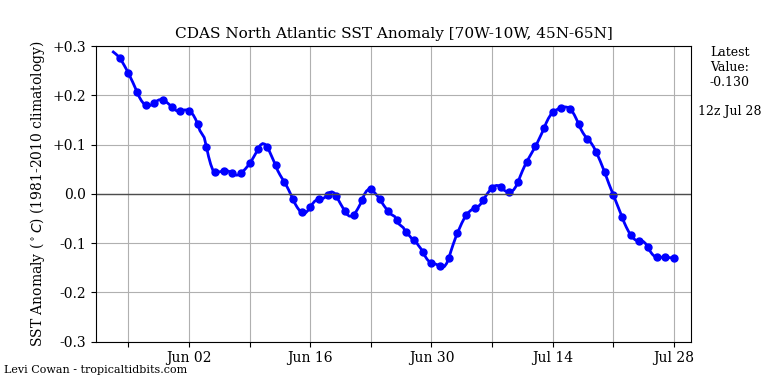
Off topic, but Kip you said in a blog comment some time ago that you were looking at the fate of tiny plastic particles once they were ingested by marine organisms.
Have you been able to make any progress on this, although I appreciate you are very busy.
StephenP ==> There is a “popular science” view that microplastics (tiny tiny bits of plastic) are somehow dangerous and damaging to marine life (mostly marine, some fresh water). Lots of money available from the anti-plastics forces pushing EPA and other agencies to study the matter.
My long-term plan is to let a further larger body of evidence build up before I take another close look at the topic.
There is legitimate concern over trash in the oceans and waters — trash does not belong in the ocean.
Floating pelagic plastics mostly break down into smaller and smaller bits and eventually disappear altogether as they are consumed (not just ingested) by microorganisms as food.
Almost no one is reporting this fact as it is counter to the anti-plastics meme.
I will come back around to the topic though. Right now I am selfishly concentrating on building an autopilot and navigation computer for my 42 ft catamaran (which is in the hands of my very competent youngest son in the Virgin Islands).
On top of that, I am following the Quinine Wars — a well-orchestrated battle of Science against Science — in which the only known effective early treatment for SARS-CoV-2 infection is being attacked endlessly in the media and journals — despite its success and near-universal use. A wonderful example for my “Modern Scientific Controversies” series.
I am still actively collecting materials on microplastics and will get to it, I promise.
I already picked up on this story on another blog because it has parallels with the UK’s Whaley Bridge dam failure that was almost a disaster, albeit on a probably smaller scale.
At the time we had all the same same sort of media coverage – climate change, unprecedented rainfall etc. whereas it was immediately obvious to ‘us skeptics’ that the dam had been allowed to deteriorate.
The eventual investigation did correctly conclude it was design/maintenance/bureaucracy failures, but of course that never got the same extensive media coverage and headlines that the failure did – so 95% of the population will still believe it was another disaster caused by extreme weather linked to climate change.
This is how the MSM climate propaganda machine routinely operates.
The UK Government machine actually covered up the true reasons for the dam failure at the time.
So everybody was happy to blame climate change.
https://www.bbc.co.uk/news/uk-england-derbyshire-49880839
McGrim ==> The CJR is running a huge, coordinated propaganda effort, fully acknowledged and out there — but still unknown to the general public. See there website on the effort:
https://www.cjr.org/covering_climate_now/
Note that thre New York Times refused to join them — the Times has its own Editorial Narrative on climate change (just as propagandistic).
Same same in Australia. Rather than accept responsibility for poor management during natural disasters our politicians are quick to blame unprecedented conditions on climate change, the next best thing to and act of God. The trouble is that the term unprecedented is used by those too lazy to look at the records. A good one lately referred to heavy rain that was unprecedented in the last twenty years
It’s interesting that warmer weather is supposed to make it rain more when this spring here in southeast Michigan has been on cold side.
But that’s just me, not an expert, just someone who has lived here for decades and observed that the cooler spring seasons have more rain and the warm ones are when I’ve had to start watering the lawn by early May.
George ==> Thanks for the local perspective!
Another thought – this flood has set a new record crest for the river at Midland at 35.05 feet. But that was with the dam failing. If the dam had not failed, what would the crest have been?
re: “this flood has set a new record crest for the river at Midland at 35.05 feet. But that was with the dam failing. If the dam had not failed, what would the crest have been?”
Hazarding an educated guess at this given the information at hand in this thread: Look at the list “20 Highest Historic Crests — Tittabawassee River at Midland” Kip has in his opening post (excepting the 1916 date when the dams were not in place) with the working assumption that the operators were exercising the dams (and associated lakes) in (limited?) “flood control” mode.
It looks like total Edenville dam failure (including the over-topping and failing of the Sanford dam) resulted in the ‘record’ crest in Midland by less than 1 and 1/8 ft over 1986.
George ==> I believe the crest is measured at Midland — there is an official gauge there.
Kip, from the USGS website it looks like the gage is in the middle of Dow Chemicals property down stream from downtown Midland near brine pond number 6. In downtown Midland you have the confluence of three rivers, the Pine River which flows into the Chippewa River which flows into the Titabawasee. That’s why there’s a three legged pedestrian bridge downtown spanning where the Chip and Tit come together.
Kevin = => Thanks for the detail.
The State of MI was warned two years ago that the dam was inadequate. This had been going on for several MI administrations, BUT the Fed closure occurred on “Whimpers“ watch. Her administration is therefore responsible for not taking corrective measures. The most recent being not to recognize the antecedent rainfalls and not lowering the level of the lakes. Unfortunately all of us MI residents, we and those effected are going to pay for her mistake. And she wants to run for USA VP. I think this and her handling of the Wuhan Virus sealed that fate….
Mr. Hansen,
Thank you for yet another meticulously researched and well-written recital of facts and rebuttal.
John ==> Thanks…
I write to take the discussion in a different direction.
Problems with legacy dams are man made problems. Many dams are old. Traditional owners want to abandon many. Transfer of ownership to shore front property owners is impeded by liability, other financial and operating concerns. Transferring ownership to towns, counties and states is impeded by competing demands on social resources–and “environmentalist” demands that watersheds be returned to their natural condition.
DM ==> Yes, that is a pretty good description of the situation with the Edenville Dam (and the other three associated dams). Owned by Boyce power, coveted by waterfront residents, regulated by the county, state and federal government agencies — all with differing priorities and agendas. A total mess. NONE had public safety as their primary goal.
The link between Climate Change of Doom and a dam failure here in Michigan is that CCOD hysteria caused Michigan to spend billions of dollars on worse-than-worthless wind turbines and solar panels instead of on critical infrastructure requirements.
One of the problems with blaming “climate change” for everything is: when you misdiagnose a problem you’re much less likely to arrive at a proper solution. Even if that area of Michigan is getting wetter, the real issue is our failure as a society to maintain critical infrastructure. The problems with the dam had been noted for years; the proper corrections are well within current engineering capabilities. The inaction was due to disputes over who should pay.
If there is a revenue stream from operating a physical plant, the owner of that cash flow has an incentive to maintain the plant and continue enjoying the income. If other forces combine to reduce or eliminate the revenue, then the plant stops being an asset and becomes a liability. Companies and individuals will always seek to reduce or eliminate uncompensated liabilities; maintenance is one of the first to suffer.
When operating, the dam was trying to please three masters: the power company, recreational users of the lake, and environmental interests. Only one of those activities generated revenue, but the other interests were able to use the courts and other state agencies to gain a measure of control without contributing to offset the resulting diminished income.
In the US the courts are completely shielded from liability for damages and injuries caused by their decisions. This may be necessary to the proper function of the courts, but it lends itself to abuse in the hands of activists. Courts in general have no more competence in the disciplines relevant to dam construction and maintenance than the average person, but they gain authority to make these decisions under the legal fiction that the process is itself omnicompetent — capable of deciding all questions. It isn’t, but we pretend otherwise because alternative methods such as trial by combat have fallen out of favor.
The mismanagement of critical infrastructure happens routinely even without interference from the courts..
Take for example the 1983 collapse of the Mianus River Bridge on I-95 in Connecticut, where I was living at the time. 3 people were killed, but it happened very early in the morning with light traffic; it could have been much worse. Granted, the bridge was an older, no longer used design. But the real cause of the collapse was neglect and inadequate or improper maintenance, which was Connecticut’s responsibility. After the collapse the state sued the engineering firm. The defense was able to show Connecticut had not followed the recommended inspection and maintenance schedule they were given when the bridge was completed. Having one of the state inspectors falsify back-dated inspection reports after the disaster did not help the state’s case.
The reason for the collapse was simple: some years prior Connecticut changed the law so gasoline taxes, vehicle registration fees and road tolls went into the general fund rather than being diverted to a restricted account that could only be used to maintain roads and bridges. Inspection and maintenance became underfunded and bridges in particular became neglected. No money, no maintenance and no chance something won’t fail eventually.
Another example which happened just after we moved to Atlanta: the 1993 sewer sinkhole. A 70-year old storm sewer failed and opened up a sinkhole over 200 feet long, 50 feet wide and over 30 feet deep. A parking lot collapsed completely taking several cars with it. As I recall it was either a 10 or 12-foot diameter pipe and repairs were delayed because that size pipe wasn’t made any more and replacement sections had to be special ordered.
The statement from the Atlanta Mayor at the scene is classic:
Atlanta had been collecting water and sewer fees for all the 70 years that pipe had been in the ground, but had no adequately funded inspection and repair program to prevent catastrophic failures. And they knew that particular section had a problem; they didn’t know how bad it was and apparently felt no need to investigate further.
Pretty much everybody does the same thing: they build something and forget about funding a capital maintenance and replacement program. Instead they wait until something fails then float a new bond issue or put their hands out to the federal government to rescue them from a “disaster”. Something you know will fail eventually and can see deteriorating years in advance isn’t a disaster; it’s negligence. And it’s what we do routinely.
There is a decommissioning fund for commercial nuclear reactors that is paid into by a tax on each KWH generated. So far it has proved adequate to cover expenses. Perhaps something similar needs to be instituted for dams. If they generate power, tax the sales. If they create lakefront property, tax the property owners. Likewise charge a fee for recreational use. That way there is a fund to pay for necessary repairs, or safe deconstruction if nobody wants to maintain it. And if the courts over-rule the professional dam management regarding releases to maintain safety, make the plaintiffs put up a bond to cover liability.
The problem here as with nearly every infrastructure “disaster” is inadequate or improper maintenance. Climate change, even if real, contributed basically nothing.
Alan ==> Great analysis! Thank you.
“In the US the courts are completely shielded from liability for damages and injuries caused by their decisions”
You would need an independent judiciary to judge those. Would it be fitted in the executive branch, with judges chosen and fired at will by the President?
It would be only fair since Judge Sullivan wants to play Special Prosecutor (or “special whatever”).
Quote “I could find no reliable historical precipitation records for Central Michigan,…”
Amazing.
From the article: “Fountain reports: “The dam that failed in Central Michigan on Tuesday gave way for the same reason most do: It was overwhelmed by water. Almost five inches of rain fell in the area in the previous two days”
That was the same storm front that dumped over 5 inches of rain in my neck of the woods before it got to Michigan. It washed out a fence behind my house (there’s creek right next to my house that filled up quickly) and I had my neighbor’s cows in my yard the next morning when I got up.
Cows can sure mess up your lawn when the ground is saturated with rain.
Well, at least it was only a fence that washed out, and not a dam.
Tom ==> At least th4e storm didn’t leave drowned cow corpses in your yard….
Visible circulation blockade over the North Atlantic.

There will be more rain on the Great Lakes.
The dam failure is horrendous for those affected, but another problem happening in Michigan is the erosion of sand from Lake Michigan shore line causing numerous homes to fall into to lake. As noted in an earlier post the low lake levels were of concern, but now the record high levels are of concern. People who want to save there homes have difficult times trying to get all the needed permits.
Whoever wished for the rain to fill the lakes can stop any time.
mkelly ==> The water levels in Lake Michigan are rather mysterious — and may not be directly tied to local rainfall. Search this site for the commenter who posted a PowerPoint on Lake Michigan water levels.
Engineers say most dams in the United States, designed decades ago, are unsuited to a warmer world and stronger storms.”
I didn’t read past this stupidity. It doesn’t even state that storms are getting stronger- because of course it’s demonstrably true they are not, so the statement and everything following is fear mongering garbage behind a political agenda.
I’m just another Dam engineer. . .
The Michigan Dams failed because the spillway gates were closed, NOT because of excess rainfall and NOT because of insufficient spillway capacity.
Do you want to know why?
The dams were delicensed by the Federal Energy Regulatory Commission (FERC) which prevented the dam owners from having kilowatts generated from the dam dispatched onto the grid. FERC delicensed the dams because of inadequate spillway capacity, which is defined as the capacity to flow 100% of the PFM (probable maximum flood). At both of the dams, the upstream basins would need to see 19 inches of rainfall in a 24-hour period to achieve PFM. According to NOAA data, only 6 inches of rain fell in the 72 hours preceding the dam failure. Way short of the PFM.
When FERC delicensed the dam for electrical generation (and subsequently recommended lowering the water levels in the lake by 8 feet), the State of Michigan stepped in and forced the owners (Boyce Hydro Power, LLC) to raise the lake levels to protect a certain species of freshwater mussel. At that instant the State of Michigan assumed responsibility for the operations and maintenance of the dam, but did not provide oversight to ensure public safety of the people downstream.
I guess they were too busy busting errant barbers.
If you watch the videos very closely, you can see that very little water (relative to the upstream head conditions) was passing through the spillway or the overflows, and if you a really observant you can see the spillway gates were closed, which makes no sense when you’re had 6 inches of rain.
Now that the dams have been breached, my guess is that the mussels Governor Whitmer was trying to protect are now going to die. The people who own property on the lakes will not see water at their boat docks for many years to come, as somebody will need to buy the dam from Boyce Hydro, pull permits to rebuild the dam, do the construction and refill the reservoir. The people downstream probably did not have flood insurance, so they will never be made whole from their loss.
This is another real tragedy that was unnecessarily caused by a tryannical government.
Mike Kelter ==> Very nice summary…and then there was the pressure fro lakeside residents’ committees pressuring all and sundry to keep water levels high for their marinas.
Mike Kelter. In your summary you mention that the flood gates were closed during a 6” rainfall event into the dam catchment. This sounds more like a ‘dam management’ issue.
Interesting comparison with shoddy dam management of Brisbane’s (Queensland, Australia) Wivenhoe water supply dam during an extreme rainfall (2016? Summer) event immediately following a long period of drought & low water levels. Water held in dam & left to build to dangerous levels that eventually had to be released, producing downstream disasterous flooding.
Similar scenario with Townsville’s (Nth Qld) Ross River dam water level-release management during the Feb 2019 rainfall event. Again disasterous flooding.